Search this blog

Friday, 16 March 2012

Post-Regency spring fashion - evening wear

This is the third article in my series of fashion blogs looking at the way spring fashions changed from 1806 to 1827. This final post on evening wear looks at the post-Regency period, from 1820 to 1827, during the reign of George IV, using fashion plates from La Belle Assemblée from 1823 and 1827.

Spring 1823
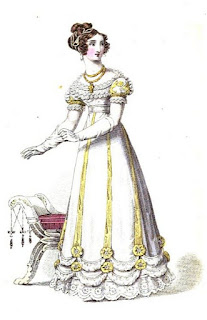
Ball dress   from La Belle Assemblée (Feb 1823)
Ball dress
 from La Belle Assemblée (Feb 1823)


“This attractive and elegant dress is of tulle over white satin; the tulle ornamented with broad stripes, laid on of amber coloured satin, till they reach a double festoon ornament, in two rows of puckered tulle en rouleaux, the points of which are headed by large rosettes of pearls; under these festoons, terminating at the hem, is a flounce of broad blond, of a rich and striking pattern. The corsage is made plain, but is trimmed round the bosom with a broad falling tucker of blond, which, from each shoulder, falls as a mancheron ornament over the sleeve, and has a very beautiful effect...The dress is confined round the waist by a white satin ribbon sash, richly striped.”

“En rouleaux” means in rolls.
I have had some trouble deciphering “mancheron”. The first translation I found was handlebars and this did not seem very appropriate! However, “manche” means sleeve and I found a reference to “mancheron” meaning a small, short sleeve or an ornamental trimming on the upper part of a sleeve.

Ball dress  from La Belle Assemblée (Mar 1823)
Ball dress
from La Belle Assemblée (Mar 1823)
“Round dress of amber coloured crape, a puckering of gauze of the same colour at the border, finished by rouleaux, wadded very full of white satin, with full blown white roses, and a few leaves of green foliage: under each rose is an antique ornament of the rosace kind, composed of white satin, with a tuft of amber in the interior. The body of this beautiful dress is of satin, and is elegantly diversified by white silk cordon and fine blond: the front of the bust is finished by a marrow falling tucker of blond, and the shoulders ornamented by bows of white satin ribbon. The sleeves are white, and are trimmed to correspond with the skirt, except that the flowers are left out, as an inappropriate and troublesome trimming to that part of the dress; they are, therefore, finished by the rouleaux in points, with the rosaces in the centre of the sleeve, encircling the arm…Shoes of white satin, and white kid gloves.”

"Rosace" means rosette.

Spring 1827
Ball dress  from La Belle Assemblée (Jan 1827)
Ball dress
from La Belle Assemblée (Jan 1827)
“Over a slip of amber-coloured satin, a dress of tulle, the border, with two rows of amber gauze, bouillonnés; the bouillon placed on the border, in close fers de cheval, and forming a rich and striking sort of trimming. The body is à la Circassienne, with a broad sash of amber-coloured satin; a small rosette on the left side, in the centre of which is a pearl ornament: long ends, edged round with narrow blond of a Vankdyke pattern, descend somewhat lower than the knee. The sleeves are short and full, of amber satin, trimmed with blond, and finished sown the outside of the arm with silk buttons.”

“Bouillonnés” means ruffled or puffed.
“Fers de cheval” means horseshoes.

My observations

These dresses show a distinct move away from the flowing designs of the Regency, with close-fitting bodices above narrow waistlines, which have dropped to a more natural position by 1827. The sleeves are short and puffy and the skirts are fuller and show a lot more ornamentation than those of the previous decade. It is interesting to note that all three of these dresses are yellow, or amber per the description. Clearly opinions had changed since 1806 when, in the very first issue of La Belle Assemblée, the following was written:
“The pale yellow colour, which is extremely elegant in the day for beautiful women, appears soiled in the evening, and tends very much to diminish the glow, and impair the brilliancy of the complexion.” 
Sources used include:
Bell, John, La Belle Assemblée, various (1806 -1827)

Tuesday, 13 March 2012

Regency spring fashion – evening wear

This is the second in my series of fashion blogs looking at the way spring fashions changed from 1806 to 1827. Continuing the theme of evening wear, today’s blog looks at the Regency period, from 1811 to 1820, using fashion plates from La Belle Assemblée from 1811, 1812 and 1816.

Spring 1811
Evening full dress   from La Belle Assemblée (Feb 1811)
Evening full dress
 from La Belle Assemblée (Feb 1811)
 “A gown of plain white India muslin, made loose in the neck, with long sleeves, and short train trimmed with a fancy border of stamped leaves in satin. A white satin cap, ornamented with crimson or maroon-coloured flossed silk trimming. A short Persian scarf of maroon-coloured silk, with rich border and tassels, is fancifully worn over the shoulders.”

Spring 1812
Evening dress   from La Belle Assemblée (Mar 1812)
Evening dress
 from La Belle Assemblée (Mar 1812)
“A velvet or gossamer satin gown of bright amaranth, ruby or cinnabar brown, with a demi-train, trimmed round the bottom, bosom and sleeves with a light tassel fringe, of the frivolité kind, of the same colour; apron of white crape, sarsnet or lace, ornamented with the same; sleeves of white satin, or of materials correspondent with the apron; these short sleeves made rather nearer to the elbow than formerly, and formed after the chemisette style. The body of the gown richly ornamented with beads or pearl, crossed like the ribband braciers, and confined at the bosom by a bright ruby broach, set round with pearl. The waist confined by two rows of beads or pearl, and fastened in front with a broach, the same as that on the bust. A lace half handkerchief, with a border richly embroidered in coloured silks, tied carelessly round the neck. Moorish turban of white satin and coloured crape twisted in the front, the same colour as the gown, and fastened on the crown with a ruby ornament to correspond with the broaches.”

Amaranth is a reddish-rose colour; cinnabar is a bright red colour tinted with orange.

Spring 1816
Parisian evening dress   from La Belle Assemblée (Feb 1816)
Parisian evening dress
 from La Belle Assemblée (Feb 1816)

“Round dress of soft white satin, made short enough to discover the muslin petticoat underneath, which is ornamented with two full quillings of fine lace; the satin dress finished at the border by four rows of scarlet velvet; the body made plain and crossed over the bust, which is very decorously covered, and ornamented by a plaited tucker of lace; the sleeves very short, and finished by a quilling to correspond with the tucker. Small Minerva bonnet of white satin and scarlet, with a superb plume of the same colours intermingled. Necklace of pearl, of the most elegant fabrication, consisting of the smaller pearls in clusters, with the large Oriental pear pearls depending. Hair is curls a-la-Ninon. White satin slippers confined round the ankle by ribbands; and white kid gloves.”

A quilling is a piece of quilled lace or other fabric used as a trim.

My observations

As expected, in common with the pre-Regency period, the dresses remain predominantly white. Many varieties of the colour red are popular throughout these designs: crimson, maroon, amaranth, cinnabar brown, ruby and scarlet are all mentioned in the details above. At the beginning of the Regency period, the sleeves are long; by 1816, they are “very short”. The last dress is much more detailed than the previous two and seems to herald the advent of the move away from Regency simplicity to the more elaborate designs and fuller skirts of the late Georgian period.

Sources used include:
Bell, John, La Belle Assemblée, various (1811-1816)

Sunday, 11 March 2012

Pre-Regency spring fashion - evening wear

The fashion plates in La Belle Assemblée are widely admired for the insights that they can give us into the world of Regency fashion and beyond. Individually, they are both attractive and informative; collectively, they illustrate the way that fashion has changed over the years.

This series of blogs follows the way spring fashions changed from 1806 to 1827, by looking at particular elements of fashion in three time periods: pre-Regency, Regency and the reign of George IV. My first blog is dedicated to evening wear in the pre-Regency period.

Spring 1806
Parisian complete full dress   from La Belle Assemblée (Feb 1806)
Parisian complete full dress
 from La Belle Assemblée (Feb 1806)
“The more elegant the taste, the more superior the beauty of a lady, the less she has occasion for ornaments; her dress, therefore, should be simple and unaffected. This incontestable truth should convince our London Fashionables, that the only improvement in dress consists in a superadded simplicity and gracefulness, and not in a singularity of costume of any kind whatever.” La Belle Assemblée (1806)

Spring 1807
Ball dress   from La Belle Assemblée (Feb 1807)
Ball dress
 from La Belle Assemblée (Feb 1807)
A ball dress “of plain crape, over a white satin slip, made a dancing length; plain back and sleeves, with quartered front, trimmed round the bottom, on the waist and sleeves, with a white velvet ribband thickly spangled with gold. A white satin sash, tied in long bows and ends on the right side, terminated with splendid gold tassels. High gathered tucker of Brussels lace.”

“India shawl, a deep amber colour, with a rich and variegated fringe and border, negligently drawn through each arm, so as to form a flowing drapery on the right side of the figure.”

A tucker was a ruffle attached to the neck of a gown to infill the neckline for a more modest look.

Spring 1810
Evening dress   from La Belle Assemblée (Feb 1810)
Evening dress
 from La Belle Assemblée (Feb 1810)
“A white satin round dress, with half yard train, laced up the back and seams with gold twist, ornamented round the neck with a full twill of frosted satin or white crape, and down the front and at the wrist with gold braiding, and small drop buttons. It is made to sit high on the neck; cut to a point in the centre of the bosom and back: a gold band encircles the waist.”

The second figure wears an “India muslin train over a white satin petticoat. A bodice of green velvet, ornamented at the seams with gold braiding, and trimmed round the neck with a twill of green crape or velvet.”

Twill is a fabric known for its diagonal weave.

My observations 

The predominant colour of all these dresses is white. The gowns relied upon the trimmings and accessories and, in one case, the bodice, to bring colour to the outfits. The earlier two plates show short sleeves and long gloves; by 1810, the sleeves were long. The dresses are in the Empire style, with high waistlines and the material falling loosely below.

Sources used include:
Bell, John, La Belle Assemblée, various (1806-1810)