Search this blog

Showing posts with label London. Show all posts

Friday, 11 November 2022

Tattersall's Horse Repository in Regency London

Tattersall's Horse Repository by Rowlandson and Pugin (pub Ackermann 1809)
Tattersall's Horse Repository
by Rowlandson and Pugin (pub Ackermann 1809)
What was Tattersall’s Repository?

Tattersall’s Repository was:

…the most fashionable resort of the sporting world for the purchase and sale of horses, hounds, carriages, &c.1

During the Regency period, when all road travel was horse-powered, there was a constant demand for horses, both to ride and to pull carriages. In addition, sportsmen needed hunters, and gentlemen of the turf bought and sold racehorses.

The best place to buy horses in Regency London was Tattersall’s Repository:

Where men of taste might enjoy the glimpses afforded of the most beautiful specimens of an exquisitely beautiful race, without being perpetually disgusted with the worst of all things—that of the jockey or horse-dealer.2

The founding of Tattersall’s Repository

Richard Tattersall, founder of Tattersall's from The Sporting Magazine (1795)
Richard Tattersall, founder of Tattersall's
from The Sporting Magazine (1795)
Tattersall’s Repository was founded by Richard Tattersall (1725–1795)—stud-groom for Evelyn Pierrepoint, 2nd Duke of Kingston.3

In 1766 Richard purchased a 99-year lease of property near Hyde Park Corner from Lord Grosvenor and opened his business as a horse and hound auctioneer.4

The Sporting Magazine (1795) wrote:

Although there were occasional sales by auction, of horses, at the time when Mr Tattersall commenced his business, yet there was no regular repository, nor fixed sales at stated periods. This was an inconvenience felt by the public, and particularly by those who had studs of race-horses.

Mr Tattersall, who was well known to the gentlemen of the turf, and to the horse-dealers, offered his services as an auctioneer, and solicited their patronage. Lord Grosvenor warmly espoused him, and built for him those extensive and commodious premises at Hyde-park-corner.5

Old and New London (1878) pinpoints the location:

At the south-eastern corner of St George’s Hospital, where now is Grosvenor Crescent, was formerly the entrance to Tattersall’s celebrated auction-mart…The building itself, at the back, occupied part of the grounds of Lanesborough House.6

A family business

Tattersall’s Repository was a family business. Richard Tattersall—“Old Tatt”—took his son Edmund (1758–1810) into business with him, and in turn, Edmund took his son, another Richard (1785–1859), into partnership in 1806. It was this Richard who was running Tattersall’s during the Regency period.

What was Tattersall’s like?

The Entrance to Old Tattersall's from Old and New London Vol 5 (1878)
The Entrance to Old Tattersall's
from Old and New London Vol 5 by E Walford (1878)
The fullest description I’ve found is in Old and New London (1878):

The entry was through an arched passage and down and incline “drive,” at the bottom of which was a public-house or “tap,” designated “The Turf,” for the accommodation of the throngs of grooms, jockeys, and poorer horse-dealers and horse-fanciers.

On the left, an open gateway led into a garden-like enclosure, with a single tree in the centre rising from the middle of a grass-plot, surrounded by a circular path of yellow sand or gravel.

Immediately beyond the gateway was the subscription-room; this building, though small, was admirably adapted for the purposes for which it was designed, and it contained merely as set of desks arranged in an octagonal form in the centre, where bets were recorded, and money paid over.

On the right of the passage, a covered gateway led into the court-yard, where the principal business of the place was carried on; this was surrounded on three sides by a covered way, and at the extremity of one side stood the auctioneer’s rostrum, overlooking the whole area.

The stables, where the horses to be sold were kept in the interim, were close at hand, and admirably arranged for light and ventilation. In the centre of the enclosure was a domed structure to an humble but important appendage—a pump.7

Interior of the Court-yard of Old Tattersall's from Old and New London Vol 5 (1878)
Interior of the Court-yard of Old Tattersall's
from Old and New London Vol 5 by E Walford (1878)

Sale by auction

Auctions were held on Mondays all year round, and on Thursdays as well, in the height of the season. In 1810, around 100 horses were sold each week, and Tattersall’s received a percentage commission on each sale.

  • A good saddle-horse cost 40–100 guineas.
  • A good pair of coach horses cost 150–400 guineas.
  • A top hunter cost around 350 pounds.
  • A racehorse cost about 1,500 pounds.

The premises were huge and could accommodate 120 horses. The sellers paid Tattersall’s a moderate fee for looking after their animals while awaiting sale, which was usually only a few days.

The horses to be sold in the main auction on Monday arrived on the previous Friday, and gentlemen could view the horses awaiting sale. 

According to The Microcosm of London:

On the mornings when there is no sale, this Repository is a fashionable lounge for sporting gentlemen. The horses, &c. are then examined, their merits or defects considered, and sporting intelligence from all parts of the country detailed and disseminated.8  

The Picture of London for 1818 is more specific:

Equestrians will be highly gratified every Sunday morning from twelve to two, at Tattersalls, where there is an exhibition of fine horses for sale, and often an assemblage of gentlemen of the first rank.9

Whole studs were sold at Tattersall’s, such as those of the Duke of Kingston (1774) and George, Prince of Wales (1786).

The Tattersall family developed their own stud. Old Tatt famously bought the unbeaten racehorse Highflyer for the incredible sum of £2,500 in 1779.

Though famous for selling horses, Tattersall’s also sold hounds and other dogs, and carriages and coach harnesses, by private contract.

A "Look in" at Tattersall's from Tom and Jerry: Life in London by E Pierce (1821)
A "Look in" at Tattersall's from Tom and Jerry: Life in London
by E Pierce (1821)
Why was Tattersall’s so successful?

Old and New London described Tattersall’s as

…renowned through all the breadth and length of horse-loving, horse-breeding, horse-racing Europe.10

The Microcosm of London echoed this:

This Repository has ever possessed an acknowledged pre-eminence over every establishment of a similar character, and may be justly considered as of much public utility. It greatly facilitates the business of buying and selling horses, &c. and attracts both parties to meet each other in the market; while the liberal dealings of the late and present proprietors have entitled them to receive that patronage which they have so long experienced.11  

But why was it so successful?

Tattersall’s was successful because it filled a gap in the market, connecting those who wanted to buy and sell horses through regular sales by auction. Old Tatt’s connections in London and Newmarket amongst the horseracing fraternity helped build Tattersall’s early reputation.

But according to The Sporting Magazine (1795), another factor that contributed to Old Tatt’s success in establishing the business was his willingness to give credit to his customers.

At other auctions the buyer generally pays a sum as a deposit when the lot is knocked down to him, and he is obliged to pay the remainder when it is taken away. But at Tattersall's, most men who were not of a very inferior order, or a disreputable class in life, took away the articles which they bought without making any deposit at the time of sale, and afterwards paid the purchase-money when it was convenient to them.12

It continued:

Gentlemen who sell, are often obliged to buy horses; with such he kept a running account, and served as a kind of banker to them. In some instances the balance was against him, but it was generally much in his favour. Those who had large studs to dispose of, found their account in enabling him to give credit. It increased the number of bidders, and always enhanced the price of the horses.13

Tattersall's from Real Life in London by E Pierce (1821)
Tattersalls - Tom and Bob looking out for a good one, among the deep ones from Real Life in London by E Pierce (1821)
The betting room

Tattersall’s was a fashionable venue for sporting gentlemen. A subscription room or betting room was set aside for the use of gentlemen of the turf, supported by a subscription of a guinea a year by its members. Here, bets were laid and settled.

Here the gentlemen of the turf assembled every sale day to lay wagers on the events of distant races, and here they met to pay and receive the money won and lost.14

The Sporting Magazine regularly reported the betting at Tattersall’s for the upcoming race meetings and boxing matches.

The Microcosm of London said:

Here the generality of bets which relate to the turf are settled, at whatever place they  may originate; as it is not the custom, among these noblemen and gentlemen, to pay on the spot where the bets have been lost, but, on the return of the respective parties to town, at Tattersall's: so that this Repository is become a kind of exchange for gentlemen of the turf. Debts of this kind are settled here to an incredible amount.15

Monday after the 'Great St Leger' or Heroes of the Turf paying & receiving at Tattersalls by R Cruikshank from The English Spy by B Blackmantle (1825)
Monday after the 'Great St Leger'
or Heroes of the Turf paying & receiving at Tattersalls

by R Cruikshank from The English Spy by B Blackmantle (1825)
After the Regency

Tattersall’s moved to a new location in Knightsbridge in 1865 when the 99-year lease on the Hyde Park corner site expired. It remained in the control of the Tattersall family until the 1940s, and is still one of the leading bloodstock auctioneers in Europe today.

Headshot of Rachel Knowles author with sea in background(2021)
Rachel Knowles writes faith-based Regency romance and historical non-fiction. She has been sharing her research on this blog since 2011. Rachel lives in the beautiful Georgian seaside town of Weymouth, Dorset, on the south coast of England, with her husband, Andrew.

Find out more about Rachel's books and sign up for her newsletter here.

If you have enjoyed this blog and want to encourage and help us to keep making our research freely available, please buy me a virtual cup of coffee by clicking the button below.

Notes

  1. The Sporting Magazine (1811).
  2. Walford, Edward, Old and New London: A narrative of its history, its people, and its places Volume 5 (1878).
  3. Sometimes the Duke of Kingston’s family name is written as Pierrepont.
  4. There are two dates I have come across for the foundation of Tattersall’s. 1766 is the date given on the Tattersall’s website for the founding of their firm, and this is supported by Vamplew’s article of the Tattersall family in the Oxford Dictionary of National Biography. It also ties in with the move to Knightsbridge after the 99-year lease expired. The Microcosm of London and some other sources set the date as 1773—the year Richard Tattersall’s employer, the Duke of Kingston, died.
  5. The Sporting Magazine (1795).
  6. Walford op cit.
  7. Ibid.
  8. Ackermann, Rudolph and Combe, William, The Microcosm of London or London in Miniature (1808-1810, reprinted 1904) Volume 3.
  9. Feltham, John, The Picture of London for 1818 (1818).
  10. Walford op cit.
  11. Ackermann op cit.
  12. The Sporting Magazine (1795).
  13. Ibid.
  14. Ibid.
  15. Ackermann op cit.

Sources used include:

Ackermann, Rudolph and Combe, William, The Microcosm of London or London in Miniature (1808-1810, reprinted 1904) Volume 3

Blackmantle, Bernard, The English Spy, illustrated by Robert Cruikshank (1825)

Egan, Pierce, Real Life in London or the rambles and adventures of Bob Tallyho, Esq, and his cousin, the Hon Tom Dashall, through the metropolis (1905 based on 1821 edition)

Egan, Pierce, Tom and Jerry: Life in London or the day and night scenes of Jerry Hawthorn Esq and his elegant friend Tom (First published  1821; 1869)

Feltham, John, The Picture of London for 1818 (1818)

The Sporting Magazine (various)

Vamplew, Wray, Tattersall family (c1765-1940) Oxford Dictionary of National Biography (Oxford University Press 2004)

Walford, Edward, Old and New London: A narrative of its history, its people, and its places Volume 5 (1878)

Wednesday, 27 October 2021

Drawing room presentations - a Regency History guide

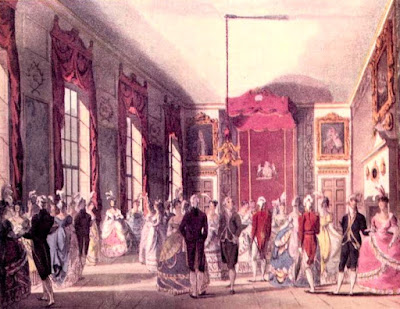
A drawing room at St James's Palace from The Microcosm of London by R Ackermann and W Combe (1808-10)
A drawing room at St James's Palace from
The Microcosm of London by R Ackermann and W Combe (1808-10)
In A Reason for Romance, Georgiana Merry and her sister Eliza are presented to the Queen by their grandmother, the Duchess of Wessex, on entering London society:

Just after two o’clock, the centre door was thrown open and Her Majesty Queen Charlotte entered, followed by the princesses and a whole bevy of servants. Although the Queen looked magnificent in dark green velvet and gold embroidery, Castleford could not help thinking, with an inner chuckle, that the Duchess of Wessex looked more regal.1

Was it just young ladies who were presented?

A common misconception is that only young ladies coming out into society for the first time were presented to the Queen. Both men and women were presented at court, at different times, for different reasons.

Lamb wrote in A book explaining the ranks and dignities of British Society (1809):

People are presented on different occasions: on first coming into the world, (which young ladies usually do about seventeen or eighteen); on their marriage, or any change of name; on going abroad, or to Ireland; or to an appointment to any situation about their majesties or the royal family.

Gentlemen are also presented on obtaining a commission in the army; promotion in the army or navy; a place under government; or any high situation in the church or law.2

A newspaper report of the Queen’s Drawing room held on 8 March 1810 stated:

Yesterday her Majesty held a Drawing-room, at which the following were presented:

Lady George Beresford, by the Countess of Arran.

Miss Harriet Thornton, by her mother, Mrs S Thornton.

Lady Charlotte Graham, by her mother, the Duchess of Montrose.

Mr Roust Broughton, on his coming of age, by his father.

Lady Mary Sackville, by her mother, the Duchess of Dorset.

The two Misses Wellesley Pole, by their mother, Mrs W Pole.

Mr Villiers, upon his return from Portugal.

Mr Yorke, upon his being appointed a Teller of the Exchequer.

Major-General Sir Stapleton Cotton, on his return from Portugal, and on coming to his title.3

Presentation of gentlemen

George III from The Public & Domestic Life of his late, most gracious majesty E Holt 1820
George III from The Public & Domestic Life
of his late, most gracious majesty
by
E Holt (1820)
Lamb wrote:

Gentlemen are all presented first to his majesty at the levee, and to her majesty at the following drawing room: they are generally presented by their nearest relation, who gives a card with their name, and the occasion of their being presented written upon it, to the lord of the bed-chamber in waiting. He names them to the king when they get up to him in the circle, on which they kneel down on one knee and kiss his hand.

To her majesty, the ceremony for gentlemen is the same, only that the card is given to her lord chamberlain.4

Presentation of ladies

Lamb wrote:

Ladies were presented to the king at the same drawing-room, but before they were presented to her majesty; but since the king has gone so much seldomer to court, they have been presented first to the queen at a common drawing-room, and to the king at the birth-day following; and those invited by her majesty to the entertainments at Windsor, have been presented to his majesty there: in that case, they are not in court dresses, but the ceremony is the same. On their being named to the king, by the lord of the bed-chamber, they make a low courtesy, and he salutes them; but their right-hand glove should be off, as if they intended to take his hand to kiss.

To her majesty, the ceremony of presentation for ladies is different according to their rank: all under the rank of right honourable kiss the queen’s hand, making so low a courtesy as to have almost the appearance of kneeling; she salutes those who have that rank, though they equally have their glove off.5

What did gentlemen wear to court?

Gentleman in court dress from A book explaining the ranks and dignities of British Society by C Lamb (1809)
Gentleman in court dress from
A book explaining the ranks and dignities
of British Society
by C Lamb (1809)
According to Lamb:

The court dress for gentlemen is what is commonly called a full dressed coat, without collar or lappels, made of silk, velvet, or cloth, and often richly embroidered in gold, silver, or coloured silks. Any naval or military uniform is reckoned a full dress, though many regimentals have, properly speaking, no full dressed uniform; those that have, cannot appear at court in the undressed uniform.

People are allowed to go to court in private mourning, except on the birth-days. Their uniforms, with a piece of black crape tied round the arm, are reckoned sufficient for officers in the deepest mourning.

Gentlemen not in uniform, wear what are called weepers in deep mourning, which are merely cambric cuffs, with broad hems turned back upon the sleeves.6

What did ladies wear to court?

Gentleman in court dress from A book explaining the ranks and dignities of British Society by C Lamb (1809)
Lady in court dress from
A book explaining the ranks and dignities
of British Society
by C Lamb (1809)

The court-dress for ladies is now distinguished only by the hoop, lappets, and full ruffles; for the mantua is now made exactly like any other open gown, and differently in shape before, according to the fashion of the year: the petticoat also is plain or trimmed, according to the fancy of the wearer. The most general form is the one followed in the plate; of late, it has been more the fashion to have the petticoat, both the drapery and the under part, of the same colour as the gown; but a coloured drapery over a white petticoat prevailed for many years, and the drapery was even often of a different colour from the gown. Velvet, sattin, silk, crape, and gause, are the only materials allowed for ladies’ court dresses; the lappets are sometimes of black lace, but oftener the same as the ruffles of fine lace or blonde. Court dresses are trimmed, and often embroidered with gold and silver; and artificial flowers are much used in ornamenting the petticoat. Feathers are not reckoned a necessary part of a court dress; but young ladies very seldom go without them, and they are supposed to be under dressed if they do.

In deep mourning, ladies wear a black hood, put on as it is represented in the plate.

Court mournings are worn by every body, according to the degree of relationship in which the person mourned for stood to his majesty.7

La Belle Assemblée recorded the dresses worn by two young ladies being presented at the Queen’s birthday drawing room in January 1810:

Two Miss Ruffos – Presented by their mother, the Princess Castelcicala, wore white crape dresses, elegantly trimmed with white satin ribbon and bunches of pink roses; robes, white satin, trimmed to correspond with the dresses.8

Lots of others are described in the same report. I thought the Duchess Dowager of Leeds’s outfit sounded particularly impressive:

A superb petticoat of white crape richly embroidered in real silver, with a border embroidered on crimson velvet, in a style perfectly unique, and beautiful, draperies richly embroidered and tastefully festooned with bunches of silver laurel and brilliant tassels; body and train of crimson velvet trimmed with silver point; head-dress, Caledonian cap of crimson velvet, diamonds, and ostrich feathers.9

What happens at a drawing room?

Queen Charlotte from The Historical and Posthumous Memoirs of Sir Nathaniel Wraxall (1884)
Queen Charlotte
from The Historical and Posthumous Memoirs
of Sir Nathaniel Wraxall (1884)

The drawing-room generally begins about two o’clock, when their majesties come in; the king first, preceded and followed by his attendants; and the queen, led by her lord chamberlain, (or vice-chamberlain in his absence); her train led by a page of honour, and followed by the princesses, each led by one of her majesties gentleman ushers, or equerries: the ladies of the bed-chamber in waiting to the queen and princesses follow; then the maids of honour; and last, the bed-chamber woman in waiting on the queen. On birth-days, the mistress of the robes, all the ladies of the bed-chamber, and the bed-chamber women, follow in the train, those in waiting going first; the mistress of the robes usually takes her waiting on the birth-days, as the groom of the stole does his upon his majesty.

At the entrance of the drawing-room, the page resigns the queen’s train to the lady of the bed-chamber, who hangs it over her arm, and keeps it there during the whole of the drawing-room; of course, she must then follow before the princesses.

The queen courteseys to the king on entering the drawing room, which she then goes round to the left, while he is doing so to the right; and their majesties speak to every person as they get up to them. The page, gentleman usher, and bed-chamber women, do not follow the queen into the inner drawing-room, nor the ladies of the bed-chamber not in waiting; and the maids of honour do not go round it with her, but stand altogether at one end till the drawing-room is over, when they follow her out, and fall into the train in their places in the outward drawing-room. Their majesties come and go through the levee-rooms.

Since there have been drawing-rooms so much seldomer, (only on every other Thursday) and that, of course, they have been more crouded, their majesties, instead of going round the room, have stood each with their back to a table between the windows, and the company have gone up to them. Any of the royal family coming to court, go in at the middle door, the company at one of the two side doors; and since their majesties have stood still, they should go in at the door next the windows, and out at the other.10

This seems to agree with the account of the Queen’s birthday drawing room on Thursday 18 January 1810 as reported in the Gentleman’s Magazine:

This day being appointed for keeping the birthday of her Majesty, soon after nine, their Majesties, the Princesses, the Dukes of York, Clarence, Kent, Cumberland, Cambridge, Sussex, and Gloucester, and Princess Charlotte of Wales, breakfasted together at the Queen's Palace. At half past twelve, her Majesty, attended by the Princesses, proceeded to the Duke of Cumberland’s apartments in St James's Palace, to dress. The Royal Party then proceeded to the Grand Council Chamber, conducted by the Earl of Morton and Col Desbrow. Her Majesty’s approach being announced, the centre door was thrown open; her Majesty entered about ten minutes past two o’clock, and took her station between the second and third window, leaning against a marble slab table. Her Majesty, as usual, it being the celebration of her own birthday, was dressed very plain. The Princesses arranged themselves on her Majesty's left hand, according to their ages. Their attendants stood nearly under the throne. The Royal Dukes stood near their Royal Sisters—Her Majesty having taken her station to receive the congratulations of the company and the presentations, the Lord Chamberlain waved his wand to Sir W Parsons, who was attending in an anti-room behind the throne, with his Majesty's band, to perform the Ode for the New Year. The presentations were very numerous; and the illuminations in the evening very general.11

How to conduct yourself in the presence of royalty

Fanny Burney recorded in her diary:

Not even the Princesses, ever speak in the presence of the King and Queen, but to answer what is immediately said by themselves. There are, indeed, occasions in which this is set aside, from particular encouragement given at the moment; but it is not less a rule, and it is one very rarely infringed.12

However, Fanny’s friend, Mrs Delany told her:

When the queen or the king speak to you, not to answer with mere monosyllables. The queen often complains to me of the difficulty with which she can get any conversation as she not only always has to start the subjects, but, commonly, entirely to support them: and she says there is nothing she so much loves as conversation, and nothing she finds so hard to get.13

No coughing, sneezing or fidgeting whilst in the presence of their Majesties was allowed. Fanny wrote:

In the first place, you must not cough. If you find a cough tickling in your throat you must arrest it from making any sound; if you find yourself choking with the forbearance, you must choke – but not cough.

In the second place, you must not sneeze. If you have a vehement cold, you must take no notice of it; if your nose membranes feel a great irritation, you must hold your breath; if a sneeze still insists upon making its way, you must oppose it, by keeping your teeth grinding together; if the violence of the repulse breaks some blood-vessel, you must break the blood-vessel – but not sneeze.

In the third place, you must not, upon any account, stir either hand or foot. If, by chance, a black pin runs into your head, you must not take it out. If the pain is very great, you must be sure to bear it without wincing; if it brings the tears into your eyes, you must not wipe them off; if they give you a tingling by running down your cheeks, you must look as if nothing was the matter.14

Public viewing

Apparently, it was possible to watch the drawing room from a viewing gallery:

There are three rooms in which those desirous of seeing the company go to court may stand, by obtaining tickets from the lord chamberlain: the guard-chamber, the royal presence-chamber, and the privy-chamber; in the last only, they also see the king, queen, and royal family pass, as it is between the levee-rooms and the outer drawing-room.15

Headshot of Rachel Knowles author with sea in background(2021)
Rachel Knowles writes clean/Christian Regency era romance and historical non-fiction. She has been sharing her research on this blog since 2011. Rachel lives in the beautiful Georgian seaside town of Weymouth, Dorset, on the south coast of England, with her husband, Andrew.

Find out more about Rachel's books and sign up for her newsletter here.

If you have enjoyed this blog and want to encourage me and help me to keep making my research freely available, please buy me a virtual cup of coffee by clicking the button below.

Notes

  1. Rachel Knowles,  A Reason for Romance (2021).
  2. Lamb, Charles, A book explaining the ranks and dignities of British Society (1809).
  3. The Times online archive, 9 March 1810.
  4. Lamb op cit.
  5. Ibid.
  6. Ibid.
  7. Ibid.
  8. La Belle Assemblée (January 1810).
  9. Ibid.
  10. Lamb op cit.
  11. Gentleman’s Magazine (January 1810).
  12. Burney, Fanny, Diary and letters of Madame D'Arblay, edited by her niece, Charlotte Barrett Volume III (1842).
  13. Ibid.
  14. Ibid.
  15. Lamb op cit.

Sources used include: 

Burney, Fanny, Diary and letters of Madame D'Arblay, edited by her niece, Charlotte Barrett Volume III (1842) 

Gentleman’s Magazine (1810) Lamb, Charles, A book explaining the ranks and dignities of British Society (1809) 

La Belle Assemblée (January 1810)

The Times online archive