Search this blog

Showing posts with label Regency. Show all posts

Friday, 6 October 2023

What the Regency newspapers say

The Newspaper by Thomas Rowlandson (1808)

In Regency England news was passed by word of mouth, by private letter and in the newspapers. This meant newspapers were highly prized as a source of printed information.

As today, a wide variety of newspapers were published. Most were distributed locally, although some found their way across the country and even abroad. Copies were passed from reader to reader, each of whom would avidly devour the contents even if it was a few months old.

Newspapers are an excellent resource for historians and writers wanting to learn more about the late Georgian and Regency era. They offer a wealth of detail about the period, from stories of international events through to snippets of insight into everyday life.

Not all newspapers have survived, and it must be remembered that then, as now, they weren’t always reliable. A number of well-known Regency personalities were amused to hear their deaths being reported as facts. 

Three Regency newspapers compared

I thought it would be an interesting exercise to compare three Regency newspapers, all published on the same day. I decided to take one from London, one from a fashionable resort and one from a more distant part of the country—in this case, Scotland.

The papers are:

     London Courier and Evening Gazette

     Bath Chronicle and Weekly Gazette

     Perthshire Courier

I selected the 7 February 1811, the day after the Prince of Wales was sworn in as Prince Regent, following the passing of the Regency Act. 

George, Prince Regent, by Thomas Lawrence c1814 NPG
George, Prince Regent, by Sir Thomas Lawrence
c1814 © National Portrait Gallery

Differences between Regency and modern newspapers

Regency newspapers look unfamiliar to the modern eye. They lack bold headlines, have very few images, and news stories often flow in quick succession with little separation.

Pictures didn’t regularly appear in newspapers until the 1830s. There are three tiny illustrations in the Bath Chronicle and Weekly Gazette, but none are representations of news stories.

The front page of the newspaper is mostly advertisements and notices. While each newspaper does have some marked sections (such as ‘Naval Intelligence’), there’s a sense that much of the content was added as it arrived.

Consistent features between all three newspapers

Reading one Regency newspaper is fascinating. Looking at three in close succession reveals some distinct similarities between them.

All three newspapers relied heavily on other publications and letters as the source of their material, and they revealed these sources. There’s little of what we could consider to be journalism.

Both the London and Perthshire newspapers gave considerable space to the Regency, which came into effect on 5 February 1811, two days before publication. The Perthshire news only went up to 1 February. There’s no surprise it was behind the London papers, given that it’s over 400 miles north of the capital city.

All three newspapers give space to announce births, deaths and marriages. There are no announcements of engagements or betrothals. I’m unsure when it became the fashion to announce these, but I’ve never seen examples in Regency newspapers.

The state lottery features in the Bath and Perthshire newspapers, with an identical announcement headlined ‘The Regent’s Procession’. The next line follows on from the heading: 

...is at this crisis interesting to the country; and this memento is at this time interesting to ourselves: for if the New Administration adopt the expected new measures, there will be No More LOTTERIES; therefore the ONLY opportunity we may ever have to gain an independent Fortune by the risk of a small Sum of Money, is the Present STATE LOTTERY.

The lottery is also advertised in the London newspaper, but without the announcement.

Lottery Drawing, Coopers Hall from The Microcosm of London Vol 2 (1808-10)
Lottery Drawing, Coopers Hall
from The Microcosm of London Vol 2 (1808-10)

Read another Regency newspaper for free

All three newspapers I’ve mentioned here are in The British Newspaper Archive, an online resource containing hundreds of papers. Many are protected by copyright, meaning you need a subscription to get access and you can’t publish screenshots.

All three papers I’ve chosen are copyright protected (links in the notes below). However, you can read other papers from 7 February 1811 for free, because they are not subject to copyright.

You can open a free account at The British Newspaper Archive and read papers such as  The General Evening Post.

Newspapers that can be read for free are marked as being in the Public Domain. However, you still can’t publish screenshots because the photos of the newspapers are also copyright protected.

Stories that caught my eye


From London Courier and Evening Gazette

An advertisement: NERVOUS DISORDERS - Doctor FOTHERGILL’s NERVOUS CORDIAL DROPS have been the happy means of restoring thousands from the following Disorders: Lowness and Nervous Affections, Consumption, Hypochonoriaism, Hysterics, Spasms, Palsy, Apoplexy, Loss of Appetite, Bilious Complaints, Convulsions and Fits attending Pregnancy proceeding from a disordered state of the Stomach, and Indigestion accompanied by Sick Head aches, Heartburns, &c &c.

From Bath Chronicle and Weekly Gazette

A curate of a parish in Sussex was, on Friday, committed to the county gaol, under the charges of writing a threatening incendiary letter to Mr R Jenner, of Maresfield, and of setting fire to his house, with the view of defrauding the Union Fire-Office.

From the Perthshire Courier

Thursday, a young man, a wright, having failed in an attempt to split a piece of hard wood, blew it up with gun-powder; but unfortunately was struck with so much violence by the splinters, on the head and breast, as to occasion his death the next morning.

A fun insight into how the newspapers collected some of their news (or in this case, didn’t):

We are obliged to our “Reader,” in Dunkeld, for his desire to acquaint us with the transactions of his neighbourhood. He should however, have subscribed his letter, that we might thus have been more able to conjecture, whether it was the wish of the parties to have their names, offices and success in the “Curling Match,” communicated to the public. He should also have paid the postage.

A Man of Fashion's Journal by Thomas Rowlandson (1802)

A summary of each newspaper


London Courier and Evening Gazette

This is a 4-page newspaper. The first page header reads ‘The Courier’, dated Thursday February 7, 1811. It’s issue number 4,911 and the price is six pence halfpenny.

This was a daily newspaper.

The four pages are dense with text, arranged into four columns of equal width.

Page 1

Articles about an intended canal, an appeal to support British prisoners of war in France and a mix of advertisements ranging from the state lottery to sale of cucumber seeds.

What we would consider to be the headline item, top left of the page, is about a meeting to object to a proposed canal in a town more than 80 miles from London. There is no headline to inform the reader what the piece is about. The article reads as minutes of a meeting.

Page 2

There’s much more news on this page, opening with information about Spain and Portugal. These were areas of interest because of the Peninsular War being fought against the French. Much of the information is cited as coming from Spanish newspapers and private letters.

The second two columns of this page deal with events in the British parliament. There’s a detailed report of the ceremony of installation for the Prince Regent, which occurred the day before.

Page 3

Information about the installation continues, along with a bulletin headlined ‘The King’. It simply reads: ‘Windsor Castle Feb 7, His Majesty seems to be making gradual progress towards recovery.’

This is followed by a number of short items relating to the war. Again, these are drawn from other sources, such as letters and other newspapers. The page continues with political news and opinion.

The final column is headed ‘Naval Intelligence’. It includes more information about the war, and ends with the story of a man stealing from various hotels.

Page 4

Unlike modern newspapers, sport does not occupy the back pages. The varied mix of content continues, with political and legal news. These are followed by announcements of births, marriages and deaths, and then more advertisements.

Bath Chronicle and Weekly Gazette

This is also a 4-page newspaper. The first page header reads ‘The Bath Chronicle’, dated Thursday February 7, 1811. It’s issue number 2,554 in volume 54, and the price is six pence halfpenny. There’s a detail that the price is broken into Stamp Duty of three and a half pence, with paper and print being what looks like 8C.

The four pages comprise five columns of text. There are a couple of small illustrations—effectively logos—at the top of advertisements.

Page 1

The first column is headlined as ‘Friday and Saturday’s Posts’, indicating that it’s news from London, from about a week earlier. This news, in turn, opens with items from American newspapers from late January.

The opening news items are followed by a host of adverts and public notices, including the ‘Rates for Carrying Soldiers’ Baggage’.

Page 2

This follows a similar pattern to page 1, being headlined ‘Sunday and Tuesday’s Posts’. This is a mix of items about the war, a summary of the short bulletins about the King’s health, and about politics in the light of the new Regency.  

There’s a note about ‘Ladies fashions for February’ and notice of a marriage and a death. A section headed ‘Market Chronicle’ gives prices for grain, flour, hops and other goods.

The rest of the page is given over to more advertisements and notices.

Page 3

Yet more news gleaned from London newspapers, more marriages, births and deaths, notices of concerts and plays in Bath, and—the most essential item for the fashionable—a list of the recently arrived in the city. Yet more advertisements.

Curiously, a short section on horse races opens: ‘Nothing can be more dull and unedifying than the accounts of sports and pastimes of the present day.’

Page 4

This opens with political news, then it’s back to military updates and sundry other news items. Yet more births, marriages and deaths, and a list of bankruptcies. This back page concludes with another couple of columns filled with advertisements.

Perthshire Courier

Again, this newspaper covers 4 pages. The first page header reads ‘Perth Courier’, dated Thursday February 7, 1811. It’s issue number 157, and the price is sixpence.

It seems to have been a weekly newspaper, published on a Thursday.

The four pages comprise five columns of text. Unlike the other two papers, the front page has a headline that stands out: ‘The Regent’s Procession’, which I mentioned above.

Page 1

The government or state lottery features heavily at the top of this page, with two advertisements from brokers promoting the lottery. The rest of the page is given over to adverts and notices.

Page 2

This page is packed with news. It’s headed ‘Foreign Intelligence’ and comprises extracts from official dispatches and private letters relating to the Peninsular War in Spain and Portugal. There’s a short section about America and Mexico.

Under ‘Domestic Intelligence’ it shares information from the London Gazette, from late January. There’s a section on the average prices of British corn, then a report from the ‘Imperial Parliament’ about the Regency Bill, dated 28 January.

Page 3

The Regency Bill discussions in Parliament take up half of this page, following its progress until 1 February. There’s a section on the health of King George III and further discussion about the Regency.

All this is followed by short news items about deaths and a shoplifting incident in London. The page ends with various news items from the Royal Navy.

Page 4

This page includes news from Scotland and Perth—typically short reports about crimes or unfortunate deaths. A reasonable number of births, marriages and deaths are listed.

The page concludes with more notices, prices of grain and other commodities, and finally  the ‘State of the barometer and thermometer taken at nine o’clock morning’ each day. This tells us that for the last week, it’s been cold with snow and rain.

Headshot of Rachel Knowles author with sea in background(2021)
Rachel Knowles writes faith-based Regency romance and historical non-fiction. She has been sharing her research on this blog since 2011. Rachel lives in the beautiful Georgian seaside town of Weymouth, Dorset, on the south coast of England, with her husband, Andrew, who wrote this blog.

Find out more about Rachel's books and sign up for her newsletter here.

If you have enjoyed this blog and want to encourage us and help us to keep making our research freely available, please buy us a virtual cup of coffee by clicking the button below.

Note:

All three newspapers are available to read if you subscribe to The British Newspaper Archive.

You can find the copies I looked at here:

London Courier and Evening Gazette

Bath Chronicle and Weekly Gazette

Perthshire Courier 

Friday, 11 November 2022

Tattersall's Horse Repository in Regency London

Tattersall's Horse Repository by Rowlandson and Pugin (pub Ackermann 1809)
Tattersall's Horse Repository
by Rowlandson and Pugin (pub Ackermann 1809)
What was Tattersall’s Repository?

Tattersall’s Repository was:

…the most fashionable resort of the sporting world for the purchase and sale of horses, hounds, carriages, &c.1

During the Regency period, when all road travel was horse-powered, there was a constant demand for horses, both to ride and to pull carriages. In addition, sportsmen needed hunters, and gentlemen of the turf bought and sold racehorses.

The best place to buy horses in Regency London was Tattersall’s Repository:

Where men of taste might enjoy the glimpses afforded of the most beautiful specimens of an exquisitely beautiful race, without being perpetually disgusted with the worst of all things—that of the jockey or horse-dealer.2

The founding of Tattersall’s Repository

Richard Tattersall, founder of Tattersall's from The Sporting Magazine (1795)
Richard Tattersall, founder of Tattersall's
from The Sporting Magazine (1795)
Tattersall’s Repository was founded by Richard Tattersall (1725–1795)—stud-groom for Evelyn Pierrepoint, 2nd Duke of Kingston.3

In 1766 Richard purchased a 99-year lease of property near Hyde Park Corner from Lord Grosvenor and opened his business as a horse and hound auctioneer.4

The Sporting Magazine (1795) wrote:

Although there were occasional sales by auction, of horses, at the time when Mr Tattersall commenced his business, yet there was no regular repository, nor fixed sales at stated periods. This was an inconvenience felt by the public, and particularly by those who had studs of race-horses.

Mr Tattersall, who was well known to the gentlemen of the turf, and to the horse-dealers, offered his services as an auctioneer, and solicited their patronage. Lord Grosvenor warmly espoused him, and built for him those extensive and commodious premises at Hyde-park-corner.5

Old and New London (1878) pinpoints the location:

At the south-eastern corner of St George’s Hospital, where now is Grosvenor Crescent, was formerly the entrance to Tattersall’s celebrated auction-mart…The building itself, at the back, occupied part of the grounds of Lanesborough House.6

A family business

Tattersall’s Repository was a family business. Richard Tattersall—“Old Tatt”—took his son Edmund (1758–1810) into business with him, and in turn, Edmund took his son, another Richard (1785–1859), into partnership in 1806. It was this Richard who was running Tattersall’s during the Regency period.

What was Tattersall’s like?

The Entrance to Old Tattersall's from Old and New London Vol 5 (1878)
The Entrance to Old Tattersall's
from Old and New London Vol 5 by E Walford (1878)
The fullest description I’ve found is in Old and New London (1878):

The entry was through an arched passage and down and incline “drive,” at the bottom of which was a public-house or “tap,” designated “The Turf,” for the accommodation of the throngs of grooms, jockeys, and poorer horse-dealers and horse-fanciers.

On the left, an open gateway led into a garden-like enclosure, with a single tree in the centre rising from the middle of a grass-plot, surrounded by a circular path of yellow sand or gravel.

Immediately beyond the gateway was the subscription-room; this building, though small, was admirably adapted for the purposes for which it was designed, and it contained merely as set of desks arranged in an octagonal form in the centre, where bets were recorded, and money paid over.

On the right of the passage, a covered gateway led into the court-yard, where the principal business of the place was carried on; this was surrounded on three sides by a covered way, and at the extremity of one side stood the auctioneer’s rostrum, overlooking the whole area.

The stables, where the horses to be sold were kept in the interim, were close at hand, and admirably arranged for light and ventilation. In the centre of the enclosure was a domed structure to an humble but important appendage—a pump.7

Interior of the Court-yard of Old Tattersall's from Old and New London Vol 5 (1878)
Interior of the Court-yard of Old Tattersall's
from Old and New London Vol 5 by E Walford (1878)

Sale by auction

Auctions were held on Mondays all year round, and on Thursdays as well, in the height of the season. In 1810, around 100 horses were sold each week, and Tattersall’s received a percentage commission on each sale.

  • A good saddle-horse cost 40–100 guineas.
  • A good pair of coach horses cost 150–400 guineas.
  • A top hunter cost around 350 pounds.
  • A racehorse cost about 1,500 pounds.

The premises were huge and could accommodate 120 horses. The sellers paid Tattersall’s a moderate fee for looking after their animals while awaiting sale, which was usually only a few days.

The horses to be sold in the main auction on Monday arrived on the previous Friday, and gentlemen could view the horses awaiting sale. 

According to The Microcosm of London:

On the mornings when there is no sale, this Repository is a fashionable lounge for sporting gentlemen. The horses, &c. are then examined, their merits or defects considered, and sporting intelligence from all parts of the country detailed and disseminated.8  

The Picture of London for 1818 is more specific:

Equestrians will be highly gratified every Sunday morning from twelve to two, at Tattersalls, where there is an exhibition of fine horses for sale, and often an assemblage of gentlemen of the first rank.9

Whole studs were sold at Tattersall’s, such as those of the Duke of Kingston (1774) and George, Prince of Wales (1786).

The Tattersall family developed their own stud. Old Tatt famously bought the unbeaten racehorse Highflyer for the incredible sum of £2,500 in 1779.

Though famous for selling horses, Tattersall’s also sold hounds and other dogs, and carriages and coach harnesses, by private contract.

A "Look in" at Tattersall's from Tom and Jerry: Life in London by E Pierce (1821)
A "Look in" at Tattersall's from Tom and Jerry: Life in London
by E Pierce (1821)
Why was Tattersall’s so successful?

Old and New London described Tattersall’s as

…renowned through all the breadth and length of horse-loving, horse-breeding, horse-racing Europe.10

The Microcosm of London echoed this:

This Repository has ever possessed an acknowledged pre-eminence over every establishment of a similar character, and may be justly considered as of much public utility. It greatly facilitates the business of buying and selling horses, &c. and attracts both parties to meet each other in the market; while the liberal dealings of the late and present proprietors have entitled them to receive that patronage which they have so long experienced.11  

But why was it so successful?

Tattersall’s was successful because it filled a gap in the market, connecting those who wanted to buy and sell horses through regular sales by auction. Old Tatt’s connections in London and Newmarket amongst the horseracing fraternity helped build Tattersall’s early reputation.

But according to The Sporting Magazine (1795), another factor that contributed to Old Tatt’s success in establishing the business was his willingness to give credit to his customers.

At other auctions the buyer generally pays a sum as a deposit when the lot is knocked down to him, and he is obliged to pay the remainder when it is taken away. But at Tattersall's, most men who were not of a very inferior order, or a disreputable class in life, took away the articles which they bought without making any deposit at the time of sale, and afterwards paid the purchase-money when it was convenient to them.12

It continued:

Gentlemen who sell, are often obliged to buy horses; with such he kept a running account, and served as a kind of banker to them. In some instances the balance was against him, but it was generally much in his favour. Those who had large studs to dispose of, found their account in enabling him to give credit. It increased the number of bidders, and always enhanced the price of the horses.13

Tattersall's from Real Life in London by E Pierce (1821)
Tattersalls - Tom and Bob looking out for a good one, among the deep ones from Real Life in London by E Pierce (1821)
The betting room

Tattersall’s was a fashionable venue for sporting gentlemen. A subscription room or betting room was set aside for the use of gentlemen of the turf, supported by a subscription of a guinea a year by its members. Here, bets were laid and settled.

Here the gentlemen of the turf assembled every sale day to lay wagers on the events of distant races, and here they met to pay and receive the money won and lost.14

The Sporting Magazine regularly reported the betting at Tattersall’s for the upcoming race meetings and boxing matches.

The Microcosm of London said:

Here the generality of bets which relate to the turf are settled, at whatever place they  may originate; as it is not the custom, among these noblemen and gentlemen, to pay on the spot where the bets have been lost, but, on the return of the respective parties to town, at Tattersall's: so that this Repository is become a kind of exchange for gentlemen of the turf. Debts of this kind are settled here to an incredible amount.15

Monday after the 'Great St Leger' or Heroes of the Turf paying & receiving at Tattersalls by R Cruikshank from The English Spy by B Blackmantle (1825)
Monday after the 'Great St Leger'
or Heroes of the Turf paying & receiving at Tattersalls

by R Cruikshank from The English Spy by B Blackmantle (1825)
After the Regency

Tattersall’s moved to a new location in Knightsbridge in 1865 when the 99-year lease on the Hyde Park corner site expired. It remained in the control of the Tattersall family until the 1940s, and is still one of the leading bloodstock auctioneers in Europe today.

Headshot of Rachel Knowles author with sea in background(2021)
Rachel Knowles writes faith-based Regency romance and historical non-fiction. She has been sharing her research on this blog since 2011. Rachel lives in the beautiful Georgian seaside town of Weymouth, Dorset, on the south coast of England, with her husband, Andrew.

Find out more about Rachel's books and sign up for her newsletter here.

If you have enjoyed this blog and want to encourage and help us to keep making our research freely available, please buy me a virtual cup of coffee by clicking the button below.

Notes

  1. The Sporting Magazine (1811).
  2. Walford, Edward, Old and New London: A narrative of its history, its people, and its places Volume 5 (1878).
  3. Sometimes the Duke of Kingston’s family name is written as Pierrepont.
  4. There are two dates I have come across for the foundation of Tattersall’s. 1766 is the date given on the Tattersall’s website for the founding of their firm, and this is supported by Vamplew’s article of the Tattersall family in the Oxford Dictionary of National Biography. It also ties in with the move to Knightsbridge after the 99-year lease expired. The Microcosm of London and some other sources set the date as 1773—the year Richard Tattersall’s employer, the Duke of Kingston, died.
  5. The Sporting Magazine (1795).
  6. Walford op cit.
  7. Ibid.
  8. Ackermann, Rudolph and Combe, William, The Microcosm of London or London in Miniature (1808-1810, reprinted 1904) Volume 3.
  9. Feltham, John, The Picture of London for 1818 (1818).
  10. Walford op cit.
  11. Ackermann op cit.
  12. The Sporting Magazine (1795).
  13. Ibid.
  14. Ibid.
  15. Ackermann op cit.

Sources used include:

Ackermann, Rudolph and Combe, William, The Microcosm of London or London in Miniature (1808-1810, reprinted 1904) Volume 3

Blackmantle, Bernard, The English Spy, illustrated by Robert Cruikshank (1825)

Egan, Pierce, Real Life in London or the rambles and adventures of Bob Tallyho, Esq, and his cousin, the Hon Tom Dashall, through the metropolis (1905 based on 1821 edition)

Egan, Pierce, Tom and Jerry: Life in London or the day and night scenes of Jerry Hawthorn Esq and his elegant friend Tom (First published  1821; 1869)

Feltham, John, The Picture of London for 1818 (1818)

The Sporting Magazine (various)

Vamplew, Wray, Tattersall family (c1765-1940) Oxford Dictionary of National Biography (Oxford University Press 2004)

Walford, Edward, Old and New London: A narrative of its history, its people, and its places Volume 5 (1878)

Friday, 28 January 2022

Tea drinking in the Regency

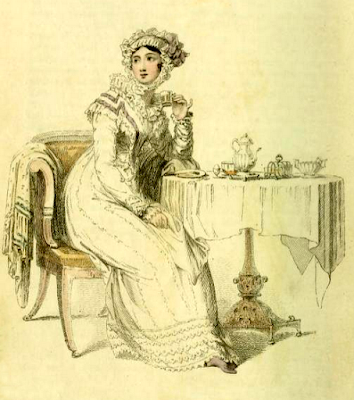
Lady in morning dress sitting beside a tea table from Ackermann's Repository (1822)
Morning dress from Ackermann's Repository (1822)

Which do you prefer, tea or coffee? It’s an easy choice for me as I don’t like coffee, but I love tea – black tea or what is sometimes called English breakfast tea. I like it weak with milk and no sugar, and I drink it all day long, from breakfast to bedtime.

But what about during the Regency? Did people drink tea or coffee? And when did they drink these beverages?

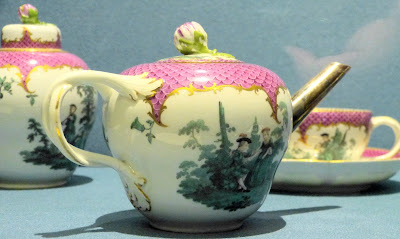
Hester Thrale's Meissen tea service on display at Dr Johnson's House Museum
Hester Thrale's Meissen tea service
on display at Dr Johnson's House Museum (2015)
A nation of tea drinkers

Most of Europe drank coffee, but England was primarily a nation of tea drinkers. Why? Quite possibly as the result of a powerful advertising campaign!

The English’s preference for tea goes back to the mid-1600s. The East India Company had a monopoly on the import of tea from China, and it was therefore in their interests to increase sales of tea. It is likely that the English started drinking more tea at least in part because of East India Company propaganda promoting tea.

Another factor was war with France and Spain which made it hard to get supplies of coffee from the Levant, whilst trade routes from China were reliable. The obvious solution was to drink tea rather than coffee.

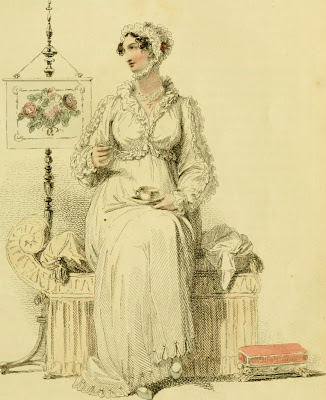
Lady in morning dress seated with a cup of tea in her lap from Ackermann's Repository (1814)
Morning dress from Ackermann's Repository (1814)
Luxury or necessity?

Tea was expensive. The price varied depending on the retailer, the type of tea and the year, but good quality tea was not cheap.

For example, in 1815 the average price per pound of tea paid by the Greenwich Hospital was 6s 3 1/2d.1 In real terms for 2020, this equates to £23.85. This sounds pretty expensive to me – and I imagine the Greenwich Hospital was buying tea at the cheaper end of the market. If you take into account average wages at the time, the real cost of a pound of tea was more like £256.30.2 Definitely a luxury good!

The price of tea was inflated due to high customs and excise duties. As a result, large quantities of tea were smuggled into the country to avoid the taxes. Before the Tea and Window Act of 1784, the tax on tea amounted to 119% of its cost! The Act reduced the tax rate to 12 1/2%, but after this, rates increased again, and smuggling continued.3

Despite its expense, everyone drank tea. Some saw drinking tea as the exclusive privilege of the wealthy and objected to the lower classes adopting the habit. Others, like the Methodists, thought drinking tea should be encouraged in preference to drinking alcohol.

The poor could make a few tea leaves go a long way. I don’t suppose the slightly flavoured water they drank bore much resemblance to the rich infusion of tea served in the houses of the haut ton.

Smouch

Cheaper tea was often smuggled, and may have been smouch rather than pure tea.

Unscrupulous merchants could make a pound of tea go further by mixing it with other, cheaper leaves. Black tea could be mixed with ash leaves to make what was known as smouch. The process sounds revolting as it involved using sheep’s dung to make the smouch look more like tea.

As it was easier to mix other leaves with green tea, a preference for black tea developed.

Licenced to sell

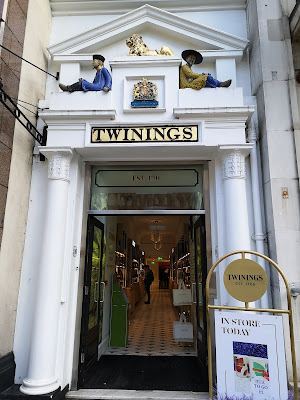
Entrance to Twinings on Strand (2021)
Adulterating tea by mixing it with sloe, liquorice or any other leaves was a criminal offence. To combat this risk, dealers in coffee, tea and chocolate had to be licensed. People could buy tea for drinking at home from coffee houses, apothecaries, and other merchants. As the popularity of tea grew, specialist tea shops like Twinings on Strand developed.

Tea was usually bought by the pound, loose from the crate, and wrapped in a screw of paper.

The most common varieties of tea on offer were bohea (black tea) and hyson (green tea). Twinings sold other types such as Pekoe, Imperial and Congo, and could mix the teas together to produce custom blends.

In a letter of 1811, Jane Austen refers to starting her China Tea and finding it very good.4

When did people drink tea?

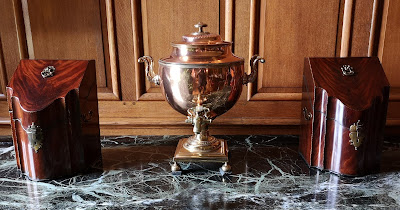
Tea caddies and urn at Dunham Massey (2019)
Tea was drunk twice a day in most households – at breakfast and after dinner – though some people drank coffee instead.

Those that could afford it added milk or cream, and nearly everyone took sugar until the 1790s when around 300,000 households boycotted sugar in support of the abolitionist movement.

Because tea was expensive, it was often kept locked up in a tea caddy. Hot water was provided by an urn, on or near the table, and the lady of the house, or one of her daughters, was usually responsible for making the tea.

Tea at breakfast time

You can read about Regency breakfast time here.

Don Manuel Alvare Espriella, a Spanish traveller, described his experience of an English breakfast in 1802:

The breakfast-table is a cheerful sight in this country: porcelain of their own manufactory, which excels the Chinese in elegance of form and ornament, is ranged on a Japan waiter, also of the country fabric; for here they imitate every thing. The mistress sits at the head of the board, and opposite to her the boiling water smokes and sings in an urn of Etruscan shape. The coffee is contained in a smaller vase of the same shape, or in a larger kind of tea-pot, wherein the grain-is suspended in a bag; but nothing is so detestable as an Englishman's coffee. The washing of our after-dinner cups would make a mixture as good; the infusion is just strong enough to make the water brown and bitter. This is not occasioned by economy, though coffee is enormously dear, for the people are extravagant in the expences of the table: they know no better; and if you tell them how it ought to be made, they reply, that it must be very disagreeable, and even that if they could drink it so strong, it would prevent them from sleeping. There is besides an act of parliament to prevent the English from drinking good coffee: they are not permitted to roast it them selves, and of course all the fresh and finer flavour evaporates in the warehouse. They make amends however by the excellence of their tea, which is still very cheap, though the ministry, in violation of an explicit bargain, increased the tax upon it four fold, during the last war. This is made in a vessel of silver, or of a fine black porcelain: they do not use boiled milk with it, but cream in its fresh state, which renders it a very delightful beverage.5

I am intrigued that Espriella described tea as very cheap as everything else I’ve read suggests it was expensive, but maybe it was in comparison to what it cost him at home or to the price of coffee.

Jane Austen’s brother Edward preferred coffee. In a letter of 1799, she wrote:

It is rather impertinent to suggest any household care to a housekeeper, but I just venture to say that the coffee-mill will be wanted every day while Edward is at Steventon, as he always drinks coffee for breakfast.6

Tea and coffee after dinner

You can read about Regency dinnertime here.

After dinner, the ladies normally left the gentlemen to drink wine and regrouped in the drawing room. 

You can read more about this custom at the end of my blog on drink at the Regency dinner table here. 

Tea and coffee were served when the gentlemen re-joined the ladies.

In Pride and Prejudice, Jane Austen describes after-dinner teatime at Longbourn:

The gentlemen came; and she [Elizabeth Bennet] thought he [Mr Darcy] looked as if he would have answered her hopes; but, alas! the ladies had crowded round the table, where Miss Bennet was making tea, and Elizabeth pouring out the coffee, in so close a confederacy that there was not a single vacancy near her which would admit of a chair.7

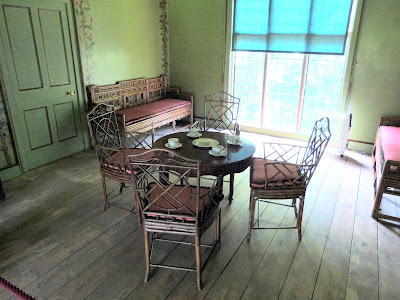
The tearoom in Queen Charlotte's Cottage, Kew (2013)
In the summer, they would sometimes drink tea outside in a teahouse or tent in the grounds. 

Queen Charlotte's Cottage, Kew, has a tearoom upstairs. You can read about it here.

In Jane Austen’s Emma, Harriet Smith talks of Mrs Martin

…having a very handsome summer-house in their garden, where some day next year they were all to drink tea:—a very handsome summer-house, large enough to hold a dozen people.8

Inviting people to join you for tea was a popular way of entertaining into the evening. Compared to having someone to dinner, it was less formal, less expensive, conferred less distinction, and was not restricted by the number of people you could get around your dining table.

In Pride and Prejudice, when Elizabeth Bennet goes to visit Charlotte, Mr Collins was hopeful of an invitation to tea:

“I confess,” said he, “that I should not have been at all surprised by her ladyship’s asking us on Sunday to drink tea and spend the evening at Rosings.”9

Charlotte’s sister Maria kept a tally of how often Lady Catherine had invited them to Rosings:

“We have dined nine times at Rosings, besides drinking tea there twice! How much I shall have to tell!”10

In Emma, Jane Austen spontaneously invited her friends to come in for tea:

He [Mr Knightley] had walked up one day after dinner, as he very often did, to spend his evening at Hartfield. Emma and Harriet were going to walk; he joined them; and, on returning, they fell in with a larger party, who, like themselves, judged it wisest to take their exercise early, as the weather threatened rain; Mr and Mrs Weston and their son, Miss Bates and her niece, who had accidentally met. They all united; and, on reaching Hartfield gates, Emma, who knew it was exactly the sort of visiting that would be welcome to her father, pressed them all to go in and drink tea with him. The Randalls party agreed to it immediately; and after a pretty long speech from Miss Bates, which few persons listened to, she also found it possible to accept dear Miss Woodhouse’s most obliging invitation.11

Jane Austen often wrote of drinking tea with friends. In a letter in April 1811 she wrote:

We drank tea again yesterday with the Tilsons, and met the Smiths. – I find all these little parties very pleasant.12

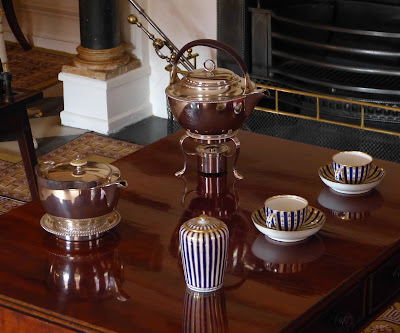
Queen Charlotte's tea things, Kew Palace (2013)
Tea things in Queen Charlotte's drawing room,
Kew Palace (2013)
Tea addicts

Of course, there were tea addicts, like Samuel Johnson, who was renowned for drinking tea at all times of the day.

In a response to a criticism of tea-drinking written in 1757, Johnson admitted that he was

…a hardened and shameless tea-drinker, who has, for twenty years, diluted his meals with only the infusion of this fascinating plant; whose kettle has scarcely time to cool; who with tea amuses the evening, with tea solaces the midnight, and, with tea, welcomes the morning.13

That sounds like me…

Headshot of Rachel Knowles author with sea in background(2021)
Rachel Knowles writes clean/Christian Regency era romance and historical non-fiction. She has been sharing her research on this blog since 2011. Rachel lives in the beautiful Georgian seaside town of Weymouth, Dorset, on the south coast of England, with her husband, Andrew.

Find out more about Rachel's books and sign up for her newsletter here.

If you have enjoyed this blog and want to encourage me and help me to keep making my research freely available, please buy me a virtual cup of coffee by clicking the button below.


Notes

  1. These figures are from Levi, Leone, Wages and Earnings of the Working Classes (1867).
  2. These figures are from The Measuring Worth website.
  3. These figures are from Wisset, Robert, A View of the rise, progress and present state of the Tea Trade in Europe (1801).
  4. Austen, Jane, Jane Austen's Letters, Collected and Edited by Le Faye, Deirdre (Oxford University Press, 1995).
  5. Espriella, Don Manuel Alvare, Letters from England, translated from the Spanish by Robert Southey 3rd edition (1814) Volume 1.
  6. Austen op cit.
  7. Austen, Jane, Pride and Prejudice (1813, London).
  8. Austen, Jane, Emma (1815, London).
  9. Austen, Jane, Pride and Prejudice (1813, London).
  10. Ibid.
  11. Austen, Jane, Emma (1815, London).
  12. Austen, Jane, Jane Austen's Letters, Collected and Edited by Le Faye, Deirdre (Oxford University Press, 1995).
  13. Johnson, Samuel, Works of Samuel Johnson Vol 6/11 (1825)

Sources used include: 

Austen, Jane, Emma (1815, London)
Austen, Jane, Jane Austen's Letters, Collected and Edited by Le Faye, Deirdre (Oxford University Press, 1995)
Austen, Jane, Pride and Prejudice (1813, London)
Cruickshank, Dan and Burton, Neil, Life in the Georgian City (1990)
Espriella, Don Manuel Alvare, Letters from England, translated from the Spanish by Robert Southey 3rd edition (1814) Volume 1
Johnson, Samuel, Works of Samuel Johnson Vol 6/11 (1825)
Levi, Leone, Wages and Earnings of the Working Classes (1867)
Pettigrew, Jane and Richardson, Bruce, A Social History of Tea (2014)
Twining, Richard, Observations on the Tea and Window Act and on the Tea Trade (1785)
Twinings website
Wisset, Robert, A View of the rise, progress and present state of the Tea Trade in Europe (1801)

Thursday, 21 October 2021

Top 30 posts from 10 years of blogging on the Regency History blog

Me (Rachel Knowles) with my husband Andrew at White Nothe, Dorset (2021)
Me (Rachel Knowles) with my husband Andrew
at White Nothe, Dorset (2021)
This month I’m celebrating 10 years of the Regency History blog. I started this blog to record and share the research I was doing into the Regency period (1811-20) as background for The Merry Romances. I became distracted by the history and expanded my research to cover what I call the long Regency – from about 1780-1830. 
 
You can read what I mean by this in my all-time top post: When is the Regency era? 
 
As a result of my research, I decided to set the first book, A Perfect Match, in 1788-9, some 20 years before the start of the Regency. The five sequels tell the stories of the children from the couple who got together in the first book. A Reason for Romance is set in 1810 and A Single Obsession (due to be published in 2022) is set in 1811. 
 
My first post went up on this blog on 1 October 2011 and this is my 357th blog post (not including pages). I’ve researched lots of different areas of Regency era life as well as some of the people who lived in late Georgian Britain and the places they lived in and visited. I’ve blogged about exhibitions and events and posted reviews of historical non-fiction and clean Regency era romance as well as cheat guides to some of the classic novels of the period. 
 
You may have read lots of these posts or perhaps you have only recently discovered my blog. You will find a list of what I’ve blogged about here or in the index tab, except for my Regency romance reviews which have got their own index under Regency reviews. 
 
Sign up to my newsletter to stay in touch 
 
If you haven’t already done so, please sign up to my newsletter so you’ll know what’s new on my blog every month. The added bonus at the moment is my blog birthday giveaway. Answer a simple question in my newsletter for a chance to win one of my books or a $10 Amazon voucher. The giveaway has now ended, but you can still sign up to my newsletter: Sign up here.
 
 
Regency History 10th birthday giveaway
 
My all-time top 30 posts (clickable links)
 
 
The first quadrille at Almack's from The Reminiscences and Recollections of Captain Gronow (1850)
 
 
A drawing room at St James' Palace from The Microcosm of London (1808-10)

 
Georgiana, Duchess of Devonshire by Thomas Gainsborough in South Sketch Gallery, Chatsworth

 
Peers (from left to right): duke, marquess, earl, viscount, baron from A book explaining the ranks and  dignitaries of British Society (1809)

 
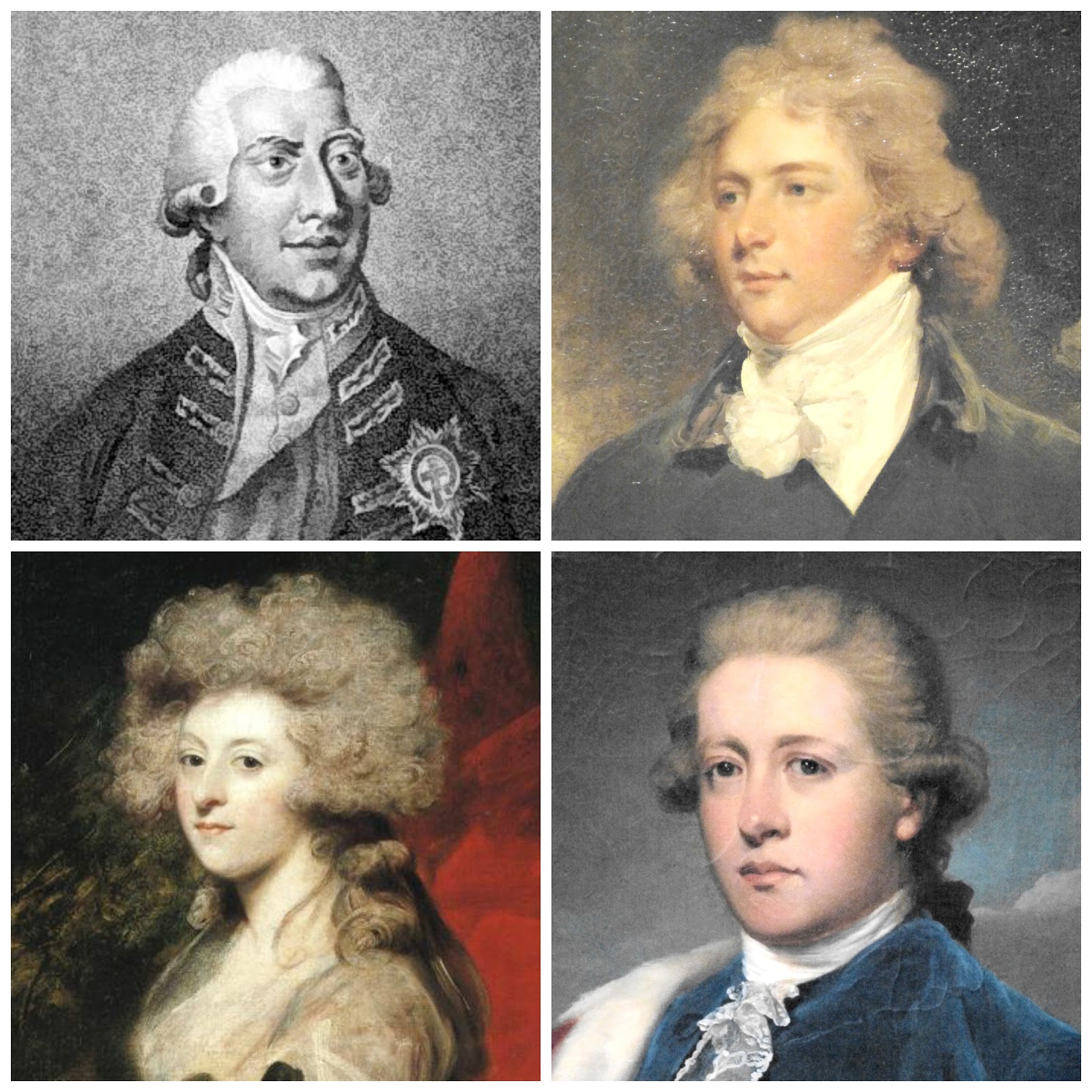
George III in a white wig; George IV, Maria Fitzherbert and William Cavendish, Duke of Devonshire, showing the effect of powder in the hair
 
 
Part of the Forum, Rome (2005)
 
 
Ladies in a phaeton from Gallery of Fashion by Nikolaus von Heideloff (1794)
 
 
The Opera House from The Microcosm of London (1808-10)
 
 
Lady Elizabeth Foster, later Duchess of Devonshire, in South Sketch Gallery, Chatsworth
 
 
A collage of 40 Regency headdresses and hairstyles by year 1811-20 from La Belle Assemblée and Ackermann's Repository

 
Ladies' voucher for Almack's - used with kind permission STG Misc. Box 7 (Almack's Voucher) © The Huntington Library, San Marino, CA
 
 
George Brummell from The History of White's  by Hon Algernon Bourke (1892)


Lyme Park - Pemberley
 
 
Prince William Frederick, Duke of Gloucester from A Biographical Memoir of Frederick,  Duke of York and Albany by John Watkins (1827)
 
 
Andrew and Rachel Knowles as "Elizabeth Bennet and Mr Darcy"
 
 
Vauxhall Gardens from The Microcosm of London (1808-10)
 
 
Detail from Merton College, Oxford: a marriage ceremony  in the chapel by J Bluck (1813) after AC Pugin Wellcome Collection used under Creative Commons Licence (CC BY 4.0)
 
 
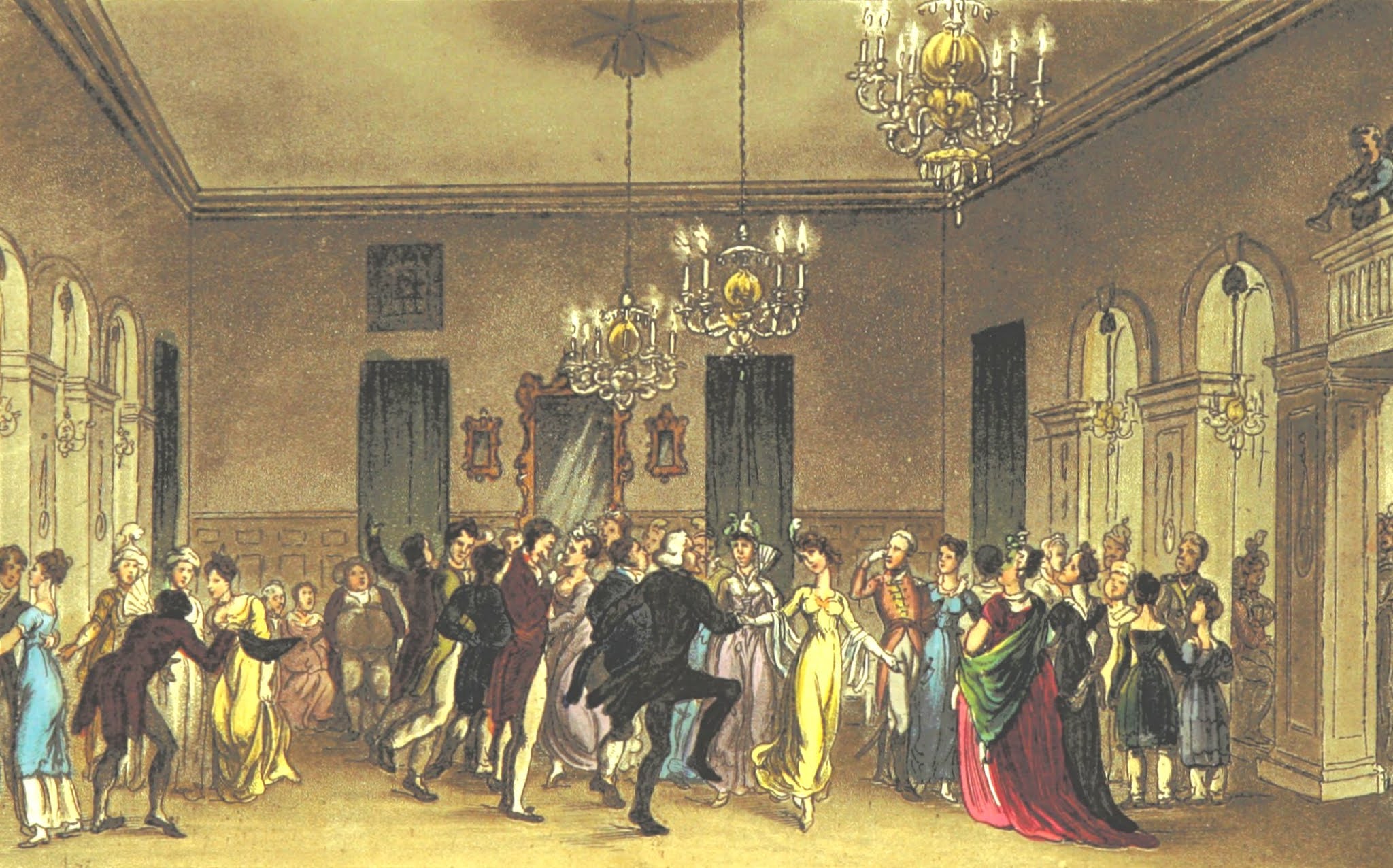
Ballroom, Scarborough, from Poetical Sketches of Scarborough by F Wrangham, W Combe and J B Papworth Pub Ackermann (1813) from Metropolitan Museum of Art
 
 
Carlton House from Pall Mall from Ackermann's Repository (1809)
 
 
Highest Life in London - Tom & Jerry 'sporting a toe' among the Corinthians at Almacks in the West by IR & G Cruikshank in Tom and Jerry: Life in London by P Egan (1869 first pub 1821)
 
 
Nostell Priory
 
 
Brummell as an old man from The History of White's  by Hon Algernon Bourke (1892)
 
 
The Orchestra at Vauxhall from London Pleasure  Gardens of the 18th Century by W & AE Wroth (1896)
 
 
From left: Lady Anne Barnard, Lady Elizabeth Foster and Lady Caro Lamb
 
 
Gold State Coach at the Royal Mews, Buckingham Palace
 
 
Tom getting the best of a Charley by George Cruikshank (1820) from The man of pleasure by R Nevill (1913)
 
 
Mrs Fitzherbert from The Creevey Papers (1904)
 
 
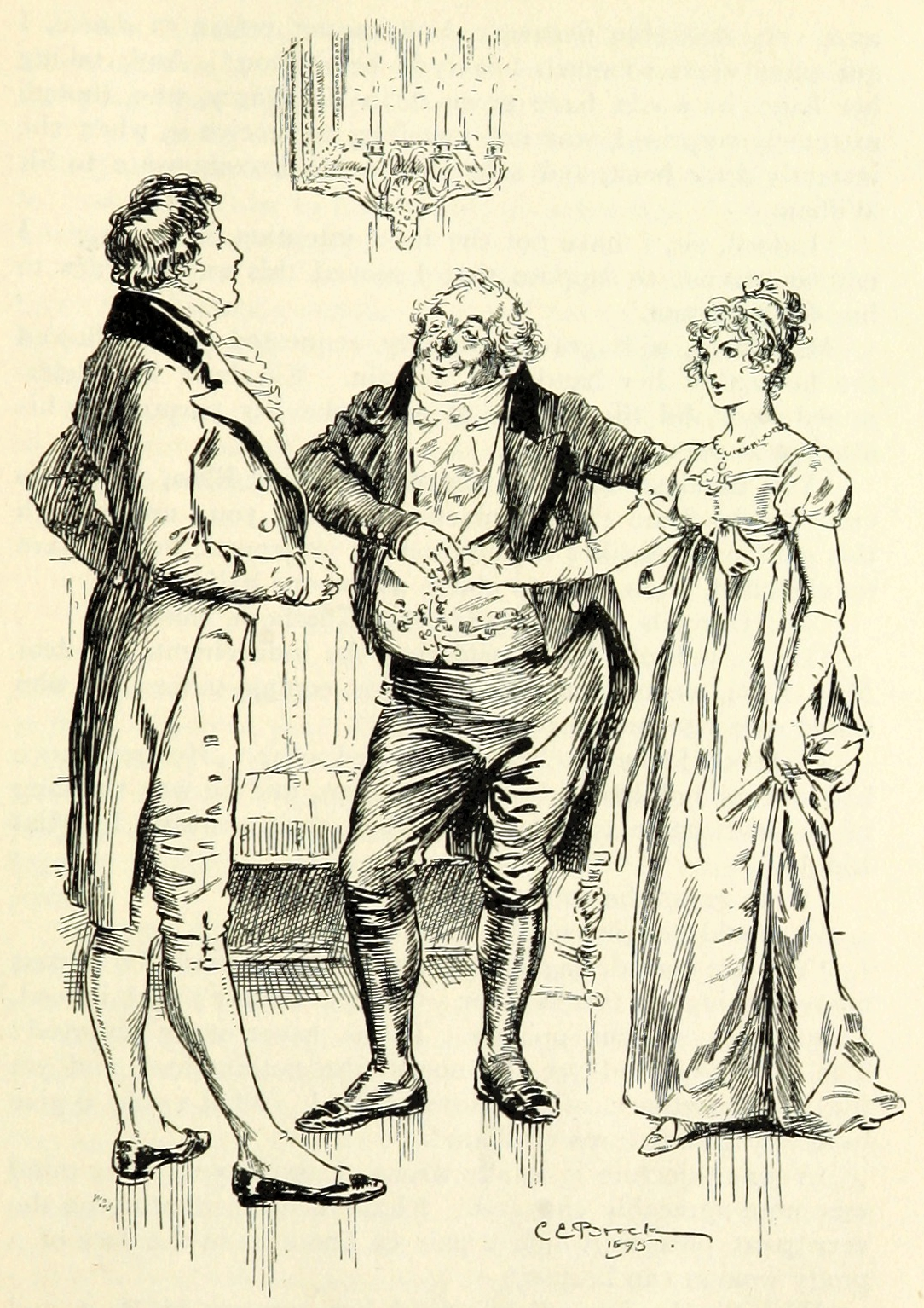
Sir William presents Elizabeth Bennet to Mr Darcy as a desirable partner by C E Brock (1895) From Pride and Prejudice by Jane Austen (1895 edition)
 
 
The House of Commons from The Microcosm of London (1808-10)
 

Headshot of Rachel Knowles author with sea in background(2021)
Rachel Knowles writes clean/Christian historical romance set in the time of Jane Austen. She has been sharing her research on this blog since 2011. Rachel lives in the beautiful Georgian seaside town of Weymouth, Dorset, on the south coast of England, with her husband, Andrew.

Find out more about Rachel's books and sign up for her newsletter here.

If you have enjoyed this blog and want to encourage me and help me to keep making my research freely available, please buy me a virtual cup of coffee by clicking the button below.


 © Regencyhistory.net