Search this blog

Showing posts with label carriages. Show all posts

Thursday, 31 August 2017

The Royal Mews at Buckingham Palace

Sign outside Royal Mews at Buckingham Palace, London

What is the Royal Mews?

The Royal Mews is a department of the Queen’s household and is responsible for all travel by road undertaken by the Queen and her family. It houses the Queen’s carriages and carriage horses as well as a fleet of cars.

Diamond Jubilee State Coach at Royal Mews, Buckingham Palace
Diamond Jubilee State Coach at Royal Mews, Buckingham Palace (2017)
The history of the Royal Mews

The King’s Mews goes back to the 14th century when Richard II was on the throne, and was originally at Charing Cross, where the National Gallery is now. It was the place where the king kept his falcons and the name mews comes from the falcons mewing, that is, moulting. Henry VIII rebuilt the mews as stables in 1534 but kept the name ‘mews’ and it has been associated with horses ever since.

The quadrangle of the Royal Mews, Buckingham Palace
The quadrangle of the Royal Mews, Buckingham Palace (2017)
The Royal Mews at Buckingham Palace

In 1761, George III bought Buckingham House for his wife, Queen Charlotte. He commissioned the building of the Riding School, which is the oldest part of the Mews. It was designed by the architect Sir William Chambers and built in 1765-6.

After George IV succeeded to the throne in 1820, he decided to rebuild Buckingham House and make it his royal palace. The Royal Mews was built in 1822-5 and was designed by the architect of Buckingham Palace, John Nash. Unfortunately, the foundations were faulty, there was a drainage problem, and the original building work was shoddy so that it was constantly under repair. 

Nash built the Doric-style arch topped with a clock tower leading into the quadrangle of the Mews, but the pediment carving portraying the tale of Hercules catching Thracian horses was added later, in 1859.

The Master of the Horse

Traditionally, the Royal Mews was under the control of the Master of the Horse – a very senior position in the royal household. The Master of the Horse is no longer a hands-on role, and the Royal Mews is now run by the Crown Equerry.

What can you see today?

The Riding School

The Riding School at the Royal Mews, Buckingham Palace
The Riding School at the Royal Mews, Buckingham Palace (2017)
 Semi-state Landau

Semi-state Landau at the Royal Mews, Buckingham Palace
Semi-state Landau at the Royal Mews, Buckingham Palace (2017)
Scottish State Coach

Built in 1830 for the Duke of Cambridge, it was used by his family before being sold to the 9th Earl of Albermarle. The earl converted it into a semi-state landau before giving it to Queen Mary in 1920.

Scottish State Coach at the Royal Mews, Buckingham Palace
Scottish State Coach at the Royal Mews, Buckingham Palace (2017)
Queen Alexandra’s Coach

Used to take the crown to the Houses of Parliament for the state opening of parliament.

Queen Alexandra's Coach at the Royal Mews, Buckingham Palace
Queen Alexandra's Coach at the Royal Mews, Buckingham Palace (2017)
Irish State Coach

Originally built in Dublin in 1803-4, the Irish State Coach was bought by Queen Victoria after seeing it at an exhibition in 1852.

Irish State Coach at the Royal Mews, Buckingham Palace
Irish State Coach at the Royal Mews, Buckingham Palace (2017)
Australian State Coach

A gift to the Queen from the people of Australia, this coach is normally on display in the Royal Mews, but is currently part of the 2017 exhibition at Buckingham Palace, Royal Gifts, until 1 October.

Australian State Coach on display at Buckingham Palace in 2015
Glass Coach

Used by many royal brides to travel to their weddings including Lady Diana Spencer in 1981.

Glass Coach at the Royal Mews, Buckingham Palace
Glass Coach at the Royal Mews, Buckingham Palace (2017)
Glass Coach at the Royal Mews, Buckingham Palace
Glass Coach at the Royal Mews, Buckingham Palace (2017)
Diamond Jubilee State Coach

This coach is a travelling time capsule. It is full of historical artefacts including a hollow crown on its roof made from wood from HMS Victory and a digital copy of the Domesday book.

Diamond Jubilee State Coach at Royal Mews, Buckingham Palace
Diamond Jubilee State Coach at Royal Mews, Buckingham Palace (2017)
 The Gold State Coach

The Gold State Coach is on display in the former State Carriage House. It was commissioned by George III, and was first used by the king to travel to the House of Lords to open parliament on 25 November 1762. Despite appearances, the coach is not made of gold, but is gilded all over, with external panels painted by Giovanni Battista Cipriani.

The coach has been used for every coronation since that of George IV in 1821. There is a frieze around the walls showing William IV’s coronation procession in 1831, painted by Richard Barrett Davis (1782-1854).

Gold State Coach at the Royal Mews, Buckingham Palace
Gold State Coach at the Royal Mews, Buckingham Palace (2017)
Royal car

Royal car at the Royal Mews, Buckingham Palace
Royal car at the Royal Mews, Buckingham Palace (2017)
The State Stables

The State Stables have a replica landau that visitors may sit in to get an idea of the suspension (or lack of it) in a royal carriage. There are also opportunities here to dress up as a footman and learn how to harness a horse. 

The State Stables at Royal Mews, Buckingham Palace
The State Stables at Royal Mews, Buckingham Palace (2017)
Rachel in the replica landau in the State Stables, Royal Mews, Buckingham Palace
Rachel in the replica landau
in the State Stables,
Royal Mews, Buckingham Palace (2017)
The working stables

The stables house the Queen’s carriage horses including the Queen’s famous Windsor Greys and Cleveland Bays.

The stables at the Royal Mews, Buckingham Palace
The stables at the Royal Mews, Buckingham Palace (2017)
The harness room at the Royal Mews, Buckingham Palace
The harness room at the Royal Mews, Buckingham Palace (2017)

Headshot of Rachel Knowles author with sea in background(2021)
Rachel Knowles writes clean/Christian Regency era romance and historical non-fiction. She has been sharing her research on this blog since 2011. Rachel lives in the beautiful Georgian seaside town of Weymouth, Dorset, on the south coast of England, with her husband, Andrew.

Find out more about Rachel's books and sign up for her newsletter here.

If you have enjoyed this blog and want to encourage me and help me to keep making my research freely available, please buy me a virtual cup of coffee by clicking the button below.


Last visited for bloggers' breakfast on 1 August 2017
All photographs © Regencyhistory.net

Thursday, 13 August 2015

Travelling chariots

A collage of travelling chariots by Rachel Knowles
Travelling chariots
One of the subjects I had to research for A Perfect Match was travel. Right at the start of my book, I needed to move Mrs Westlake and her daughter from Oxfordshire to London. Obviously they would travel by horse-drawn vehicle, but what type of carriage would they have used and how would this have been accomplished?

To help me with my research, I visited the National Trust Carriage Museum at Arlington Court in Devon and the Red House Stables in the Peak District in Derbyshire. I soon decided that the wealthy Mrs Westlake would undoubtedly have travelled by private chaise or travelling chariot:
She [Mrs Westlake] was very proud of her brand new travelling chariot which had been built to the latest design and offered the most comfortable ride that money could buy.1
What was a travelling chariot?

A travelling chariot was a privately owned post-chaise used for long journeys.

Travelling chariot, National Trust Carriage Museum, Arlington Court
Travelling chariot, National Trust Carriage Museum, Arlington Court (2014)
Why was it called a chariot rather than a coach?

It was called a chariot because it was designed to transport two people on a single, forward-facing internal seat, set behind the doors. A coach, on the other hand, was designed to transport four people on two internal seats—a forward-facing seat behind the doors like in a chariot, but with a backward-facing seat opposite, set ahead of the doors.

View inside a travelling chariot from the front window, National Trust Carriage Museum, Arlington Court
View inside a travelling chariot from the front window,
National Trust Carriage Museum, Arlington Court (2014)
How was it driven?

A travelling chariot was designed to be driven by postilions or post-boys. This meant that the carriage was directed by one or more postilions—men riding the horses pulling the carriage—rather than by a coachman sitting on a coach box which would obscure the travellers’ view. The postilions usually rode the horses on the left or near side. The pair of horses nearest the carriage was called the wheelers and the pair in front was called the leaders.

Step up into a travelling chariot extended at Red House Stables
Step up into a travelling chariot extended
at Red House Stables (2014)
How did the post system work?

The post system enabled people to travel more quickly by refreshing their horses at different stages along the way. A traveller could hire horses and post-boys at a posting house to convey their carriage to a posting house further along the post road. This journey was known as a stage and was usually eight to ten miles long. At the end of the stage, the traveller paid off the post-boys who then stayed with the horses until they were hired by someone travelling in the opposite direction, back to the inn where they were hired.

An ostler at the second posting inn would harness a fresh team of horses to the carriage accompanied by a new set of post-boys, which would take the traveller on the second stage of their journey. 

It was possible to hire a carriage as well as horses and these public travelling chariots were called post-chaises and were often painted yellow.

Travelling chariot, Red House Stables
Travelling chariot, Red House Stables (2014)
Travelling with your own horses

Travellers frequently covered the first stage of their journey with their own horses and postilions. These postilions would ensure that the owner’s horses were returned to their stables or wait with them for the owner’s return journey.

The very wealthy sometimes travelled with their own horses along the whole length of the journey by having horses stabled at every stage along the route.

Travelling chariot with box seat fitted for town travel, Red House Stables
Travelling chariot with box seat fitted for town travel, Red House Stables (2014)
Adapted for travelling

Because a travelling chariot only had one seat and a window in front, it was ideal for sightseeing en route.

It sometimes had a dormouse boot—a system of folding panels inside the coach that allowed the passengers to stretch out their legs fully into the boot of the carriage.

Travellers could stow their belongings in the chariot’s imperials—light wooden cases covered with leather which could be carried on the roof and in the front boot.

In addition, the chariot might have a sword case which could only be accessed from the inside.

Travelling chariot with imperials mounted on the roof,  National Trust Carriage Museum, Arlington Court
Travelling chariot with imperials mounted on the roof,
National Trust Carriage Museum, Arlington Court (2014)
A versatile vehicle

A travelling chariot was not just used for travelling long distances. After arriving in town, the chariot could have a box seat added so that it could be driven around town by a coachman.

Behind the main body of the carriage, above the boot, was an outside seat called a rumble seat which could be used for transporting servants. This could be removed so that footmen could stand on the footboard behind the carriage when it was used around town.

Rumble seat on a travelling chariot, Red House Stables
Rumble seat on a travelling chariot, Red House Stables (2014)
Windows

The windows could be covered over with screens or shutters in order to shut out the light and allow the passengers to sleep and maintain their privacy. The different screens could be lowered and raised as required.

Inside a travelling chariot, showing the window screens, Red House Stables
Inside a travelling chariot, showing the window screens,
Red House Stables (2014)

Headshot of Rachel Knowles author with sea in background(2021)
Rachel Knowles writes clean/Christian Regency era romance and historical non-fiction. She has been sharing her research on this blog since 2011. Rachel lives in the beautiful Georgian seaside town of Weymouth, Dorset, on the south coast of England, with her husband, Andrew.

Find out more about Rachel's books and sign up for her newsletter here.

If you have enjoyed this blog and want to encourage me and help me to keep making my research freely available, please buy me a virtual cup of coffee by clicking the button below.

 
Note
(1) Excerpt from A Perfect Match by Rachel Knowles.

Sources used include:
Badcock, Marigold, Gibbons, David and Parker-Williams, Demelza, Arlington Court and the National Trust Carriage Museum, National Trust Guide (2009)

National Trust carriage listing

Photos © RegencyHistory.net

Monday, 20 October 2014

The National Trust Carriage Museum at Arlington Court – a Regency History guide

The National Trust Carriage Museum, Arlington Court
The National Trust Carriage Museum, Arlington Court (2014)
Where is it?

The National Trust Carriage Museum is housed in the stables of Arlington Court near Barnstaple in North Devon.
 

History

In 1966, the National Trust decided to start a collection of British carriages and display them in the stables of Arlington Court – one of the few stables of a National Trust property that had not already been converted into a restaurant or other building.

The stables, Arlington Court
The stables, Arlington Court (2014)
Some of the carriages were gifted to the Trust, such as eight carriages from the 7th Marquess of Bute, whereas others are on loan, mostly from other National Trust properties and museums.

The collection

The National Trust Carriage Collection includes a wide variety of carriages, mostly dating from the 1800s. I have highlighted a few of the earliest vehicles.
 

The Speaker’s State Coach

This recently restored golden coach dates from the late 17th century and was used by the Speaker of the House of Commons. It is on loan from the Houses of Parliament.


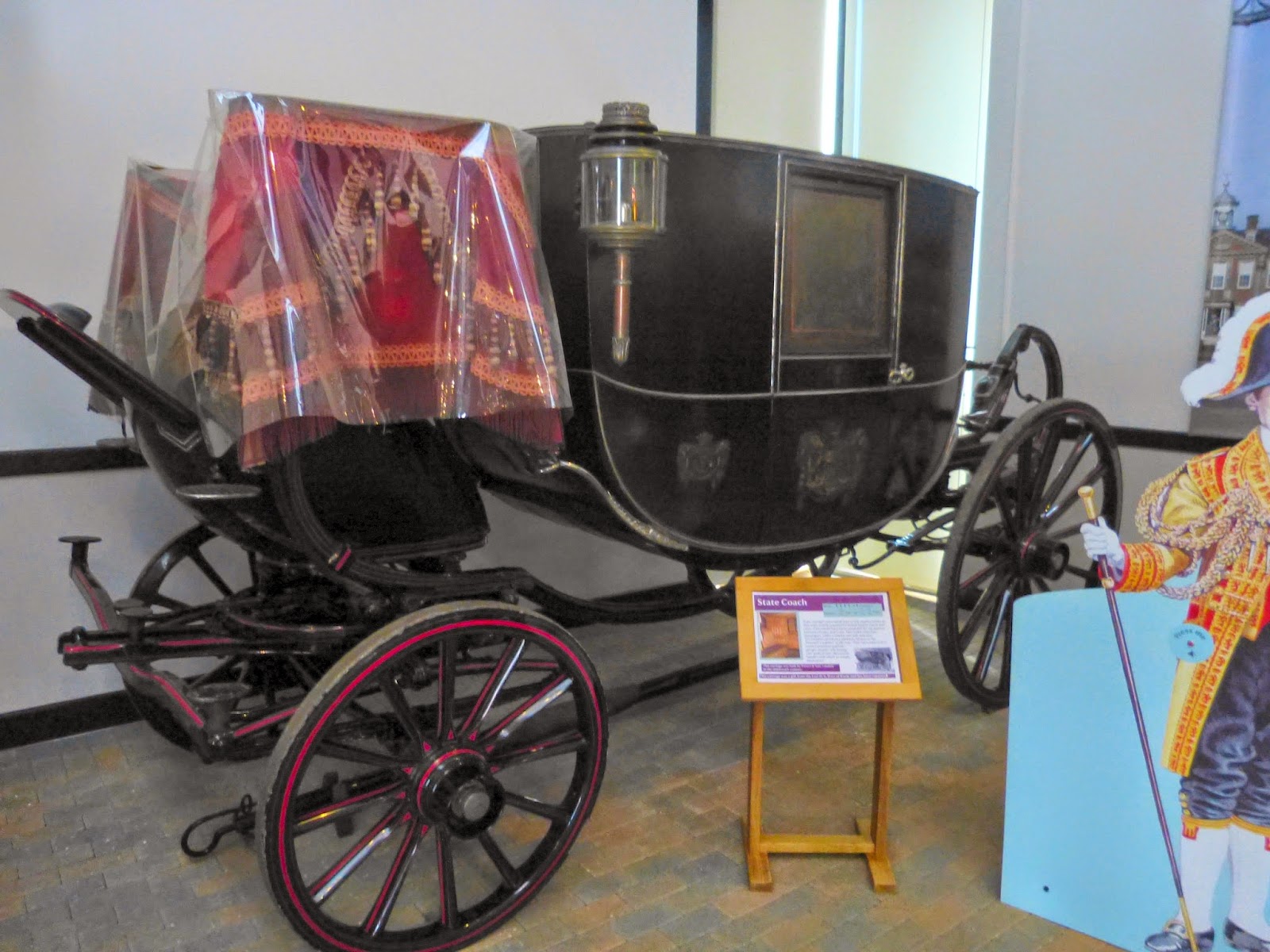
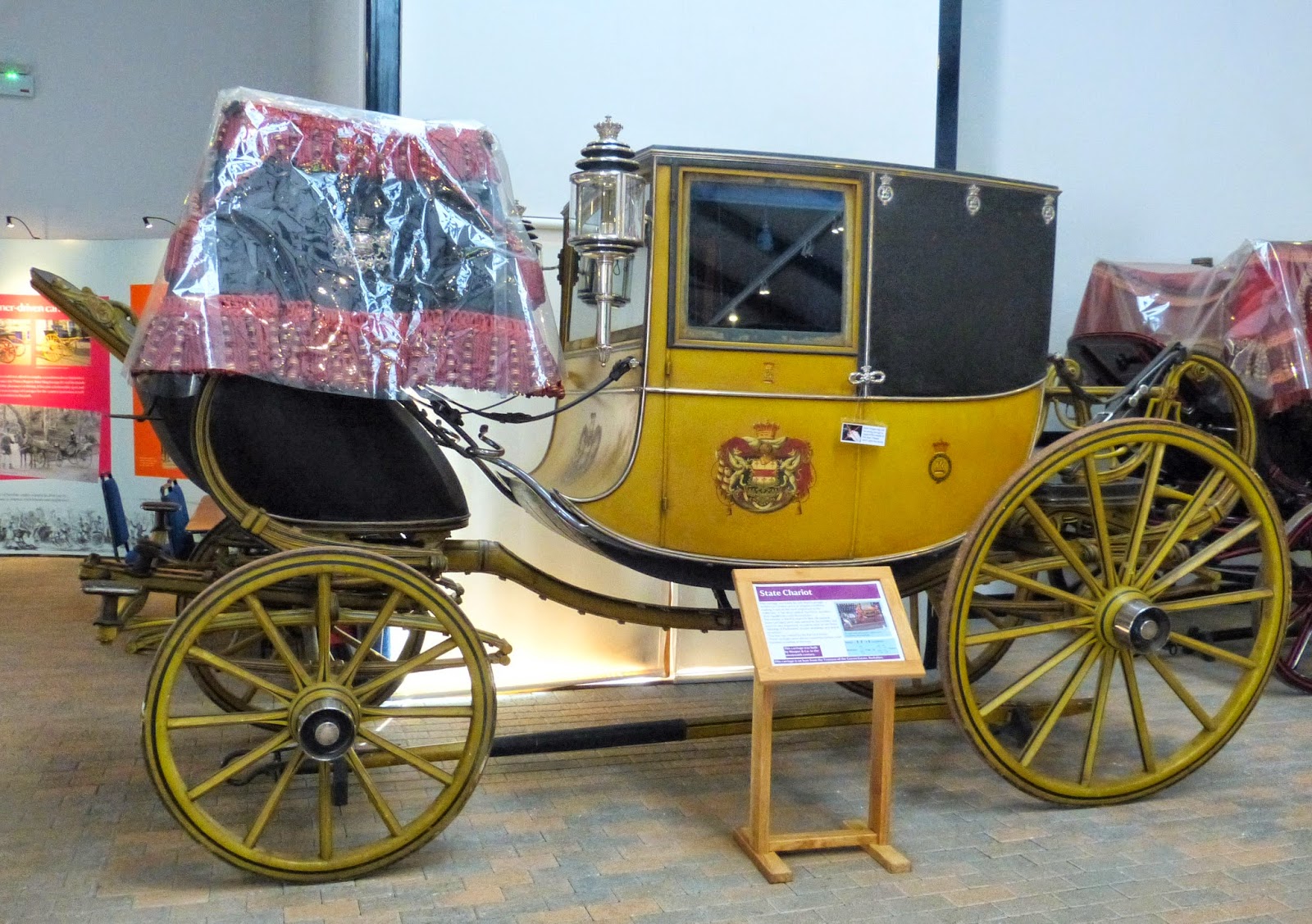
State coach and state chariots

State coach, Arlington Court
State coach, Arlington Court (2014)
These carriages date from the mid-1800s and because they were only used for state occasions, they are in very good condition.

The main difference between a state coach and a state chariot is the shape of the body. A coach can seat four people inside on two seats, one ahead of the doors and one behind the doors. A chariot, on the other hand, is only designed to seat two people and they both sit on the single seat behind the doors.

State chariot, Arlington Court
State chariot, Arlington Court (2014)
Both state coaches and chariots would have been driven by a coachman in full livery with a decorative seat cloth covering the coachman’s seat known as a hammer cloth (shown under a protective covering in both photographs above).

Behind the carriage body is the footmen’s cushion – a padded perch on which two liveried footmen would stand.

Travelling chariots

Travelling chariot, Arlington Court (2014)
A travelling chariot accommodated two people on a single seat behind the doors. It was used for long journeys, including making the Grand Tour.

It was postilion-driven which meant that the carriage was driven by one or more post-boys riding the horses instead of by a coachman on a box. However, a coachman’s seat could be added to adapt it for driving about town.
 

A selection of other carriages on display

Barouche

Barouche, Arlington Court (2014)
Brougham – double and single

Double Brougham, Arlington Court (2014)
Single Brougham, Arlington Court (2014)
Britzschka

Britzschka, Arlington Court (2014)
Landau

Postilion Landau, Arlington Court (2014)
Gig

Hooded Gig, Arlington Court (2014)

You can read about gigs, curricles and phaetons here.

 Cabriolet

Cabriolet, Arlington Court (2014)
Victoria

A carriage called a Victoria, Arlington Court (2014)
Victoria, Arlington Court (2014)
Last visited: June 2014.

Headshot of Rachel Knowles author with sea in background(2021)
Rachel Knowles writes clean/Christian Regency era romance and historical non-fiction. She has been sharing her research on this blog since 2011. Rachel lives in the beautiful Georgian seaside town of Weymouth, Dorset, on the south coast of England, with her husband, Andrew.

Find out more about Rachel's books and sign up for her newsletter here.

If you have enjoyed this blog and want to encourage me and help me to keep making my research freely available, please buy me a virtual cup of coffee by clicking the button below.


Sources used include:
Badcock, Marigold, Gibbons, David and Parker-Williams, Demelza, Arlington Court and the National Trust Carriage Museum, National Trust Guide (2009)
Arlington Court website

All photographs © RegencyHistory.net

Wednesday, 2 July 2014

Arlington Court – a Regency History guide

Arlington Court
Arlington Court (2014)
Where is it?

Arlington Court is a Neoclassical house near Barnstaple in North Devon. The stables are home to the National Trust Carriage Museum.

The stables, Arlington Court
The stables, Arlington Court (2014)
History

The Arlington estate was owned by the Chichester family who had been wealthy Devonshire landowners since the 14th century. They supported the King during the Civil War and had a strong Catholic heritage. A Georgian house was built at Arlington in the early 1790s and a second Georgian house, in the Neoclassical style, was built in the 1820s. It is this house that still stands today.

The estate was given to the National Trust by Miss Rosalie Chichester in 1949.

The Georgian connection

Colonel John Palmer Chichester (1769-1823)

Colonel Chichester married Mary Anne Cary in 1790 and commissioned a fashionable Georgian mansion to be built at Arlington to replace the Tudor manor house he had inherited.

A View of Arlington Court and St James' Church Tower  from the Park by Maria Pixell (1797)
A View of Arlington Court and St James' Church Tower
from the Park by Maria Pixell (1797)
After the death of his first wife in childbirth, Colonel Chichester married the Protestant, Agnes Hamilton, with whom he had six children. To the great distress of his family, he publicly renounced his Catholic faith in Exeter Cathedral in 1793.

By the early 1820s, it became apparent that the Colonel’s Georgian house had structural issues and he commissioned the architect Thomas Lee to build him a new house in the Neoclassical style. This house was completed in 1823. Sadly, Colonel Chichester died the same year and never lived in it.

Sir John Palmer Bruce Chichester (1794-1851)

Sir John Palmer Bruce Chichester
Sir John Palmer Bruce Chichester,
Arlington Court (2014)
Known to his friends as ‘Arlington Jack’, Sir John Chichester served in the navy before inheriting Arlington on the death of his father in 1823. He decorated and furnished the house that his father had commissioned but never lived in - the Morning Room, Ante Room and Boudoir still have the original schemes of decoration.

Part of the Morning Room, Arlington Court
The Morning Room, Arlington Court (2014)
Sir John was a Whig MP for Barnstaple from 1831 to 1841 and he was made a baronet in 1840. He married Caroline Thistlethwayte in 1838 and had two children.

What can you see today?
 
The Neoclassical frontage of Arlington Court

Arlington Court
Arlington Court (2014)
The Morning Room
 
The Morning Room, Arlington Court (2014)
The White Drawing Room

The White Drawing Room, Arlington Court (2014)
Ceiling, White Drawing Room, Arlington Court (2014)
The Boudoir
 
The Boudoir, Arlington Court (2014)
The Enderlein Charger (on display in June 2014)

The Nurnberg Temperantia
The Enderlein Charger (2014)
Read more about the Enderlein Charger here.
 
Items from Miss Chichester's collections

Snuffboxes and other items, Arlington Court (2014)
 The National Trust's collection of carriages (in the stables)

Travelling chariot in the National Trust Carriage Museum, Arlington Court
Travelling chariot in the National Trust Carriage Museum, Arlington Court (2014)

You can read more about the National Trust Carriage Museum here.
 
Last visited: June 2014.

Headshot of Rachel Knowles author with sea in background(2021)
Rachel Knowles writes clean/Christian Regency era romance and historical non-fiction. She has been sharing her research on this blog since 2011. Rachel lives in the beautiful Georgian seaside town of Weymouth, Dorset, on the south coast of England, with her husband, Andrew.

Find out more about Rachel's books and sign up for her newsletter here.

If you have enjoyed this blog and want to encourage me and help me to keep making my research freely available, please buy me a virtual cup of coffee by clicking the button below.

 
Sources used include:
Badcock, Marigold, Gibbons, David and Parker-Williams, Demelza, Arlington Court and the National Trust Carriage Museum, National Trust Guide (2009)
 

All photographs © RegencyHistory.net