Search this blog

Showing posts with label William IV. Show all posts

Wednesday, 2 August 2023

Athelhampton House in Dorset revisited - a new Regency History guide

Athelhampton House - front entrance 2015
Athelhampton House
Athelhampton House, in Dorset, was a 326-year-old pigsty at the start of the Regency period. The ground floor of the Tudor Great Hall, built in 1485, and the connected West Wing, had become home to pigs and poultry. And they had been that way for decades.

Today Athelhampton is one of England’s finest Tudor mansions. It was pretty impressive when it was built, but a visitor in the Regency period would have seen it as a tired, rundown relic of a farmhouse. Little more than an ornate barn.

Not that many people would have visited Athelhampton. Despite King George III regularly passing nearby on his way to and from Weymouth, the house wasn’t on the itinerary of anyone of any consequence. It was lived in by tenant farmers—hence the livestock roaming the halls.

Athelhampton House - back of house and dovecote 2023
Rear view of Athelhampton House and the dovecote (2023)

A house protected by the pigs

In July 2023 Andrew and I were invited to tour Athelhampton, which has been under new ownership since 2019. The house, which was already ancient by the time of the Regency, offers an alternative narrative to what we associate with the grand halls of the period.

Athelhampton stands out as a historic mansion, because it’s not built in the classical style we associate with the Georgians. It lacks the symmetry and bold pillars of so many grand houses. The Tudor styling and unbalanced frontage would have looked quaintly old-fashioned to the Regency eye.

That the house survived for so long (the Great Hall is now over 530 years old) is probably because Nicholas Martyn died with no male heir in 1595. He was the grandson of the house builder, Sir William Martyn, who put it up in 1485.

Nicholas Martyn had four daughters, each of whom inherited a quarter of the property. Because no one person owned the house, no one was able to make major changes to it. By 1700, ownership had been consolidated to a three-quarter and a one-quarter share, split between two families, each of which owned other estates. Neither family lived at Athelhampton, preferring to rent the property to farmers.

This relegation in status protected the architecture we admire today. Had a wealthy Georgian had sole control over Athelhampton, it’s likely he would have wanted to make a statement by tearing it down, and rebuilding it in a more fashionable style. Hence, it’s the pigs that protected the house.

Ironically, it was also a farmer who helped the house survive into the 21st century. Tenant farmer George Wood bought the largest share of the Athelhampton inheritance in 1848. In 1861 he acquired the other share to become the first sole owner in over 250 years.

In 1891 the Woods sold the house to Alfred Cart de Lafontaine. He began the process of restoring the house to its former glory, and laid out the elegant gardens. This work, and that of subsequent owners, protected the house from the rampant demolition that destroyed so many historic buildings in the 20th century.

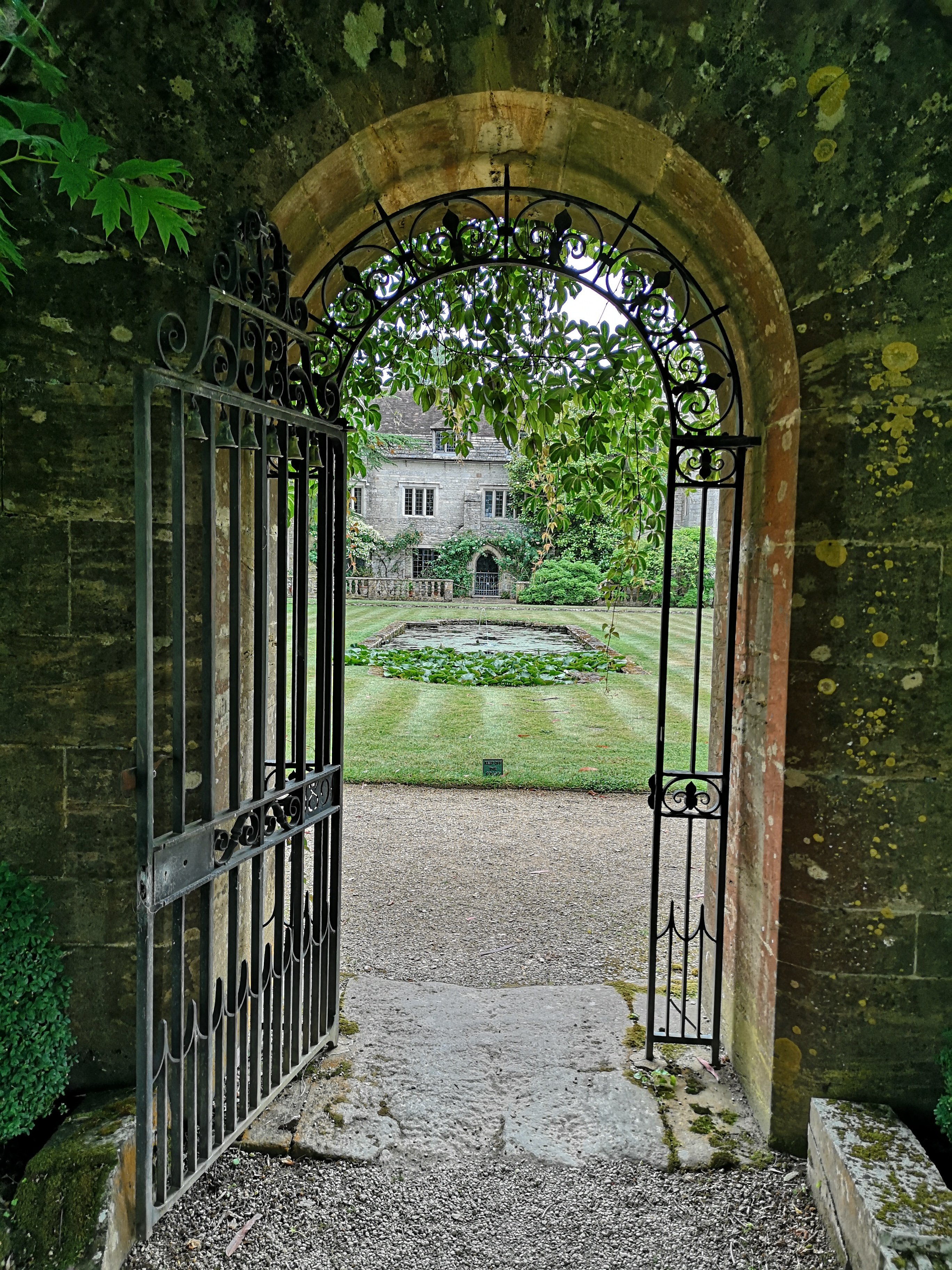
Ornate gate leading to garden at Athelhampton (2023)
One of the gardens at Athelhampton (2023)

Regency Athelhampton

During the Regency (1811–1820) Athelhampton was owned by Catherine Tylney-Long (1789–1825), an heiress believed to be the richest commoner in England. She inherited a huge portfolio of properties as a teenager in 1805, giving her the nickname of “The Wiltshire Heiress”.

As already mentioned, at the time the house was leased to farmers, and it stayed that way during her ownership. She probably never visited the house.

Catherine Tylney-Long by an unknown artist

A close brush with royalty

Despite being incredibly wealthy, Catherine Tylney-Long’s story is tragic.

She also came close to being queen. She was courted by William, Duke of Clarence, third son of King George III, who was nearly 25 years her senior. The press mocked him for pursuing her.

The Duke of Clarence became William IV in 1830. Had Catherine married him, she would have become queen, if—and this is an extremely big if—George III had given his permission for the marriage. With that permission, the marriage would have been legal, and the eldest of their children would have become monarch after William, not his niece Victoria.

The Disconsolate Sailor (1811) - a cartoon by Argus (Charles Williams)
The Disconsolate Sailor (1811) by Argus (Charles Williams)

But Catherine turned down the Duke of Clarence and accepted a proposal from William Wellesley-Pole, a man with a wild reputation. They married in March 1812. William continued his outrageous lifestyle of womanising and gambling, spending much of her wealth.

She died in 1825, aged just 35. The newspapers reported:

To her, riches have been worse than poverty; and her life seems to have been sacrificed, and her heart ultimately broken, through the very means which should have cherished and maintained her in the happiness and splendour which her fortune and disposition were alike qualified to produce.1

Catherine was also connected with another major figure of the Regency era, the Duke of Wellington. Her husband was the great man’s nephew. It was Catherine’s son who sold Athelhampton to the tenant farmer, George Wood, in 1848, to pay off some of his father’s debts.

What you can see at Athelhampton today

Rachel Knowles by staircase in Athelhampton House (2023)
Rachel at Athelhampton House (2023)

Our comprehensive tour of Athelhampton House took several hours, as the extremely knowledgeable manager of the site—Owen Davies—showed us around. A new owner bought the house in 2019 and implemented a series of renovations. He opened up new areas of the house, and visitors are now allowed to enter rooms which previously you could only see from the doorway.

The previous owner auctioned off the house contents separately, and so apart from a few items, such as the portrait of Princess Sophia, which the new owner was able to secure, most of what you see today has come into the house since then. However, much of it is authentic period furniture, and the rooms have been set out to represent different periods in Athelhampton’s history.

Portrait of Princess Sophia by Robinson after Sir William Beechey (1820)
Portrait of Princess Sophia
by Robinson after Sir William Beechey (1820)

There is also more emphasis on one of Athelhampton’s most famous visitors—author Thomas Hardy.

These are some of the highlights:

Tudor doors

Tudor door at Athelhampton House (2023)
Tudor door, Athelhampton House (2023)

The Tudor Great Hall, with its impressive, beamed ceiling and Oriel window.

Tudor Great Hall, Athelhampton House (2023)
 
Ceiling of the Tudor Great Hall at Athelhampton House (2023)
Ceiling of the Tudor Great Hall, Athelhampton House (2023)

Oriel Window in Tudor Great Hall at Athelhampton House (2023)
Oriel Window in Tudor Great Hall, Athelhampton House (2023)

The Green Parlour, where author Thomas Hardy was dining in 1914 when a telegram arrived announcing the beginning of World War I.  

Green Parlour, Athelhampton House (2023)

 The recently restored Elizabethan Kitchen.

Elizabethan Kitchen, Athelhampton House (2023)

The Marriage Chamber, with its original fireplace, showing the motifs of Sir William Martyn and his first wife, Isabel Farringdon—the ape and the unicorn—and an Elizabethan tester bed.

Marriage Chamber, Athelhampton House (2023)

Marriage Chamber, Athelhampton House (2023)

The Armada Chest in the King’s Room—a late 16th century portable safe.

Armada Chest in the King's Room, Athelhampton House (2023)

The Library—originally Elizabethan bedrooms, there is a hidden door in the wood panelling leading to the staircase that comes out in the Great Chamber. The room is dominated by a billiard table dating from 1915.

Billiard table in The Library, Athelhampton House (2023)
The Library, Athelhampton House (2023)

Secret door in the Library, Athelhampton House (2023)

The Great Chamber—used to store grain in the 1850s, the room is lined with Elizabethan oak panels, with Italian carving over the fireplace. And it hides a secret—a door leading to a priest hole and a staircase up to the Library, which was originally a bedroom.

The magnificent plaster ceiling is an early 20th century replica of the pattern used in the Globe Room in the Reindeer Inn, Banbury, Oxfordshire, thought to be where Oliver Cromwell held meetings during the English Civil War.

Italian carved panels, Secret door in the Great Chamber, Athelhampton House (2023)
Italian carved panels in the Great Chamber, Athelhampton House (2023)

Secret door in the Great Chamber, Athelhampton House (2023)

The Great Chamber, Athelhampton House (2023)

Ornate plaster ceiling in the Great Chamber, Athelhampton House (2023)

Gardens

Gateway to one of the gardens at Athelhampton (2023)

One of the gardens at Athelhampton (2023)

Find out about visiting Athelhampton here.

You can see what the house was like under the previous ownership on my original blog here.

Headshot of Rachel Knowles author with sea in background(2021)
Rachel Knowles writes faith-based Regency romance and historical non-fiction. She has been sharing her research on this blog since 2011. Rachel lives in the beautiful Georgian seaside town of Weymouth, Dorset, on the south coast of England, with her husband, Andrew.

Find out more about Rachel's books and sign up for her newsletter here.

If you have enjoyed this blog and want to encourage us and help us to keep making our research freely available, please buy us a virtual cup of coffee by clicking the button below.


Note   

  1. Englishman, 18 September 1825.
Photos © Andrew Knowles - RegencyHistory.net

Thursday, 17 May 2018

The Gold State Coach at the Royal Mews, Buckingham Palace

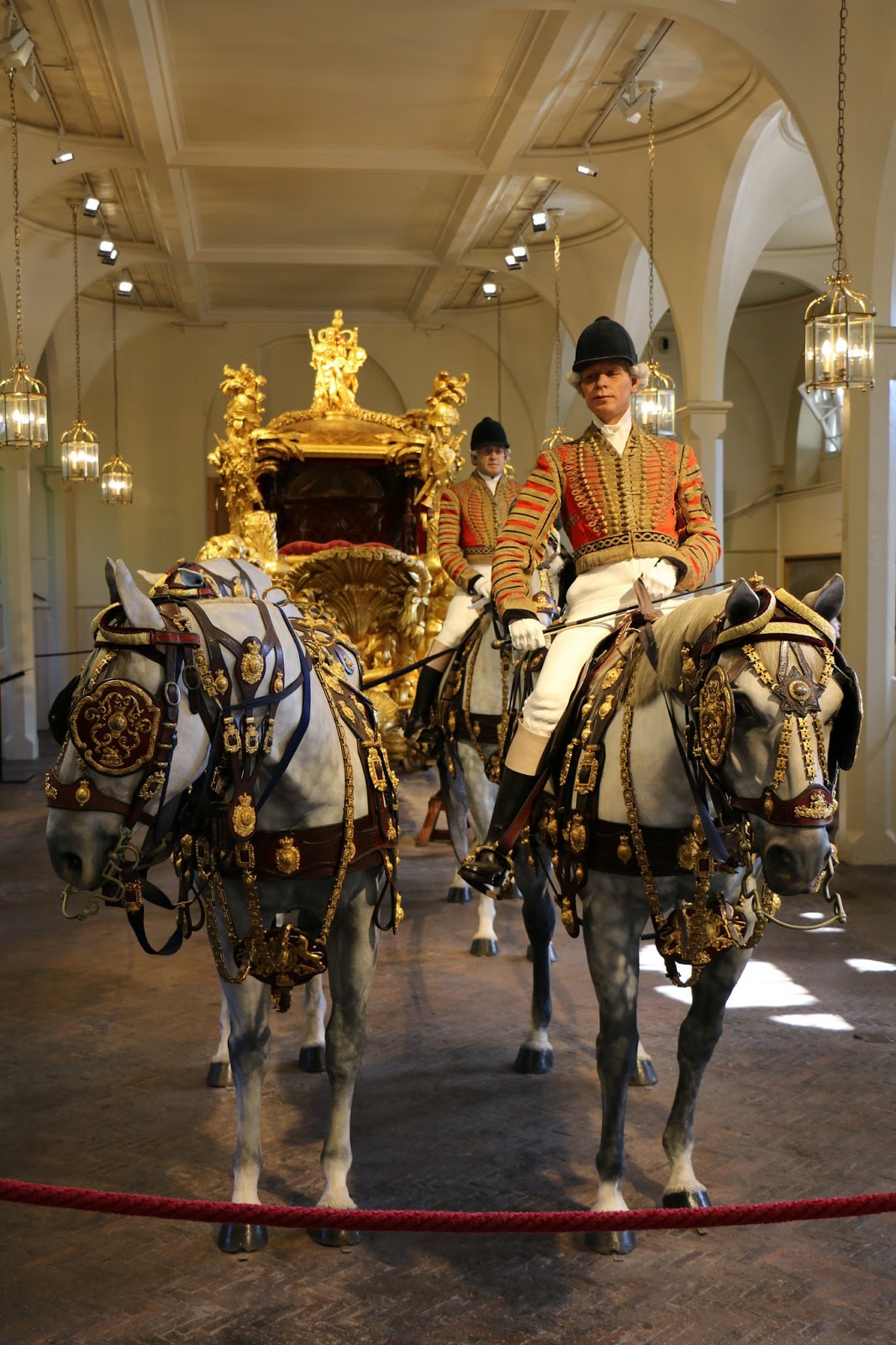
Gold State Coach at the Royal Mews, Buckingham Palace
The Gold State Coach is, without doubt, the most magnificent coach I have ever seen. What is more, it is Georgian. For me, this huge golden carriage is the highlight of any visit to the Royal Mews at Buckingham Palace, London.

‘A beautiful object’

The Gold State Coach is on display in the former State Carriage House at the Royal Mews. It measures 7.3 metres long, 2.5 metres high and 3.9 metres wide, and is gilded all over.

Gold State Coach at the Royal Mews, Buckingham Palace
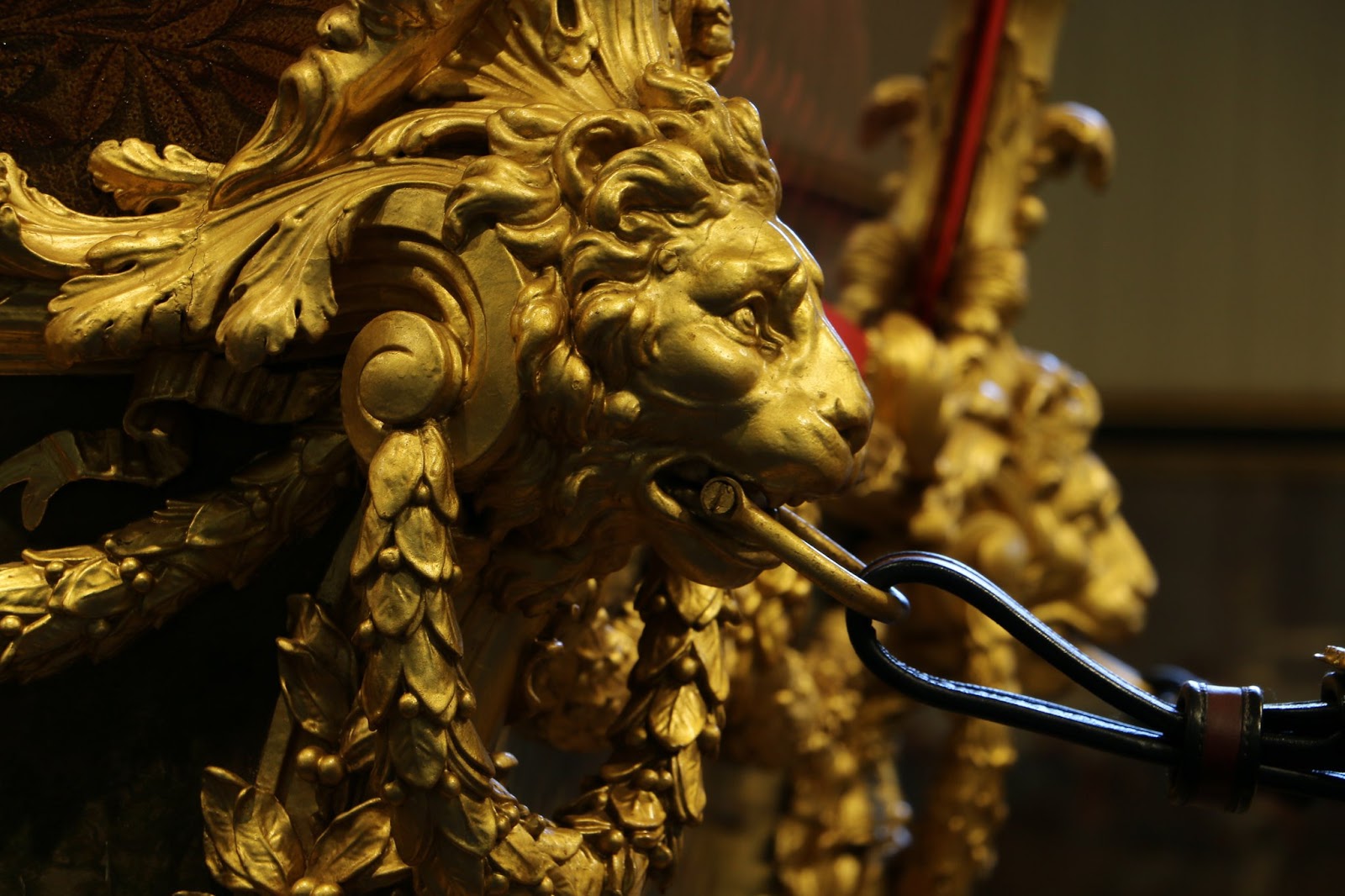
The coach is adorned with palm trees and lions’ heads, and devices representing the British victory in the Seven Years’ War against France.

Lion detail on Gold State Coach at the Royal Mews, Buckingham Palace
The exterior boasts exquisitely painted panels by the Florentine artist, Giovanni Battista Cipriani.

Panel detail on Gold State Coach at the Royal Mews, Buckingham Palace
On its roof, there are three cherubs representing the guardian spirits of England, Scotland and Ireland, supporting the Royal Crown, and holding the Sceptre, the Sword of State and the Ensign of the Knighthood in their hands.

herubs on the roof of the Gold State Coach at the Royal Mews, Buckingham Palace
Cherubs on the roof of the Gold State Coach
at the Royal Mews, Buckingham Palace
The body of the coach is supported by braces covered in Morocco leather decorated with gilded buckles held by Tritons.

Triton detail on Gold State Coach at the Royal Mews, Buckingham Palace
Horace Walpole wrote to his friend Horace Mann:
There is come forth a new state coach, which has cost 8,000l. It is a beautiful object, though crowded with improprieties. Its support are Tritons, not very well adapted to land-carriage; and formed of palm-trees, which are as little aquatic as Tritons are terrestrial. The crowd to see it on the opening of the Parliament was greater than at the coronation, and much more mischief done.1
Gold State Coach at the Royal Mews, Buckingham Palace
An unusual piece of extravagance

George III commissioned the Gold State Coach in 1760 and it was designed by the architect Sir William Chambers. As Walpole wrote in his letter, the coach cost nearly £8,000 to build. Based on the Retail Price Index, £8,000 would equate to well over £1,000,000 in today’s money. If we consider relative incomes, the equivalent cost would be as much as £14,000,000 or more.2 This seems uncharacteristically extravagant of George III.

Given the cost of building the Gold State Coach, it is perhaps surprising to discover that it was made not for George IV – renowned for his profligacy and love of pomp and ceremony – but for his much more frugal father.

The Gold State Coach’s first outing

The coach was completed in time for the State Opening of Parliament on 25 November 1762. Its first journey was deemed a success, despite the fact that one of the door handles broke and a pane of glass cracked.

Driving the coach

Gold State Coach at the Royal Mews, Buckingham Palace
The Gold State Coach is usually displayed with four replica horses, with a postilion riding one horse in each pair. However, the coach actually requires eight horses to pull it as it weighs around four tonnes. The horses wear a special harness made of red Morocco leather, known as No. 1 State Harness which is reserved especially for this coach.

Originally, the coach was pulled by eight Cream Hanoverian stallions, with six of the horses being driven by a coachman from the box and the leading pair being driven by a postilion riding one of them. From 1918 to 1925, black horses were used, but since George VI’s coronation in 1937, the coach has been drawn by Windsor Greys.

The hammer cloth and box were removed by Edward VII to promote greater visibility and the coach is now pulled by eight postilion-driven horses.

Because of its weight, the coach can only travel at a walking pace and is no good at all on hills. It also takes a very long time to stop. A brakeman walks immediately behind the coach, ready to operate the brake handle when required. The brake needs to be applied approximately 27 metres before the desired stopping point.

Unfortunately, the magnificence of its exterior is not matched with the comfort of the ride. The body of the coach is supported by leather braces and not only rocks backwards and forwards, but sways from side to side as well.

Gold State Coach at the Royal Mews, Buckingham Palace
Gold State Coach
at the Royal Mews, Buckingham Palace
Coronations and jubilees

The Gold State Coach has been used at every coronation since that of George IV in 1821. The frieze around the walls of the former State Carriage Room where the coach is on display was painted by Richard Barrett Davis (1782-1854) and depicts the coronation procession of William IV in 1831.

The coach is still used today, but only for special occasions. This is just as well as a large section of the wall on one side of the carriage room has to be removed in order to get the enormous coach out.

The Queen used the Gold State Coach for her coronation on 2 June 1953. It was last used on 4 June 2002 as part of the Queen’s Golden Jubilee celebrations.

Gold State Coach at the Royal Mews, Buckingham Palace
Last visited 1 August 2017 for Bloggers' breakfast event.

Headshot of Rachel Knowles author with sea in background(2021)
Rachel Knowles writes clean/Christian historical romance set in the time of Jane Austen. She has been sharing her research on this blog since 2011. Rachel lives in the beautiful Georgian seaside town of Weymouth, Dorset, on the south coast of England, with her husband, Andrew.

Find out more about Rachel's books and sign up for her newsletter here.

If you have enjoyed this blog and want to encourage me and help me to keep making my research freely available, please buy me a virtual cup of coffee by clicking the button below.

 
Notes
(1) In a letter dated 30 November 1762, from Walpole, Horace, Letters of Horace Walpole to Sir Horace Mann volume 1 p126 (1833).
(2) Relative values calculated using the Measuring Worth website (see link below).

Sources used include:
Vickers, Hugo, The Royal Mews at Buckingham Palace (Royal Collection Enterprises Ltd, 2011)
Walpole, Horace, Letters of Horace Walpole to Sir Horace Mann volume 1 (1833).
Measuring worth website

All photographs © Regencyhistory.net

Thursday, 31 August 2017

The Royal Mews at Buckingham Palace

Sign outside Royal Mews at Buckingham Palace, London

What is the Royal Mews?

The Royal Mews is a department of the Queen’s household and is responsible for all travel by road undertaken by the Queen and her family. It houses the Queen’s carriages and carriage horses as well as a fleet of cars.

Diamond Jubilee State Coach at Royal Mews, Buckingham Palace
Diamond Jubilee State Coach at Royal Mews, Buckingham Palace (2017)
The history of the Royal Mews

The King’s Mews goes back to the 14th century when Richard II was on the throne, and was originally at Charing Cross, where the National Gallery is now. It was the place where the king kept his falcons and the name mews comes from the falcons mewing, that is, moulting. Henry VIII rebuilt the mews as stables in 1534 but kept the name ‘mews’ and it has been associated with horses ever since.

The quadrangle of the Royal Mews, Buckingham Palace
The quadrangle of the Royal Mews, Buckingham Palace (2017)
The Royal Mews at Buckingham Palace

In 1761, George III bought Buckingham House for his wife, Queen Charlotte. He commissioned the building of the Riding School, which is the oldest part of the Mews. It was designed by the architect Sir William Chambers and built in 1765-6.

After George IV succeeded to the throne in 1820, he decided to rebuild Buckingham House and make it his royal palace. The Royal Mews was built in 1822-5 and was designed by the architect of Buckingham Palace, John Nash. Unfortunately, the foundations were faulty, there was a drainage problem, and the original building work was shoddy so that it was constantly under repair. 

Nash built the Doric-style arch topped with a clock tower leading into the quadrangle of the Mews, but the pediment carving portraying the tale of Hercules catching Thracian horses was added later, in 1859.

The Master of the Horse

Traditionally, the Royal Mews was under the control of the Master of the Horse – a very senior position in the royal household. The Master of the Horse is no longer a hands-on role, and the Royal Mews is now run by the Crown Equerry.

What can you see today?

The Riding School

The Riding School at the Royal Mews, Buckingham Palace
The Riding School at the Royal Mews, Buckingham Palace (2017)
 Semi-state Landau

Semi-state Landau at the Royal Mews, Buckingham Palace
Semi-state Landau at the Royal Mews, Buckingham Palace (2017)
Scottish State Coach

Built in 1830 for the Duke of Cambridge, it was used by his family before being sold to the 9th Earl of Albermarle. The earl converted it into a semi-state landau before giving it to Queen Mary in 1920.

Scottish State Coach at the Royal Mews, Buckingham Palace
Scottish State Coach at the Royal Mews, Buckingham Palace (2017)
Queen Alexandra’s Coach

Used to take the crown to the Houses of Parliament for the state opening of parliament.

Queen Alexandra's Coach at the Royal Mews, Buckingham Palace
Queen Alexandra's Coach at the Royal Mews, Buckingham Palace (2017)
Irish State Coach

Originally built in Dublin in 1803-4, the Irish State Coach was bought by Queen Victoria after seeing it at an exhibition in 1852.

Irish State Coach at the Royal Mews, Buckingham Palace
Irish State Coach at the Royal Mews, Buckingham Palace (2017)
Australian State Coach

A gift to the Queen from the people of Australia, this coach is normally on display in the Royal Mews, but is currently part of the 2017 exhibition at Buckingham Palace, Royal Gifts, until 1 October.

Australian State Coach on display at Buckingham Palace in 2015
Glass Coach

Used by many royal brides to travel to their weddings including Lady Diana Spencer in 1981.

Glass Coach at the Royal Mews, Buckingham Palace
Glass Coach at the Royal Mews, Buckingham Palace (2017)
Glass Coach at the Royal Mews, Buckingham Palace
Glass Coach at the Royal Mews, Buckingham Palace (2017)
Diamond Jubilee State Coach

This coach is a travelling time capsule. It is full of historical artefacts including a hollow crown on its roof made from wood from HMS Victory and a digital copy of the Domesday book.

Diamond Jubilee State Coach at Royal Mews, Buckingham Palace
Diamond Jubilee State Coach at Royal Mews, Buckingham Palace (2017)
 The Gold State Coach

The Gold State Coach is on display in the former State Carriage House. It was commissioned by George III, and was first used by the king to travel to the House of Lords to open parliament on 25 November 1762. Despite appearances, the coach is not made of gold, but is gilded all over, with external panels painted by Giovanni Battista Cipriani.

The coach has been used for every coronation since that of George IV in 1821. There is a frieze around the walls showing William IV’s coronation procession in 1831, painted by Richard Barrett Davis (1782-1854).

Gold State Coach at the Royal Mews, Buckingham Palace
Gold State Coach at the Royal Mews, Buckingham Palace (2017)
Royal car

Royal car at the Royal Mews, Buckingham Palace
Royal car at the Royal Mews, Buckingham Palace (2017)
The State Stables

The State Stables have a replica landau that visitors may sit in to get an idea of the suspension (or lack of it) in a royal carriage. There are also opportunities here to dress up as a footman and learn how to harness a horse. 

The State Stables at Royal Mews, Buckingham Palace
The State Stables at Royal Mews, Buckingham Palace (2017)
Rachel in the replica landau in the State Stables, Royal Mews, Buckingham Palace
Rachel in the replica landau
in the State Stables,
Royal Mews, Buckingham Palace (2017)
The working stables

The stables house the Queen’s carriage horses including the Queen’s famous Windsor Greys and Cleveland Bays.

The stables at the Royal Mews, Buckingham Palace
The stables at the Royal Mews, Buckingham Palace (2017)
The harness room at the Royal Mews, Buckingham Palace
The harness room at the Royal Mews, Buckingham Palace (2017)

Headshot of Rachel Knowles author with sea in background(2021)
Rachel Knowles writes clean/Christian Regency era romance and historical non-fiction. She has been sharing her research on this blog since 2011. Rachel lives in the beautiful Georgian seaside town of Weymouth, Dorset, on the south coast of England, with her husband, Andrew.

Find out more about Rachel's books and sign up for her newsletter here.

If you have enjoyed this blog and want to encourage me and help me to keep making my research freely available, please buy me a virtual cup of coffee by clicking the button below.


Last visited for bloggers' breakfast on 1 August 2017
All photographs © Regencyhistory.net