Search this blog

Showing posts with label industrial revolution. Show all posts

Friday, 26 February 2016

The original steamy Georgian romance

Steam engines in the Science Museum, London (2016)
The first commercial steam engine was developed in 1712, just a couple of years before the Georgian era began. In the century that followed, many Georgians fell in love with steam power because of the benefits it brought to them, to their businesses and to the wider economy. While steam power doesn’t feature in many Georgian and Regency romances, both contemporary and written at the time, it was working noisily in the background to power the industrial revolution.

A brief history of the steam engine

The term ‘steam engine’ probably brings to mind the image of a majestic locomotive, of the sort now relegated to heritage railways, museums and the occasional movie appearance.

Back in 1712, when ironmonger and Baptist preacher Thomas Newcomen (1664-1729) created the first commercially viable steam engine, its function was to pump water out of coal and tin mines. Newcomen adapted the experimental work of others to create and patent a machine that proved popular with mine owners.

Newcomen probably referred to his machine as a ‘fire engine’. The name of the business through which he and others built the engines was called ‘Proprietors of the invention of raising water by fire’. The term ‘atmospheric engine’ is also used to describe Newcomen’s invention.

A working replica of Newcomen's steam engine at the Black Country Living Museum, Dudley (2014)
A working replica of Newcomen's steam engine
at the Black Country Living Museum, Dudley (2014)
James Watt pushes steam power forward

Other engineers refined Newcomen’s designs, particularly John Smeaton (1724-1792). However, being relatively low powered, it proved unsuitable for being used to power anything other than pumps. As a result, its use was limited to the mining industry.

The next major development came with Scottish instrument maker James Watt (1736-1819) who became fascinated by the potential of steam power.

James Watt from the European  Magazine and London Review (1820)
James Watt from the European 
Magazine and London Review (1820)
In 1763 he was asked to restore to operation a model of Newcomen’s engine that belonged to the University of Glasgow. In doing so, he realised that the design was grossly inefficient. By 1765 he had designed a much more efficient engine but it took another ten years for him to find ironworkers with the skills needed to build it.

In 1775 Watt began working with Matthew Boulton (1728-1809), manufacturer and owner of the Soho Works where Watt was finally able to build his steam engine. This led to the formation of Boulton and Watt, the business that built the steam engines which powered much of the industrial revolution. The firm employed another Georgian inventor, William Murdoch (1754-1839), who is credited with the invention of gas lighting in the early 1790s.

Bell-crank engine by Bolton and Watt c1810 in the Science Museum, London (2016)
Bell-crank engine by Bolton and Watt c1810
in the Science Museum, London (2016)
The significance of Watt’s work is described in this Memoir:
The original inventor of the steam-engine undoubtedly laid the foundation for all the wonderful effects that are now produced by that mighty machine; but while it was merely employed for the drawing of water from mines, it was of but little importance, compared to what it is at the present day: and that change, from a small degree of importance, to that of the very first-rate degree, was exclusively almost the work of Mr Watt.1
Golden statue of Boulton, Watt and Murdoch, Birmingham (2013)
Statue of Boulton, Watt and Murdoch,
Birmingham (2013)
The trials and tribulations of high pressure steam 

While Newcomen and then Watt were busy with static steam engines, others dreamt of harnessing this new power for transport. Richard Trevithick (1771-1833) built and demonstrated a steam road vehicle in 1801 at Camborne in Cornwall.

In doing so, Trevithick overcame the huge challenge of making an engine small enough to fit on a vehicle, and that meant working with a potentially dangerous high pressure steam engine.

Richard Trevithick from Life of  Richard Trevithick by Francis Trevithick (1872)
Richard Trevithick from Life of 
Richard Trevithick by Francis Trevithick (1872)
The Watt engine operated at low pressure. Boulton and Watt opposed the use of high pressure because of the risk of explosion. Their concern seemed justified when, in 1803, four men died when one of Trevithick’s high pressure static engines exploded at Greenwich.

Trevithick responded by introducing safety valves. That same year his London Steam Carriage made a journey between Holborn and Paddington. In 1808, Trevithick exhibited a new locomotive called Catch-Me-Who-Can on a circular track in London. Anyone could ride on the train for a mere shilling, but the track broke after a couple of months and the enterprise was abandoned.

Trevithick's London railway and Catch-Me-Who-Can locomotive of 1808 from Life of Richard Trevithick by Francis Trevithick (1872)
Trevithick's London railway and Catch-Me-Who-Can locomotive
of 1808 from Life of Richard Trevithick by Francis Trevithick (1872)
While he proved the concept of using high-pressure steam to drive vehicles, none of Trevithick’s innovations went beyond its test run.

Stream engines take to the rails

The first commercially viable steam locomotive ran at Middleton Colliery, near Leeds, in 1812. It was designed and built by Matthew Murray (1765-1826) who adapted a Trevithick model with so much success, that he built three more. They were in service for around twenty years, although during that time, two blew up, killing their drivers.

In the early 1800s, forward-thinking mine owners could see, as their predecessors had done a century earlier, that introducing steam powered machines could save them money. In the early 1700s the machines had just powered pumps; now they could replace horses and men as transport.

George Stephenson (1781-1848) worked in collieries, looking after steam engines. In 1814, inspired by Murray’s locomotive, he began designing his own and may have built up to 16 to work at Killington Colliery. In 1820 he was hired to build the first railway to operate without animal power, at Hetton Colliery.

The world’s first passenger railway, the Stockton and Darlington Railway, was initiated by Act of Parliament in 1821 and Stephenson built the first locomotive to run on it, named Locomotion.

As the Georgian era due to close, steam power was set to revolutionise the world by driving ever increasing numbers of trains, ships and industrial machines. The last notable landmark before the Victorian age was the Rainhill Trials of 1829, where the locomotive for the new Liverpool and Manchester Railway was chosen.

Stephenson entered with an engine designed largely by his son, Robert (1803-1859). His locomotive, Rocket, won the day and secured its place in railway history.

Stephenson's Rocket, Science Museum, London (2016)
Places where you can find examples of Georgian steam engine history

Black Country Living Museum: In the 1980s the museum built a working replica of a Newcomen steam engine. While it’s not a Georgian survivor, it operates on certain days and gives a feel of how it was to be near an early steam engine.

Crofton Pumping Station: A unique example of a Boulton and Watt engine still used for its original purpose, pumping water on the Kennet and Avon canal. Installed in 1812, it’s long been replaced by modern pumps, but it’s still used a few times a year.

Dartmouth Circus, Birmingham: An 1817 Boulton and Watt blowing engine has been installed on a traffic roundabout.

Dartmouth Museum: Home to a 1725 Newcomen engine.


Darlington Railway Museum: The first steam engine to pull a passenger car on the Stockport and Darlington Railway, Locomotion No.1, is displayed here.


Elsecar Heritage Centre: Here you can see the only Newcomen engine still in its original location. Built in 1795, it’s recently been restored to working order.

Henry Ford Museum: A Newcomen engine from 1750-60 is on display.

Hunterian Museum, Glasgow: The model Newcomen engine worked on by James Watt is in the museum collection.

Kinneil House, Scotland: Here James Watt worked on the model Newcomen engine and developed his ideas for a new design. The remains of his cottage can still be viewed.


Locomotion, Shildon: Part of the National Railway Museum, the Shildon site is home to Sans Pereil, one of the engines that lost to Rocket at the 1829 Rainhill Trails.

Powerhouse Museum, Sydney: This claims to have the earliest surviving rotative steam engine in the world, a Boulton and Watt from 1785, originally used at Whitbread’s Brewery in London.


Science Museum, London: Unsurprisingly, this is now the home of several landmark inventions including Stephenson’s Rocket, an example of Trevithick’s high-pressure engine from 1806 and several Boulton and Watt engines including Old Bess, an early beam engine built in 1777.

Thinktank, Birmingham: The Smethwick Engine is the oldest working example of a Boulton and Watt machine, dating from 1779.

Headshot of Rachel Knowles author with sea in background(2021)
Rachel Knowles writes faith-based Regency romance and historical non-fiction. She has been sharing her research on this blog since 2011. Rachel lives in the beautiful Georgian seaside town of Weymouth, Dorset, on the south coast of England, with her husband, Andrew, who wrote this blog.

Find out more about Rachel's books and sign up for her newsletter here.

If you have enjoyed this blog and want to encourage me and help me to keep making my research freely available, please buy me a virtual cup of coffee by clicking the button below.

 
Notes
(1) From Memoir of the late James Watt, Esq, FRS, in Philosophical Magazine Series 1, LXXII (1819)

Sources used include:
Cookson, Gillian, Murray, Matthew (1765-1826), Oxford Dictionary of National Biography (Oxford University Press, 2004; accessed 25 Feb 2016)
Kirby, MW, Stephenson, George (1781-1848), Oxford Dictionary of National Biography (Oxford University Press, 2004; online edn Jan 2008, accessed 6 Oct 2012)
Kirby, MW, Stephenson, Robert (1803-1859), Oxford Dictionary of National Biography (Oxford University Press, 2004; online edn Jan 2008, accessed 25 Feb 2016)
Payton, Philip, Trevithick, Richard (1771-1833), Oxford Dictionary of National Biography (Oxford University Press, 2004; online edn Oct 2007, accessed 25 Feb 2016)
Tann, Jennifer, Watt, James (1736-1819), Oxford Dictionary of National Biography (Oxford University Press, 2004; online edn May 2007, accessed 6 Oct 2012)
Tilloch, Alexander and Taylor, Richard, Memoir of the late James Watt, Esq, FRS, in Philosophical Magazine Series 1, LXXII (1819)
Trevithick, Francis, Life of Richard Trevithick (1872) 

Photos © Andrew Knowles RegencyHistory.net

Thursday, 6 November 2014

Princess Charlotte, Percy Shelley and High Treason in Derbyshire

Road sign on entering Pentrich, Derbyshire

A post by my husband Andrew Knowles inspired by a holiday in Derbyshire in October 2014.

Sometimes Regency history takes us by surprise. Only this week, I learned about a significant historical event that occurred during the Regency and my introduction was via a very modern road sign.

Driving through the small village of Pentrich, Derbyshire, I noticed that the village sign was topped with the phrase: "Revolution 1817." Perhaps you already know about the Pentrich Revolution. I didn't, and here is what I have since discovered.

"The mischiefs flowing from oppression"

Discontent was rife in England during the early nineteenth century. The Industrial Revolution brought unsettling change, the Corn Laws pushed up food prices, and what many considered to be unfair taxes put a huge burden on the working population. Many ordinary people, particularly in the Midlands, considered themselves to be oppressed. 

Political agitation for change took various forms. The Luddite movement attacked industrial machines between 1811 and 1813. Debating groups, known as Hampden clubs, sprang up across the country. There was a growing appetite for reform, particularly of the way the nation was governed.

Many wanted to bring about change without violence, but the government was fearful of the large crowds the agitators could muster. The Seditious Meetings Act of March 1817 banned assemblies of more than 50 people.

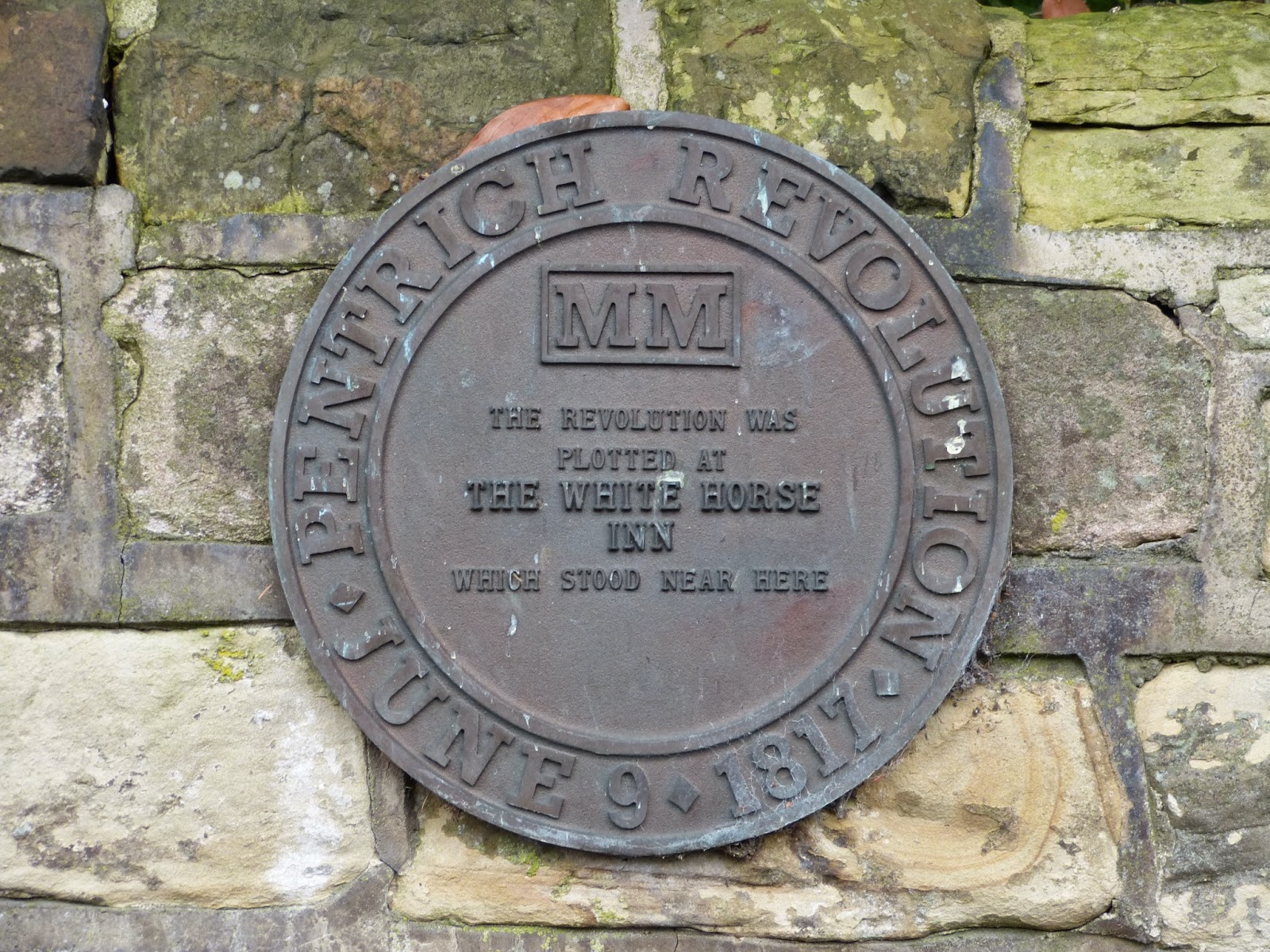
On a wall opposite the church in Pentrich
The plaque reads: "The revolution was plotted at
the White Horse Inn which stood near here."
"Their infernal agents"

In their enthusiasm to detect trouble, the government dispatched several spies. One of these, William Oliver, became involved with political meetings taking place at Pentrich (then often spelled Pentridge). It seems likely that Oliver went beyond his role as observer and actively encouraged the frustrated group to take direct action.

St Matthew's Church, Pentrich
The plaque reads: "The curate hid rebels here
from the government troops."
On the evening of 9 June 1817, a group of several hundred men from around Pentrich gathered in a barn in nearby South Wingfield. Under the leadership of Jeremiah Brandreth, a 27 year old stockinger, they began marching towards Nottingham. It seems they believed a larger uprising would happen across the country, leading to political change.

As they marched, they sought to recruit others and in one encounter, Brandreth killed someone. But as the night wore on and rain soaked his band, their numbers decreased until by dawn, only a small group crossed into Nottinghamshire to face a detachment of the King's Hussars. Some were arrested, while others fled.

Pentrich plaque
The plaque states: "Near here was Widow Hepworth's
Farm where a servant was shot dead."
"That dreadful penalty"

Brandreth, along with Isaac Ludlam and William Turner, was found guilty of High Treason and were sentenced to be hung, drawn and quartered. This is apparently the last time this sentence was given but the Prince Regent showed 'clemency' by reducing the punishment to hanging followed by beheading.

Another 14 men were sentenced to transportation, from which none ever returned. A further six were imprisoned for up to two years.

"We pity the plumage, but forget the dying bird"

But what about Princess Charlotte and Percy Shelley, as referred to in the title of this post? How are they mixed up in the Pentrich Revolution of 1817?

Princess Charlotte, the only legitimate child of the Prince Regent (later George IV), died on 6 November 1817. Adored by the public, her death in childbirth provoked a huge outpouring of grief across the country.

Princess Charlotte by William Dawe (c1817)  at the National Portrait Gallery, London
Princess Charlotte by George Dawe (1817)
at the National Portrait Gallery, London
Brandreth, Ludlam and Turner were executed outside Derby Gaol on 7 November 1817, the day after Charlotte died. Their trial and execution for High Treason also attracted national attention.

The poet Percy Shelley made an emphatic connection between these two major events, articulated in his pamphlet "We pity the plumage, but forget the dying bird - an address to the people on the death of Princess Charlotte".1

"LIBERTY is dead"

"Mourn then People of England. Clothe yourselves in solemn black. Let the bells be tolled." A beautiful princess is dead, wrote Shelley, referring at once to both Princess Charlotte and to the notion of liberty.

Charlotte was "young, innocent and beautiful", and "the last and best of her race". Yet, said Shelley, "the accident of her birth neither made her life more virtuous nor her death more worthy of grief". He had no criticism to make of her, but sought to remind people that the deaths of Brandreth, Ludlam and Turner also provoked grief in those that knew them.

The funeral procession of Princess Charlotte at Windsor  from Memoirs of Her Late Royal Highness   Charlotte Augusta by Robert Huish (1818)
The funeral procession of Princess Charlotte at Windsor
from Memoirs of Her Late Royal Highness
 Charlotte Augusta by Robert Huish (1818)
"They had sons, and brothers, and sisters, and fathers, who loved them." Shelley was clearly upset by their execution: "Nothing is more horrible than that man should for any cause shed the life of man."

He goes on to explain how the government created an oppressive system, with the effect that "the day labourer gains no more now by working sixteen hours a day than he gained before by working eight." It is no surprise to Shelley that people want parliamentary reform and he attacks both the spies who provoked 'rebellion' and the government that dispatched them.

Percy Bysshe Shelley  by Amelia Curran (1819)  at the National Portrait Gallery, London
Percy Bysshe Shelley
by Amelia Curran (1819)
at the National Portrait Gallery, London
"It is a national calamity, that we endure men to rule over us, who sanction for whatever ends a conspiracy which is to arrive at its purpose through such a frightful pouring forth of human blood and agony."

"Our alternatives," he wrote, "are a despotism, a revolution, or reform." In that one sentence Shelley sums up the fears or hopes of so many ordinary people in 1817. It was these hopes that drove the men of Pentrich to commit what would become, in the eyes of the law, High Treason.

All this I have discovered, just because I spotted a word and a date on a road sign.

Notes
(1) The pamphlet is popularly referred to by this title, but the phrase "We pity the plumage, but forget the dying bird" was a motto and was probably never intended to be a part of the title of this pamphlet.
(2) All quotes are from "An Address to the People on The Death of the Princess Charlotte" by Percy Bysshe Shelley (1817).

Sources:
Huish, Robert, Memoirs of her late royal highness Charlotte Augusta (1818)
Shelley, Percy Bysshe, The Works of Percy Bysshe Shelley in Verse and Prose, edited by H. Buxton Forman (1880).
The Pentrich Revolution Trail
The Pentrich Rebellion website
The Percy Bysshe Shelley Resource Page

All photographs © Andrew Knowles - www.flickr.com/photos/dragontomato

Wednesday, 24 September 2014

The Industrial Revolution - a Regency History guide

In 1712, two years before a portly German prince arrived from Hanover to become George I, Thomas Newcomen (1664-1729) installed an innovative water pump at a mine in Staffordshire. Newcomen’s device, the first commercially successful steam engine, solved a practical problem of extracting floodwater from mines. It also began the era of technological development we refer to as the Industrial Revolution.


A working replica of Newcomen's steam engine  at the Black Country Living Museum, Dudley
A working replica of Newcomen's steam engine
at the Black Country Living Museum, Dudley (2014)
Harnessing the new source of power

Such was the success of Newcomen’s steam engine that hundreds were built over the next hundred years and it would be half a century before the design was significantly improved on. In the 1770s, Scottish engineer James Watt (1736-1819) dramatically improved the engine’s efficiency. He went into partnership with Matthew Boulton (1728-1809) to manufacture the machines, making him immensely wealthy.

'Old Bess' engine by Boulton and Watt  built in 1777 - in the   Science Museum, London
'Old Bess' engine
by Boulton and Watt (1777)
 in the Science Museum, London (2014)
By 1800 steam engines powered a host of industries including mining and manufacturing.
The next major innovation was using steam to power a vehicle. Early models were developed in the 1780s and 90s but the first full-size engine was constructed by Richard Trevithick (1771-1833).

The coming of the railways

On 21 February 1804, Trevithick's engine made the world’s first steam-driven railway journey, pulling a train in South Wales.

The first railway opened to the public was the Liverpool and Manchester Railway, opened in 1830. The previous year they organised the Rainhill Trials, won by Robert Stephenson’s Rocket, securing him the contract to build engines for the new railway.

By 1837, when Queen Victoria came to the throne, steam railways were being built across the world, and steam engines were being put to many different uses.

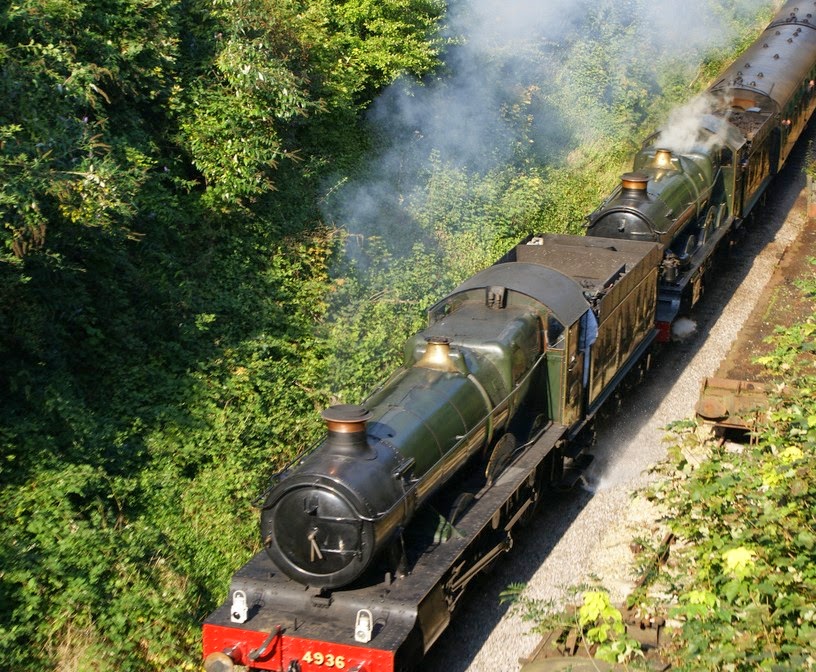
Steam train on Watercress Line in Alton, Hampshire
Steam train on Watercress Line in Alton, Hampshire (2014)
Iron smelting and Ironbridge

Ironbridge Gorge, Shropshire, has been awarded World Heritage Site status because of its key role in the Industrial Revolution.

Here, in 1709, Abraham Darby (1678-1717) was the first person to smelt iron in a furnace powered by coke, rather than charcoal. Using coke, made from coal which was locally abundant, removed the reliance on wood, an increasingly scarce resource. It also meant much more iron could be produced. Coalbrookedale, where Darby was working, became a centre of innovation and industry for decades.

In 1779, the world’s first iron bridge was completed, crossing the gorge. The iron bridge is now a monument to the Industrial Revolution.

Mechanisation of the textile industry

During the seventeenth century, cotton fabric became increasingly popular. Lighter and easier to wash than wool, cotton garments were initially imported from India while domestic spinning and weaving industries developed slowly, the work carried out by hand, typically in homes.

James Hargreaves (1720-1778) and Richard Arkwright (1732-1792) both introduced mechanisation to the cotton industry in the 1760s. Hargreaves invented the Spinning Jenny while Arkwright created the Water Frame.

Arkwright built ‘manufactories’ to house his machines and employed hundreds of unskilled workers to operate them. He also took advantage of steam power, using a Watts engine to pump the water that drove his machines.

By the 1790s, Britain was producing over a million cotton garments a year. Reaction against increased mechanisation included the Luddite riots of 1811-1813, where many machines were destroyed by workers who felt threatened by new technology.

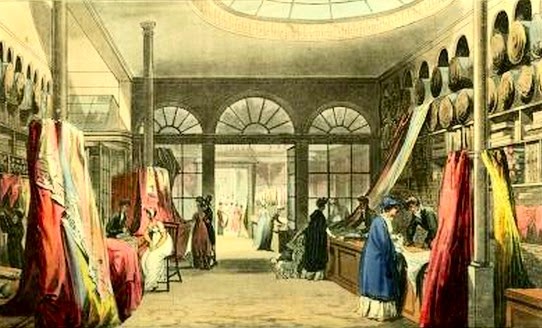
Harding, Howell and co. from Ackermann's Repository (1809)
Agricultural revolution in Britain

The population of Britain in 1750, at 5.7 million people, was probably not dissimilar to the number living here in Roman times. It was also the maximum number that could be fed by the land using contemporary agricultural methods.

By 1850 the population had more than doubled to 16.6 million. New ideas about farming, combined with new technologies, meant more food could be produced from the same area of land. During the same period large areas of land were made usable through drainage or deforestation.

Canals and roads

As the population grew, along with demand for new products, the nation’s transport infrastructure required improvement. The final quarter of the eighteenth century was the great age of canal building, starting with the Bridgewater Canal which opened in 1776. By 1810 Britain was criss-crossed by over four thousand miles of artificial waterways, traversed by thousands of barges carrying coal, clay and manufactured goods.

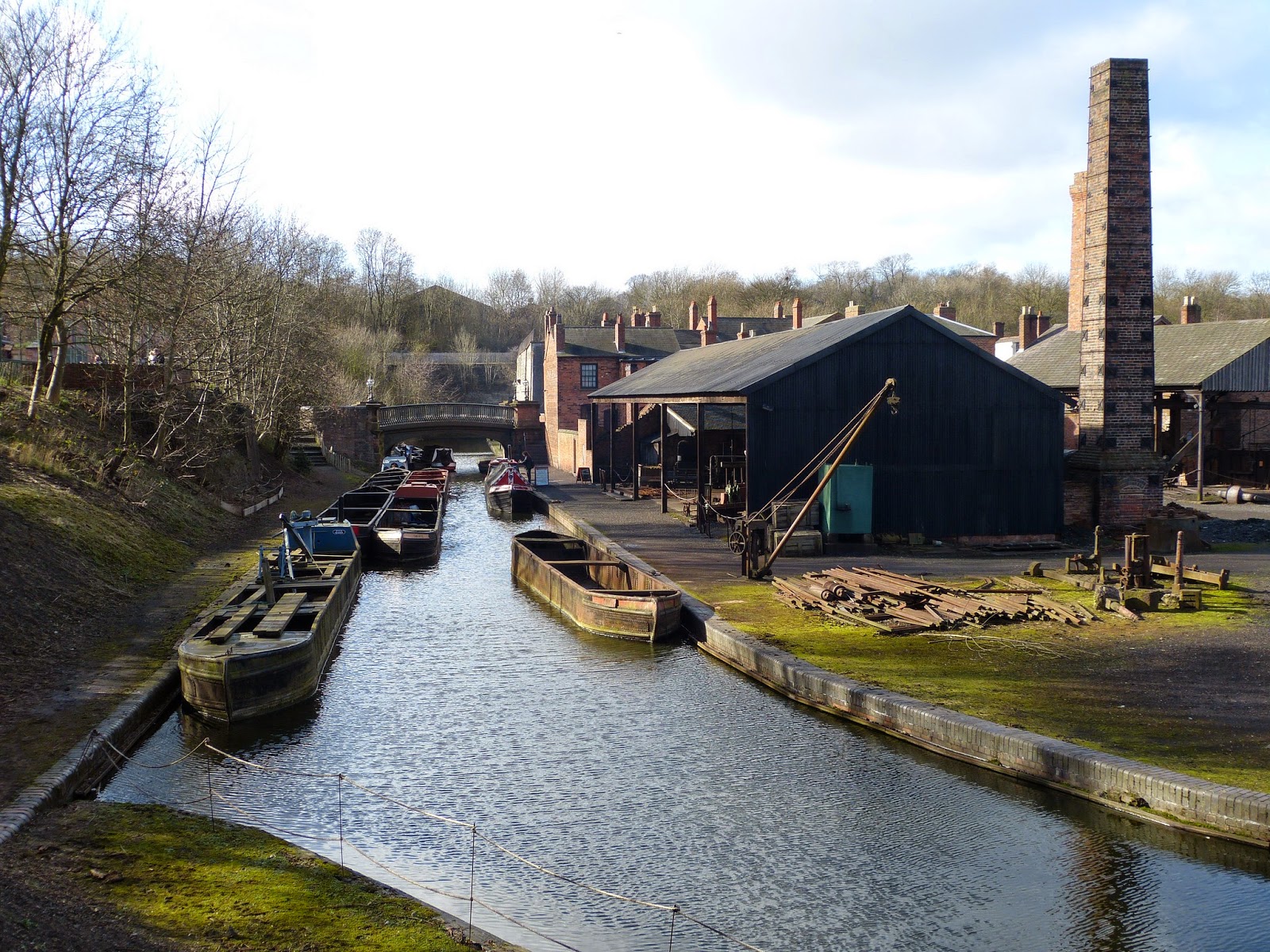
Canal at the Black Country Living Museum, Dudley
Canal at the Black Country Living Museum, Dudley (2014)
While canals provided transport for large quantities of heavy or bulky items, the majority of people who travelled any distance did so by road. Poor maintenance and increasing volumes of traffic damaged the surface of many roads, which were unpaved and could become almost impassable in bad weather.

The solution was the Turnpike system, which began in the late seventeenth century and lasted until the 1870s. Turnpikes were toll roads, managed by Turnpike Trusts, where money was invested in building a more solid surface, making it easier for horses and carriages to travel at a reasonable speed. In 1825 there were one thousand Turnpike Trusts controlling 18,000 miles of road.


Table of tolls at the  Weald and Downland Open Air Museum
Table of tolls at the
Weald and Downland Open Air Museum (2014)
In the early nineteenth century, the rate of building of new canals and Turnpike roads slowed dramatically, as railways became an increasingly popular alternative.

Peace allowed freedom of thought 

The Industrial Revolution was the result of many factors that combined during the eighteenth century. One of these was the relative peace enjoyed by the country, particularly later in the century, when many other European nations were being ravaged by war.

This relative peace, and along with it the reign of the Hanoverian kings, was secured in 1746 at the last pitched battle in Britain, at Culloden. The destruction and disruption which follows the movement of armies during wartime ceased.

At the same time, neither the monarchy nor the church sought to impose strict controls on society, allowing free thought and experimentation to flourish. Public lectures on science, or ‘natural philosophy’ as it was known at the time, became popular during the first half of the eighteenth century.

George III, who became king in 1760, was fascinated by science. He collected, or had made, numerous scientific instruments that were used to both entertain and instruct. His collection, which includes air pumps, globes of the known world and a model diving bell, is now on display in the Science Museum, London.

Air pump made for George III  by George Adams (1761)
Air pump made for George III
by George Adams (1761) (Photo 2014)

Headshot of Rachel Knowles author with sea in background(2021)
Rachel Knowles writes faith-based Regency romance and historical non-fiction. She has been sharing her research on this blog since 2011. Rachel lives in the beautiful Georgian seaside town of Weymouth, Dorset, on the south coast of England, with her husband, Andrew, who wrote this blog.

Find out more about Rachel's books and sign up for her newsletter here.

If you have enjoyed this blog and want to encourage us and help us to keep making our research freely available, please buy us a virtual cup of coffee by clicking the button below.


Sources used include:
BBC history website: Agricultural revolution, James Watt, Sir Richard Arkwright, the inventors of the steam engine and why the industrial revolution happened in Britain
Canal museum
English Heritage website: Ironbridge
Ironbridge website
Saburchill.com: History of the cotton industry
Science museum: King George III's collection and Rise of the factory system
Smithsoniam: What the Luddites really fought against
Turnpike roads in England
Wikipedia: Industrial Revolution, steam locomotive and timeline of steam power

Photographs © Andrew Knowles RegencyHistory.net