Search this blog

Showing posts with label Percy Shelley. Show all posts

Thursday, 6 November 2014

Princess Charlotte, Percy Shelley and High Treason in Derbyshire

Road sign on entering Pentrich, Derbyshire

A post by my husband Andrew Knowles inspired by a holiday in Derbyshire in October 2014.

Sometimes Regency history takes us by surprise. Only this week, I learned about a significant historical event that occurred during the Regency and my introduction was via a very modern road sign.

Driving through the small village of Pentrich, Derbyshire, I noticed that the village sign was topped with the phrase: "Revolution 1817." Perhaps you already know about the Pentrich Revolution. I didn't, and here is what I have since discovered.

"The mischiefs flowing from oppression"

Discontent was rife in England during the early nineteenth century. The Industrial Revolution brought unsettling change, the Corn Laws pushed up food prices, and what many considered to be unfair taxes put a huge burden on the working population. Many ordinary people, particularly in the Midlands, considered themselves to be oppressed. 

Political agitation for change took various forms. The Luddite movement attacked industrial machines between 1811 and 1813. Debating groups, known as Hampden clubs, sprang up across the country. There was a growing appetite for reform, particularly of the way the nation was governed.

Many wanted to bring about change without violence, but the government was fearful of the large crowds the agitators could muster. The Seditious Meetings Act of March 1817 banned assemblies of more than 50 people.
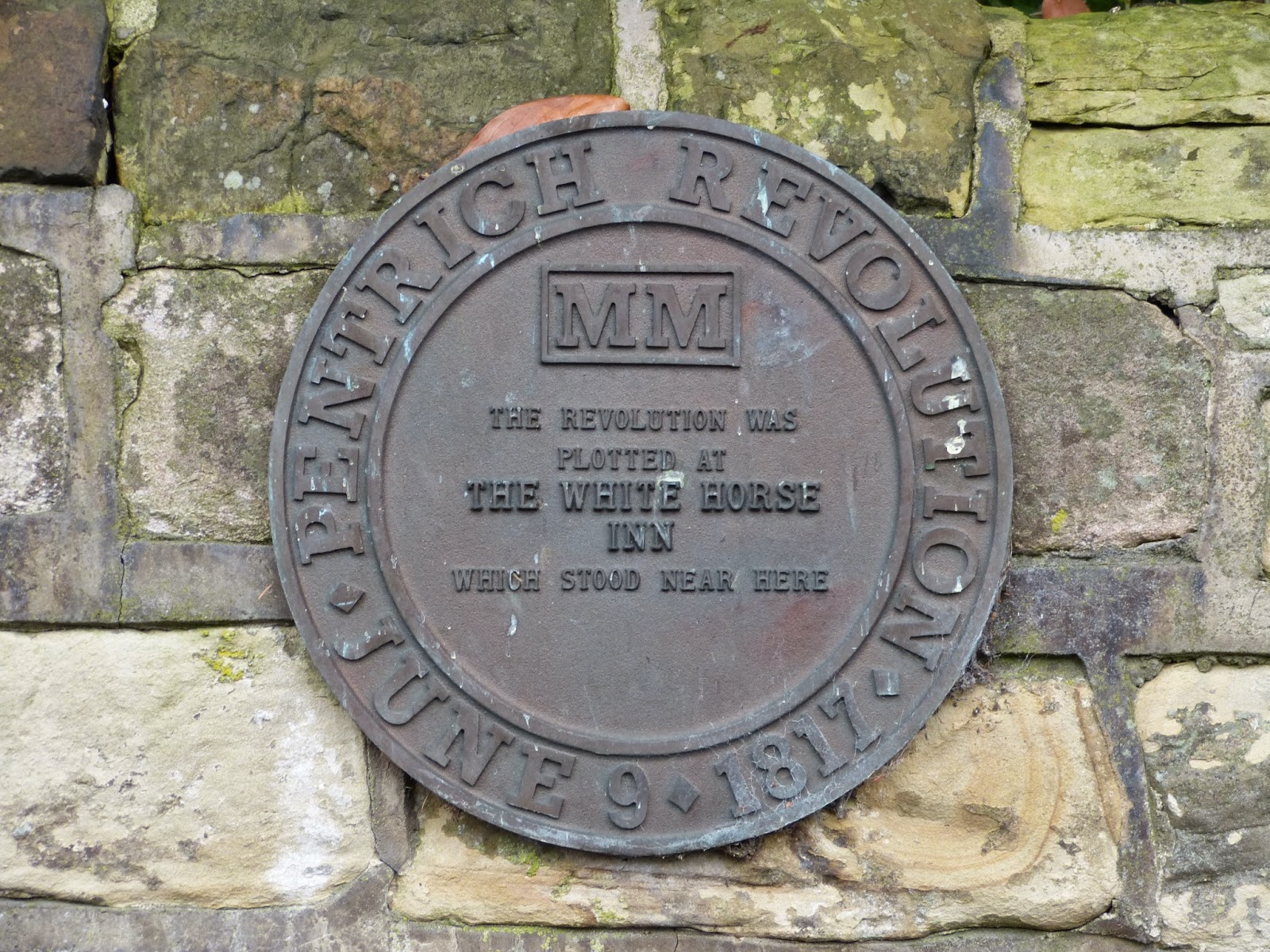
On a wall opposite the church in Pentrich
The plaque reads: "The revolution was plotted at
the White Horse Inn which stood near here."
"Their infernal agents"

In their enthusiasm to detect trouble, the government dispatched several spies. One of these, William Oliver, became involved with political meetings taking place at Pentrich (then often spelled Pentridge). It seems likely that Oliver went beyond his role as observer and actively encouraged the frustrated group to take direct action.

St Matthew's Church, Pentrich
The plaque reads: "The curate hid rebels here
from the government troops."
On the evening of 9 June 1817, a group of several hundred men from around Pentrich gathered in a barn in nearby South Wingfield. Under the leadership of Jeremiah Brandreth, a 27 year old stockinger, they began marching towards Nottingham. It seems they believed a larger uprising would happen across the country, leading to political change.

As they marched, they sought to recruit others and in one encounter, Brandreth killed someone. But as the night wore on and rain soaked his band, their numbers decreased until by dawn, only a small group crossed into Nottinghamshire to face a detachment of the King's Hussars. Some were arrested, while others fled.

Pentrich plaque
The plaque states: "Near here was Widow Hepworth's
Farm where a servant was shot dead."
"That dreadful penalty"

Brandreth, along with Isaac Ludlam and William Turner, was found guilty of High Treason and were sentenced to be hung, drawn and quartered. This is apparently the last time this sentence was given but the Prince Regent showed 'clemency' by reducing the punishment to hanging followed by beheading.

Another 14 men were sentenced to transportation, from which none ever returned. A further six were imprisoned for up to two years.

"We pity the plumage, but forget the dying bird"

But what about Princess Charlotte and Percy Shelley, as referred to in the title of this post? How are they mixed up in the Pentrich Revolution of 1817?

Princess Charlotte, the only legitimate child of the Prince Regent (later George IV), died on 6 November 1817. Adored by the public, her death in childbirth provoked a huge outpouring of grief across the country.

Princess Charlotte by William Dawe (c1817)  at the National Portrait Gallery, London
Princess Charlotte by George Dawe (1817)
at the National Portrait Gallery, London
Brandreth, Ludlam and Turner were executed outside Derby Gaol on 7 November 1817, the day after Charlotte died. Their trial and execution for High Treason also attracted national attention.

The poet Percy Shelley made an emphatic connection between these two major events, articulated in his pamphlet "We pity the plumage, but forget the dying bird - an address to the people on the death of Princess Charlotte".1

"LIBERTY is dead"

"Mourn then People of England. Clothe yourselves in solemn black. Let the bells be tolled." A beautiful princess is dead, wrote Shelley, referring at once to both Princess Charlotte and to the notion of liberty.

Charlotte was "young, innocent and beautiful", and "the last and best of her race". Yet, said Shelley, "the accident of her birth neither made her life more virtuous nor her death more worthy of grief". He had no criticism to make of her, but sought to remind people that the deaths of Brandreth, Ludlam and Turner also provoked grief in those that knew them.

The funeral procession of Princess Charlotte at Windsor  from Memoirs of Her Late Royal Highness   Charlotte Augusta by Robert Huish (1818)
The funeral procession of Princess Charlotte at Windsor
from Memoirs of Her Late Royal Highness
 Charlotte Augusta by Robert Huish (1818)
"They had sons, and brothers, and sisters, and fathers, who loved them." Shelley was clearly upset by their execution: "Nothing is more horrible than that man should for any cause shed the life of man."

He goes on to explain how the government created an oppressive system, with the effect that "the day labourer gains no more now by working sixteen hours a day than he gained before by working eight." It is no surprise to Shelley that people want parliamentary reform and he attacks both the spies who provoked 'rebellion' and the government that dispatched them.

Percy Bysshe Shelley  by Amelia Curran (1819)  at the National Portrait Gallery, London
Percy Bysshe Shelley
by Amelia Curran (1819)
at the National Portrait Gallery, London
"It is a national calamity, that we endure men to rule over us, who sanction for whatever ends a conspiracy which is to arrive at its purpose through such a frightful pouring forth of human blood and agony."

"Our alternatives," he wrote, "are a despotism, a revolution, or reform." In that one sentence Shelley sums up the fears or hopes of so many ordinary people in 1817. It was these hopes that drove the men of Pentrich to commit what would become, in the eyes of the law, High Treason.

All this I have discovered, just because I spotted a word and a date on a road sign.

Notes
(1) The pamphlet is popularly referred to by this title, but the phrase "We pity the plumage, but forget the dying bird" was a motto and was probably never intended to be a part of the title of this pamphlet.
(2) All quotes are from "An Address to the People on The Death of the Princess Charlotte" by Percy Bysshe Shelley (1817).

Sources:
Huish, Robert, Memoirs of her late royal highness Charlotte Augusta (1818)
Shelley, Percy Bysshe, The Works of Percy Bysshe Shelley in Verse and Prose, edited by H. Buxton Forman (1880).
The Pentrich Revolution Trail
The Pentrich Rebellion website
The Percy Bysshe Shelley Resource Page

All photographs © Andrew Knowles - www.flickr.com/photos/dragontomato

Wednesday, 11 September 2013

Lord Byron (1788-1824)

Lord Byron by Stanfield  from Life, Letters and Journals of Lord Byron (1839)
Lord Byron by Stanfield
from Life, Letters and Journals of Lord Byron (1839)
Profile

George Gordon Noel Byron, 6th Baron Byron (22 January 1788 - 19 April 1824), was a leading poet in the Romantic Movement. His most famous works include The Pilgrimage of Childe Harold and Don Juan.

Family life

George Gordon Byron was born in London on 22 January 1788, the son of Captain John Byron and his second wife, Catherine Gordon. There was one child from his father’s previous marriage, Augusta. Captain 'Mad Jack' Byron was a reckless man who had married Byron’s mother for her money. He soon left his family and died in 1791. Byron lived in Aberdeen with his highly volatile mother.

Education

Byron attended school in Aberdeen, Dulwich and Harrow before going up to Trinity College, Cambridge, in 1805. One of his more eccentric actions was to keep a tame bear in the tower above his rooms. Here he formed many lasting friendships, in particular, those with William John Bankes, John Cam Hobhouse and Scrope Berdmore Davies.

Lord Byron

In 1794, Byron unexpectedly became heir to his uncle on the death of his cousin. He inherited the title on his uncle’s death on 21 May 1798, becoming the 6th Baron Byron.

On the death of his mother-in-law, Lady Noel, in January 1822, Byron took the name Noel.

Newstead Abbey

Newstead Abbey  from The life of Byron by Thomas Moore (1849)
Newstead Abbey
from The Life of Byron by Thomas Moore (1849)
Byron inherited Newstead Abbey with the title, but discovered that it was in a dilapidated state. At times, he let the Abbey to tenants whilst at others he lived there, liking the romantic aspect of the place.

Byron liked to entertain his friends whilst staying at the Abbey. He wrote: “We went down to Newstead together, where I had got a famous cellar, and Monks’ dresses from a masquerade warehouse…drinking burgundy, claret, champagne, and what not, out of the skull-cup, and all sorts of glasses..”(1)

He sold Newstead Abbey in November 1818 for £94,500.

Poetry

In June 1807, Byron’s first volume of poetry, Hours of Idleness, was published. In February 1808, the Edinburgh Review ridiculed both the poems and their author. Byron was distraught and in response, he wrote his first satirical poem, English Bards and Scotch Reviewers, which was published in March 1809.

Parliament

Byron took his seat in the House of Lords on 13 March 1809 as a Whig supporter. He made two speeches in the House, both in favour of reform.

The Grand Tour

On 2 July 1809, Byron left England with his friend Hobhouse and went on the Grand Tour. His travels included Lisbon and Malta, Albania and Greece, Smyrna, Ephesus and Constantinople. He returned to England two years later, arriving in Portsmouth on 14 July 1811.

Childe Harold

Lord Byron  from A Journal of the Conversations of Lord Byron with the Countess of Blessington (1893)
Lord Byron
from A Journal of the Conversations of 
Lord Byron with the Countess of Blessington (1893)
Whilst on his travels, Byron wrote the first two cantos of Childe Harold’s Pilgrimage which were published by John Murray on 10 March 1812. It was so popular that it sold out within three days. His success was instantaneous. As Byron later declared:
“I awoke one morning and found myself famous.”(2)
Disabled sportsman

Byron was born with a lame right foot which caused him considerable pain when well-intentioned doctors tried to cure it.

Despite his lameness, Byron was a keen sportsman. He was particularly good at diving and swimming.

Whilst on the Grand Tour, on 3 May 1810, he repeated Leander’s legendary feat of swimming the Hellespont from Sestos to Abydos.

Byron’s affairs

Byron was fatally attractive to women.
“Of his face, the beauty may be pronounced to have been of the highest order, as combining at once regularity of features with the most varied and interesting expression.”(3)
His affairs were numerous and his lovers included: Julia Leacroft; Mrs Constance Spencer Smith; Lady Caroline Lamb, wife of William Lamb, later Viscount Melbourne; Lady Oxford; Claire Clairmont, Mary Shelley’s step-sister; Marianna Segati; Margarita Cogni; and Countess Teresa Guiccioli.

Lady Caroline Lamb  from Wives of the Prime Ministers (1844-1906)
Lady Caroline Lamb
from Wives of the Prime Ministers (1844-1906)
Augusta Leigh

Byron was also very close to his half-sister, Augusta Leigh. It was rumoured that they had an incestuous relationship and that Augusta’s daughter Medora, born in 1814, may have been fathered by Byron.

Lady Byron
Lady Byron from The Works of Lord Byron (1833)
Lady Byron
from The Works of Lord Byron (1833)
Encouraged by Lady Melbourne, who had become his friend and confidante, Byron proposed to her niece, Anne Isabella 'Annabella' Milbanke, with whom he was already corresponding. Annabella refused, but when he proposed a second time, she accepted and the couple were married on 2 January 1815. Although they appeared to be fond of each other, the marriage was a disaster.

Mad?

Lady Caroline Lamb described Byron as “Mad, bad and dangerous to know”(4). After his marriage, Byron seemed determined to prove the truth of these words to his new wife. He started behaving erratically and flaunted his past affairs in her face. But worst of all, he hinted at the nature of his relationship with Augusta, alarming both his wife and his sister.

Lady Byron became convinced that he was mad. She gave birth to a daughter, Augusta Ada, on 10 December 1815 and a month later, on 15 January 1816, she left with the baby on a visit to her parents. Byron never saw his wife or daughter again.

Ada Byron from Letters and Journals of Lord Byron (1833)
Ada Byron
from Letters and Journals of Lord Byron (1833)
To ensure she kept custody of their daughter, Lady Byron threatened to reveal Byron’s hideous crimes to the world. Rumours were rife and Byron was ostracised from the society that had revered him. On 24 April 1816, he left England for good.

Exile

Byron travelled through Switzerland and Italy. In Geneva he met Percy Shelley and his wife, Mary, and her step-sister Claire Clairmont, with whom he had indulged a brief affair back in London and who was now pregnant with his child. One wet night, they wrote ghost stories together, resulting in Mary Shelley’s masterpiece, Frankenstein.

Clara Allegra Byron

Claire Clairmont gave birth to Byron’s daughter, Clara Allegra, on 12 January 1817. Hoping to give her daughter a more secure future, she gave Allegra into Byron’s care. Tragically, Allegra died at the convent where she was residing on 20 April 1822, aged five.

Don Juan

Byron wrote the first canto of Don Juan and sent it to his publisher, Murray, who declared that it was “unpublishable”. He eventually yielded, under threat of losing such a lucrative writer, but further arguments between them led to Byron later changing his publisher to John Hunt. Don Juan was extremely readable and proved to be very popular.

The Carbonari

In 1819, Byron embarked on an affair with Countess Teresa Guiccioli. Teresa’s father was involved with the Carbonari, a secret revolutionary group, and Byron’s political zeal was rekindled. When the insurrection failed in 1821, the disillusioned Byron moved to Pisa with Teresa’s family and the Shelleys. More grief followed. On 8 July 1822, Percy Shelley was drowned.

Political activist

In 1823, Byron was persuaded to join the cause for Greek independence. He sailed for Greece, funding a small military force with his own money. He was dismayed to find that the revolutionary leaders were not united, making progress difficult.

Byron joined forces with Prince Alexander Mavrocordatos in Missolonghi on 4 January 1824 and started to plan an assault on Lepanto. However, on 15 February(2), Byron had a violent convulsion, and though he seemed to recover, the assault had to be abandoned.

Illness and death

But Byron’s constitution had been irreparably weakened. He became ill with fever and died on 19 April 1824. Despite his own wishes to be buried in Greece, his body was sent home to England, arriving on 29 June.

Memorial in Hucknall Church  from The Works of Lord Byron (1833)
Memorial in Hucknall Church
from The Works of Lord Byron (1833)

His body lay in state on 9-10 July and then a funeral procession consisting of 47 carriages, accompanied Byron’s hearse out of London. He was buried in the family vault in Hucknall Church near Newstead.


Hucknall Church from The Works of Lord Byron (1833)
For more on Lord Byron, see 20 Lord Byron quotes.
More details of his relationship with Lady Caroline Lamb here.

Notes
(1) In a letter to Murray from Ravenna (1820) in Thomas Moore's The Life of Lord Byron (1844).
(2) From Life, Letter and Journals of Lord Byron ed Thomas Moore (1839).
(3) From Thomas Moore's The Life of Lord Byron (1844).
(4) From Lady Caroline's diary recorded in Oxford Dictionary of National Biography, Lady Caroline Lamb by Caroline Franklin (2005)

Sources used include:
Byron, George Gordon, Baron, The Works of Lord Byron (1833)
Byron, George Gordon, Baron and Moore, Thomas, Life, Letters and Journals of Lord Byron (1839)
Franklin, Caroline, Lamb, Lady Caroline (1785-1828), Oxford Dictionary of National Biography (Oxford University Press, 2004; online edn, Oct 2005, accessed 28 Nov 2012)
McGann, Jerome, Byron, George Gordon Noel, 6th Baron Byron (1788-1824) Oxford Dictionary of National Biography (Oxford University Press, 2004; online edn Oct 2009, accessed 2 Jul 2013)
Moore, Thomas, The Life of Lord Byron (1844)

Tuesday, 25 September 2012

When is the Regency era?

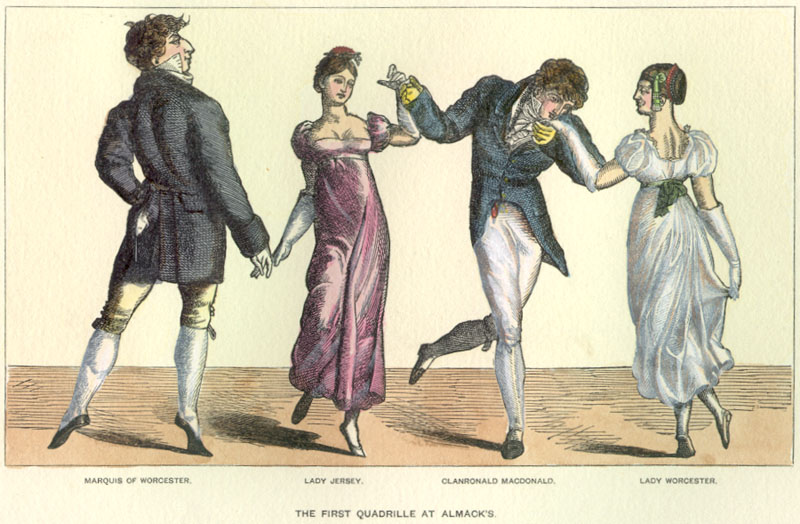
The first quadrille at Almack's  from The Reminiscences and Recollections of Captain Gronow (1850)
The first quadrille at Almack's
from The Reminiscences and Recollections of Captain Gronow (1850)

When is a Regency romance not a Regency romance?

I love Regency romances. The Regency is a period ruled by elegance and etiquette. It is a romantic world full of balls and duels, Corinthians and debutantes, Almack’s and Vauxhall Gardens, and rakes reformed by love.

When I started to blog about Regency history, I was motivated by wanting to explore the historical background to the Regency romances that I love to read so that I could write my own. And yet I have often picked up a ‘Regency’ romance, only to find that it is set in 1823 and not set in the Regency at all!

The strict definition of the Regency period

The Regency lasted a mere nine years, from February 1811 until January 1820. In 1810, George III was taken seriously ill. He was declared incapable of ruling because of mental incapacity and the Regency Act was passed the following year making his son George Prince Regent to rule in his stead. The Regency lasted until George III’s death in 1820 when the Regent became King George IV and was able to rule in his own right.

Regency feel

So why is it that not all Regency romances are set in the period 1811 to 1820? And if they are not set in the Regency, why do we call them Regency romances?

I believe the answer lies in the ‘feel’ of the Regency. The term Regency has come to represent a much wider period of time than the nine years to which it actually relates.

The Regent
George IV  from Huish's Memoirs of her late  royal highness Charlotte Augusta (1818)
George IV
from Huish's Memoirs of her late
royal highness Charlotte Augusta (1818)
The Regency period is epitomised by the Regent himself. As a young man, George IV was a handsome and personable figure, described as ‘the first gentleman of England’. The romantic figure of Prinny had almost disappeared by the time the long-awaited Regency started. He had become fat and his extravagant habits had made him unpopular and, as the years progressed, he became more and more reclusive.

But to the modern reader, the Regent in his youth represents the world of glamorous elegance, extravagant follies and romantic liaisons. It is this image of George IV as a young man that embodies the Regency, an image that was established long before he ever became Regent.

Romanticism

The Romantic Movement was well-established by the time the Regency started. This was a time that was rich in literature, both poetry and prose. It was the time of the Romantic poets like Wordsworth, Byron, Coleridge and Shelley and the Romantic novelist, Sir Walter Scott. Constable and Turner were painting and Beethoven was composing. The Regency finished, but the Romantics went on.

Jane Austen

The works of Jane Austen are inextricably linked to the Regency. All six of Jane Austen’s completed novels were published during this period, making them archetypal Regency romances. But they were not wholly written during the nine years of the Regency and although Jane died before the Regency ended, her books lived on.

Regency style

The Regency is associated with a style of architecture, furniture and design that spans more than a single decade. The Encyclopaedia Britannica describes Regency style as the
... decorative arts produced during the Regency of George, Prince of Wales, and the opening years of the 19th century as well as his entire reign as King George IV of England, ending in 1830.1
A period of high fashion

Saul David in his biography of George IV describes the Regency ‘in its widest sense (1800-1830)’ as a ‘devil-may-care period of low morals and high fashion’.2

A notice at the entrance to the Regency galleries in the National Portrait Gallery suggests an even wider time span:
As a distinctive period in Britain’s social and cultural life, the Regency spanned the four decades from the start of the French Revolution in 1789 to the passing of Britain’s great Reform Act in 1832.3
Ball dress  from La Belle Assemblée (1816)
Ball dress
from La Belle Assemblée (1816)
So, when is the Regency era?

The Regency era is, by very definition, related to the life of the Regent. It is characterised by the freedom and extravagance of George IV compared with the ascetic lifestyle of his father. Although the Regency is a mere nine years long, I am inclined to think that the Regency ‘feel’ starts around the time that George IV came of age in 1783 and continues until his death in 1830. This is sometimes referred to as the 'long Regency'.

Perhaps ‘Regency’ romances can be set in 1823 after all!

Headshot of Rachel Knowles author with sea in background (2021)Rachel Knowles writes clean/Christian historical romance set in the time of Jane Austen. She has been sharing her research on this blog since 2011. Rachel lives in the beautiful Georgian seaside town of Weymouth, Dorset, on the south coast of England, with her husband, Andrew.

Find out more about Rachel's books and sign up for her newsletter here.

If you have enjoyed this blog and want to encourage me and help me to keep making my research freely available, please buy me a virtual cup of coffee by clicking the button below.


Notes

  1. Encyclopaedia Britannica 15th edition (1994, Encyclopaedia Britannica Inc).
  2. David, Saul, The Prince of Pleasure (Little, Brown & co., 1998).
  3. From a sign in the National Portrait Gallery, London (2012).
Sources used include:
David, Saul, The Prince of Pleasure (Little, Brown & co., 1998)
Encyclopaedia Britannica 15th edition (1994, Encyclopaedia Britannica Inc)
Gronow, Captain, The Reminiscences and Recollections of Captain Gronow (1850)

Sunday, 13 November 2011

Frankenstein's author, Mary Shelley (1797-1851)

Mary Shelley  from The Life and Letters of Mary Wollstonecraft Shelley  by Mrs Julian Marshall (1889)
Mary Shelley
from The Life and Letters of Mary Wollstonecraft Shelley
by Mrs Julian Marshall (1889)
Profile

Mary Shelley (30 August 1797 - 1 February 1851) was an English writer who is most famous for her novel Frankenstein. She was the wife of the Romantic poet, Percy Bysshe Shelley.

Family history

Mary Wollstonecraft Godwin was born in London on 30 August 1797, the daughter of William Godwin and Mary Wollstonecraft. Godwin was a radical political philosopher and author; his most famous work, Political Justice, was published in 1793. Wollstonecraft was an ardent feminist and author of A Vindication of the Rights of Woman, published in 1792. In this work, she spoke out vehemently against the position of women in society, most notably describing marriage as “legal prostitution”.

Given their radical views, it is perhaps surprising that Godwin and Wollstonecraft married. However, Godwin’s intent was to provide security for their unborn child, which Wollstonecraft had lacked when her older daughter, Fanny Imlay, had been born and her lover, Gilbert, had deserted them.

After Wollstonecraft’s death, Godwin published Memoirs of the Author of A Vindication of the Rights of Woman; the scandalous book was not received well as the memoirs included details of Wollstonecraft’s affairs and her illegitimate child.

Childhood

Mary’s mother died from complications shortly after her birth leaving her and her half-sister, Fanny, to be raised by Godwin. In 1801, he married Mrs Claremont, who brought her own children, Charles and Jane - later known as Claire - into the Godwin family unit. Mary resented her step-mother whilst idealising her own mother. Her early years were spent in Scotland, near Dundee, and in London, where her family had a house in Skinner Street, Holborn. The Godwins were often plagued with a shortage of funds.

Godwin describes his daughter in a letter to an unknown correspondent:
She is singularly bold, somewhat imperious and active of mind. Her desire of knowledge is great, and her perseverance in everything she undertakes almost invincible. My own daughter is, I believe, very pretty.1
The house in Skinner Street was a stimulating intellectual environment. Godwin received many visitors including Lamb, Burr and Coleridge, who read his poem, The Ancient Mariner, in Mary’s hearing.

Percy Bysshe Shelley

Percy Bysshe Shelley  from Percy Bysshe Shelley, a monograph  by HS Salt (1888)
Percy Bysshe Shelley
from Percy Bysshe Shelley, a monograph
by HS Salt (1888)
The poet, Percy Bysshe Shelley, and his wife, Harriet, were regular visitors to Skinner Street. Shelley was a much younger man than most of Godwin’s other friends and he revered his work, Political Justice, giving it a fanatical interpretation.

Mary and Shelley fell in love and embarked upon a scandalous affair. Despite his views on marriage, Godwin did not support the relationship; he had fallen out with Shelley who had promised him money which he was not then able to give him due to his own financial situation.

Elopement

Together with Mary’s stepsister, Claire Claremont, Shelley and Mary went abroad in July 1814, travelling throughout Europe. When they returned to England, Mary was pregnant with Shelley’s child, and Godwin refused to receive them. The couple were penniless and found themselves ostracised from society. When her baby daughter died shortly after her birth in February 1815, Mary became depressed and isolated from Shelley who was trying to avoid his creditors.

The birth of Frankenstein

However, Mary fell pregnant again and gave birth to a son, William, on 24 January 1816, which eased her depression. The couple’s monetary problems were pressing, and so in the summer, they decided to go abroad to Geneva in Switzerland in the company of Lord Byron, John Polidori and Claire Claremont. It was while this illustrious company were writing ghost stories together that Mary conceived the idea for her novel, Frankenstein.

Front cover of Frankenstein  (1831 edition)
Front cover of Frankenstein
(1831 edition)
Marriage

On 30 December 1816, Shelley and Mary were married, following the death of Shelley’s first wife. Godwin now became reconciled to the match, but the relationship between them continued to be strained as he regularly demanded financial support from his son-in-law.

Travels in Italy

In 1818, plagued by debt, the couple and their young family – William and baby Clara, who had been born on 2 September 1817 – went abroad again. Over the next three years, the Shelleys travelled around Italy, to Venice, Naples, Rome and Florence, but it was a time of great sadness. First Clara and then William became ill and died. Mary was devastated. “Everything on earth has lost its interest to me,” she wrote to her friend, Miss Curran.2

On 12 November 1819, Percy Florence was born, but Mary feared she would lose him just like her other children. The Shelleys were constantly short of money but gained enjoyment from reading and writing and the intellectual stimulus of their own company and that of their many visitors.

Widowhood

On 8 July 1822, tragedy struck: Shelley was drowned when his sailing boat sunk during a storm. Mary returned to England the following year and devoted herself to bringing up her son and continuing her writing. Sir Timothy Shelley provided her with a small income on the understanding that she would not publish any of Shelley’s work or a biography during his lifetime.

Mary never remarried; no one else was Shelley’s equal. “Mary Shelley shall be written on my tomb,” she wrote to her friend and suitor, Trelawney.3 Her son, Percy, studied at Harrow and Cambridge, but showed no signs of his parents’ genius. Mary struggled with continued social ostracism and friends who continually let her down. Jane St John, who became Percy’s wife, was a great source of comfort to Mary in the last years of her life.

Illness and death

Mary grew increasingly unwell during the last years of her life and died on 1 February 1851 after a series of strokes. She was buried in St. Peter’s churchyard, Bournemouth, in Dorset.

Mary Shelley's gravestone in St Peter's churchyard, Bournemouth
The works of Mary Shelley

As well as Frankenstein, Mary wrote several other lesser known novels: Valperga (1823), The Last Man (1826), Perkin Warbeck (1830), Lodore (1835) and Falkner (1837). She also wrote a volume of travel studies – Rambles in Germany and Italy (1844). She also edited and promoted the work of her husband, Percy Shelley.

Headshot of Rachel Knowles author with sea in background(2021)
Rachel Knowles writes clean/Christian Regency era romance and historical non-fiction. She has been sharing her research on this blog since 2011. Rachel lives in the beautiful Georgian seaside town of Weymouth, Dorset, on the south coast of England, with her husband, Andrew.

Find out more about Rachel's books and sign up for her newsletter here.

If you have enjoyed this blog and want to encourage me and help me to keep making my research freely available, please buy me a virtual cup of coffee by clicking the button below.


Notes

  1. Marshall, Mrs. Julian, The Life and Letters of Mary Wollstonecraft Shelley (1889).
  2. Ibid.
  3. Ibid.

Sources used include:
Marshall, Mrs. Julian, The Life and Letters of Mary Wollstonecraft Shelley (1889) in 2 volumes
Spark, Muriel, Mary Shelley (1988)

Photos © RegencyHistory.net