Search this blog

Showing posts with label turnpikes. Show all posts

Monday, 30 September 2019

Turnpikes and toll houses

Toll house, Blists Hill, Ironbridge © A Knowles (2018)
Toll house, Blists Hill Victorian Town, Ironbridge (2018)
What was a turnpike road?

A turnpike road was a toll road operated under a trust set up by an Act of Parliament. A Turnpike Act authorised a group of trustees to levy tolls on a stretch of road in order to finance its maintenance and improvement. The toll rates were set by the Act which also empowered the trustees to borrow money secured on future tolls in order to invest in road improvements. Money could be borrowed by bonds and loans secured on the toll income or by mortgaging the tolls.

The term of a turnpike trust was 21 years, but tolls were to cease earlier if the money borrowed had been repaid. Extensions were regularly granted to trusts for ongoing improvement and maintenance.

Why was it called a turnpike?

Turnpike roads got their name from the turnpikes or toll gates which barred the way until the road users had paid the required toll. The turnpikes were placed at strategic points along the road where it was difficult for travellers to evade paying, such as at bridges or where the lie of the land constricted the road. 
 
Tyburn Turnpike (1820) from Old and New London by E Walford (1878)
Tyburn Turnpike (1820)
from Old and New London by E Walford (1878)
 Why were turnpike roads needed?

The state of the roads around large conurbations like London were in a bad state of repair due to overuse. The preamble to a Turnpike Act for Surrey passed in 1718 stated that certain roads
...by reason of the many heavy loads and carriages of meal, timber, stone, hops, and other goods, and great number of stage and hackney coaches, passengers and droves of cattle daily passing through the same, are become so very ruinous and almost impassable, for the space of five months in the year, so that it is dangerous to all persons, horses, and other cattle to pass through the said roads.1
Road maintenance was the responsibility of the parishes through which the roads passed, but they did not have the resources to keep the roads in good repair.

Turnpike Acts provided the means for raising money to build and maintain better roads and allow the fast transport of people, mail and goods from place to place.

Toll house at the Weald and Downland  Living Museum © A Knowles (2014)
Toll house at the Weald and Downland
Living Museum (2014)
When was the turnpike system in operation?

The turnpike system was not a unified road network but rather a large number of individual turnpike roads, operated by different trusts, that provided better road conditions across Britain and Scotland. Generally, the trusts coordinated their improvements to provide continuous stretches of good road, but if they were offering alternative routes to the same place, they sometimes competed with each other, trying to attract traffic and therefore tolls to travel their route. 

The first Turnpike Acts were passed in the late 17th century and by the mid-1830s, about 22,000 miles of road in England and Wales – about one fifth of the road network – were managed by turnpike trusts.2 The turnpikes were wound up in the 1870s and the responsibility for road maintenance passed to the Highways Board.

Who collected the tolls?

Trusts could either appoint collectors, who would have to sign an oath to confirm they had handed all the tolls over, or they could let the tolls. 

An advert in The Times for April 1810 stated the date and place when the trustees of the New Cross Turnpike Roads intended to auction the tolls, giving the sum collected in a previous period as guide price to bidders.3

Toll house, Athelhampton House © A Knowles (2015)
Toll house, Athelhampton House (2015)
Toll houses

Toll houses were built next to the turnpikes as someone needed to be collecting the tolls 24 hours a day. These represented a significant investment from the trusts. The standard toll house design adopted in the 1820s was of a small, single-story cottage with a polygonal bay front. 

Some toll houses on major roads were built on a rather grander design, with castellated rooves, designed to impress rich travellers and tempt them to use their route over an alternative.

Turnpikes were generally placed outside the town so that local businesses did not have to pay the toll. However, the remoteness of their locations meant that the toll houses were vulnerable to theft and as a precaution, they tended to be fitted with bars and a safe.

Many toll houses were demolished when the turnpike trusts were abolished particularly if their position restricted the width of the road. Others were sold into private ownership. 

Spaniards gate toll house, Hampstead © R Knowles (2019)
Spaniards Gate toll house, Hampstead (2019)
Plaque on side of Spaniards Gate toll house,  Hampstead © R Knowles (2019)
Plaque on side of Spaniards Gate toll house,
Hampstead (2019)
How much were the tolls?

The toll rates for each turnpike were set according to the Turnpike Act that established it and differed according to the type of user.

The Mail did not have to pay tolls. An outrider blew a horn as the coach approached so that the toll keeper could get the gate open ready without the Mail having to slow down.

Table of tolls from Weald and Downland  Living Museum © A Knowles (2014)
Table of tolls from Weald and Downland
Living Museum (2014)
The Surrey Turnpike Act of 1718 set the rates as follows:
For every horse, mule, or ass, laden or unladen, and for every chaise, cart, dray, or other carriage drawn by one horse, one penny
For every coach, chariot, or calash drawn by two or more horses, sixpence
For every waggon not laden with hay or straw, sixpence
For every waggon laden with hay or straw, threepence
For every cart, dray, or carriage laden with hay, straw, or other goods, twopence
For every drove of oxen or neat cattle, twopence per score
For every drove of calves, hogs, sheep, or lambs one penny per score
A ticket for the toll road lasted all day.
Soldiers, all persons riding post, and all carts and waggons travelling with vagrants, were permitted to pass free of toll.4
The Sussex Turnpike Act of 1749 set the rates as follows:
For every coach, berlin, landau, chariot, chaise, calash, chair, caravan, or hearse, drawn by six horses or mules, the sum of one shilling
If drawn by four horses, &c., ninepence
If drawn by two horses, &c., sixpence
If drawn by one horse, threepence
For every waggon, wain, cart, or carriage drawn by six horses or oxen, one shilling and sixpence
If drawn by four horses or oxen, ninepence
If drawn by two horses or oxen, sixpence
If by one horse, threepence
For every waggon or cart, laden only with hay or straw, threepence
For every horse, mule, or ass, laden or unladen, and not drawing, one penny
For every drove of oxen, tenpence per score
For every drove of calves, sheep, &c., fivepence per score.
The Act specifically prohibited the repair of pavements in the streets of any town.
Those travelling to county elections were exempt.5
Milestones

Most turnpike trusts put up milestones, marking the distance to significant places.

Milestone in Blandford, Dorset © A Knowles (2016)
Milestone in Blandford, Dorset (2016)

Headshot of Rachel Knowles author with sea in background(2021)
Rachel Knowles writes clean/Christian Regency era romance and historical non-fiction. She has been sharing her research on this blog since 2011. Rachel lives in the beautiful Georgian seaside town of Weymouth, Dorset, on the south coast of England, with her husband, Andrew.

Find out more about Rachel's books and sign up for her newsletter here.

If you have enjoyed this blog and want to encourage me and help me to keep making my research freely available, please buy me a virtual cup of coffee by clicking the button below.

 
Notes
1. Parliamentary papers, House of Commons vol 44 (1852)(Turnpike Roads)
3. The Times online archive, April 1810.
4. Parliamentary papers op cit.
5. Ibid.

Sources used include:
Parliamentary papers, House of Commons vol 44 (1852)(Turnpike Roads)

All photographs © RegencyHistory.net

Wednesday, 24 September 2014

The Industrial Revolution - a Regency History guide

In 1712, two years before a portly German prince arrived from Hanover to become George I, Thomas Newcomen (1664-1729) installed an innovative water pump at a mine in Staffordshire. Newcomen’s device, the first commercially successful steam engine, solved a practical problem of extracting floodwater from mines. It also began the era of technological development we refer to as the Industrial Revolution.


A working replica of Newcomen's steam engine  at the Black Country Living Museum, Dudley
A working replica of Newcomen's steam engine
at the Black Country Living Museum, Dudley (2014)
Harnessing the new source of power

Such was the success of Newcomen’s steam engine that hundreds were built over the next hundred years and it would be half a century before the design was significantly improved on. In the 1770s, Scottish engineer James Watt (1736-1819) dramatically improved the engine’s efficiency. He went into partnership with Matthew Boulton (1728-1809) to manufacture the machines, making him immensely wealthy.

'Old Bess' engine by Boulton and Watt  built in 1777 - in the   Science Museum, London
'Old Bess' engine
by Boulton and Watt (1777)
 in the Science Museum, London (2014)
By 1800 steam engines powered a host of industries including mining and manufacturing.
The next major innovation was using steam to power a vehicle. Early models were developed in the 1780s and 90s but the first full-size engine was constructed by Richard Trevithick (1771-1833).

The coming of the railways

On 21 February 1804, Trevithick's engine made the world’s first steam-driven railway journey, pulling a train in South Wales.

The first railway opened to the public was the Liverpool and Manchester Railway, opened in 1830. The previous year they organised the Rainhill Trials, won by Robert Stephenson’s Rocket, securing him the contract to build engines for the new railway.

By 1837, when Queen Victoria came to the throne, steam railways were being built across the world, and steam engines were being put to many different uses.

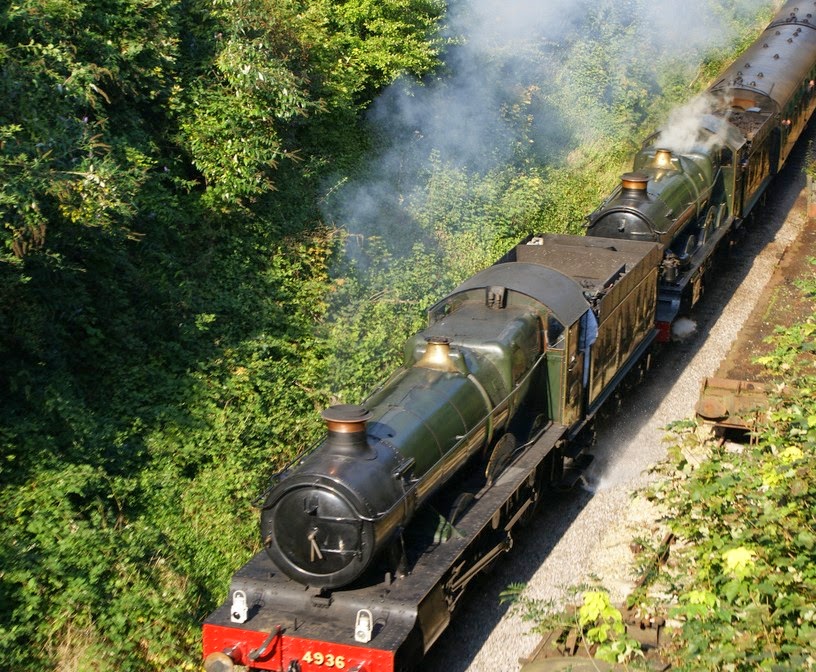
Steam train on Watercress Line in Alton, Hampshire
Steam train on Watercress Line in Alton, Hampshire (2014)
Iron smelting and Ironbridge

Ironbridge Gorge, Shropshire, has been awarded World Heritage Site status because of its key role in the Industrial Revolution.

Here, in 1709, Abraham Darby (1678-1717) was the first person to smelt iron in a furnace powered by coke, rather than charcoal. Using coke, made from coal which was locally abundant, removed the reliance on wood, an increasingly scarce resource. It also meant much more iron could be produced. Coalbrookedale, where Darby was working, became a centre of innovation and industry for decades.

In 1779, the world’s first iron bridge was completed, crossing the gorge. The iron bridge is now a monument to the Industrial Revolution.

Mechanisation of the textile industry

During the seventeenth century, cotton fabric became increasingly popular. Lighter and easier to wash than wool, cotton garments were initially imported from India while domestic spinning and weaving industries developed slowly, the work carried out by hand, typically in homes.

James Hargreaves (1720-1778) and Richard Arkwright (1732-1792) both introduced mechanisation to the cotton industry in the 1760s. Hargreaves invented the Spinning Jenny while Arkwright created the Water Frame.

Arkwright built ‘manufactories’ to house his machines and employed hundreds of unskilled workers to operate them. He also took advantage of steam power, using a Watts engine to pump the water that drove his machines.

By the 1790s, Britain was producing over a million cotton garments a year. Reaction against increased mechanisation included the Luddite riots of 1811-1813, where many machines were destroyed by workers who felt threatened by new technology.

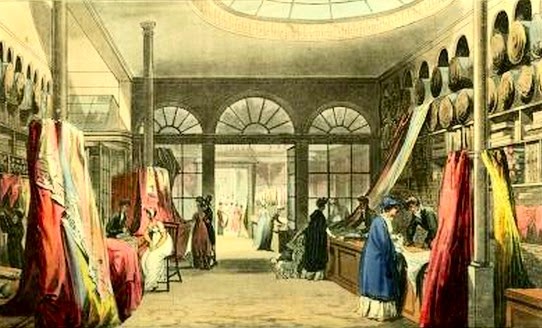
Harding, Howell and co. from Ackermann's Repository (1809)
Agricultural revolution in Britain

The population of Britain in 1750, at 5.7 million people, was probably not dissimilar to the number living here in Roman times. It was also the maximum number that could be fed by the land using contemporary agricultural methods.

By 1850 the population had more than doubled to 16.6 million. New ideas about farming, combined with new technologies, meant more food could be produced from the same area of land. During the same period large areas of land were made usable through drainage or deforestation.

Canals and roads

As the population grew, along with demand for new products, the nation’s transport infrastructure required improvement. The final quarter of the eighteenth century was the great age of canal building, starting with the Bridgewater Canal which opened in 1776. By 1810 Britain was criss-crossed by over four thousand miles of artificial waterways, traversed by thousands of barges carrying coal, clay and manufactured goods.

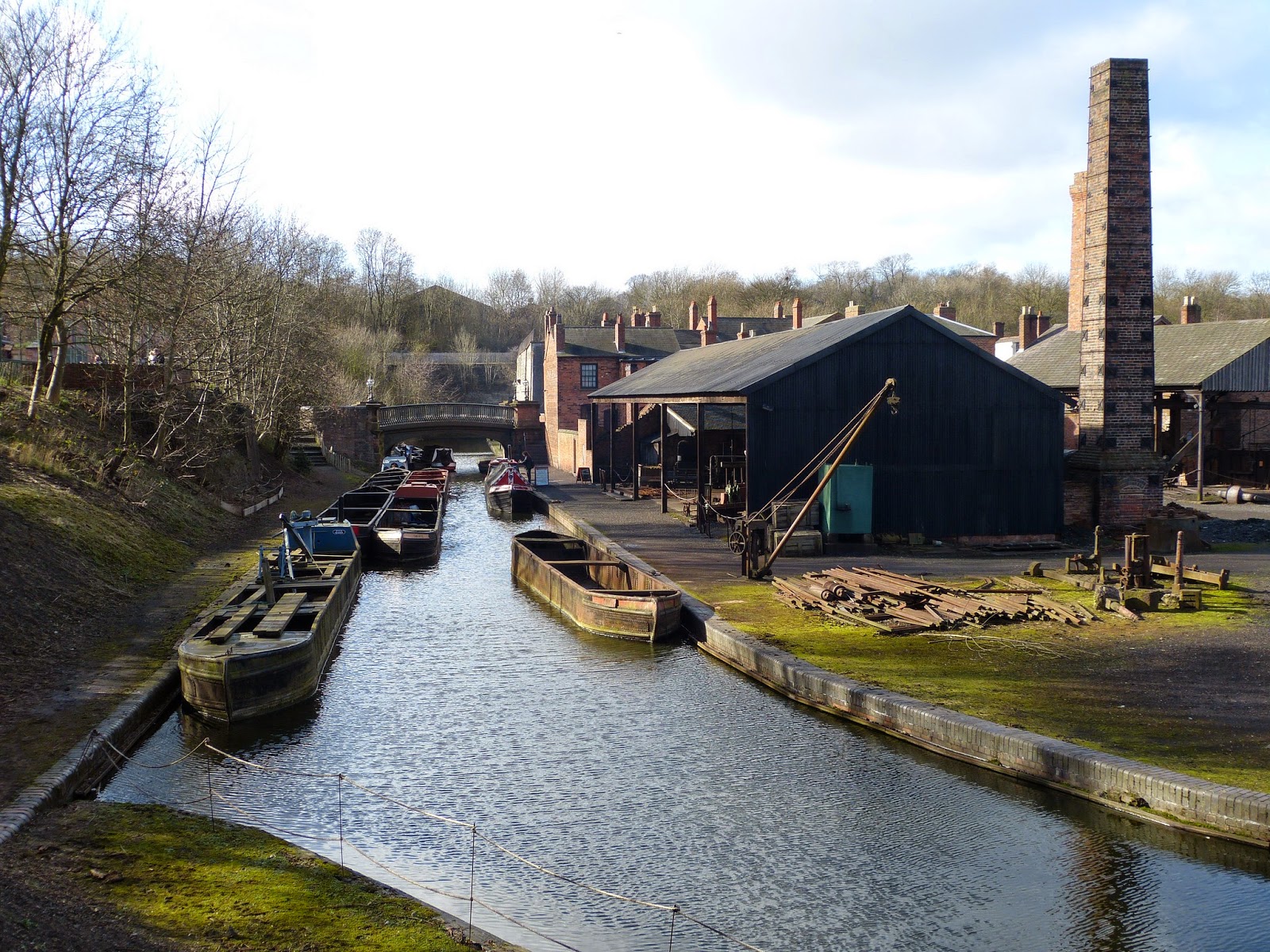
Canal at the Black Country Living Museum, Dudley
Canal at the Black Country Living Museum, Dudley (2014)
While canals provided transport for large quantities of heavy or bulky items, the majority of people who travelled any distance did so by road. Poor maintenance and increasing volumes of traffic damaged the surface of many roads, which were unpaved and could become almost impassable in bad weather.

The solution was the Turnpike system, which began in the late seventeenth century and lasted until the 1870s. Turnpikes were toll roads, managed by Turnpike Trusts, where money was invested in building a more solid surface, making it easier for horses and carriages to travel at a reasonable speed. In 1825 there were one thousand Turnpike Trusts controlling 18,000 miles of road.


Table of tolls at the  Weald and Downland Open Air Museum
Table of tolls at the
Weald and Downland Open Air Museum (2014)
In the early nineteenth century, the rate of building of new canals and Turnpike roads slowed dramatically, as railways became an increasingly popular alternative.

Peace allowed freedom of thought 

The Industrial Revolution was the result of many factors that combined during the eighteenth century. One of these was the relative peace enjoyed by the country, particularly later in the century, when many other European nations were being ravaged by war.

This relative peace, and along with it the reign of the Hanoverian kings, was secured in 1746 at the last pitched battle in Britain, at Culloden. The destruction and disruption which follows the movement of armies during wartime ceased.

At the same time, neither the monarchy nor the church sought to impose strict controls on society, allowing free thought and experimentation to flourish. Public lectures on science, or ‘natural philosophy’ as it was known at the time, became popular during the first half of the eighteenth century.

George III, who became king in 1760, was fascinated by science. He collected, or had made, numerous scientific instruments that were used to both entertain and instruct. His collection, which includes air pumps, globes of the known world and a model diving bell, is now on display in the Science Museum, London.

Air pump made for George III  by George Adams (1761)
Air pump made for George III
by George Adams (1761) (Photo 2014)

Headshot of Rachel Knowles author with sea in background(2021)
Rachel Knowles writes faith-based Regency romance and historical non-fiction. She has been sharing her research on this blog since 2011. Rachel lives in the beautiful Georgian seaside town of Weymouth, Dorset, on the south coast of England, with her husband, Andrew, who wrote this blog.

Find out more about Rachel's books and sign up for her newsletter here.

If you have enjoyed this blog and want to encourage us and help us to keep making our research freely available, please buy us a virtual cup of coffee by clicking the button below.


Sources used include:
BBC history website: Agricultural revolution, James Watt, Sir Richard Arkwright, the inventors of the steam engine and why the industrial revolution happened in Britain
Canal museum
English Heritage website: Ironbridge
Ironbridge website
Saburchill.com: History of the cotton industry
Science museum: King George III's collection and Rise of the factory system
Smithsoniam: What the Luddites really fought against
Turnpike roads in England
Wikipedia: Industrial Revolution, steam locomotive and timeline of steam power

Photographs © Andrew Knowles RegencyHistory.net