Search this blog

Showing posts with label military history. Show all posts

Monday, 23 October 2023

Napoleon’s Invasion of Egypt - an eyewitness history by Jonathan North - book review

Napoleon’s Invasion of Egypt By Jonathan North

Did Napoleon’s troops fire cannons at the pyramids of Egypt? And what was his army doing there?

Those were questions provoked by the teaser trailer for the 2023 movie Napoleon. The second of these questions is answered by this new book by Jonathan North, Napoleon’s Invasion of Egypt.

The book’s subtitle, ‘An Eyewitness History’, promises a wealth of firsthand accounts from the French invasion and occupation of a corner of North Africa. It delivers on that promise. This is a compelling account of that French adventure, told in the words of many who were there.

Napoleon at Arcole from The Life of Napoleon Bonaparte by WSloane 1896
Napoleon at Arcole from The Life of Napoleon
Bonaparte
by W Sloane 1896

An introduction to Napoleon’s occupation of Egypt

While it’s titled the ‘Invasion of Egypt’, Jonathan North’s book covers the full period of the French occupation. Napoleon and his army arrived in July 1798 and the survivors left three years later, in 1801. Bonaparte himself effectively abandoned his troops in late 1800, sailing back to France, somehow evading the British Royal Navy.

The expedition was sent by the Directory, the committee that ruled revolutionary France. Their star general, Napoleon, proposed it, with a view to opening a land route to India.

It was also to be a scientific expedition, taking scholars to examine the marvels of ancient Egypt. Their discovery of the Rosetta Stone, the key to deciphering Egyptian writing, helped to open up the field of Egyptology.

Napoleon and his army landed in Egypt on 1 July 1798 and was immediately engaged in fighting the occupying Mamelukes, rulers of Egypt under the distant auspices of the Ottoman Empire.

‘The boats were rowed to the shore and a mass of cavalry showed itself and seemed ready to wade into the sea to oppose the landing. A few rounds of artillery saw them off,’ wrote 18- year-old soldier Joseph Laporte.1

The Battle of the Pyramids on 21 July inflicted a heavy defeat on the Mamelukes, allowing Napoleon to enter Cairo and commence his occupation of Egypt.

Despite sweeping in as victorious invaders, in only days the French became a beleaguered garrison. On 1 August 1798 a British fleet, under Horatio Nelson, defeated the warships of the French fleet that had transported the army across the Mediterranean, at the Battle of the Nile. The victory put the British in command of the sea, making it unlikely that the plan to reach India could be fulfilled.

‘We realised that any communication with Europe would now be impossible,’ wrote Captain Etienne Louis Malus in his journal. ‘We began to lose hope that we would ever see our homeland again.’2

The Destruction of L'Orient at the Battle of the Nile 1 August 1798 by G Arnald 1825-7 at National Maritime Musuem AKnowles photo2022
The Destruction of L'Orient at the Battle of the Nile
1 August 1798
by G Arnald (1825-7)
at National Maritime Musuem Photo A Knowles (2022)

Occupation and assimilation

Napoleon set up a French administration of Egypt that included some of the local rulers, and established a scientific Institute. During their time in Cairo the French attempted to replicate something of their culture from home, including street cafes. Some adopted a local style of dress, partly because of the climate.

The French invasion force was almost exclusively male. It wasn’t long before soldiers began to find mistresses among the local population. General Menou married a Muslim woman and converted. He seemed to be one of the few who would have preferred to remain in Egypt indefinitely.

Most did not feel the same way. Etienne Geoffroy Saint-Hilaire, a young scholar, wrote:

The soldiers yearn for the delights of France. Their hatred for Egypt stems from being denied essentials. They have only water to drink. They cannot be attracted to women who hide themselves in veils.3

North’s book goes into considerable details about the challenges faced by the French as they experienced life in a different climate and culture. Scorpions, slavery, plague, mirages and mummies are all discussed, often in the words of eyewitnesses.

The end of the Egyptian adventure

To help protect Egypt, Napoleon’s army ventured into Syria and reached the Holy Land in 1799. Unable to capture the city of Acre, defended with British help, he had to turn back.

By now Napoleon sought a return to France, knowing he would be welcomed by the people. His departure was kept secret from almost all his officers and when they discovered he’d gone, many felt abandoned in a strange, unwelcoming land.

The remaining French army, significantly reduced by death and disease, began looking for its own way home. They continued to fight off local revolts and attacks by the Ottomans. On 21 March 1801 they were defeated by the British at the Battle of Alexandria, after which many were repatriated to France in British ships.

The British kept many of the artefacts discovered by the French in Egypt, including the Rosetta Stone.

A page-turning eyewitness account

This is my kind of history book—a strong story illustrated with an extensive tapestry of quotes from those who experienced it firsthand. Letters, journals and reports provide a rich seam of material which North has used to great effect.

I would like to have heard more from those being occupied. How did they feel about this French army inserting itself into their world? I’m guessing that sources for this are limited, hence their scant use.

The book contains a number of illustrations and maps, along with a detailed bibliography. The index only seems to include names of people—not places or key subjects. There’s a separate list of the around 40 eyewitnesses whose words are included in the book (presumably all translated).

This book has a high, and sometimes gruesome, body count. Thousands died, both soldiers and civilians. Battles, executions, revolts, raids, assassinations and plague all contributed to the carnage, and both sides carried out massacres.  

I recommend this book to anyone who’s interested in the history of Napoleon or that of France or the Middle East in the period. It’s packed with fascinating details and has certainly helped me better understand Bonaparte himself, along with how Egypt became a subject of fascination during the Regency period.

Napoleon's Invasion of Egypt is available from Amberley Publishing.


Andrew Knowles
 researches and writes about the Regency and late Georgian period. He's also a freelance editor and writer for business. He lives in the beautiful Georgian seaside town of Weymouth, Dorset, on the south coast of England, with his wife, Rachel.

Learn more about Regency History. Sign up for our newsletter.

If you found this article interesting or useful, and you want to encourage us, help us to keep our research freely available by buying us a virtual cup of coffee.  Click the button below.

Notes – all quotes from Napoleon’s Invasion of Egypt

1. p49

2. p99

3. p114

All photos © A Knowles RegencyHistory.net

Friday, 1 July 2022

A Regency History guide to the British Army in 1815

The Battle of Waterloo from The wars of Wellington, a narrative poem by Dr Syntax, illustrated by W Heath & JC Stadler (1819)
The Battle of Waterloo from The wars of Wellington, a narrative poem
by Dr Syntax, illustrated by W Heath & JC Stadler (1819)
Such carnage I never before beheld. The firing of guns etc was so great that the man next to me could not hear my orders.

Captain Joseph Logan, 2nd Battalion 95th Foot, writing from Paris a month after the Battle of Waterloo.1

Captain Logan was one of the thousands of British soldiers on the battlefield that June day in 1815.

Every one of those thousands of soldiers could tell their own tale of British Army life. They’d have stories of how they were recruited, of hours of drill and practice, of travelling to new places and of strict regulations and tough discipline. 

You can read more about the Battle of Waterloo here.

Like Captain Logan, many would also have graphic stories from battlefields in India, North and South America, Portugal and Spain and, of course, the rolling Belgian countryside at Waterloo.

The British Army of 1815 had been honed by years of active confrontation and battle, most recently with France, in the Revolutionary and Napoleonic wars.

Infantry, Cavalry, Artillery and More

There were many different types of soldier in the British Army of 1815. Each type performed a different function, both on and off the battlefield.

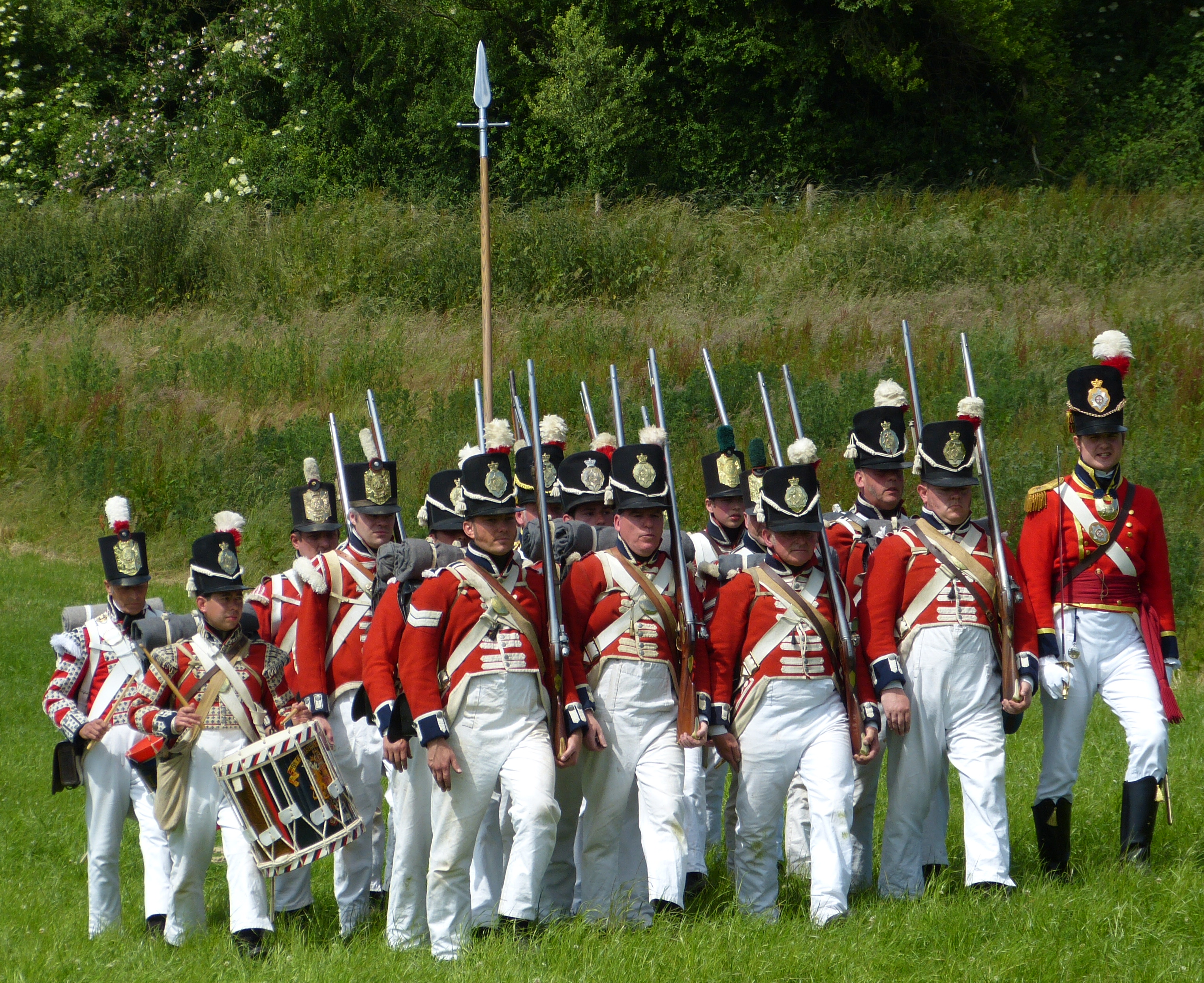
Reenactors at Chalke Valley history fair (2013)
Infantry

The bulk of the British Army in 1815 were foot soldiers. As such, they walked everywhere - or rather, marched, carrying everything they needed with them.

Rifleman Harris served in the British Army from 1802 to 1814. He recalled:

I am convinced that many of our infantry sank and died under the weight of their knapsacks...Besides my well-filled kit, there was the great-coat rolled on its top, my blanket and camp kettle, my haversack, stuffed full of leather for repairing the men’s shoes, together with a hammer and other tools, ship-biscuit and beef for three days. I also carried my canteen filled with water, my hatchet and rifle, and eighty rounds of ball cartridge in my pouch.2

Harris was no longer with the army in 1815, but he served as part of Wellington’s army in the Peninsula Wars.

Infantrymen were known as ‘red coats’, because of the colour of their jackets. They were armed with a musket and a bayonet. There were two battalions of rifles, which were more accurate than muskets.

Cavalry 

The Marquis of Anglesea wounded whilst leading a charge of heavy cavalry at the close of the Battle of Waterloo (1815) Print by M Dubourg after JA Atkinson (1815) Yale Center for British Art, Paul Mellon Collection
The Marquis of Anglesea wounded whilst leading a charge
of heavy cavalry at the close of the Battle of Waterloo
Print by M Dubourg after JA Atkinson (1815)
Being on horseback, the cavalry was the most glamorous unit in the British Army. They were also the shock troops, having both a height and speed advantage over foot soldiers.

Captain Charles Edward Radclyffe wrote:

The charge of the heavy cavalry in line was a magnificent sight, and I have every reason to believe they did everything to justify the high expectations their appearance had excited.3

Cavalry were armed with a sabre and a carbine, a light pistol.

Artillery

Waterloo battery - bronze 6-pounder seized at the Battle of Waterloo - Tower of London (2016)
Waterloo battery - bronze 6-pounder gun seized at the
Battle of Waterloo - Tower of London (2016)
The British infantry and cavalry of 1815 were supported by three different forms of artillery.

The first was the regular cannon, which typically fired either a solid ball or canister shot—smaller pieces of shot designed to damage infantry or cavalry. The cannon usually aimed directly at their target.

Gunner John Edwards of the Royal Horse Artillery wrote:

About half past 10 o’clock the French Imperial Guards dressed in steel armour back and breast plates, they weigh about 32 pounds, charged up the main road till they came within 600 yards they extended right and left of the road, we fired case shot at them and swept them off like a swathe of grass before a scythe.4

The second was the howitzer, a short-barrelled cannon angled upwards. These fired shot into the air, reaching targets behind obstacles.

The third was the Congreve rocket, a relatively new innovation that delivered mixed results. The rockets were easier to deploy and faster to fire than cannon, but they weren’t always the most effective.

Years after Waterloo, Henry Leathes recalled that a rocket launched during the battle opened a gap in the French ranks “probably from the novelty of such a pyrotechnique salute.”5

Bronze 3-pounder gun, 1815 at National Army Museum, London (2022)
Bronze 3-pounder gun, 1815
at National Army Museum, London (2022)

Supporting roles

Royal Engineers

The Royal Engineers were formed a century before 1815 to provide map-making, bridge building, fortifications and camp drainage systems. They also ran the Army’s postal service.

Initially the Royal Engineers comprised only officers, who would hire civilian labour or use private soldiers to perform the hands-on work of digging and building. However, by 1815 they had their own private soldiers, known as sappers.

Medical services

Saw used to amputate Lord Uxbridge's leg at the Battle of Waterloo (1815) On display in the National Army Museum, London (2022)
Saw used to amputate Lord Uxbridge's leg
at the Battle of Waterloo (1815)
On display in the National Army Museum, London (2022)
The British Army had various medical roles, from Deputy Inspectors of Hospitals to staff surgeons, orderlies and nurses. Most battalions had a medical officer and a couple of assistants.

There was no formal process for getting injured soldiers from the frontline to wherever the medical service was based.

Amputation of damaged limbs was a common procedure, with around 500 probably being performed during the Battle of Waterloo. The most well-known was the removal of Lord Uxbridge’s leg. These and other procedures were performed without anaesthetic.

Deputy Inspector John Hume wrote:

There was but one opinion amongst us, so having prepared the dressings etc, we returned into the room where I announced to Lord Uxbridge that the operation being found necessary the sooner it was performed the better.6

Civilians

A number of non-military personnel, typically women, followed the British Army of 1815. Many of  these camp followers were working class wives, widows and mothers who had some form of relationship with soldiers.

A number of wives were permitted to travel with their soldier husbands, both of commissioned and non-commissioned officers.

Other civilians included clerks, cooks and those associated with transport and supply activities.

Organisation of the British Army in 1815

As today, the British Army of 1815 was made up of many different regiments—there were well over 100. Every regiment has its own history, traditions, insignia and colours (flag). The oldest regiments trace their history back to the English Civil War in the mid-1600s

The Coldstream Guards hold the honour of being the oldest continuously serving regiment. It was formed in 1650, ten years before the British Army was founded by Charles II in 1660.

A regiment was made up of battalions, each numbering several hundred men. Some regiments had more than one battalion and these usually operated independently, rarely fighting together.

In 1815 most infantry regiments had been allocated a number and a county designation. The numbering indicated their seniority, or precedence, which was based on when and where they were founded.

This led to regiments having names such as:

  • 54th (West Norfolk) Regiment of Foot
  • 1st Life Guards
Some historic regiments were permitted to keep their name, such as:
  • Coldstream Guards
  • Royal Welch Fusiliers

A regiment was led by a colonel.

Ranks in the British Army of 1815

Most men entered the army by enrolling as a private soldier.

Many never progressed beyond the rank of private, but they were often referred to with a designation that represented the branch of the army they were part of, such as Trooper, Gunner, Sapper, Rifleman etc.

A private soldier could be promoted to a non-commissioned officer, such as a corporal or sergeant. 

A captain from A book explaining the ranks and dignitaries of British Society (1809)
A captain from A book explaining
the ranks and dignitaries of British Society
(1809)
A second route of entry into the army was the purchase of a commission. 

This allowed a man to join up as an officer, despite having no military experience or training. Because the commission had to be paid for, it ensured that most officers came from the upper levels of society.

Some soldiers were promoted from the ranks on merit, but it wasn’t very common.

Listing a hierarchy of ranks in 1815 isn’t as simple as it might appear. There were various forms of rank, and there were exceptions to all of these. It was possible for a specific captain to be senior to a specific major, depending on the positions they were serving in.

Another example would be a colonel given the rank of brigadier general while they were leading a brigade (a force comprising a number of battalions). Once that role was over, they went back to being a colonel.

Outline of ranks in the army

  • General
  • Lieutenant general
  • Major general
  • Brigadier general
  • Colonel - one per regiment, and not a rank that could be purchased.
  • Lieutenant Colonel - between one and three in a regiment.
  • Major
  • Captain
  • Lieutenant
  • Ensign/Cornet (Infantry/Cavalry)
  • Sergeant
  • Corporal
  • Private

Headshot of Rachel Knowles author with sea in background(2021)
Rachel Knowles writes clean/Christian Regency era romance and historical non-fiction. She has been sharing her research on this blog since 2011. Rachel lives in the beautiful Georgian seaside town of Weymouth, Dorset, on the south coast of England, with her husband, Andrew, who wrote this blog. 
 
Find out more about Rachel's books and sign up for her newsletter here.

If you have enjoyed this blog and want to encourage me and help me to keep making my research freely available, please buy me a virtual cup of coffee by clicking the button below.


 Notes

  1. Glover, Gareth (editor), The Waterloo Archive Volume I: British Sources (2010) p157, Captain Joseph Logan.
  2. Hibbert, Christopher (editor), The Recollections of Rifleman Harris (1970) p13.
  3. Glover, Gareth (editor), The Waterloo Archive Volume I: British Sources (2010) p23, Captain Charles Edward Radclyffe.
  4. Glover, Gareth (editor), The Waterloo Archive Volume I: British Sources (2010) p102, Gunner John Edwards, Royal Horse Artillery.
  5. Glover, Gareth (editor), The Waterloo Archive Volume I: British Sources (2010) p110, Henry Leathes.
  6. Glover, Gareth (editor), The Waterloo Archive Volume I: British Sources (2010) p215 Deputy Inspector John Hume

Sources used include:

Burnham, Robert and McGuigan, Ron, The Napoleon Series (2016)

Glover, Gareth (editor), The Waterloo Archive Volume I: British Sources (2010)

Hibbert, Christopher (editor), The Recollections of Rifleman Harris (1970)

Simonson, Sheila, Following the drum: British women in the Peninsular War (1981)

Sinclair, Joseph, A Soldier of the Seventy-first (2010)

All Things Liberty website 

British army website

British Military History website

Military History Matters website 

National Army Museum website 

Royal Armouries Collections website 

Photographs © RegencyHistory.net

Sunday, 12 June 2016

The almost forgotten War of 1812

A view of the bombardment of Fort McHenry, near Baltimore, by the British fleet, taken from the observatory under the command of Admirals Cochrane & Cockburn on the morning of the 13 Sept 1814 which lasted 24 hours, and thrown from 1500 to  1800 shells in the night attempted to land by forcing a passage up the ferry branch but were repulsed with great loss - courtesy of the Library of Congress
A view of the bombardment of Fort McHenry, near Baltimore, by the British fleet,
taken from the observatory under the command of Admirals Cochrane & Cockburn
on the morning of the 13 Sept 1814 which lasted 24 hours, and thrown from 1500 to 
1800 shells in the night attempted to land by forcing a passage up the ferry branch
but were repulsed with great loss - courtesy of the Library of Congress
Did you know that Britain was at war with the United States of America during the Regency period? A war involving thousands of British soldiers in North America, with hundreds killed in a host of battles? A war that included the British burning what is now one of the most prestigious buildings in the world - the White House in Washington DC?

It’s well known that the first half of the Regency (1811-1815) saw the end of a long military conflict with France. Wellington’s victory over Napoleon Bonaparte at Waterloo in 1815 concluded a series of wars that began over twenty years earlier, in 1793.

This extended struggle made the military a familiar feature of Regency life. Jane Austen included significant references to both the army and the Royal Navy in her books. Elements of Regency women’s fashion incorporated details from military uniforms.

Today the war with the United States of America, from 1812 to 1814, is little more than a footnote in British history. It’s remembered, even celebrated, in both Canada and the United States. But here in Britain, the War of 1812, as it’s known, is easily overlooked.

Morning walking dress with 'military front' from La Belle Assemblée (Mar 1812)
Morning walking dress with 'military front'
from La Belle Assemblée (Mar 1812)
The origins of the War of 1812

The American War of Independence had concluded in 1783. By the early 1800s, some of those idealistic young men and women who’d fought for freedom were frustrated by what they considered continued British arrogance.

In particular, the USA objected to Britain interfering with its ships and seamen. The Royal Navy’s domination of the seas meant many American vessels were prevented from trading with mainland Europe. Worse, American sailors were being forced to crew British ships, through the long-established tradition of press gangs.

America wanted to remain outside the conflicts that troubled Europe, and to trade freely with other nations.

Some have labelled the War of 1812 as the ‘Second War of Independence’, in which the young United States asserted its right to be free from British interference.

The USA declares its first war against another nation

Historians argue over the exact causes of the War of 1812. American pride was clearly offended by British treatment of its ships and sailors. It was also offended by Britain inciting Native American tribes to attack American settlers. There’s debate over whether some American politicians hoped a war would lead to the capture of Canada from the British.

Whatever the motivation, the enthusiasm for war grew steadily for several years before 1812.

On 18 June 1812, after several days of deliberation, the American government voted to declare war against Great Britain.

This was the first time the USA formally agreed to go to war with another nation and it wasn’t by an overwhelming majority. Of the 160 politicians who voted, 62 were against going to war.

200th anniversary ceremony at Fort McHenry, Baltimore, Maryland © Jay Baker, Maryland Govpics 2012 via Flickr
200th anniversary ceremony at Fort McHenry, Baltimore, Maryland
© Jay Baker, Maryland Govpics 2012 via Flickr
Principal events of the War of 1812

Despite years of agitation for war, the Americans were not well prepared. Their army comprised ill-equipped local militias who were unwilling to travel far from home. In 1812 and 1813, they launched several small invasions into Canada, all of which were easily repulsed.

The British and American navies engaged in a number of actions off the Atlantic coast of the USA. In order to prevent the Americans from trading, the Royal Navy attempted to blockade the entire eastern coast. In a series of engagements, both sides captured and lost ships. The Americans made considerable use of privateers to bolster their naval forces.

From 1813 to 1815, hundreds of American sailors captured by the British were locked up in Dartmoor Prison.

The Great Lakes, which straddle a huge section of the border between Canada and the USA, saw military action on and off the water. A host of engagements saw first one side gain the upper hand, then the other.

The burning of Washington DC
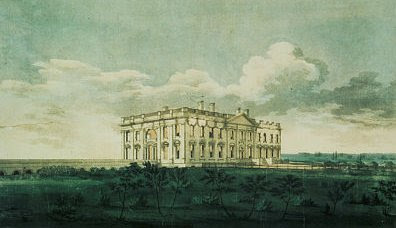
Burnt out shell of the White House (1814) - engraving by W Strickland after watercolour by George Munger - courtesty of the Library of Congress
Burnt out shell of the White House (1814) - engraving by W Strickland
after watercolour by George Munger - courtesty of the Library of Congress
The war took on a new character in 1814, following the abdication of Bonaparte and the end of war in Europe. British troops were now freed up to travel to America and some were enthusiastic to go. One British soldier later wrote:
We were all, moreover, from our commanding officer down to the youngest ensign, anxious to gather a few more laurels, even in America.1
In August 1814 a force of 4,500 British troops, supported by ships of the Royal Navy, targeted Washington DC.

The government of the USA had chosen to base itself in Washington DC, moving there in 1800. President James Madison and his government were in the city as the British approached, initially confident that their militia of 6,000 men offered adequate protection.

However, when the militia engaged the British at Bladensburg, six miles from the Capitol, it was clear they were outclassed by the smaller yet more professional army. President Madison himself rode out to witness some of the battle, leaving before the militia fled.

Washington DC was now undefended. According to a later account of a soldier present, the British commander sought payment from the Americans for sparing the city.

It was accepted tradition that the victors could help themselves to the spoils of war. Having limited means to remove valuables, the British knew their only choices were to destroy what they found, or accept a cash payment.
Such being the intention of General Ross, he did not march the troops immediately into the city, but halted them upon a plain in its immediate vicinity, whilst a flag of truce was sent forward with terms. But whatever his proposal might have been, it was not so much as heard; for scarcely had the party bearing the flag entered the street, when it was fired upon from the windows of one of the houses, and the horse of the General himself, who accompanied it, killed. The indignation excited by this act throughout ranks and classes of men in the army, was such as the nature of the case could not fail to occasion. All thought of accommodation was instantly laid aside; the troops advanced forthwith into the town…they proceeded, without a moment’s delay, to burn and destroy every thing in the most distant degree connected with the Government.1
On 24 August 1814, the British deliberately set fire to both the Capitol building and the President’s House, what we now know as the White House. 

Our eyewitness noted:
I cannot help admiring the forbearance and humanity of the British troops, who, irritated as they had every right to be, spared as far as possible all private property, neither plundering nor destroying a single house in the place, except that from which the General’s horse had been killed.1
The original star spangled banner

Fort McHenry, Baltimore, from Our Country's Story; an elementary history of the United States by EM Tappan (1908)
Fort McHenry, Baltimore, from Our Country's Story;
an elementary history of the United States by EM Tappan (1908)
Having achieved a symbolic conquest of Washington, the British moved on to the port city of Baltimore. They intended a land attack supported by fire from Royal Navy ships, but the vessels first needed to pass the recently fortified Fort McHenry, occupied by American troops.

Baltimore’s defences were much stronger than those in Washington DC. After initial forays, the British army decided to hold back until Fort McHenry was neutralised. On 13 September the Navy began bombarding the fort with cannon and Congreve rockets. The attack went on for over 24 hours.

An American lawyer, Francis Key Scott, had boarded one of the Royal Navy ships to negotiate a prisoner exchange. He remained aboard during the bombardment, having no idea of its impact on his fellow countrymen in the fort. On the morning of 14 September, he was delighted to see a large American stars and stripes flag raised over the fort, indicating that its defenders remained resolute. The British finally gave up their attacks on Baltimore and withdrew.

That image of the flag flying in the midst of the bombardment inspired Scott to write a patriotic poem. It was quickly spotted that the poem matched a popular melody and within days it began appearing in American newspapers.

During the later nineteenth century, the song became associated with the raising of the American flag at formal events. In 1931 it was adopted as the National Anthem for the USA.

The original star spangled banner, the flag flown over Fort McHenry in 1814, is in the National Museum of American History, Washington DC.

An account of the bombardment was published in Baltimore a few days after it occurred:
But the attack on Fort M’Henry was terribly grand and magnificent. The enemy’s vessels formed a great halfcircle in front of the works on the 12th, but out of reach of our guns… At 6 o’clock on Tuesday morning, six bomb and some rocket vessels commenced the attack, keeping such a respectful distance as to make the fort rather a target than an opponent; though Major Armistead, the gallant commander, and his brave garrison fired occasionally to let the enemy know the place was not given up! Four or five bombs were frequently in the air at a time, and, making a double explosion, with the noise of the foolish rockets and the firings of our fort, Lazaretto and our barges, created a horrible clatter.2
National star-spangled banner centennial Baltimore, Maryland, September 1914
National star-spangled banner centennial
Baltimore, Maryland, September 1914
Peace negotiations begin

Even as the British and Americans tussled on the battlefields of continental USA in the late summer of 1814, their governments were starting to talk about peace. Negotiations began in Ghent, Belgium.

The Treaty of Ghent was ratified by the British on 27 December 1814 and by the American government on 18 February 1815.

Slow communication meant that even after the treaty was agreed, fighting continued. In late December 1814, a British army began its attempt to capture the city of New Orleans. After some initial successes, the British held back to allow the main body of their army to gather. This gave the Americans, under future President Andrew Jackson, time to construct defences.

The main attack on the city was launched on 8 January 1815 and was a dismal failure for the British. The unit responsible for supplying ladders to the attackers, necessary for climbing the defences, failed to deliver the equipment before the attack was launched.

A British soldier wrote later that soldiers:
...though thrown into some confusion by the enemy’s fire, pushed on with desperate gallantry to the ditch; but to scale the parapet without ladders was a work of no slight difficulty. Some few, indeed, by mounting one upon another’s shoulders, succeeded in entering the works, but these were speedily overpowered, most of them killed and the rest taken; whilst as many as stood without were exposed to a sweeping fire, which cut them down by whole companies.1
Within a few hours, hundreds of British troops were dead, while the American defenders counted only 24 killed, and their defences were unbroken.

The Battle of New Orleans quickly gained a place in American culture as a major symbolic victory.

Who won the War of 1812?

Historians disagree about who, if anyone, won this war between the USA and Britain. The Americans initiated the war partly out of pride and perhaps in the hope of capturing Canada. They failed in the latter but their pride was boosted, particularly by the defence of Baltimore and the victory in New Orleans.

Perhaps some in Britain were pleased with the opportunity for a rematch against the upstarts across the Atlantic, who’d won independence thirty years earlier. They would be disappointed. However, disappointment with events in America were soon to be eclipsed by the re-emergence of a more immediate threat, as Bonaparte returned to France in March 1815.

Headshot of Rachel Knowles author with sea in background(2021)
Rachel Knowles writes clean/Christian Regency era romance and historical non-fiction. She has been sharing her research on this blog since 2011. Rachel lives in the beautiful Georgian seaside town of Weymouth, Dorset, on the south coast of England, with her husband, Andrew, who wrote this post.

Find out more about Rachel's books and sign up for her newsletter here.

If you have enjoyed this blog and want to encourage me and help me to keep making my research freely available, please buy me a virtual cup of coffee by clicking the button below.

Notes:
(1) From Gleig, George Robert, The campaigns of the British Army at Washington and New Orleans, in the years 1814-15 (1821) (This edition 1827)
(2) From The Citizen Soldiers at North Point and Fort McHenry, September 12 & 13 1814 (1889 reprint)

Sources used include:
Gleig, George Robert, The campaigns of the British Army at Washington and New Orleans, in the years 1814-15 (1821) (This edition 1827)
Risjord, Norman K, 1812: Conservatives, War Hawks and the Nation's Honor in The William and Mary Quarterly Vol 18 no.2 (April 1961)
Soldiers' and citizens' album of biographical record containing personal sketches of army men and citizens prominent in loyalty to the union (1890)
The Citizen Soldiers at North Point and Fort McHenry, September 12 & 13 1814 (1889 reprint)

Sunday, 21 June 2015

The Battle of Vitoria 21 June 1813 - a live report from the battlefield

The Battle of Vittoria - print by H Moses and FC Lewis after JM Wright  published by John Hassell (1814) © The Trustees of the British Museum
The Battle of Vittoria2 - print by H Moses and FC Lewis after JM Wright
published by Hassell and Rickards (1814)
© The Trustees of the British Museum
“We have had a great day, and have been successful,” wrote Major Augustus Frazer, commander of the Horse Artillery in Wellington’s army, at 9pm on 21 June 1813.2 The dust would still have been settling after a day of ferocious military action.

Frazer wrote a letter almost every day during his time in Wellington’s army, providing us with dramatic insights into military life during the Peninsula War. On this occasion he penned his correspondence from a site freshly contested, and no doubt still surrounded by the sights, sounds and smells that immediately followed a battle.

Reenactment at the Chalke Valley History Fair (2013)
The confusion of victory
The action began at eight am, in front of Subijana de Morillas, and lasted till dark; the enemy having been forced back at least four leagues. I write on the spot where the action ceased, ie, at a village a league and a half in front of Vitoria, and hardly know what have been the casualties of the day; from my own observation, however, they are very considerable: to-morrow you shall know more.2
While good communication was essential to an army's performance on the battlefield, even senior officers in the early nineteenth century struggled to keep up with what was happening beyond their immediate surroundings. In this letter from Vitoria, Frazer offers little description of the battle itself, but plenty of glimpses into the detail of the aftermath.

Illustration from The Life of Field-Marshal His Grace the Duke of Wellington by WH Maxwell (1852)
Illustration from The Life of Field-Marshal
His Grace the Duke of Wellington
by WH Maxwell (1852)
The human cost of battle

Those who came through the battle unscathed had the task of dealing with their less fortunate companions.

Frazer wrote:
At daybreak I shall perform the last sad offices to George Thelusson, who was killed in an unsuccessful charge of cavalry at the entrance of this village. His head was split with a sabre cut, and he received a stab just above the heart. I shall write to Lord Rendlesham on the melancholy subject.2
The following day Frazer oversaw the burial of “poor George Thelusson”, taking from his body his watch, ring and locket, which he implied would be passed on to the family.

Reenactment at the Chalke Valley History Fair (2013)
Differences between combatants were laid aside in the aftermath of battle.
I had an opportunity of solacing the agonies, and probably the last moments, of the French general of division, Sarrut, whom I helped out of the road, and laid against a bank, under charge of Bombardier Smith.
I got the poor general some brandy, and sent him a surgeon. He said he was grateful, but dying. He was sadly wounded with case shot.

The action being just over I know no particulars, nor what friends may be lost. I have great reason to be thankful, having escaped unhurt. My mare was shot through the neck early in the day. We have taken many guns. I know not how many, nor how many thousand prisoners; tomorrow at daybreak will tell us all.2
More than 5,000 troops under Wellington’s command were casualties in the battle, compared to 8,000 for the French.

The death of Colonel Cadogan at the Battle of Vittoria  from the History of the present war in Spain and Portugal by Theophilus Camden (1813)
The death of Colonel Cadogan at the Battle of Vittoria
from the History of the present war in Spain and Portugal
by Theophilus Camden (1813)
Living on the battlefield
We are in a house gutted: furniture strewed about, the inhabitants of course fled. The enemy behaved well. His artillery was more than usually well served. I imagine he must have lost much the greater part of it. The road was in many places blocked up with the guns, and with ammunition and other carriages. Adieu: tomorrow you shall have a connected account. All now is hurry, bustle, and the strange sensation which succeeds the active scenes of the day.2
Frazer was right that the French had lost most of their artillery. In total over 150 guns were captured by the British, comprising most of the French arsenal.

The French general, Sarrut, died, as Frazer had anticipated. The following day Frazer wrote:
Poor man!! I wish now I had taken his decoration of the Legion of Honour, but though I saw it, the general thanked me so warmly, and squeezed my hand with such earnestness, that I felt it would have been ungenerous to have taken the prize.2
Note
(1) The modern spelling is Vitoria but it was sometimes spelt with two 't's in the 19th century.
(2) All quotes from The Letters of Colonel Sir Augustus Simon Frazer.

Headshot of Rachel Knowles author with sea in background(2021)
Rachel Knowles writes clean/Christian Regency era romance and historical non-fiction. She has been sharing her research on this blog since 2011. Rachel lives in the beautiful Georgian seaside town of Weymouth, Dorset, on the south coast of England, with her husband, Andrew, who wrote this post.

Find out more about Rachel's books and sign up for her newsletter here.

If you have enjoyed this blog and want to encourage me and help me to keep making my research freely available, please buy me a virtual cup of coffee by clicking the button below.


Sources:
Camden, Theophilus, The History of the Present War in Spain and Portugal from its commencement to the Battle of Vittoria (1813)
Encyclopedia Britannica 1994 edition, Micropedia Vol 12, p405
Frazer, Sir Augustus Simon, The Letters of Colonel Sir Augustus Simon Frazer, KCB, written during the Peninsular and Waterloo campaigns edited by Major-General Edward Sabine (1859)

British Library images on Flicker
British Museum website

Thursday, 18 June 2015

In the shadow of the Battle of Waterloo - three days in June: part 3 - 18 June 1815

The Battle of Waterloo in The wars of Wellington, a narrative poem  by Dr Syntax illustrated by W Heath and JC Stadler (1819)
The Battle of Waterloo in The wars of Wellington, a narrative poem
by Dr Syntax illustrated by W Heath and JC Stadler (1819)
For two days, Friday 16 and Saturday 17 June 1815, the population of Brussels, including many visitors from England, had endured painful uncertainty. They could hear the sounds of cannon to the south and knew that Wellington's army was engaging the French under Napoleon. But it was far from clear who had the upper hand.


What these thousands of civilians feared most was that victorious French troops would enter, and ransack, the city.

An anonymous observer of events in the city later published an account of their experience, offering us a vivid insight into what it was like for civilians during the Battle of Waterloo.

Decisive charge at Waterloo by A Cooper engraved by P Lightfoot  from The Life of Field-Marshal His Grace the Duke of Wellington  by WH Maxwell (1852)
Decisive charge at Waterloo by A Cooper engraved by P Lightfoot
from The Life of Field-Marshal His Grace the Duke of Wellington
by WH Maxwell (1852)
Day 3: Sunday 18 June 1815

“On Sunday the terror and confusion reached its highest point.” After two uncomfortable nights for Brussels, probably sleepless for many, “news arrived of the French having gained a complete victory, and it was universally believed.”1

Panic swept through the baggage train at the rear of the British army, and a torrent of frightened people fled into Brussels, leaving a trail of “broken and overturned waggons – heaps of abandoned baggage – dead horses, and terrified people.”1

Surrounded by this chaos, everyone in Brussels was desperate for news.
Ladies accosted men they had never seen before, without preface or apology, with eager questions. Strangers conversed together like friends – every body addressed each other without hesitation, and English reserve seemed no longer to exist.1
Despite all the questions, there were no answers. The dreadful overture of battle, the distant rumble of cannon fire, again played in the background throughout the day. Their nerves shredded by three days of suspense, “constant agitation and fluctuating hopes”, the population who chose to stay, or could not flee, had no choice but to wait. Just a few miles away, one of the most celebrated battles in European history was being fought in the fields, woods and hedgerows of Waterloo.

Finally, at around 9pm, “some wounded officers arrived on horseback from the field, bringing the dreadful news, that the battle was lost!” This prompted a fresh exodus away from the city, and the sense of foreboding deepened as carriages filled with wounded rolled into the city.

Lieutenant-General Sir Thomas Picton  - one of the officers who died at the Battle of Waterloo  from The Life of Field-Marshal His Grace the Duke of Wellington  by WH Maxwell (1852)
Lieutenant-General Sir Thomas Picton
- one of the officers who died at the Battle of Waterloo
from The Life of Field-Marshal His Grace the Duke of Wellington
by WH Maxwell (1852)
Reliable news at last!

Finally, at around 3am on Monday 19 June 1815, an official message arrived from Waterloo
...containing a brief account of the victory. A party of wounded Highlanders, who had found their way on foot from the field of battle, no sooner heard the news, than, regardless of their sufferings, they began to shout and huzza with the most vociferous demonstrations of joy.1
The ‘near observer’ who recorded this account soon paid a personal visit to the battlefield.
Every tree in the wood of Hougoumont is pierced with cannon-balls – in one alone, I counted the holes, where upwards of twenty had lodged.1
The mixture of relief and disgust engendered by a trip to the battlefield so soon after the conflict is hard to imagine.
Wild flowers are still blooming, and wild raspberries ripening beneath their shade; while huge black piles of human ashes, dreadfully offensive in smell, are all that now remain of the heroes who fought and fell upon this fatal spot.1
Horse Guards at the Battle of Waterloo from Historic, military and   naval anecdotes of particular incidents by E Orme & illustrated   by Heath & Dubourg (1819)
Horse Guards at the Battle of Waterloo from Historic, military and 
naval anecdotes of particular incidents by E Orme & illustrated
 by Heath & Dubourg (1819)
A summary of the events on Sunday 18 June

Following two days of smaller military engagements, Napoleon and Wellington faced one another on the battlefield for the first and only time. The Battle of Waterloo began at around midday and continued into the long June evening, both sides bitterly contesting the battlefield in a bid to break the other. Many of those present later recorded that it was the most ferocious battle they had ever experienced.

In early evening the Prussian army under Blucher, defeated by the French two days earlier, arrived to support the struggling Allied army led by Wellington. Napoleon made a final assault with his Imperial Guard, undefeated in all their previous engagements. They were broken and their defeat signalled the end to the French, who fled the battlefield.

The meeting of Wellington and Blucher at La Belle Alliance in  The wars of Wellington, a narrative poem  by Dr Syntax illustrated by W Heath and JC Stadler (1819)
The meeting of Wellington and Blucher at La Belle Alliance in
The wars of Wellington, a narrative poem
by Dr Syntax illustrated by W Heath and JC Stadler (1819)
While not the last battle between the French and the Allies, Waterloo was effectively the end of Napoleon's campaign. He raced back to Paris, but discovered he had little support and on 15 July, at Rochefort on the French coast, he gave himself up to a British warship. He hoped to be allowed to travel to America, or make a quiet home in England, but was instead exiled to the distant island of St Helena. 
List of dead and wounded at the Battle of Waterloo  from The Life of Field-Marshal His Grace the Duke of Wellington  by WH Maxwell (1852)
List of dead and wounded at the Battle of Waterloo
from The Life of Field-Marshal His Grace the Duke of Wellington
by WH Maxwell (1852)

Headshot of Rachel Knowles author with sea in background(2021)
Rachel Knowles writes clean/Christian Regency era romance and historical non-fiction. She has been sharing her research on this blog since 2011. Rachel lives in the beautiful Georgian seaside town of Weymouth, Dorset, on the south coast of England, with her husband, Andrew, who wrote this post.

Find out more about Rachel's books and sign up for her newsletter here.

If you have enjoyed this blog and want to encourage me and help me to keep making my research freely available, please buy me a virtual cup of coffee by clicking the button below.


Note
(1) All quotes from The Battle of Waterloo by a near observer (1815).

Sources used include:
Booth, J (publisher), The Battle of Waterloo by a near observer (1815)
Maxwell, William Hamilton, Life of Field-Marshal His Grace the Duke of Wellington in three volumes (1852)