Search this blog

Showing posts with label Waterloo. Show all posts

Friday, 1 July 2022

A Regency History guide to the British Army in 1815

The Battle of Waterloo from The wars of Wellington, a narrative poem by Dr Syntax, illustrated by W Heath & JC Stadler (1819)
The Battle of Waterloo from The wars of Wellington, a narrative poem
by Dr Syntax, illustrated by W Heath & JC Stadler (1819)
Such carnage I never before beheld. The firing of guns etc was so great that the man next to me could not hear my orders.

Captain Joseph Logan, 2nd Battalion 95th Foot, writing from Paris a month after the Battle of Waterloo.1

Captain Logan was one of the thousands of British soldiers on the battlefield that June day in 1815.

Every one of those thousands of soldiers could tell their own tale of British Army life. They’d have stories of how they were recruited, of hours of drill and practice, of travelling to new places and of strict regulations and tough discipline. 

You can read more about the Battle of Waterloo here.

Like Captain Logan, many would also have graphic stories from battlefields in India, North and South America, Portugal and Spain and, of course, the rolling Belgian countryside at Waterloo.

The British Army of 1815 had been honed by years of active confrontation and battle, most recently with France, in the Revolutionary and Napoleonic wars.

Infantry, Cavalry, Artillery and More

There were many different types of soldier in the British Army of 1815. Each type performed a different function, both on and off the battlefield.
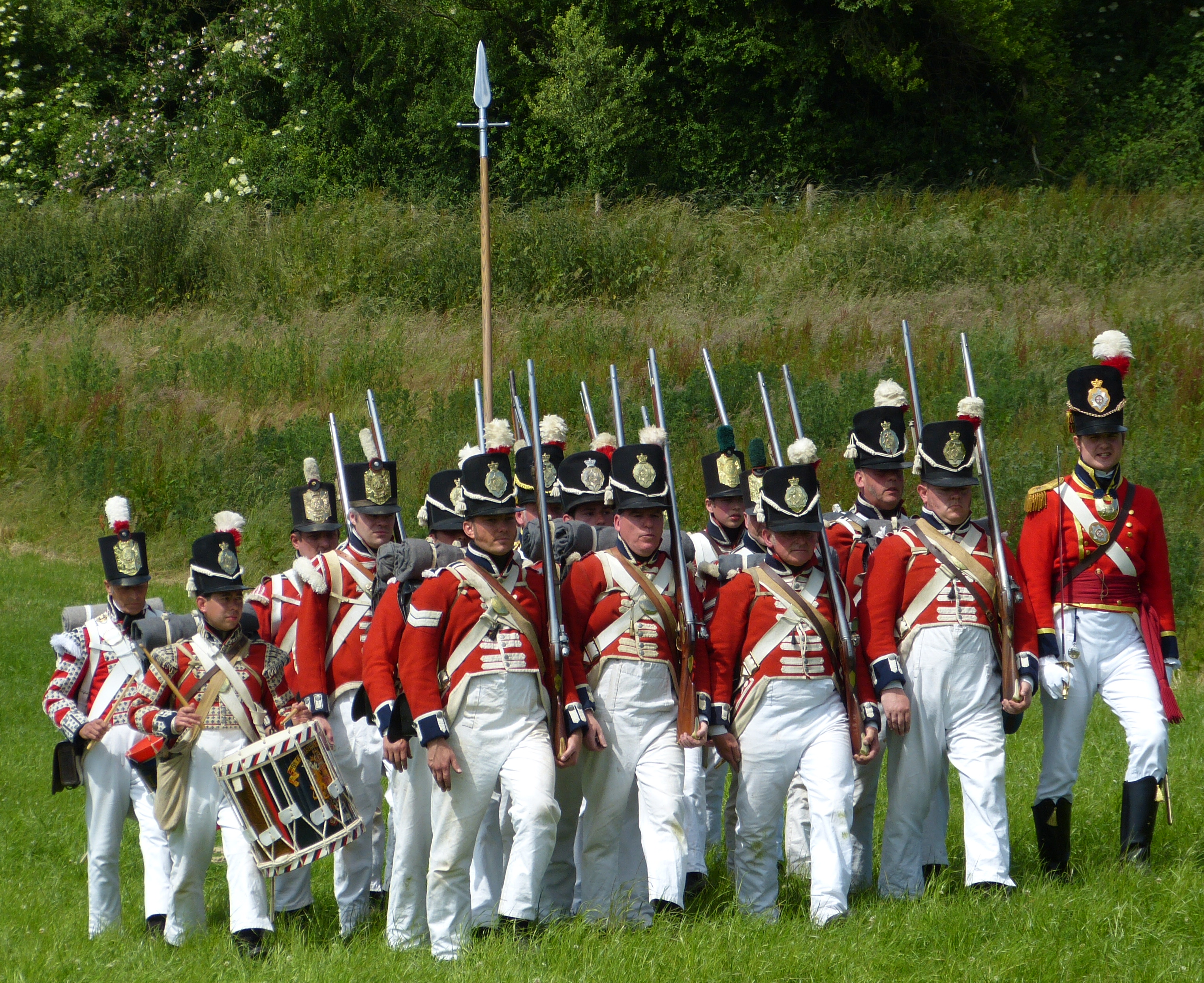
Reenactors at Chalke Valley history fair (2013)
Infantry

The bulk of the British Army in 1815 were foot soldiers. As such, they walked everywhere - or rather, marched, carrying everything they needed with them.

Rifleman Harris served in the British Army from 1802 to 1814. He recalled:

I am convinced that many of our infantry sank and died under the weight of their knapsacks...Besides my well-filled kit, there was the great-coat rolled on its top, my blanket and camp kettle, my haversack, stuffed full of leather for repairing the men’s shoes, together with a hammer and other tools, ship-biscuit and beef for three days. I also carried my canteen filled with water, my hatchet and rifle, and eighty rounds of ball cartridge in my pouch.2

Harris was no longer with the army in 1815, but he served as part of Wellington’s army in the Peninsula Wars.

Infantrymen were known as ‘red coats’, because of the colour of their jackets. They were armed with a musket and a bayonet. There were two battalions of rifles, which were more accurate than muskets.

Cavalry 

The Marquis of Anglesea wounded whilst leading a charge of heavy cavalry at the close of the Battle of Waterloo (1815) Print by M Dubourg after JA Atkinson (1815) Yale Center for British Art, Paul Mellon Collection
The Marquis of Anglesea wounded whilst leading a charge
of heavy cavalry at the close of the Battle of Waterloo
Print by M Dubourg after JA Atkinson (1815)
Being on horseback, the cavalry was the most glamorous unit in the British Army. They were also the shock troops, having both a height and speed advantage over foot soldiers.

Captain Charles Edward Radclyffe wrote:

The charge of the heavy cavalry in line was a magnificent sight, and I have every reason to believe they did everything to justify the high expectations their appearance had excited.3

Cavalry were armed with a sabre and a carbine, a light pistol.

Artillery

Waterloo battery - bronze 6-pounder seized at the Battle of Waterloo - Tower of London (2016)
Waterloo battery - bronze 6-pounder gun seized at the
Battle of Waterloo - Tower of London (2016)
The British infantry and cavalry of 1815 were supported by three different forms of artillery.

The first was the regular cannon, which typically fired either a solid ball or canister shot—smaller pieces of shot designed to damage infantry or cavalry. The cannon usually aimed directly at their target.

Gunner John Edwards of the Royal Horse Artillery wrote:

About half past 10 o’clock the French Imperial Guards dressed in steel armour back and breast plates, they weigh about 32 pounds, charged up the main road till they came within 600 yards they extended right and left of the road, we fired case shot at them and swept them off like a swathe of grass before a scythe.4

The second was the howitzer, a short-barrelled cannon angled upwards. These fired shot into the air, reaching targets behind obstacles.

The third was the Congreve rocket, a relatively new innovation that delivered mixed results. The rockets were easier to deploy and faster to fire than cannon, but they weren’t always the most effective.

Years after Waterloo, Henry Leathes recalled that a rocket launched during the battle opened a gap in the French ranks “probably from the novelty of such a pyrotechnique salute.”5

Bronze 3-pounder gun, 1815 at National Army Museum, London (2022)
Bronze 3-pounder gun, 1815
at National Army Museum, London (2022)

Supporting roles

Royal Engineers

The Royal Engineers were formed a century before 1815 to provide map-making, bridge building, fortifications and camp drainage systems. They also ran the Army’s postal service.

Initially the Royal Engineers comprised only officers, who would hire civilian labour or use private soldiers to perform the hands-on work of digging and building. However, by 1815 they had their own private soldiers, known as sappers.

Medical services

Saw used to amputate Lord Uxbridge's leg at the Battle of Waterloo (1815) On display in the National Army Museum, London (2022)
Saw used to amputate Lord Uxbridge's leg
at the Battle of Waterloo (1815)
On display in the National Army Museum, London (2022)
The British Army had various medical roles, from Deputy Inspectors of Hospitals to staff surgeons, orderlies and nurses. Most battalions had a medical officer and a couple of assistants.

There was no formal process for getting injured soldiers from the frontline to wherever the medical service was based.

Amputation of damaged limbs was a common procedure, with around 500 probably being performed during the Battle of Waterloo. The most well-known was the removal of Lord Uxbridge’s leg. These and other procedures were performed without anaesthetic.

Deputy Inspector John Hume wrote:

There was but one opinion amongst us, so having prepared the dressings etc, we returned into the room where I announced to Lord Uxbridge that the operation being found necessary the sooner it was performed the better.6

Civilians

A number of non-military personnel, typically women, followed the British Army of 1815. Many of  these camp followers were working class wives, widows and mothers who had some form of relationship with soldiers.

A number of wives were permitted to travel with their soldier husbands, both of commissioned and non-commissioned officers.

Other civilians included clerks, cooks and those associated with transport and supply activities.

Organisation of the British Army in 1815

As today, the British Army of 1815 was made up of many different regiments—there were well over 100. Every regiment has its own history, traditions, insignia and colours (flag). The oldest regiments trace their history back to the English Civil War in the mid-1600s

The Coldstream Guards hold the honour of being the oldest continuously serving regiment. It was formed in 1650, ten years before the British Army was founded by Charles II in 1660.

A regiment was made up of battalions, each numbering several hundred men. Some regiments had more than one battalion and these usually operated independently, rarely fighting together.

In 1815 most infantry regiments had been allocated a number and a county designation. The numbering indicated their seniority, or precedence, which was based on when and where they were founded.

This led to regiments having names such as:

  • 54th (West Norfolk) Regiment of Foot
  • 1st Life Guards
Some historic regiments were permitted to keep their name, such as:
  • Coldstream Guards
  • Royal Welch Fusiliers

A regiment was led by a colonel.

Ranks in the British Army of 1815

Most men entered the army by enrolling as a private soldier.

Many never progressed beyond the rank of private, but they were often referred to with a designation that represented the branch of the army they were part of, such as Trooper, Gunner, Sapper, Rifleman etc.

A private soldier could be promoted to a non-commissioned officer, such as a corporal or sergeant. 

A captain from A book explaining the ranks and dignitaries of British Society (1809)
A captain from A book explaining
the ranks and dignitaries of British Society
(1809)
A second route of entry into the army was the purchase of a commission. 

This allowed a man to join up as an officer, despite having no military experience or training. Because the commission had to be paid for, it ensured that most officers came from the upper levels of society.

Some soldiers were promoted from the ranks on merit, but it wasn’t very common.

Listing a hierarchy of ranks in 1815 isn’t as simple as it might appear. There were various forms of rank, and there were exceptions to all of these. It was possible for a specific captain to be senior to a specific major, depending on the positions they were serving in.

Another example would be a colonel given the rank of brigadier general while they were leading a brigade (a force comprising a number of battalions). Once that role was over, they went back to being a colonel.

Outline of ranks in the army

  • General
  • Lieutenant general
  • Major general
  • Brigadier general
  • Colonel - one per regiment, and not a rank that could be purchased.
  • Lieutenant Colonel - between one and three in a regiment.
  • Major
  • Captain
  • Lieutenant
  • Ensign/Cornet (Infantry/Cavalry)
  • Sergeant
  • Corporal
  • Private

Headshot of Rachel Knowles author with sea in background(2021)
Rachel Knowles writes clean/Christian Regency era romance and historical non-fiction. She has been sharing her research on this blog since 2011. Rachel lives in the beautiful Georgian seaside town of Weymouth, Dorset, on the south coast of England, with her husband, Andrew, who wrote this blog. 
 
Find out more about Rachel's books and sign up for her newsletter here.

If you have enjoyed this blog and want to encourage me and help me to keep making my research freely available, please buy me a virtual cup of coffee by clicking the button below.


 Notes

  1. Glover, Gareth (editor), The Waterloo Archive Volume I: British Sources (2010) p157, Captain Joseph Logan.
  2. Hibbert, Christopher (editor), The Recollections of Rifleman Harris (1970) p13.
  3. Glover, Gareth (editor), The Waterloo Archive Volume I: British Sources (2010) p23, Captain Charles Edward Radclyffe.
  4. Glover, Gareth (editor), The Waterloo Archive Volume I: British Sources (2010) p102, Gunner John Edwards, Royal Horse Artillery.
  5. Glover, Gareth (editor), The Waterloo Archive Volume I: British Sources (2010) p110, Henry Leathes.
  6. Glover, Gareth (editor), The Waterloo Archive Volume I: British Sources (2010) p215 Deputy Inspector John Hume

Sources used include:

Burnham, Robert and McGuigan, Ron, The Napoleon Series (2016)

Glover, Gareth (editor), The Waterloo Archive Volume I: British Sources (2010)

Hibbert, Christopher (editor), The Recollections of Rifleman Harris (1970)

Simonson, Sheila, Following the drum: British women in the Peninsular War (1981)

Sinclair, Joseph, A Soldier of the Seventy-first (2010)

All Things Liberty website 

British army website

British Military History website

Military History Matters website 

National Army Museum website 

Royal Armouries Collections website 

Photographs © RegencyHistory.net

Saturday, 7 January 2017

Wellington's Dearest Georgy by Alice Marie Crossland - a review

Front cover of Wellington's Dearest Georgy by Alice Marie Crossland

Who was Wellington’s ‘dearest Georgy’?

Every Regency historian has heard of the Duke of Wellington, but who was his ‘dearest Georgy’? In this new biography, author Alice Marie Crossland paints an engaging picture of the little-known Lady Georgiana Lennox and her intimate friendship with Arthur Wellesley, 1st Duke of Wellington. 

Lady Georgiana Lennox (1795-1891), known to her close friends as Georgy, was the third daughter of Charles Lennox, 4th Duke of Richmond, and his wife, Lady Charlotte Gordon. As well as her relationship with Wellington, Georgy’s other claim to fame is that her mother, the Duchess of Richmond, held a celebrated ball in Brussels on the eve of Waterloo.

A charming tale of friendship and romance

Georgy’s story appealed to me on many levels, not least because it had a happy ending. Crossland depicts Georgy as a vivacious, highly sociable lady who became the close friend of the Duke of Wellington when she was only a girl. It was an intimacy based on a shared wit and sense of humour and one that was deep enough to lead Wellington to give Georgy a miniature of himself on the eve of Waterloo. 
 
Perhaps if the Duke of Wellington had been unmarried, Georgy, although some 26 years his junior, would have become his duchess. As it was, their relationship appears to have remained platonic, and Georgy watched as his mistresses came and went, whilst she retained a special place in Wellington’s heart.

Arthur Wellesley, 1st Duke of Wellington  from Life of the Duke of Wellington by J E Alexander (1840)
Arthur Wellesley, 1st Duke of Wellington
from Life of the Duke of Wellington
by J E Alexander (1840)
The combination of Georgy’s infatuation with Wellington combined with the impoverished state of her family’s finances meant that Georgy struggled to find a husband. It was not until she was nearly 30 that she eventually fell in love and married. Her husband was William Fitzgerald-de Ros, a man whose elder brother Henry repeatedly scandalised society with his behaviour which included the disgrace of cheating at cards.
 
As the third son, William never expected to inherit the title, but after the death of both his elder brothers, he became 23rd Baron de Ros. William and Georgy had a happy marriage that lasted almost 50 years.

Crossland had a distinct advantage when writing this biography – the full support of Lady Georgiana Lennox’s descendant, Peter Maxwell, 28th Baron de Ros, who gave her access to the family papers.

Though perhaps not as technically well-written as the biography of another Regency-era woman that I read recently (Defiance - The Life and Choices of Lady Anne Barnard), I confess that I enjoyed this one more. Part of this was due to Crossland’s passion for her subject which spilled over into her writing.

Georgiana, Lady de Ros  from A sketch of the life of Georgiana,   Lady de Ros by Blanche Swinton (1893)
Georgiana, Lady de Ros
from A sketch of the life of Georgiana,
Lady de Ros by Blanche Swinton (1893)
Matters of presentation

I found the front cover of the book very appealing. My copy was a hybrid between a paperback and a hardback – a double carboard cover that gave a nice feel to the book although technically it was still a paperback. I feel, however, that some of the internal presentation let the book down. Little things, like having page numbers on the title page and blank pages, inconsistent gaps around dashes and hyphens, and speech marks that were formatted inconsistently. 

Matters of fact

The story was interesting and engaging, but it would have benefitted from additional editing. A few inconsistencies and inaccuracies crept into the text that tighter editing would, hopefully, have noticed. I know how hard it is to get all the facts right. I have just written my first history book (What Regency Women Did For Us) and I freaked out when I discovered a couple of glaring errors at the final proofreading stage.

I don’t think that it is fundamental that Georgy would have been 11 years old rather than 9 when her father became duke as stated in the text. Nor is the inconsistent representation of the character of Georgy’s husband, William Fitzgerald-de Ros. When he is first introduced into the story, William is described along with his brother Henry as being a hard-drinking, womanising man, but later Crossland draws a sharp contrast between the wild Henry and his reliable brother William.

I was, however, somewhat surprised to read that Georgy and her sisters were presented at court in 1813 and that her sister Sarah had dialogue with George III. Why? Because this was during the Regency and the mentally unstable king would have been shut up in Windsor Castle by this time.

I have some sympathy with the author as I followed her notes to the source – A Sketch of the Life of Georgiana, Lady de Ros, by her daughter, Blanche Swinton. Crossland was perpetuating someone else’s error. It is a warning to all us historians not to take everything we read as fact. I wrote a blog post about an illustration of a ball at Almack’s that was dated 1815 and how it just could not be correct. Although it was reasonable to assume that Georgy’s daughter knew what she was writing about, the dates had clearly got muddled, and a little sense checking would have revealed her mistake. Having a beta reader or editor who is familiar with your period of history helps eradicate errors like this.

Indexing is important

I don’t know how many reviews look at a book’s index, but for a non-fiction book, this is an important area. If a historical biography is going to be a useful research tool, it needs to have a good index. I hope I never want to look up anything specific in this book in the future as the index is not very helpful. Not even the bigger entries like those for Georgy and Wellington are broken down into any sub-sections – not very user-friendly.

An enjoyable read about Regency life

In conclusion, I found Wellington’s Dearest Georgy an enjoyable read about Regency life which would have been even better with some additional editing.

Headshot of Rachel Knowles author with sea in background(2021)
Rachel Knowles writes clean/Christian Regency era romance and historical non-fiction. She has been sharing her research on this blog since 2011. Rachel lives in the beautiful Georgian seaside town of Weymouth, Dorset, on the south coast of England, with her husband, Andrew.

Find out more about Rachel's books and sign up for her newsletter here.

If you have enjoyed this blog and want to encourage me and help me to keep making my research freely available, please buy me a virtual cup of coffee by clicking the button below.


Sources used:
Crossland, Alice Marie, Wellington's Dearest Georgy - The Life and Loves of Lady Georgiana Lennox (Universe Press, 2016)
Swinton, Blanche, A sketch of the life of Georgiana, Lady de Ros: with some reminscences of her family and friends, including the Duke of Wellington (1893)

Tuesday, 23 June 2015

What happened to Napoleon's carriage?

The capture of Napoleon's carriage after the Battle of Waterloo  from Ackermann's Repository (1816)
The capture of Napoleon's carriage after the Battle of Waterloo
from Ackermann's Repository (1816)
How Napoleon’s carriage came to London

Napoleon’s carriage was captured by Major Von Keller at Genappe on the night of 18 June 1815 as Napoleon fled the battlefield of Waterloo. The Prussian Major “reserved the carriage as his own booty” and “brought it to England to gratify the curiosity of the people of this country, who have now an opportunity of viewing it at the London Museum, Piccadilly.”1

It is not clear whether the carriage was sold to the British government by the Prussians or sent as a present to the Prince Regent.

According to the Literary Panorama (1815):
The splendid carriage taken at the battle of Waterloo which was fitted up in a most magnificent style, for Buonaparte, was taken while waiting for the Ex-Emperor: the driver was killed by a Prussian general and Major. It was sent as a present to the Prince Regent, with the four horses which were attached to it, and a French driver accompanied it.2
However, the Monthly Magazine (1816) said: 
It was taken by the Prussians, sold to Government, and re-sold,—lent to Mr Bullock as a Prussian trophy. Mr Bullock’s room constantly filled with company, and at least a hundred thousand persons have already gratified themselves by sitting in the very chariot which once held Napoleon le Grand.3
Mr Bullock's London Museum, Piccadilly  from Ackermann's Repository (1815)
Mr Bullock's London Museum, Piccadilly
from Ackermann's Repository (1815)
Either way, the carriage came to England and was sold (or lent) to Mr Bullock. It went on display at his London Museum, at the Egyptian Hall, Piccadilly, and then, at the Prince Regent’s desire, went on tour throughout England, Scotland and Ireland. The carriage excited a good deal of interest and it was estimated that Mr Bullock made in excess of £26,000 from the exhibition!

The popularity of the exhibition at Bullock’s Museum was caricatured in Rowlandson’s print, shown below. 

Exhibition at Bullocks Museum of Bonepartes Carriage taken at Waterloo by Thomas Rowlandson, published by  R Ackermann (1816)  © The Trustees of the British Museum
Exhibition at Bullocks Museum of Bonepartes Carriage
taken at Waterloo
by Thomas Rowlandson, published by
R Ackermann (1816)  © The Trustees of the British Museum
What was the carriage like?

There was a detailed description of the carriage included with the print shown at the top of this post which appeared in Ackermann’s Repository (1816):

The exterior
The exterior of the carriage is, in many respects, very like the modern English travelling chariots. The colour is a dark blue, with a handsome bordure ornament in gold; but the Imperial arms are emblazoned on the pannels of the doors. It has a lamp at each corner of the roof, and there is one lamp fixed at the back which can throw a strong light into the interior.1
It claimed that “the pannels of the carriage are bullet-proof” and stated that “the under-carriage and wheels are painted in vermillion, edged with the colour of the body, and heightened with gold.”
On the outside of the front windows is a roller-blind made of strong painted canvass: when pulled down, this will exclude rain and snow, and therefore secure the windows and blinds from being blocked up, as well as prevent the damp from penetrating.1
The interior
The interior deserves particular attention; for it is adapted to the various purposes of a kitchen, a bed-room, a dressing-room, an office, and an eating-room.
Among the gold articles are a tea-pot, coffee-pot, sugar-bason, cream-ewer, coffee-cup and saucer, slop-bason, candle-sticks, wash-hand-bason, plates for breakfast, &c. Each article is superbly embossed with the Imperial arms, and engraved with his favourite N.; and by the aid of the lamp, any thing could be heated in the carriage.
Beneath the coachman’s seat is a small box about two feet and a half long, and about four inches square; this contains a bedstead of polished steel, which could be fitted up within one or two minutes.
Other items in the carriage included “a small mahogany case” containing “the peculiar necessaire of the ex-emperor” - “nearly one hundred articles, almost all of them solid gold”; a liquor-case; and a writing desk.

Exhibited at Madame Tussaud’s

After the tour, the carriage and its contents were sold by auction and bought by someone who wanted to exhibit them in America. Unable to realise his intentions, it was sold again and then taken by a coach maker as part payment of a bad debt! In 1842, this company sold it to Madame Tussaud and Sons where it formed part of a special exhibition about Napoleon.

An advertisement in The Times (1843) stated:
Napoleon’s celebrated military carriage, taken at Waterloo, room magnificently fitted to show the decorations of his period, engravings of his history, splendid bust by Canova, the cloak he wore at Marenge, the sword of Egypt, the standard given to his guards, his watch, gold snuff box, ring, one of this teeth, the instrument that drew it, tooth-brush, Madras worn in exile, dessert service used by him at St Helens, counterpane stained with his blood: the greater part late the property of Prince Lucien – Madame Tussaud and Son’s Exhibition, Bazaar, Baker-Street: open from 11 till dusk, and from 7 till 10. Great room, 1s; Napoleon relics and chamber of horrors, 6d.4
Napoleon from The Life  of Field-Marshal His Grace the Duke  of Wellington by WH Maxwell (1852)
Napoleon from The Life 
of Field-Marshal His Grace the Duke
 of Wellington by WH Maxwell (1852)
The end of the road for Napoleon’s carriage

The carriage was exhibited at Madame Tussaud's until 18 March 1925 when fire swept through the waxworks. A report in The Times declared that:
Madame Tussaud’s, the famous waxworks exhibition, which for generations has had a great fascination for visitors from every land, is no more.
Of the most treasured possessions of the exhibition, the Napoleonic relics, only scrap iron remains to suggest the coach in which the Emperor rode at Waterloo.
The owner, John Tussaud, commented that:
You cannot put a price on the Napoleonic relics…which cannot be replaced. I consider many of the most valuable things in the collection have been destroyed. They include Napoleon’s three coaches—the Waterloo coach, the carriage he used at St Helena, and the coach he is said to have used on the occasion of his coronation at Milan.5
And so Napoleon’s carriage met a sad end, consumed by flames, 110 years after the Battle of Waterloo at which it was captured.

Fortunately, some of the items captured from Napoleon’s baggage train did survive and a number of them were on display at Windsor Castle in the Waterloo at Windsor 1815-2015 exhibition.

Notes
(1) From Ackermann’s Repository (Feb 1816).
(2) From Literary Panorama (Dec 1815) as quoted in The Military Carriage printed for Madame Tussaud and Sons (1843).
(3) From the Monthly Magazine (July 1816) as quoted in The Military Carriage printed for Madame Tussaud and Sons (1843).
(4) From The Times Digital Archive for 8 Apr 1843 accessed 6 Feb 2015 © Times Newspapers Ltd – transcribed by me.
(5) From The Times Digital Archive for 20 Mar 1925 accessed 6 Feb 2015 © Times Newspapers Ltd – transcribed by me.

Headshot of Rachel Knowles author with sea in background(2021)
Rachel Knowles writes clean/Christian Regency era romance and historical non-fiction. She has been sharing her research on this blog since 2011. Rachel lives in the beautiful Georgian seaside town of Weymouth, Dorset, on the south coast of England, with her husband, Andrew.

Find out more about Rachel's books and sign up for her newsletter here.

If you have enjoyed this blog and want to encourage me and help me to keep making my research freely available, please buy me a virtual cup of coffee by clicking the button below.

Sources used include:
Ackermann’s Repository (1815-1816)
The Military Carriage of Napoleon Bonaparte, taken after the Battle of Waterloo, printed for Madame Tussaud and Sons (1843)

British Museum website
The Times Digital Archive

Thursday, 18 June 2015

In the shadow of the Battle of Waterloo - three days in June: part 3 - 18 June 1815

The Battle of Waterloo in The wars of Wellington, a narrative poem  by Dr Syntax illustrated by W Heath and JC Stadler (1819)
The Battle of Waterloo in The wars of Wellington, a narrative poem
by Dr Syntax illustrated by W Heath and JC Stadler (1819)
For two days, Friday 16 and Saturday 17 June 1815, the population of Brussels, including many visitors from England, had endured painful uncertainty. They could hear the sounds of cannon to the south and knew that Wellington's army was engaging the French under Napoleon. But it was far from clear who had the upper hand.


What these thousands of civilians feared most was that victorious French troops would enter, and ransack, the city.

An anonymous observer of events in the city later published an account of their experience, offering us a vivid insight into what it was like for civilians during the Battle of Waterloo.

Decisive charge at Waterloo by A Cooper engraved by P Lightfoot  from The Life of Field-Marshal His Grace the Duke of Wellington  by WH Maxwell (1852)
Decisive charge at Waterloo by A Cooper engraved by P Lightfoot
from The Life of Field-Marshal His Grace the Duke of Wellington
by WH Maxwell (1852)
Day 3: Sunday 18 June 1815

“On Sunday the terror and confusion reached its highest point.” After two uncomfortable nights for Brussels, probably sleepless for many, “news arrived of the French having gained a complete victory, and it was universally believed.”1

Panic swept through the baggage train at the rear of the British army, and a torrent of frightened people fled into Brussels, leaving a trail of “broken and overturned waggons – heaps of abandoned baggage – dead horses, and terrified people.”1

Surrounded by this chaos, everyone in Brussels was desperate for news.
Ladies accosted men they had never seen before, without preface or apology, with eager questions. Strangers conversed together like friends – every body addressed each other without hesitation, and English reserve seemed no longer to exist.1
Despite all the questions, there were no answers. The dreadful overture of battle, the distant rumble of cannon fire, again played in the background throughout the day. Their nerves shredded by three days of suspense, “constant agitation and fluctuating hopes”, the population who chose to stay, or could not flee, had no choice but to wait. Just a few miles away, one of the most celebrated battles in European history was being fought in the fields, woods and hedgerows of Waterloo.

Finally, at around 9pm, “some wounded officers arrived on horseback from the field, bringing the dreadful news, that the battle was lost!” This prompted a fresh exodus away from the city, and the sense of foreboding deepened as carriages filled with wounded rolled into the city.

Lieutenant-General Sir Thomas Picton  - one of the officers who died at the Battle of Waterloo  from The Life of Field-Marshal His Grace the Duke of Wellington  by WH Maxwell (1852)
Lieutenant-General Sir Thomas Picton
- one of the officers who died at the Battle of Waterloo
from The Life of Field-Marshal His Grace the Duke of Wellington
by WH Maxwell (1852)
Reliable news at last!

Finally, at around 3am on Monday 19 June 1815, an official message arrived from Waterloo
...containing a brief account of the victory. A party of wounded Highlanders, who had found their way on foot from the field of battle, no sooner heard the news, than, regardless of their sufferings, they began to shout and huzza with the most vociferous demonstrations of joy.1
The ‘near observer’ who recorded this account soon paid a personal visit to the battlefield.
Every tree in the wood of Hougoumont is pierced with cannon-balls – in one alone, I counted the holes, where upwards of twenty had lodged.1
The mixture of relief and disgust engendered by a trip to the battlefield so soon after the conflict is hard to imagine.
Wild flowers are still blooming, and wild raspberries ripening beneath their shade; while huge black piles of human ashes, dreadfully offensive in smell, are all that now remain of the heroes who fought and fell upon this fatal spot.1
Horse Guards at the Battle of Waterloo from Historic, military and   naval anecdotes of particular incidents by E Orme & illustrated   by Heath & Dubourg (1819)
Horse Guards at the Battle of Waterloo from Historic, military and 
naval anecdotes of particular incidents by E Orme & illustrated
 by Heath & Dubourg (1819)
A summary of the events on Sunday 18 June

Following two days of smaller military engagements, Napoleon and Wellington faced one another on the battlefield for the first and only time. The Battle of Waterloo began at around midday and continued into the long June evening, both sides bitterly contesting the battlefield in a bid to break the other. Many of those present later recorded that it was the most ferocious battle they had ever experienced.

In early evening the Prussian army under Blucher, defeated by the French two days earlier, arrived to support the struggling Allied army led by Wellington. Napoleon made a final assault with his Imperial Guard, undefeated in all their previous engagements. They were broken and their defeat signalled the end to the French, who fled the battlefield.

The meeting of Wellington and Blucher at La Belle Alliance in  The wars of Wellington, a narrative poem  by Dr Syntax illustrated by W Heath and JC Stadler (1819)
The meeting of Wellington and Blucher at La Belle Alliance in
The wars of Wellington, a narrative poem
by Dr Syntax illustrated by W Heath and JC Stadler (1819)
While not the last battle between the French and the Allies, Waterloo was effectively the end of Napoleon's campaign. He raced back to Paris, but discovered he had little support and on 15 July, at Rochefort on the French coast, he gave himself up to a British warship. He hoped to be allowed to travel to America, or make a quiet home in England, but was instead exiled to the distant island of St Helena. 
List of dead and wounded at the Battle of Waterloo  from The Life of Field-Marshal His Grace the Duke of Wellington  by WH Maxwell (1852)
List of dead and wounded at the Battle of Waterloo
from The Life of Field-Marshal His Grace the Duke of Wellington
by WH Maxwell (1852)

Headshot of Rachel Knowles author with sea in background(2021)
Rachel Knowles writes clean/Christian Regency era romance and historical non-fiction. She has been sharing her research on this blog since 2011. Rachel lives in the beautiful Georgian seaside town of Weymouth, Dorset, on the south coast of England, with her husband, Andrew, who wrote this post.

Find out more about Rachel's books and sign up for her newsletter here.

If you have enjoyed this blog and want to encourage me and help me to keep making my research freely available, please buy me a virtual cup of coffee by clicking the button below.


Note
(1) All quotes from The Battle of Waterloo by a near observer (1815).

Sources used include:
Booth, J (publisher), The Battle of Waterloo by a near observer (1815)
Maxwell, William Hamilton, Life of Field-Marshal His Grace the Duke of Wellington in three volumes (1852)

Wednesday, 17 June 2015

In the shadow of the Battle of Waterloo - three days in June: part 2 - 17 June 1815

The Battle of Waterloo  from Historic, military and naval anecdotes of particular incidents by E Orme & illustrated by JA Atkinson (1819)
The Battle of Waterloo from Historic, military and naval anecdotes
of particular incidents by E Orme & illustrated by JA Atkinson (1819)
On Friday 16 June 1815, the city of Brussels listened in fear and awe to the sound of distant cannon fire. The British and their allies had marched from the city in the early hours to face the advancing French under Napoleon.


All day rumours and reports from the nearby battlefields reached the increasingly nervous inhabitants, who feared that a French victory would see their city sacked by the French. Few went to bed easily that Friday night.

An anonymous observer of events in the city later published an account of their experiences, offering us a vivid insight into what is was like for a civilian during the three days of the Waterloo campaign.

Napoleon from The Life of Field-Marshal His Grace the Duke of Wellington by WH Maxwell (1852)
Napoleon from The Life 
of Field-Marshal His Grace the Duke
 of Wellington by WH Maxwell (1852)
Day 2: Saturday 17 June 1815

Not long after midnight, the population of Brussels, mainly Belgian but swollen by the many British who accompanied the army, was disturbed once more. This time it was by “the rolling of heavy carriages, in long succession, passing rapidly through the Place Royale.”1

Rising to enquire what was happening, the ‘near observer’ who recorded an account met a panic-stricken chambermaid, who insisted that the French were within half an hour of taking the city. “At the bottom of the stairs, a group of the affrighted Belgians were assembled - consternation pictured on their faces.”

The alarm subsided, for now, when they realised the wagons were artillery heading towards, not away, from the battlefields to the south of the city. But fresh panic swept in at 6am when Belgian cavalry galloped through the streets “at full speed, as if the enemy were at their heels.”1
The doors of all the bed-rooms open - the people flew out with their night-caps on, scarcely half dressed and looking quite distracted, running about pale and trembling.1
Retreat from Waterloo by J Gilbert engraved by AW Warren  from The Life of Field-Marshal His Grace the Duke of Wellington  by WH Maxwell (1852)
Retreat from Waterloo by J Gilbert engraved by AW Warren
from The Life of Field-Marshal His Grace the Duke of Wellington
by WH Maxwell (1852)
Flight from the fight

The nervous made hasty preparations to flee.
In the court-yard below, a scene of the most dreadful confusion ensued; the scuffle that took place to get at the horses and carriages it was impossible to describe; the squabbling of masters and servants, ostlers, chambermaids, coachmen and gentlemen.1
Yet again, this disorder was followed by news, from an aide-de-camp of the Duke of Wellington, that the British army was in good order and more fighting was to be expected.

Illustration from The Life of Field-Marshal His Grace the Duke of Wellington by WH Maxwell (1852)
Illustration from The Life of Field-Marshal
His Grace the Duke of Wellington
by WH Maxwell (1852)
The grim reality of war soon became evident on the streets, as wagons filled with injured troops began to arrive, along with the bodies of those who had died during the journey.
Numbers of wounded who were able to walk, were wandering upon every road; their blood-stained clothes and pale haggard countenances looking most dreadful.1
These terrible sights were accompanied by accurate reports that Wellington had retreated towards Brussels, as part of a tactical game of cat and mouse with the enemy. But
...nobody could convince the Belgians that a retreat and a flight were not one and the same thing; and firmly convinced that the English had been defeated, they fully expected every moment to see them enter Brussels in the utmost confusion, with the French after them.1
The sense of panic intensified on what must have been a sultry afternoon. “Every hour only served to add to the dismay.” The fearful were offering huge sums of money for a horse on which to escape the city, and many left on foot or in canal boats.

The weather broke later that day, with a “violent thunderstorm”. As night fell, the frightened city and the armies in the field were lashed by “torrents of rain”.
Illustration from The Life of Field-Marshal His Grace the Duke of Wellington by WH Maxwell (1852)
Illustration from The Life of Field-Marshal
His Grace the Duke of Wellington
by WH Maxwell (1852)
A summary of the events on Saturday 17 June

After the battles of Friday, the French and British armies spent Saturday positioning themselves for another fight the following day. The heavy rain that soaked the ground at Waterloo, making movement difficult, is considered to be one of the factors turning the final battle in favour of the British.

Read about the Battle of Waterloo in the final post of the series.

Headshot of Rachel Knowles author with sea in background(2021)
Rachel Knowles writes clean/Christian Regency era romance and historical non-fiction. She has been sharing her research on this blog since 2011. Rachel lives in the beautiful Georgian seaside town of Weymouth, Dorset, on the south coast of England, with her husband, Andrew, who wrote this post.

Find out more about Rachel's books and sign up for her newsletter here.

If you have enjoyed this blog and want to encourage me and help me to keep making my research freely available, please buy me a virtual cup of coffee by clicking the button below.


Note
(1) All quotes from The Battle of Waterloo by a near observer (1815).

Sources used include:
Booth, J (publisher), The Battle of Waterloo by a near observer (1815)
Maxwell, William Hamilton, Life of Field-Marshal His Grace the Duke of Wellington in three volumes (1852)