Search this blog

Showing posts with label Peninsular war. Show all posts

Friday, 17 March 2023

A quick guide to the Napoleonic Wars and the Great War against France (1792-1815)

The Battle of Waterloo in The wars of Wellington, a narrative poem by Dr Syntax illustrated by W Heath and JC Stadler (1819)
The Battle of Waterloo in The wars of Wellington, a narrative poem
by Dr Syntax illustrated by W Heath and JC Stadler (1819)
Rachel writes: I don’t do military history, but as a Regency romance author, it’s impossible to ignore the war with France that raged during the opening years of the 19th century. If I want to make a soldier the hero of a Regency romance, I can’t afford to be completely ignorant about the Napoleonic Wars or was it the Peninsular War or the War of the Something-or-other Coalition…?

I confess to have got somewhat confused about the war with France, and in the name of historical accuracy, I would at least like to try to refer to the war correctly in my novels. Fortunately, my husband does like military history, and as he has a better understanding of the Great War with France, he wrote this blog to help me understand it. I thought others might find it helpful too.

The Great War against France

It’s really easy to get confused about the various wars with France that raged outside Regency-era England. It’s also easy to make silly mistakes in your writing, by using the wrong names for the various wars, campaigns and even battles.

This guide should help you make more sense of what was going on where, and what to call it.

Britain1 was at war with France for around 23 years—almost a quarter of a century. That’s most of Jane Austen’s adult life, from when she was a teenager to just two years before she died.

When people talk about the ‘war with France’ at this time, they could mean one of several different wars. They were all sparked by the French Revolution in 1789.

Napoleon Bonaparte from The Life of Napoleon,
Emperor of the Frenc
h by Sir Walter Scott (1871)

The Coalition Wars

The French Revolution shocked the rulers of other European countries. Relations between the revolutionaries in France and their neighbours broke down, initiating the first of several wars.

The first two Coalition Wars are also known as the French Revolutionary wars, because France was under a revolutionary government. The later Coalition Wars are part of the Napoleonic wars, because Napoleon Bonaparte governed France.

Coalition, meaning temporary alliance, is the name given to these. That’s because each war involved an alliance of different European nations.

Admiral Lord Nelson after the painting by John Hoppner in Miller's edition of Robert Southey's Life of Nelson (1896)
Admiral Lord Nelson after the painting by John Hoppner
in Miller's edition of Robert Southey's Life of Nelson (1896)

The French Revolutionary Wars

War of the First Coalition 1792–1797

France declared war on Austria in April 1792, and then on Britain and the Netherlands in February 1793.

Britain, the Netherlands, Spain, Prussia, the Holy Roman Empire (much of central Europe) and various smaller nations formed an alliance against France. Over time, different nations dropped out, making their own peace deals with France.

France captured the Netherlands and turned it into the Batavian Republic.

It included the only battle of the Revolutionary Wars fought in Britain, near Fishguard in Wales, where a small French invasion force was quickly defeated 22–24 February 1797.

The war ended in October 1797, although Britain did not make a peace treaty.

War of the Second Coalition 1798–1802

Britain, Russia, Portugal, the Holy Roman and Ottoman Empires, with other smaller countries, again took on France in a series of campaigns all over the continent, and in Egypt.

This war saw Nelson defeat a French fleet at the Battle of the Nile, on 1–2 August 1798.

The Battle of the Nile from Horatio Nelson and  the Naval Supremacy of England by W Clark (1890)
The Battle of the Nile from Horatio Nelson and 
the Naval Supremacy of England by W Clark (1890)
Again, countries made their own peace with the French. Britain signed a peace treaty on 25 March 1802—the Treaty of Amiens.

End of the French Revolutionary Wars

The peace of March 1802 initiated the longest period of peace during the long years of war with France.

It also marks the end of the French Revolutionary wars. In 1799 Napoleon had effectively become ruler of France. In 1802 he became ruler for life, and in 1804 he crowned himself Emperor of France.

The peace lasted just 14 months, with Britain declaring war on France in May 1803. Britain faced France alone from 1803 to 1805, during which time the French threatened to launch an invasion.

The Napoleonic Wars

War of the Third Coalition 1805–1806

Britain, Russia, Sweden and the Holy Roman Empire, plus smaller states, allied against France. This war includes the Battle of Trafalgar on 21 October 1805, where Nelson defeated a French and Spanish fleet.

The Battle of Trafalgar from Horatio Nelson and the  Naval Supremacy of England by W Clark (1890)
The Battle of Trafalgar from Horatio Nelson and the 
Naval Supremacy of England by W Clark (1890)
Just a few weeks later, on 2 December 1805, Napoleon crushed the armies of the Emperors of Russia and Austria at the battle of Austerlitz. The war effectively ended, although there was no peace agreement with Britain or Russia.

War of the Fourth Coalition 1806–1807

Britain, Prussia, Russia, Saxony and Sweden again allied themselves against France. French military successes soon reduced the alliance to Britain and Sweden. Russia swapped sides, declaring war on Britain.

With most of Europe under his control, Napoleon turned his eyes to Portugal, still an ally with Britain. In late 1807 he sent an army to capture its ports, thereby initiating the Peninsular Wars. These are separate from the Coalition Wars.

Napoleon Bonaparte from The Life of Napoleon Bonaparte by W Sloane (1896)
Napoleon Bonaparte from The Life of
Napoleon Bonaparte
by W Sloane (1896)

War of the Fifth Coalition 1809

Britain, Austria, Sardinia and Sicily joined forces, with Austria fighting back after its huge defeat at Austerlitz. This war saw the British launch the Walcheren campaign, in an attempt to support the Austrians by invading the Netherlands. It failed and the war ended with Austria’s defeat at Wagram.

War of the Sixth Coalition 1813–1814

Britain, Prussia, Austria, Russia, Spain, Portugal, Sweden and other smaller states formed an alliance that defeated Napoleon.

The allies took advantage of France being weakened by the failed invasion of Russia in 1812 and the ongoing Peninsular Wars.

The allies captured Paris on 31 March 1814 and Napoleon was sent into exile on the island of Elba.

War of the Seventh Coalition 1815

Also known as the Hundred Days, this was the final campaign of the Napoleonic Wars, prompted by Napoleon’s escape from exile on Elba in February 1815.

It led to Napoleon being defeated at the Battle of Waterloo on 18 June 1815  and surrendering himself soon after, on 15 July 1815. He was sent into exile on the remote island of St Helena.

The Battle of Waterloo from Historic, military and naval anecdotes of particular incidents by E Orme & illustrated by JA Atkinson (1819)
The Battle of Waterloo from Historic, military and naval anecdotes
of particular incidents by E Orme & illustrated by JA Atkinson (1819)
A huge number of nations allied against France, including Britain, Prussia, Austria, the Netherlands, Russia, Portugal, Spain, Sweden and Switzerland.

The Peninsular War 1807–1814

This war overlapped with the fifth and sixth Coalition Wars. It saw Britain and Portugal, and later Spain, taking on the French. The name comes from its location on the Iberian Peninsula.

This war began with the Corunna campaign, with the British being driven out of Spain in early 1808. However, under Arthur Wellesley, later 1st Duke of Wellington, the British soon returned to Portugal. They launched a series of campaigns that eventually drove the French back to their own country.

Arthur Wellesley, 1st Duke of Wellington © Rachel Knowles - own collection
Arthur Wellesley, 1st Duke of Wellington
© Rachel Knowles - own collection

The French invasion of Russia 1812

The peace made between France and Russia in 1807, after the War of the Fourth Coalition, was breaking down. Napoleon launched a massive invasion of Russia, but it failed.

This war has other names. Napoleon himself called it the Second Polish War.

The failure of the invasion, and the decimation of the French army, helped encourage the formation of another alliance against France, leading to the War of the Sixth Coalition.

Headshot of Rachel Knowles author with sea in background(2021)
Rachel Knowles writes faith-based Regency romance and historical non-fiction. She has been sharing her research on this blog since 2011. Rachel lives in the beautiful Georgian seaside town of Weymouth, Dorset, on the south coast of England, with her husband, Andrew, who has written this post.

Find out more about Rachel's books and sign up for her newsletter here.

If you have enjoyed this blog and want to encourage us and help us to keep making our research freely available, please buy us a virtual cup of coffee by clicking the button below.

Note

  1. I have used the term Britain throughout for simplicity. Until 1801, Britain was known as the Kingdom of Great Britain. From 1801 onwards, Ireland joined the union and Britain became known as the United Kingdom of Great Britain and Ireland.

Friday, 1 July 2022

A Regency History guide to the British Army in 1815

The Battle of Waterloo from The wars of Wellington, a narrative poem by Dr Syntax, illustrated by W Heath & JC Stadler (1819)
The Battle of Waterloo from The wars of Wellington, a narrative poem
by Dr Syntax, illustrated by W Heath & JC Stadler (1819)
Such carnage I never before beheld. The firing of guns etc was so great that the man next to me could not hear my orders.

Captain Joseph Logan, 2nd Battalion 95th Foot, writing from Paris a month after the Battle of Waterloo.1

Captain Logan was one of the thousands of British soldiers on the battlefield that June day in 1815.

Every one of those thousands of soldiers could tell their own tale of British Army life. They’d have stories of how they were recruited, of hours of drill and practice, of travelling to new places and of strict regulations and tough discipline. 

You can read more about the Battle of Waterloo here.

Like Captain Logan, many would also have graphic stories from battlefields in India, North and South America, Portugal and Spain and, of course, the rolling Belgian countryside at Waterloo.

The British Army of 1815 had been honed by years of active confrontation and battle, most recently with France, in the Revolutionary and Napoleonic wars.

Infantry, Cavalry, Artillery and More

There were many different types of soldier in the British Army of 1815. Each type performed a different function, both on and off the battlefield.

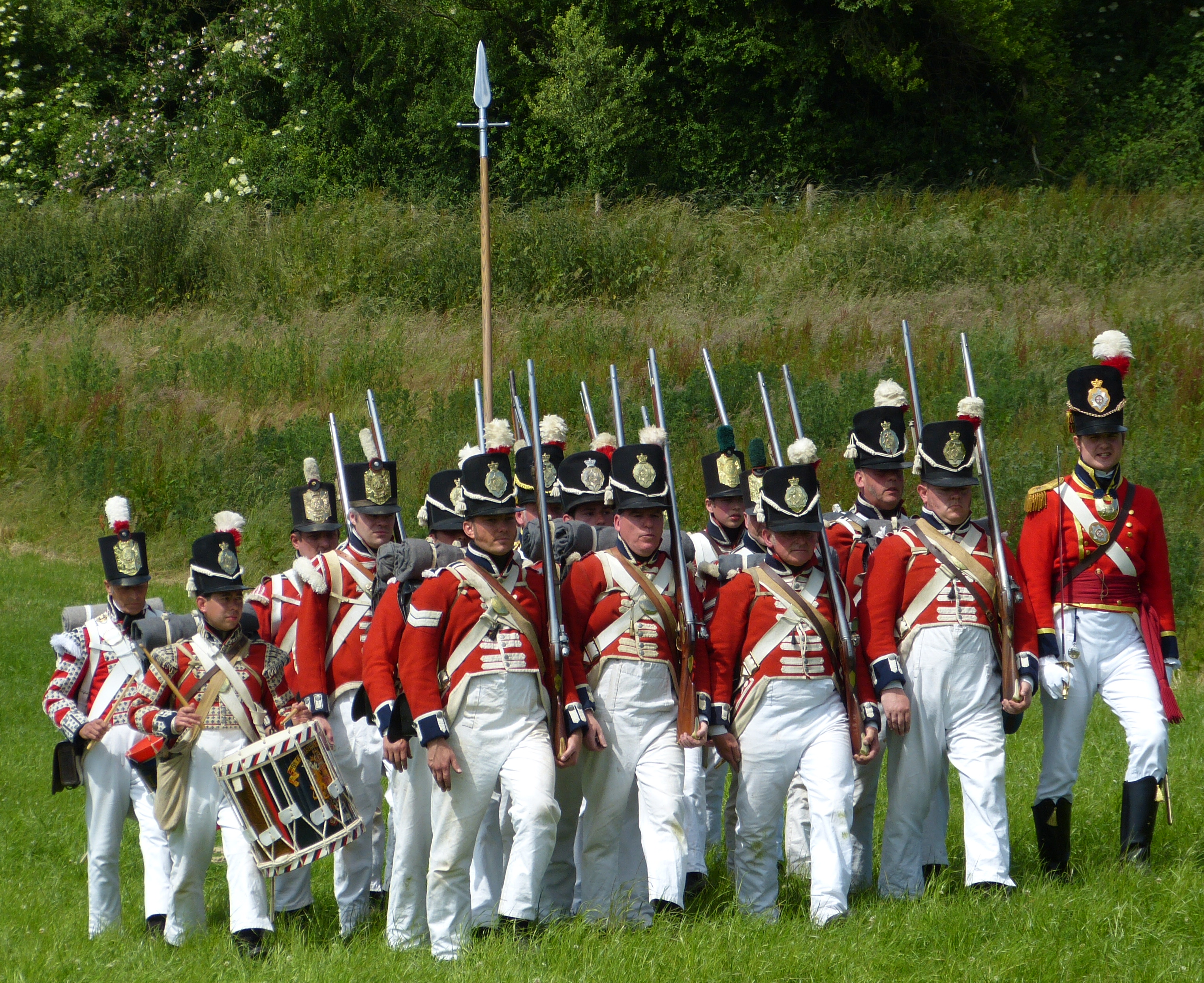
Reenactors at Chalke Valley history fair (2013)
Infantry

The bulk of the British Army in 1815 were foot soldiers. As such, they walked everywhere - or rather, marched, carrying everything they needed with them.

Rifleman Harris served in the British Army from 1802 to 1814. He recalled:

I am convinced that many of our infantry sank and died under the weight of their knapsacks...Besides my well-filled kit, there was the great-coat rolled on its top, my blanket and camp kettle, my haversack, stuffed full of leather for repairing the men’s shoes, together with a hammer and other tools, ship-biscuit and beef for three days. I also carried my canteen filled with water, my hatchet and rifle, and eighty rounds of ball cartridge in my pouch.2

Harris was no longer with the army in 1815, but he served as part of Wellington’s army in the Peninsula Wars.

Infantrymen were known as ‘red coats’, because of the colour of their jackets. They were armed with a musket and a bayonet. There were two battalions of rifles, which were more accurate than muskets.

Cavalry 

The Marquis of Anglesea wounded whilst leading a charge of heavy cavalry at the close of the Battle of Waterloo (1815) Print by M Dubourg after JA Atkinson (1815) Yale Center for British Art, Paul Mellon Collection
The Marquis of Anglesea wounded whilst leading a charge
of heavy cavalry at the close of the Battle of Waterloo
Print by M Dubourg after JA Atkinson (1815)
Being on horseback, the cavalry was the most glamorous unit in the British Army. They were also the shock troops, having both a height and speed advantage over foot soldiers.

Captain Charles Edward Radclyffe wrote:

The charge of the heavy cavalry in line was a magnificent sight, and I have every reason to believe they did everything to justify the high expectations their appearance had excited.3

Cavalry were armed with a sabre and a carbine, a light pistol.

Artillery

Waterloo battery - bronze 6-pounder seized at the Battle of Waterloo - Tower of London (2016)
Waterloo battery - bronze 6-pounder gun seized at the
Battle of Waterloo - Tower of London (2016)
The British infantry and cavalry of 1815 were supported by three different forms of artillery.

The first was the regular cannon, which typically fired either a solid ball or canister shot—smaller pieces of shot designed to damage infantry or cavalry. The cannon usually aimed directly at their target.

Gunner John Edwards of the Royal Horse Artillery wrote:

About half past 10 o’clock the French Imperial Guards dressed in steel armour back and breast plates, they weigh about 32 pounds, charged up the main road till they came within 600 yards they extended right and left of the road, we fired case shot at them and swept them off like a swathe of grass before a scythe.4

The second was the howitzer, a short-barrelled cannon angled upwards. These fired shot into the air, reaching targets behind obstacles.

The third was the Congreve rocket, a relatively new innovation that delivered mixed results. The rockets were easier to deploy and faster to fire than cannon, but they weren’t always the most effective.

Years after Waterloo, Henry Leathes recalled that a rocket launched during the battle opened a gap in the French ranks “probably from the novelty of such a pyrotechnique salute.”5

Bronze 3-pounder gun, 1815 at National Army Museum, London (2022)
Bronze 3-pounder gun, 1815
at National Army Museum, London (2022)

Supporting roles

Royal Engineers

The Royal Engineers were formed a century before 1815 to provide map-making, bridge building, fortifications and camp drainage systems. They also ran the Army’s postal service.

Initially the Royal Engineers comprised only officers, who would hire civilian labour or use private soldiers to perform the hands-on work of digging and building. However, by 1815 they had their own private soldiers, known as sappers.

Medical services

Saw used to amputate Lord Uxbridge's leg at the Battle of Waterloo (1815) On display in the National Army Museum, London (2022)
Saw used to amputate Lord Uxbridge's leg
at the Battle of Waterloo (1815)
On display in the National Army Museum, London (2022)
The British Army had various medical roles, from Deputy Inspectors of Hospitals to staff surgeons, orderlies and nurses. Most battalions had a medical officer and a couple of assistants.

There was no formal process for getting injured soldiers from the frontline to wherever the medical service was based.

Amputation of damaged limbs was a common procedure, with around 500 probably being performed during the Battle of Waterloo. The most well-known was the removal of Lord Uxbridge’s leg. These and other procedures were performed without anaesthetic.

Deputy Inspector John Hume wrote:

There was but one opinion amongst us, so having prepared the dressings etc, we returned into the room where I announced to Lord Uxbridge that the operation being found necessary the sooner it was performed the better.6

Civilians

A number of non-military personnel, typically women, followed the British Army of 1815. Many of  these camp followers were working class wives, widows and mothers who had some form of relationship with soldiers.

A number of wives were permitted to travel with their soldier husbands, both of commissioned and non-commissioned officers.

Other civilians included clerks, cooks and those associated with transport and supply activities.

Organisation of the British Army in 1815

As today, the British Army of 1815 was made up of many different regiments—there were well over 100. Every regiment has its own history, traditions, insignia and colours (flag). The oldest regiments trace their history back to the English Civil War in the mid-1600s

The Coldstream Guards hold the honour of being the oldest continuously serving regiment. It was formed in 1650, ten years before the British Army was founded by Charles II in 1660.

A regiment was made up of battalions, each numbering several hundred men. Some regiments had more than one battalion and these usually operated independently, rarely fighting together.

In 1815 most infantry regiments had been allocated a number and a county designation. The numbering indicated their seniority, or precedence, which was based on when and where they were founded.

This led to regiments having names such as:

  • 54th (West Norfolk) Regiment of Foot
  • 1st Life Guards
Some historic regiments were permitted to keep their name, such as:
  • Coldstream Guards
  • Royal Welch Fusiliers

A regiment was led by a colonel.

Ranks in the British Army of 1815

Most men entered the army by enrolling as a private soldier.

Many never progressed beyond the rank of private, but they were often referred to with a designation that represented the branch of the army they were part of, such as Trooper, Gunner, Sapper, Rifleman etc.

A private soldier could be promoted to a non-commissioned officer, such as a corporal or sergeant. 

A captain from A book explaining the ranks and dignitaries of British Society (1809)
A captain from A book explaining
the ranks and dignitaries of British Society
(1809)
A second route of entry into the army was the purchase of a commission. 

This allowed a man to join up as an officer, despite having no military experience or training. Because the commission had to be paid for, it ensured that most officers came from the upper levels of society.

Some soldiers were promoted from the ranks on merit, but it wasn’t very common.

Listing a hierarchy of ranks in 1815 isn’t as simple as it might appear. There were various forms of rank, and there were exceptions to all of these. It was possible for a specific captain to be senior to a specific major, depending on the positions they were serving in.

Another example would be a colonel given the rank of brigadier general while they were leading a brigade (a force comprising a number of battalions). Once that role was over, they went back to being a colonel.

Outline of ranks in the army

  • General
  • Lieutenant general
  • Major general
  • Brigadier general
  • Colonel - one per regiment, and not a rank that could be purchased.
  • Lieutenant Colonel - between one and three in a regiment.
  • Major
  • Captain
  • Lieutenant
  • Ensign/Cornet (Infantry/Cavalry)
  • Sergeant
  • Corporal
  • Private

Headshot of Rachel Knowles author with sea in background(2021)
Rachel Knowles writes clean/Christian Regency era romance and historical non-fiction. She has been sharing her research on this blog since 2011. Rachel lives in the beautiful Georgian seaside town of Weymouth, Dorset, on the south coast of England, with her husband, Andrew, who wrote this blog. 
 
Find out more about Rachel's books and sign up for her newsletter here.

If you have enjoyed this blog and want to encourage me and help me to keep making my research freely available, please buy me a virtual cup of coffee by clicking the button below.


 Notes

  1. Glover, Gareth (editor), The Waterloo Archive Volume I: British Sources (2010) p157, Captain Joseph Logan.
  2. Hibbert, Christopher (editor), The Recollections of Rifleman Harris (1970) p13.
  3. Glover, Gareth (editor), The Waterloo Archive Volume I: British Sources (2010) p23, Captain Charles Edward Radclyffe.
  4. Glover, Gareth (editor), The Waterloo Archive Volume I: British Sources (2010) p102, Gunner John Edwards, Royal Horse Artillery.
  5. Glover, Gareth (editor), The Waterloo Archive Volume I: British Sources (2010) p110, Henry Leathes.
  6. Glover, Gareth (editor), The Waterloo Archive Volume I: British Sources (2010) p215 Deputy Inspector John Hume

Sources used include:

Burnham, Robert and McGuigan, Ron, The Napoleon Series (2016)

Glover, Gareth (editor), The Waterloo Archive Volume I: British Sources (2010)

Hibbert, Christopher (editor), The Recollections of Rifleman Harris (1970)

Simonson, Sheila, Following the drum: British women in the Peninsular War (1981)

Sinclair, Joseph, A Soldier of the Seventy-first (2010)

All Things Liberty website 

British army website

British Military History website

Military History Matters website 

National Army Museum website 

Royal Armouries Collections website 

Photographs © RegencyHistory.net

Tuesday, 14 July 2015

Lady Jersey in miniature

I was recently contacted by Jayne Parkes who had inherited a wonderful historical booklet from her mother and wanted to know whether I could tell her anything about it. Jayne has very kindly agreed to let me share her booklet with you.

A souvenir booklet

The booklet is labelled ‘Souvenir’ and contains a miniature of a lady and a lock of hair.

Miniature of Lady Jersey in souvenir booklet  © Jayne Parkes
Miniature of Lady Jersey in souvenir booklet
© Jayne Parkes
Lock of hair of Lady Jersey in souvenir booklet  © Jayne Parkes
Lock of hair of Lady Jersey in souvenir booklet
© Jayne Parkes
This would be interesting enough in itself, but in addition, the booklet includes the following note:


As far as I have been able to make out, the text reads:
“Pocket book with miniature & lock of hair of Sarah (nee Fane) Countess of Jersey given by her to my mother Louisa Mrs Hope (afterwards Viscountess Beresford)
Signed A J B Beresford Hope May 6 1883
Nb the almanack (?) lines/here (?) date 1817
Lady Sarah Sophia Fane daughter of John 10th Earl of Westmorland born March 4, 1785, married May 23 1804 George 5th Earl of Jersey, died Jan 26 1867”
Lady Jersey

Let us first consider the subject of the miniature. Sarah Child Villiers, Countess of Jersey (1785-1867), was one of the leading figures of Regency society. You can read more about her in a previous post on this blog. I am not sure what the line ending ‘date 1817’ says, but the details below it concern the birth, marriage and death of Lady Jersey and this information tallies with other sources.

But is the miniature really of Lady Jersey? Below is a close up of the miniature compared with a portrait of Lady Jersey that appeared in The Illustrated Belle Assemblée for 1844 on the left and a print of her on display at Osterley Park on the right. I think that the similarity is very good.
 
Left: Lady Jersey from The Illustrated Belle Assemblée (1844)  Centre: Miniature shown above © Jayne Parkes  Right: Lady Jersey from a print on display at Osterley Park
Left: Lady Jersey from The Illustrated Belle Assemblée (1844)
Centre: Miniature shown above © Jayne Parkes
Right: Lady Jersey from a print on display at Osterley Park
Viscountess Beresford

The miniature was given to Louisa, Viscountess Beresford. In 1837, The Court Magazine and Monthly Critic printed a portrait of the Viscountess together with a brief history of who she was and, very usefully, a list of her children by her first marriage.

Louisa Beresford, Viscountess Beresford  from The Court Magazine and Monthly Critic (1837)
Louisa Beresford, Viscountess Beresford
from The Court Magazine and Monthly Critic (1837)
Louisa Beresford was the youngest daughter of William Beresford, 1st Lord Decies and Archbishop of Tuam, and his wife Elizabeth Fitzgibbon. William Beresford was the brother of George de la Poer Beresford, 1st Marquess of Waterford.

Louisa married Thomas Hope of Deepdene, Surrey, on 16 April 1806. Thomas Hope was a merchant banker, art collector and author. His most famous publication was Anastasius (1819) — a racy novel which rivalled the popularity of Byron’s work and was said to have made Byron weep because he had not written it!

Deepdene, Surrey, the seat of Thomas Hope,  from Select Illustrations of the County of Surrey by GF Prosser (1828)
Deepdene, Surrey, the seat of Thomas Hope,
from Select Illustrations of the County of Surrey by GF Prosser (1828)
Louisa and Thomas had three sons: Henry Thomas Hope; Adrian John Hope and Alexander James Beresford Hope. Thomas Hope died on 2 February 1831 leaving his wealth and art collections to his eldest son Henry.

William Carr Beresford

Viscount Beresford engraved by P Lightfoot  from picture by G Bradley inLife of Field-Marshal His Grace   the Duke of Wellington by WH Maxwell (1840)
Viscount Beresford engraved by P Lightfoot
from picture by G Bradley inLife of Field-Marshal His Grace 
the Duke of Wellington by WH Maxwell (1840)
On 29 November 1832, Louisa married her first cousin William Carr Beresford, the illegitimate son of her uncle, the Marquess of Waterford. William was a General in the British Army, Colonel of the 16th Regiment of Foot and Governor of Jersey and had held the rank of Field Marshal in the Portuguese Army. He served in the Peninsular Wars under the Duke of Wellington and held the chief command in the Battle of Albuera, for which he was honoured with the title of Baron Beresford of Albuera on 17 May 1814. He was given the title of Viscount Beresford on 28 March 1823.

William and Louisa had no children and on his death in 1854, William's estates passed to Louisa’s youngest son, Alexander, who took the additional name Beresford from this time. It is Alexander’s signature—AJB Beresford Hope—that is on the note shown above.

The painter

Signature on miniature of Lady Jersey in souvenir booklet  © Jayne Parkes
Close-up of signature on miniature of Lady Jersey
in souvenir booklet © Jayne Parkes
The last thing I investigated was the painter of the miniature. The painting is signed Dun. Nicholas-François Dun (1764-1832)1 was a French painter who worked mostly in Naples in Italy. 

I have not been able to find out anything else about this painter, but there is another portrait by him from the Metropolitan Museum of Art website shown below. As you can see, the signature is virtually identical.

Portrait of a Woman, said to be Madame Récamier  by Nicolas François Dun c1812-14
Portrait of a Woman, said to be Madame Récamier (1777-1849)
by Nicolas François Dun c1812-14
There are some other paintings by Dun here.

Note
1. Sometimes Dun’s name is spelt Nicolas without the ‘h’.

Sources used include:
Courthope, William, editor, Debrett's Complete Peerage of the United Kingdom of Great Britain and Ireland (1838)
Court Magazine and Monthly Critic (1837)

Anastasius — The Novel Which Made Byron Weep! on The Regency Redingote

Sunday, 21 June 2015

The Battle of Vitoria 21 June 1813 - a live report from the battlefield

The Battle of Vittoria - print by H Moses and FC Lewis after JM Wright  published by John Hassell (1814) © The Trustees of the British Museum
The Battle of Vittoria2 - print by H Moses and FC Lewis after JM Wright
published by Hassell and Rickards (1814)
© The Trustees of the British Museum
“We have had a great day, and have been successful,” wrote Major Augustus Frazer, commander of the Horse Artillery in Wellington’s army, at 9pm on 21 June 1813.2 The dust would still have been settling after a day of ferocious military action.

Frazer wrote a letter almost every day during his time in Wellington’s army, providing us with dramatic insights into military life during the Peninsula War. On this occasion he penned his correspondence from a site freshly contested, and no doubt still surrounded by the sights, sounds and smells that immediately followed a battle.

Reenactment at the Chalke Valley History Fair (2013)
The confusion of victory
The action began at eight am, in front of Subijana de Morillas, and lasted till dark; the enemy having been forced back at least four leagues. I write on the spot where the action ceased, ie, at a village a league and a half in front of Vitoria, and hardly know what have been the casualties of the day; from my own observation, however, they are very considerable: to-morrow you shall know more.2
While good communication was essential to an army's performance on the battlefield, even senior officers in the early nineteenth century struggled to keep up with what was happening beyond their immediate surroundings. In this letter from Vitoria, Frazer offers little description of the battle itself, but plenty of glimpses into the detail of the aftermath.

Illustration from The Life of Field-Marshal His Grace the Duke of Wellington by WH Maxwell (1852)
Illustration from The Life of Field-Marshal
His Grace the Duke of Wellington
by WH Maxwell (1852)
The human cost of battle

Those who came through the battle unscathed had the task of dealing with their less fortunate companions.

Frazer wrote:
At daybreak I shall perform the last sad offices to George Thelusson, who was killed in an unsuccessful charge of cavalry at the entrance of this village. His head was split with a sabre cut, and he received a stab just above the heart. I shall write to Lord Rendlesham on the melancholy subject.2
The following day Frazer oversaw the burial of “poor George Thelusson”, taking from his body his watch, ring and locket, which he implied would be passed on to the family.

Reenactment at the Chalke Valley History Fair (2013)
Differences between combatants were laid aside in the aftermath of battle.
I had an opportunity of solacing the agonies, and probably the last moments, of the French general of division, Sarrut, whom I helped out of the road, and laid against a bank, under charge of Bombardier Smith.
I got the poor general some brandy, and sent him a surgeon. He said he was grateful, but dying. He was sadly wounded with case shot.

The action being just over I know no particulars, nor what friends may be lost. I have great reason to be thankful, having escaped unhurt. My mare was shot through the neck early in the day. We have taken many guns. I know not how many, nor how many thousand prisoners; tomorrow at daybreak will tell us all.2
More than 5,000 troops under Wellington’s command were casualties in the battle, compared to 8,000 for the French.

The death of Colonel Cadogan at the Battle of Vittoria  from the History of the present war in Spain and Portugal by Theophilus Camden (1813)
The death of Colonel Cadogan at the Battle of Vittoria
from the History of the present war in Spain and Portugal
by Theophilus Camden (1813)
Living on the battlefield
We are in a house gutted: furniture strewed about, the inhabitants of course fled. The enemy behaved well. His artillery was more than usually well served. I imagine he must have lost much the greater part of it. The road was in many places blocked up with the guns, and with ammunition and other carriages. Adieu: tomorrow you shall have a connected account. All now is hurry, bustle, and the strange sensation which succeeds the active scenes of the day.2
Frazer was right that the French had lost most of their artillery. In total over 150 guns were captured by the British, comprising most of the French arsenal.

The French general, Sarrut, died, as Frazer had anticipated. The following day Frazer wrote:
Poor man!! I wish now I had taken his decoration of the Legion of Honour, but though I saw it, the general thanked me so warmly, and squeezed my hand with such earnestness, that I felt it would have been ungenerous to have taken the prize.2
Note
(1) The modern spelling is Vitoria but it was sometimes spelt with two 't's in the 19th century.
(2) All quotes from The Letters of Colonel Sir Augustus Simon Frazer.

Headshot of Rachel Knowles author with sea in background(2021)
Rachel Knowles writes clean/Christian Regency era romance and historical non-fiction. She has been sharing her research on this blog since 2011. Rachel lives in the beautiful Georgian seaside town of Weymouth, Dorset, on the south coast of England, with her husband, Andrew, who wrote this post.

Find out more about Rachel's books and sign up for her newsletter here.

If you have enjoyed this blog and want to encourage me and help me to keep making my research freely available, please buy me a virtual cup of coffee by clicking the button below.


Sources:
Camden, Theophilus, The History of the Present War in Spain and Portugal from its commencement to the Battle of Vittoria (1813)
Encyclopedia Britannica 1994 edition, Micropedia Vol 12, p405
Frazer, Sir Augustus Simon, The Letters of Colonel Sir Augustus Simon Frazer, KCB, written during the Peninsular and Waterloo campaigns edited by Major-General Edward Sabine (1859)

British Library images on Flicker
British Museum website