Search this blog

Monday, 11 February 2013

Regency evening wear - a tale in ten dresses


The Regency period lasted from 1811 to 1820. These ten Regency evening dresses show how fashions changed during those nine years and how by the end of the Regency, the flowing Grecian styles were gone and frills and flounces had become popular.

Details

1st row:
1. Evening dress from La Belle Assemblée (Apr 1811)
“A robe and petticoat of white satin” with “a light green drapery of crape, fastened on the left shoulder with an amber or cornelian brooch” and a “Turkish turban of green crape”.

2. Evening costume from La Belle Assemblée (Jan 1812)
“An amber crape dress over white sarsnet” with “a demi-train” and a “light short jacket, rather scanty” and hair dressed “in the antique Roman style” with a “demi-turban formed of plain amber satin”.

3. Evening dress from Ackermann’s Repository (May 1813)
“A celestial blue satin slip” and a “Polonese long robe of white crape, or gossamer net” with hair “in irregular curls, confined in the Eastern style, and blended with flowers” and a “Grecian scarf, a pale buff colour, embroidered with shaded morone silks”.

2nd row:
1. Evening dress from La Belle Assemblée (Mar 1814)
“A white crape, or fine muslin petticoat, worn over white satin, embroidered in silver lama” with a “bodice of olive, or spring-green satin, ornamented with a silver stomacher” and an “occasional scarf of white silk, richly embroidered”.

2. Evening dress from La Belle Assemblée (Feb 1815)
“Pale pink or primrose-coloured crape petticoat over white satin, ornamented at the feet with a deep border of tull, trimmed with blond lace and pink, or primrose-coloured ribband, festooned and decorated with roses" with a "French scarf".

3rd row:
1. Saxe-Cobourg robe for evening full dress from La Belle Assemblée (Mar 1816)
“The robe of pink, worn over a white satin slip flounced with crape, finished by blond” with a “bridal veil, fastened with a brooch of pearl and pink topazes” and a “muff formed of white satin and gossamer silk trimming”.

2. Ball dress from La Belle Assemblée (Nov 1816)
“A white crape frock over peach coloured satin, beautifully finished round the border with tulle, blond, and garlands of roses” with a “wreath à-la-Flore round the hair”.

3. Evening dress from La Belle Assemblée (Mar 1818)
“Castilian robe of pearl grey sarsnet, elegantly trimmed with pink satin, interspersed with crape and velvet” and a “fichu of the finest net, left open in front, and surmounted by a deep Spanish ruff, standing à-l’Elizabeth” with a “crown turban of white satin, net, and pearls”.

4th row:
1. Ball dress from La Belle Assemblée (Jan 1819)
“Frock of scarlet gauze, brocaded with white silken flowers, worn over a white satin slip” with a “head-dress consisting of either a beautiful tiara of pearls, or a fancy ornament of downy plumage, or of frosted Italian frivolité” and a “bonnet de Ture, composed entirely of white ostrich feathers”.

2. Evening dress from La Belle Assemblée (Mar 1820)
“Round dress of black crape, over a black satin slip” with a “demi-train, and ornamented round the border with three fluted flounces of crape” and “the head adorned with the regal coronet turban”.


Sources
Ackermann, Rudolph, The Repository of Arts, Literature, Commerce, Manufactures, Fashions and Politics (1813)
Bell, John, La Belle Assemblée (1811-1820)

Tuesday, 5 February 2013

The Regency in ten dresses


The Regency Act was passed on 5 February 1811. To celebrate this anniversary, I have chosen ten dresses to illustrate how outdoor fashions changed during the Regency years.

Details

1st row:
1. Regency walking dress from La Belle Assemblée (Jan 1811)
“A pelisse of scarlet Merino cloth” with “an ermine tippet” and a “bonnet of scarlet cloth, turned up with velvet”.

2. Walking dress from La Belle Assemblée (Jan 1812)
“Round dress of cambric muslin” and a “cassimere crimson mantle” with “a deep cape falling from the shoulders” with “tassels” and a “crimson velvet bonnet, turban front”.

3. Morning walking dress from Ackermann's Repository (Jan 1813)
"A round robe of Cambric muslin” with a “robe pelisse of bright morone velvet” trimmed with “spotted ermine” and a “Flora cap” underneath a “village hat of morone velvet, with open edge of black chenille”.

2nd row:
1. Promenade costume from Ackermann's Repository (Jan 1814)
“A plain cambric robe” with a “Spanish lapelled coat of fine orange Merino cloth” with “full epaulette ornaments on the shoulders” and a “white spotted ermine or Chinchilli muff”.

2. Walking dress from Ackermann's Repository (Mar 1815)
“Pelisse of short walking length made of evening primrose-coloured velvet” with a “French bonnet, composed of white velvet” with “full plume of ostrich feathers in the front”.

3. Riding dress from La Belle Assemblée (May 1816)
“Of fine blue Merino cloth” with a “full double ruff of fine Vandyke lace”.

3rd row:
1. Carriage costume from La Belle Assemblée (Dec 1816 for Jan 1817)
“A velvet pelisse of bright carmine red, superbly trimmed with ermine” with “rich military silk chain work” and a “Russian hussar cap of ermine”.

2. Walking dress from La Belle Assemblée (Apr 1818)
“Bridal morning robe of fine cambric” with “Elizabeth spenser and bonnet of ethereal blue” worn with “a Brussels lace cornette” and a “Cachemire shawl”.

3. Walking dress La Belle Assemblée (Feb 1819)
“Round dress of muslin” with a “spencer of ethereal blue Terry velvet”.

4th row :
1. Carriage costume from La Belle Assemblée (Feb 1820)
“Round dress of black crape over black satin” with a “spencer of black velvet”.

Note
The spellings of some words varies eg spencer and spenser. I have left all words spelled as recorded in the issue from which the detail was taken.

Sources
Ackermann, Rudolph, The Repository of Arts, Literature, Commerce, Manufactures, Fashions and Politics (1813-1815)
Bell, John, La Belle Assemblée (1811-1820)

Friday, 1 February 2013

25 Quotes from Pride and Prejudice

Andrew and Rachel Knowles as  "Elizabeth Bennet and Mr Darcy"
Andrew and Rachel Knowles as
"Elizabeth Bennet and Mr Darcy"
I compiled this list of my favourite quotes from Pride and Prejudice to celebrate the 200th anniversary of its publication on 28 January 2013. I limited myself to twenty-five, but I find the book so quotable that I could have found many more!

I will start with the famous opening line that is quoted so often:

1. It is a truth universally acknowledged, that a single man in possession of a good fortune must be in want of a wife.

Photograph of old writing highlighting the words "to have and to hold"

2. “You mistake me, my dear. I have a high respect for your nerves. They are my old friends. I have heard you mention them with consideration these twenty years at least.” Mr Bennet to Mrs Bennet

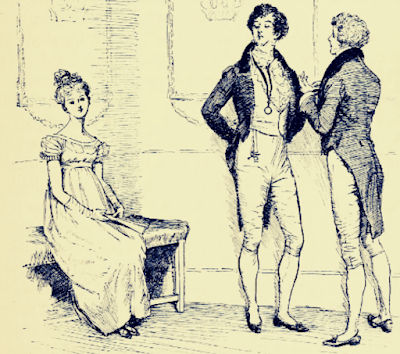
3. “She is tolerable, but not handsome enough to tempt me; and I am in no humour at present to give consequence to young ladies who are slighted by other men.” Mr Darcy of Elizabeth Bennet
 
"Not handsome enough to tempt me" by Hugh Thomson from Pride and Prejudice by Jane Austen (1894 edition)
"Not handsome enough to tempt me" by Hugh Thomson
from Pride and Prejudice by Jane Austen (1894 edition)
4. “I have been meditating on the very great pleasure which a pair of fine eyes in the face of a pretty woman can bestow.” Mr Darcy

5. “I wonder who first discovered the efficacy of poetry in driving away love!” Elizabeth Bennet

6. “About a month ago I received this letter; and about a fortnight ago I answered it, for I thought it a case of some delicacy, and requiring early attention.” Mr Bennet

7. “Can he be a sensible man, sir?”
“No, my dear; I think not. I have great hopes of finding him quite the reverse. There is a mixture of servility and self-importance in his letter, which promises well. I am impatient to see him.” Conversation between Elizabeth Bennet and Mr Bennet about Mr Collins

8. “That will do extremely well, child. You have delighted us long enough. Let the other young ladies have time to exhibit.” Mr Bennet to Mary Bennet

9. The idea of Mr Collins, with all his solemn composure, being run away with by his feelings, made Elizabeth so near laughing that she could not use the short pause he allowed in any attempt to stop him farther.

10. “An unhappy alternative is before you, Elizabeth. From this day you must be a stranger to one of your parents. Your mother will never see you again if you do not marry Mr Collins, and I will never see you again if you do.” Mr Bennet

11. “Happiness in marriage is entirely a matter of chance.” Charlotte Lucas

A replica of George III's bathing machine, Weymouth, Dorset
A replica of George III's bathing machine, Weymouth
12. “A little sea-bathing would set me up for ever.” Mrs Bennet

13. “If I had ever learnt, I should have been a great proficient. And so would Anne, if her health had allowed her to apply. I am confident that she would have performed delightfully.” Lady Catherine de Bourgh

14. “My fingers,” said Elizabeth, “do not move over this instrument in the masterly manner which I see so many women’s do. They have not the same force or rapidity, and do not produce the same expression. But then I have always supposed it to be my own fault – because I would not take the trouble of practising.” Elizabeth Bennet

Original drawing piano keyboard by Mirabelle Knowles (2012)
Original drawing by Mirabelle Knowles (2012)
15. “In vain have I struggled. It will not do. My feelings will not be repressed. You must allow me to tell you how ardently I admire and love you.” Mr Darcy to Elizabeth Bennet

16. "You are mistaken, Mr Darcy, if you suppose that the mode of your declaration affected me in any other way, than as it spared me the concern which I might have felt in refusing you, had you behaved in a more gentlemanlike manner.” Elizabeth Bennet

17. “Where does discretion end, and avarice begin?” Elizabeth Bennet to her Aunt Gardiner

18. “There certainly was some great mismanagement in the education of those two young men. One has got all the goodness, and the other all the appearance of it.” Elizabeth Bennet of Mr Darcy and Mr Wickham

19. “No, Lizzy, let me once in my life feel how much I have been to blame. I am not afraid of being overpowered by the impression. It will pass away soon enough.” Mr Bennet

20. “Well, well,” said he, “do not make yourself unhappy. If you are a good girl for the next ten years, I will take you to a review at the end of them.” Mr Bennet to Kitty Bennet

21. “I take no leave of you, Miss Bennet. I send no compliments to your mother. You deserve no such attention. I am most seriously displeased.” Lady Catherine de Bourgh

22. Mr Bennet: “For what do we live, but to make sport for our neighbours, and laugh at them in our turn?”
"Oh!" cried Elizabeth, "I am excessively diverted. But it is so strange!"

23. “After abusing you so abominably to your face, I could have no scruple in abusing you to all your relations.” Elizabeth Bennet to Mr Darcy

24. “Will you tell me how long you have loved him?”
“It has been coming on so gradually, that I hardly know when it began. But I believe I must date it from my first seeing his beautiful grounds at Pemberley.” Elizabeth Bennet to Jane Bennet about her love for Mr Darcy

View of Lyme Park over the lake
Lyme Park - Pemberley in 1995 BBC adaptation of Pride and Prejudice
25. “I am the happiest creature in the world. Perhaps other people have said so before, but no one with such justice. I am happier even than Jane; she only smiles, I laugh.” Elizabeth Bennet

Headshot of Rachel Knowles author with sea in background(2021)
Rachel Knowles writes clean/Christian Regency era romance and historical non-fiction. She has been sharing her research on this blog since 2011. Rachel lives in the beautiful Georgian seaside town of Weymouth, Dorset, on the south coast of England, with her husband, Andrew.

Find out more about Rachel's books and sign up for her newsletter here.

If you have enjoyed this blog and want to encourage me and help me to keep making my research freely available, please buy me a virtual cup of coffee by clicking the button below.

 
All quotes from Jane Austen's Pride and Prejudice (1813).

All photographs by Andrew Knowles © Regencyhistory.net