Search this blog

Showing posts with label quotes. Show all posts

Wednesday, 11 June 2014

The wit and wisdom of John Constable

John Constable
from Memoirs of the Life of John Constable
by CR Leslie (1845)
John Constable (1776-1837) was an English painter famous for his landscapes, particularly of the Suffolk countryside. Here is a selection of quotes said by him and about him.

On Brighton

1. “Brighton is the receptacle of the fashion and off-scouring of London. The magnificence of the sea, and its, to use your own beautiful expression, ‘everlasting voice’, is drowned in the din and tumult of stage coaches, gigs, flys, &c. and the beach is only Piccadilly or worse by the sea-side. Ladies dressed and undressed; gentlemen in morning-gowns and slippers, or without them or any thing else, about knee deep in the breakers; footmen, children, nursery-maids, dogs, boys, fishermen, and Preventive Service men with hangers and pistols; rotten fish, and those hideous amphibious animals, the old bathing-women, whose language, both in oaths and voice, resembles men, all mixed together in endless and indecent confusion.” In a letter to his friend, Archdeacon Fisher, from Brighton, 29 May 1824.

Brighton Steyne from History of Brighton and its environs by R Sickelmore (1827)
On Turner and Byron

2. “I dined with the Royal Academy last Monday in the Council room…I sat next to Turner, and opposite Mr West and Lawrence. I was a good deal entertained with Turner. I always expected to find him what I did. He has a wonderful range of mind.” In a letter to his future wife, Maria, 30 June 1813.

3. “The world is rid of Lord Byron, but the deadly slime of his touch still remains.” In a letter to Fisher, May 1824.

Lord Byron from A Journal of the Conversations
of Lord Byron with the Countess of Blessington
(1893)
Constable’s wit 

4. “The amiable but eccentric Blake, looking through one of Constable’s sketch books, said of a beautiful drawing of an avenue of fir trees on Hampstead Heath, ‘Why, this is not drawing, but inspiration;’ and he replied, ‘I never knew it before; I meant it for drawing.’”

5. “He could not easily resist the temptation of making an unexpected reply, and when Archdeacon Fisher, one Sunday, after preaching, asked him how he liked his sermon, he said, ‘Very much indeed, Fisher; I always did like that sermon.’”

Constable’s wisdom

6. “The difference between power and truth is very material in painting, as it is in other matters of taste. It may be illustrated by an anecdote of Barry and Garrick. Few actors had more power than Barry; indeed, he was able for some time to divide the admiration of the town with Garrick. They played Lear in competition fifty nights; but the public were set right by an epigram, which placed the distinction between them in the proper light, the last line of which was: ‘To Barry we give loud applause, to Garrick only tears.’”

David Garrick
from Memoirs of the Life of David Garrick
 by T Davies (1808)
7. “Whatever may be thought of my art, it is my own; and I would rather possess a freehold, though but a cottage, than live in a palace belonging to another.”

8. “On hearing somebody say of the celebrated collection of Raphael’s drawings that belonged to Sir Thomas Lawrence, ‘They inspire,’ he replied, ‘They do more, they inform.’”

9. “To a lady who, looking at an engraving of a house, called it an ugly thing, he said, ‘No madam, there is nothing ugly; I never saw an ugly thing in my life: for let the form of an object be what it may, - light, shade and perspective will always make it beautiful. It is perspective which improves the form of this.’”

10. “A friend of Constable expressing to him his dissatisfaction at his own progress in art, received (as he told me) the greatest encouragement to proceed he ever met with, in the following answer: ‘If you had found painting as easy as you once thought it, you would have given it up long ago.’”

11. “There has never been a boy painter, nor can there be. The art requires a long apprenticeship, being mechanical, as well as intellectual.”

12. “There were many occasions on which Constable quoted the aphorism of Dr Johnson: ‘That which is greatest is not always best.’”

Drawing manual - the Cabinet of Arts (1805)  from the V&A Museum, London
Drawing manual - the Cabinet of Arts (1805)
from the V&A Museum, London
On the practice of painting

13. “The more facility of practice I get, the more pleasure I shall find in my art; without the power of execution I should be continually embarrassed, and it would be a burthen to me.” In a letter to fellow artist, John Dunthorne, c1799.

14. “I am most anxious to get into my London painting-room, for I do not consider myself at work unless I am before a six-foot canvas.” In a letter to Fisher, 23 Oct 1821.

15. “I am certain my reputation rises as a landscape painter, and that my style of art, as Farrington always said it would, is fast becoming a distinct feature.” In a letter to Fisher, 17 April 1822.

16. “I beg to congratulate you on the appearance of your name in the newspapers. Do not despise them too much. They cannot give fame, but they attend on her. Smoke gives notice that the house is on fire.” In a letter from Fisher dated Feb 12 1824, Weymouth.

On Constable’s love of the Suffolk landscape 

17. “Still I should paint my own places best; painting is with me but another word for feeling, and I associate ‘my careless boyhood’ with all that lies on the banks of the Stour; those scenes made me a painter, and I am grateful; that is, I had often thought of pictures of them before I ever touched a pencil, and your picture is the strongest instance of it I can recollect; but I will say no more, for I am a great egotist in whatever relates to painting.” In a letter to Fisher, 23 Oct 1821.

18. In the frontispiece to English Landscape, Constable confessed: “Perhaps, the Author, with an over-weening affection for these scenes, may estimate them too highly, and may have dwelt on them too exclusively.”

19. “I hold the genuine pastoral feeling of landscape to be very rare, and difficult of attainment. It is by far the most lovely department of painting as well as of poetry.” 17 Nov 1824.

20. “The landscape painter must walk in the fields with an humble mind. No arrogant man was ever permitted to see nature in all her beauty.” In his last lecture, 25 July 1836.

21. “My pictures will never be popular for they had no handling. But I do not see handling in nature.”
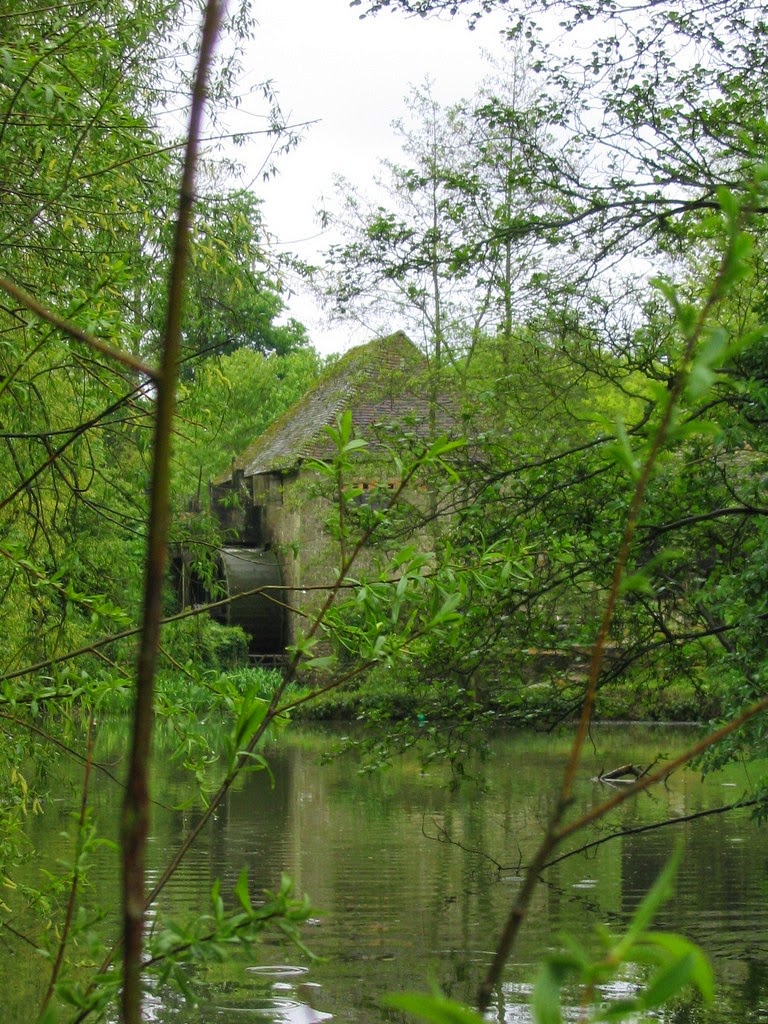
Watermill
On Constable’s life

22. Constable was “remarkable among the young men of the village for muscular strength, and being tall and well formed, with good features, a fresh complexion, and fine dark eyes, his white hat and coat were not unbecoming to him, and he was called in the neighbourhood the ‘handsome miller’.” CR Leslie of Constable.

23. “I see plainly it will be my lot to walk through life in a path contrary to that in which my inclination would lead me.” In a letter to JT “Antiquity” Smith, 2 March 1797, when forced to take on a role in his father’s business rather than pursue his art.

24. “Be assured, we have only to consider our union as an event that must happen, and we shall yet be happy.” In a letter to his future wife, Maria, 1811.

25. “His fondness for children exceeded, indeed, that of any man I ever knew.” CR Leslie of Constable.

26. “It has been delayed until I am solitary, and cannot impart it.” On being accepted as a full member of the Royal Academy in 1829, the year after his beloved wife Maria’s death.

Read about John Constable's life.

More quotes: Beau Brummell, Lord Byron and Richard Brinsley Sheridan.

Note
All quotes are from Memoirs of the Life of John Constable, Esq, RA (1845) by CR Leslie.

Sources used include:
Leslie, Charles Robert, RA, Memoirs of the Life of John Constable, Esq, RA (1845)
Sickelmore, Richard, History of Brighton and its environs (1827)

Wednesday, 30 October 2013

Clever quotes by Richard Brinsley Sheridan

Richard Brinsley Sheridan
from Memoirs of the Life of Richard 
Brinsley Sheridan by T Moore (1825)

Richard Brinsley Sheridan (30 October 1751 - 7 July 1816) was an Irish playwright and Whig MP. His most famous works include The School for Scandal and The Rivals.

Read about Richard Brinsley Sheridan's life here.

Here is a selection of quotes from Sheridan's life and works.

1. “In all undertakings which depend principally on ourselves, the surest way not to fail is to determine to succeed.” In a letter to Mr Linley (1776)1

2. “The Right Honourable gentleman is indebted to his memory for his jests, and to his imagination for his facts.”
Speech in reply to Mr Dundas in the House of Commons1

3. On 24 February 1809, Sheridan's theatre, the Drury Lane, burnt down. When his calmness was commented on by a friend who met him at the Piazza coffee house, watching his theatre burn, he is reputed to have said:

“A man may surely be allowed to take a glass of wine by his own fireside.”1


Theatre Royal, Drury Lane, 1809
from a publication of The Critic (1897)
4. “You write with ease, to show your breeding,
     But easy writing’s vile hard reading.”2

5. “A bumper of good liquor
     Will end a contest quicker
     Than justice, judge or vicar.”3

6. “Conscience has no more to do with gallantry than it has with politics.”3

7. “I was struck all on a heap.”3

8. “You blockhead, never say more than is necessary.”4

9. “Illiterate him, I say, quite from your memory.”4

10. “’Tis safest in matrimony to begin with a little aversion.”4

11. “He is the very pineapple of politeness.”4

12. “An aspersion upon my parts of speech!”4

13. “She’s as headstrong as an allegory on the banks of the Nile.”4

14. “Our ancestors are very good kind of folks; but they are the last people I should choose to have a visiting acquaintance with.”4

15. “The quarrel is a very pretty quarrel as it stands – we should only spoil it by trying to explain it.”4

16. “My valour is certainly going! – it is sneaking off! – I feel it oozing out as it were at the palms of my hands!”4

17. “To smile at the jest which plants a thorn in another’s breast it to become a principal in the mischief.”5

18. “You shall see them on a beautiful quarto page where a neat rivulet of text shall meander through a meadow of margin.”5

19. Mrs Candour: “I’ll swear her colour is natural – I have seen it come and go.
Lady Teazle: “I dare swear you have, ma’am; it goes of a night and comes again in the morning.”5

20. “An unforgiving eye, and a damned disinheriting countenance!”5

21. “Tale bearers are as bad as the tale makers.”5

22. “The newspapers! Sir, they are the most villainous – licentious –abominable – infernal – Not that I ever read them – No – I make it a rule never to look into a newspaper.”6

23. “If it is abuse, - why one is always sure to hear of it from one damned goodnatured friend or another!”6

24. “There is not a passion so strongly rooted in the human heart as envy!”6

25. “O Lord, Sir – when a heroine goes mad she always goes into white satin.”6

26. “The number of those who undergo the fatigue of judging for themselves is very small indeed.”6

27. “The throne we honour is the people’s choice.”7

28. “Won’t you come into the garden? I would like my roses to see you.”
 To a young lady.8

A pink rose

Read about Sheridan's life here.
Read about Sheridan's affair with the Duchess of Devonshire's sister, Harriet, Lady Bessborough.

Other collections of quotes:
Quotes by Lord Byron
Quotes by Beau Brummell
Quotes from Pride and Prejudice

Headshot of Rachel Knowles author with sea in background(2021)
Rachel Knowles writes clean/Christian Regency era romance and historical non-fiction. She has been sharing her research on this blog since 2011. Rachel lives in the beautiful Georgian seaside town of Weymouth, Dorset, on the south coast of England, with her husband, Andrew.

Find out more about Rachel's books and sign up for her newsletter here.

If you have enjoyed this blog and want to encourage me and help me to keep making my research freely available, please buy me a virtual cup of coffee by clicking the button below.


Notes
(1) From Thomas Moore’s Memoirs of the Life of RH Richard Brinsley Sheridan (1825)
(2) From Clio’s Protest (written 1771, pub 1819)
(3) From The Duenna (1775)
(4) From The Rivals (1775)
(5) From The School for Scandal (1777)
(6) From The Critic (1779)
(7) From Pizarro (1799)
(8) Attributed to Richard Brinsley Sheridan

Sources used include:
Moore, Thomas, Memoirs of the Life of the Right Honourable Richard Brinsley Sheridan 1825
Sheridan, Richard Brinsley, Clio's Protest (written 1771 published 1819)
Sheridan, Richard Brinsley, Pizarro (1799)
Sheridan, Richard Brinsley, The Critic (1779)
Sheridan, Richard Brinsley, The Duenna (1775)
Sheridan, Richard Brinsley, The Rivals (1775)
Sheridan, Richard Brinsley, The School for Scandal (1777)

Photographs by © RegencyHistory.net

Tuesday, 27 August 2013

A litter of cupolas - Brighton Pavilion in 1823

Today’s post is a first for Regency History. I have just made my very first YouTube video!

I recently gave a speech at my local Toastmasters’ group about one of my favourite Regency buildings – the Brighton Pavilion. I called it: “A litter of cupolas”.

The title comes from a quote by William Wilberforce about the Brighton Pavilion:
“It looks very much as if St Paul’s had come down to the sea and left behind a litter of cupolas!”
St. Paul's from D Hughson's London (1806) and Brighton Pavilion
A cupola is a dome. As I am sure you know, a litter refers to the multiple offspring of an animal born at one time e.g. a litter of puppies. So a litter of cupolas is a number of little domes. A very witty description of Brighton Pavilion!

My speech transports the listener back in time to experience the Pavilion in its heyday. I recorded my speech and illustrated it with pictures in PowerPoint and then converted it into a YouTube video.

I hope you enjoy it. Please let me have your feedback. This is my first attempt and I am anxious to improve.


Read more about George IV and Brighton Pavilion.

Sources used include:
Feltham, John, A Guide to all the Watering and Sea-bathing Places (1815)
Hughson, David, London; being an accurate history and description of the British Metropolis and its neighbourhood Volume IV (1806, London)
Moule, Thomas, Great Britain Illustrated, a series of original views (1830)
Nash, John, Views of the Royal Pavilion with commentary by Gervase Jackson-Stops (1991)
Wilberforce, Robert, Isaac and Samuel, The Life of William Wilberforce (John Murray, 1839)

British Museum website
Photographs by Andrew Knowles - www.flickr.com/photos/dragontomato

Friday, 19 April 2013

20 Lord Byron quotes

Lord Byron
from Lord Byron's Correspondence
edited by John Murray (1922)
George Gordon Byron, 6th Baron Byron, was an English poet who was influential in the Romantic movement. His most famous works include Don Juan and Childe Harold’s Pilgrimage.
1. “Friendship is Love without his wings!” L’Amitié est l’amour sans ailes (1806, pub 1831)
2. “The petrifactions of a plodding brain.” English Bards and Scotch Reviewers (1809)
3. “I awoke one morning and found myself famous.” Famously declared after the publication of Childe Harold in 1812 which was an immediate success. (1)
4. “We have progressively improved into a less spiritual species of tenderness – but the seal is not yet fixed though the wax is preparing for the impression.” Speaking of Lady Frances Webster in a letter to Lady Melbourne, 14 October 1813 (2)
5. “My Princess of Parallelograms” - speaking of Annabella Milbanke, later Lady Byron, in a letter to Lady Melbourne. “Her proceedings are quite rectangular, or rather we are two parallel lines prolonged to infinity side by side but never to meet.” 18 October 1812. (2)
6. “The best friend I ever had in my life, and the cleverest of women.” “If she had been a few years younger, what a fool she would have made of me had she thought it worth her while.” Speaking of Lady Melbourne, 17 & 24 November 1813 in his journal.
7. “I by no means rank poetry high in the scale of intelligence – this may look like affectation – but it is my real opinion – it is the lava of the imagination whose eruption prevents an earthquake.” In a letter to Annabella Milbanke, 29 November 1813. (2)
8. “What is hope? Nothing but the paint on the face of Existence; the least touch of truth rubs it off, and then we see what a hollow-cheeked harlot we have got hold of.” In a letter to Thomas Moore, 28 October 1815. (2)
9. “Like other parties of the kind, it was first silent, then talky, then argumentative, then disputatious, then unintelligible, then altogethery, then inarticulate, and then drunk.” In a letter to Thomas Moore, 31 October 1815. (2)
10. “Love in this part of the world is no sinecure.” In a letter from Venice to John Murray from Venice, 27 December 1816. (2)
11. “Wordsworth – stupendous genius! Damned fool! These poets run about their ponds though they cannot fish.” In the diary of Henry Crabb Robinson, 1 December 1816, reporting a letter to James Hogg. (2)
12. “I hate things all fiction… there should always be some foundation of fact for the most airy fabric and pure invention is but the talent of a liar.” In a letter from Venice to John Murray, 2 April 1817. (2)
13. “Fair Greece! Sad relic of departed worth!
       Immortal, though no more! Though fallen, great!”
       Childe Harold’s Pilgrimage (1812-18)
14. “Oh Rome! My country! City of the soul!”
      Childe Harold’s Pilgrimage (1812-18)
15. “When, for a moment, like a drop of rain,
        He sinks into thy depths with bubbling groan,
        Without a grave, unknelled, uncoffined, and unknown.”
       Childe Harold’s Pilgrimage (1812-18)
16. “And Coleridge, too, has lately taken wing,
       But, like a hawk encumbered with his hood,
       Explaining metaphysics to the nation –
       I wish he would explain his explanation.”
      Don Juan (1819-24)
17. “Man’s love is of man’s life a thing apart,
       ‘Tis woman’s whole existence.”
       Don Juan (1819-24)
18. “All tragedies are finished by a death,
       All comedies are ended by a marriage;
       The future states of both are left to faith.”
       Don Juan (1819-24)
19. “Proud Wellington, with eagle beak so curled,
       That nose, the hook where he suspends the world!”
       The Age of Bronze (1823)
20. “For what were all these country patriots born?
       To hunt, and vote, and raise the price of corn?”
       The Age of Bronze (1823)
This selection of 20 quotes from Lord Byron's poems, journals and letters was compiled to celebrate the anniversary of his death, 19 April 1824.

Notes
(1) From Life, Letter and Journals of Lord Byron ed Thomas Moore (1839)
(2) From Byron's Letters and Journals ed by LA Marchand (1976)

Sources used include:
Byron, George Gordon, Baron, The Works of Lord Byron (1842)
Byron, George Gordon, Baron and Marchand, LA (ed) Byron's Letter and Journals (1976)
Byron, George Gordon, Baron and Moore, Thomas, Life, Letters and Journals of Lord Byron (1839)
Byron, George Gordon, Baron and Murray, John (ed), Lord Byron's Correspondence (1922)

Friday, 1 February 2013

25 Quotes from Pride and Prejudice

Andrew and Rachel Knowles as  "Elizabeth Bennet and Mr Darcy"
Andrew and Rachel Knowles as
"Elizabeth Bennet and Mr Darcy"
I compiled this list of my favourite quotes from Pride and Prejudice to celebrate the 200th anniversary of its publication on 28 January 2013. I limited myself to twenty-five, but I find the book so quotable that I could have found many more!

I will start with the famous opening line that is quoted so often:

1. It is a truth universally acknowledged, that a single man in possession of a good fortune must be in want of a wife.

Photograph of old writing highlighting the words "to have and to hold"

2. “You mistake me, my dear. I have a high respect for your nerves. They are my old friends. I have heard you mention them with consideration these twenty years at least.” Mr Bennet to Mrs Bennet

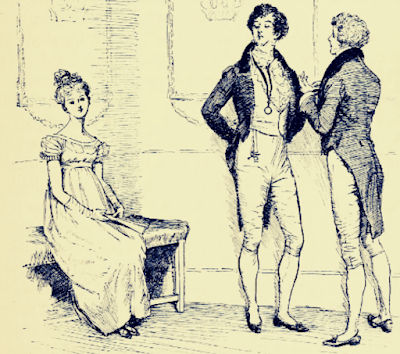
3. “She is tolerable, but not handsome enough to tempt me; and I am in no humour at present to give consequence to young ladies who are slighted by other men.” Mr Darcy of Elizabeth Bennet
 
"Not handsome enough to tempt me" by Hugh Thomson from Pride and Prejudice by Jane Austen (1894 edition)
"Not handsome enough to tempt me" by Hugh Thomson
from Pride and Prejudice by Jane Austen (1894 edition)
4. “I have been meditating on the very great pleasure which a pair of fine eyes in the face of a pretty woman can bestow.” Mr Darcy

5. “I wonder who first discovered the efficacy of poetry in driving away love!” Elizabeth Bennet

6. “About a month ago I received this letter; and about a fortnight ago I answered it, for I thought it a case of some delicacy, and requiring early attention.” Mr Bennet

7. “Can he be a sensible man, sir?”
“No, my dear; I think not. I have great hopes of finding him quite the reverse. There is a mixture of servility and self-importance in his letter, which promises well. I am impatient to see him.” Conversation between Elizabeth Bennet and Mr Bennet about Mr Collins

8. “That will do extremely well, child. You have delighted us long enough. Let the other young ladies have time to exhibit.” Mr Bennet to Mary Bennet

9. The idea of Mr Collins, with all his solemn composure, being run away with by his feelings, made Elizabeth so near laughing that she could not use the short pause he allowed in any attempt to stop him farther.

10. “An unhappy alternative is before you, Elizabeth. From this day you must be a stranger to one of your parents. Your mother will never see you again if you do not marry Mr Collins, and I will never see you again if you do.” Mr Bennet

11. “Happiness in marriage is entirely a matter of chance.” Charlotte Lucas

A replica of George III's bathing machine, Weymouth, Dorset
A replica of George III's bathing machine, Weymouth
12. “A little sea-bathing would set me up for ever.” Mrs Bennet

13. “If I had ever learnt, I should have been a great proficient. And so would Anne, if her health had allowed her to apply. I am confident that she would have performed delightfully.” Lady Catherine de Bourgh

14. “My fingers,” said Elizabeth, “do not move over this instrument in the masterly manner which I see so many women’s do. They have not the same force or rapidity, and do not produce the same expression. But then I have always supposed it to be my own fault – because I would not take the trouble of practising.” Elizabeth Bennet

Original drawing piano keyboard by Mirabelle Knowles (2012)
Original drawing by Mirabelle Knowles (2012)
15. “In vain have I struggled. It will not do. My feelings will not be repressed. You must allow me to tell you how ardently I admire and love you.” Mr Darcy to Elizabeth Bennet

16. "You are mistaken, Mr Darcy, if you suppose that the mode of your declaration affected me in any other way, than as it spared me the concern which I might have felt in refusing you, had you behaved in a more gentlemanlike manner.” Elizabeth Bennet

17. “Where does discretion end, and avarice begin?” Elizabeth Bennet to her Aunt Gardiner

18. “There certainly was some great mismanagement in the education of those two young men. One has got all the goodness, and the other all the appearance of it.” Elizabeth Bennet of Mr Darcy and Mr Wickham

19. “No, Lizzy, let me once in my life feel how much I have been to blame. I am not afraid of being overpowered by the impression. It will pass away soon enough.” Mr Bennet

20. “Well, well,” said he, “do not make yourself unhappy. If you are a good girl for the next ten years, I will take you to a review at the end of them.” Mr Bennet to Kitty Bennet

21. “I take no leave of you, Miss Bennet. I send no compliments to your mother. You deserve no such attention. I am most seriously displeased.” Lady Catherine de Bourgh

22. Mr Bennet: “For what do we live, but to make sport for our neighbours, and laugh at them in our turn?”
"Oh!" cried Elizabeth, "I am excessively diverted. But it is so strange!"

23. “After abusing you so abominably to your face, I could have no scruple in abusing you to all your relations.” Elizabeth Bennet to Mr Darcy

24. “Will you tell me how long you have loved him?”
“It has been coming on so gradually, that I hardly know when it began. But I believe I must date it from my first seeing his beautiful grounds at Pemberley.” Elizabeth Bennet to Jane Bennet about her love for Mr Darcy

View of Lyme Park over the lake
Lyme Park - Pemberley in 1995 BBC adaptation of Pride and Prejudice
25. “I am the happiest creature in the world. Perhaps other people have said so before, but no one with such justice. I am happier even than Jane; she only smiles, I laugh.” Elizabeth Bennet

Headshot of Rachel Knowles author with sea in background(2021)
Rachel Knowles writes clean/Christian Regency era romance and historical non-fiction. She has been sharing her research on this blog since 2011. Rachel lives in the beautiful Georgian seaside town of Weymouth, Dorset, on the south coast of England, with her husband, Andrew.

Find out more about Rachel's books and sign up for her newsletter here.

If you have enjoyed this blog and want to encourage me and help me to keep making my research freely available, please buy me a virtual cup of coffee by clicking the button below.

 
All quotes from Jane Austen's Pride and Prejudice (1813).

All photographs by Andrew Knowles © Regencyhistory.net

Wednesday, 21 November 2012

30 Beau Brummell quotes and anecdotes

George Brummell  from The History of White's   by Hon Algernon Bourke (1892)
George Brummell from The History of White's
 by Hon Algernon Bourke (1892)
Beau Brummell was famous not only for his elegance in dress, but also for his wit. He loved to play practical jokes and took great pleasure in confounding his audience by saying something unexpected and making them laugh at his absurdities. Often he used his wit to depress pretension. Many quotes and anecdotes about the Beau exist. I expect that most of them are true though some may simply be stories that grew up or were invented by the Beau to entertain.

1: ‘Who’s your fat friend?’

‘Who’s your fat friend?’ is one of the most often quoted remarks made by Beau Brummell – a comment made of his erstwhile patron, the Prince Regent before Brummell had fallen out of favour. Brummell’s biographer, William Jesse, described the scenario:
The Prince, leaning on Lord Moira’s arm, met Brummell and Lord Alvanley, coming in the opposite direction, and, probably with the intention of making the cut more evident, His Royal Highness stopped and spoke to his Lordship, without noticing the Beau – little thinking that he would resent it; great therefore must have been his surprise and annoyance, as each party turned to continue their promenade, to hear him say in a distinct tone, expressive of complete ignorance of his person, ‘Alvanley, who’s your fat friend?’1
William Arden, 2nd Baron Alvanley  from The History of White's   by Hon Algernon Bourke (1892)
William Arden, 2nd Baron Alvanley
from The History of White's
 by Hon Algernon Bourke (1892)
Another version of the story suggests that the famous interchange happened at a ball held by Brummell and three friends where the Regent openly ignored his host, leading to the rude rejoinder.

2: Brummell sells out

When applying to the Regent for permission to sell out of the army, Brummell replied:
‘Why the fact is, your Royal Highness, I have heard that we are ordered to Manchester. Now you must be aware, how disagreeable this would be to me; I really could not go – think, your Royal Highness, Manchester! Besides,’ and here was an instance of his tact, ‘you would not be there. I have therefore, with your Royal Highness’s permission, determined to sell out.’2
3: ‘I can unmake him’

Brummell is reported to have said of the Prince Regent to Colonel McMahon, the Prince’s private secretary: ‘I made him what he is, and I can unmake him.’3

4: Lack of respect for Mrs Fitzherbert

Jesse wrote:
When desired by the Regent at a ball at Lady Jersey’s to call her [Mrs Fitzherbert’s] carriage, he [Brummell] obeyed, but in doing so, substituted the word mistress for the usual one of Mrs and laid a strong emphasis on the insulting epithet.4

Mrs Fitzherbert  from The Creevey Papers  by Thomas Creevey (1904)
Mrs Fitzherbert from The Creevey
 Papers by Thomas Creevey (1904)
5: Big Ben and Benina

Jesse wrote:
There was at that time a burly porter at Carlton House, nicknamed ‘Big Ben’, who was so tall that he could look over the gates, and as the Regent was then increasing in size, Brummell often designated the master, by the appellation of the servant – and Mrs Fitzherbert, by that of ‘Benina’.5
6: A note on the Prince’s lack of propriety

After Brummell’s flight to France, his possessions were sold in order to pay his debts. Jesse wrote:
Amongst them was a very handsome snuff-box, which, on being opened by the auctioneer before it was put up, was found to contain a piece of paper with the following sentence, in Brummell’s handwriting, upon it: ‘This snuff-box was intended for the Prince Regent, if he had conducted himself with more propriety towards me.’6
George, Prince of Wales, later George IV  from Memoirs of Her Late Majesty  Queen Charlotte  by WC Oulton (1819)
George, Prince of Wales, later George IV
from Memoirs of Her Late Majesty
Queen Charlotte by WC Oulton (1819)
7: On preserving a favourite snuffbox

Whilst George IV was staying in Calais, where Brummell was residing having left England to escape his debts, word was sent to Brummell that the King required some snuff. Jesse wrote:
The Consul came to Brummell late one evening, and intimated that the King was out of snuff, saying, as he took up one of the boxes that were lying on the Beau’s table, ‘Give me one of yours.’‘With all my heart,’ replied Brummell, ‘but not that box, for if the King saw it I should never have it again.’7
8: A snuffbox is not an oyster

When Brummell found that someone had been trying to open a favourite snuffbox of his with a knife, he exclaimed: ‘Confound the fellow, he takes my snuff-box for an oyster.’8

9: Brummell on fashion

In her memoirs, Harriette Wilson wrote:
‘No perfumes,’ Brummell used to say, ‘but very fine linen, plenty of it, and country washing.’9
10: A tailor’s opinion of Brummell
A baronet went to Schweitzer for a coat and asked his tailor what cloth he recommended. ‘Why, Sir,’ said the artiste, ‘the Prince wears superfine, and Mr Brummell the Bath coating; but it is immaterial which you choose, Sir John, you must be right; suppose, Sir, we say Bath coating - I think Mr Brummell has a trifle the preference.’10
11: Shoes or slippers?
Brummell asked Lord ___ what he called those things on his feet. ‘Why shoes,’ he replied. ‘Shoes, are they?’ said Brummell doubtfully, and stooping to look at them, ‘I thought they were slippers.’11
12: The Duke of Bedford’s coat

On another occasion, the Duke of Bedford asked Brummell for an opinion on his new coat.
Brummell examined him from head to foot with as much attention as an adjutant of the Life Guards would the sentries on a drawing-room day. ‘Turn round,’ said the Beau: his Grace did so, and the examination was continued in front. When it was concluded Brummell stepped forward, and feeling the lapel delicately with his thumb and finger, said, in a most earnest and amusing manner, ‘Bedford, do you call this thing a coat?’12
Duke of Bedford from The Life of George Brummell by W Jesse (1886)
Duke of Bedford from The Life of
George Brummell
by W Jesse (1886)
13: Brummell on his brother

When Brummell’s brother William was in town, he was asked if he was not going to see him, Brummell replied:
Yes, in a day or two; but I have recommended him to walk the back streets till his new clothes come home.13
14: On the cost of being fashionable

When asked by a widow lady of fashion how much it would cost for her son to be fashionably dressed, Brummell is credited with replying, in all seriousness:
My dear Madam, with strict economy, it might be done for eight hundred a year.14
15: Brummell on mornings

Brummell used to say that ‘whether it was summer or winter, he always liked to have the morning well-aired before he got up.’15

16: Brummell on Brighton

‘Come to Brighton, my dear fellow,’ Brummell once said to Cecil Jenkinson, later Lord Liverpool. ‘Let us be off tomorrow; we’ll eat currant-tart, and live in chintz and salt-water.’16

Brighton Pavilion
Brighton Pavilion
17: The Beau depresses pretension

On one occasion, a woman called down to Brummell from her balcony, inviting him up to take tea. ‘Madam, you take medicine, you take a walk, you take a liberty, but you drink tea.’17

18: Brummell on the Lake District 

Jesse wrote:
An acquaintance having, in a morning call, bored him dreadfully about some tour he had made in the North of England, enquired with great pertinacity of his impatient listener which of the lakes he preferred when Brummell, quite tired of the man’s tedious raptures, turned his head imploringly towards his valet, who was arranging something in the room, and said, ‘Robinson.’
‘Sir.’
‘Which of the lakes do I admire?’
‘Windermere, sir,’ replied that distinguished individual.
‘Ah, yes, - Windermere,’ repeated Brummell, ‘so it is – Windermere.’18
19: Brummell on vegetables

A lady at dinner, observing that he did not take any vegetables, asked him whether such was his general habit, and if he never ate any. He replied, ‘Yes, madam, I once ate a pea.’19

Peas in a pod

20: Brummell’s dislike of cabbage

Brummell was taxed with why a matrimonial prospect had failed. ‘Why what could I do, my good fellow, but cut the connexion? I discovered that Lady Mary actually ate cabbage!’20

21: Brummell’s opinion of himself

In her memoirs, Lady Hester Stanhope recalled Brummell once saying to her, in Bond Street:
My dear Lady Hester, it is my folly that is the making of me. If I did not impertinently stare duchesses out of countenance, and nod over my shoulder to a prince, I should be forgotten in a week: and, if the world is so silly as to admire my absurdities, you and I may know better, but what does that signify?21
22: An absurdity

One day a friend, meeting him limping in Bond Street, asked him what was the matter. He replied, he had hurt his leg, and the worst of it was, ‘it was his favourite leg’.22

23: Another absurdity

Once Brummell had a bad cold, and a friend asked him how he had got it. Brummell replied:
Why, do you know, I left my carriage yesterday evening, on my way to town from the Pavilion, and the infidel of a landlord put me into a room with a damp stranger.23
24: Dealing with unfashionable persons

At an Ascot meeting, early in the day, Brummell walked his horse up a certain lady’s carriage. She expressed her surprise at his throwing away his time on her, or running the risk of being seen talking to such a very quiet and unfashionable person. ‘My dear Lady ___,’ he replied, ‘pray don’t mention it; there is no one near us.’24

25: Brummell’s self-importance

Brummell was once offered a lift to Lady Jersey’s ball in the carriage of a young gentleman.
‘Thank you exceedingly,’ replied the Beau, ‘very kind of you, indeed! But pray how are you to go? You surely would not like to get up behind; no that would not be right, and yet it will scarcely do for me to be seen in the same carriage with you.’25
26: Brummell on the horrors of prison
Imagine a position more wretched than mine - they have put me with all the common people. I am surrounded by the greatest villains, and have nothing but prison fare.26
27: Lord Byron on Brummell

Jesse wrote:
Mr Leigh Hunt in a note, in which he kindly referred me to some anecdotes of Brummell, says, ‘I remember that Lord Byron once described him to me, as having nothing remarkable in his style of dress, except a “certain exquisite propriety”.’27

Lord Byron from   from The Life of Lord Byron  by Thomas Moore (1844)
Lord Byron from 
from The Life of Lord Byron
by Thomas Moore (1844)
28: A fashionable arm

When Brummell was accused by an angry father of leading his son into a disreputable gambling transaction, Brummell replied:
Really, I did all I could for the young man. I once gave him my arm all the way from White’s to Watier’s.28
29: Thompson and Johnson

There were once two ladies in London who both liked to hold great parties, one called Mrs Thompson and the other, Mrs Johnson. Jesse wrote:
Sometime after the Beau’s quarrel with the Prince, the former lady [Mrs Thompson] gave a splendid ball, at which His Royal Highness had signified his intention of being present; it is therefore scarcely necessary to add, that Brummell was not included in the list of invitations. On the evening of the entertainment, however, while Mrs Thompson was waiting in her ante-room, supported by a bevy of intimate friends, in momentary expectation of the arrival of her royal guest, and exulting in the completeness of all her preparations – the Beau, to her ineffable surprise and disgust, made his appearance, and his best bow. Justly indignant at this outrage, she informed him, with as much coolness as she could command, that he was not invited.
‘Not invited, Madam! Not invited!’ said Brummell, in his blandest tones, ‘surely there must be some mistake,’ and leisurely feeling in all his pockets to prolong the chances of the Prince’s arrival, and therefore her misery, he at last drew forth an invitation card, and presented it to the incensed lady.
She took it, and saw at a glance it was not her own card, but that of her rival in the East, and haughtily throwing it from her, in a climax of vexation and anxiety to get rid of him, said,‘That card, sir, is a Mrs Johnson’s; my name is Thompson.’

‘Is it indeed?’ replied Brummell, perfectly cool, and affecting the most innocent surprise, ‘Dear me, how very unfortunate! Really, Mrs Johns – Thompson, I mean, I am very sorry for this mistake; but you know, Johnson and Thompson – and Thompson and Johnson, are really so much the same kind of thing.’29
30: Bad champagne

Once when Brummell was dining at a gentleman’s house in Hampshire, the champagne was far from good. Brummell waited for a pause in the conversation and then raised his glass and said, in a voice loud enough for everyone to hear, ‘John, give me some more of that cider.’30

Updated 19 August 2019

Headshot of Rachel Knowles author with sea in background(2021)
Rachel Knowles writes clean/Christian historical romance set in the time of Jane Austen. She has been sharing her research on this blog since 2011. Rachel lives in the beautiful Georgian seaside town of Weymouth, Dorset, on the south coast of England, with her husband, Andrew.

Find out more about Rachel's books and sign up for her newsletter here.

If you have enjoyed this blog and want to encourage me and help me to keep making my research freely available, please buy me a virtual cup of coffee by clicking the button below.

 
Notes
1. Jesse, William, The Life of George Brummell (1844) Volume I p258
2. Ibid p45
3. Ibid p2573
4. Ibid p256
5. Ibid
6. Ibid p327
7. Jesse, William, The Life of George Brummell (1844) Volume II p10
8. Jesse op cit Volume I p330
9. Memoirs of Harriette Wilson (first published 1825, my reference copy 1919) Volume I p47
10. Jesse op cit Volume I p65
11. Ibid p64
12. Ibid
13. Ibid
14. Jesse op cit Volume II p367
15. Macfarlane, Charles, Reminiscences of a literary life (1927) chapter 27
16. Jesse op cit Volume II p393
17. Ibid p50
18. Jesse op cit Volume I p111
19. Ibid
20. Ibid p119
21. Stanhope, Lady Hester, Memoirs of the Lady Hester Stanhope (1845) Volume I p281
22. Jesse op cit Volume I p111-2
23. Ibid p112
24. Ibid
25. Ibid p104
26. Jesse op cit Volume II p186-7
27. Jesse op cit Volume I p70
28. Ibid p96
29. Ibid p101
30. Ibid p105

Sources used include:
Bourke, Hon. Algernon, The History of White's (1892)
Jesse, William, The Life of George Brummell, esq., Commonly called Beau Brummell (First published 1844. This edition 1886)
Kelly, Ian, Beau Brummell, The Ultimate Dandy (Hodder & Stoughton, 2005)
Macfarlane, Charles, Reminiscences of a literary life (J. Murray, 1917)
Stanhope, Lady Hester, Memoirs of the Lady Hester Stanhope, as related by herself in conversations with her physician (1845) I/III
Wilson, Harriette, The Memoirs of Harriette Wilson, written by herself (First published 1825. This edition 1909)

All photographs © regencyhistory.net

Sunday, 4 November 2012

What did Regency visitors think of the Brighton Pavilion?

A fairytale palace

Brighton Pavilion from the gardens
Brighton Pavilion is a fairytale palace – a bizarre mixture of domes and minarets, fitted out internally in luxurious but eccentric style. You cannot help but marvel at the unconventional architecture and the sumptuous decoration, but it is not to everyone’s taste. I was fortunate enough to be able to visit the Pavilion last week and see the exhibition on Princess Charlotte. The audio commentary reminded me that, when it was built, the Pavilion was far from universally admired.

 A litter of cupolas

Brighton Pavilion from the Steyne

“The Pavilion in Chinese style – beautiful and tasty,” wrote William Wilberforce, “though it looks very much as if St Paul’s had come down to the sea and left behind a litter of cupolas”.

Sydney Smith agreed: “It looks as if St Paul’s Cathedral has come down to Brighton and pupped.” These quotes are so similar that it seems likely that one was derived from the other.

Turnips and bulbs

William Cobbett claimed that the Pavilion, which he nicknamed the Kremlin, had “long been a subject of laughter all over the country”. He described the Pavilion in very unflattering terms, no doubt strongly influenced by his disgust at the Prince Regent’s extravagance in rebuilding it:

Brighton Pavilion- the entrance
“Take a square box, the sides of which are three feet and a half, and the height a foot and a half. Take a large Norfolk turnip, cut off the green of the leaves, leave the stalks nine inches long, tie these round with a string three inches from the top, and put the turnip on the middle of the box. Then take four turnips of half the size, threat them in the same way, and put them on the corners of the box. Then take a considerable number of bulbs of the crown imperial, the narcissus, the hyacinth, the tulip, the crocus, and others; let the leaves of each have sprouted to about an inch, more or less according to the size of the bulb; put all these, pretty promiscuously, but pretty thickly, on the top of the box. Then stand off and look at your architecture. There! That’s ‘a Kremlin’!”

Pumpkins and pepper boxes

William Hazlitt was similarly unimpressed:
“The Pavilion at Brighton is like a collection of stone pumpkins and pepper boxes. It seems as if the genius of architecture had at once the dropsy and the megrims. Anything more fantastical, with a greater dearth of invention, was never seen.”

The skyline at Brighton Pavilion
The Folly at Brighton

Another less than flattering reference to the Pavilion and its owner was in The Joss and His Folly, a poem illustrated by George Cruikshank. The verses were written by William Hone and appeared in an 1820 pamphlet, The Queen’s Matrimonial Ladder, which accompanied a “national toy”. The first four verses refer to “The Folly at Brighton”:

The Joss and His Folly by George Cruikshank
From The Queen's Matrimonial Ladder
by William Hone (1820)
The queerest of all the queer sights
I’ve set sights on;
Is the what d’ye call’t thing, here,
The Folly at Brighton

The outside – huge teapots,
All drill’d round with holes,
Relieved by extinguishers,
Sticking on poles;

The inside – all tea-things,
And dragons, and bells,
The show-rooms – all show,
The sleeping rooms – cells.

But the grand Curiosity’s
Not to be seen –
The owner himself –
An old fat Mandarin.
A Regency icon

I like Brighton Pavilion. To me, it sums up George IV so beautifully. It is a vivid statement of his lifestyle – extravagant, inconsistent and hedonistic. He was continually redecorating and rebuilding, filling his palace with beautiful things and entertaining lavishly. And yet when it was finished, he decided its situation was too public, and soon after, he abandoned it for the privacy of Windsor. Yes, it is over the top and I am not a big fan of all the dragons and snakes, but I am so glad that the palace has been preserved as a lasting symbol of the Regency.

Sources used include:
Cobbett, William, Rural rides in the counties of Surrey, Kent etc during the years 1821 to 1832, ed Pitt Cobbett (1893)
Low, Donald A, That Sunny Dome - a portrait of Regency Britain (Book Club Associates, 1977)
Feltham, John, A Guide to all the Watering and Sea-bathing Places (1815)
Hazlitt, William, Notes of a journey through France and Italy (1826)
Hone, William, The Queen's Matrimonial Ladder (1820)
Morley, John, The Royal Pavilion, Brighton
Nash, John, Views of the Royal Pavilion with commentary by Gervase Jackson-Stops (1991)
Wilberforce, Robert Isaac and Samuel, The Life of William Wilberforce (John Murray, 1839)

Photographs by Andrew Knowles - www.flickr.com/photos/dragontomato