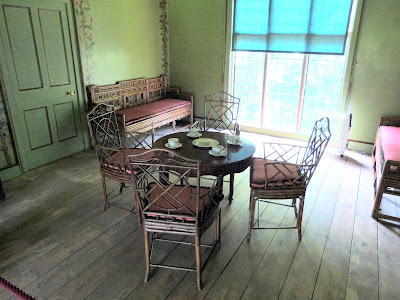
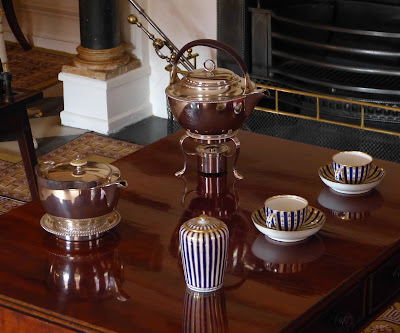
Search this blog

Showing posts with label Pride and Prejudice. Show all posts

Saturday, 26 February 2022

How do you address a baronet or knight?

Sir Walter Elliot, Bt, walking with Colonel Wallis by H Thomson (1897) From Persuasion by Jane Austen (1897 edition)
Sir Walter Elliot, Bt, walking with 
Colonel Wallis by H Thomson (1897)
From Persuasion by Jane Austen (1897 edition)
Jane Austen rarely wrote about peers of the realm, but her books do contain a fair smattering of baronets and knights—the subject of this post.

In this post I answer the following questions:

Are baronets and knights peers?

Are the titles hereditary?

How do you address a baronet or a knight?

How do you address a baronet’s wife or a knight’s wife?

How do you address a baronet’s widow or a knight’s widow?

What is a baronetess?

Are all orders of knighthood the same?

I also highlight a mistake sometimes made by Regency romance authors.

Are baronets and knights peers?

No. Baronets and knights are titled gentlemen but not peers.

There are only five ranks in the English aristocracy: duke, marquess, earl, viscount and baron.

You can read about how to address peers here. 

Baronets and knights rank below this. They are not lords and could stand as Members of Parliament in the House of Commons.

Is baronet a hereditary title?

Yes. The title of baronet is hereditary, passing down the male line in the same way that aristocratic titles do.
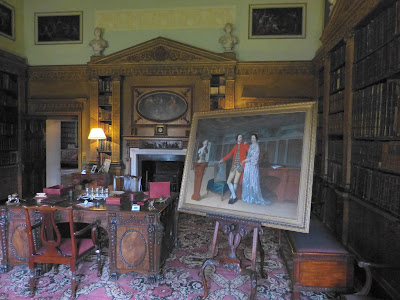
Sir Rowland Winn, 5th Baronet, and his wife in the library of their house, Nostell Priory (2014)
Sir Rowland Winn, 5th Baronet, and his wife
in the library of their house, Nostell Priory (2014)
How do you address a baronet?

A baronet adopts the title Sir Christian-name Surname with the abbreviation Bt or Bart after it.

For example, in Jane Austen’s Persuasion, Anne Elliot’s father is a baronet, and his full title is Sir Walter Elliot, Bt. He is always referred to as Sir Walter—never as Sir Elliot.1

How do you address a baronet’s wife?

The wife of a baronet is always referred to as Lady Surname unless she has a title of her own.

In Persuasion, Anne Elliot’s deceased mother is referred to as Lady Elliot.2

Similarly, in Mansfield Park, Sir Thomas Bertram’s wife is referred to as Lady Bertram.3

The exception to this rule is when a baronet’s wife has a title of her own.

For example, Sir William Wyndham, 3rd Baronet (c1688–1740) married Lady Catherine Seymour, a daughter of Charles Seymour, 6th Duke of Somerset. As her husband was not a peer, Lady Catherine was entitled to keep the title she held as the daughter of a duke and be called Lady Catherine Wyndham. 

You can read more about married daughters of peers here.
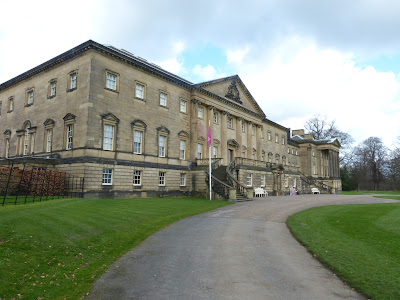
Nostell Priory (2014)
How do you address a baronet’s widow?

If a baronet dies, his widow retains the title she held as his wife unless and until the next baronet is married, in which case she becomes the Dowager Lady Surname, or Christian-name, Lady Surname, to distinguish her from the current baronet’s wife. If she has a title in her own right, she continues to use that.

If she remarries to a peer, she takes her new husband’s title.

If she remarries to a commoner, she loses her right to the title of Lady. But if she has her own title, she continues to use this eg as the daughter of an earl, she becomes Lady Christian-name New-husband’s-surname.

What is a baronetess?

A baronetess is either a woman holding the rank of baronet in her own right, or the wife or widow of a baronet.

It is extremely rare for women to hold the rank of baronet in their own right, and there were none during the Regency era. I have only been able to find a couple of contemporary uses of the term, one of which refers to Dame Mary Bolles, 1st Baronetess (1579–1662).4

Sir John Middleton and Mrs Jennings by H Thomson (1896) From Sense and Sensibility by Jane Austen (1896 edition)
Sir John Middleton and Mrs Jennings
by H Thomson (1896)
From Sense and Sensibility by Jane Austen (1896 edition)
Is knight a hereditary title?

No. There are different orders of knighthood, but unlike baronetcies, none of them are hereditary.

Are all knighthoods the same?

No. In the Regency, there were various orders of knighthood.5

In order of precedence they were:

Knights of the Most Noble Order of the Garter

Knights of the Most Honourable Order of the Bath

Knights of the Most Distinguished Order of Saint Michael and Saint George

Knights Bachelor
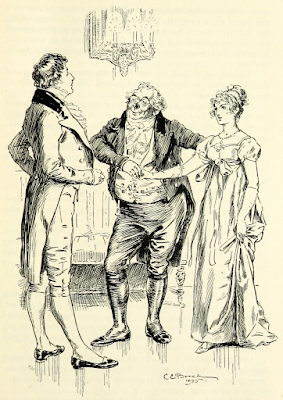
Sir William presents Elizabeth Bennet to Mr Darcy as a desirable partner by C E Brock (1895) From Pride and Prejudice by Jane Austen (1895 edition)
Sir William Lucas presents Elizabeth Bennet
to Mr Darcy as a desirable partner
by C E Brock (1895) from Pride and Prejudice
by Jane Austen (1895 edition)
How do you address a knight?

A knight bachelor is the lowest class of knight, and the most common. It is the one we come across in the novels of Jane Austen.

As with a baronet, a knight adopts the title Sir Christian-name Surname, though without the word or abbreviation for baronet after it. Sometimes the name might be written with Knight or Knt after it in formal documents.

In Jane Austen’s Pride and Prejudice, Charlotte Lucas’s father was a knight and was called Sir William Lucas:

Sir William Lucas had been formerly in trade in Meryton, where he had made a tolerable fortune, and risen to the honour of knighthood by an address to the king during his mayoralty.6

Similarly, in Sense and Sensibility, Mrs Dashwood had a relative, Sir John Middleton, who was “a gentleman of consequence and property in Devonshire.”7

For the variations for the other classes of knights, see the end of this post.

How do you address a knight’s wife?

The rules are the same as for a baronet’s wife. She is always referred to as Lady Surname unless she has a title of her own.

In the two examples above, Sir William Lucas’s wife is always referred to as Lady Lucas, and Sir John Middleton’s wife as Lady Middleton.

How do you address a knight’s widow?

The widow of a knight may continue to use the designation Lady Surname unless she remarries.

In Persuasion, Anne Elliot’s friend, Lady Russell, is the widow of Sir Henry Russell, a knight.8

If she has a title in her own right, she continues to use that.

In Pride and Prejudice, Mr Darcy’s aunt is referred to as Lady Catherine de Bourgh. Mr Collins writes:

I have been so fortunate as to be distinguished by the patronage of the Right Honourable Lady Catherine de Bourgh, widow of Sir Lewis de Bourgh.9

As Mr Collins made a lot of Lady Catherine’s patronage, and Sir Lewis de Bourgh is not described as a baronet, I assume he was a knight. On her marriage, Lady Catherine retained the use of her title as the daughter of an earl.

Although it doesn’t say this directly in the book, we can deduce this because we know that one of Lady Catherine’s nephews, Colonel Fitzwilliam, is the younger son of an earl—Lady Catherine’s brother. He must have inherited this title from his father, making Lady Catherine the daughter of an earl.

On her husband’s death, Lady Catherine continued to use her title, Lady Catherine de Bourgh.

Lady Catherine de Bourgh by C E Brock (1895) From Pride and Prejudice by Jane Austen (1895 edition)
Lady Catherine de Bourgh by C E Brock (1895)
From Pride and Prejudice by Jane Austen (1895 edition)
Who ranks more highly, a baronet or a knight?

With the exception of Knights of the Order of the Garter, baronets rank higher than knights.

In Persuasion, Lady Russell is fully aware of this:

Lady Russell…had a cultivated mind, and was, generally speaking, rational and consistent; but she had prejudices on the side of ancestry; she had a value for rank and consequence, which blinded her a little to the faults of those who possessed them. Herself the widow of only a knight, she gave the dignity of a baronet all its due; and Sir Walter, independent of his claims as an old acquaintance, an attentive neighbour, an obliging landlord, the husband of her very dear friend, the father of Anne and her sisters, was, as being Sir Walter, in her apprehension, entitled to a great deal of compassion and consideration under his present difficulties.10

A word of warning to Regency romance authors

Titles are tricky, and it is easy to make mistakes, particularly when introducing your characters for the first time. It is tempting to give the wife of a baronet or knight as full a name as possible, with both title and Christian name.

The basic rule is don’t mix and match! If she’s got no title, she’s always Lady Surname. If she has the courtesy title of Lady from her father, she’s always Lady Christian-name Surname.

Let us take the example of Lady Bertram in Mansfield Park. She has no title of her own and so would always be referred to as Lady Bertram, never as Lady Maria Bertram. If you wanted to introduce her with her Christian name, you could say Maria, Lady Bertram.

Jane Austen’s introduction of Lady Bertram reads:

About thirty years ago Miss Maria Ward, of Huntingdon, with only seven thousand pounds, had the good luck to captivate Sir Thomas Bertram, of Mansfield Park, in the county of Northampton, and to be thereby raised to the rank of a baronet’s lady, with all the comforts and consequences of a handsome house and large income.11

If Sir Thomas Bertram’s wife were titled eg as the daughter of an earl, it would be correct to call her Lady Maria Bertram, but then she would be referred to as Lady Maria all through the book and never Lady Bertram.

Lady Bertram by H Thomson (1897) From Mansfield Park by Jane Austen (1897 edition)
Lady Bertram by H Thomson (1897)
From Mansfield Park by Jane Austen (1897 edition)
The higher orders of knighthood

In addition to being called Sir Christian-name Surname if otherwise untitled, knights of the higher orders had letters after their names.

The Most Noble Order of the Garter

Knights of the Garter were members of royalty or peers, and were distinguished by the initials KG after their name eg Charles Lennox, 4th Duke of Richmond, KG, made a Knight of the Garter in 1812.

The Most Honourable Order of the Bath

This originally had a single class of membership—the Knights Companion—signified by the letters KB after the name. It was reorganised by the Prince Regent on 2 January 1815 to increase the opportunity for honouring those who had served in the Peninsular War.

The Order of the Bath was divided into three classes, the first two of which were knights. All existing members of the Order were automatically transferred to the highest level of the new system, Knights Grand Cross:

Knights Grand Cross distinguished by the initials GCB after the name eg Arthur Wellesley, 1st Duke of Wellington, GCB

Knights Commanders distinguished by the initials KCB after the name.

Companions – these are not knights but are distinguished by the letters CB after the name.

The Most Distinguished Order of St Michael and St George

The Order of St Michael and St George was introduced by the Prince Regent in 1818.

As above, there are three classes, the first two of which are knights:

Knights Grand Cross distinguished by the initials GCMG after the name.

Knights Commanders distinguished by the initials KCMG after the name.

Companions – these are not knights, but are distinguished by the letters CMG after the name.

Headshot of Rachel Knowles author with sea in background(2021)
Rachel Knowles writes clean/Christian Regency era romance and historical non-fiction. She has been sharing her research on this blog since 2011. Rachel lives in the beautiful Georgian seaside town of Weymouth, Dorset, on the south coast of England, with her husband, Andrew.

Find out more about Rachel's books and sign up for her newsletter here.

If you have enjoyed this blog and want to encourage me and help me to keep making my research freely available, please buy me a virtual cup of coffee by clicking the button below.

Notes

  1. Austen, Jane, Persuasion (1817).
  2. Ibid.
  3. Austen, Jane, Mansfield Park (1814).
  4. Brydson, Thomas, A Summary View of Heraldry (1795).
  5. Scottish nobles could be made Knights of the Most Ancient and Most Noble Order of the Thistle, which ranked after the Order of the Garter. They were distinguished by the initials KT after their name. A further order of knights was the knights banneret, a military honour conferred by the sovereign. It ranked below the Order of the Garter but above baronets, but there seems to be some debate as to whether this order still existed in the Regency or not.
  6. Austen, Jane, Pride and Prejudice (1813).
  7. Austen, Jane, Sense and Sensibility (1811).
  8. Austen, Jane, Persuasion (1817).
  9. Austen, Jane, Pride and Prejudice (1813).
  10. Austen, Jane, Persuasion (1817).
  11. Austen, Jane, Mansfield Park (1814).

Sources used include:

Austen, Jane, Mansfield Park (1814)
Austen, Jane, Persuasion (1817)
Austen,Jane, Pride and Prejudice (1813)
Austen,Jane, Sense and Sensibility (1811)
Black,Adam and Charles (publishers), Titles and forms of address - a guide to their correct use (9th edition)(1955)
Blackstone,Sir W, Commentaries on the Laws of England Vol 1 (1826)
Brydson,Thomas, A Summary View of Heraldry (1795)
Debrett,John, Debrett's Baronetage of England (1835)
Lamb,Charles, A book explaining the ranks and dignities of British Society (1809)

Friday, 28 January 2022

Tea drinking in the Regency

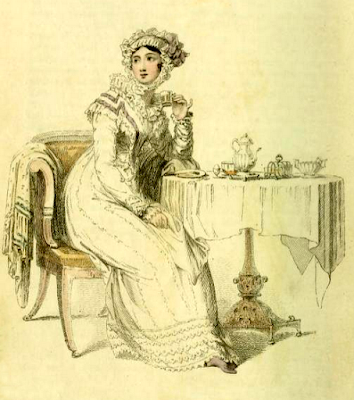
Lady in morning dress sitting beside a tea table from Ackermann's Repository (1822)
Morning dress from Ackermann's Repository (1822)

Which do you prefer, tea or coffee? It’s an easy choice for me as I don’t like coffee, but I love tea – black tea or what is sometimes called English breakfast tea. I like it weak with milk and no sugar, and I drink it all day long, from breakfast to bedtime.

But what about during the Regency? Did people drink tea or coffee? And when did they drink these beverages?

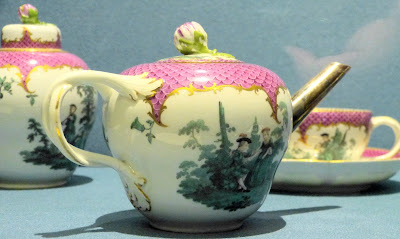
Hester Thrale's Meissen tea service on display at Dr Johnson's House Museum
Hester Thrale's Meissen tea service
on display at Dr Johnson's House Museum (2015)
A nation of tea drinkers

Most of Europe drank coffee, but England was primarily a nation of tea drinkers. Why? Quite possibly as the result of a powerful advertising campaign!

The English’s preference for tea goes back to the mid-1600s. The East India Company had a monopoly on the import of tea from China, and it was therefore in their interests to increase sales of tea. It is likely that the English started drinking more tea at least in part because of East India Company propaganda promoting tea.

Another factor was war with France and Spain which made it hard to get supplies of coffee from the Levant, whilst trade routes from China were reliable. The obvious solution was to drink tea rather than coffee.

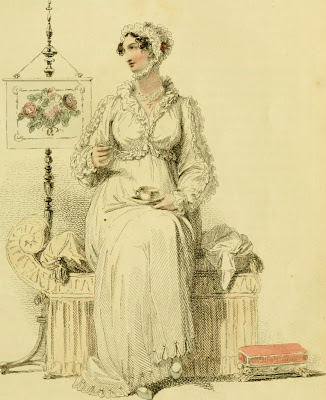
Lady in morning dress seated with a cup of tea in her lap from Ackermann's Repository (1814)
Morning dress from Ackermann's Repository (1814)
Luxury or necessity?

Tea was expensive. The price varied depending on the retailer, the type of tea and the year, but good quality tea was not cheap.

For example, in 1815 the average price per pound of tea paid by the Greenwich Hospital was 6s 3 1/2d.1 In real terms for 2020, this equates to £23.85. This sounds pretty expensive to me – and I imagine the Greenwich Hospital was buying tea at the cheaper end of the market. If you take into account average wages at the time, the real cost of a pound of tea was more like £256.30.2 Definitely a luxury good!

The price of tea was inflated due to high customs and excise duties. As a result, large quantities of tea were smuggled into the country to avoid the taxes. Before the Tea and Window Act of 1784, the tax on tea amounted to 119% of its cost! The Act reduced the tax rate to 12 1/2%, but after this, rates increased again, and smuggling continued.3

Despite its expense, everyone drank tea. Some saw drinking tea as the exclusive privilege of the wealthy and objected to the lower classes adopting the habit. Others, like the Methodists, thought drinking tea should be encouraged in preference to drinking alcohol.

The poor could make a few tea leaves go a long way. I don’t suppose the slightly flavoured water they drank bore much resemblance to the rich infusion of tea served in the houses of the haut ton.

Smouch

Cheaper tea was often smuggled, and may have been smouch rather than pure tea.

Unscrupulous merchants could make a pound of tea go further by mixing it with other, cheaper leaves. Black tea could be mixed with ash leaves to make what was known as smouch. The process sounds revolting as it involved using sheep’s dung to make the smouch look more like tea.

As it was easier to mix other leaves with green tea, a preference for black tea developed.

Licenced to sell

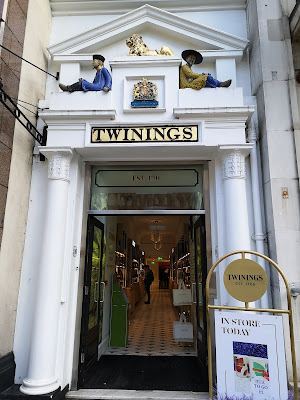
Entrance to Twinings on Strand (2021)
Adulterating tea by mixing it with sloe, liquorice or any other leaves was a criminal offence. To combat this risk, dealers in coffee, tea and chocolate had to be licensed. People could buy tea for drinking at home from coffee houses, apothecaries, and other merchants. As the popularity of tea grew, specialist tea shops like Twinings on Strand developed.

Tea was usually bought by the pound, loose from the crate, and wrapped in a screw of paper.

The most common varieties of tea on offer were bohea (black tea) and hyson (green tea). Twinings sold other types such as Pekoe, Imperial and Congo, and could mix the teas together to produce custom blends.

In a letter of 1811, Jane Austen refers to starting her China Tea and finding it very good.4

When did people drink tea?

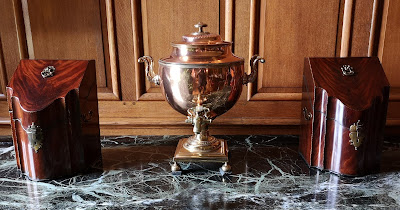
Tea caddies and urn at Dunham Massey (2019)
Tea was drunk twice a day in most households – at breakfast and after dinner – though some people drank coffee instead.

Those that could afford it added milk or cream, and nearly everyone took sugar until the 1790s when around 300,000 households boycotted sugar in support of the abolitionist movement.

Because tea was expensive, it was often kept locked up in a tea caddy. Hot water was provided by an urn, on or near the table, and the lady of the house, or one of her daughters, was usually responsible for making the tea.

Tea at breakfast time

You can read about Regency breakfast time here.

Don Manuel Alvare Espriella, a Spanish traveller, described his experience of an English breakfast in 1802:

The breakfast-table is a cheerful sight in this country: porcelain of their own manufactory, which excels the Chinese in elegance of form and ornament, is ranged on a Japan waiter, also of the country fabric; for here they imitate every thing. The mistress sits at the head of the board, and opposite to her the boiling water smokes and sings in an urn of Etruscan shape. The coffee is contained in a smaller vase of the same shape, or in a larger kind of tea-pot, wherein the grain-is suspended in a bag; but nothing is so detestable as an Englishman's coffee. The washing of our after-dinner cups would make a mixture as good; the infusion is just strong enough to make the water brown and bitter. This is not occasioned by economy, though coffee is enormously dear, for the people are extravagant in the expences of the table: they know no better; and if you tell them how it ought to be made, they reply, that it must be very disagreeable, and even that if they could drink it so strong, it would prevent them from sleeping. There is besides an act of parliament to prevent the English from drinking good coffee: they are not permitted to roast it them selves, and of course all the fresh and finer flavour evaporates in the warehouse. They make amends however by the excellence of their tea, which is still very cheap, though the ministry, in violation of an explicit bargain, increased the tax upon it four fold, during the last war. This is made in a vessel of silver, or of a fine black porcelain: they do not use boiled milk with it, but cream in its fresh state, which renders it a very delightful beverage.5

I am intrigued that Espriella described tea as very cheap as everything else I’ve read suggests it was expensive, but maybe it was in comparison to what it cost him at home or to the price of coffee.

Jane Austen’s brother Edward preferred coffee. In a letter of 1799, she wrote:

It is rather impertinent to suggest any household care to a housekeeper, but I just venture to say that the coffee-mill will be wanted every day while Edward is at Steventon, as he always drinks coffee for breakfast.6

Tea and coffee after dinner

You can read about Regency dinnertime here.

After dinner, the ladies normally left the gentlemen to drink wine and regrouped in the drawing room. 

You can read more about this custom at the end of my blog on drink at the Regency dinner table here. 

Tea and coffee were served when the gentlemen re-joined the ladies.

In Pride and Prejudice, Jane Austen describes after-dinner teatime at Longbourn:

The gentlemen came; and she [Elizabeth Bennet] thought he [Mr Darcy] looked as if he would have answered her hopes; but, alas! the ladies had crowded round the table, where Miss Bennet was making tea, and Elizabeth pouring out the coffee, in so close a confederacy that there was not a single vacancy near her which would admit of a chair.7

The tearoom in Queen Charlotte's Cottage, Kew (2013)
In the summer, they would sometimes drink tea outside in a teahouse or tent in the grounds. 

Queen Charlotte's Cottage, Kew, has a tearoom upstairs. You can read about it here.

In Jane Austen’s Emma, Harriet Smith talks of Mrs Martin

…having a very handsome summer-house in their garden, where some day next year they were all to drink tea:—a very handsome summer-house, large enough to hold a dozen people.8

Inviting people to join you for tea was a popular way of entertaining into the evening. Compared to having someone to dinner, it was less formal, less expensive, conferred less distinction, and was not restricted by the number of people you could get around your dining table.

In Pride and Prejudice, when Elizabeth Bennet goes to visit Charlotte, Mr Collins was hopeful of an invitation to tea:

“I confess,” said he, “that I should not have been at all surprised by her ladyship’s asking us on Sunday to drink tea and spend the evening at Rosings.”9

Charlotte’s sister Maria kept a tally of how often Lady Catherine had invited them to Rosings:

“We have dined nine times at Rosings, besides drinking tea there twice! How much I shall have to tell!”10

In Emma, Jane Austen spontaneously invited her friends to come in for tea:

He [Mr Knightley] had walked up one day after dinner, as he very often did, to spend his evening at Hartfield. Emma and Harriet were going to walk; he joined them; and, on returning, they fell in with a larger party, who, like themselves, judged it wisest to take their exercise early, as the weather threatened rain; Mr and Mrs Weston and their son, Miss Bates and her niece, who had accidentally met. They all united; and, on reaching Hartfield gates, Emma, who knew it was exactly the sort of visiting that would be welcome to her father, pressed them all to go in and drink tea with him. The Randalls party agreed to it immediately; and after a pretty long speech from Miss Bates, which few persons listened to, she also found it possible to accept dear Miss Woodhouse’s most obliging invitation.11

Jane Austen often wrote of drinking tea with friends. In a letter in April 1811 she wrote:

We drank tea again yesterday with the Tilsons, and met the Smiths. – I find all these little parties very pleasant.12

Queen Charlotte's tea things, Kew Palace (2013)
Tea things in Queen Charlotte's drawing room,
Kew Palace (2013)
Tea addicts

Of course, there were tea addicts, like Samuel Johnson, who was renowned for drinking tea at all times of the day.

In a response to a criticism of tea-drinking written in 1757, Johnson admitted that he was

…a hardened and shameless tea-drinker, who has, for twenty years, diluted his meals with only the infusion of this fascinating plant; whose kettle has scarcely time to cool; who with tea amuses the evening, with tea solaces the midnight, and, with tea, welcomes the morning.13

That sounds like me…

Headshot of Rachel Knowles author with sea in background(2021)
Rachel Knowles writes clean/Christian Regency era romance and historical non-fiction. She has been sharing her research on this blog since 2011. Rachel lives in the beautiful Georgian seaside town of Weymouth, Dorset, on the south coast of England, with her husband, Andrew.

Find out more about Rachel's books and sign up for her newsletter here.

If you have enjoyed this blog and want to encourage me and help me to keep making my research freely available, please buy me a virtual cup of coffee by clicking the button below.


Notes

  1. These figures are from Levi, Leone, Wages and Earnings of the Working Classes (1867).
  2. These figures are from The Measuring Worth website.
  3. These figures are from Wisset, Robert, A View of the rise, progress and present state of the Tea Trade in Europe (1801).
  4. Austen, Jane, Jane Austen's Letters, Collected and Edited by Le Faye, Deirdre (Oxford University Press, 1995).
  5. Espriella, Don Manuel Alvare, Letters from England, translated from the Spanish by Robert Southey 3rd edition (1814) Volume 1.
  6. Austen op cit.
  7. Austen, Jane, Pride and Prejudice (1813, London).
  8. Austen, Jane, Emma (1815, London).
  9. Austen, Jane, Pride and Prejudice (1813, London).
  10. Ibid.
  11. Austen, Jane, Emma (1815, London).
  12. Austen, Jane, Jane Austen's Letters, Collected and Edited by Le Faye, Deirdre (Oxford University Press, 1995).
  13. Johnson, Samuel, Works of Samuel Johnson Vol 6/11 (1825)

Sources used include: 

Austen, Jane, Emma (1815, London)
Austen, Jane, Jane Austen's Letters, Collected and Edited by Le Faye, Deirdre (Oxford University Press, 1995)
Austen, Jane, Pride and Prejudice (1813, London)
Cruickshank, Dan and Burton, Neil, Life in the Georgian City (1990)
Espriella, Don Manuel Alvare, Letters from England, translated from the Spanish by Robert Southey 3rd edition (1814) Volume 1
Johnson, Samuel, Works of Samuel Johnson Vol 6/11 (1825)
Levi, Leone, Wages and Earnings of the Working Classes (1867)
Pettigrew, Jane and Richardson, Bruce, A Social History of Tea (2014)
Twining, Richard, Observations on the Tea and Window Act and on the Tea Trade (1785)
Twinings website
Wisset, Robert, A View of the rise, progress and present state of the Tea Trade in Europe (1801)

Monday, 6 September 2021

Regency dining etiquette - a Regency History guide

A banquet at the Royal Pavilion, Brighton from the coloured lithograph by J Nash in Life in Regency and Early Victorian Times by EB Chancellor (1926)
A banquet at the Royal Pavilion, Brighton from the coloured
lithograph by J Nash in Life in Regency and
Early Victorian Times
by EB Chancellor (1926)
When I’m writing a scene set at a Regency dinner party, I often find myself asking questions about how they would have done things. As I strive for historical accuracy in what I write, I’ve tried to develop an understanding of the etiquette observed at the time. I have looked at books on etiquette, contemporary novels, letters and journals to try and establish some rules. As with all things historical, they are more guidelines than a strict code of behaviour, as no doubt there was variation as to when or even if these rules were applied, across time, class and location.
 

Did Regency people gather in the drawing room before dinner?

In Trusler’s A System of Etiquette (1804), he wrote:

When invited to dinner, make a point of always being there in proper time, not to make the company wait; fifteen minutes at least before the appointed hour, and to prevent mistakes, see that your watch goes right, and make a proper allowance for the time in going. A superior indeed, will not wait your coming beyond the time; and if you enter after the company is seated, you are a general disturber.

He continued:

On your entering the room where the company is, address yourself first to the lady of the house, next to the master, and after, to the rest of the company you are introduced to, by a respectful bow to each.1

As he then proceeded to give instructions about walking into the room where dinner is served, this suggests it was expected that the company would gather before going into the dining room.

The Pocket Book of Etiquette (1837) states that this usually took place in the drawing room:

On arriving at the house of the inviter, you will be shown into the room in which the party are assembling (ordinarily the drawing room); here, of course, you will be presented.2

This would seem to be borne out in Jane Austen’s novels. In Mansfield Park, she wrote:

Thus much was settled before Edmund, who had been out all the morning, knew anything of the matter; but when he entered the drawing-room before dinner, the buzz of discussion was high between Tom, Maria, and Mr Yates.3

Dining room, Felbrigg Hall (2019)
Did they use a dinner bell or gong?

I have not, as yet, come across any contemporary reference to a dinner gong, but Maria Edgeworth mentions a dinner bell in her novel Belinda (1801):

Before Belinda had answered these questions to her satisfaction, the dinner-bell rang.4

In Jane Austen’s Northanger Abbey, Elinor Tilney knows what time her father expects dinner to be served and urges Catherine Morland to hurry to the drawing room. When the company is gathered, the General calls for dinner:

Miss Tilney gently hinted her fear of being late; and in half a minute they ran downstairs together, in an alarm not wholly unfounded, for General Tilney was pacing the drawing-room, his watch in his hand, and having, on the very instant of their entering, pulled the bell with violence, ordered “Dinner to be on table directly!”5

How did guests enter the dining room?

In The Honours of the Table (1791), Trusler wrote:

In all public companies precedence is attended to, and particularly at table. Women have here always taken place of men, and both men and women have sat above each other, according to the rank they bear in life. Where a company is equal in point of rank, married ladies take place of single ones and older ones of younger ones.

When dinner is announced, the mistress of the house requests the lady first in rank, in company, to shew the way to the rest, and walk first into the room where the table is served; she then asks the second in precedence to follow, and after all the ladies are passed, she brings up the rear herself. The master of the house does the same with the gentlemen. Among persons of real distinction, this marshalling of the company is unnecessary, every woman and every man present knows his rank and precedence, and takes the lead, without any direction from the mistress or the master.6

In Pride and Prejudice, after her marriage, Lydia is anxious to assert her precedence over her eldest sister Jane:

She [Elizabeth] then joined them soon enough to see Lydia, with anxious parade, walk up to her mother’s right hand, and hear her say to her eldest sister, “Ah! Jane, I take your place now, and you must go lower, because I am a married woman.”7

Domestic Duties (1825) suggests that the host rather than the hostess takes the lead, and that the company proceeds in couples rather than all the ladies before the gentlemen:

When dinner is announced, the gentleman of the house selects the lady most distinguished by rank, or respectable by age; or the one who is the greatest stranger in the party, to lead to the dining-room…the rest of the party follow in couples.8
Illustration by Hugh Thomson from Emma by Jane Austen (1896 edition)
Illustration by Hugh Thomson
from Emma by Jane Austen (1896 edition)

How were guests seated at the table?

Describing an English dinner in 1810, Simond wrote:

The master and mistress of the house sit at each end of the table, — narrower and longer than the French tables, — the mistress at the upper end ; — and the places near her are the places of honour.9

In his 1804 book on etiquette, Trusler wrote:

Seats at table, are taken generally in the like manner, the ladies at the upper end of the table, the gentlemen at the lower; but the master or mistress of the house will sometimes direct it otherwise, and seat the ladies and gentlemen alternately, that is one gentleman and one lady, and so on, for convenience. When the men and women are so mixed, it is a mark of good manners to carve and help the ladies, to any dish that may be near you.

The mistress of the house always sits at the upper-end of her table, provided any ladies are present, and her husband at the lower-end; but, if the company consists of gentlemen only, the mistress seldom appears, in which case, the master takes the upper-seat.10

In Pride and Prejudice, Jane Austen described a dinner party at Rosings, the home of Lady Catherine de Bourgh:

The dinner was exceedingly handsome, and there were all the servants and all the articles of plate which Mr Collins had promised; and, as he had likewise foretold, he took his seat at the bottom of the table, by her ladyship’s desire, and looked as if he felt that life could furnish nothing greater. He carved, and ate, and praised with delighted alacrity.11

Later in the book, at a dinner party at Longbourn, most of the company are left to choose their own places at the table:

When they repaired to the dining-room, Elizabeth eagerly watched to see whether Bingley would take the place, which, in all their former parties, had belonged to him, by her sister. Her prudent mother, occupied by the same ideas, forbore to invite him to sit by herself. On entering the room, he seemed to hesitate; but Jane happened to look round, and happened to smile: it was decided. He placed himself by her.12

In Domestic Duties (1825), Mrs Parkes wrote:

When dinner is announced, the gentleman of the house selects the lady most distinguished by rank, or respectable by age; or the one who is the greatest stranger in the party, to lead to the dining-room, where he places her by himself. If her husband be of the party, he takes the lady of the house to her place at table, and seats himself beside her: the rest of the party follow in couples; and the hostess arranges them according to their rank, or according to what she imagines may be their expectations; always, however, placing the greatest strangers amongst the gentlemen near herself. This arrangement should be effected in an easy, gentle manner, and with as little form as possible.13

This arrangement was clearly not universal as Mrs Parkes felt the need to comment on the custom of host and hostess sitting together:

It is customary in some houses, which are regarded as fashionable, for the master and mistress to sit together at the head of the table, leaving the lower end in charge of a son, or some male relation or friend; but this custom has never been sanctioned by general usage, and is so objectionable, as far as regards the attention and comfort which every guest has a right to expect from his host, that it is not likely ever to prevail. It is true that bad health, advanced age, or accidental circumstances may place a gentleman as a guest at his own table, but when these do not exist, his appropriate situation is, certainly, at the lower end of the table.14

Elizabeth Bennet and Mr Wickham at dinner   Pride and Prejudice by Jane Austen (1813) Illustration by C E Brock (1895)
Elizabeth Bennet and Mr Wickham at dinner
  Pride and Prejudice by Jane Austen (1813)
Illustration by C E Brock (1895)
Who could you speak to at a Regency dinner party?

I have long held the belief that you weren’t supposed to talk to anyone apart from the person seated on your immediate right and left, but I am struggling to find this spelt out in any of the books on etiquette I have read. In smaller gatherings, it seems that general conversation was normal:

In Domestic Duties (1825), Mrs Parkes wrote:

A very large party is not likely to be so lively and sociable, as one of moderate size. A remark has somewhere been made, that a dinner party should never be less in number than the graces, nor more than the muses, but certainly more than ten or twelve in number is not desirable. When a table is very long, the conversation, witticisms and pleasantries at one end, must be lost at the other.

She continued:

The conversation must, in a great degree, however, be regulated by the host and hostess; who should be always prepared to rouse it, when it becomes heavy, or to change it, skilfully, when it is likely to turn upon subjects known to be unpleasant to any of their visitors.15

In Pride and Prejudice, at the dinner at Rosings Park mentioned above, Lady Catherine listens to Mr Collins’s conversation, even though he is seated at the far end of the table from her. Elizabeth, however, finds it hard to converse because of where she is placed:

Every dish was commended, first by him [Mr Collins] and then by Sir William, who was now enough recovered to echo whatever his son-in-law said, in a manner which Elizabeth wondered Lady Catherine could bear. But Lady Catherine seemed gratified by their excessive admiration, and gave most gracious smiles, especially when any dish on the table proved a novelty to them. The party did not supply much conversation. Elizabeth was ready to speak whenever there was an opening, but she was seated between Charlotte and Miss de Bourgh—the former of whom was engaged in listening to Lady Catherine, and the latter said not a word to her all dinner-time. Mrs Jenkinson was chiefly employed in watching how little Miss de Bourgh ate, pressing her to try some other dish, and fearing she was indisposed. Maria thought speaking out of the question, and the gentlemen did nothing but eat and admire.16

At the dinner at Longbourn also mentioned above, Elizabeth reflects on Mr Darcy’s position at the dinner table. As was due to a gentleman of his consequence, he is seated next to the hostess:

Mr Darcy was almost as far from her as the table could divide them. He was on one side of her mother. She knew how little such a situation would give pleasure to either, or make either appear to advantage. She was not near enough to hear any of their discourse, but she could see how seldom they spoke to each other, and how formal and cold was their manner whenever they did.17

In Mansfield Park, Fanny Price is invited to dinner by Mrs Grant at the parsonage. With six sat down to dinner, there seems to be only one conversation going on at the dinner table:

A very cordial meeting passed between him [Henry Crawford] and Edmund; and with the exception of Fanny, the pleasure was general; and even to her there might be some advantage in his presence, since every addition to the party must rather forward her favourite indulgence of being suffered to sit silent and unattended to. She was soon aware of this herself; for though she must submit, as her own propriety of mind directed, in spite of her aunt Norris’s opinion, to being the principal lady in company, and to all the little distinctions consequent thereon, she found, while they were at table, such a happy flow of conversation prevailing, in which she was not required to take any part—there was so much to be said between the brother and sister about Bath, so much between the two young men about hunting, so much of politics between Mr Crawford and Dr Grant, and of everything and all together between Mr Crawford and Mrs Grant, as to leave her the fairest prospect of having only to listen in quiet, and of passing a very agreeable day.18

The Dashwoods at dinner with the Middletons   Sense and Sensibility by Jane Austen (1811) Illustration by Hugh Thomson (1896)
The Dashwoods at dinner with the Middletons
  Sense and Sensibility by Jane Austen (1811)
Illustration by Hugh Thomson (1896)
In Sense and Sensibility, Mrs Jennings has rather vulgar manners:

Willoughby took his usual place between the two elder Miss Dashwoods. Mrs Jennings sat on Elinor’s right hand; and they had not been long seated, before she leant behind her and Willoughby, and said to Marianne, loud enough for them both to hear, “I have found you out in spite of all your tricks. I know where you spent the morning.”19

Did they use napkins?

Domestic Duties (1825) states:

When, according to the continental fashion, the cloth is allowed to remain on the table; or, according to the more general custom of this country, before it is removed, a silver, or a china or glass dish, containing rose-water, is passed round the table, into which each guest dips the corner of his table napkin, for the purpose of refreshing his mouth and fingers, prior to the appearance of the dessert.20

Earlier, in 1810, Simonds observed that sometimes the tablecloth was used instead of a napkin:

Towards the end of dinner, and before the ladies retire, bowls of coloured glass full of water are placed before each person. All (women as well as men) stoop over it, sucking up some of the water, and returning it, often more than once, and, with a spitting and washing sort of noise, quite charming,— the operation frequently assisted by a finger elegantly thrust into the mouth! This done, and the hands dipped also, the napkins, and sometimes the table-cloth, are used to wipe hand and mouth.21

When was dinner over?

It was polite for the host or hostess of a dinner party to keep eating as long as any of their guests. Trusler wrote in The Honours of the Table (1791):

The master or mistress of the table should continue eating, whilst any of the company are so employed, and to enable them to do this, they should help themselves accordingly.22

Did the children of the house join the company after dinner?

This must have been a custom in the circles in which Jane Austen moved. In Emma, she described a dinner party at the Coles’s:

She [Emma] said no more, other subjects took their turn; and the rest of the dinner passed away; the dessert succeeded, the children came in, and were talked to and admired amid the usual rate of conversation.23

Similarly, in Sense and Sensibility:

Lady Middleton seemed to be roused to enjoyment only by the entrance of her four noisy children after dinner, who pulled her about, tore her clothes, and put an end to every kind of discourse except what related to themselves.24

I’ve looked at the question of drinking healths and ladies withdrawing from the table to leave the men at their wine in a separate post here.

Rachel Knowles writes clean/Christian historical romance set in the time of Jane Austen. She has been sharing her research on this blog since 2011. Rachel lives in the beautiful Georgian seaside town of Weymouth, Dorset, on the south coast of England, with her husband, Andrew.

Find out more about Rachel's books and sign up for her newsletter here.

If you have enjoyed this blog and want to encourage me and help me to keep making my research freely available, please buy me a virtual cup of coffee by clicking the button below.


Notes

  1. Trusler, Rev Dr John, A System of Etiquette (1804).

  2. Freeling, Arthur, The Pocket Book of Etiquette (Liverpool, 1837).

  3. Austen, Jane, Mansfield Park (1814).

  4. Edgeworth, Maria, Belinda (1801).

  5. Austen, Jane, Northanger Abbey (1817).

  6. Trusler, John, The Honours of the Table, or, rules for behaviour during meals (1791).

  7. Austen, Jane, Pride and Prejudice (1813).

  8. Parkes, Mrs William, Domestic Duties or Instructions to young married ladies on the management of their households (London, 1825).

  9. Simond, Louis, Journal of a Tour and Residence in Great Britain, during the years 1810 and 1811 (1815).

  10. Trusler, Rev Dr John, A System of Etiquette (1804).

  11. Austen, Jane, Pride and Prejudice (1813).

  12. Ibid.

  13. Parkes op cit.

  14. Ibid.

  15. Ibid.

  16. Austen, Jane, Pride and Prejudice (1813).

  17. Ibid.

  18. Austen, Jane, Mansfield Park (1814).

  19. Austen, Jane, Sense and Sensibility (1811).

  20. Parkes op cit.

  21. Simond op cit.

  22. Trusler, John, The Honours of the Table, or, rules for behaviour during meals (1791).

  23. Austen, Jane, Emma (1815).

  24. Austen, Jane, Sense and Sensibility (1811).

  25.  

    Sources used include:

    Austen, Jane, Emma (1815)

    Austen, Jane, Jane Austen's Letters, Collected and Edited by Le Faye, Deirdre (Oxford University Press, 1995)

    Austen, Jane, Mansfield Park (1814)

    Austen, Jane, Northanger Abbey (1817)

    Austen, Jane, Pride and Prejudice (1813)

    Austen, Jane, Sense and Sensibility (1811)

    Austen, Jane, The Letters of Jane Austen selected from the compilation of her great nephew, Edward, Lord Bradbourne ed Sarah Woolsey (1892)

    Cruickshank, Dan and Burton, Neil, Life in the Georgian City (1990)

    Edgeworth, Maria, Belinda (1801)

    Espriella, Don Manuel Alvare, Letters from England, translated from the Spanish by Robert Southey 3rd edition (1814) Volume 1

    Freeling, Arthur, The Pocket Book of Etiquette (Liverpool, 1837)

    Parkes, Mrs William, Domestic Duties or Instructions to young married ladies on the management of their households (London, 1825)

    Simond, Louis, Journal of a Tour and Residence in Great Britain, during the years 1810 and 1811 (1815)

    Trusler, Rev Dr John, A System of Etiquette (1804)

    Trusler, John, The Honours of the Table, or, rules for behaviour during meals (1791)

    All photographs © Regencyhistory.net