My eldest daughter, Beckie, has just introduced me to Bloglovin - a way of getting the latest posts from all your favourite blogs in one place.
Follow my blog with Bloglovin

Saturday, 15 February 2014

Thursday, 13 February 2014
Sir Joshua Reynolds (1723-1792)
 |
| Sir Joshua Reynolds from The Literary Works of Sir Joshua Reynolds by HW Beechey (1852) |
Sir Joshua Reynolds (16 July 1723 - 23 February 1792) was a leading 18th century English portrait painter and President of the Royal Academy from 1769 to 1792.
You can see some of his paintings in my blog post about a 2015 exhibition of his work.
You can see some of his paintings in my blog post about a 2015 exhibition of his work.
Family background
Joshua Reynolds was born on 16 July 1723 in Plympton, Devon, one of the 11 children of Samuel Reynolds and Theophila Potter. His father was master of Plympton grammar school and it was here that Joshua received his education.
Artist or apothecary
Joshua was encouraged to take an active interest in art and painted his first known portrait at the age of 12. He was highly influenced by Jonathan Richardson’s An Essay on the Theory of Painting (1715). When it came to choosing a career, Joshua told his father that
Artist or apothecary
Joshua was encouraged to take an active interest in art and painted his first known portrait at the age of 12. He was highly influenced by Jonathan Richardson’s An Essay on the Theory of Painting (1715). When it came to choosing a career, Joshua told his father that
he would rather be an apothecary than an ordinary painter; but if he could be bound to an eminent master, he should choose the latter.1In 1740, Joshua’s father bound him to an “eminent master” – Thomas Hudson, a native of Devon who had become a leading portrait painter in London. Although he was bound for four years, he only served two; Hudson dismissed him after an argument.2 The two men were soon reconciled and Joshua continued to paint, dividing his time between Plymouth Dock in Devon and London.
The Grand Tour
On 11 May 1749, Joshua sailed to Europe with Augustus Keppel. Over the next three years, his travels encompassed Cadiz, Minorca, Gibraltar, Morocco, Rome, Perugia, Arezzo, Florence, Venice, Lyons and Paris. He made copies of many old masters and also painted some caricatures, but had no formal artistic training. Whilst in Rome, he took on his first pupil, Giuseppe Marchi, who returned with him to England on 16 October 1752.
 |
| Admiral Keppel from The Life and Times of Sir Joshua Reynolds by Leslie and Taylor (1865) |
On his return to England, Joshua took apartments in St Martin’s Lane, a very fashionable address for a painter. He later moved to 5 Great Newport Street and then to 47 Leicester Square in 1760, where he remained for the rest of his life.
Joshua was a prolific painter. During the 1750s, he painted over 100 portraits a year, often working seven days a week, except in the summer when the ton deserted the city. He kept pocket notebooks listing his appointments, which give a wonderful insight into both his sitters and his social engagements.
His popularity was reflected in his charges. His rates went up from 48 guineas for a full-length portrait in 1753 to 100 guineas in 1759 and then 150 guineas in 1764.
He promoted his works through engravings of his paintings.
Joshua was a prolific painter. During the 1750s, he painted over 100 portraits a year, often working seven days a week, except in the summer when the ton deserted the city. He kept pocket notebooks listing his appointments, which give a wonderful insight into both his sitters and his social engagements.
His popularity was reflected in his charges. His rates went up from 48 guineas for a full-length portrait in 1753 to 100 guineas in 1759 and then 150 guineas in 1764.
He promoted his works through engravings of his paintings.
The Royal Academy
 |
| Drawing from life at the Royal Academy from The Microcosm of London (1808-10) |
The Royal Academy of Arts was founded in December 1768 and Joshua was the first President. He was very involved with the running of the Academy and introduced the annual dinner on 23 April 1771. But the Academy members were not all supportive; William Chambers and James Barry were both antagonistic towards him.
During his presidency, he wrote 15 lectures on art, known as discourses, which were read out and then published. Unfortunately, Joshua was not a good public speaker and people had difficulty hearing him.
Exhibitions
Joshua exhibited at the first annual exhibition of works held by the Society of Artists in 1760 and at the Royal Academy, whose first exhibition opened on 26 April 1769 and continued every year. Between 1769 and 1779, Joshua exhibited over 100 pictures.
During his presidency, he wrote 15 lectures on art, known as discourses, which were read out and then published. Unfortunately, Joshua was not a good public speaker and people had difficulty hearing him.
Exhibitions
Joshua exhibited at the first annual exhibition of works held by the Society of Artists in 1760 and at the Royal Academy, whose first exhibition opened on 26 April 1769 and continued every year. Between 1769 and 1779, Joshua exhibited over 100 pictures.
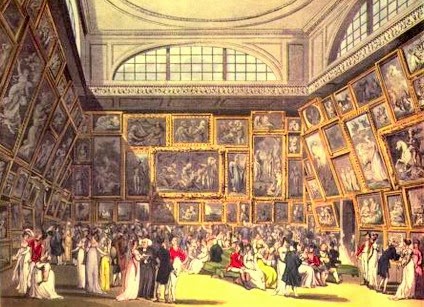 |
| The exhibition at the Royal Academy, Somerset House from The Microcosm of London (1808-10) |
Joshua was eager for royal recognition and was disappointed when Allan Ramsay was appointed portrait painter to the King in 1760. It was not until 1 October 1784 that Joshua was made principal painter-in-ordinary on Ramsay’s death.
On 21 April 1769, Joshua was knighted at St James’ Palace.
On 21 April 1769, Joshua was knighted at St James’ Palace.
 |
| St James' Palace, London (2013) |
In 1772, Joshua was elected an alderman of Plympton and in 1773, he was elected mayor. He was awarded a doctorate of civil law by the University of Oxford in July 1773.
The Georgian networker
Joshua was a very sociable man and developed a wide circle of patrons and friends. He was a member of a number of clubs including the Artists’ Club, the Dilettanti Society, the Devonshire, the Thursday night club and the Eumelian.
The Georgian networker
Joshua was a very sociable man and developed a wide circle of patrons and friends. He was a member of a number of clubs including the Artists’ Club, the Dilettanti Society, the Devonshire, the Thursday night club and the Eumelian.
He was a frequent guest at the bluestocking circle assemblies of Mrs Montagu where he developed friendships with Fanny Burney and Hannah More.
His friends included lexicographer Samuel Johnson, author Oliver Goldsmith, politician Edmund Burke and radical John Wilkes.
In later years, Joshua was part of ‘The Gang’ with James Boswell, Edward Malone and John Courtnay.
His friends included lexicographer Samuel Johnson, author Oliver Goldsmith, politician Edmund Burke and radical John Wilkes.
In later years, Joshua was part of ‘The Gang’ with James Boswell, Edward Malone and John Courtnay.
Samuel Johnson
 |
| Samuel Johnson from The Life and Times of Sir Joshua Reynolds by Leslie and Taylor (1865) |
In 1764, the Literary Club was formed at Joshua’s suggestion, meeting at the Turk’s Head in Gerrard Street for many years.
The object of Reynolds in the establishment of this club was to give Johnson undisturbed opportunities of talking; and to procure for himself and his friends such opportunities of listening to his wisdom and wit, as did not often occur in the accidental intercourse of mixed society.3Romance
Joshua never married. There are letters to a Miss Weston that suggest a romantic attachment in the late 1740s and rumours of other attachments in the late 1770s. He was very fond of Fanny Burney and it was thought he would offer for her, but in 1782, he suffered a severe paralysis and Fanny wrote to her sister that to be married to him would leave her in perpetual fear of his suffering a fatal stroke.4
 |
| Fanny Burney from Diary and letters of Madame D'Arblay (1846) |
The Whig influence
Many of Joshua’s friends and patrons were leading members of the Whig party and it is probable that he, too, was a Whig.
Johnson complained that:
Reynolds is too much under Fox and Burke at present. He is under the Fox Star, and the Irish constellation.6What was Sir Joshua like?
Joshua was about five foot six inches tall, with a rounded face and a lip that had been damaged by a riding accident in Minorca. He was dedicated to his painting and had a tendency to be sloppy in his appearance, careless of whether he had thrown snuff down his front whilst at work.
Sadly Joshua did not get on well with his unmarried sister Frances who lived with him as housekeeper for many years. Joshua found her constant indecisiveness frustrating and he did not treat her kindly, leading some to assume that he was cold in all his relationships. In the 1770s, Frances left and his niece, Mary Palmer, became his housekeeper for the rest of his life.
Joshua was highly sociable and known for his generosity, often inviting far more people to dinner than his table could accommodate, but his haphazard dinners seemed to endear him to his friends rather than provoking disgust.
He loved to play cards and visit the theatre and was fond of wine.
Sadly Joshua did not get on well with his unmarried sister Frances who lived with him as housekeeper for many years. Joshua found her constant indecisiveness frustrating and he did not treat her kindly, leading some to assume that he was cold in all his relationships. In the 1770s, Frances left and his niece, Mary Palmer, became his housekeeper for the rest of his life.
Joshua was highly sociable and known for his generosity, often inviting far more people to dinner than his table could accommodate, but his haphazard dinners seemed to endear him to his friends rather than provoking disgust.
He loved to play cards and visit the theatre and was fond of wine.
I am, said Sir Joshua, in very good spirits when I get up in the morning. By dinner time I am exhausted; wine puts me in the same state as when I got up; and I am sure that moderate drinking makes people talk better.7
 |
| Wine and glasses, Kew Palace (2014) |
Joshua was partially deaf and often used a silver ear trumpet to aid his hearing. He wore spectacles from at least 1783 when he complained of a violent inflammation of the eyes, but as an examination of his spectacles indicates that he was short-sighted, he may have worn them for longer.
 |
| Sir Joshua Reynolds - self-portrait c1788 from The Literary Works of Sir Joshua Reynolds ed J Farrington and E Malone (1819) |
In July 1789, Joshua’s sight began to fail. He had to cancel an appointment because he could not see properly and by the end of July, he was forced into retirement.
Illness and death
In the autumn of 1791, Joshua started experiencing severe pain in his left eye, a result, so it transpired, of liver disease. He died on 23 February 1792 and was given a state burial in the crypt of St Paul’s on 2 March. The night before his burial, his body lay in state in the Life Room at Somerset House before being transported to St Paul’s followed by a funeral procession of 91 carriages.
Illness and death
In the autumn of 1791, Joshua started experiencing severe pain in his left eye, a result, so it transpired, of liver disease. He died on 23 February 1792 and was given a state burial in the crypt of St Paul’s on 2 March. The night before his burial, his body lay in state in the Life Room at Somerset House before being transported to St Paul’s followed by a funeral procession of 91 carriages.

Rachel Knowles writes clean/Christian Regency era romance and historical non-fiction. She has been sharing her research on this blog since 2011. Rachel lives in the beautiful Georgian seaside town of Weymouth, Dorset, on the south coast of England, with her husband, Andrew.
Find out more about Rachel's books and sign up for her newsletter here.If you have enjoyed this blog and want to encourage me and help me to keep making my research freely available, please buy me a virtual cup of coffee by clicking the button below.
Notes
(1) In a letter by his father to Mr Cutcliffe 17 March 1740, from Leslie and Taylor’s Life and Times of Sir Joshua Reynolds (1865).
(2) Oxford Dictionary of National Biography entry by Martin Postle says the split happened in the summer of 1743 which would mean that Joshua served three years, not two.
(3) From Leslie and Taylor's Life and Times of Sir Joshua Reynolds (1865).
(4) A letter from Fanny Burney to her sister from Leslie and Taylor’s Life and Times of Sir Joshua Reynolds (1865).
(5) From Sir Joshua Reynolds, a personal study by Derek Hudson (1958)
(6) A conversation between Johnson and Boswell in 1778 from Boswell's Life of Johnson (1851).
(7) A conversation between Johnson and Reynolds in 1776 from Boswell's Life of Johnson (1851.
Sources used include:
Boswell, James, The Life of Samuel Johnson LL.D, with new additions by John Wilson Croker (1851)
Burney, Fanny, Diary and letters of Madame D'Arblay, edited by her niece, Charlotte Barrett (1846)
Hudson, Derek, Sir Joshua Reynolds, a personal study (1958)
Leslie, Charles Robert, RA, and Taylor, Tom, MA, Life and Times of Sir Joshua Reynolds (1865)
Postle, Martin, Reynolds, Sir Joshua (1723-1792) Oxford Dictionary of National Biography (Oxford University Press, 2004; online edn Oct 2009, accessed 2 Jul 2013)
Reynolds, Sir Joshua, ed Beechey, HW, The Literary Works of Sir Joshua Reynolds (1852)
Reynolds, Sir Joshua, ed Farrington, J and Malone, E, The Literary Works of Sir Joshua Reynolds (1819)
All photographs © RegencyHistory.net
(1) In a letter by his father to Mr Cutcliffe 17 March 1740, from Leslie and Taylor’s Life and Times of Sir Joshua Reynolds (1865).
(2) Oxford Dictionary of National Biography entry by Martin Postle says the split happened in the summer of 1743 which would mean that Joshua served three years, not two.
(3) From Leslie and Taylor's Life and Times of Sir Joshua Reynolds (1865).
(4) A letter from Fanny Burney to her sister from Leslie and Taylor’s Life and Times of Sir Joshua Reynolds (1865).
(5) From Sir Joshua Reynolds, a personal study by Derek Hudson (1958)
(6) A conversation between Johnson and Boswell in 1778 from Boswell's Life of Johnson (1851).
(7) A conversation between Johnson and Reynolds in 1776 from Boswell's Life of Johnson (1851.
Sources used include:
Boswell, James, The Life of Samuel Johnson LL.D, with new additions by John Wilson Croker (1851)
Burney, Fanny, Diary and letters of Madame D'Arblay, edited by her niece, Charlotte Barrett (1846)
Hudson, Derek, Sir Joshua Reynolds, a personal study (1958)
Leslie, Charles Robert, RA, and Taylor, Tom, MA, Life and Times of Sir Joshua Reynolds (1865)
Postle, Martin, Reynolds, Sir Joshua (1723-1792) Oxford Dictionary of National Biography (Oxford University Press, 2004; online edn Oct 2009, accessed 2 Jul 2013)
Reynolds, Sir Joshua, ed Beechey, HW, The Literary Works of Sir Joshua Reynolds (1852)
Reynolds, Sir Joshua, ed Farrington, J and Malone, E, The Literary Works of Sir Joshua Reynolds (1819)
All photographs © RegencyHistory.net
Sunday, 9 February 2014
The bluestocking circle
 |
| Pen and ink stand from A La Ronde, Exmouth |
According to the Chambers dictionary, a bluestocking is an intellectual woman. In the second half of the 18th century, the term referred to the men and women who attended the literary assemblies of the bluestocking circle or society, but it subsequently came to mean a lady of learning and was often applied in a derogative way, suggesting that too much knowledge was unfeminine.
 |
| Books on the shelves at Knightshayes, Devon |
In the 1750s, a number of wealthy, intellectual women started to hold literary parties at their London houses. Although the bluestocking gatherings were hosted by women, they were open to people of both sexes and drew together people from different backgrounds. Their aim was to provide a setting where women could expand their knowledge by conversing freely with other women and men of learning.
James Boswell stated that...
it was much the fashion for several ladies to have evening assemblies, where the fair sex might participate in conversation with literary and ingenious men, animated by a desire to please. These societies were denominated Bluestocking Clubs.1
 |
| James Boswell from The Life of Samuel Johnson by J Boswell (1851 edition) |
The bluestocking assemblies challenged the fashion of the day, offering stimulating conversation rather than cards or dancing, and tea rather than alcohol to drink. They were influenced by the French salons which were famous for their conversation, but unlike the French salons, they were unconnected with the court and insisted on high moral behaviour.
The bluestocking hostesses
Three of the most prominent bluestocking hostesses were Elizabeth Montagu, Elizabeth Vesey and Frances Boscawen. These wealthy, well-connected women held literary salons in their homes in London: Elizabeth Montagu in Hill Street and later in Portman Square; Elizabeth Vesey in Clarges Street; and Frances Boscawen in South Audley Street.
The hostesses vied with each other to offer the most distinguished company. According to Taylor:
Mrs Montagu bore away the bell, thanks as much to her name, her diamonds, her dinners, and her determination, as to her agreeableness or learning.2
Samuel Johnson dubbed Mrs Montagu “Queen of the Blues”.
 |
| Elizabeth Montagu from The Letters of Mrs Elizabeth Montagu (1810) |
Mrs Montagu seated her guests in a large semi-circle in order to encourage a unified discussion whilst Mrs Vesey favoured more random, scattered groups, sometimes even placing chairs back to back.
The bluestockings
The bluestocking assemblies drew together a wide range of people – artists and writers, botanists and politicians, actors and musicians.
The bluestocking circle included Hester Thrale; Hannah More; Hester Chapone; Mary Delany; Margaret Bentinck, Duchess of Portland; Elizabeth Carter; Sir Joshua Reynolds and his sister Frances; Fanny Burney; Samuel Johnson; William Pulteney, 1st Earl of Bath; James Boswell; David and Eva Garrick; Edmund Burke; George Lyttelton; Mrs Ord; Mrs Crewe and Benjamin Stillingfleet.
 |
| Elizabeth Carter from Memoirs of the Life of Elizabeth Carter by Rev M Pennington (1816) |
The term bluestocking is said to derive from a story regarding Benjamin Stillingfleet, a botanist and author, who attended the bluestocking assemblies.
Boswell wrote that:
One of the most eminent members of those societies, when they first commenced, was Mr Stillingfleet, whose dress was remarkably grave, and in particular it was observed that he wore blue stockings. Such was the excellence of his conversation, that his absence was felt as so great a loss, that it used to be said, ‘We can do nothing without the blue stockings’ and thus by degrees the title was established.1
 |
| Benjamin Stillingfleet from Literary life and selected works of Benjamin Stillingfleet (1811) |
The blue stockings referred to were blue worsted stockings, everyday rather than evening wear. The implication was that conversation was more important than fashion and informal dress was acceptable.
Taylor wrote a slightly different account, that Mrs Vesey had invited Stillingfleet to an assembly and cut short his excuses on account of his dress by saying ‘Pooh, pooh! Come in your blue stockings.’2
Taylor also suggested an alternative source for the term. He quoted Mrs Crewe, another of the bluestockings, as saying that it arose from Madame de Polignac appearing at one of Mrs Montagu’s assemblies in her blue silk stockings which were fashionable in Paris.2
The bluestocking influence
The bluestockings were active in philanthropy and advocated the provision of education. They patronised new talent and encouraged women to go into publication who might otherwise not have done so. Hannah More was the most widely published and encouraged other women by her example.
Despite its seemingly forward-thinking promotion of women’s education, the bluestocking circle was conservative in its views towards society and religion. When Hester Thrale married Gabriel Piozzi, an Italian musician, her fellow bluestockings reacted very negatively.
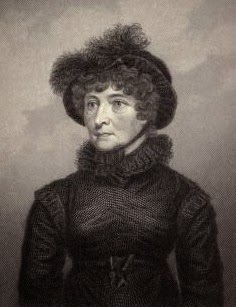 |
| Hester Thrale Piozzi from Autobiography Letters and Literary Remains of Mrs Piozzi (Thrale) (1861) |
In 1786, Hannah More published a poem, Le bas bleu, in defence of the bluestockings. The poem praised the bluestocking assemblies and attempted to show that conversation was more desirable than fashionable pursuits.
 |
| Hannah More from Memoirs of the life and correspondence of Mrs Hannah More by William Roberts (1835) |
The bluestocking circle was at its peak between 1770 and 1785. After this time, the bluestocking influence began to decline. In 1785, Elizabeth Vesey’s husband died, leaving her in relative poverty. With failing health, she closed her home, dying in 1791. Elizabeth Montagu died in 1800 and Frances Boscawen in 1805.
In addition, the French revolution ushered in a time of greater conservatism. Learning in women was ridiculed by some influential writers, such as William Hazlitt, and bluestocking became a term of derision applied to women who were considered too learned to be marriageable.
Rachel Knowles writes clean/Christian Regency era romance and historical non-fiction. She has been sharing her research on this blog since 2011. Rachel lives in the beautiful Georgian seaside town of Weymouth, Dorset, on the south coast of England, with her husband, Andrew.
Find out more about Rachel's books and sign up for her newsletter here.If you have enjoyed this blog and want to encourage me and help me to keep making my research freely available, please buy me a virtual cup of coffee by clicking the button below.
Notes
1. The Life of Samuel Johnson by James Boswell (1791).
2. Life and Times of Sir Joshua Reynolds by Robert Leslie and Tom Taylor (1865).
Sources used include:
Boswell, James, The Life of Samuel Johnson LL.D, with new additions by John Wilson Croker (1851 edition)
Burney, Fanny, Diary and letters of Madame D'Arblay, edited by her niece, Charlotte Barrett (1846)
Eger, Elizabeth, Bluestocking circle (c1755-c1795), Oxford Dictionary of National Biography (Oxford University Press, online edn Jan 2012, accessed 7 June 2012)
Leslie, Charles Robert, RA, and Taylor, Tom, MA, Life and Times of Sir Joshua Reynolds (1865)
McCalman, Iain (ed), Bluestockings, An Oxford Companion to the Romantic Age (OUP 2009 Oxford Reference Online, accessed 14 November 2011)
Schnorrenberg, Barbara Brandon, Montagu, Elizabeth (1718-1800) Oxford Dictionary of National Biography (Oxford University Press, 2004, online edn May 2009, accessed 7 June 2012)
Stillingfleet, Benjamin, Literary life and select works of Benjamin Stillingfleet, ed W Coxe (1811)
Thrale, Hester, Autobiography Letters and Literary Remains of Mrs Piozzi (Thrale) edited by A Hayward (1861)
All photographs © RegencyHistory.net
Subscribe to:
Posts (Atom)