Search this blog

Showing posts with label Hannah More. Show all posts

Thursday, 30 April 2020

Fanny Boscawen, bluestocking hostess (1719-1805)

Fanny Boscawen by Allan Ramsay (1749)  © Croome Park NT/Lionel Matthews
Fanny Boscawen by Allan Ramsay (1749)
© Croome Park NT/Lionel Matthews
Fanny Boscawen (23 July 1719 – 26 February 1805) was a bluestocking hostess and writer. Her husband Edward commissioned Robert Adam to design the interiors for their home, Hatchlands Park, Surrey.

Early years

Frances Evelyn Glanville was born on 23 July 1719 at St Clere, near Wrotham, Kent. Frances, known as Fanny, was the only daughter of William Evelyn and his wife Frances Glanville, a great niece of the diarist John Evelyn. Her father took her mother’s name on their marriage by Act of Parliament, at the same time as inheriting her fortune.

Fanny’s mother died in childbirth and her father remarried a few years later. Fanny spent much of her childhood staying with relatives - an aunt, Mrs Gore, who lived at Boxley near Maidstone; at Wotton in Surrey with Sir John Evelyn, the grandson of the diarist, and his wife Anne Boscawen; and with Sir John’s son John and his wife Mary Boscawen, his first cousin, a daughter of Hugh Boscawen, 1st Viscount Falmouth.

Marriage

Admiral Edward Boscawen from the painting  by Sir Joshua Reynolds from An Historical   Journal of the Campaigns in North America  by Captain John Knox (1914)
Admiral Edward Boscawen from the painting
by Sir Joshua Reynolds from An Historical
 Journal of the Campaigns in North America
by Captain John Knox (1914)
It was at the home of John and Mary Evelyn that Fanny first met Edward Boscawen (1711-1761), Mary’s brother, in 1738. Edward was a captain in the navy. Fanny later wrote a letter that alluded to these ‘when you and I loved one another and told it only by our eyes.’1

When Edward returned after three years active service in the war against Spain, he became MP for Truro and was made captain of the Dreadnought. He resumed his courtship of Fanny and they were married on 11 December 1742. They lived in George Street, Hanover Square, London.

Edward and Fanny were very happy together and had five children: Edward Hugh (1744), Frances (1746), Elizabeth (1747), William Glanville (1749) and George (1758).

Hatchlands Park

Hatchlands Park © A Knowles (2014)
In 1746, Fanny rented a small house in the country, in Beddington, Surrey, and in 1747, Edward and Fanny moved to a new London address, 14 South Audley Street.

In 1749, Edward and Fanny bought Hatchlands Park, near Guildford, in Surrey. It was an estate that Fanny had set her heart on some time before. Fanny wrote in her journal on 10th August 1748 that she had ‘made no enquiries, my heart still fixed at Hatchlands.’2

Again, on 23rd November 1748 Fanny wrote:
I shall wait for the charming summons at Englefield Green, where I propose to reside again this summer, Hatchland (which I still think of) being neither sold nor saleable.3
Edward and Fanny spent four happy years at Hatchlands together before Edward was once more called away on active service.

In 1757, they commissioned a new house at Hatchlands with interiors designed by Robert Adam.

Adam fireplace in the Drawing Room, Hatchlands from The architecture of Robert and James Adam by AT Bolton (1922)
Adam fireplace in the Drawing Room, Hatchlands
from The architecture of Robert and James Adam by AT Bolton (1922)
A successful naval career

Edward’s naval career meant that both during their courtship and after their marriage, Edward and Fanny spent many months apart. Fanny kept a journal to keep Edward in touch with what was happening at home.

Edward proved himself to be a very able naval commander. He was promoted to Rear-Admiral of the Blue in 1747 and appointed Lord Commissioner of the Admiralty in 1751. (Admiral’s wife p146) He rose to Vice Admiral in 1755 and Admiral in 1758. Edward is particularly remembered for his successes in the Siege of Louisburg (1758) and the Battle of Lagos (1759).

Widowhood

Edward died at Hatchlands on 10 January 1761 after an acute attack of typhoid fever. Fanny was distraught. Edward was buried at St Michael Penkevil in Cornwall, in a tomb designed by Robert Adam, and with an inscription written by Fanny herself and ending with the words:
His once happy wife inscribes this marble – an unequal testimony of his worth and of her affection.4
Hre friend Elizabeth Montagu wrote to her husband a week after Edward’s death:
I thank God her mind is very calm and settled; she endeavours all she can to bring herself to submit to this dire misfortune. I know time must be her best comforter, so that I oppose her lamentations rarely and gently, but when they continue long, I set before her the merit of her five children, the want they will have of her, and the comfort she may derive from them.5
Blue-stocking hostess

Edward left his entire fortune to Fanny. She sold Hatchlands and moved back to London, to 14 South Audley Street, where she gained a reputation as an excellent letter writer and conversationalist and became famous for her bluestocking assemblies. Her guests included Elizabeth Montagu, Dr Johnson, Joshua Reynolds, Elizabeth Carter and Hannah More.

You can read more about the bluestocking circle on my earlier blog here.

Elizabeth Montagu wrote:
I look upon it as a fortunate omen to begin my New Year in Mrs Boscawen’s company. She is in her conversation everything that can make the hours pass agreeably. I must be happier, and I should be better for her friendship.6
Elizabeth Montagu from a print on display in Dr Johnson's House Museum
Elizabeth Montagu from a print on display
in Dr Johnson's House Museum
What was Fanny Boscawen like?

In Admiral’s Wife, Cecil Aspinall-Oglander wrote:
Though even Fanny’s dearest friends can never have called her beautiful, her vivacious little face and attractive figure, her level brow and restful wide-apart eyes, her ready wit and subtle understanding, her captivating manner and complete lack of self-consciousness were utterly irresistible.7
Fellow bluestocking Mrs Montagu described Fanny in a letter dated 1757:
She is in very good spirits, and sensible of her many felicities, which I pray God to preserve to her; but her cup is so full of good, I am always afraid it will spill. She is one of the few whom an unbounded prosperity could not spoil. I think there is not a grain of evil in her composition. She is humble, charitable, pious, of gentle temper, with the firmest principles and with a great deal of discretion, void of any degree of art, warm and constant in her affections, mild towards offenders, but rigorous towards offence.8
Hannah More referred to Fanny in this excerpt from her poem, The Bas Bleu; or, Conversation:
Long was society o’er-run
By whist, that desolating Hun;
Long did quadrille despotic sit,
That Vandal of colloquial wit;
And conversation’s setting light
Lay half-obscured in Gothic night.
At length the mental shades decline,
Colloquial wit begins to shine;
Genius prevails, and conversation
Emerges into reformation.
The vanquish'd triple crown to you,
Boscawen sage, bright Montagu,
Divided, fell; - your cares in haste
Rescued the ravag'd realms of Taste.9
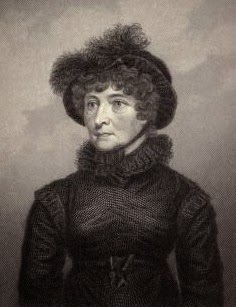
Hannah More from Memoirs of the life and correspondence  of Mrs Hannah More by William Roberts (1835)
Hannah More
from Memoirs of the life and correspondence 
of Mrs Hannah More by William Roberts (1835)
Family sadness

Losing her beloved husband was not the only loss that Fanny had to bear. Three of her five children died before her: William was drowned in 1769, Edward died in 1774, and Frances Leveson-Gower, to whom she was particularly close, died in 1801. In 1803, her daughter Elizabeth’s husband, Henry Somerset, 5th Duke of Beaufort, also died.

Fanny had a close friendship with her cousin Julia Sayer (née Evelyn) with whom she corresponded regularly until Julia’s death in 1777. Fanny continued to correspond with Julia’s daughter, her god-daughter Frances Sayer, who became her closest companion in the latter years of her life. It was Frances Sayer who collected and saved Fanny’s letters.

Death

Fanny died on 26 February 1805 at her home in South Audley Street, London. She was buried in her husband’s tomb in Cornwall.

The inscription on her grave reads:
Here lie the remains of the Honourable Frances Boscawen, daughter of William Evelyn Glanville Esq of St Clere in the County of Kent and relict of the right Hon Admiral Boscawen to whom she was a faithful and affectionate wife for eighteen years and by whom she had five children, whom she most carefully and tenderly educated: Viz Edward Hugh Boscawen, member of parliament for Truro who died at the spa in Germany July 17th 1774 aged 29 years. Frances, the wife of Rear Admiral the Hon John Leveson Gower who died July 14th 1801 aged 55 years, Elizabeth, married to Henry, 5th Duke of Beaufort who survived her. William Glanville Boscawen who was unhappily drowned at Jamaica 21st April 1769 aged 17 years: A Lieutenant in the Navy and George Evelyn Boscawen third Viscount Falmouth who survived her. Her long and well spent life in the observance of the purest and most exemplary piety and in the practice of every Christian virtue was terminated on the 26th day of February 1805 in London in the 86th year of her age. She was endowed with an uncommon and remarkable strength of understanding and in society, she is thus most truly described by a contemporary author: ‘Her manners are the most agreeable and her conversation the best of any Lady with whom I ever had the happiness to be acquainted.’10

Headshot of Rachel Knowles author with sea in background(2021)
Rachel Knowles writes clean/Christian Regency era romance and historical non-fiction. She has been sharing her research on this blog since 2011. Rachel lives in the beautiful Georgian seaside town of Weymouth, Dorset, on the south coast of England, with her husband, Andrew.

Find out more about Rachel's books and sign up for her newsletter here.

If you have enjoyed this blog and want to encourage me and help me to keep making my research freely available, please buy me a virtual cup of coffee by clicking the button below.

 
Notes
1. Aspinall-Oglander, Cecil, Admiral's Wife, Being the life and letters of The Hon Mrs Edward Boscawen from 1719-1761 (1940)
2. Ibid
3. Ibid
4. Ibid
5. Ibid
6. Ibid
7. Ibid
8. Climenson, Emily J, Elizabeth Montagu, The Queen of the Blue-Stockings Volume 2 (1906)
9. More, Hannah, The Works of Hannah More Volume 5 (1835)
10. Findagrave website - entry for Frances Evelyn Glanville Boscawen

Sources used include:
Aspinall-Oglander, Cecil, Admiral's Wife, Being the life and letters of The Hon Mrs Edward Boscawen from 1719-1761 (1940)
Climenson, Emily J, Elizabeth Montagu, The Queen of the Blue-Stockings Volume 2 (1906)
Eger, Elizabeth, Boscawen (née Glanville), Frances Evelyn (Fanny) (1719-1805), Oxford Dictionary of National Biography (Oxford University Press, online edn 23 Sept 2004)
Knox, Captain John, An Historical Journal of the Campaigns in North America Volume 1 (1914)

 
All photographs © RegencyHistory.net

Monday, 15 May 2017

Coelebs in Search of a Wife by Hannah More (1808) – a review

Gentleman's full dress  from Ackermann's Repository (1810)
Gentleman's full dress
from Ackermann's Repository (1810)
Coelebs in Search of a Wife 1 could perhaps be more aptly named Reader in Search of a Story! If you pick up this book expecting an action-filled tale of romance and adventure, you will be disappointed. Not much happens! There is a gentle storyline following the hero, Charles, as he looks for a wife, but the book is less about the love story and more about the different people he meets. 

This is what I found fascinating. Hannah More painted a series of character portraits based on her observations, giving the modern-day reader an insight into how people were living their lives in the early 1800s. In particular, More looked at the subject of religion and how people’s beliefs were worked out in their day-to-day lives – or not!

It seems incredible to us that, early on in the book, More felt it was necessary to make an apology, suggesting that ‘the religious may throw it aside as frivolous’.2 I guess it might have seemed frivolous compared to a book of sermons!

It is much easier to understand why she also pre-empted the criticism of the novel reader whom she thought might ‘reject it as dull’. The book is full of good conversation and good advice but, as I’ve already mentioned, very little action takes place.

That said, the book was very popular in its time, and others tried to mimic More’s success with titles such as Nubilia in Search of a Husband. The popularity of Coelebs and the charitable character of its heroine, Lucilla Stanley, helped to make it fashionable to care for the poor.

Hannah More from Memoirs of the life and correspondence  of Mrs Hannah More by William Roberts (1835)
Hannah More
from Memoirs of the life and correspondence 
of Mrs Hannah More by William Roberts (1835)
A summary of the story

What Charles is looking for in a wife

The hero, Charles, lives at the Priory in Westmoreland, where he has been living a retired life, attending his father through his final illness and then supporting his mother until her death. He is now eager to find a wife. His own ideas of the ideal woman are based on Eve in Milton’s Paradise Lost.

Before his death, his father had counselled him to choose a wife who was informed, cultivated and refined. 
The exhibiting, the displaying wife may entertain your company, but it is only the informed, the refined, the cultivated woman who can entertain yourself. 
You will want a companion: an artist you may hire.
He had also urged him not to choose a wife until he had visited his old friend Mr Stanley, who lived at Stanley Grove in Hampshire.

His mother had also given him advice, saying that many unobjectionable characters were not designed to give rational happiness in marriage. She advised him:  
It is not unreasonable to expect consistency.
Charles spells out what he is looking for in a wife: 
I do not want a Helen, a Saint Cecilia, or a Madame Dacier; yet she must be elegant, or I should not love her; sensible, or I should not respect her; well-informed, or she could not educate my children; well-bred, or she could not entertain my friends; consistent, or I should offend the shade of my mother; pious or I should not be happy with her, because the prime comfort in a companion for life is the delightful hope that she will be a companion for eternity.
The search begins

Charles visits some of the local families before heading for London on his way to Mr Stanley’s house. Everywhere he goes, he meets potential brides and becomes aware of numerous inconsistencies in people’s characters.

Charles finds Mr Stanley as amiable as he had hoped. Mr Stanley has the ability to say the right thing at the right time and to turn discussions on non-religious subjects into useful instruction. Mrs Stanley has the ability to bring out the best in people. She laments the damage done by novels by establishing the omnipotence of love, encouraging young readers to unresistingly submit to a feeling.

Lucilla Stanley   

Morning dress  from Ackermann's Repository (1811)
Morning dress
from Ackermann's Repository (1811)
Mr and Mrs Stanley have a family of daughters: 18-year-old Lucilla, 15-year-old Phoebe and several younger girls. They lost their only son some years before. Lucilla is everything that Charles wants in a wife. She is intelligent, kind, truly good and charitable, and modest with it. She has been doing the housekeeping since she was 16 and sets aside a day each week to serve the poor and visits them two evenings a week in their homes. She and her sisters have built up a large stock of clothing that they give out at Christmas.

The Stanleys believe too much time is spent on music for exhibition rather than developing conversation, and so Lucilla is cultured rather than accomplished. 
The excellence of musical performance is a decorated screen, behind which all defects in domestic knowledge, in taste, judgement, and literature, and the talents which make an elegant companion, are creditably concealed.
Fashionable afternoon and morning dress from Lady's Magazine (1807)
Fashionable afternoon and morning dress
from Lady's Magazine (1807)
Charles falls in love with her and asks Mr Stanley for her hand in marriage. Charles is told not to rush, but to stay a month and get to know Lucilla better and win her affections.

Lucilla is not without other suitors and Charles is jealous of Lord Staunton. Lucilla has rejected him once because of his loose principles, but he has not taken ‘no’ for an answer. He has told her that she can reform him. Lucilla refuses to accept a man with promises of reform because if he failed to reform, ‘it would be too late to repent of my folly, after my presumption had incurred its just punishment.’ Charles fears that Lord Staunton will genuinely reform and be accepted.

Charles’s new carriage arrives and Lucilla’s youngest sister, Celia, is afraid that Charles is going to go home. Charles invites her to go with him. She innocently says that she will go to the Priory with him if Lucilla will go too, making her poor sister blush. Despite the promised month not being up, Charles proposes and Lucilla accepts him.

Elliott's patent eccentric laundaulet or chariot   from Ackermann's Repository (1809)
Elliott's patent eccentric laundaulet or chariot
from Ackermann's Repository (1809)
When Charles goes to Mr Stanley to ask for his blessing, he discovers that Mr Stanley and his father had hoped that he would marry Lucilla, although they realised that it was not likely. The two fathers had resolved to keep their children apart until they were adults and then see if they were attracted to each other, but to say nothing, so there would be no compulsion on their part to marry if they were not inclined. Charles and Lucilla were delighted that their marriage had been long hoped for – an extra blessing to their union.

A bevy of little stories

The people that Charles meets along his journey each have a little story of their own, containing examples of good behaviour and bad, and how people either suffered the consequences of their folly or profited from adopting better habits. Here is a summary of some – but by no means all – of these stories.

Sir John and Lady Belfield were religious at heart but it did not affect the way they behaved. Sir John had found that too much religion could damage a man’s reputation. Lady Belfield was over indulgent towards her children. After visiting Stanley Grove and talking with and observing Mr and Mrs Stanley and their family, they made the decision to reduce the time they stayed in London over the winter and instruct their children better.

Mr and Mrs Carlton started off as an unmatched couple, obliged to marry to keep property within the family. Mr Carlton was irreligious and unkind whilst Mrs Carlton was devoutly religious. Although she had been in love with someone else, she lived out her faith in front of her husband, never allowing herself to criticise him and excelling in her domestic duties. Her faithful witness eventually won over her husband.

Ned Tyrrel had been at college with Mr Stanley but turned very dissolute. Later he reformed, but became addicted to ambition and then money, and he adopted some very extreme ideas about religion based on forgiveness without reform. Only when he becomes ill and is about to die does he suddenly realise how hollow his religion is.

Lady Melbury is a very popular lady in London’s high society. She is very charitable, but also very profligate. This comes to a head when she proposes to give a poor girl in a flower shop who is caring for her sick mother her custom but then realises it is her own failure to meet her debts that caused the poverty of the family in the first place. She claims she will give up gambling and never get in debt again, but finds it hard to resist the influence of others. It is only when she is left alone to think about her faults that the change really occurs. She saves enough money to pay off her debt by retiring to the country and cancelling a big entertainment she had planned. She resolves to live a retired life to avoid the contaminating influence of London society.

Opera dress from  Ackermann's Repository (1809)
Opera dress from
Ackermann's Repository (1809)
Lady Denham gives the appearance of religiosity but has no real feeling. She blames her inability to support charity on taxes and yet finds it possible to give generously to her favourite opera singer Signor Squallini’s benefit concert. With her, music is supreme. She gets her come-uppance when her daughter elopes with Squallini.

Lady Aston had lived a retired life in the country ever since her husband’s death. She saw it as a duty to mourn him and would not let her daughters do anything. As a result, they were wasting their time. Mr Stanley encouraged the girls to set up a school for the poor and read with the curate. The whole family became much happier.

Mr and Mrs Ranby had a reputation for being pious, but their religion consisted of a ‘disproportionate zeal for a very few doctrines’. Mrs Ranby was coarse and censorious and gave no religious instruction to her daughters who wasted their time. She thought it was enough to pray for them! Mrs Ranby did not see the relevance of religion to everyday matters, such as governing her temper.

Mr Stanhope was drawn in by beauty to an unequal marriage. His wife held his books in great aversion and was ill-informed and bad tempered. An example of a marriage where two people were ‘joined not matched’.

To protect each other from worry, Mr and Mrs Hamilton had tried to conceal their illnesses from each other for the first seven years of their marriage. They came to realise that concealment was dangerous even when the intentions were good. 
Unreserved communication is the lawful commerce of conjugal affection, and all concealment is contraband.
Miss Sparkes, a single lady of 45 who was neither poor nor ugly, was very masculine in her habits – she was a politician, a huntsman, a farrier and a coachman. She believed that clever men married stupid women because they feared a rival, and that a woman who excelled in domesticity must be downtrodden.

A noble hunting party by T Rowlandson  from Dr Syntax's Three Tours by William Combe (1868)
A noble hunting party by T Rowlandson
from Dr Syntax's Three Tours by William Combe (1868)
Mr Flam had good deeds without religion. Dr Barlow, the minister, warns him that he is as much at risk as Mr Tyrrel and his sham religion. However, Mr Flam is young and thinks he has plenty of time ahead of him to sort things out.

Notes
(1) Sometimes written as Cœlebs in Search of a Wife.
(2) All quotes taken from Cœlebs in Search of a Wife by Hannah More, (New York, 1859, edition).

Thursday, 13 February 2014

Sir Joshua Reynolds (1723-1792)

Sir Joshua Reynolds from The Literary Works of
Sir Joshua Reynolds by HW Beechey (1852)
Profile

Sir Joshua Reynolds (16 July 1723 - 23 February 1792) was a leading 18th century English portrait painter and President of the Royal Academy from 1769 to 1792.

You can see some of his paintings in my blog post about a 2015 exhibition of his work.

Family background

Joshua Reynolds was born on 16 July 1723 in Plympton, Devon, one of the 11 children of Samuel Reynolds and Theophila Potter. His father was master of Plympton grammar school and it was here that Joshua received his education.

Artist or apothecary

Joshua was encouraged to take an active interest in art and painted his first known portrait at the age of 12. He was highly influenced by Jonathan Richardson’s An Essay on the Theory of Painting (1715). When it came to choosing a career, Joshua told his father that
he would rather be an apothecary than an ordinary painter; but if he could be bound to an eminent master, he should choose the latter.1
In 1740, Joshua’s father bound him to an “eminent master” – Thomas Hudson, a native of Devon who had become a leading portrait painter in London. Although he was bound for four years, he only served two; Hudson dismissed him after an argument.2 The two men were soon reconciled and Joshua continued to paint, dividing his time between Plymouth Dock in Devon and London.

The Grand Tour

On 11 May 1749, Joshua sailed to Europe with Augustus Keppel. Over the next three years, his travels encompassed Cadiz, Minorca, Gibraltar, Morocco, Rome, Perugia, Arezzo, Florence, Venice, Lyons and Paris. He made copies of many old masters and also painted some caricatures, but had no formal artistic training. Whilst in Rome, he took on his first pupil, Giuseppe Marchi, who returned with him to England on 16 October 1752.

Admiral Keppel from The Life and
Times of Sir Joshua Reynolds by Leslie and Taylor (1865)
Portrait painter

On his return to England, Joshua took apartments in St Martin’s Lane, a very fashionable address for a painter. He later moved to 5 Great Newport Street and then to 47 Leicester Square in 1760, where he remained for the rest of his life.

Joshua was a prolific painter. During the 1750s, he painted over 100 portraits a year, often working seven days a week, except in the summer when the ton deserted the city. He kept pocket notebooks listing his appointments, which give a wonderful insight into both his sitters and his social engagements.

His popularity was reflected in his charges. His rates went up from 48 guineas for a full-length portrait in 1753 to 100 guineas in 1759 and then 150 guineas in 1764.

He promoted his works through engravings of his paintings.

The Royal Academy

Drawing from life at the Royal Academy from The Microcosm of London (1808-10)
Drawing from life at the Royal Academy
from The Microcosm of London (1808-10)
The Royal Academy of Arts was founded in December 1768 and Joshua was the first President. He was very involved with the running of the Academy and introduced the annual dinner on 23 April 1771. But the Academy members were not all supportive; William Chambers and James Barry were both antagonistic towards him.

During his presidency, he wrote 15 lectures on art, known as discourses, which were read out and then published. Unfortunately, Joshua was not a good public speaker and people had difficulty hearing him.

Exhibitions

Joshua exhibited at the first annual exhibition of works held by the Society of Artists in 1760 and at the Royal Academy, whose first exhibition opened on 26 April 1769 and continued every year. Between 1769 and 1779, Joshua exhibited over 100 pictures.

Drawing from life at the Royal Academy from The Microcosm of London (1808-10)
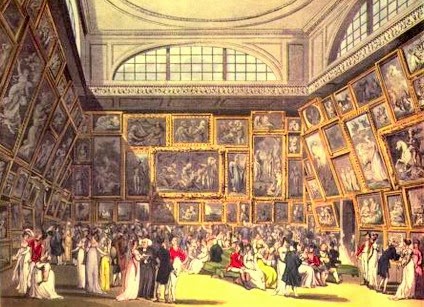
The exhibition at the Royal Academy, Somerset House
from The Microcosm of London (1808-10)
Recognition

Joshua was eager for royal recognition and was disappointed when Allan Ramsay was appointed portrait painter to the King in 1760. It was not until 1 October 1784 that Joshua was made principal painter-in-ordinary on Ramsay’s death.

On 21 April 1769, Joshua was knighted at St James’ Palace.
 
St James' Palace, London (2013)
In 1772, Joshua was elected an alderman of Plympton and in 1773, he was elected mayor. He was awarded a doctorate of civil law by the University of Oxford in July 1773.

The Georgian networker

Joshua was a very sociable man and developed a wide circle of patrons and friends. He was a member of a number of clubs including the Artists’ Club, the Dilettanti Society, the Devonshire, the Thursday night club and the Eumelian.

He was a frequent guest at the bluestocking circle assemblies of Mrs Montagu where he developed friendships with Fanny Burney and Hannah More.

His friends included lexicographer Samuel Johnson, author Oliver Goldsmith, politician Edmund Burke and radical John Wilkes.

In later years, Joshua was part of ‘The Gang’ with James Boswell, Edward Malone and John Courtnay.

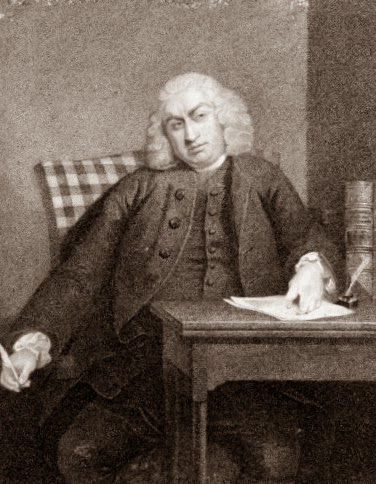
Samuel Johnson

Samuel Johnson
from The Life and Times of Sir Joshua Reynolds
 by Leslie and Taylor (1865)
Joshua’s closest friend and influencer was Samuel Johnson. He encouraged Joshua to embark on a literary career by commissioning him to write three essays for The Idler.

In 1764, the Literary Club was formed at Joshua’s suggestion, meeting at the Turk’s Head in Gerrard Street for many years.
The object of Reynolds in the establishment of this club was to give Johnson undisturbed opportunities of talking; and to procure for himself and his friends such opportunities of listening to his wisdom and wit, as did not often occur in the accidental intercourse of mixed society.3
Romance

Joshua never married. There are letters to a Miss Weston that suggest a romantic attachment in the late 1740s and rumours of other attachments in the late 1770s. He was very fond of Fanny Burney and it was thought he would offer for her, but in 1782, he suffered a severe paralysis and Fanny wrote to her sister that to be married to him would leave her in perpetual fear of his suffering a fatal stroke.4

Fanny Burney from Diary and letters of Madame D'Arblay (1846)
Fanny Burney
from Diary and letters of Madame D'Arblay (1846)
In 1788, Joshua told Boswell he had never married, because “every woman whom he had liked had grown indifferent to him.”5

The Whig influence

Many of Joshua’s friends and patrons were leading members of the Whig party and it is probable that he, too, was a Whig.

Johnson complained that:
Reynolds is too much under Fox and Burke at present. He is under the Fox Star, and the Irish constellation.6
What was Sir Joshua like?

Joshua was about five foot six inches tall, with a rounded face and a lip that had been damaged by a riding accident in Minorca. He was dedicated to his painting and had a tendency to be sloppy in his appearance, careless of whether he had thrown snuff down his front whilst at work.

Sadly Joshua did not get on well with his unmarried sister Frances who lived with him as housekeeper for many years. Joshua found her constant indecisiveness frustrating and he did not treat her kindly, leading some to assume that he was cold in all his relationships. In the 1770s, Frances left and his niece, Mary Palmer, became his housekeeper for the rest of his life.

Joshua was highly sociable and known for his generosity, often inviting far more people to dinner than his table could accommodate, but his haphazard dinners seemed to endear him to his friends rather than provoking disgust.

He loved to play cards and visit the theatre and was fond of wine.
I am, said Sir Joshua, in very good spirits when I get up in the morning. By dinner time I am exhausted; wine puts me in the same state as when I got up; and I am sure that moderate drinking makes people talk better.7
Wine and glasses, Kew Palace (2014)
Failing faculties

Joshua was partially deaf and often used a silver ear trumpet to aid his hearing. He wore spectacles from at least 1783 when he complained of a violent inflammation of the eyes, but as an examination of his spectacles indicates that he was short-sighted, he may have worn them for longer.

Sir Joshua Reynolds - self-portrait c1788 from
The Literary Works of Sir Joshua Reynolds
ed J Farrington and E Malone (1819)
In July 1789, Joshua’s sight began to fail. He had to cancel an appointment because he could not see properly and by the end of July, he was forced into retirement.

Illness and death

In the autumn of 1791, Joshua started experiencing severe pain in his left eye, a result, so it transpired, of liver disease. He died on 23 February 1792 and was given a state burial in the crypt of St Paul’s on 2 March. The night before his burial, his body lay in state in the Life Room at Somerset House before being transported to St Paul’s followed by a funeral procession of 91 carriages.

Headshot of Rachel Knowles author with sea in background(2021)
Rachel Knowles writes clean/Christian Regency era romance and historical non-fiction. She has been sharing her research on this blog since 2011. Rachel lives in the beautiful Georgian seaside town of Weymouth, Dorset, on the south coast of England, with her husband, Andrew.

Find out more about Rachel's books and sign up for her newsletter here.

If you have enjoyed this blog and want to encourage me and help me to keep making my research freely available, please buy me a virtual cup of coffee by clicking the button below.

 
Notes
(1) In a letter by his father to Mr Cutcliffe 17 March 1740, from Leslie and Taylor’s Life and Times of Sir Joshua Reynolds (1865).
(2) Oxford Dictionary of National Biography entry by Martin Postle says the split happened in the summer of 1743 which would mean that Joshua served three years, not two.
(3) From Leslie and Taylor's Life and Times of Sir Joshua Reynolds (1865).
(4) A letter from Fanny Burney to her sister from Leslie and Taylor’s Life and Times of Sir Joshua Reynolds (1865).
(5) From Sir Joshua Reynolds, a personal study by Derek Hudson (1958)
(6) A conversation between Johnson and Boswell in 1778 from Boswell's Life of Johnson (1851).
(7) A conversation between Johnson and Reynolds in 1776 from Boswell's Life of Johnson (1851.

Sources used include:
Boswell, James, The Life of Samuel Johnson LL.D, with new additions by John Wilson Croker (1851)
Burney, Fanny, Diary and letters of Madame D'Arblay, edited by her niece, Charlotte Barrett (1846)
Hudson, Derek, Sir Joshua Reynolds, a personal study (1958)
Leslie, Charles Robert, RA, and Taylor, Tom, MA, Life and Times of Sir Joshua Reynolds (1865)
Postle, Martin, Reynolds, Sir Joshua (1723-1792) Oxford Dictionary of National Biography (Oxford University Press, 2004; online edn Oct 2009, accessed 2 Jul 2013)
Reynolds, Sir Joshua, ed Beechey, HW, The Literary Works of Sir Joshua Reynolds (1852)
Reynolds, Sir Joshua, ed Farrington, J and Malone, E, The Literary Works of Sir Joshua Reynolds (1819)

All photographs © RegencyHistory.net

Sunday, 9 February 2014

The bluestocking circle

Pen and ink stand from A La Ronde, Exmouth
What is a bluestocking?

According to the Chambers dictionary, a bluestocking is an intellectual woman. In the second half of the 18th century, the term referred to the men and women who attended the literary assemblies of the bluestocking circle or society, but it subsequently came to mean a lady of learning and was often applied in a derogative way, suggesting that too much knowledge was unfeminine.

Books on the shelves at Knightshayes, Devon
The bluestocking circle

In the 1750s, a number of wealthy, intellectual women started to hold literary parties at their London houses. Although the bluestocking gatherings were hosted by women, they were open to people of both sexes and drew together people from different backgrounds. Their aim was to provide a setting where women could expand their knowledge by conversing freely with other women and men of learning.

James Boswell stated that...
it was much the fashion for several ladies to have evening assemblies, where the fair sex might participate in conversation with literary and ingenious men, animated by a desire to please. These societies were denominated Bluestocking Clubs.1

James Boswell from The Life of Samuel  Johnson by J Boswell (1851 edition)
James Boswell from The Life of Samuel
Johnson by J Boswell (1851 edition)
The bluestocking assemblies challenged the fashion of the day, offering stimulating conversation rather than cards or dancing, and tea rather than alcohol to drink. They were influenced by the French salons which were famous for their conversation, but unlike the French salons, they were unconnected with the court and insisted on high moral behaviour.

The bluestocking hostesses

Three of the most prominent bluestocking hostesses were Elizabeth Montagu, Elizabeth Vesey and Frances Boscawen. These wealthy, well-connected women held literary salons in their homes in London: Elizabeth Montagu in Hill Street and later in Portman Square; Elizabeth Vesey in Clarges Street; and Frances Boscawen in South Audley Street.

The hostesses vied with each other to offer the most distinguished company. According to Taylor:  
Mrs Montagu bore away the bell, thanks as much to her name, her diamonds, her dinners, and her determination, as to her agreeableness or learning.2 
Samuel Johnson dubbed Mrs Montagu “Queen of the Blues”.

Elizabeth Montagu from The Letters of Mrs Elizabeth Montagu (1810)
Elizabeth Montagu
from The Letters of Mrs Elizabeth Montagu (1810)
Mrs Montagu seated her guests in a large semi-circle in order to encourage a unified discussion whilst Mrs Vesey favoured more random, scattered groups, sometimes even placing chairs back to back.

The bluestockings

The bluestocking assemblies drew together a wide range of people – artists and writers, botanists and politicians, actors and musicians.

The bluestocking circle included Hester Thrale; Hannah More; Hester Chapone; Mary Delany; Margaret Bentinck, Duchess of Portland; Elizabeth Carter; Sir Joshua Reynolds and his sister Frances; Fanny Burney; Samuel Johnson; William Pulteney, 1st Earl of Bath; James Boswell; David and Eva Garrick; Edmund Burke; George Lyttelton; Mrs Ord; Mrs Crewe and Benjamin Stillingfleet.

Elizabeth Carter from Memoirs of the Life  of Elizabeth Carter by Rev M Pennnington (1816)
Elizabeth Carter from Memoirs of the Life
of Elizabeth Carter by Rev M Pennington (1816)
Where did the term bluestocking come from?

The term bluestocking is said to derive from a story regarding Benjamin Stillingfleet, a botanist and author, who attended the bluestocking assemblies.

Boswell wrote that:
One of the most eminent members of those societies, when they first commenced, was Mr Stillingfleet, whose dress was remarkably grave, and in particular it was observed that he wore blue stockings. Such was the excellence of his conversation, that his absence was felt as so great a loss, that it used to be said, ‘We can do nothing without the blue stockings’ and thus by degrees the title was established.1

Benjamin Stillingfleet from Literary life  and selected works of Benjamin Stillingfleet (1811)
Benjamin Stillingfleet from Literary life
and selected works of Benjamin Stillingfleet (1811)
The blue stockings referred to were blue worsted stockings, everyday rather than evening wear. The implication was that conversation was more important than fashion and informal dress was acceptable.

Taylor wrote a slightly different account, that Mrs Vesey had invited Stillingfleet to an assembly and cut short his excuses on account of his dress by saying ‘Pooh, pooh! Come in your blue stockings.’2

Taylor also suggested an alternative source for the term. He quoted Mrs Crewe, another of the bluestockings, as saying that it arose from Madame de Polignac appearing at one of Mrs Montagu’s assemblies in her blue silk stockings which were fashionable in Paris.2

The bluestocking influence

The bluestockings were active in philanthropy and advocated the provision of education. They patronised new talent and encouraged women to go into publication who might otherwise not have done so. Hannah More was the most widely published and encouraged other women by her example.

Despite its seemingly forward-thinking promotion of women’s education, the bluestocking circle was conservative in its views towards society and religion. When Hester Thrale married Gabriel Piozzi, an Italian musician, her fellow bluestockings reacted very negatively.

Hester Thrale Piozzi from Autobiography Letters and Literary Remains of Mrs Piozzi (Thrale) (1861)
Hester Thrale Piozzi from Autobiography Letters
and Literary Remains of Mrs Piozzi (Thrale)
(1861)
Le bas bleu

In 1786, Hannah More published a poem, Le bas bleu, in defence of the bluestockings. The poem praised the bluestocking assemblies and attempted to show that conversation was more desirable than fashionable pursuits.

Hannah More from Memoirs of the life and correspondence  of Mrs Hannah More  by William Roberts (1835)
Hannah More
from Memoirs of the life and correspondence 
of Mrs Hannah More  by William Roberts (1835)
The decline of the bluestocking circle

The bluestocking circle was at its peak between 1770 and 1785. After this time, the bluestocking influence began to decline. In 1785, Elizabeth Vesey’s husband died, leaving her in relative poverty. With failing health, she closed her home, dying in 1791. Elizabeth Montagu died in 1800 and Frances Boscawen in 1805.

In addition, the French revolution ushered in a time of greater conservatism. Learning in women was ridiculed by some influential writers, such as William Hazlitt, and bluestocking became a term of derision applied to women who were considered too learned to be marriageable.

Headshot of Rachel Knowles author with sea in background(2021)
Rachel Knowles writes clean/Christian Regency era romance and historical non-fiction. She has been sharing her research on this blog since 2011. Rachel lives in the beautiful Georgian seaside town of Weymouth, Dorset, on the south coast of England, with her husband, Andrew.

Find out more about Rachel's books and sign up for her newsletter here.

If you have enjoyed this blog and want to encourage me and help me to keep making my research freely available, please buy me a virtual cup of coffee by clicking the button below.


Notes
1. The Life of Samuel Johnson by James Boswell (1791).
2. Life and Times of Sir Joshua Reynolds by Robert Leslie and Tom Taylor (1865).

Sources used include:
Boswell, James, The Life of Samuel Johnson LL.D, with new additions by John Wilson Croker (1851 edition)
Burney, Fanny, Diary and letters of Madame D'Arblay, edited by her niece, Charlotte Barrett (1846)
Eger, Elizabeth, Bluestocking circle (c1755-c1795), Oxford Dictionary of National Biography (Oxford University Press, online edn Jan 2012, accessed 7 June 2012)
Leslie, Charles Robert, RA, and Taylor, Tom, MA, Life and Times of Sir Joshua Reynolds (1865)
McCalman, Iain (ed), Bluestockings, An Oxford Companion to the Romantic Age (OUP 2009 Oxford Reference Online, accessed 14 November 2011)
Schnorrenberg, Barbara Brandon, Montagu, Elizabeth (1718-1800) Oxford Dictionary of National Biography (Oxford University Press, 2004, online edn May 2009, accessed 7 June 2012)
Stillingfleet, Benjamin, Literary life and select works of Benjamin Stillingfleet, ed W Coxe (1811)
Thrale, Hester, Autobiography Letters and Literary Remains of Mrs Piozzi (Thrale) edited by A Hayward (1861)

All photographs © RegencyHistory.net

Thursday, 30 January 2014

Queen of the bluestockings: Elizabeth Montagu (1718-1800)

Elizabeth Montagu from a print on display in Dr Johnson's House Museum
Elizabeth Montagu from a print on display
in Dr Johnson's House Museum
Mrs Montagu is one of the Georgians I researched when writing A Perfect Match. She makes an appearance in my novel as an old friend of Alicia Westlake's father and it is while visiting her house in Portman Square that Alicia first comes face to face with the intriguing Mr Merry. 

Profile

Elizabeth Montagu (2 October 1718 - 25 August 1800) was a bluestocking hostess and the author of An Essay on the Writings and Genius of Shakespeare (1769).

Family background

Elizabeth Robinson was born in York on 2 October 1718, the daughter of Matthew Robinson and his wife Elizabeth Drake. Both families were wealthy and well-connected, and the family estate included land in Yorkshire and Cambridge and later Kent.1

Mount Morris, Monks Horton, Kent,  main residence of Elizabeth's family from the 1730s
Mount Morris, Monks Horton, Kent,
main residence of Elizabeth's family from the 1730s
Elizabeth had seven brothers and one sister, Sarah, with whom she was very close. The girls were taught Latin, French and Italian as well as classical and English literature and history.

Cambridge

Elizabeth often stayed with her maternal grandmother and her second husband, Dr Conyers Middleton, who was a respected Cambridge academic. Elizabeth developed an appreciation for lively intellectual conversation both with her parents and in the Middleton household.

Her nephew wrote:
Her uncommon sensibility and acuteness of understanding, as well as her extraordinary beauty as a child, rendered her an object of great notice in the University.2
Whilst in Cambridge, Elizabeth became friends with Lady Margaret Harley, daughter of the Earl of Oxford, who married William Bentinck, 2nd Duke of Portland in 1734. Lady Margaret’s mother gave her the nickname Fidget. She visited the Duchess of Portland in London and widened her network of acquaintances to include Mary Pendarves, the poet Edward Young and Gilbert West.3

Elizabeth Montagu  from The Letters of Mrs Elizabeth Montagu (1810)
Elizabeth Montagu
from The Letters of Mrs Elizabeth Montagu (1810)
Marriage

On 5 August 1742, Elizabeth married Edward Montagu, a man nearly thirty years her senior. He was a grandson of the 1st Earl of Sandwich and MP for Huntingdon and owned coalmines and estates in Northumberland, Yorkshire and Berkshire.

They had one son, John, whom they called Punch, who was born on 11 May 1743 in London. Elizabeth was devastated when he died suddenly in September 1744 and from this time onwards, she became increasingly religious.

After 1750, Elizabeth and Edward lived in London in Hill Street, Mayfair, but visited Sandleford Priory, their Berkshire estate near Newbury, in the spring and summer. The couple remained on friendly terms, but often spent time apart. Edward often visited his estates in the north alone whilst at various times, Elizabeth visited Bath, Tunbridge Wells, Paris, the Rhineland, the Low Countries and the Scottish highlands.

Literary hostess

Elizabeth became one of the three leading literary or bluestocking hostesses, together with Elizabeth Vesey and Frances Boscawen.

She started by inviting people to literary breakfasts and by 1760, she was hosting large evening assemblies where intellectual conversation and not cards was the central attraction. According to Fanny Burney, the chairs were arranged in a semi-circle in order to facilitate discussion.4

Fanny Burney  from Diary and letters of Madame D'Arblay (1846)
Fanny Burney
from Diary and letters of Madame D'Arblay (1846)
An introduction to Mrs Montagu’s was seen as a way to securing patronage. Her visitors included Dr Samuel Johnson, Sir Joshua Reynolds, Edmund Burke, David and Eva Garrick, Horace Walpole, William Pulteney, 1st Earl of Bath, Elizabeth Carter, Hester Thrale, Mary Delany, James Boswell, George Lyttelton, James Beattie, Hannah More, Fanny Burney, Anna Laetitia Barbauld, Sarah Fielding, Hester Chapone, and Anna Williams.3

Elizabeth Montagu's protegée, Hannah More,  from Memoirs of the life and correspondence   of Mrs Hannah More  by William Roberts (1835)
Elizabeth Montagu's protegée, Hannah More,
from Memoirs of the life and correspondence 
of Mrs Hannah More  by William Roberts (1835)
The critical writer

Hester Thrale described Elizabeth as “the first woman for literary knowledge in England, and if in England, I hope I may say in the world”.5

But although hailed as a great writer, Elizabeth had very little published. Apart from her contributions to Lyttelton’s Dialogues of the Dead (1760), her only published work was her critical An Essay on the Writings and Genius of Shakespeare (1769), supporting the English playwright’s work against Voltaire’s criticisms. It was very well received, but it included criticism of Samuel Johnson’s work and damaged her relationship with him.

“The wittiest woman in this Country”

Elizabeth was a brilliant conversationalist. Hannah More described her as having
 “a large and manly as well as a gay and brilliant mind, much veracity, kindness and great fidelity in friendship.”6 She also declared that Elizabeth was “without exception the wittiest woman in this Country” whilst Samuel Johnson is said to have nicknamed her “Queen of the Blues”.7

Samuel Johnson,  from The Life of Samuel Johnson by James Boswell (1791)
Samuel Johnson,
from The Life of Samuel Johnson by James Boswell (1791)
Elizabeth was painted as one of the nine women depicted as muses in Portraits in the Characters of the Muses in the Temple of Apollo by Richard Samuel (1778).

Appearance

Fanny Burney described her as
...middle-sized, very thin, and looks infirm; she has a sensible and penetrating countenance, and the air and manner of a woman accustomed to being distinguished, and of great parts.8
Her nephew said:
She was of the middle stature, and stooped a little, which gave an air of modesty to her countenance.2
A domineering woman

Elizabeth was a forceful character and this often came out in her letters, as did her strong opinions. She believed in the independence of women and that marriage was a matter of wealth and connections. She was interested in politics and was fiercely loyal to the crown.

Her sister, Sarah, lived as her companion for some years before getting married. It has been suggested that it was a wish to be free of her sister’s overbearing behaviour that pushed Sarah into her brief, unhappy marriage.

Elizabeth was apt to fall out with people who did not agree with her. In 1772, Dorothea Gregory, a doctor’s daughter from Edinburgh, became Elizabeth’s ward. Elizabeth treated her like a daughter and intended her for her nephew, but when Dorothea fell in love with and agreed to marry a penniless suitor, Elizabeth was furious and cast her off.

Widowhood

On 12 May 1775, Edward Montagu died, leaving Elizabeth almost his entire estate – an income of around £7,000 per annum. She successfully managed her business affairs and was generous with her money.

She granted annuities to indigent writers and patronised promising new talent, such as Hannah More’s Bristol milkmaid turned poet, Ann Yearsley. Sadly, this attempt at benevolence ended badly; their desire to manage the poet’s income led to a scandalous break with her patrons.

Portman Square

Portman Square, from Ackermann's Repository of Arts (Aug 1813)
In 1777, Elizabeth commissioned James Stuart to build Montagu House in Portman Square. She was finally able to move in in late 1781 and continue her literary assemblies here. She had a special room made to display her feather work – a huge tapestry made entirely from feathers which Queen Charlotte visited Montagu House to see.

Montagu House, 22 Portman Square, from The Private Palaces   of London past and present by EB Chancellor (1908)
Montagu House, 22 Portman Square, from The Private Palaces
 of London past and present by EB Chancellor (1908)
Elizabeth gave an annual entertainment in Portman Square for London climbing boys.

Death

Elizabeth Montagu died on 25 August 1800. She left her entire estate to her nephew, Matthew Robinson Montagu, later Baron Rokeby.

Headshot of Rachel Knowles author with sea in background(2021)
Rachel Knowles writes clean/Christian Regency era romance and historical non-fiction. She has been sharing her research on this blog since 2011. Rachel lives in the beautiful Georgian seaside town of Weymouth, Dorset, on the south coast of England, with her husband, Andrew.

Find out more about Rachel's books and sign up for her newsletter here.

If you have enjoyed this blog and want to encourage me and help me to keep making my research freely available, please buy me a virtual cup of coffee by clicking the button below.

 
Notes
(1) Some sources give her date of birth as 2 October 1720.
(2) From The Letters of Mrs Elizabeth Montagu, published by Matthew Montagu (1810).
(3) Mary Pendarves (neé Granville) became Mary Delany on her second marriage in 1743.
(4) From Burney memoirs as quoted in Hannah More, The First Victorian by Anne Stott (2003).
(5) From Diary and letters of Madame D'Arblay, volume 1, 23 Aug 1778.
(6) From a letter by Hannah More 2 Sept 1800 quoted in Hannah More, The First Victorian by Anne Stott (2003).
(7) From a letter by Hannah More 1 Sept 1800 quoted in Hannah More, The First Victorian by Anne Stott (2003).
(8) From Diary and letters of Madame D'Arblay, volume 1.

Sources used include:
Burney, Fanny, Diary and letters of Madame D'Arblay, edited by her niece, Charlotte Barrett (Henry Colburn, 1846, London)
Chancellor, E Beresford, The Private Palaces of London past and present (1908)
Eger, Elizabeth, Bluestocking circle (c1755-c1795), Oxford Dictionary of National Biography (Oxford University Press, online edn Jan 2012, accessed 7 June 2012)
Montagu, Elizabeth, ed Climenson, Emily, Elizabeth Montagu, The Queen of the Bluestockings, her correspondence from 1720-1761 (1906)
Montagu, Elizabeth, The Letters of Mrs Elizabeth Montagu, pub Matthew Montagu (1810)
Schnorrenberg, Barbara Brandon, Montagu, Elizabeth (1718-1800) Oxford Dictionary of National Biography (Oxford University Press, 2004, online edn May 2009, accessed 7 June 2012)
Stott, Anne, Hannah More, The First Victorian (2003)