Search this blog

Showing posts with label Artist. Show all posts

Thursday, 8 June 2017

The Lyceum Theatre in Regency London

The Proscenium of the English Opera House (The Lyceum)  as it appeared on March 21 1817 with Walker's Exhibition, the   Eidouranian from The Lyceum and Henry Irvine by A Brereton (1903)
The Proscenium of the English Opera House (The Lyceum)
as it appeared on March 21 1817 with Walker's Exhibition, the 
Eidouranian from The Lyceum and Henry Irvine by A Brereton (1903)
Profile

The Lyceum Theatre was built as an exhibition space which was later converted into a theatre. It did not have a patent for performances during the winter season, but from 1809 to 1812, the Drury Lane Theatre company performed at the Lyceum under their own licence whilst their theatre was being rebuilt. The Lyceum was hired for a variety of purposes including private theatricals, exhibitions and concerts, and later specialised in English Opera.

The Society of Artists

The original Lyceum was built on the Strand on a site near that of the current Lyceum Theatre. It was designed by the architect James Paine as an exhibition space for the Society of Artists of Great Britain.

It has been suggested that the Lyceum was built in 1765, predating the formation of the Royal Academy of Arts by three years. This would seem to be supported by The Microcosm of London which stated:
Previous to the institution of a Royal Academy, there was an exhibition at the Lyceum in the Strand. It was denominated THE SOCIETY OF ARTISTS OF GREAT BRITAIN; and the profits were to be applied to the relief of distressed artists, their widows and children. In this place were exhibited some very fine productions by Mortimer and other of our most celebrated painters.1
However, Austin Brereton in his 1903 book The Lyceum and Henry Irving recorded that the foundation stone was not laid until 1771 and that the exhibition centre opened on 11 May 1772.

According to Old and New London: ‘The apartments consisted of a large saloon, with a sky-light, and lesser rooms adjoining.’2
 
Interior of the Lyceum in 1790  from The Lyceum and Henry Irvine by A Brereton (1903)
Interior of the Lyceum in 1790
from The Lyceum and Henry Irvine by A Brereton (1903)
A myriad of exhibitions

The Society of Artists was unable to compete with the Royal Academy and the venture failed. The Lyceum was sold and let out to anyone who could pay the rent. Around 1794, Samuel Arnold leased the building and converted it into a theatre, but he could not obtain a licence to perform plays there due to the intense opposition from the Theatres Royal at Drury Lane and Covent Garden.

At various times, the Lyceum was used by a public debating society and as a saleroom and to house different exhibitions. The Picture of London for 1805 said:
During the winter season, there are generally a variety of occasional exhibitions, particularly at the Lyceum in the Strand, as Phillipstal’s Phantasmagoria, and Cartwright's Philosophical Glasses.3
These included:
  • An aeropyric branch
  • Mr Diller’s Philosophical Fireworks
  • The Irish giant, Mr O’Brien, who was said to be over 8 feet tall
  • Mr Cartwright’s Musical Glasses
  • The display of a rhinoceros, a zebra and an ostrich

    Advert for animals on display at the Lyceum (1791)  from The Lyceum and Henry Irvine by A Brereton (1903)
    Advert for animals on display at the Lyceum (1791)
    from The Lyceum and Henry Irvine by A Brereton (1903)
  • The Phantasmagoria
    The Picture of London for 1802 stated:
The Phantasmagoria; at the Lyceum.
This exhibition consists simply of a new application of the common magic lanthorn; the images, instead of being thrown, in the usual way, upon a white sheet, are thrown upon a transparent scene, which is hung between the lanthorn and the spectator. The images are consequently seen through the scene, are more distinct, and the effect to the spectator is greatly improved. To prevent the passage of extraneous light, the sliders are painted black, except on the part on which the figures are painted. The motion of the eyes and mouth, in some figures, is produced by double sliders.
The admittance is four shillings to the boxes, and two shillings to the pit. Some weak imitations have been exhibited in other parts of the town.4
  • A second phantasmagoria was also advertised in the same year:
The Egyptiana, and Phantasmagoria; at the Lyceum in the Strand.
This consists of various scenery, drawn and designed from nature in Egypt; and, by way of relief, there is an intermixture of recitations. The plan of exhibiting the scenery of foreign countries upon a. large scale, deserves encouragement; and, it is to be hoped, that it will in due time be extended to other countries besides Egypt: and thus amusement be made a vehicle of historical knowledge. Phantasmagoria are added.4
  • Madame Tussaud’s waxworks
    Philipstal and his phantasmagoria have long been forgotten, but his business partner at the time has not. That partner was Madame Tussaud, who travelled to England with Philipstal in 1802 to exhibit her waxworks at the Lyceum. These were not the first waxworks to go on display at the Lyceum. For several seasons in the 1780s, Mr Silvester had exhibited his waxworks there.

    Madame Tussaud from Madame Tussaud's   Memoirs and Reminiscences of France (1838)
    Madame Tussaud from Madame Tussaud's 
    Memoirs and Reminiscences of France (1838)
    It is interesting to note that the Picture of London for 1802 did not include any reference to Madame Tussaud’s waxworks. I discovered when researching Madame Tussaud’s story for What Regency Women Did For Us that Philipstal was responsible for all the advertising for their exhibitions. Madame Tussaud complained that Philipstal did not mention her on the advertisements and I wonder whether that might account for why her exhibition is not mentioned in the Picture Of London.
  • Mr Porter’s pictures
    Robert Kerr Porter exhibited several large paintings over a number of seasons at the Lyceum, including The Battle of Alexandria in 1802 and The Storming of Seringapatam in 1805. The Picture of London for 1802 advertised the Picture of the Battle of Alexandria:
Mr Porter, at the Lyceum, in the Strand, has lately opened an exhibition of a large picture, representing the celebrated battle between the English and French armies, on the 23d of March, 1801, before Alexandria, in Egypt. The subject is connected with the national vanity, and will, therefore, no doubt, draw large assemblages of spectators. The admission is one shilling.4
Theatrical entertainments

Although the Lyceum did not have a licence for theatrical performances, it was able to show other entertainments. These included:
  • Flockton’s puppet show
  • Theatrical imitations by George Saville Carey called The Diversions of an Evening
  • Mr Dibdin’s New Entertainment.
    Charles Dibdin was a famous songwriter and his show ran for 108 nights at the Lyceum in the autumn of 1790 alone.
  • Astley’s Circus
    When Astley’s Amphitheatre at Westminster Bridge burn down in 1794, Philip Astley transferred part of his circus to the Lyceum whilst it was rebuilt.
  • Boxing in Mendoza’s Academy
    Champion boxer Daniel Mendoza opened a boxing academy in the Lyceum in 1789. Spectators could watch a fight between one and three o’clock and the prices were 1s 6d for boxes and 1s for the gallery. The proprietor of the Lyceum advertised the academy saying:
    As Daniel Mendoza has divested his Exhibition of every degree of Brutality and rendered the Art of Boxing equally neat with Fencing, he thinks it necessary to mention that his Plan does not exclude the Company of Ladies.5
    Polite Amusement or an Exhibition of Brute Beasts at the Lyceum   from The Lyceum and Henry Irvine by A Brereton (1903)
    Polite Amusement or an Exhibition of Brute Beasts at the Lyceum
    from The Lyceum and Henry Irvine by A Brereton (1903)
  • The Loyal Theatre of Mirth
    In 1805, the Lyceum put on a Grand Spectacle called The Female Hussar.
  • The emperor of all the conjurors
    The Picture of London for 1809 stated that:
A licence has likewise been obtained for a theatre in Catherine-street for conjurors; and another at the Lyceum, in the Strand, for the same purpose. The one is conducted by Mr. Ingleby, who has assumed the title of king of the conjurors; the other by Mr M, who stiles himself emperor of all the conjurors.6
Private Theatricals

The theatre was also used for private theatricals. The Picture of London for 1806 stated:
Private Theatres.
Upon a small scale may be mentioned those of Tottenham-court-road, Berwick-street, and the Lyceum in the Strand; in the two latter of which not less than ten different companies perform. Tickets are delivered gratis by the performers to their friends, and are procured, in their respective neighbourhoods, without much difficulty.7
The Drury Lane Theatre company at the Lyceum (1809-1812)

In 1809, Samuel Arnold applied for a licence for the Lyceum, but was only granted a licence from 3 June to 3 October for ‘musical works of a light order’.8

However, when the Drury Lane Theatre burnt down on 24 February 1809, the company performed at the Lyceum under their own licence from 11 April 1809. It continued to perform there until the new Drury Lane Theatre opened in October 1812. According to Austin Brereton, Arnold did not fare badly by this arrangement. He received £900 a year and a third of the profit for the three seasons that the Drury Lane company performed at the Lyceum.

English Opera

During the summer, the Lyceum was used mostly for operas, burlettas and other musical pieces. It was known by different names at this time – sometimes the Theatre Royal, Lyceum, and sometimes as the Theatre Royal English Opera. The Picture of London for 1813 stated:
Mr. Arnold, author of a variety of dramatic pieces of superior merit, and son of Dr Arnold, of musical celebrity, has tried, with deserved success, the experiment of an English opera during the two last seasons at the Lyceum. We can assert, that it has afforded the highest gratification, and is one of the most elegant entertainments to an English ear which the metropolis affords. An English school of harmony, like an English school of painting, has been thought a solecism by some conceited critics, but many of the performances of the Lyceum have proved the falsehood of those observations, as much as the exhibitions of English painters have proved the error of foreign critics.
The English Opera is under the joint management of Messrs. Arnold and Raymond, and its whole conduct evinces superior taste and great public spirit.
The prices of admission are the same as those of the Drury-lane Company at the same house.9
These prices were: 7s to the boxes; 3s 6d to the pit and 2s and 1s to the galleries.

Samuel Arnold’s new theatre (1816-1830)

The Lyceum was rebuilt by Samuel Arnold in 1816 to a design by playwright and theatre architect Samuel Beazley (1786-1851) at a cost of £80,000. It was known as the English Opera House.

It opened on 17 June 1816 with a performance of Arnold’s opera Up All Night.
“The front is in line with the houses on the north side of the Strand. It has a stone portico, supported by eight Ionic columns, between which” (in 1825) “suspended large gas lanterns. The columns are connected by an inclosure of fancy iron-work, and support a stone balcony, with rounded balustrades; in the centre of which is a large square tablet, in which is engraved the word ‘Lyceum’. Above this, are three tiers of windows (three in a tier) surmounted by a neat pediment; and the second and third tiers are divided by bands, on the upper of which appears ‘Theatre Royal’ and on the lower ‘Lyceum Tavern’. The lower part of the building, under the portico, contains two admission doors to the boxes and pit, and one window. The entrances to the two galleries, and another to the pit, are in a court communicating with the Strand and with Exeter Street; and in the latter street is the stage-door. A long passage and a staircase lead to the boxes, whence there is an entrance to a long room, called The Shrubbery, from a large quantity of green and flowering shrubs being placed in the centre and corners of the room, rising pyramidically to the ceiling.”10
The auditorium was in the shape of a lyre. There were two tiers of twenty boxes and four ‘pigeon-holes’ or small boxes on each side of the stage.

On 6 August 1817, the Lyceum introduced gas light on the stage and later that year, it lit the auditorium by gas as well.

Lyceum Theatre, Box Entrance (in the Strand), 1825  from The Lyceum and Henry Irvine by A Brereton (1903)
Lyceum Theatre, Box Entrance (in the Strand), 1825
from The Lyceum and Henry Irvine by A Brereton (1903)
Mixed fortunes

The Lyceum struggled to find steady success. Some entertainments drew in the crowds, but in 1817, the Lyceum was putting on two shows a night, at 6pm and 9.30pm, in order to increase its profitability. Some of the more notable entertainments held at the Lyceum during this period were:
  • A Grand Venetian Festival and Masqued Ball on 17 February 1817
  • Gentlemen’s tickets were priced at £1 11s 6d and ladies’ tickets at £1 1s 0d, with supper tickets, including wines 10s 6d each. 
  • Walker’s Eidouranian
    A scientific and astronomical lecture, featured in the print at the top of this post.
  • The Gathering of the Clans
    A Scottish entertainment including highland dances and reels and an exhibition of broad sword playing. It was first shown on 10 February 1818 under the express patronage of the Duke of Sussex and several highland noblemen.
  • Charles Mathew’s one-man shows
    On 2 April 1818, Charles Mathews announced he was ‘At Home at the Theatre Royal English Opera House’ with Mail Coach Adventures which ran, very successfully, until 17 June. He returned in subsequent seasons with different shows including A Trip to Paris and Country Cousins and the Sights of London.

    Charles Mathews from The Lyceum and Henry Irvine by A Brereton (1903)
    Charles Mathews from The Lyceum and Henry Irvine by A Brereton (1903)
  • The Vampire
    A melodrama, successfully performed from 1820.
  • Carnivals
    These were fancy dress balls held at the Lyceum in 1821 for the price of 1 guinea admission. Supper tickets were an additional ½ guinea and guests were advised that private rooms could be engaged in advance and that there would be plenty of police around to ensure security.
The Covent Garden theatre company performed at the Lyceum from 17 November 1828 when its building was temporarily closed after a gas explosion. 

The later years

On 16 February 1830, in the early hours of the morning following the first performance of Les Trois Quartiers, the English Opera House was completely destroyed by fire. The theatre was immediately rebuilt to a design by Samuel Beazley, with its main entrance now onto Wellington Street rather than the Strand. It opened as the new Theatre Royal Lyceum and English Opera House on 14 July 1834.

The Lyceum was rebuilt in 1904 by Bertie Crewe, but retained Beazley’s façade and grand portico. The Lyceum Theatre still operates as a theatre in the West End of London today.  You can find out about the theatre today on the Lyceum Theatre website.

Lyceum Theatre (2015)

Headshot of Rachel Knowles author with sea in background(2021)
Rachel Knowles writes clean/Christian Regency era romance and historical non-fiction. She has been sharing her research on this blog since 2011. Rachel lives in the beautiful Georgian seaside town of Weymouth, Dorset, on the south coast of England, with her husband, Andrew.

Find out more about Rachel's books and sign up for her newsletter here.

If you have enjoyed this blog and want to encourage me and help me to keep making my research freely available, please buy me a virtual cup of coffee by clicking the button below.

 
Notes
(1) From Ackermann, Rudolph, and Pyne, William Henry, The Microcosm of London or London in miniature Volume 1 (Rudolph Ackermann 1808-1810, reprinted 1904)
(2) From Walford, Edward, Old and New London: A narrative of its history, its people, and its places (Cassell, Petter & Galpin, 1873, London) Vol 3
(3) From Feltham, John, The Picture of London for 1805 (1805)
(4) From Feltham, John, The Picture of London for 1802 (1802)
(5) From Brereton, Austin, The Lyceum and Henry Irving (1903)
(6) From Feltham, John, The Picture of London for 1809 (1809)
(7) Feltham, John, The Picture of London for 1806 (1806)
(8) From Brereton, Austin, The Lyceum and Henry Irving (1903)
(9) From Feltham, John, The Picture of London for 1813 (1813)
(10) From Brereton, Austin, The Lyceum and Henry Irving (1903)

Sources used include:
Ackermann, Rudolph, and Pyne, William Henry, The Microcosm of London or London in miniature Volume 1 (Rudolph Ackermann 1808-1810, reprinted 1904)
Brereton, Austin, The Lyceum and Henry Irving (1903)
Feltham, John, The Picture of London for 1802 (1802)
Feltham, John, The Picture of London for 1805 (1805)
Feltham, John, The Picture of London for 1806 (1806)
Feltham, John, The Picture of London for 1807 (1807)
Feltham, John, The Picture of London for 1809 (1809)
Feltham, John, The Picture of London for 1810 (Jan 1810)
Feltham, John, The Picture of London for 1813 (1813)
Feltham, John, The Picture of London for 1818 (1818)
Walford, Edward, Old and New London: A narrative of its history, its people, and its places (Cassell, Petter & Galpin, 1873, London) Vol 3

Lyceum Theatre website
 
Photographs © RegencyHistory.net

Monday, 18 April 2016

Scottish Artists 1750-1900 - 2016 exhibition at the Queen's Gallery


Last Friday, I was delighted to visit the Queen’s Gallery, Buckingham Palace, London, for a bloggers’ breakfast and curator-led tour of the new exhibitions—Scottish Artists 1750-1900: From Caledonia to the Continent and Maria Merian’s Butterflies. In this post, I will look at the first of these exhibitions—Scottish Artists.

You can read about Maria Merian’s Butterflies here.

The best collection of Scottish Art outside of Scotland

The Scottish Artists exhibition is a sumptuous display of Scottish art from the Georgian and Victorian periods. But what constitutes Scottish art? I wasn’t sure whether to expect pictures of Scotland or works of art by Scottish artists. The exhibition curator was quick to explain that the exhibition was of works of art by artists born in Scotland, wherever they subsequently worked.

The first room was dominated by the work of two major Scottish artists of the Georgian period: Allan Ramsay and Sir David Wilkie.

First main exhibition room in the Queen's Gallery
Ramsay’s portraits

Allan Ramsay (1713-1784) was born in Edinburgh and was patronised by George III, having been introduced to him by fellow Scotsman, Lord Bute. He was commissioned to paint the state portrait of George III in his coronation robes—a picture with which I am very familiar. Part of the reason for this is no doubt that there are a lot of copies of this portrait around. It was reproduced more than 150 times by Ramsay for members of the royal family, courtiers and the like. The curator assured us that it was the prime version of the state portrait which was on display.

George III by Alllan Ramsay (1761-2)
Detail from George III by Alllan Ramsay (1761-2)
Alongside the state portrait of George III was a picture of his wife, Queen Charlotte, in a less formal setting, with the toddling George IV by her side and his younger brother Frederick, Duke of York, balanced on her lap. The young George, Prince of Wales, aged about two, could be mistaken for a girl as he is wearing a long dress. This is because at this time, boys wore dresses or ‘coats’ until the age of around four to seven when they were breeched, that is, put into trousers for the first time. I love the way that George is pictured with one hand on his hip and a bow in the other.

Queen Charlotte with her two eldest sons
by Allan Ramsay (c1764-9)
Close-up of Queen Charlotte
from Queen Charlotte with her two eldest sons
by Allan Ramsay (c1764-9)
Close-up of George IV from  
Queen Charlotte with her two eldest sons
by Allan Ramsay (c1764-9)
On an adjacent wall were three more Ramsay portraits including a charming one of William IV as a small boy before he was breeched playing a drum bearing his father’s royal cipher.

William IV as a two-year-old
- Prince William, later Duke of Clarence
by Allan Ramsay (c1767)
Royal commissions for Wilkie

Born in Fife, Sir David Wilkie (1785-1841) rose to even greater fame than Ramsay had done. George IV appointed Wilkie as His Majesty’s Painter and Limner in Scotland in 1823 and then Principal Painter in Ordinary to the King in 1830, before knighting him in 1836.

Two of Wilkie’s early royal commissions were on display—Blind-Man’s Buff and its companion piece, The Penny Wedding—together with a number of later works that he had painted on the continent.

Blind-Man's Buff by Sir David Wilkie (1812)
Royal Collection Trust © HM Queen Elizabeth II 2016
The Penny Wedding by Sir David Wilkie (1818)
Royal Collection Trust © HM Queen Elizabeth II 2016
My favourite Wilkie piece was undoubtedly The Entrance of George IV to Holyroodhouse. The painting depicts George IV’s arrival at Holyroodhouse Palace on 15 August 1822 during his tour of Scotland—a significant visit as he was the first reigning monarch to travel north of the border for almost two hundred years. This picture reminded me that George IV did occasionally get things right as his Scottish tour was a great success!

The Entrance of George IV to Holyroodhouse
 by Sir David Wilkie (1822-30)
Detail from The Entrance of George IV to Holyroodhouse
 by Sir David Wilkie (1822-30)
The young Queen Victoria

The second large display room was dominated by the works of Scottish artists patronised by Queen Victoria. These included paintings by David Roberts (1796-1864), James Giles (1801-1870), Sir Francis Grant (1803-1878) and William Dyce (1806-1864), as well as some by her favourite artist, John Phillip (1817-1867), such as The Dying Contrabandista.

A View of Balmoral by James Giles (1848)
Detail from Queen Victoria Riding Out by Sir Francis Grant (1839-40)
The Dying Contrabandista by John Phillip (1858)
Ruins of the Abbey of Holyrood
by David Roberts (1823)
As usual, I was looking at the exhibition from a Georgian point of view and was glad to spot a few earlier pieces in the room, including Ruins of the Abbey of Holyrood (above), painted by David Roberts in 1823, and a wonderfully detailed painting of Georgian Edinburgh—View of the High Street Edinburgh and the Lawn Market (below)—painted by Alexander Nasmyth (1758-1840) in 1824.

View of the High Street Edinburgh and the Lawn Market
by Alexander Nasmyth (1824)
Detail from View of the High Street Edinburgh and the Lawn Market
by Alexander Nasmyth (1824)
There were also several paintings by Wilkie. I loved his painting of Queen Adelaide with Princess Victoria and Members of Her Family showing the 11-year-old Queen Victoria’s first court appearance at St James’ Palace on 24 February 1831.

Queen Adelaide with Princess Victoria  and 
Members of her Family
by Sir David Wilkie (c1831-2)
A later Wilkie showed another momentous occasion in Queen Victoria’s life—The First Council of Queen Victoria on 20 June 1837, shortly after becoming Queen. Unfortunately, Queen Victoria did not like the picture and Wilkie fell out of royal favour.

The First Council of Queen Victoria
by Sir David Wilkie (1838)
A study for the Queen's head for The First Council of Queen Victoria
- the first known portrait of Queen Victoria as reigning monarch
 by Sir David Wilkie (1837)
Georgian princesses in miniature

Amongst the Victorian miniatures in one of the side rooms, I spied a couple of Georgian princesses: Princess Elizabeth and Princess Sophia. They were both painted in 1807 by Andrew Robertson (1777-1845) who was Miniature Painter to the princesses’ brother, Augustus, Duke of Sussex.

Princess Elizabeth by Andrew Robertson (1807)
Princess Sophia by Andrew Robertson (1807)
Tables, marbles and an amazing clock

The main exhibition rooms also had several items of furniture and sculpture on display. These included a pair of pier tables and a writing table supplied to the Palace of Holyroodhouse in 1796; a marble bust of Adolphus, Duke of Cambridge, 7th son of George III; and the most incredible pedestal clock.

One of a pair of pier tables made by Young, Trotter and
Hamilton for the Palace of Holyroodhouse (1796)
Adolphus, Duke of Cambridge,
by Lawrence Macdonald (1846)
Second main exhibition room at the Queen's Gallery
showing John Smith's clock
The clock was made by John Smith of Fife c1800-1808 and was exhibited by him in London in 1808. It was both an automaton and a musical clock with a choice of 16 tunes to play and two sets of figures—the higher one of the royal family and the lower one of members of the royal household—who would promenade across one face of the clock every three hours.

Pedestal clock by John Smith (1800-08)
Close-up of the automaton dial of
pedestal clock by John Smith (1800-08)
Close-up of figures waiting to enter the
automaton dial of the pedestal clock
by John Smith (1800-08)
Close-up of the automaton dial of
pedestal clock by John Smith (1800-08)
Don’t forget to pick up a media guide for the exhibition if you are visiting. By selecting the section on the clock it is possible to see the clock in full operation with its music playing and its figures processing around the clock.

Scottish Artists 1750-1900: From Caledonia to the Continent is on at the Queen’s Gallery, Buckingham Palace, London, alongside Maria Merian’s Butterflies, until Sunday 9 October 2016.

Tuesday, 14 July 2015

Lady Jersey in miniature

I was recently contacted by Jayne Parkes who had inherited a wonderful historical booklet from her mother and wanted to know whether I could tell her anything about it. Jayne has very kindly agreed to let me share her booklet with you.

A souvenir booklet

The booklet is labelled ‘Souvenir’ and contains a miniature of a lady and a lock of hair.

Miniature of Lady Jersey in souvenir booklet  © Jayne Parkes
Miniature of Lady Jersey in souvenir booklet
© Jayne Parkes
Lock of hair of Lady Jersey in souvenir booklet  © Jayne Parkes
Lock of hair of Lady Jersey in souvenir booklet
© Jayne Parkes
This would be interesting enough in itself, but in addition, the booklet includes the following note:


As far as I have been able to make out, the text reads:
“Pocket book with miniature & lock of hair of Sarah (nee Fane) Countess of Jersey given by her to my mother Louisa Mrs Hope (afterwards Viscountess Beresford)
Signed A J B Beresford Hope May 6 1883
Nb the almanack (?) lines/here (?) date 1817
Lady Sarah Sophia Fane daughter of John 10th Earl of Westmorland born March 4, 1785, married May 23 1804 George 5th Earl of Jersey, died Jan 26 1867”
Lady Jersey

Let us first consider the subject of the miniature. Sarah Child Villiers, Countess of Jersey (1785-1867), was one of the leading figures of Regency society. You can read more about her in a previous post on this blog. I am not sure what the line ending ‘date 1817’ says, but the details below it concern the birth, marriage and death of Lady Jersey and this information tallies with other sources.

But is the miniature really of Lady Jersey? Below is a close up of the miniature compared with a portrait of Lady Jersey that appeared in The Illustrated Belle Assemblée for 1844 on the left and a print of her on display at Osterley Park on the right. I think that the similarity is very good.
 
Left: Lady Jersey from The Illustrated Belle Assemblée (1844)  Centre: Miniature shown above © Jayne Parkes  Right: Lady Jersey from a print on display at Osterley Park
Left: Lady Jersey from The Illustrated Belle Assemblée (1844)
Centre: Miniature shown above © Jayne Parkes
Right: Lady Jersey from a print on display at Osterley Park
Viscountess Beresford

The miniature was given to Louisa, Viscountess Beresford. In 1837, The Court Magazine and Monthly Critic printed a portrait of the Viscountess together with a brief history of who she was and, very usefully, a list of her children by her first marriage.

Louisa Beresford, Viscountess Beresford  from The Court Magazine and Monthly Critic (1837)
Louisa Beresford, Viscountess Beresford
from The Court Magazine and Monthly Critic (1837)
Louisa Beresford was the youngest daughter of William Beresford, 1st Lord Decies and Archbishop of Tuam, and his wife Elizabeth Fitzgibbon. William Beresford was the brother of George de la Poer Beresford, 1st Marquess of Waterford.

Louisa married Thomas Hope of Deepdene, Surrey, on 16 April 1806. Thomas Hope was a merchant banker, art collector and author. His most famous publication was Anastasius (1819) — a racy novel which rivalled the popularity of Byron’s work and was said to have made Byron weep because he had not written it!

Deepdene, Surrey, the seat of Thomas Hope,  from Select Illustrations of the County of Surrey by GF Prosser (1828)
Deepdene, Surrey, the seat of Thomas Hope,
from Select Illustrations of the County of Surrey by GF Prosser (1828)
Louisa and Thomas had three sons: Henry Thomas Hope; Adrian John Hope and Alexander James Beresford Hope. Thomas Hope died on 2 February 1831 leaving his wealth and art collections to his eldest son Henry.

William Carr Beresford

Viscount Beresford engraved by P Lightfoot  from picture by G Bradley inLife of Field-Marshal His Grace   the Duke of Wellington by WH Maxwell (1840)
Viscount Beresford engraved by P Lightfoot
from picture by G Bradley inLife of Field-Marshal His Grace 
the Duke of Wellington by WH Maxwell (1840)
On 29 November 1832, Louisa married her first cousin William Carr Beresford, the illegitimate son of her uncle, the Marquess of Waterford. William was a General in the British Army, Colonel of the 16th Regiment of Foot and Governor of Jersey and had held the rank of Field Marshal in the Portuguese Army. He served in the Peninsular Wars under the Duke of Wellington and held the chief command in the Battle of Albuera, for which he was honoured with the title of Baron Beresford of Albuera on 17 May 1814. He was given the title of Viscount Beresford on 28 March 1823.

William and Louisa had no children and on his death in 1854, William's estates passed to Louisa’s youngest son, Alexander, who took the additional name Beresford from this time. It is Alexander’s signature—AJB Beresford Hope—that is on the note shown above.

The painter

Signature on miniature of Lady Jersey in souvenir booklet  © Jayne Parkes
Close-up of signature on miniature of Lady Jersey
in souvenir booklet © Jayne Parkes
The last thing I investigated was the painter of the miniature. The painting is signed Dun. Nicholas-François Dun (1764-1832)1 was a French painter who worked mostly in Naples in Italy. 

I have not been able to find out anything else about this painter, but there is another portrait by him from the Metropolitan Museum of Art website shown below. As you can see, the signature is virtually identical.

Portrait of a Woman, said to be Madame Récamier  by Nicolas François Dun c1812-14
Portrait of a Woman, said to be Madame Récamier (1777-1849)
by Nicolas François Dun c1812-14
There are some other paintings by Dun here.

Note
1. Sometimes Dun’s name is spelt Nicolas without the ‘h’.

Sources used include:
Courthope, William, editor, Debrett's Complete Peerage of the United Kingdom of Great Britain and Ireland (1838)
Court Magazine and Monthly Critic (1837)

Anastasius — The Novel Which Made Byron Weep! on The Regency Redingote

Saturday, 21 March 2015

Joshua Reynolds: Experiments in Paint – exhibition at the Wallace Collection

Mrs Mary Robinson by Sir Joshua Reynolds (1783-4)  © The Wallace Collection; Photo © Andrew Knowles
Mrs Mary Robinson by Sir Joshua Reynolds (1783-4)
© The Wallace Collection; Photo © Andrew Knowles
Last week, I visited a relatively little known museum, the Wallace Collection, for a special bloggers’ event to celebrate the opening of a new exhibition: Joshua Reynolds: Experiments in Paint. The exhibition runs ended on 7 June 2015 and comprised two rooms displaying 20 Reynolds paintings – 11 belonging to the Wallace Collection and the remainder on loan.

Here is a short video of the exhibition:


Popular and experimental

Sir Joshua Reynolds (1723-1792) was a very fashionable portrait painter during the second half of the 18th century and the first President of the Royal Academy.

The exhibition is the culmination of a four-year research project into the Reynolds paintings owned by the Wallace. Using various techniques including X-ray and infrared imaging, the paintings have been investigated by experts at the Wallace with advice from the National Gallery and the Yale Center for British Art.

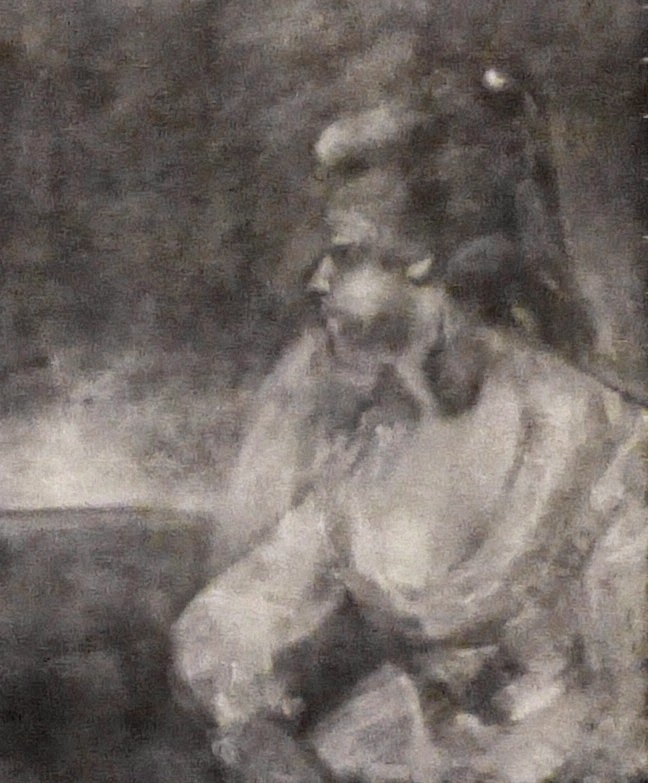
X-ray image of the portrait of Mary Robinson shown   above.
X-ray image of the portrait of Mary Robinson shown
above. The X-ray shows that Mary's hand was
originally painted supporting her chin
Photo © Andrew Knowles
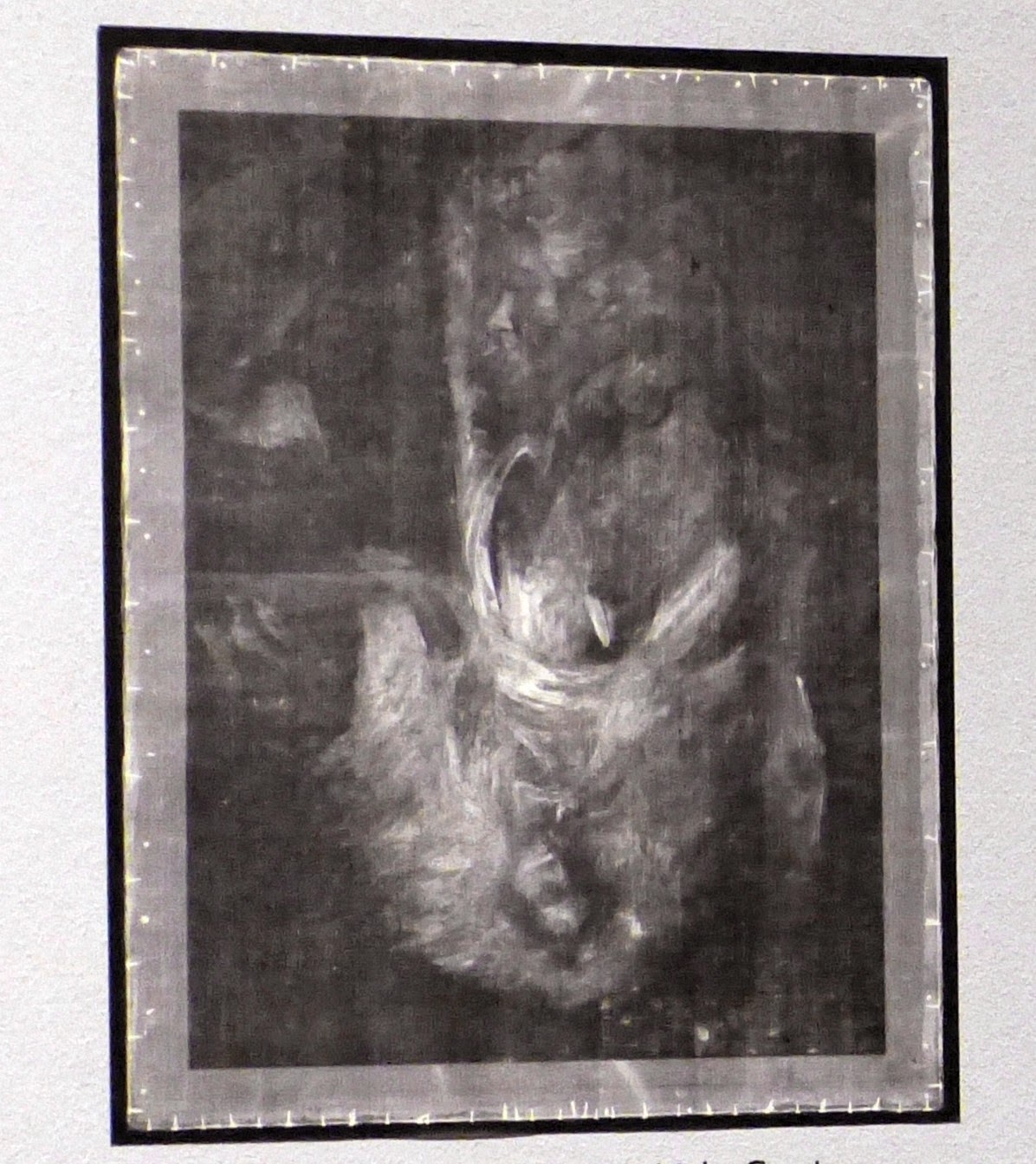
The research has given new insights into the way that Reynolds painted. Some of the images produced during the research are on display alongside the actual paintings. These reveal earlier details, from the position of Mary's hand, shown above, to old paintings that have been painted over.

The X-ray image of the Yale Center's portrait of Mary Robinson shown below reveals that the painting was not Reynold’s first attempt, but that underneath the existing painting is another, earlier painting, upside down.

X-ray image of the Yale Center's portrait of Mary   Robinson shown below.
X-ray image of the Yale Center's portrait of Mary
Robinson shown below. The X-ray shows another
portrait that has been painted over.
Photo © Andrew Knowles
Early paintings

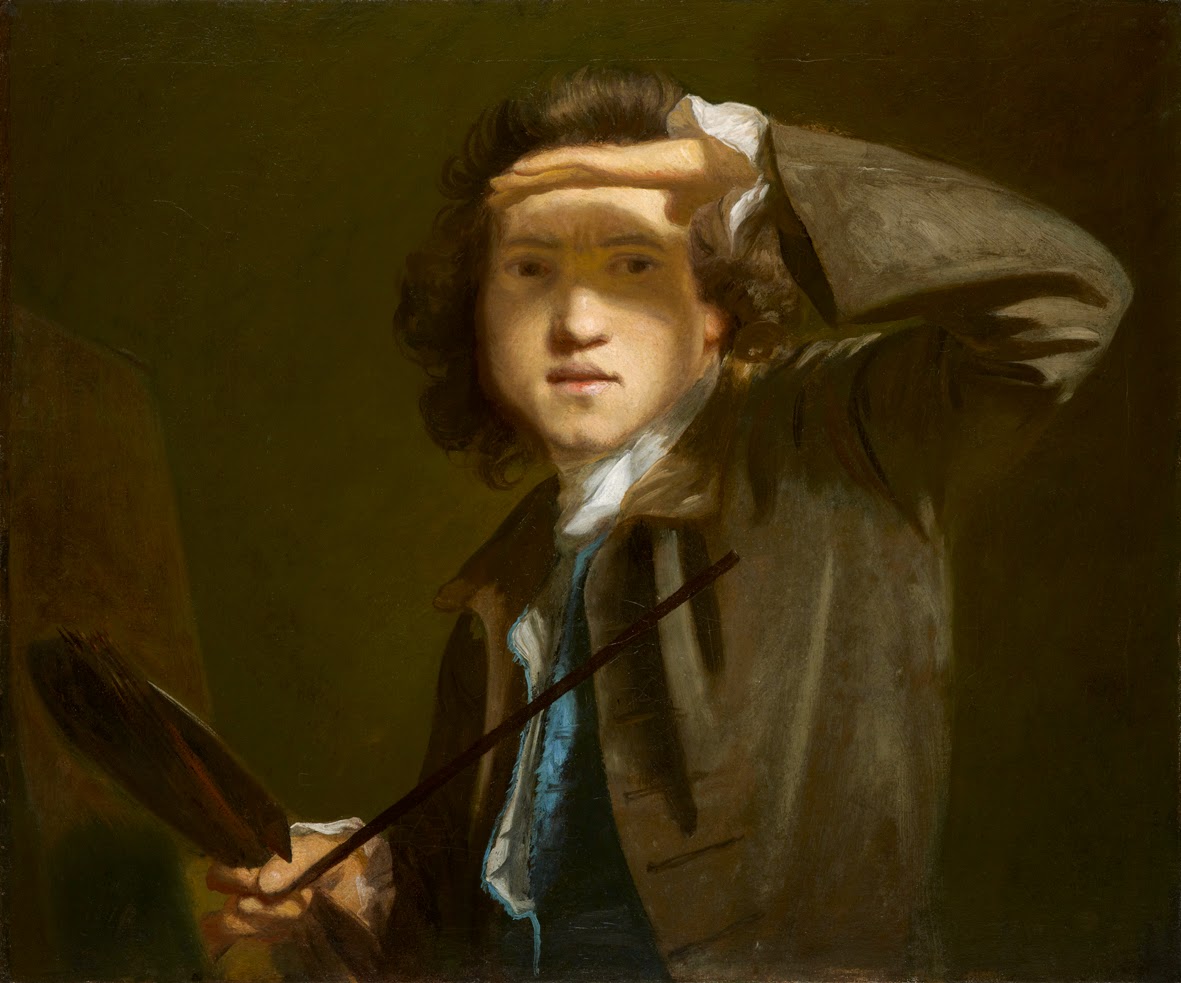
The paintings on display include some of Reynold's earliest work such as his self-portrait, painted c1747-9, before he went on the Grand Tour and a canvas entitled Studio Experiments in Colour and Media.

Self-portrait by Sir Joshua Reynolds (1747-9)  © The National Portrait Gallery, London
Self-portrait Shading the Eyes by Sir Joshua Reynolds (1747-9)
© The National Portrait Gallery, London
Studio Experiments in Colour and Media © Royal Academy of Arts, London
Studio Experiments in Colour and Media
© Royal Academy of Arts, London
Fancy paintings

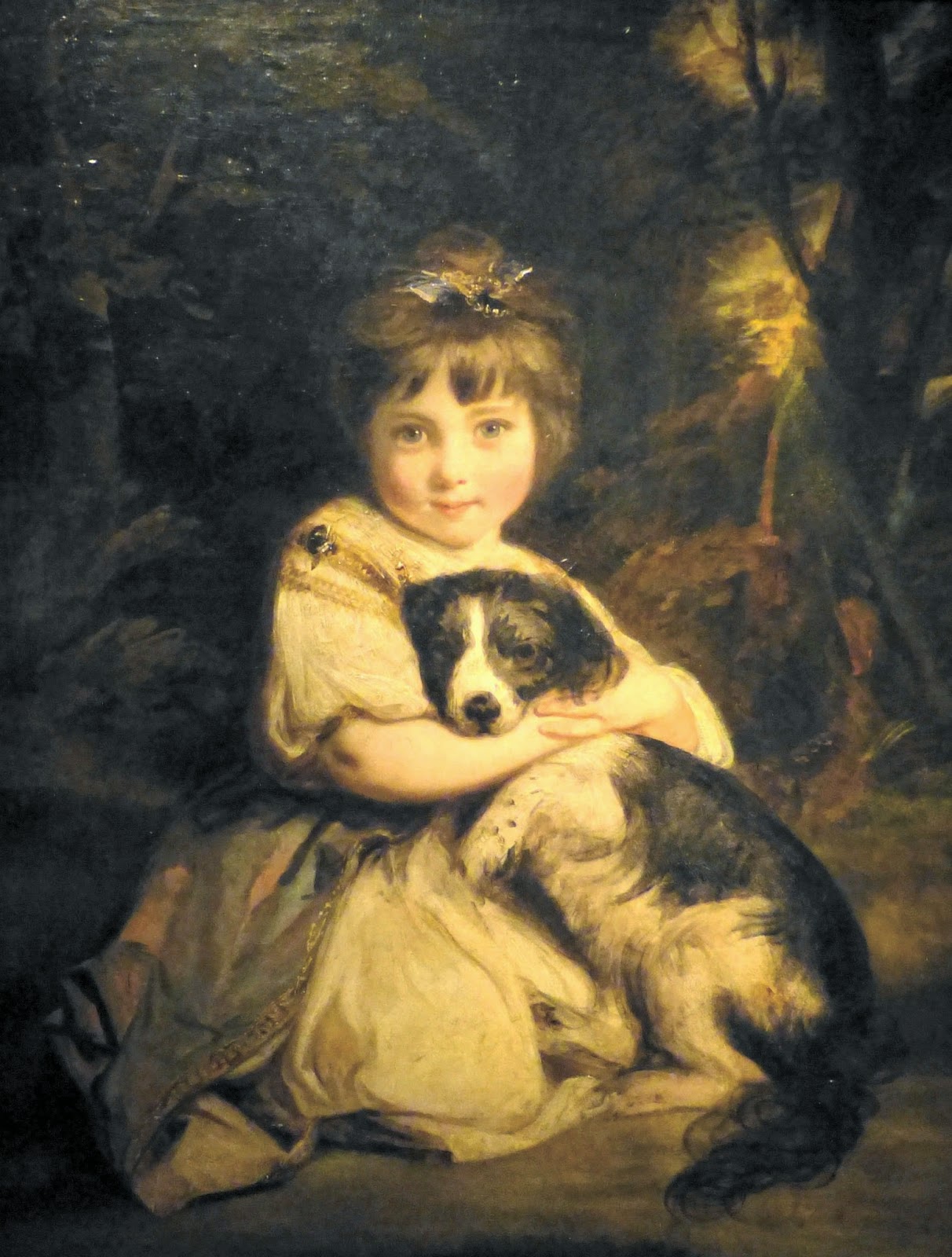
The exhibition includes a number of fancy paintings – imaginative paintings of people, representing ideas rather than intended as portraits. These include The Strawberry Girl and The Age of Innocence.

The Strawberry Girl by Sir Joshua Reynolds (1772-3)  © The Wallace Collection; Photo © Andrew Knowles
The Strawberry Girl by Sir Joshua Reynolds (1772-3)
© The Wallace Collection; Photo © Andrew Knowles
The Age of Innocence by Sir Joshua Reynolds (1788)  © The Tate; Photo © Andrew Knowles
The Age of Innocence by Sir Joshua Reynolds (1788)
© The Tate; Photo © Andrew Knowles
Portraits

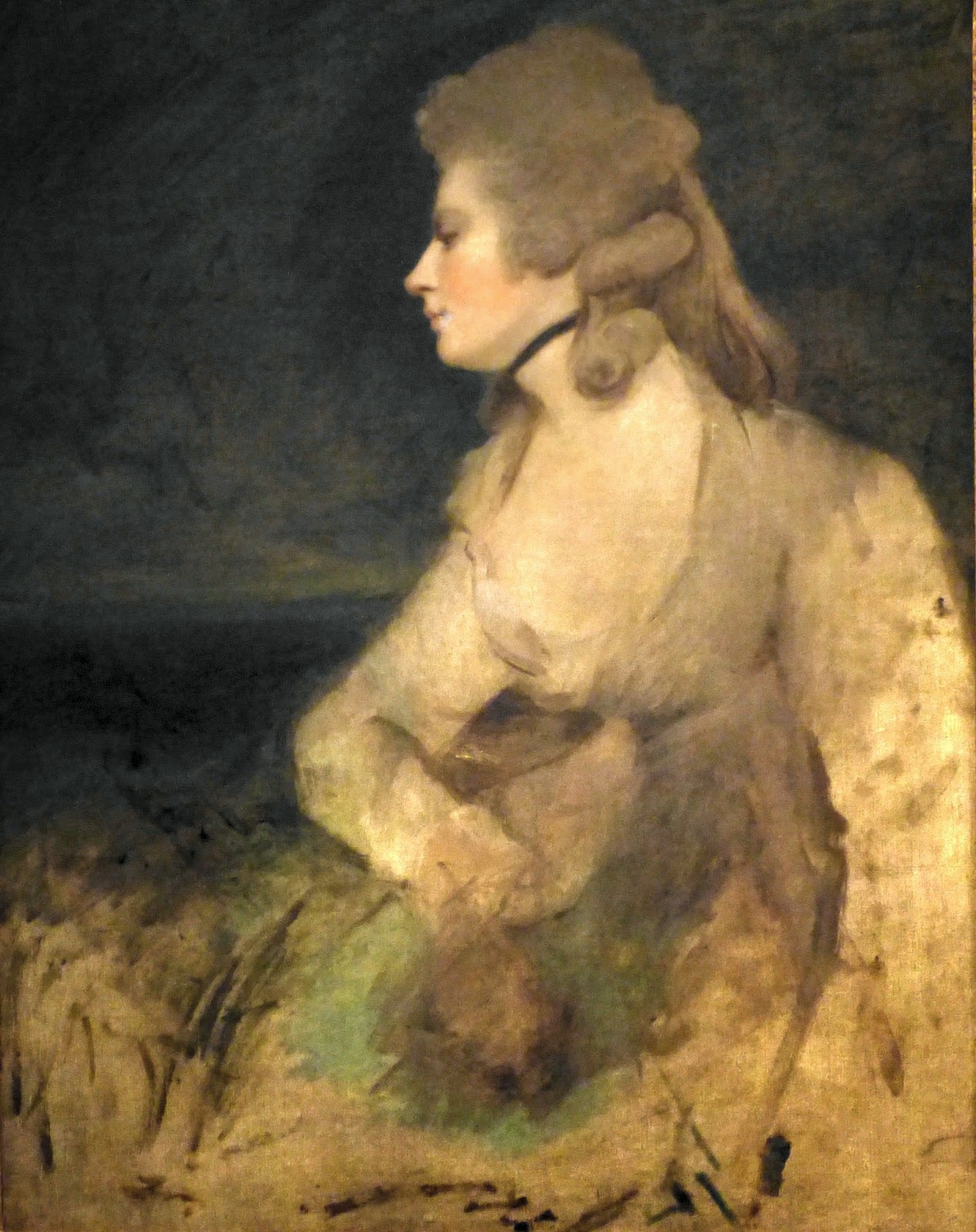
I particularly liked the two paintings of Mary Robinson, probably because she is the character with whom I am most familiar. The portrait owned by the Wallace Collection is shown at the top of this blog post and is very similar to that owned by the Yale Center for British Art (shown below) although this latter portrait is less finished.

Mrs Mary Robinson by Sir Joshua Reynolds (1783-5)  © The Yale Center for British Art, Paul Mellon Collection  Photo © Andrew Knowles
Mrs Mary Robinson by Sir Joshua Reynolds (1783-5)
© The Yale Center for British Art, Paul Mellon Collection
Photo © Andrew Knowles
4th Duke of Queensbury (Old Q)   by Sir Joshua Reynolds (1759)  © The Wallace Collection; Photo © Andrew Knowles
4th Duke of Queensbury ('Old Q') as Earl of March
by Sir Joshua Reynolds (1759)
© The Wallace Collection; Photo © Andrew Knowles
Miss Jane Bowles by Sir Joshua Reynolds (1775)  © The Wallace Collection; Photo © Andrew Knowles
Miss Jane Bowles by Sir Joshua Reynolds (1775)
© The Wallace Collection; Photo © Andrew Knowles
Miss Nelly O'Brien by Sir Joshua Reynolds (c1762-4)  © The Wallace Collection; Photo © Andrew Knowles
Miss Nelly O'Brien by Sir Joshua Reynolds (c1762-4)
© The Wallace Collection; Photo © Andrew Knowles
There is a second portrait of Miss Nelly O'Brien and a lovely portrait of Miss Kitty Fisher which were on loan and could not be photographed.

Mrs Susanna Hoare and Child
by Sir Joshua Reynolds (c1763-4)
© The Wallace Collection; Photo © Andrew Knowles
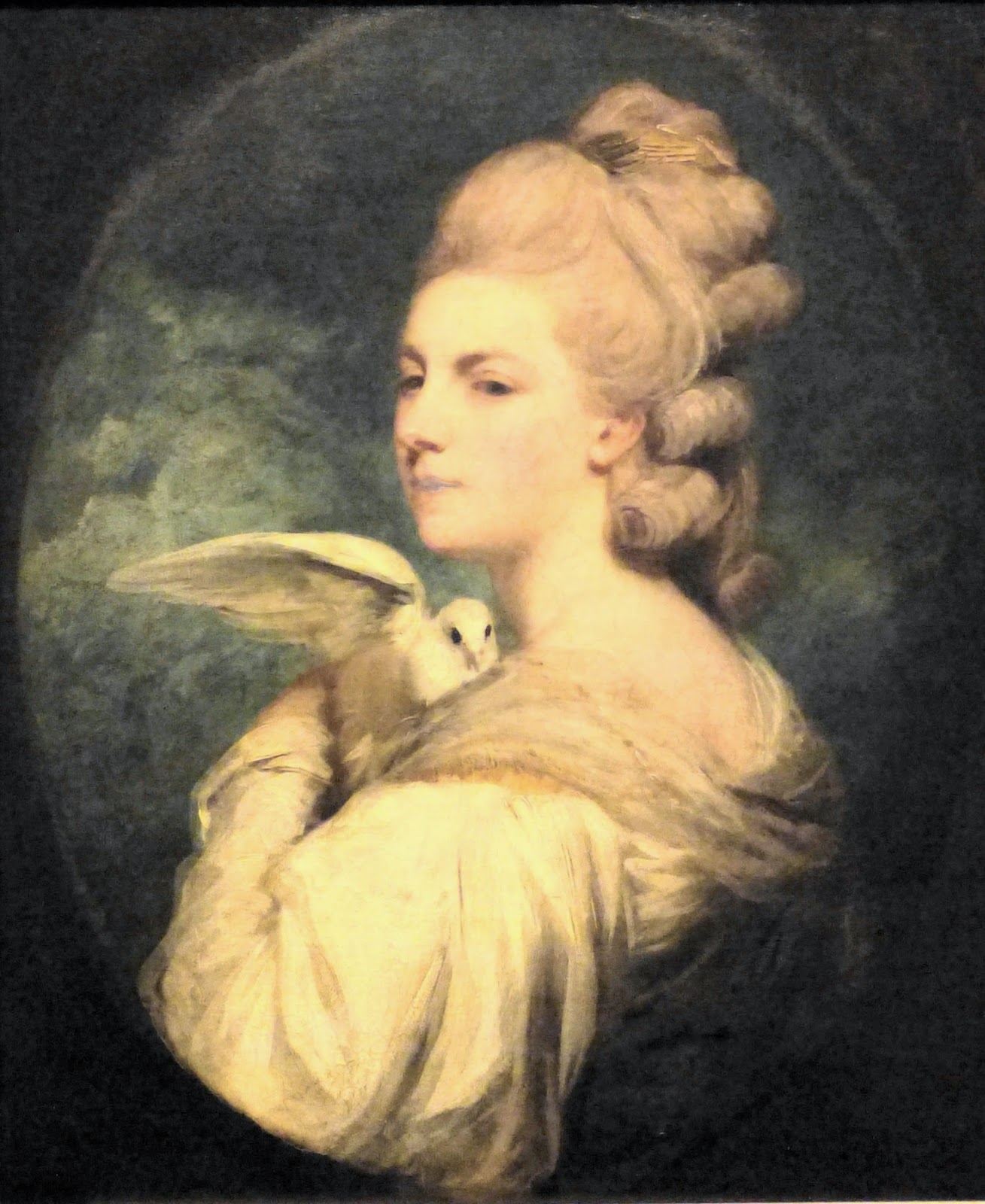
Mrs Mary Nesbitt by Sir Joshua Reynolds (c1781)  © The Wallace Collection; Photo © Andrew Knowles
Mrs Mary Nesbitt by Sir Joshua Reynolds (c1781)
© The Wallace Collection; Photo © Andrew Knowles
Reynolds sometimes depicted his sitters in character, such as Mrs Abington as Miss Prue in Love for Love by William Congreve (below).

Mrs Abington as Miss Prue by Sir Joshua Reynolds (1771)  © The Yale Center for British Art, Paul Mellon Collection  Photo © Andrew Knowles
Mrs Abington as Miss Prue by Sir Joshua Reynolds (1771)
© The Yale Center for British Art, Paul Mellon Collection
Photo © Andrew Knowles
The Wallace Collection is in Hertford House in Manchester Square, London and is open every day from 10am to 5pm. Admission to the museum is free.

Headshot of Rachel Knowles author with sea in background(2021)
Rachel Knowles writes faith-based Regency romance and historical non-fiction. She has been sharing her research on this blog since 2011. Rachel lives in the beautiful Georgian seaside town of Weymouth, Dorset, on the south coast of England, with her husband, Andrew.

Find out more about Rachel's books and sign up for her newsletter here.

If you have enjoyed this blog and want to encourage me and help me to keep making my research freely available, please buy me a virtual cup of coffee by clicking the button below.