Search this blog

Wednesday, 2 May 2018

Margaret Mercer Elphinstone, Princess Charlotte's friend

Margaret Mercer Elphinstone by John Hoppner  in John Hoppner RA by WD McKay and W Roberts (1909)
Margaret Mercer Elphinstone by John Hoppner
in John Hoppner RA by WD McKay and W Roberts (1909)
Profile

Margaret Mercer Elphinstone (12 June 1788 – 11 November 1867), later Baroness Keith, Lady Nairne and Comtesse de Flahault, was an intimate friend of Princess Charlotte of Wales and a society hostess.

Early years

Margaret Mercer Elphinstone was born on 12 June 1788, the only child of Admiral George Keith Elphinstone, Viscount Keith (1746-1823), and his first wife, Jane Mercer. Margaret’s mother died in 1789, but Lord Keith did not remarry until almost twenty years later, when he wed Hester Maria Thrale (1764-1857), the eldest daughter and heir of Henry and Hester Thrale, on 10 January 1808.

Princess Charlotte's friend

Princess Charlotte of Wales  from the Autobiography of Miss Cornelia Knight, lady companion to the Princess Charlotte of Wales (1861)
Princess Charlotte of Wales
from the Autobiography of Miss Cornelia Knight,
lady companion to the Princess Charlotte of Wales
(1861)
Margaret, often referred to as Miss Mercer in contemporary documents, became a close and influential companion of Charlotte, Princess of Wales. According to Princess Charlotte’s lady companion, Cornelia Knight, the Princess ‘constantly communicated’ with Margaret.1

Princess Charlotte’s biographer Coote agreed, stating:
The amiable Miss Elphinstone enjoyed her particular confidence and was continually employed by her to execute her several benevolent commissions.2
Princess Charlotte’s relationship with Margaret was probably encouraged by her father. In 1813, some of the details of the supposedly secret 'Delicate Investigation' into the alleged adultery of Princess Charlotte’s mother, Princess Caroline of Wales, became common knowledge. Princess Charlotte was inclined to take her mother’s part against her father, as did most of the public.

Princess Caroline of Brunswick from Huish's Memoirs of her late  royal highness Charlotte Augusta (1818)
Princess Caroline of Brunswick
from Huish's Memoirs of her late
 royal highness Charlotte Augusta (1818) 
Some people believed that Margaret was being used by the Prince Regent to turn Princess Charlotte against her mother. Cornelia Knight wrote:
About this time Miss Mercer Elphinstone came to Town, and Princess Charlotte wrote to ask the Regent’s permission for seeing her; which was granted. It was evident that this had been arranged beforehand, and that the conditions were that Miss Mercer, who had more influence than any one with Princess Charlotte, should open her eyes to her mother’s imprudence, and break the confidential intimacy between them.3
George IV by Sir Thomas Lawrence (1816)  Photo © RegencyHistory Painting © NPG London
George IV by Sir Thomas Lawrence (1816)
Photo © RegencyHistory Painting © NPG London
In June 1814, Princess Charlotte decided that she could not marry the Prince of Orange and ran away to see her mother. Margaret was one of those who went to Connaught House to find her, and one of the few who was still allowed to communicate with her after her return to Warwick House.

The accusations of duplicity did not go away. In January 1815, Cornelia Knight wrote:
Miss Mercer Elphinstone has been allowed to visit Princess Charlotte since her return from Cranbourne, and is in constant and undisturbed correspondence with her.
Miss M. is also accused by many of playing a double part. I believe her to be desirous of governing Princess Charlotte without a rival, but I cannot think she would deal treacherously by her, though she may not be aware of the use made of her by her uncle, Mr Adam, who is the Prince’s Chancellor for the Duchy of Cornwall and is supposed to be devoted to the Duke of York. Miss Mercer is in her politics strongly attached to the Opposition, and very intimate with many of them.4
Cornelia Knight was not always complimentary about the influence that Margaret had on Princess Charlotte, but she did write that it was natural that people were suspicious of her because
… it is to be remembered that Miss Mercer is an heiress, and very clever, and will, therefore, always excite jealousy.4
The Duke of Devonshire

William Spencer Cavendish, 6th Duke of   Devonshire, in Chatsworth House
William Spencer Cavendish, 6th Duke of
Devonshire, in Chatsworth House
It has been suggested that Margaret wanted to marry the Duke of Devonshire. Cornelia Knight wrote:
Followed by all the mothers and all the misses in London, because he was the yet unmarried Duke of Devonshire, it is probable that he might wish to be liked for himself alone, and this must be the case if Princess Charlotte liked him. His ambition, also, might be roused, and he might, and perhaps unfortunately did, feel really attached to her. A good young man, of a benevolent heart, moderate abilities, and romantic turn (which I understand was the case with him), might easily fall into such a snare. He was very attentive, and Princess Charlotte’s friends were, almost all, very intimate with him. Miss Mercer Elphinstone was supposed to like him, to wish to marry him, and to be playing a deep game, so that when he was disappointed of Princess Charlotte, he might take her, out of gratitude for her good offices. This ill-natured story was too ridiculous to be believed; for if Miss Mercer wished to marry him, she could not at the same time wish to encourage his attachment to a beautiful young Princess of seventeen, who was generally thought the handsomest woman in the ball-room (for dress became her particularly), and who must, at all events, eclipse a woman of twenty-eight, whose great fortune would be no attraction to the Duke.5
Although she disbelieved the rumours, Cornelia Knight recorded two newspaper reports that were printed in the Morning Chronicle in May 1815. The first, published on 11 May announced:
We have great pleasure in announcing that the marriage is settled between the Duke of Devonshire and Miss Mercer, daughter of Lord Keith. It is to take place next week.
The following day, a second newspaper report stated:
We are desired to contradict, from authority, the report of the Honourable Miss Mercer Elphinstone’s marriage with the Duke of Devonshire.6
Princess Charlotte’s wedding anniversary

Margaret maintained her friendship with the Princess after her marriage to Prince Leopold. She was one of a select party invited to Claremont for a dinner and concert to celebrate their first wedding anniversary on 2 May 1817. Princess Charlotte was pregnant and had determined ‘to abstain in future from all crowded assemblies.’7

Claremont from Select Illustrations of the County of Surrey by GF Prosser (1828)
Claremont from Select Illustrations
of the County of Surrey
by GF Prosser (1828)
Marriage to the Comte de Flahault

On 20 June 1817, Margaret married a French nobleman, Auguste Charles Joseph, Comte de Flahault de la Billardrie, in Edinburgh. Auguste had been an aide-de-camp to Napoleon Bonaparte. After Napoleon’s fall, he came to Britain, where he had spent part of his youth.

Margaret and Auguste had five daughters whilst living in Perth, Scotland: Emily Jane (1819), Clementina Hortense (1821), Georgiana Gabrielle (1822), Adele Elizabeth Josephine (1824), and Sarah Sophia Louisa (1825). Emily married Henry Petty-Fitzmaurice, 4th Marquess of Lansdowne, and Georgiana married Jean Charles Marie Felix, Marquis of La Valette. Clementina and Adele died young and Sarah did not marry.

Auguste and Margaret moved to France in 1827 and Auguste was accepted back into the French government, as ambassador to Rome, Vienna and St James’s, before becoming chancellor to the Legion of Honour.

Baroness Keith and Lady Nairne

Margaret became Baroness Keith in the Irish and UK peerages in 1823 on the death of her father, and succeeded her cousin as Lady Nairne in 1837. The two baronies of Keith became extinct on Margaret’s death, but her eldest daughter Emily, Marchioness of Lansdowne, succeeded her as Lady Nairne.

Margaret was a well-known society hostess in Paris, where she died on 11 November 1867. She was buried at Tulliallan Castle in Perthshire, Scotland.

Notes
(1) From Knight, Cornelia, Autobiography of Miss Cornelia Knight, lady companion to the Princess Charlotte of Wales volume 1 (1861).
(2) From Coote, J, A biographical memoir of the much lamented Princess Charlotte Augusta of Wales and Saxe Coburg (1818).
(3) From Knight, Cornelia, Autobiography of Miss Cornelia Knight, lady companion to the Princess Charlotte of Wales volume 1 (1861).
(4) From Knight, Cornelia, Autobiography of Miss Cornelia Knight, lady companion to the Princess Charlotte of Wales volume 2 (1861).
(5) From Knight, Cornelia, Autobiography of Miss Cornelia Knight, lady companion to the Princess Charlotte of Wales volume 1 (1861).
(6) From Knight, Cornelia, Autobiography of Miss Cornelia Knight, lady companion to the Princess Charlotte of Wales volume 2 (1861).
(7) Huish, Robert, Memoirs of her late royal highness Charlotte Augusta, Princess of Wales (Thomas Kelly, 1818, London.

Sources used include:
Coote, J, A biographical memoir of the much lamented Princess Charlotte Augusta of Wales and Saxe Coburg (1818)
Huish, Robert, Memoirs of her late royal highness Charlotte Augusta, Princess of Wales (Thomas Kelly, 1818, London)
Knight, Cornelia, Autobiography of Miss Cornelia Knight, lady companion to the Princess Charlotte of Wales (1861)
Reynolds, KD, Flahault de la Billardrie, Margaret de, suo jure Lady Nairne and suo jure Baroness Keith, and Countess de Flahault de la Billardrie in the French nobility (1788-1867) Oxford Dictionary of National Biography (Oxford University Press, 2004; accessed 19 June 2017)
The Gentleman's Magazine (1868)

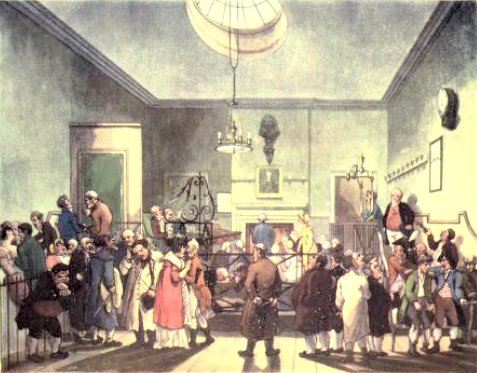
Wednesday, 11 April 2018

Policing Georgian London and the Bow Street Runners - guest post by Julie Tetel Andresen

I am delighted to welcome author Julie Tetel Andresen to the Regency History blog today with a guest post on policing Georgian London and the Bow Street Runners.

Bow Street from The Microcosm of London Vol 1 by R Ackermann and WH Pyne (1808)
Number 4 Bow Street

In the early 1750s, magistrate and novelist Sir Henry Fielding persuaded the government to provide funds to hire men who would have the capacity to track down the highwaymen and footpads who were terrorizing the roads in and around London. He lived at Number 4 Bow Street, Covent Garden. A few months after receiving the funds, Henry Fielding died, leaving the Bow Street residence to John Fielding, his younger half-brother. Although John had been blind since the age of nineteen, he turned out to be the most imaginative magistrate of the eighteenth century, and created a force of policemen who were popularly called Bow Street Runners.

Since the thirteenth century, London had unpaid night watchmen. However, a troubling spike in crime occurred in the late seventeenth century, likely caused by the demobilization of armed forces after William III won the war for the throne in 1689. In response to this increase in violence, two things had come about by the middle of the eighteenth century: first, the lighting of the streets had been improved; and, second, the night watchmen had become a paid force. They had established beats at set times, called out the time throughout the night, and made an arrest if they happened upon a crime. However, they were not expected to search out offenders.

Parish Constables

The parish constables were largely private citizens who served for part of a year as their civic duty. They were expected to clear the streets of vagrants and prostitutes, and they could arrest petty criminals if, like the night watchmen, they happened upon them. They were also supposed to keep crowds under control on days of celebration or when crowds assembled for unlawful purposes. The constables were under no obligation to do anything beyond the boundaries of their jurisdiction, and they were not expected to investigate crimes or find criminals.

Thief-takers

Occasionally a magistrate would take an interest in a particular case and follow through on it. However, it was mostly left to the victim to find the perpetrator or to pay someone to do so. In the early eighteenth century, one could hire a private ‘thief-taker’, as they were called. The men Sir John Fielding hired became the first professional public thief-takers, although the term they came to be known by, namely Runners, was surely derogatory since it associated them with the bailiffs who arrested debtors or escorted men to jail.

Sir John Fielding and the Bow Street Runners

Sir John Fielding by Nathaniel Hone  Oil on canvas (1762) NPG 3834 (1)
Sir John Fielding by Nathaniel Hone
Oil on canvas (1762) NPG 3834 (1)
The Runners, whom Sir John often recruited from the ranks of ex-constables, helped victims at no cost, followed investigations wherever they went, and had the authority to arrest the criminals anywhere. By bringing to justice those guilty of highway robbery and murder, and by increasing the geographical range of pursuit, the Runners formed the very beginnings of a national police force.

Since 1748, Sir Henry Fielding had made his house on Bow Street the centre of his work. When Sir John took over in 1754, he made it a centre for information gathering, which went beyond the clerical requirements of ordinary magistrates at the time. He hired extra staff to collect information about crimes and criminals and believed informers should be paid. He also used advertising as fundamental to his policing strategy. For crimes of theft, he sent information to appear in the next day’s newspapers and had handbills printed and distributed to pawnbrokers and other likely places, under the belief that rapid dispersal of information was necessary if goods were going to be found and the thieves arrested. The office seemed to have been open for business for long hours most days of the week, and people came to assume they could go to Bow Street at any time of the day, and well into the evening, to see a magistrate (or at least someone who could take and perhaps act on their complaint).

On occasion, a Runner might take an alleged criminal to the Brown Bear, a pub across the street from the office, which served as a temporary lock-up and a place where suspects could be interrogated before being taken before the magistrate. Conveniently, Sir John often ate at the Brown Bear, and so was on hand if fresh business came up during his meal.

The Brown Bear from Chronicles of Bow Street   Police-Office by Percy Fitzgerald (1888)
The Brown Bear from Chronicles of Bow Street 
Police-Office by Percy Fitzgerald (1888)
The effectiveness of the Runners can be illustrated with an example. In 1767, John Griffiths and three other men were returning to London by coach when a gang of armed men stopped them and demanded their money. One of the men in the coach jumped out in an effort to escape and was knocked down and badly beaten. Griffiths refused to give up his purse and was shot dead. The other two did not resist. Within hours of the incident, seven Runners went in search of the robbers, gathering information from pubs and a variety of informers. Two days later, the Runners arrested five men, four of whom were convicted. Three days later, the fifth man who had killed Griffiths, was hanged.

Covent Garden, home to Bow Street, was notorious for its bawdy houses, unlicensed alehouses, and gambling houses – precisely the kind of businesses that drew men into crime. Although at first Sir John did not think regulating morality was part of his job as magistrate, he eventually turned his and his Runners’ attention into policing immoral behaviours involving hard alcohol, gambling, and prostitution. Sir John drew censure when his moral policing widened to include popular dancing.

Beer Street and Gin Alley by William Hogarth (1751) via Wikimedia Commons
This policing activity came at a price. Sir John’s office expenses for the year 1767 came to nearly £600 and paid for: investigations and arrests, patrolling, maintenance of ‘pursuit horses’, rewards to shopkeepers, support of witnesses, payments to informers, salary of the ‘register clerk’, maintenance of the criminal records, transport of prisoners, coach hire, printing and distributing of handbills, advertisements, correspondence with country magistrates, office expenses and, finally, Runners’ arrest of prostitutes, gamblers, and beggars.

In 1829, Sir Robert Peel created the Metropolitan Police, and Bow Street disbanded in 1839. The first professional detective department was formed in 1842.

Sources:
Cox, David, A Certain Share of Low Cunning: A History of the Bow Street Runners, 1792 – 1839 (Willen Publishing, 2010)
Beattie, JM, The First English Detectives: The Bow Street Runners and the Policing of London, 1750 – 1840 (Oxford University Press, 2012)

About the author: Julie Tetel Andresen has written more than twenty-five romance novels, one of her most recent being John Carter’s Conundrum, a Georgian-era novella whose hero, John Carter, is a Bow Street Runner. Visit Julie's website here where you can download John Carter’s Conundrum for free.

Note
1. This image is being shared under a Creative Commons Licence (CC BY-NC-ND 3.0).

Wednesday, 4 April 2018

The Asylum for female orphans in Regency London

The Dining Room at the Asylum  from Ackermann's The Microcosm of London (1808-10)
The Dining Room at the Asylum
from Ackermann's The Microcosm of London (1808-10)
What was the Asylum?

The Asylum was a refuge for female orphans established by Sir John Fielding, a philanthropic magistrate, in 1758, and incorporated by Act of Parliament in 1800. 

Its aim was to house and educate orphaned girls. Orphans were the responsibility of the parish where their parents had resided. If this parish or settlement could not be established, they theoretically became the responsibility of the parish in which they lived. In the case of orphans of soldiers, sailors and other indigent persons, the settlement of their parents could often not be found, and the orphans could be left destitute and far away from any relations. The charity aimed to relieve this suffering and protect young girls who might otherwise be drawn into prostitution.

The Asylum for Female Orphans 1823 from The History   and Antiquities of the Parish of Lambeth by T Allen (1827)
The Asylum for Female Orphans 1823 from The History
 and Antiquities of the Parish of Lambeth by T Allen (1827)
Where was the Asylum?

The Asylum was situated south of the River Thames in St George’s Fields, Lambeth, 'directly opposite the road which leads from Westminster Bridge to Vauxhall.'1

The charity took out a lease on the premises of the Hercules Inn from the Corporation of the City of London in 1754 at a rent of £8 10s a year. When the lease expired in around 1823, they bought the freehold for about £16,000 and demolished the old building, with the exception of the chapel and the residences for the officers and matron. They replaced it with a neat, low building with wings on the design of Mr Lloyd.

The New Asylum for Female Orphans 1826 from The History   and Antiquities of the Parish of Lambeth by T Allen (1827)
The New Asylum for Female Orphans 1826 from The History
 and Antiquities of the Parish of Lambeth by T Allen (1827)
How was it run?

Her Majesty Queen Charlotte was the patroness of the Asylum and Prince Adolphus, Duke of Cambridge, was President. The charity was governed by a committee of 19 gentlemen, elected annually, who met at the Asylum every Thursday at 11 o’clock in the morning.

The Asylum received an income from stocks and consols and was supported by annual subscriptions amounting to about £500 a year and by collections taken at the chapel doors each Sunday amounting to some £2,000 a year more.2

A gentleman could become an annual guardian of the charity by subscribing at least three guineas a year. Alternatively, he could become a perpetual guardian by a donation of thirty guineas or more, or by being the first named executor on a legacy of £100 or more. A guardian could recommend a girl for admission when a vacancy arose.

According to Allen in The History and Antiquities of the Parish of Lambeth (1827): 'Ladies subscribing certain specified sums are entitled to vote by proxy.'3

The charity employed various staff to run the asylum and chapel. In 1827, their annual salaries were as follows:
Chaplain and secretary £200
Alternate morning preachers £100 each
Evening preacher £126
Organist £63
Writing master £50
Apothecary (including supply of medicine) £70
Messenger £52
Matron £60
Assistant matron £20
First school-mistress £40
Two assistant mistresses £15 15s each
Nurse £20
Chapel clerk £21
Four chapel keepers £12 each4
Life in the Asylum

Girls were admitted between the ages of nine and twelve, housed and educated, and then apprenticed as a domestic servant or into a trade from the age of about fifteen.

The Microcosm of London described the education of the girls:
Carefully instructed in the principles of religion; in reading, writing, needlework, and household business, they are trained to habits of industry and regularity, by which means there is a supply of diligent and sober domestics for the use of that public, which, by its contributions, has so nobly acquired a right to their services.5
The girls were required
... to make and mend their own linen; make shirts, shifts, and table-linen; to do all kinds of plain needle-work, and to perform the business of the house and kitchen; to which latter twelve are appointed weekly, according to their age and abilities, to assist the cook, to wash, iron, and get up all the linen. They are likewise taught to read the Bible, write a legible hand, and understand the first four rules in arithmetic.6
The girls helped support the Asylum with their work:
All kinds of plain needle-work are taken in at the Asylum, and performed by the children at certain rates, which are regulated by the committee.7
Visits by gentlewomen

According to The Microcosm of London, the guardians
... earnestly solicit the ladies, who are particularly qualified for that purpose, frequently to visit the charity, inspect the management of the house, and particularly the employment of the children; also to see that they are properly instructed in housewifery, so as to be qualified for useful domestic servants; and from time to time communicate to the committee, by letter or otherwise, such observations as they shall deem proper to make.8
The chapel
A very neat chapel is included in the plan, in which some respectable minister officiates as preacher on Sundays. The girls also sing, accompanied by a good organ.

A number of the nobility and gentry frequent this place of worship, and at the same time become contributors to a noble charity, which preserves from probable destruction a great number of indigent female orphans, and makes them at the same time a comfort to their remaining relations, and a benefit to the community.9
What happened to the girls?

When the girls were about fifteen years of age, they were apprenticed:
They are to be bound apprentices for seven years, at the age of fifteen, or sooner, as domestic servants to reputable families in Great Britain.10
When a girl was old enough to be apprenticed, the guardian who presented her was asked if he had a placement for her in mind. If this was not the case, the girl could be sent to any respectable person who applied for an apprentice, once the committee had approved their character.

If a girl completed her apprenticeship and their master or mistress vouched for their good behaviour, she was given five guineas by the committee.

If the committee deemed that the girl was unfit for domestic service, they could apprentice her into any trade they thought proper. The maximum they would pay to secure this apprenticeship was £10.

The success of the Asylum

According to The Microcosm of London:
Two hundred deserted females are daily sheltered and protected from vice and want, supplied with food and raiment, and taught what-ever can render them useful in their situation, or comfortable and happy in themselves.11

Headshot of Rachel Knowles author with sea in background(2021)
Rachel Knowles writes clean/Christian Regency era romance and historical non-fiction. She has been sharing her research on this blog since 2011. Rachel lives in the beautiful Georgian seaside town of Weymouth, Dorset, on the south coast of England, with her husband, Andrew.

Find out more about Rachel's books and sign up for her newsletter here.

If you have enjoyed this blog and want to encourage me and help me to keep making my research freely available, please buy me a virtual cup of coffee by clicking the button below.

Notes
(1) From Feltham, John, The Picture of London for 1809 (1809).
(2) These amounts are taken from Allen, Thomas, The History and Antiquities of the Parish of Lambeth (1827).
(3) From Allen, Thomas, The History and Antiquities of the Parish of Lambeth (1827).
(4) Ibid.
(5) From Ackermann, Rudolph and Pyne, William Henry, The Microcosm of London or London in miniature Volume 1 (Rudolph Ackermann 1808-1810, reprinted 1904).
(6) Ibid.
(7) Ibid.
(8) Ibid.
(9) Allen op cit.
(10) Ackermann op cit.
(11) Ibid.

Sources used include:
Ackermann, Rudolph and Pyne, William Henry, The Microcosm of London or London in miniature Volume 1 (Rudolph Ackermann 1808-1810, reprinted 1904)
Allen, Thomas, The History and Antiquities of the Parish of Lambeth (1827)
Feltham, John, The Picture of London for 1809 (1809)