Search this blog

Showing posts with label crime. Show all posts

Thursday, 20 July 2023

Book review: The Yorkshire Coiners - the true story of the Cragg Vale Gang by Steve Hartley

Front cover of The Yorkshire Coiners by Steve Hartley on wooden plate with collection of Georgian coins

On 9 November 1769, William Dighton was shot and killed in Halifax, Yorkshire. It was a planned assassination of a Supervisor of Excise—an official responsible for ensuring the collection of tax.

Dighton was the victim of the Cragg Vale Gang—criminals who operated what was perhaps England’s largest clipping and coining operation. That is, they created counterfeit coins from gold shaved off genuine coins.

Steve Hartley, author of The Yorkshire Coiners is a descendant of David Hartley, or ‘King David’, leader of the Cragg Vale Gang. He’s spent years researching the gang’s activities from various documents and, in his words, this book:

brings together the facts from these and other sources and places them in chronological order, so that the events relating to the Coiners can be seen in the order they occurred.

It’s important to note these words because this book is very much a reference work. It’s not an easy-to-read account of the Cragg Vale Gang story.

What’s in the book

It’s a relatively short (125 pages) book organised into 25 brief chapters. Each chapter has a narrative that presents facts from original sources, including local newspapers, letters and court records.

There are a number of photographs, such as buildings once lived in by characters featured in the history, along with portraits and documents.

The author has strung the sources together into a narrative that’s strictly chronological. I found there was not much in the way of additional insight or observation, except in the final chapter, where there’s an attempt to tie up some loose ends.

Most of the sources are summarised, with occasional direct quotes.

Almost all the material in the book relates to the activities of the clippers and coiners, what they got up to, and how they were treated by the law enforcement bodies.

What’s not in the book

Other than a few brief descriptions, the book does not go into detail about clipping and coining, nor about the regional or national context in which the Cragg Vale Gang operated.

There’s no real discussion of the background culture, or explanation of how the gang may have functioned.

This is unsurprising, given the book’s focus on describing the contents of primary sources. However, I would have liked to have read more about the society the gang was operating in, and their methods.

How did coins find their way into the hands of the gang, what did they do with them and how were the clipped coins, and counterfeits, fed back into circulation? There are some clues in the book, but these issues aren’t examined.

Nor did I find any real discussion of the attitudes of society towards the criminals. Were their crimes considered to be largely victimless and therefore tolerated by many? Were they respected or feared by their community?

The book did not set out to address these issues, so I should not have been disappointed.

However, I feel the book did not fully live up to its subtitle, The true story of the Cragg Vale Gang. Yes, it focused on the truth (at least as reported in newspapers and other documents), but it was not organised in a way to tell a story.

There are, in fact, several stories: the origins of the gang, Dighton’s murder and the subsequent manhunts, the trials and executions, and the official response, which went as high as King George III himself.

A story still waiting to be told

Lack of documentary evidence always limits the historian’s scope for telling a story, without resorting to embellishing it with fiction. In this book, Steve Hartley has chosen to stick to the facts as he found them, sharing them in chronological order.

This book is a useful resource to anyone researching clipping and coining in the Georgian era, particularly the Yorkshire gang it describes.

But in my opinion, an easy-to-read account of the Cragg Vale Gang is still waiting to be written.

The Yorkshire Coiners is published by Amberley Books and is available here.

Headshot of Rachel Knowles author with sea in background(2021)

Rachel Knowles writes faith-based Regency romance and historical non-fiction. She has been sharing her research on this blog since 2011. Rachel lives in the beautiful Georgian seaside town of Weymouth, Dorset, on the south coast of England, with her husband, Andrew, who wrote this review.

Find out more about Rachel's books and sign up for her newsletter here.

If you have enjoyed this blog and want to encourage us and help us to keep making our research freely available, please buy us a virtual cup of coffee by clicking the button below.

Wednesday, 11 April 2018

Policing Georgian London and the Bow Street Runners - guest post by Julie Tetel Andresen

I am delighted to welcome author Julie Tetel Andresen to the Regency History blog today with a guest post on policing Georgian London and the Bow Street Runners.

Bow Street from The Microcosm of London Vol 1 by R Ackermann and WH Pyne (1808)
Number 4 Bow Street

In the early 1750s, magistrate and novelist Sir Henry Fielding persuaded the government to provide funds to hire men who would have the capacity to track down the highwaymen and footpads who were terrorizing the roads in and around London. He lived at Number 4 Bow Street, Covent Garden. A few months after receiving the funds, Henry Fielding died, leaving the Bow Street residence to John Fielding, his younger half-brother. Although John had been blind since the age of nineteen, he turned out to be the most imaginative magistrate of the eighteenth century, and created a force of policemen who were popularly called Bow Street Runners.

Since the thirteenth century, London had unpaid night watchmen. However, a troubling spike in crime occurred in the late seventeenth century, likely caused by the demobilization of armed forces after William III won the war for the throne in 1689. In response to this increase in violence, two things had come about by the middle of the eighteenth century: first, the lighting of the streets had been improved; and, second, the night watchmen had become a paid force. They had established beats at set times, called out the time throughout the night, and made an arrest if they happened upon a crime. However, they were not expected to search out offenders.

Parish Constables

The parish constables were largely private citizens who served for part of a year as their civic duty. They were expected to clear the streets of vagrants and prostitutes, and they could arrest petty criminals if, like the night watchmen, they happened upon them. They were also supposed to keep crowds under control on days of celebration or when crowds assembled for unlawful purposes. The constables were under no obligation to do anything beyond the boundaries of their jurisdiction, and they were not expected to investigate crimes or find criminals.

Thief-takers

Occasionally a magistrate would take an interest in a particular case and follow through on it. However, it was mostly left to the victim to find the perpetrator or to pay someone to do so. In the early eighteenth century, one could hire a private ‘thief-taker’, as they were called. The men Sir John Fielding hired became the first professional public thief-takers, although the term they came to be known by, namely Runners, was surely derogatory since it associated them with the bailiffs who arrested debtors or escorted men to jail.

Sir John Fielding and the Bow Street Runners

Sir John Fielding by Nathaniel Hone  Oil on canvas (1762) NPG 3834 (1)
Sir John Fielding by Nathaniel Hone
Oil on canvas (1762) NPG 3834 (1)
The Runners, whom Sir John often recruited from the ranks of ex-constables, helped victims at no cost, followed investigations wherever they went, and had the authority to arrest the criminals anywhere. By bringing to justice those guilty of highway robbery and murder, and by increasing the geographical range of pursuit, the Runners formed the very beginnings of a national police force.

Since 1748, Sir Henry Fielding had made his house on Bow Street the centre of his work. When Sir John took over in 1754, he made it a centre for information gathering, which went beyond the clerical requirements of ordinary magistrates at the time. He hired extra staff to collect information about crimes and criminals and believed informers should be paid. He also used advertising as fundamental to his policing strategy. For crimes of theft, he sent information to appear in the next day’s newspapers and had handbills printed and distributed to pawnbrokers and other likely places, under the belief that rapid dispersal of information was necessary if goods were going to be found and the thieves arrested. The office seemed to have been open for business for long hours most days of the week, and people came to assume they could go to Bow Street at any time of the day, and well into the evening, to see a magistrate (or at least someone who could take and perhaps act on their complaint).

On occasion, a Runner might take an alleged criminal to the Brown Bear, a pub across the street from the office, which served as a temporary lock-up and a place where suspects could be interrogated before being taken before the magistrate. Conveniently, Sir John often ate at the Brown Bear, and so was on hand if fresh business came up during his meal.

The Brown Bear from Chronicles of Bow Street   Police-Office by Percy Fitzgerald (1888)
The Brown Bear from Chronicles of Bow Street 
Police-Office by Percy Fitzgerald (1888)
The effectiveness of the Runners can be illustrated with an example. In 1767, John Griffiths and three other men were returning to London by coach when a gang of armed men stopped them and demanded their money. One of the men in the coach jumped out in an effort to escape and was knocked down and badly beaten. Griffiths refused to give up his purse and was shot dead. The other two did not resist. Within hours of the incident, seven Runners went in search of the robbers, gathering information from pubs and a variety of informers. Two days later, the Runners arrested five men, four of whom were convicted. Three days later, the fifth man who had killed Griffiths, was hanged.

Covent Garden, home to Bow Street, was notorious for its bawdy houses, unlicensed alehouses, and gambling houses – precisely the kind of businesses that drew men into crime. Although at first Sir John did not think regulating morality was part of his job as magistrate, he eventually turned his and his Runners’ attention into policing immoral behaviours involving hard alcohol, gambling, and prostitution. Sir John drew censure when his moral policing widened to include popular dancing.

Beer Street and Gin Alley by William Hogarth (1751) via Wikimedia Commons
This policing activity came at a price. Sir John’s office expenses for the year 1767 came to nearly £600 and paid for: investigations and arrests, patrolling, maintenance of ‘pursuit horses’, rewards to shopkeepers, support of witnesses, payments to informers, salary of the ‘register clerk’, maintenance of the criminal records, transport of prisoners, coach hire, printing and distributing of handbills, advertisements, correspondence with country magistrates, office expenses and, finally, Runners’ arrest of prostitutes, gamblers, and beggars.

In 1829, Sir Robert Peel created the Metropolitan Police, and Bow Street disbanded in 1839. The first professional detective department was formed in 1842.

Sources:
Cox, David, A Certain Share of Low Cunning: A History of the Bow Street Runners, 1792 – 1839 (Willen Publishing, 2010)
Beattie, JM, The First English Detectives: The Bow Street Runners and the Policing of London, 1750 – 1840 (Oxford University Press, 2012)

About the author: Julie Tetel Andresen has written more than twenty-five romance novels, one of her most recent being John Carter’s Conundrum, a Georgian-era novella whose hero, John Carter, is a Bow Street Runner. Visit Julie's website here where you can download John Carter’s Conundrum for free.

Note
1. This image is being shared under a Creative Commons Licence (CC BY-NC-ND 3.0).

Thursday, 4 August 2016

Georgian watchmen - security on the night-time streets

Tom getting the best of a Charley by George Cruikshank (1820) from The man of pleasure by R Nevill (1913)
Tom getting the best of a Charley by George Cruikshank (1820)
from The man of pleasure by R Nevill (1913)
The street watchman was a familiar character to the inhabitants of Georgian cities and towns. Their job was to literally keep an eye on their designated section of roadway, as a defence against the common perils of crime and fire. In addition, they had the job of calling out the time and describing the weather.

The history of the watchman
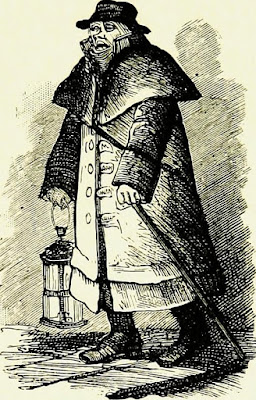
A watchman from Fifty Years Ago by W Besant (1888)
A watchman
from Fifty Years Ago by W Besant (1888)
Because our urban nights are often ablaze with artificial light, it’s easy to forget how dark the streets were before electricity became abundant.

Night watchmen had been on the streets of England’s towns and cities since medieval times. Artificial light was a precious commodity, supplied only by the flame, be it in the form of candle, brazier or oil lamp. When it was employed to illuminate a street, such forms of lighting had a limited range. Because huge patches of darkness made it easy for the criminally intentioned to move about unseen, watchmen were a necessary protection.

In London, early night watchmen were householders obliged to carry on the duty on a rota basis.

In a letter to his family, Swiss traveller Cesar de Saussure described the role of the watchman in 1725:
London does not possess any watchmen, either on foot or on horseback as in Paris, to prevent murder and robbery; the only watchman you see is a man in every street carrying a stick and a lantern, who, every time the clock strikes, calls out the hour and the state of the weather.1
In addition, Saussure noted that the watchman used his stick to push on shop doors, alerting the owner if it wasn't fastened correctly.

In 1735, an Act of Parliament allowed the appointment of paid night watchmen in St James', Piccadilly, and St George’s, Hanover Square. Many other Acts followed during the century, providing a system of paid night watchmen that covered most of London. The cost of the watch was passed on to householders through the rates they were obliged to pay the parish.

The professional watchman’s job was to do more than just call out the time and weather and check for loose doors. The Act of Parliament establishing the St Martin-in-the-Fields watch said they were “to prevent as well the Mischiefs which may happen from Fire, as Murders, Burglaries, Robberies, and other Outrages and Disorders.”2

The system of night watchmen in central London ended in 1829, with the creation of the Metropolitan Police. However, it was several years before police forces were established in other town and cities, meaning that in many part of the country, the night watchmen would have continued to serve well into the 1830s. How many of the first police officers would previously have done time in the watch?

The job of the night watchman

Jack startles the watchman from Spring-heel'd Jack: the Terror of London by the author of the Confederate's Daughter (1867)
From Spring-heel'd Jack: the Terror of London
by the author of the Confederate's Daughter (1867)
Night watchmen were on patrol, usually in pairs, from around 9pm until sunrise and their job was to challenge anyone who seemed suspicious, unauthorised street traders and “any person casting night soil in the street.”3

There’s was not a well-paid or highly respected role, and there seems to have been some concern that some watchmen were too friendly with the criminals they were meant to be watching out for.

Indeed ‘Charlies’or 'Charleys', as watchmen were nicknamed, were caricatured in Georgian prints as often being asleep on the job, allowing criminals to take advantage. This image of the lazy, incompetent watchman goes back at least two hundred years to the time of Shakespeare, who made them comic figures in his play Much Ado About Nothing.

However, at least some Georgian watchmen were not afraid to step in when they thought a crime had been committed. In 1796, John Wilson was stopped by two watchmen in Hanover Square, London, and taken to the constable who, on searching him, discovered pewter pots stolen from a pub.

The dangers of being a watchman

Patrolling the dark streets also meant responding to cries of alarm. On the night of 4 February 1795, at least two watchmen were called by a girl shouting “Watch and murder!” to a house near St Paul’s cathedral. On arrival they were threatened and chased off by an angry householder, John Dunn, who brandished two pistols and threatened to shoot the next watchman who approached his home. He was possibly drunk.

It seems a number of watchmen were attracted to the commotion, perhaps drawn by a moment of excitement in what was often a dull job. So many came that Richard Fitzgerald, who patrolled the area that included the house, had to tell them to go back to their own beats. He also told some of them to stop using their rattle, as the noise seemed to aggravate Dunn.

In his testimony at the Old Bailey some months later, Fitzgerald and other witnesses recalled that Dunn seemed very angry with the watchmen, continually cursing and threatening them as he wandered in the street outside his house. Dunn encountered a trainee watchman, on only his second night, and gave him a real fright by threatening him with the guns.

The episode reached a climax when another watchman, Thomas Price, approached Dunn. For some reason Price was off his beat, perhaps unable to resist the sight of an armed man strutting a London street. Unfortunately, Dunn marched up to Price and, from a distance of just few inches, discharged one of his weapons. Price was killed instantly.

Dunn was tried at the Old Bailey on 16 April 1795, found guilty of murder and sentenced to death. It’s not clear if this was carried out.

The organisation of night watchmen
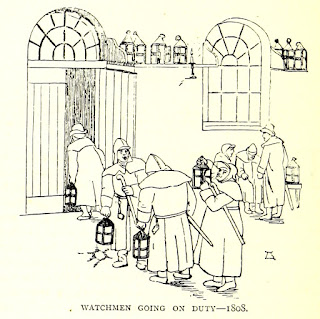
Watchmen going on duty From The Dawn of the XIXth Century in England by John Ashton (1886)
From The Dawn of the XIXth Century in England
by John Ashton (1886)
In 1735, when they established the first system of paid monitoring of the night time streets, St George’s hired 38 watchmen, four beadles and a watchhouse keeper. What sort of people were attracted to the job is not clear in the early eighteenth century, but nearly a century later, in the 1820s, many watchmen was ex-soldiers. It’s should be no surprise that then, as now, many military men took up jobs in the security sector.

The beadle was in charge of the watchmen, responsible for ensuring they were on duty at the correct time and reporting any problems to the churchwardens. Typically, one beadle was on duty at a time.

The watchhouse was the base from which the watchmen operated. It was their store, where equipment was kept, and could also act as a jail when someone needed to be detained. It was also where the watch book was stored, in which they made kept notes of their rounds.

The equipment of a night watchman

Contemporary illustrations of watchmen by Cruikshank and others show the typical items a watchman would have carried or used.
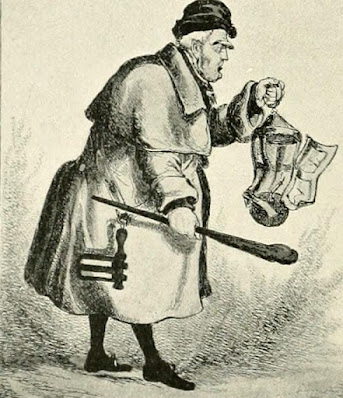
Master Dogberry the Parish Watchman from Social England by HD Traill and JS Saumarez (1901)
Master Dogberry the Parish Watchman
from Social England by HD Traill and JS Saumarez (1901)
Coat. It’s no surprise that a watchman would usually be wearing a long, thick coat. Even at the height of an English summer it can get chilly in the early hours of the morning.

Hat. Every respectable, and even disreputable, Georgian had at least one hat. The watchman’s was less about fashion and more about practicality, having a wide brim to help against the rain on a damp night.

Hut. The watchman’s hut, similar in appearance to a sentry box, would have been a familiar sight on urban streets. One of Cruikshank’s illustrations, from 1820, shows young men showing off to their ladies by tipping one over, complete with its hapless occupant.

Lantern. Illustrations and written accounts suggest that candles were commonly used as a light source.

Rattle. Watchmen carried a rattle, a wooden device that made a loud clattering sound when spun on its handle. In contemporary accounts, the action of using a rattle was variously described by watchmen as: ‘rung my rattle’, ‘swung my rattle’, ‘turned my rattle’, ‘played the rattle’ or ‘sprung the rattle’.

Staff. A long wooden stick that could be used for self-defence or for prodding a sleeping drunk.

Headshot of Rachel Knowles author with sea in background(2021)
Rachel Knowles writes clean/Christian Regency era romance and historical non-fiction. She has been sharing her research on this blog since 2011. Rachel lives in the beautiful Georgian seaside town of Weymouth, Dorset, on the south coast of England, with her husband, Andrew, who wrote this post.

Find out more about Rachel's books and sign up for her newsletter here.

If you have enjoyed this blog and want to encourage me and help me to keep making my research freely available, please buy me a virtual cup of coffee by clicking the button below.

 
Notes
1. Cesar de Saussure, A foreign view of England in the reigns of George I and George II, (1902) p68.
2. Elaine A Reynolds, Before the Bobbies - The Night Watch and Police Reform in Metropolitan London, 1720-1830 (Macmillan Press Ltd, 1998) p24.
3. Dan Cruickshank and Neil Burton, Life in the Georgian City (Viking, 1990) p18.

Sources used include:
Cruickshank, Dan and Burton, Neil, Life in the Georgian City (Viking, 1990)
Emsley, Clive, Crime and Society in England 1750-1900 (Pearson Education Ltd, 4th edition 2010)
Reynolds, Elaine A, Before the Bobbies - The Night Watch and Police Reform in Metropolitan London, 1720-1830 (Macmillan Press Ltd, 1998)
Saussure, Cesar de, A foreign view of England in the reigns of George I and George II (1902)

Friday, 31 May 2013

The scandalous death of the Duke of Cumberland's valet

HRH Ernest, Duke of Cumberland  from A Biographical Memoir of Frederick,   Duke of York and Albany  by John Watkins (1827)
HRH Ernest, Duke of Cumberland
from A Biographical Memoir of Frederick,
 Duke of York and Albany
by John Watkins (1827)
A royal scandal

On 31 May 1810, the Duke of Cumberland was attacked while asleep in his bed in his apartments in St James’s Palace. One of the Duke’s valets, Joseph Sellis, was later found dead in his room. His throat had been cut.

The scandalous story caused a lot of gossip. In A Reason for Romance, the heroine Georgiana reads the account of the attack in The Times, excerpts from which are included below, and is desperate to talk about it. Popular opinion at the time was so against the Duke that it was generally believed that he had murdered his valet. But was Sellis responsible for the attack on the Duke? And did he commit suicide or was he murdered?

Night attack

In the early hours of 31 May 1810, Ernest, Duke of Cumberland, asleep in bed, was woken by being hit over the head. Initially he thought a bat had got into his bedroom.

The Times, 1 June 1810, reported:
On Wednesday, the Duke of Cumberland dined at Greenwich. His Royal Highness returned to town, about eight o’clock, in an open carriage and four. The Duke then went to the Concert for the benefit of the Royal Society of Musicians. His Royal Highness returned to his apartments in St James’s Palace about half-past twelve o’clock, and went to bed about one. About two o’clock, he was awoke by the assassin, when he was sound asleep.1
According to the Duke of Cumberland’s own testimony:
Who, being upon his oath, saith, that, before three o’clock this morning, being in bed and asleep, he received two blows upon his head, which awoke him, and, upon starting up, he received two other blows upon his head, which, being accompanied with a hissing noise, it occurred to him that some bat had flown against him, being between sleeping and waking, and immediately received two other blows; there was a lamp burning in the room, but he did not see any body; that there was a night table standing near the bed side, where a letter lay which was covered with blood. 

His Royal Highness says, he then got up and made for the door, which opens at the head of the bed; he then received a wound upon his right thigh with a sabre; he then called out to Neale, his page, and, upon returning to the bedroom with Neale, he perceived that the door leading to the yellow room, was wide open, which is always locked the last thing when he gets into bed; a naked sword had been dropped, which he supposes must have given the wound in this thigh.2
Attempted murder

The Times report continued:
On his Royal Highness extricating himself from the attack of the villain, and getting out of his bedroom, he exclaimed aloud to his valet in waiting, repeatedly, ‘Neale, Neale, I am murdered! I am murdered!’ Neale, who was sleeping in an adjoining room, got up instantly; and the Duke informed him of the particulars, and said, the murderers were in his bedroom. Neale armed himself with a poker, and he and his Royal Highness proceeded along the passage; when Neale stepped upon the sword with which the Duke had been attacked, which was one of the Duke’s, and had been sharpened within these few days.3
Cornelius Neale said that:
Joseph Sellis had taken out his Royal Highness’s uniform and the sword, and brought them into his bedroom for a regiment inspection which did not take place, and Sellis afterwards returned the regimentals to the wardrobe, but left the sword in the bedroom, where informant believes he saw the sword some time yesterday.4
By this time, the Duke’s assailant had fled, but the door to the yellow room which had been locked before he went to bed, stood open. The Duke gave orders to secure the premises to prevent his attacker escaping. In the closet at the foot of his bed was a pair of slippers belonging to Sellis, a darkened lantern and the key of the closet door.

St James's Palace from The Beauties of England and Wales Vol X   by EW Brayley, J Nightingale and J Brewer (1814)
St James's Palace from The Beauties of England and Wales Vol X
  by EW Brayley, J Nightingale and J Brewer (1814)
Death of a valet

When the servants went to arouse Joseph Sellis, they found that the door to his apartment was locked. They hurried round to his room by the other available route through the state apartments, the doors to which were, surprisingly, unlocked. By the time they entered the room, Sellis was dead; his throat had been cut with a razor.

The Times reported:
Upon the alarm being given in the Palace, Lieut Buller, with a Serjeant and several men, who were on duty in the Palace, entered his Royal Highness’s apartments, and found the villain on his bed with his head nearly severed from his body; the blood that issued from him had nearly covered the bed-clothes and furniture.5
But why would Sellis attack the Duke?

The Times stated:
No reason has been assigned sufficient to account in the smallest degree for this accumulation of crime and ingratitude.6
In his statement, the Duke of Cumberland said:
His Royal Highness further saith, that the said Joseph Sellis had not incurred his displeasure, and that he had not any reason to think ill of him.7
Several possible motives have been put forward. One is that the Duke may have made advances towards Sellis’s wife. The Duke and Princess Augusta stood as godparents to Sellis’s youngest child and the Queen had sent a gift of Indian muslin. Some people have suggested that this indicated a closer relationship between the Duke and Sellis’s wife.

Another possible motive is that the vehemently anti-Catholic Duke, who had a malicious streak, was inclined to poke jibes at Sellis who was a Sardinian and supposedly Roman Catholic and that Sellis could not take any more of it. However, Sellis had his children baptised according to the rites of the Church of England, so this argument loses much of its force.

Another theory is that he was seized by a fit of insanity.

Probably the best suggestion of a motive is jealousy and theft. Sellis was jealous of the other valet Neale who appeared to be given preferential treatment over him. His plan may have been to attack the Duke and rob him and leave Neale to take the blame. As Neale was the valet on duty that night, suspicion would most naturally have fallen on him.

Once a thief…

Sellis had once been valet to a Mr Church in America and had been accused of thievery before New York magistrates but there was insufficient evidence to convict him. Sellis left America for England and after first working for Lord Mount Edgecumbe, he moved into service for the Duke.

What went wrong?

Sellis used the Duke’s sword as his weapon, but he miscalculated his attack and hit the Duke with the flat of the blade rather than the edge, which only succeeded in rousing the Duke rather than killing him.

When help was called, Sellis escaped to his room, but he was unable to eradicate the evidence of his crime before the servants came knocking on his door. Rather than face the consequences of his actions, he committed suicide.

The jury’s verdict: Sellis committed suicide

The murderous Duke?

Did the Duke murder his valet? Probably not. I do not think that the Duke can have killed Sellis because of his own injuries and it seems unlikely that the dozen or so witnesses could have corroborated each other’s testimonies if they were not speaking the truth.

Also, Sellis’s door was locked. It is impossible to believe that the Duke, who had been viciously injured in the attack, could have killed Sellis and then set it up to look like suicide.

Another interpretation?

But what if there is another interpretation of what happened? What if the attack was set up by someone who wanted to get rid of Sellis? The obvious culprit would be Sellis’s rival valet, Neale.

The reason that I still feel uncertain as to whether this was truly what happened is that the attempted murder was such a botched affair. How difficult is it to kill someone with a sword? And why use the sword anyway when Sellis proved how effective a razor was at killing someone when he committed suicide, if, indeed, he killed himself.

Or what if Sellis used the sword against the Duke in anger or self-defence, in the heat of the moment, during an argument over his wife or money or his recent dispute with Neale, and then committed suicide when he realised what he had done?

A libel action

In 1832, the matter raised its ugly head again when the Duke brought a libel action against Josiah Phillips, author of a book called The Authentic Records of the Court of England for the last Seventy Years in which the writer accused the Duke of murdering Sellis to prevent him from exposing the Duke’s alleged homosexual acts with his other valet, Neale.

At the trial, it was proved that the book’s information was not sound, and Phillips was found guilty of libel.

Updated 15 May 2020

Headshot of Rachel Knowles author with sea in background(2021)
Rachel Knowles writes clean/Christian Regency era romance and historical non-fiction. She has been sharing her research on this blog since 2011. Rachel lives in the beautiful Georgian seaside town of Weymouth, Dorset, on the south coast of England, with her husband, Andrew.

Find out more about Rachel's books and sign up for her newsletter here.

If you have enjoyed this blog and want to encourage me and help me to keep making my research freely available, please buy me a virtual cup of coffee by clicking the button below.

Notes
1. The Times digital archive, 1 June 1810.
2. Stockdale, JJ, A minute detail of the attempt to assassinate HRH the Duke of Cumberland (1810)
3. The Times op cit.
4. Stockdale op cit.
5. The Times op cit.
6. Ibid
7. Stockdale op cit.

Sources used include:
Fulford, Roger, Royal Dukes (1933, revised 1973)
Hatchard, J and son, The Trial of Josiah Phillips, for a libel on the Duke of Cumberland, and the proceedings previous thereto arising out of the suicide of Sellis, in 1810 (1833)
Leigh, Samuel, Leigh's New Picture of London (London, 1827)
Palmer, Alan, Ernest Augustus (1771-1851), Oxford Dictionary of National Biography, (Oxford University Press, 2004, online edn, May 2009, accessed 23 Mar 2013)
Stockdale, JJ, A minute detail of the attempt to assassinate HRH the Duke of Cumberland, in a letter to WI esq (JJ Stockdale, 1810)
Watkins, John, A Biographical Memoir of Frederick, Duke of York and Albany (1827, London)

The Times digital archive

Friday, 11 May 2012

The Assassination of Spencer Perceval 11 May 1812

Spencer Perceval,  from The Life and Administration of the  Right Hon. Spencer Perceval  by Charles Williams (1813)
Spencer Perceval from The Life and Administration of the
Right Hon. Spencer Perceval by Charles Williams (1813)
On 11 May 1812, Spencer Perceval was assassinated. He remains the only British Prime Minister to have been assassinated.

A difficult political situation

Spencer Perceval became First Lord of the Treasury in 1809 when the Duke of Portland’s health made it impossible for him to continue leading the government. He was not the King’s first choice, but such was the division in the government at the time that many of the politicians refused to serve with one another. Perceval was eventually chosen to form a cabinet, effectively making him Prime Minister. He also kept the role of Chancellor of the Exchequer as no one else would accept it.

The assassination

The June 1812 issue of La Belle Assemblée included a long account of the assassination of Perceval and subsequent trial of his murderer. It gave the following account of the assassination:
On the 11th May, about a quarter past five, as the Right Honourable Spencer Perceval, Chancellor of the Exchequer and First Lord of the Treasury &c. &c. was entering the lobby of the House of Commons, he was shot by a person of the name of Bellingham, who had place himself for that purpose at the side door leading from the stone staircase. Mr Perceval was in company with Lord F Osborne, and immediately on receiving the Ball, which entered the left breast, he staggered and fell at the feet of Mr W Smith, MP for Norwich, who was standing near the second pillar. The only words he uttered were – “Oh! I am murdered,” and the latter was inarticulate, the sound dying between his lips. He was instantly taken up by Mr Smith, who did not recognise him until he had looked in his face. The report of the pistol immediately drew great numbers to the spot, who assisted Mr Smith in conveying the body of Mr Perceval into the Speaker’s apartments, but before he reached them, all signs of life had departed.1
The assassin

John Bellingham, a disgruntled bankrupt, shot Perceval as the figurehead of the government which he held responsible for his financial misfortune. Had he been of a mind to escape, he probably could have done so, as little attention was paid him in the furore surrounding the fallen Perceval. However, such was not his intention. Bellingham was arrested, tried at the Old Bailey, pronounced guilty and sentenced to death.

Tribute to Perceval 

Before the death sentence was given, the Recorder spoke these words:
You have been guilty of the murder of a person whose suavity of manners disarmed hostility and rancour. By his death charity has been deprived of its warmest friend, and religion of its best support, and the country of its greatest ornament. A man whose public character and talents were capable of saving his country. The murder you have perpetrated in the midst of unarmed men, confiding in their innocence and the sacred functions vested in them by their country, and in the very sanctuary of the law.2
Spencer Perceval,  from The Georgian Era (1832)
Spencer Perceval
from The Georgian Era (1832)
This post was written on 11 May 2012 to celebrate the 200th anniversary of Spencer Perceval's assassination. 

Notes
1. Bell, John, La Belle Assemblée (May 1812)
2. Ibid.
Sources used include:
Bell, John, La Belle Assemblée (1812, London)
Clarke, The Georgian Era (Vizetelly, Branston and Co, 1832, London)
Williams, Charles, The Life and Administration of the Right Hon. Spencer Perceval (1813)