|
The Mistletoe in Popular Pastimes by FW Stephanoff (1816)
|
A Christmas tradition that romance
authors love is kissing under the mistletoe.
But when did the tradition begin? Did
young ladies of quality kiss under the mistletoe in the Regency? These are the
questions I set out to answer in this blog.
What is mistletoe?
 |
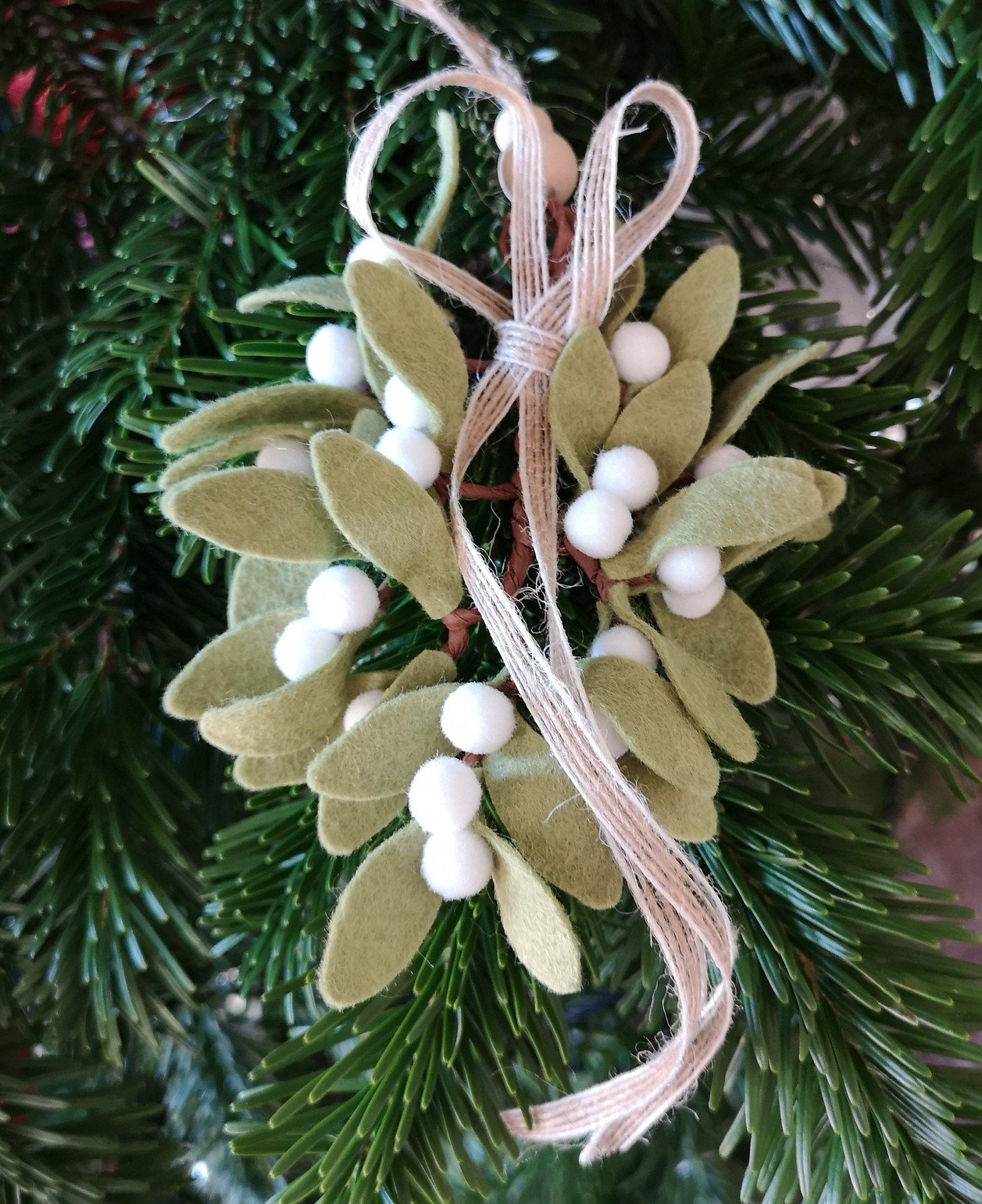
Mistletoe decoration (2022)
|
Mistletoe—sometimes spelt misletoe
in old texts—is an evergreen plant with oval leaves that grow in pairs. It
produces small white flowers, but is better known for its waxy, white berries
which grow in clusters from October to May—right over the Christmas season.
It is an unusual plant because it is
semi-parasitic. Rather than growing in the ground, it lives on the branches of
other trees, such as apple, lime, pear, or oak.
Although all parts of the plant are
poisonous, mistletoe is used in medicines to treat certain disorders like
epilepsy and cancer.
When was mistletoe first
associated with Christmas?
In pre-Christian Britain, mistletoe
was connected with the winter solstice. The Druids revered the oak, and this
reverence spread to everything connected with it—including mistletoe that grew
on oak. It was revered for its healing properties and gathered in a ceremony
steeped with superstition at the winter solstice.
When Christianity was established in
Britain, new traditions developed. Stephanoff wrote in Popular Pastimes
(1816):
The custom of decking our
churches and habitations with evergreens, has existed from the very
establishment of Christianity, and was unquestionably derived from the like
similar practice of our Pagan ancestors.1
These evergreens included mistletoe,
which is mentioned in Candlemas Eve, a poem written by Robert Herrick
(1591–1674). He wrote about taking down the greenery, including mistletoe, on
Candlemas Eve, signalling the end of the Christmas season:2
Down with the
rosemary and bays,
Down with the
mistletoe;
Instead of
holly, now up-raise
The greener box, for show.3
Another early reference to mistletoe
is in Art of Simpling, published in 1656. Coles wrote of mistletoe:
It is carryed many miles to set
up in houses about Christmas time, when it is adorned with a white glistering
berry.4
When did people first kiss under
the mistletoe?
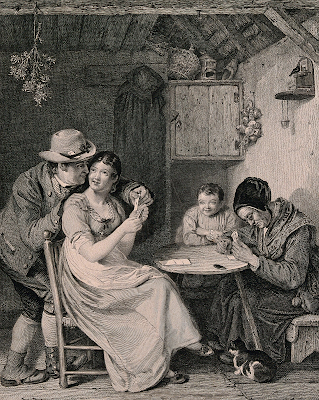 |
Christmas Eve by J Burnett (1815)
|
The earliest reference to kissing
under the mistletoe that I’ve come across is in a comic opera written in 1784
called
Two to One:
When at Christmas in the hall
The men and maids are hopping
If by chance I hear ‘em bawl,
Amongst ‘em quick I pop in.
When all the men, Jem, John, and Joe,
Cry, “What good luck has sent ye?”
And kiss beneath the mistletoe
The girl not turn’d of twenty.5
A poem quoted in Popular Pastimes
(1816) is undated, but it hints at the possibility that the custom went back
earlier:
The Misletoe hangs from an oaken beam,
The Ivy creeps up the outer wall;
The Bays our broken casements screen,
The Holly-bush
graces the hall.
Then hey for our Christmas revelling,
For all its
pastimes pleasures bring.
The Misletoe's berries are fair and
white,
The Ivy's of gloomy sable hue;
Red as blood the Laurel's affect our
sight,
And the
Holly's the same with prickles too.
Then hey,
& c.
Nor black nor ensanguined red for me: -
The Misletoe only is my delight:
For pure as love all its berries be,
And to kissing
my Fanny's sweet lips invite.
Then hey for our Christmas revelling,
For thus its
symbols pleasures bring.6
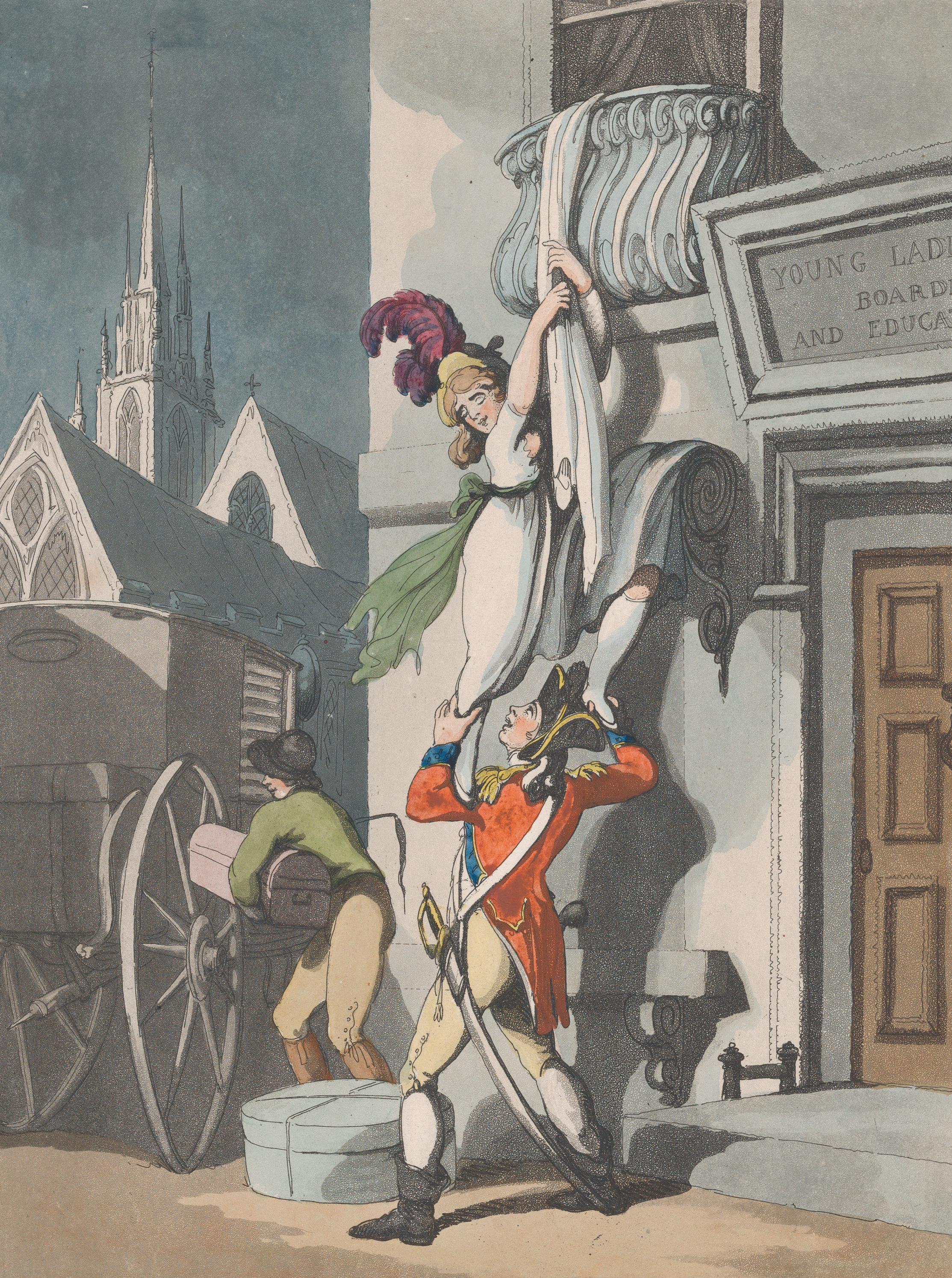
Upstairs or downstairs?
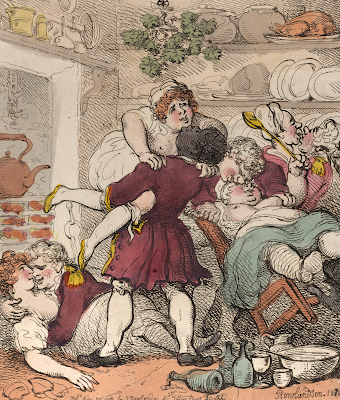 |
Christmas Gambols by Thomas Rowlandson (1812)
|
Contemporary prints from the late
Georgian period show mistletoe hung up in the kitchen—below stairs.
Mary Robinson’s poem, The
Mistletoe – a Christmas Tale (1800) says:
‘Twas Christmas time, the
peasant throng
Assembled gay, with dance and
Song:
The Farmer's Kitchen long had
been
Of annual sports the busy scene
…
It happen'd, that some sport to
shew
The ceiling held a MISTLETOE.
A magic bough, and well
design'd
To prove the coyest Maiden,
kind.
A magic bough, which DRUIDS old
Its sacred mysteries enroll'd;
And which, or gossip Fame's a
liar,
Still warms the soul with vivid
fire;
Still promises a store of bliss
While bigots snatch their
Idol's kiss.7
Observations on Popular
Antiquities (1841) stated that mistletoe
…was the heathenish or profane
plant, as having been of such distinction in the Pagan rites of Druidism, and
it therefore had its place assigned it in kitchens.8
Stephanoff’s Popular Pastimes
(1816) confirms this. He wrote mistletoe
…is still beheld with emotions of
pleasurable interest, when hung up in our kitchens at Christmas; it gives
licence to seize “the soft kiss” from the ruby lips of whatever female can be
enticed or caught beneath. So custom authorizes, and it enjoins also, that one
of the berries of the Misletoe be plucked off after every salute. Though coy in
appearance, the “chariest maid” at this season of festivity is seldom loth to
submit to the established usage; especially when the swain who tempts her is
one whom she approves.9
Pickwick Papers by Charles
Dickens (1836–7) suggests that though mistletoe was hung below stairs, the
kissing was not restricted to the servants:
From the centre of the ceiling of
this kitchen, old Wardle had just suspended, with his own hands, a huge branch
of mistletoe, and this same branch of mistletoe instantaneously gave rise to a
scene of general and most delightful struggling and confusion; in the midst of
which, Mr Pickwick, with a gallantry that would have done honour to a
descendant of Lady Tollimglower herself, took the old lady by the hand, led her
beneath the mystic branch, and saluted her in all courtesy and decorum.
The old
lady submitted to this piece of practical politeness with all the dignity which
befitted so important and serious a solemnity, but the younger ladies, not
being so thoroughly imbued with a superstitious veneration for the custom, or
imagining that the value of a salute is very much enhanced if it cost a little
trouble to obtain it, screamed and struggled, and ran into corners, and
threatened and remonstrated, and did everything but leave the room, until some
of the less adventurous gentlemen were on the point of desisting, when they all
at once found it useless to resist any longer, and submitted to be kissed with
a good grace.
Mr Winkle kissed the young lady with the black eyes, and Mr
Snodgrass kissed Emily; and Mr Weller, not being particular about the form of
being under the mistletoe, kissed Emma and the other female servants, just as
he caught them. As to the poor relations, they kissed everybody, not even
excepting the plainer portions of the young lady visitors, who, in their
excessive confusion, ran right under the mistletoe, as soon as it was hung up,
without knowing it!10
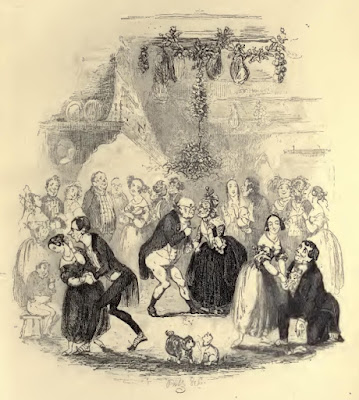 |
Christmas Eve at Mr Wardle's by Phiz
from Pickwick Papers by Charles Dickens (1836-7)
|
When was the mistletoe put up?
I’ve not found a definitive answer
to this one, although I’ve read multiple times of a superstition that it was
bad luck to decorate the house before Christmas Eve. I’ve not found any contemporary
evidence as yet to support this, but it is possible that the church discouraged
people from decorating before the winter solstice (21 December) to separate the
Christian festival of Christmas from the pagan celebration of the solstice.
Also, as Christmas Day was the start
of the Christmas festivities, decorating on Christmas Eve would make sense. In
the excerpt above from Pickwick Papers, this scene took place on
Christmas Eve.
When was mistletoe taken down?
Another superstition I’ve come
across is that it was bad luck to leave greenery up after Twelfth Night (5
January). Traditionally, greenery was taken down on Candlemas Eve (2 February)
but at some point this changed to Twelfth Night.
Some sources suggest the lower
classes were keen to keep the celebrations going and clung onto Candlemas as
the end of the festivities for as long as possible.
What was a kissing bough?
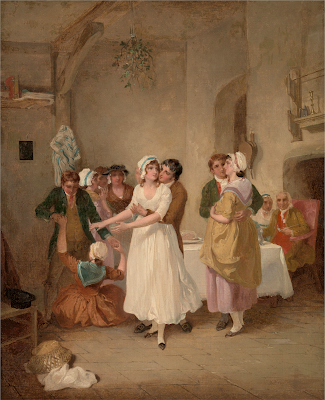 |
The Mistletoe Bough by F Wheatley (c1790)
|
Mistletoe may have been incorporated
into kissing boughs before it was hung up alone as a Christmas decoration. I’ve
not found any references to kissing boughs in the books of customs and other contemporary
records I’ve looked at, so my information here is based on secondary sources.
According to the English Heritage
website, a kissing bough comprised two intersecting circles of greenery. It
says:
It is not certain when kissing
boughs were first introduced in England although they are often considered to
have been a popular Christmas decoration in the Tudor period.11
A kissing bough was hung on a wall
or from a ceiling or in a doorway near the entrance of the house to welcome
visitors. Visitors embraced the master and mistress of the house under the
kissing bough as a sign of goodwill.
I’ve come across various other names
for a kissing bough, though it’s unclear whether these were all the same: a
kissing ball, a Christmas bough, a mistletoe bough or a holy bough, with a clay
figure of the baby Jesus in the middle.
Other sources suggest a kissing
bough was the top part of a tree, hung upside down as a symbol of the Holy
Trinity.
The inclusion of mistletoe in a
kissing bough may have given rise to the tradition of kissing under the
mistletoe.
In John Leech’s illustration of Mr
Fezziwig’s Christmas party in A Christmas Carol (below), there appears
to be a kissing bough hanging from the ceiling as well as mistletoe
being held by hand over a girl’s head.
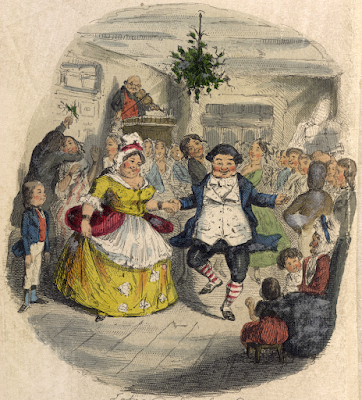 |
Mr Fezziwig's Ball by John Leech from A Christmas Carol
by Charles Dickens (1920 reprint of original 1843 edition) |
Was mistletoe used to decorate
churches?
There seems to be some debate whether
mistletoe was used to decorate churches or not.
John Gay (1685–1732) wrote in his
poem The Approach of Christmas:
When Rosemary and Bays, the poet's
crown,
Are bawled in frequent cries through all
the town;
Then judge the festival of Christmas
near,
Christmas, the joyous period of the
year!
Now with bright Holly all the temples
strew,
With Laurel green, and sacred MISLETOE.12
This seems to imply that all these
evergreens were used to decorate churches at Christmas.
Observations on Popular
Antiquities (1841) disagreed, stating that mistletoe
…never entered those sacred
edifices, but by mistake or ignorance of the sextons.13
However, Popular Pastimes quoted
Dr Stukeley as saying that the druids had a custom of laying mistletoe, which
they called “All-heal”, on their altars, and that this custom still continued
in the north, at York Minster.
Stephanoff added:
Rachel Knowles writes faith-based Regency romance and historical non-fiction. She has been sharing her research on this blog since 2011. Rachel lives in the beautiful Georgian seaside town of Weymouth, Dorset, on the south coast of England, with her husband, Andrew.
Find out more about Rachel's books and sign up for her newsletter here.
If you have enjoyed this blog and want to encourage me and help me to keep making my research freely available, please buy me a virtual cup of coffee by clicking the button below.
Notes
- Stephanoff, Francis William, Popular Pastimes, Being a Selection of Picturesque Representations of the Customs & Amusements of Great Britain, in Ancient and Modern Times: Accompanied with Historical Descriptions (1816).
- Candlemas is on 2 February—40 days after Christmas—and celebrates the day Mary was purified according to Jewish law after giving birth to Jesus.
- Vizetelly, Henry, Christmas with the poets (1851).
- Quoted in Brand, John, & Ellis, Henry, Observations on Popular Antiquities (1841).
- Arnold, Dr, Two to One, a comic opera (1784).
- Stephanoff op cit.
- Robinson, Mary, The Mistletoe - a Christmas tale (1800).
- Brand & Ellis op cit.
- Stephanoff op cit.
- Dickens, Charles, The Pickwick Papers (1836-7).
- English Heritage website
- Vizetelly op cit.
- Brand & Ellis op cit.
- Stephanoff op cit.
Sources used include:
Arnold, Dr, Two
to One, a comic opera (1784)
Brand, John, &
Ellis, Henry, Observations on Popular Antiquities (1841)
Dickens, Charles, A Christmas Carol
(1843)
Dickens, Charles, The Pickwick
Papers (1836-7)
Hone, William, The Everyday Book
(1826)
Newcomb, G, History of the Christmas
Festival (1843)
Robinson, Mary, Lyrical Tales including
The Mistletoe - a Christmas tale (1800)
Stephanoff, Francis William, Popular
Pastimes, Being a Selection of Picturesque Representations of the Customs &
Amusements of Great Britain, in Ancient and Modern Times: Accompanied with
Historical Descriptions (1816)
The Kaleidoscope: or, Literary and
scientific mirror (1821)
The New Monthly Magazine and Universal
Register (1817)
Vizetelly, Henry, Christmas with the
poets (1851)
English Heritage website on Tudor Christmas decorations
English Heritage website on Christmas greenery
Photograph © Rachel Knowles regencyhistory.net