Search this blog

Showing posts with label Dorset. Show all posts

Wednesday, 2 August 2023

Athelhampton House in Dorset revisited - a new Regency History guide

Athelhampton House - front entrance 2015
Athelhampton House
Athelhampton House, in Dorset, was a 326-year-old pigsty at the start of the Regency period. The ground floor of the Tudor Great Hall, built in 1485, and the connected West Wing, had become home to pigs and poultry. And they had been that way for decades.

Today Athelhampton is one of England’s finest Tudor mansions. It was pretty impressive when it was built, but a visitor in the Regency period would have seen it as a tired, rundown relic of a farmhouse. Little more than an ornate barn.

Not that many people would have visited Athelhampton. Despite King George III regularly passing nearby on his way to and from Weymouth, the house wasn’t on the itinerary of anyone of any consequence. It was lived in by tenant farmers—hence the livestock roaming the halls.

Athelhampton House - back of house and dovecote 2023
Rear view of Athelhampton House and the dovecote (2023)

A house protected by the pigs

In July 2023 Andrew and I were invited to tour Athelhampton, which has been under new ownership since 2019. The house, which was already ancient by the time of the Regency, offers an alternative narrative to what we associate with the grand halls of the period.

Athelhampton stands out as a historic mansion, because it’s not built in the classical style we associate with the Georgians. It lacks the symmetry and bold pillars of so many grand houses. The Tudor styling and unbalanced frontage would have looked quaintly old-fashioned to the Regency eye.

That the house survived for so long (the Great Hall is now over 530 years old) is probably because Nicholas Martyn died with no male heir in 1595. He was the grandson of the house builder, Sir William Martyn, who put it up in 1485.

Nicholas Martyn had four daughters, each of whom inherited a quarter of the property. Because no one person owned the house, no one was able to make major changes to it. By 1700, ownership had been consolidated to a three-quarter and a one-quarter share, split between two families, each of which owned other estates. Neither family lived at Athelhampton, preferring to rent the property to farmers.

This relegation in status protected the architecture we admire today. Had a wealthy Georgian had sole control over Athelhampton, it’s likely he would have wanted to make a statement by tearing it down, and rebuilding it in a more fashionable style. Hence, it’s the pigs that protected the house.

Ironically, it was also a farmer who helped the house survive into the 21st century. Tenant farmer George Wood bought the largest share of the Athelhampton inheritance in 1848. In 1861 he acquired the other share to become the first sole owner in over 250 years.

In 1891 the Woods sold the house to Alfred Cart de Lafontaine. He began the process of restoring the house to its former glory, and laid out the elegant gardens. This work, and that of subsequent owners, protected the house from the rampant demolition that destroyed so many historic buildings in the 20th century.

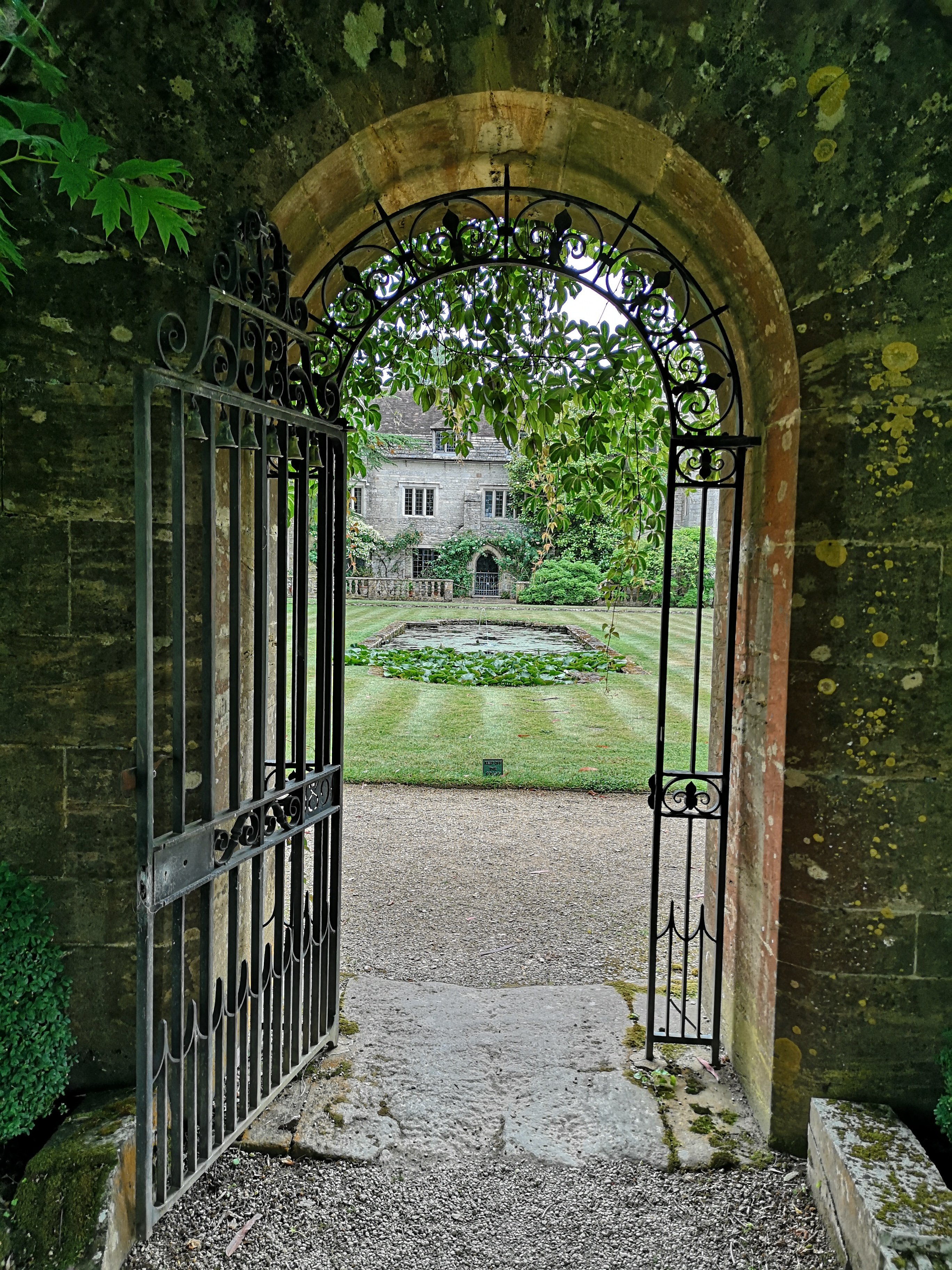
Ornate gate leading to garden at Athelhampton (2023)
One of the gardens at Athelhampton (2023)

Regency Athelhampton

During the Regency (1811–1820) Athelhampton was owned by Catherine Tylney-Long (1789–1825), an heiress believed to be the richest commoner in England. She inherited a huge portfolio of properties as a teenager in 1805, giving her the nickname of “The Wiltshire Heiress”.

As already mentioned, at the time the house was leased to farmers, and it stayed that way during her ownership. She probably never visited the house.

Catherine Tylney-Long by an unknown artist

A close brush with royalty

Despite being incredibly wealthy, Catherine Tylney-Long’s story is tragic.

She also came close to being queen. She was courted by William, Duke of Clarence, third son of King George III, who was nearly 25 years her senior. The press mocked him for pursuing her.

The Duke of Clarence became William IV in 1830. Had Catherine married him, she would have become queen, if—and this is an extremely big if—George III had given his permission for the marriage. With that permission, the marriage would have been legal, and the eldest of their children would have become monarch after William, not his niece Victoria.

The Disconsolate Sailor (1811) - a cartoon by Argus (Charles Williams)
The Disconsolate Sailor (1811) by Argus (Charles Williams)

But Catherine turned down the Duke of Clarence and accepted a proposal from William Wellesley-Pole, a man with a wild reputation. They married in March 1812. William continued his outrageous lifestyle of womanising and gambling, spending much of her wealth.

She died in 1825, aged just 35. The newspapers reported:

To her, riches have been worse than poverty; and her life seems to have been sacrificed, and her heart ultimately broken, through the very means which should have cherished and maintained her in the happiness and splendour which her fortune and disposition were alike qualified to produce.1

Catherine was also connected with another major figure of the Regency era, the Duke of Wellington. Her husband was the great man’s nephew. It was Catherine’s son who sold Athelhampton to the tenant farmer, George Wood, in 1848, to pay off some of his father’s debts.

What you can see at Athelhampton today

Rachel Knowles by staircase in Athelhampton House (2023)
Rachel at Athelhampton House (2023)

Our comprehensive tour of Athelhampton House took several hours, as the extremely knowledgeable manager of the site—Owen Davies—showed us around. A new owner bought the house in 2019 and implemented a series of renovations. He opened up new areas of the house, and visitors are now allowed to enter rooms which previously you could only see from the doorway.

The previous owner auctioned off the house contents separately, and so apart from a few items, such as the portrait of Princess Sophia, which the new owner was able to secure, most of what you see today has come into the house since then. However, much of it is authentic period furniture, and the rooms have been set out to represent different periods in Athelhampton’s history.

Portrait of Princess Sophia by Robinson after Sir William Beechey (1820)
Portrait of Princess Sophia
by Robinson after Sir William Beechey (1820)

There is also more emphasis on one of Athelhampton’s most famous visitors—author Thomas Hardy.

These are some of the highlights:

Tudor doors

Tudor door at Athelhampton House (2023)
Tudor door, Athelhampton House (2023)

The Tudor Great Hall, with its impressive, beamed ceiling and Oriel window.

Tudor Great Hall, Athelhampton House (2023)
 
Ceiling of the Tudor Great Hall at Athelhampton House (2023)
Ceiling of the Tudor Great Hall, Athelhampton House (2023)

Oriel Window in Tudor Great Hall at Athelhampton House (2023)
Oriel Window in Tudor Great Hall, Athelhampton House (2023)

The Green Parlour, where author Thomas Hardy was dining in 1914 when a telegram arrived announcing the beginning of World War I.  

Green Parlour, Athelhampton House (2023)

 The recently restored Elizabethan Kitchen.

Elizabethan Kitchen, Athelhampton House (2023)

The Marriage Chamber, with its original fireplace, showing the motifs of Sir William Martyn and his first wife, Isabel Farringdon—the ape and the unicorn—and an Elizabethan tester bed.

Marriage Chamber, Athelhampton House (2023)

Marriage Chamber, Athelhampton House (2023)

The Armada Chest in the King’s Room—a late 16th century portable safe.

Armada Chest in the King's Room, Athelhampton House (2023)

The Library—originally Elizabethan bedrooms, there is a hidden door in the wood panelling leading to the staircase that comes out in the Great Chamber. The room is dominated by a billiard table dating from 1915.

Billiard table in The Library, Athelhampton House (2023)
The Library, Athelhampton House (2023)

Secret door in the Library, Athelhampton House (2023)

The Great Chamber—used to store grain in the 1850s, the room is lined with Elizabethan oak panels, with Italian carving over the fireplace. And it hides a secret—a door leading to a priest hole and a staircase up to the Library, which was originally a bedroom.

The magnificent plaster ceiling is an early 20th century replica of the pattern used in the Globe Room in the Reindeer Inn, Banbury, Oxfordshire, thought to be where Oliver Cromwell held meetings during the English Civil War.

Italian carved panels, Secret door in the Great Chamber, Athelhampton House (2023)
Italian carved panels in the Great Chamber, Athelhampton House (2023)

Secret door in the Great Chamber, Athelhampton House (2023)

The Great Chamber, Athelhampton House (2023)

Ornate plaster ceiling in the Great Chamber, Athelhampton House (2023)

Gardens

Gateway to one of the gardens at Athelhampton (2023)

One of the gardens at Athelhampton (2023)

Find out about visiting Athelhampton here.

You can see what the house was like under the previous ownership on my original blog here.

Headshot of Rachel Knowles author with sea in background(2021)
Rachel Knowles writes faith-based Regency romance and historical non-fiction. She has been sharing her research on this blog since 2011. Rachel lives in the beautiful Georgian seaside town of Weymouth, Dorset, on the south coast of England, with her husband, Andrew.

Find out more about Rachel's books and sign up for her newsletter here.

If you have enjoyed this blog and want to encourage us and help us to keep making our research freely available, please buy us a virtual cup of coffee by clicking the button below.


Note   

  1. Englishman, 18 September 1825.
Photos © Andrew Knowles - RegencyHistory.net

Monday, 3 October 2016

Almost a sailing tragedy off Weymouth in 1800: a first-hand account

Portland Bill, Dorset
Portland Bill, Dorset (2016)
Overcoming adversity always makes for a good story, particularly when it involves a life-threatening situation. Charles Sturt, Member of Parliament for Bridport, Dorset, had such a tale to tell after sailing off Weymouth in 1800. Within a few days of his adventure, he wrote an account that was later published.

The story begins with King George III, a frequent visitor to the seaside town, who often went aboard Royal Navy ships moored in the bay. On 20 September, the King, with Queen Charlotte and other members of the royal family, went aboard the frigate Cambrian.

While the royals were being entertained by the Navy, Sturt sailed out into Weymouth Bay, where he encountered the cutter of Mr Weld, of Lulworth Castle. 

Weymouth, Dorsetshire by JMW Turner
Weymouth, Dorsetshire by JMW Turner 1
Racing towards disaster

He decided to race Weld’s cutter, but was held back because his own vessel was towing a smaller boat. Sturt asked one of his crew to board this small boat and sail it back to Weymouth, but 
...at this he hesitated and refused. I observed, ‘You my lads, have known me long enough to be satisfied I should not order you to do a thing I would not readily do myself, therefore, reef the sail, slip the mast, I will go myself.’2
Ordering his crew to continue the race with Weld, Sturt began the task of returning his boat to Weymouth. This required him to avoid the Shambles Bank, an area of submerged rocks to the south east of Portland Bill.
A very strong ebb tide carried me to the westward, and on for the Shambles, which I wished to avoid; put before the wind, but, being under a very low sail, could not stem the tide; dared not quit the helm to let the reefs out of the sail, for fear of broaching-to; the tide hauling me dead on the Shambles, where the sea was running tremendously high, and breaking horridly, no time to be lost.
The danger from the shallows of the Shambles is amplified by the nearby Portland Race, where land forces the tides to flow fast and dangerously, just off Portland Bill. Many ships have been wrecked and lives lost because of the Race and the Shambles.

Portland Bill, Dorset
Portland Bill, Dorset (2016)
Time to take emergency action

Realising that he was in trouble, Sturt attempted to lighten his boat by throwing all his ballast overboard. 
And convinced my boat could not exist many minutes, and nothing but the interposition of Providence save me, to divert my thoughts from the horrid idea of death, I began singing the sea song, ‘Cease rude Boreas’.
Written by playwright and poet George Alexander Stevens, ‘Cease rude Boreas’ was also known as ‘the storm song’ and seems to have been a popular choice among sailors facing serious wind and waves.
As I was singing the second verse, a dreadful sea, all foaming, took my boat on her larboard quarter, sheered a-weather my helm she lost her shorage-way broached-to, upset and overwhelmed, the sea rolling over and over; recovering from my alarm without the smallest hope of escaping, I swam to my boat, which was lying on her broadside: with difficulty I got into her and held her fast.
Having been thrown from his boat, and regaining it, Sturt decided he was overdressed for the occasion. He recorded that he “immediately pulled off my coat, waistcoat, shirt, and cravat; this I accomplished with much difficulty being wet”. Now he took in the gravity of his situation.
No sail near me; above fifteen miles from the nearest land; a dreadful hollow, broken sea running in every direction, and frequently overwhelming me, gave me no hopes of saving my life.
Waves crashing against the rocks on Portland
Facing near certain death

Living near the Dorset coast, Sturt was an accomplished sailor, familiar with the hazards of sailing.
To surrender without a struggle, I considered weak; the thoughts of my wife and children, which at that period struck my mind very forcibly (I thought I saw them,) recollecting the difficulties I surmounted two years before, in saving some men from a wreck off my house, and knowing that they were saved from a situation as dreadful as my own by the assistance of Divine Providence this gave me resolution and fortitude to exert myself.
Sturt busied himself trying to organise his vessel as best he could, despite “being repeatedly washed off the boat”. While there were no other ships in sight, Sturt was not alone with the waves.
At this period, several gurnets (a large species of sea-gull,) hovered close to me, and were so bold as to come within two feet of my head. I suppose they anticipated a good meal on me; however, by hollowing pretty loud, I convinced them I was not yet dead; they took flight and I saw no more of them.
Having now spent three hours being soaked by the raging seas, Sturt was roused by the sight of two sails, but the ships were too distant for him to attract attention, so he didn’t bother. When a third, a brig, passed closer, he did all he could to get noticed.

The Pelican sailing off Weymouth Bay
A chance of rescue
I succeeded; I saw her men go up the main shrouds, and the crew stand close together, but passed me without offering to lend me the smallest assistance; this indeed was enough for me to surrender up a life which was no longer supportable; such inhumanity excited in me the strongest emotions of anger; but alas! I had no means of redress; I gave up all hopes of being saved.
Now the wind began pushing Sturt’s boat towards the dangers of the Portland Race. Prospects of rescue failing, he began preparing his body for identification once he was dead.
I took a valuable diamond watch of my wife's out of my fob, tied it securely round the waistband of my trowsers, pulled them off, and tied them round the short of the boat; when I had done this, I made a running knot with the painter, intending to put it round me in my last moments, that my boat, as the wind was, would be driven near my house, or Bridport, and that my watch and seal would lead to a discovery of who I was: having done this, I became quite indifferent, death was no longer terrible; and as I saw no chance of being saved, I sat quietly in the boat, patiently waiting for the next wave to put an end to my suffering.
By his own account, Sturt’s patient waiting seems to have involved regularly being tipped out of and swimming back to his boat, for around an hour. By now, his boat seems to have capsized.

Running out of time

Then, at about half past four in the afternoon, he spotted a further eight sails. The first few to pass by were too far away to spot him.
I reserved my strength for the only two of the eight that had not passed me; a brig came by, I hailed her, lifted up my hands and fortunately I observed they saw me, for her men went up aloft to see what I was; they then tacked and stood toward me, but did not hoist a boat out; this alarmed me.
For whatever reason, the captains of two ships had decided to ignore the shouts and waving from a man in trouble on the seas. 
There was only one more vessel to pass; it was nearly dark, a dismal sea and within two miles of Portland Race: if this passed me, all was over. I roused myself on this occasion, and hailed, her stood on the boat's bottom, was washed off, got on her again and was again washed off; however life was still desirable as long as I saw a chance of being saved.
On this occasion he was rewarded by the sight of a boat being lowered, and he realised rescue was imminent. 
At that instant I was agitated, my firmness seemed to forsake me, for I burst into a flood of tears, and was seized with a violent retching from the quantity of salt water I had swallowed.
Rescue and rewards

It seems that with the assistance of his rescuers, Sturt was able to bring his boat alongside the ship Middleton, under Captain Rankin. Once aboard, Sturt was welcomed by Colonel Jackson of the 85th. At 8pm the Middleton sailed into Portland Roads, the sheltered waters that are now Portland Harbour.

Portland Harbour, Dorset
Here he was reunited with his friends
Mr and Mrs Smith, from whom I received the kindest attention; they thought I was irrecoverably gone, so did their majesties, particularly as captain Ingram declared he saw my boat go down; however it was extremely reasonable to suppose I was lost, the sea running high and breaking in a most tremendous manner: he well knew on those shoals a boat could not long exist, and, on the whole, a most dreadful evening, it was reasonable to suppose I was no more.
Their majesties, with the dukes of Kent and Cumberland, lord and lady Cathcart, Parlet Cathcart: colonels Desborough and Wynyard, generals Goldsworthy Garth, &c, every soul, in short, in Weymouth, heartily congratulated me on my providential escape; the king and queen with their family, on the esplanade, expressed, in the kindest manner their very sincere happiness at my being saved.
Three days later, Sturt returned to the Middleton to thank his rescuers. He gave 10 guineas and a silver cup to Captain Rankin, 5 guineas each to four named crew members, and 20 to be distributed among the other sailors.

The captain and crew of the Earl of Abergavenny were less fortunate.  
 

Headshot of Rachel Knowles author with sea in background(2021)
Rachel Knowles writes clean/Christian Regency era romance and historical non-fiction. She has been sharing her research on this blog since 2011. Rachel lives in the beautiful Georgian seaside town of Weymouth, Dorset, on the south coast of England, with her husband, Andrew, who wrote this post.

Find out more about Rachel's books and sign up for her newsletter here.

If you have enjoyed this blog and want to encourage me and help me to keep making my research freely available, please buy me a virtual cup of coffee by clicking the button below.

 
Notes
(1) From Picturesque Views on the Southern Coast of England (details below).
(2) All quotes from The Cabinet of Curiosities Vol 2 (1822) by Samuel Griswold Goodrich.

Sources used include:
Crotch, W, MacFarren, GA, and Wade, J Augustine, A Collection of National English Airs (1838)
Goodrich, Samuel Griswold, The Cabinet of Curiosities: Natural, Artificial and Historical Volume 2 (Hartford, 1822)
Turner, JMW, Picturesque Views on the southern coast of England, from drawings made principally by JMW Turner and engraved by WB Cooke and others (1826)

Wednesday, 21 September 2016

A Regency History guide to Athelhampton House in Dorset

Athelhampton House, Dorset
Where is Athelhampton?

Athelhampton is a Tudor manor house situated near Dorchester in Dorset. 
 

A history of Athelhampton

The story of Athelhampton starts in 1485 when Sir William Martyn was granted the right to enclose his estate and deer park and build a stone manor with towers and crenellations—the battlements that give a castle its characteristic shape. The result was the Great Hall with a solar on one side, providing living accommodation, and a buttery on the other. Subsequent owners added the west wing and a gatehouse and extended the house to the rear.

View of Athelhampton House from the White Garden
About 100 years after the Great Hall was built, one of Sir William’s descendants, Nicholas Martyn, died without male heirs. He left the estate to his four daughters in equal shares and the house was split into separate dwellings. Sir Ralph Bankes of Corfe Castle acquired three of these shares by marriage and other means, but sold them to Sir Robert Long, 1st Baronet, to help finance his expensive new house at Kingston Lacy. 

This three-quarter share was subsequently inherited by Catherine Tylney-Long, who married the Duke of Wellington’s nephew, William Pole-Tylney-Long-Wellesley, 4th Earl of Mornington, in 1812. The Duke’s nephew only had a life interest in his wife’s property and so the house passed to her son William, 5th Earl of Mornington, on her death in 1825. He subsequently sold Athelhampton to George Wood who acquired the fourth share, reuniting the house once more. By now, the property was very run down, having been used by tenant farmers for many years. The gatehouse was demolished around 1862 and the Norman church was replaced by a new church before passing to a new owner, Alfred Cart de Lafontaine in 1891. 

Athelhampton House, Dorset
De Lafontaine laid out formal gardens and restored the house but sold it on when he ran out of money. Eventually, the house was bought by the Cooke family who sold it in 2019.

The house was visited often by the author Thomas Hardy (1840-1928) and was once lived in by the Russian cubist artist Marevna—Marie Vorobieff—whose paintings are on display in a gallery in the house.

The Gardens, Athelhampton House, Dorset
A change of ownership
 
Athelhampton House changed ownership in 2019. It still belongs to Historic Houses and is open to visitors, but its contents were sold at auction and I don't know how much of what I saw in 2016 is still the same as I haven't been back yet.


A tour of Athelhampton House as it was in 2016
 
There were a number of items on display which are of particular interest to the Georgian historian. Some rooms are only viewable from the doorway.

Front door, Athelhampton House, Dorset
Great Hall

The Great Hall dates back to the late 15th century and includes some original heraldic glass. On the balcony, there is a George III mahogany organ.

The Great Hall, Athelhampton House, Dorset

King’s Ante Room

This little passage way includes some prints of Carlton House and a lovely portrait of George III’s fifth daughter, Princess Sophia.

Portrait of Princess Sophia, King's Ante Room,  Athelhampton House, Dorset
Portrait of Princess Sophia, King's Ante Room,
Athelhampton House, Dorset
Wine Cellar

Just inside the entrance to the wine cellar is a Coade stone torchère. This was part of a set of ten candlestick stands made by Coade and Sealy of Lambeth in 1810 for George, Prince of Wales, at Carlton House. Coade and Sealy was the artificial stone manufactory run by Eleanor Coade, one of the women featured in my forthcoming book, What Regency Women Did For Us. At this time, Eleanor had taken her cousin John Sealy into partnership, hence the name, Coade and Sealy.

The Wine Cellar, Athelhampton House, Dorset
Great Chamber

The Great Chamber, Athelhampton House, Dorset
Library (now used as a billiard room)

This is one of the rooms that you can only view from the doorway. At the far end of the room is a Georgian globe which apparently shows the voyages of Captain Cook, but I couldn’t get close enough to see!

The Library, Athelhampton House, Dorset
King’s Room

The King's Room, Athelhampton House, Dorset
Green Parlour

The Green Parlour, Athelhampton House, Dorset
Dressing Room

There is a small collection of vintage clothing on display, including a Georgian dress and a Regency costume, though sadly, not easy to see from the doorway.

Vintage clothing in the Dressing Room, Athelhampton House, Dorset
Georgian dress in the Dressing Room,  Athelhampton House, Dorset
Georgian dress in the Dressing Room,
Athelhampton House, Dorset
Yellow Bedroom Closet

Yellow Bedroom Closet, Athelhampton House, Dorset
Yellow Bedroom

Yellow Bedroom, Athelhampton House, Dorset
State Bedroom

A rather dark picture of the State Bedroom, Athelhampton House, Dorset
The Gardens

Although the formal gardens have no claim to Georgian origins as they were laid out in the 1890s, they are beautiful and well worth a visit. There are also other gardens formed later including The Canal and a bridge over the River Piddle leading to a short riverside walk. There is also a toll house within the grounds, beyond the Lime Walk.

Bridge over the River Piddle, Athelhampton House, Dorset
The Great Court

The Great Court, Athelhampton House, Dorset
The Corona

The Corona, Athelhampton House, Dorset
The Canal

The Canal, Athelhampton House, Dorset
The Dovecote

The dovecote was built in the early 16th century at the same time as the west wing.

The Dovecote, Athelhampton House, Dorset
Toll House

The Toll House at Athelhampton House, Dorset
Last visited: June 2016.
Blog updated: July 2021.

Headshot of Rachel Knowles author with sea in background(2021)
Rachel Knowles writes faith-based Regency romance and historical non-fiction. She has been sharing her research on this blog since 2011. Rachel lives in the beautiful Georgian seaside town of Weymouth, Dorset, on the south coast of England, with her husband, Andrew.

Find out more about Rachel's books and sign up for her newsletter here.

If you have enjoyed this blog and want to encourage us and help us to keep making our research freely available, please buy us a virtual cup of coffee by clicking the button below.

 
Sources used include:
Cooke, Patrick, Athelhampton House & Gardens (Dorchester, 2010)

All photographs © Andrew Knowles - RegencyHistory.net