Search this blog

Showing posts with label Weymouth. Show all posts

Friday, 1 December 2023

A Regency Christmas romance full of hope


A heartbroken widower. A downtrodden companion. 

Their instant attraction offers hope for the future—if their secrets don’t destroy them first.

Estate manager Peter Crowley has abandoned hope of ever loving again. No woman has touched his heart since the death of his wife.

Now his life is centred on the beloved daughter he’s been forced to send away to school.

Meg Harding knows nothing of love. The sole companion of a cantankerous old lady, she smiles in the face of adversity, but dreams of a better life.

Thrown into conversation on the coach to Weymouth, Peter and Meg are drawn to each other by a shared sense of humour.

The downtrodden Meg revels in Peter’s kindness—and he yearns to rescue her.

Six months later they meet again. Both their situations have changed—and not all for the better.

As they share the joy of the Christmas season, their love is given a chance to flourish. But all is not as it seems. Secrets from their past cast shadows over their future and threaten to destroy them…

Set in 1810 in the seaside town of Weymouth, Dorset, this novella is rich in historical detail and includes a glossary and historical notes.

An introduction to the Women of Weymouth series, this is a clean and wholesome, faith-based, standalone romance with witty dialogue and its own happily ever after. 

Available in Kindle ebook and paperback versions Get Miss Harding's Hope here.

Read more about Regency Christmas celebrations here.

Monday, 3 October 2016

Almost a sailing tragedy off Weymouth in 1800: a first-hand account

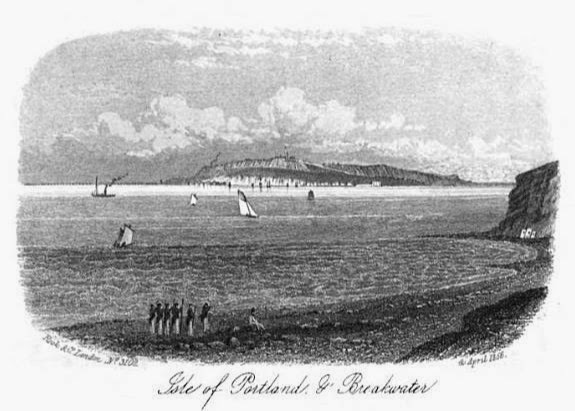
Portland Bill, Dorset
Portland Bill, Dorset (2016)
Overcoming adversity always makes for a good story, particularly when it involves a life-threatening situation. Charles Sturt, Member of Parliament for Bridport, Dorset, had such a tale to tell after sailing off Weymouth in 1800. Within a few days of his adventure, he wrote an account that was later published.

The story begins with King George III, a frequent visitor to the seaside town, who often went aboard Royal Navy ships moored in the bay. On 20 September, the King, with Queen Charlotte and other members of the royal family, went aboard the frigate Cambrian.

While the royals were being entertained by the Navy, Sturt sailed out into Weymouth Bay, where he encountered the cutter of Mr Weld, of Lulworth Castle. 

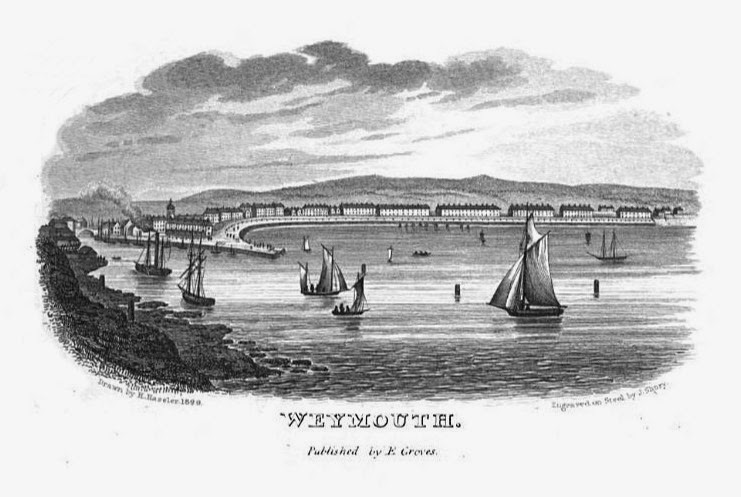
Weymouth, Dorsetshire by JMW Turner
Weymouth, Dorsetshire by JMW Turner 1
Racing towards disaster

He decided to race Weld’s cutter, but was held back because his own vessel was towing a smaller boat. Sturt asked one of his crew to board this small boat and sail it back to Weymouth, but 
...at this he hesitated and refused. I observed, ‘You my lads, have known me long enough to be satisfied I should not order you to do a thing I would not readily do myself, therefore, reef the sail, slip the mast, I will go myself.’2
Ordering his crew to continue the race with Weld, Sturt began the task of returning his boat to Weymouth. This required him to avoid the Shambles Bank, an area of submerged rocks to the south east of Portland Bill.
A very strong ebb tide carried me to the westward, and on for the Shambles, which I wished to avoid; put before the wind, but, being under a very low sail, could not stem the tide; dared not quit the helm to let the reefs out of the sail, for fear of broaching-to; the tide hauling me dead on the Shambles, where the sea was running tremendously high, and breaking horridly, no time to be lost.
The danger from the shallows of the Shambles is amplified by the nearby Portland Race, where land forces the tides to flow fast and dangerously, just off Portland Bill. Many ships have been wrecked and lives lost because of the Race and the Shambles.

Portland Bill, Dorset
Portland Bill, Dorset (2016)
Time to take emergency action

Realising that he was in trouble, Sturt attempted to lighten his boat by throwing all his ballast overboard. 
And convinced my boat could not exist many minutes, and nothing but the interposition of Providence save me, to divert my thoughts from the horrid idea of death, I began singing the sea song, ‘Cease rude Boreas’.
Written by playwright and poet George Alexander Stevens, ‘Cease rude Boreas’ was also known as ‘the storm song’ and seems to have been a popular choice among sailors facing serious wind and waves.
As I was singing the second verse, a dreadful sea, all foaming, took my boat on her larboard quarter, sheered a-weather my helm she lost her shorage-way broached-to, upset and overwhelmed, the sea rolling over and over; recovering from my alarm without the smallest hope of escaping, I swam to my boat, which was lying on her broadside: with difficulty I got into her and held her fast.
Having been thrown from his boat, and regaining it, Sturt decided he was overdressed for the occasion. He recorded that he “immediately pulled off my coat, waistcoat, shirt, and cravat; this I accomplished with much difficulty being wet”. Now he took in the gravity of his situation.
No sail near me; above fifteen miles from the nearest land; a dreadful hollow, broken sea running in every direction, and frequently overwhelming me, gave me no hopes of saving my life.
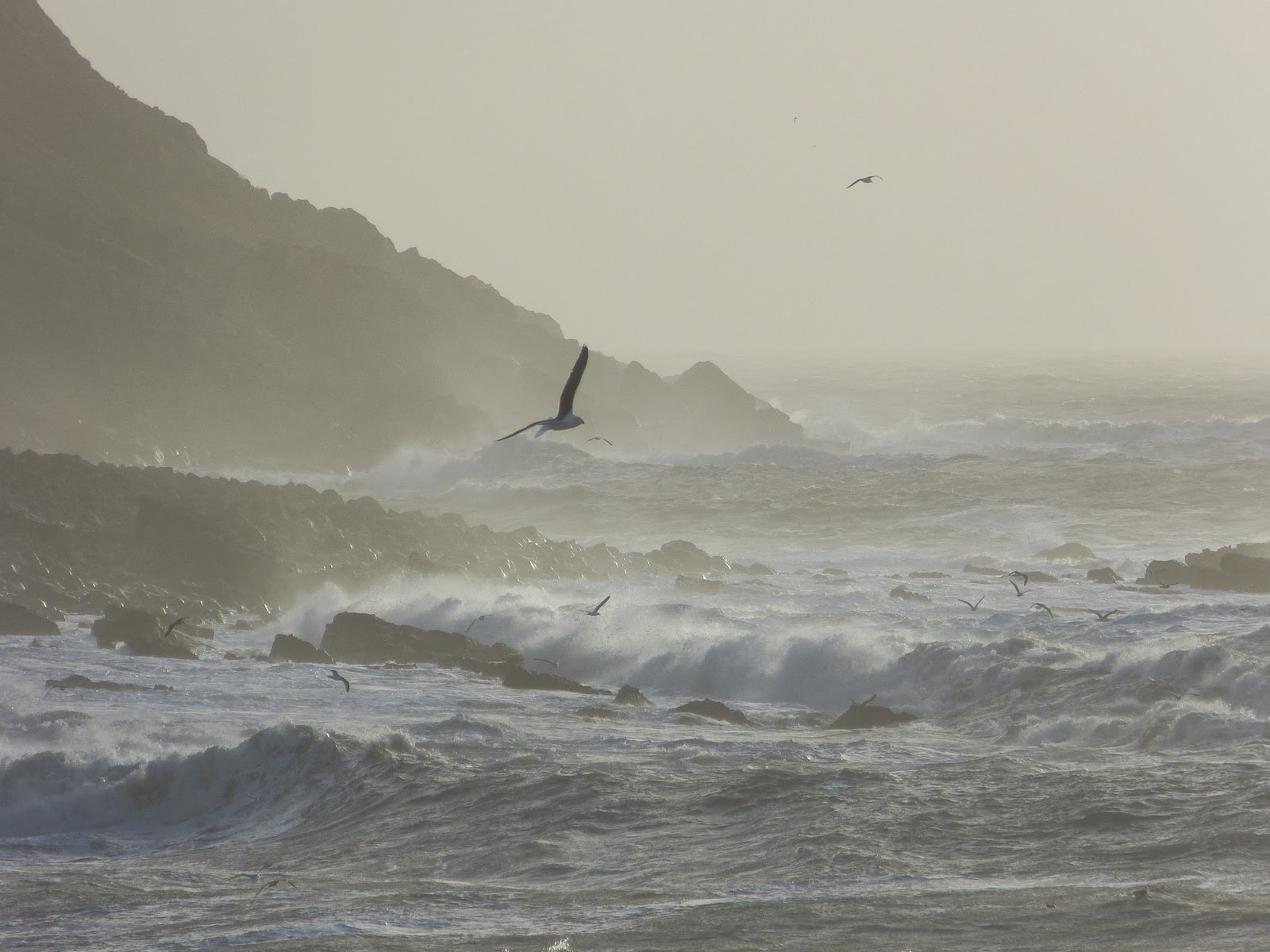
Waves crashing against the rocks on Portland
Facing near certain death

Living near the Dorset coast, Sturt was an accomplished sailor, familiar with the hazards of sailing.
To surrender without a struggle, I considered weak; the thoughts of my wife and children, which at that period struck my mind very forcibly (I thought I saw them,) recollecting the difficulties I surmounted two years before, in saving some men from a wreck off my house, and knowing that they were saved from a situation as dreadful as my own by the assistance of Divine Providence this gave me resolution and fortitude to exert myself.
Sturt busied himself trying to organise his vessel as best he could, despite “being repeatedly washed off the boat”. While there were no other ships in sight, Sturt was not alone with the waves.
At this period, several gurnets (a large species of sea-gull,) hovered close to me, and were so bold as to come within two feet of my head. I suppose they anticipated a good meal on me; however, by hollowing pretty loud, I convinced them I was not yet dead; they took flight and I saw no more of them.
Having now spent three hours being soaked by the raging seas, Sturt was roused by the sight of two sails, but the ships were too distant for him to attract attention, so he didn’t bother. When a third, a brig, passed closer, he did all he could to get noticed.

The Pelican sailing off Weymouth Bay
A chance of rescue
I succeeded; I saw her men go up the main shrouds, and the crew stand close together, but passed me without offering to lend me the smallest assistance; this indeed was enough for me to surrender up a life which was no longer supportable; such inhumanity excited in me the strongest emotions of anger; but alas! I had no means of redress; I gave up all hopes of being saved.
Now the wind began pushing Sturt’s boat towards the dangers of the Portland Race. Prospects of rescue failing, he began preparing his body for identification once he was dead.
I took a valuable diamond watch of my wife's out of my fob, tied it securely round the waistband of my trowsers, pulled them off, and tied them round the short of the boat; when I had done this, I made a running knot with the painter, intending to put it round me in my last moments, that my boat, as the wind was, would be driven near my house, or Bridport, and that my watch and seal would lead to a discovery of who I was: having done this, I became quite indifferent, death was no longer terrible; and as I saw no chance of being saved, I sat quietly in the boat, patiently waiting for the next wave to put an end to my suffering.
By his own account, Sturt’s patient waiting seems to have involved regularly being tipped out of and swimming back to his boat, for around an hour. By now, his boat seems to have capsized.

Running out of time

Then, at about half past four in the afternoon, he spotted a further eight sails. The first few to pass by were too far away to spot him.
I reserved my strength for the only two of the eight that had not passed me; a brig came by, I hailed her, lifted up my hands and fortunately I observed they saw me, for her men went up aloft to see what I was; they then tacked and stood toward me, but did not hoist a boat out; this alarmed me.
For whatever reason, the captains of two ships had decided to ignore the shouts and waving from a man in trouble on the seas. 
There was only one more vessel to pass; it was nearly dark, a dismal sea and within two miles of Portland Race: if this passed me, all was over. I roused myself on this occasion, and hailed, her stood on the boat's bottom, was washed off, got on her again and was again washed off; however life was still desirable as long as I saw a chance of being saved.
On this occasion he was rewarded by the sight of a boat being lowered, and he realised rescue was imminent. 
At that instant I was agitated, my firmness seemed to forsake me, for I burst into a flood of tears, and was seized with a violent retching from the quantity of salt water I had swallowed.
Rescue and rewards

It seems that with the assistance of his rescuers, Sturt was able to bring his boat alongside the ship Middleton, under Captain Rankin. Once aboard, Sturt was welcomed by Colonel Jackson of the 85th. At 8pm the Middleton sailed into Portland Roads, the sheltered waters that are now Portland Harbour.
Portland Harbour, Dorset
Here he was reunited with his friends
Mr and Mrs Smith, from whom I received the kindest attention; they thought I was irrecoverably gone, so did their majesties, particularly as captain Ingram declared he saw my boat go down; however it was extremely reasonable to suppose I was lost, the sea running high and breaking in a most tremendous manner: he well knew on those shoals a boat could not long exist, and, on the whole, a most dreadful evening, it was reasonable to suppose I was no more.
Their majesties, with the dukes of Kent and Cumberland, lord and lady Cathcart, Parlet Cathcart: colonels Desborough and Wynyard, generals Goldsworthy Garth, &c, every soul, in short, in Weymouth, heartily congratulated me on my providential escape; the king and queen with their family, on the esplanade, expressed, in the kindest manner their very sincere happiness at my being saved.
Three days later, Sturt returned to the Middleton to thank his rescuers. He gave 10 guineas and a silver cup to Captain Rankin, 5 guineas each to four named crew members, and 20 to be distributed among the other sailors.

The captain and crew of the Earl of Abergavenny were less fortunate.  
 

Headshot of Rachel Knowles author with sea in background(2021)
Rachel Knowles writes clean/Christian Regency era romance and historical non-fiction. She has been sharing her research on this blog since 2011. Rachel lives in the beautiful Georgian seaside town of Weymouth, Dorset, on the south coast of England, with her husband, Andrew, who wrote this post.

Find out more about Rachel's books and sign up for her newsletter here.

If you have enjoyed this blog and want to encourage me and help me to keep making my research freely available, please buy me a virtual cup of coffee by clicking the button below.

 
Notes
(1) From Picturesque Views on the Southern Coast of England (details below).
(2) All quotes from The Cabinet of Curiosities Vol 2 (1822) by Samuel Griswold Goodrich.

Sources used include:
Crotch, W, MacFarren, GA, and Wade, J Augustine, A Collection of National English Airs (1838)
Goodrich, Samuel Griswold, The Cabinet of Curiosities: Natural, Artificial and Historical Volume 2 (Hartford, 1822)
Turner, JMW, Picturesque Views on the southern coast of England, from drawings made principally by JMW Turner and engraved by WB Cooke and others (1826)

Thursday, 14 May 2015

Sandsfoot Castle, Weymouth, Dorset

Sandsfoot Castle
Sandsfoot Castle
Weymouth Castle

On the cliff overlooking Portland Harbour, just a little way along the coast from Weymouth, stand the ruins of Sandsfoot Castle. The castle has been known by various names over the years – Weymouth Castle, Sandes Foot or Sandes Fort – but is now usually referred to as Sandsfoot Castle.

Sandsfoot Castle from the Rodwell trail
A Tudor blockhouse

Sandsfoot Castle was built as a Tudor blockhouse during the reign of Henry VIII in c1539-41 to protect the south coast of England from European invasion after Henry’s break with Rome. Its position high up on the cliff would have made it very visible to approaching ships, forcing them to plot a course much closer to Portland. This would have put them in the firing line of Portland Castle, Sandsfoot’s sister castle, also built by Henry VIII, which would have been hidden until the ships were well into Portland Roads, that is, Portland Harbour.

The castle was governed by a series of governors and captains. It was part of the defensive network against the Spanish Armada and changed hands several times during the Civil War.

In 1665, when Humphrey Weld of Lulworth Castle was governor, the castle was removed from the military register. It was due to be slighted, that is, deliberately destroyed, to prevent it being used against the government, but for whatever reason, this never happened and the castle was simply abandoned.

View from Sandsfoot Castle
View down to the beach
from Sandsfoot Castle
What was the castle like?

Sandsfoot consisted of a rectangular, two-storey accommodation block with a storage area in the basement, a tower on the west end and a gun platform on the eastern side, overlooking the sea. Earthworks and ditches were added later to protect the castle from inland attack. The castle walls contained a number of decorated pieces of stone which probably came from nearby Bindon Abbey, just east of Wool.

Model of Sandsfoot Castle in Weymouth Museum
Sandsfoot Castle as a ruin

By 1725, Sandsfoot Castle had become a ruin. Since 1691, stone had been robbed from the walls for use elsewhere; some was probably used in the building of the Weymouth town bridge in 1712. The royal coat of arms carved in stone was removed from the castle in 1825 and is now over the south door of All Saints Church, Wyke Regis.

Royal coat of arms from Sandsfoot Castle in All Saints Church, Wyke Regis
Royal coat of arms from Sandsfoot Castle
in All Saints Church, Wyke Regis
But the castle’s biggest enemy was the sea. Even during its active service, regular repairs had been necessary to prevent it falling into the sea, but once abandoned, nothing was done to protect it from its fate. In 1837, most of the gun platform collapsed onto the beach, but sea erosion slowed down after 1849 when the new Portland Harbour breakwater was created.

A Georgian visitor attraction

Weymouth Castle by S Prout from Picturesque Views on the South Coast of England (1826)
Weymouth Castle by S Prout
from Picturesque Views on the South Coast of England (1826)
Sandsfoot Castle attracted artists and other visitors to its picturesque ruins, looking out over the sea. It was described in Delamotte’s The Weymouth Guide (1785):
“Weymouth Castle, called also Sandes Foot, or Sandes Fort, stands a miles S. W. of the town, on a high cliff, almost opposite Portland Castle, and commands the Bay. It was built by King Henry VIII. Leland calls it “a right goodly and warlyke castle, having one open barbicane”. Its form is a parallelogram, or long square, and was faced with square stone, now all carried away. At the north end was a tower, on which were the arms of England, supported by a wyvern and unicorn: the north part seems to have been the Governor's apartment, which is all vaulted; the south front is semicircular, and said to have been the gun room: before it, on the south, was formerly a platform for cannon. On the east is the remains of a small gate, and a deep trench surrounds the whole, except on the south: the walls were thick and lofty when entire; and though it was not large, must have been a beautiful structure. It seems to have been neglected since the Restoration. In 1631, George Bamfield had a grant of the office of Custos [ie Guardian] of Sandsfoot Castle, during pleasure: and in 1640, Nathaniel Speccot, Knight, was made Custos for life. After the restoration, Humphrey Weld, of Lulworth Castle, was Governor for many years.” (1)
Sandsfoot Castle from The Lady's Magazine (1789)
The Lady’s Magazine (1789) wrote:
"Weymouth Castle, called also Sandes Foot, or Fort, stands a mile south-west of the town on a high cliff, almost opposite Portland Castle, and commands the bay. It was built by king Henry VIII. Leland calls it ‘a right goodly and warlyke castle, having one open barbicane’. Its form is a parallelogram, or long square stone, now all carried away. At the north end was a tower on which were the arms of England, supported by a wyvern and unicorn: the north part seems to have been the governor’s apartment, which was vaulted: the south front is semi-circular, and said to have been the gun-room: before it, on the south, was formerly a platform for cannon. On the east is the remains of a small gate, and a deep trench surrounds the whole, except on the south. The walls were lofty and thick when entire; and though it was not large, it must have been a beautiful structure. It seems to have been neglected since the Reformation." (2)
Harvey’s Improved Weymouth Guide (1800) was more succinct:
"At a small distance from hence is an old ruin called Weymouth, or Sandsfoot Castle, the remains of which are well worth seeing: from this Castle along the sands leading to the ferry house, when tide is out may be justly deemed a pleasing healthful excursion, it being quite level and as smooth as a bowling green." (3)
Part of Sandsfoot Castle showing some old graffiti
Part of Sandsfoot Castle showing some old graffiti 
The later years

In 1902, the castle was bought by the Weymouth Corporation for £150, but it had to be closed to the public in 1930 because the structure had become unsafe. Tudor style gardens were added in 1931 and in 1953 it became a Scheduled Monument and Grade II* Listed Building. The final part of the gun room collapsed in 1954.

The Castle was stabilised and repaired by the Friends of Rodwell Trail and Sandsfoot Castle in conjunction with Weymouth & Portland Borough Council and reopened to the public in 2012.

Sandsfoot Castle with Portland Harbour in the background
Notes:
(1) From The Weymouth Guide by Peter Delamotte (1785).
(2) From The Lady’s Magazine or Entertaining Companion for the Fair Sex, Appropriated Solely to Their Use and Amusement (1789).
(3) From Harvey's Improved Weymouth Guide (1800)

Sources used include:
Delamotte, Peter, The Weymouth Guide (1785)
Friends of Rodwell Trail & Sandsfoot Castle, Sandsfoot Castle (2014)
Harvey, John, Harvey's Improved Weymouth Guide (1800)
The Lady’s Magazine or Entertaining Companion for the Fair Sex, Appropriated Solely to Their Use and Amusement (1789)
Turner, JMW, Picturesque Views on the southern coast of England, from drawings made principally by JMW Turner and engraved by WB Cooke and others (1826)
Sandsfoot Castle and the Rodwell Trail website

Photographs © Andrew Knowles - More of Andrew's photos of Sandsfoot Castle on Flickr

Monday, 9 March 2015

Royal residences of the Georgian kings

A collage of 12 royal residences
12 royal residences (details of each picture below)
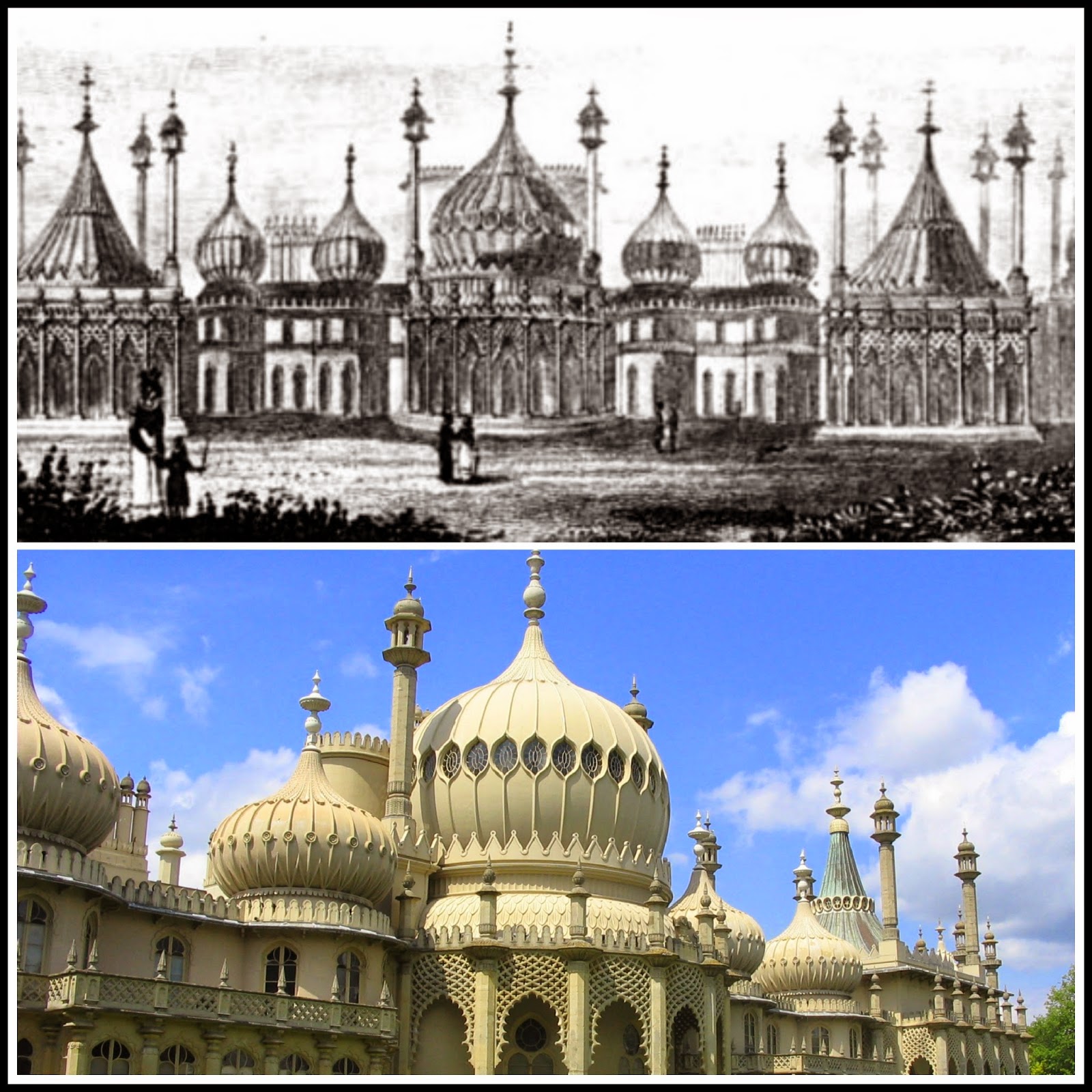
Brighton Pavilion

George IV made the Royal Pavilion at Brighton his summer residence from 1786 until 1827, when he abandoned it as lacking in privacy. It started life as a modest farmhouse and was redeveloped into the magnificent, if somewhat eccentric, palace that exists today.

Brighton Pavilion  Top: From History of Brighton and its environs by R Sickelmore (1827)  Bottom: Brighton Pavilion today © Andrew Knowles
Top: Brighton Pavilion from  
History of Brighton and its environs by R Sickelmore (1827)
Bottom: Brighton Pavilion (2004) © Andrew Knowles
Read more about:
George IV’s Brighton
George IV and the Marine Pavilion, Brighton
George IV and the Brighton Pavilion
What did Regency visitors think of the Brighton Pavilion?
Watch my video: A litter of cupolas – Brighton Pavilion in 1823

Buckingham Palace

Buckingham Palace was acquired by George III as a private residence for the royal family in 1761 and was originally known as Buckingham House or the Queen’s House. George IV transformed it into a palace fit for a king, but did not live to see it completed. William IV disliked it and would not live there, but it became the official London residence of Queen Victoria and British monarchs ever since.

Top: Buckingham House from    The History of the Royal Residences by WH Pyne (1819)  Bottom: Buckingham Palace today © Andrew Knowles
Top: Buckingham House from  
The History of the Royal Residences by WH Pyne (1819)
Bottom: Buckingham Palace (2015) © Andrew Knowles
Bushy House

William IV resided at Bushy House from 1797 when, as Duke of Clarence, he was appointed Ranger of Bushy Park. He lived there with his mistress, Dorothea Jordan, until their relationship ended in 1811, and then later with his wife Princess Adelaide. He continued to live at Bushy House even after he became king and following his death, it became the official residence of Queen Adelaide until her death in 1849. In 1900, the site was offered to the Royal Society to house the National Physical Laboratory and ceased to be a royal residence.

Top: Bushy House from History of the life and reign   of William the Fourth (1837) by R Huish   Bottom: The house in Bushy Park today © Andrew Knowles
Top: Bushy House from History of the life and reign
 of William the Fourth (1837) by R Huish
Bottom: The house in Bushy Park (2014) © Andrew Knowles
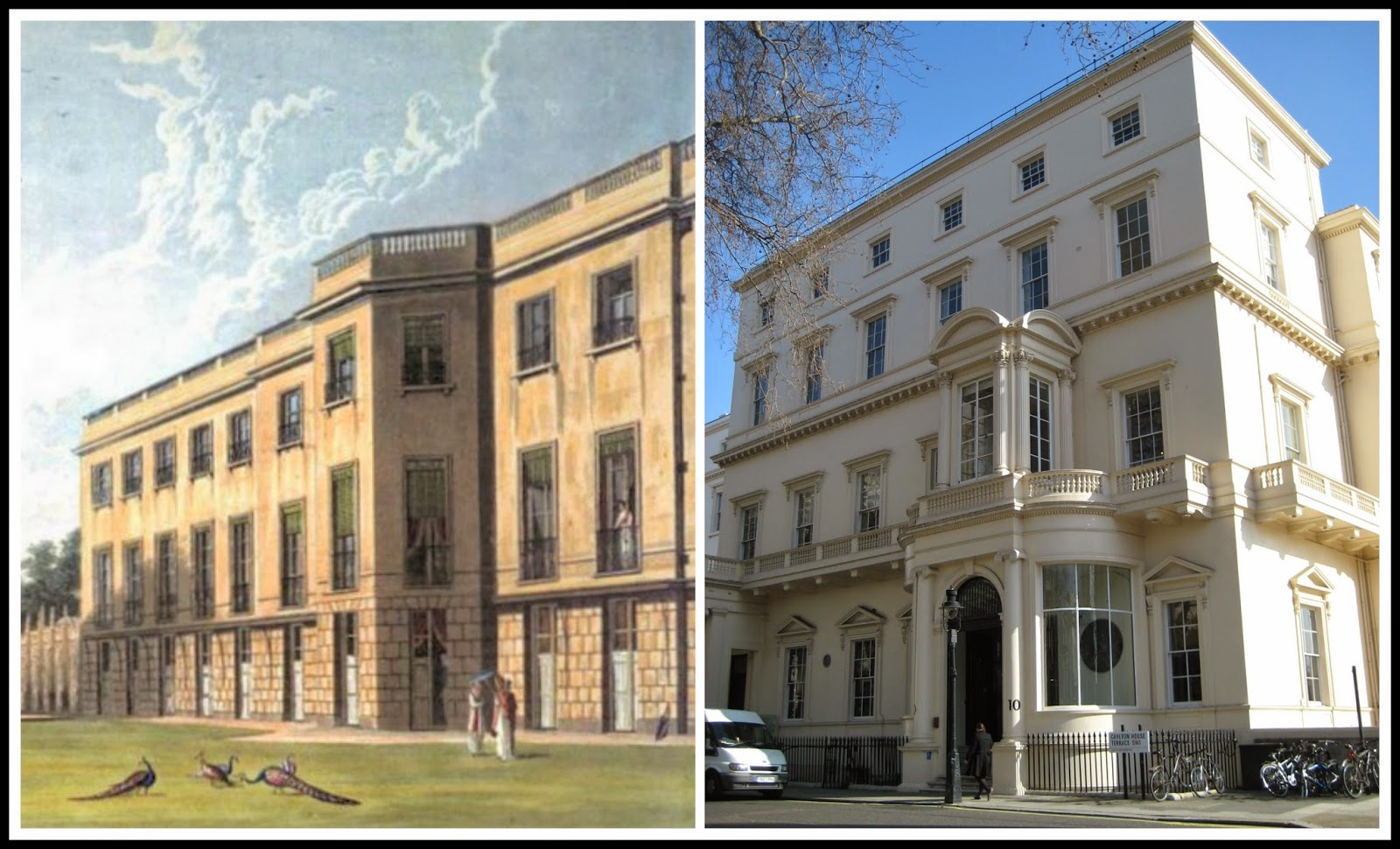
Carlton House

Carlton House was purchased as the official residence of Frederick, Prince of Wales, George III’s father, in 1732. In 1783, it became the residence of the future George IV when he came of age. George IV continually remodelled it until he became king, at which point he transferred his interest to the other royal residences. It was demolished in 1825 and replaced by a number of prestigious houses - Carlton House Terrace.

Left: Carlton House, south front,  from    The History of the Royal Residences by WH Pyne (1819)  Right: Carlton House Terrace © Andrew Knowles
Left: Carlton House, south front,  from  
The History of the Royal Residences by WH Pyne (1819)
Right: Carlton House Terrace (2015) © Andrew Knowles
Clarence House

Clarence House was built in 1825-7 as the London residence of William IV when he was Duke of Clarence. He continued to live there after he became king in 1830. Following his death, it became the residence of Princess Augusta and the Princess Victoria, Duchess of Kent, Queen Victoria’s mother. It is now the official residence of the Prince of Wales.

Top: Clarence House from The Graphic (Nov 1874)  Bottom: Clarence House today © Andrew Knowles
Top: Clarence House from The Graphic (Nov 1874)
Bottom: Clarence House (2015) © Andrew Knowles
Gloucester Lodge

George III visited Weymouth nearly every year from 1789 to 1805 and stayed at Gloucester Lodge, the house built for his brother William, Duke of Gloucester, on the seafront. It was sold by George IV when he became king and is now a hotel.

Top: Weymouth seafront from The Lady's Magazine (1789)  Bottom: Gloucester Lodge today © Andrew Knowles
Top: Weymouth seafront from The Lady's Magazine (1789)
Bottom: Gloucester Lodge (2012) © Andrew Knowles
Read more about:
George III in Weymouth
Sea bathing in Regency Weymouth
Fashionable entertainment in Regency Weymouth
Watch my video: George’s seaside adventure - George III in Weymouth

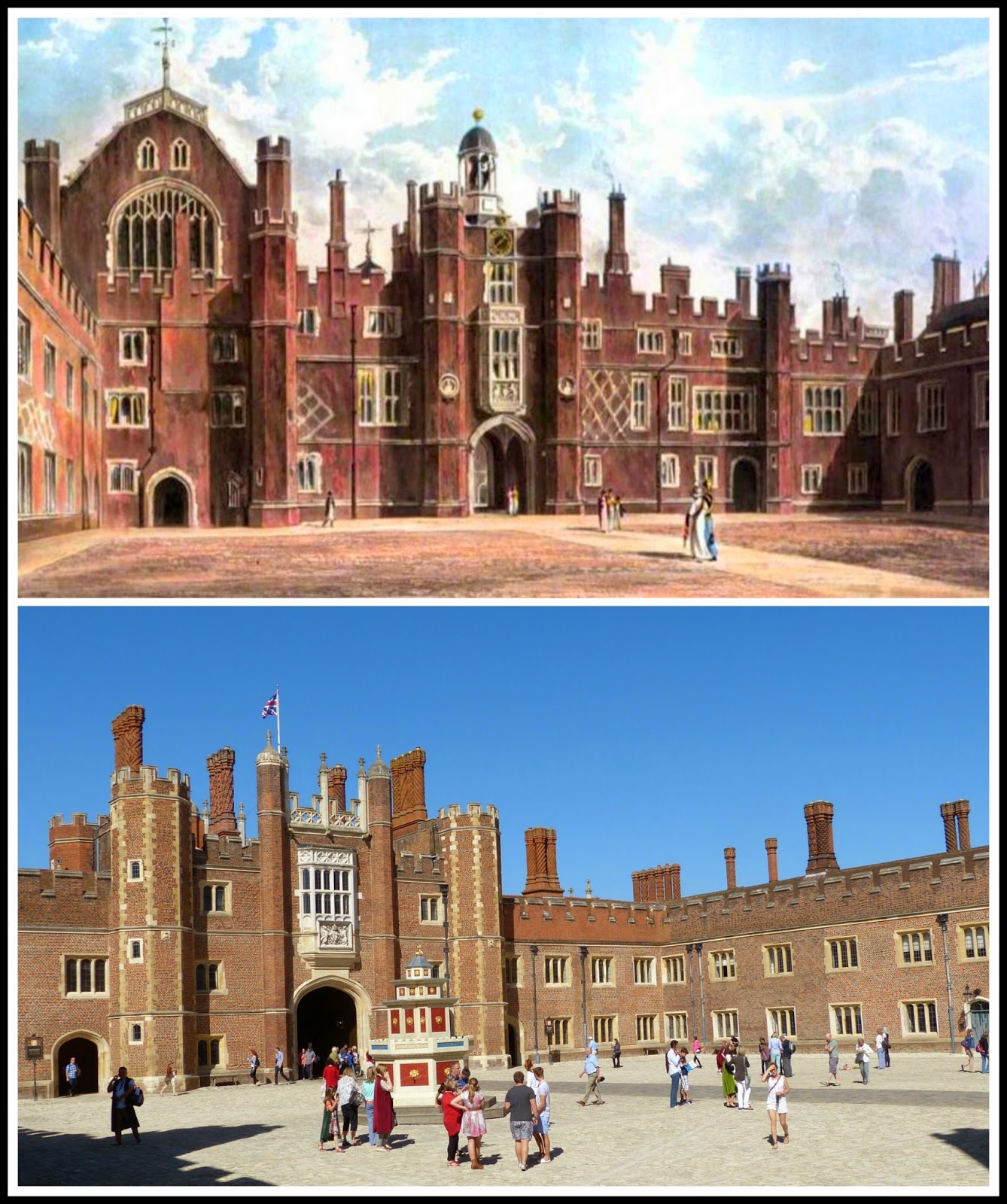
Hampton Court

Hampton Court first became a royal residence after it was acquired by Henry VIII in 1528 and rebuilt to his design. It was used by the early Georgian monarchs, but under George III, the palace was divided up into grace-and-favour apartments – rent-free accommodation for those favoured by the King. It is now in the care of Historic Royal Palaces and is open to the public.

Top: Quadrangle, Hampton Court, from    The History of the Royal Residences by WH Pyne (1819)  Bottom: Hampton Court today © Andrew Knowle
Top: Quadrangle, Hampton Court, from  
The History of the Royal Residences by WH Pyne (1819)
Bottom: Hampton Court (2014) © Andrew Knowles
Kensington Palace

William III and Mary bought Nottingham House in 1689 and transformed it into Kensington Palace, an out-of-town royal residence in which to live in preference to St James’s Palace. It was renovated under George I and used extensively by George II. Members of the royal family continued to live there, but it was never used as the residence of the sovereign again. Kensington Palace is in the care of Historic Royal Palaces and is open to the public.

Top: Kensington Palace from  
The History of the Royal Residences by WH Pyne (1819)
Bottom: Kensington Palace (2012) © Andrew Knowles
Read more about Kensington Palace

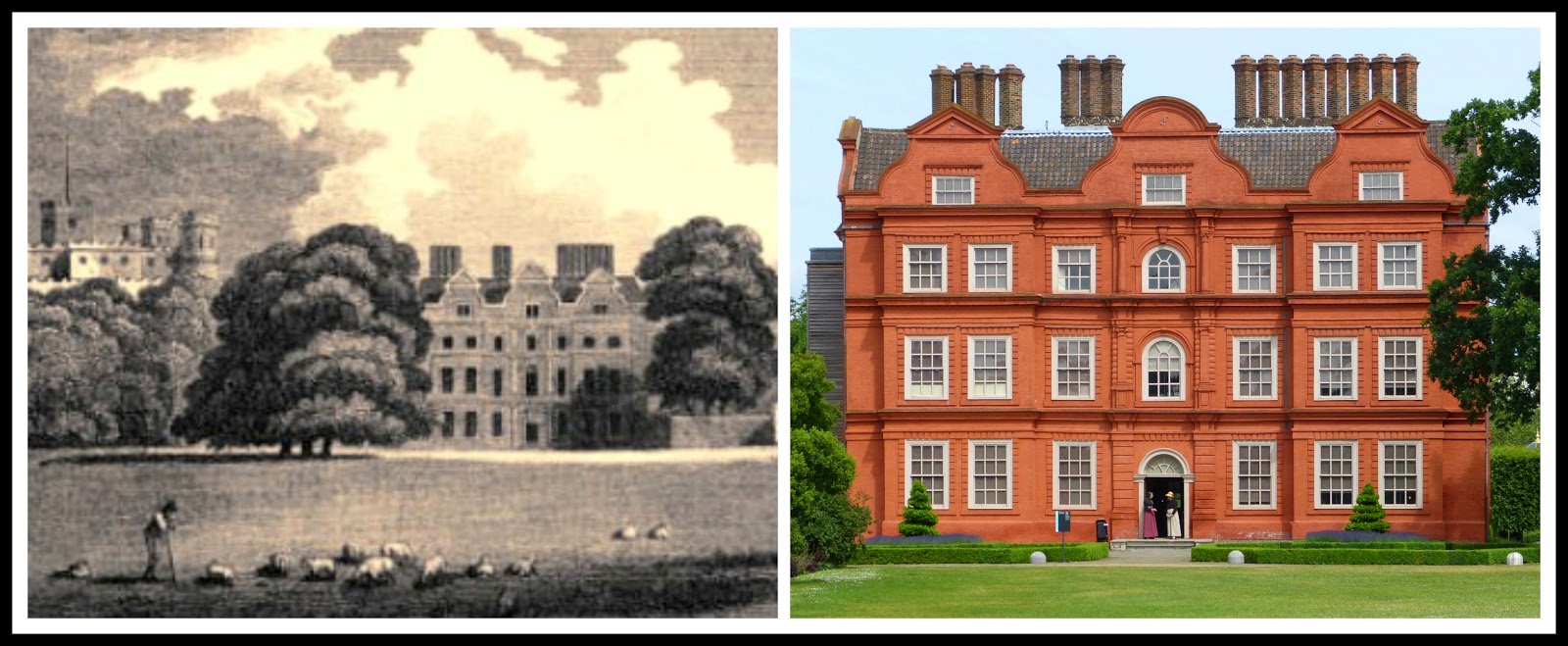
Kew Palace

George II first used Kew Palace as a royal residence for part of his family from 1729. George III housed his two eldest sons here whilst using the White House, Kew, as a country retreat. Kew Palace was used during George III’s mentally incapacitating illness and Queen Charlotte died there in 1818. Queen Victoria gave the palace to the public and it is now managed by Historic Royal Palaces.

Left: The old palace at Kew from Memoirs of HM Sophia Charlotte   of Mecklenburg Strelitz, Queen of Great Britain by WM Craig (1818)  Right: Kew Palace today © Andrew Knowles
Left: The old palace at Kew from Memoirs of HM Sophia Charlotte
 of Mecklenburg Strelitz, Queen of Great Britain by WM Craig (1818)
Right: Kew Palace (2014) © Andrew Knowles
Read more about:
Kew Palace
Kew Gardens
Queen Charlotte’s Cottage, within Kew Gardens

St James’s Palace

Built for Henry VIII in the 1530s, St James’s Palace became the principal London palace of the British sovereign after the Palace of Whitehall was destroyed by fire in 1698. Part of the St James’s Palace was destroyed by fire in 1809, but court levées were still held here until 1939. It remains an official residence although no sovereign has resided here since the time of William IV.


Top: St James' Palace from    The History of the Royal Residences by WH Pyne (1819)  Bottom: St James' Palace today © Andrew Knowles
Top: St James's Palace from  
The History of the Royal Residences by WH Pyne (1819)
Bottom: St James's Palace (2014) © Andrew Knowles
White House, Kew

Frederick, Prince of Wales, George III’s father, lived in the White House at Kew from 1730. George III inherited the White House from his mother and used it as a country retreat. George III was incarcerated here during several bouts of mental illness and he ordered its demolition in 1802. All that remains to mark the site is a sundial opposite to Kew Palace.

Left: The north prospect of HRH The Prince of Wales' House at Kew  - detail from John Rocue's map A New Plan of Richmond Garden (1748)  Right: The sundial opposite Kew Palace that marks the site  of the White House © Andrew Knowles
Left: The north prospect of HRH The Prince of Wales' House at Kew
- detail from John Rocque's map A New Plan of Richmond Garden (1748)
Right: The sundial opposite Kew Palace that marks the site
of the White House (2014) © Andrew Knowles
Read more about the White House at Kew

Windsor Castle

Windsor Castle has been a royal residence since about 1100. It was a favoured out-of-town residence of both George III and George IV who carried out extensive building works at the castle. It remains an official residence of the King today.

Top: The Upper Ward, Windsor Castle from   The History of the Royal Residences by WH Pyne (1819)  Bottom: The Lower Ward, Windsor Castle today © Andrew Knowles
Top: The Upper Ward, Windsor Castle from 
The History of the Royal Residences by WH Pyne (1819)
Bottom: The Lower Ward, Windsor Castle (2015) © Andrew Knowles
Read more about:
Windsor Castle
St George’s Chapel, Windsor Castle
1815 exhibition: Waterloo at Windsor 1815-2015
Updated 30/9/22

Headshot of Rachel Knowles author with sea in background(2021)
Rachel Knowles writes faith-based Regency romance and historical non-fiction. She has been sharing her research on this blog since 2011. Rachel lives in the beautiful Georgian seaside town of Weymouth, Dorset, on the south coast of England, with her husband, Andrew.

Find out more about Rachel's books and sign up for her newsletter here.

If you have enjoyed this blog and want to encourage me and help me to keep making my research freely available, please buy me a virtual cup of coffee by clicking the button below.

 
Sources used include:
Craig, William Marshall, Memoirs of HM Sophia Charlotte of Mecklenburg Strelitz, Queen of Great Britain (1818)
Huish, Robert, History of the life and reign of William the Fourth (1837)
Pyne, WH, The history of the Royal Residences of Windsor Castle, St James's Palace, Carlton House, Kensington Palace, Hampton Court, Buckingham House and Frogmore (1819)
Rocque, John, A New Plan of Richmond Garden (1748)
Sickelmore, Richard, History of Brighton and its environs (1827)
The Graphic (1874)
The Lady's Magazine (1789)

Historic Royal Palaces website
Royal Collection Trust website
The official website of The British Monarchy 
 
© RegencyHistory

Thursday, 9 January 2014

The Great Gale in Weymouth and Portland

A wild sea off Portland, January 2014
The sea off Portland 7 January 2014
UK storms - January 2014

The UK has been battered by storms this week. Strong winds and heavy rain have caused severe flooding in some parts, with ferocious seas and swollen rivers bursting their banks. Down the road from where I live in Weymouth, the road over to the Isle of Portland was closed and the siren was sounded to indicate that the sea defences had been breached. Chesil Beach has been re-sculpted. Instead of steps of shingle down to the sea, there is now a steep wall of pebbles.

Aerial view of Chesil Beach, January 2014
Chesil Beach 7 January 2014
The storm of 23 November 1824

But this is nothing to the damage caused by the storm of 22-23 November 1824, known as the Great Gale. The storm that hit the south coast of England on the night of the 22 November 1824 is the worst that Weymouth and Portland has ever seen. Hurricane-force winds combined with spring tides to produce tsunami-like waves that topped Chesil Beach.

Chiswell village destroyed

The sea water crashed over the top of Chesil Beach, crushing the village of Chiswell with the force of the sea. More than 30 houses were destroyed and many more made uninhabitable. At least 25 people lost their lives, swept away by the water or crushed beneath the ruins of their homes.

The Gentleman’s Magazine reported:
The destruction of lives and property at Chiswell, Portland Island, Dorset, has been most dreadful; about twenty men, women, and children, were found dead and missing, and more than two hundred persons were without a habitation, and not a particle of property left them. There was scarcely a boat left out of the great number that belonged to the fishermen of the island. Whole streets were swept away in less than half an hour from the time the sea first made in, which was about six o’clock in the morning, and the cries of despair and suffering of the poor unfortunates upon whom the houses were falling, was dreadful. Numbers were dangerously wounded and bruised in their courageous and humane endeavours to rescue others from death.1
Disaster at Ferry Bridge

A view of Portland from a Weymouth guidebook from 1857
The Isle of Portland from Weymouth as a Watering Place (1857)
The wild waters eroded Chesil’s pebbled bank and 'the Chisel Bank throughout its whole extent was lowered some twenty to thirty feet.'2

The rope-drawn ferry that operated between the mainland of Weymouth at Wyke and the Isle of Portland, was destroyed by the storm. The ferryman’s cottage was swept away and the ferryman was drowned trying to save a horse.

The sandbank which had previously enabled horses and wagons to drive across to the Island at low water was completely washed away and the gap between Wyke and Portland was four times as big. For some days, Portland was completely cut off from the mainland.

Weymouth seafront smashed to pieces

A view of Weymouth seafront from a Weymouth guidebook from 1835
Weymouth seafront
from Weymouth and Melcombe Regis New Guide
by E Groves (1835)
The rector of Wyke recorded:
The pier of Weymouth Harbour was materially damaged, and three fourths of the esplanade at Melcombe Regis entirely thrown down and demolished.2
The stone posts and chains were pulled from their places and destroyed. Waves poured over the road and flooded the houses on the seafront in Gloucester Row and the Crescent with sand, water and gravel. Boats were torn from their moorings and destroyed or carried down the main streets as if they were at sea.

At a place called the Narrows where the Weymouth backwater joined the sea over the road, two people were swept away and drowned.

The Gentleman’s Magazine reported:
The breakwater, and nearly the whole of the esplanade are washed away. The houses near the sea had four feet of water on their basements.1
At the Preston end of Weymouth, the sea again swept over the road and flooded Lodmor flat – where Lodmoor Country Park is today.

A stone on Weymouth seafront commemorating  the destruction of Weymouth esplanade in 1824
A stone on Weymouth seafront commemorating
the destruction of Weymouth esplanade in 1824
More local destruction

Further west along the coast at Abbotsbury, seven metres of floodwater were recorded. At East Fleet, a tidal wave picked up a haystack and other debris and crashed into the village. The church and several cottages were wrecked. In Dorchester, a falling chimney stack killed the Reverend Richman and his wife in their bed.

A post marking the high water mark  from the 1824 storm, the Swannery, Abbotsbury
A post marking the high water mark
from the 1824 storm, the Swannery, Abbotsbury
Shipwrecks

The storm wrought havoc on the seas causing shipwrecks all along the Dorset coast. The West Indiamen Carvalho and Colville were wrecked on Chesil Beach.

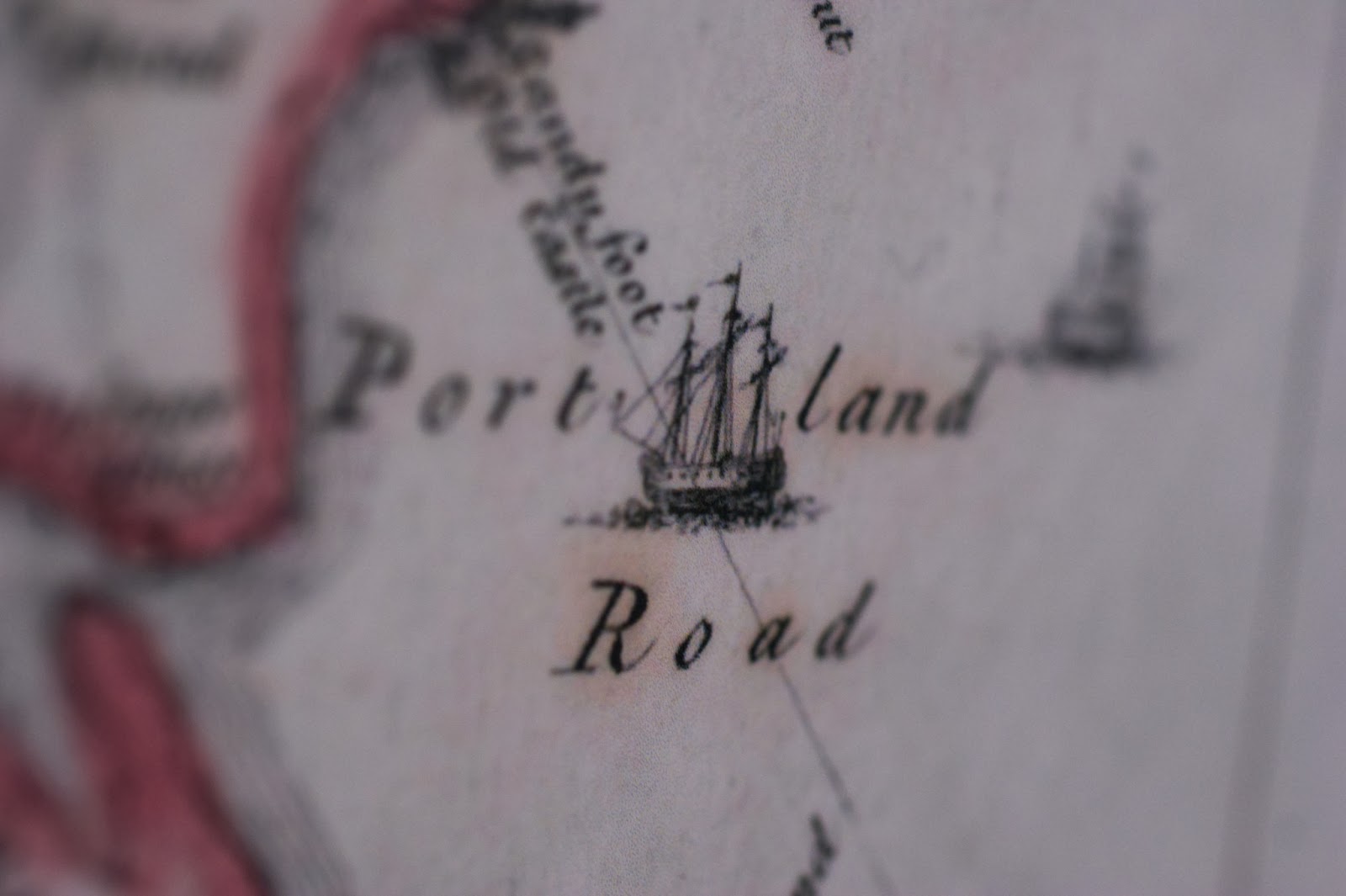
A close-up shot of an old map of Weymouth and Portland showing the words Portland Road

The Gentleman’s Magazine reported:
Off Weymouth, a large ship, entitled the Colville, was wrecked, and every soul on board perished. Seventeen of the dead bodies were thrown up by the sea.1
One of those who drowned – Henry Gosling – was determined not to be buried in an unmarked grave and wrote his name and address on a piece of his shirt and tied it around his neck before he died.

The Ebenezer was more fortunate. The huge waves tossed the ship high onto Chesil Beach; its captain and one crew member were drowned, but the rest were saved. After being repaired, it was relaunched on the Weymouth side of Chesil Beach rather than attempting to lift it back over the top.

Headshot of Rachel Knowles author with sea in background(2021)
Rachel Knowles writes clean/Christian Regency era romance and historical non-fiction. She has been sharing her research on this blog since 2011. Rachel lives in the beautiful Georgian seaside town of Weymouth, Dorset, on the south coast of England, with her husband, Andrew.

Find out more about Rachel's books and sign up for her newsletter here.

If you have enjoyed this blog and want to encourage me and help me to keep making my research freely available, please buy me a virtual cup of coffee by clicking the button below.

 
Notes
(1) From The Gentleman’s Magazine (1824).
(2) From a record of the storm by George Chamberlaine, Rector of Wyke church, written in the back of the baptismal register on 16 December 1824 as quoted in All about Ferry Bridge by Doug Hollings (1993).

Sources used include:
Attwooll, Maureen, Shipwrecks (Discover Dorset series) (1998)
Ellis, George, The History and Antiquities of the Borough and Town of Weymouth and Melcombe Regis (1829)
Hollings, Doug, All about Ferry Bridge (or Smallmouth) (1993)
Simpkin & Marshall, Weymouth as a Watering Place (1857)
The Gentleman's Magazine and Historical Chronicle (1824)
Tucker (pub), Tucker's Improved Weymouth Guide (1851)

All photographs © RegencyHistory.net

Thursday, 14 November 2013

Prince William Henry, 1st Duke of Gloucester (1743-1805)

William Henry, Duke of Gloucester
 by Richard Earlom after Hugh Douglas Hamilton
pubd by Robert Sayer (1771) © British Museum
Profile

Prince William Henry, 1st Duke of Gloucester (14 November 1743 - 25 August 1805), was one of the younger brothers of George III. He was a regular visitor to Weymouth and he lent his house there to his brother George for his seaside breaks.

Family background

Prince William Henry was born on 14 November 1743 at Leicester House, London, the third son of Frederick, Prince of Wales, and his wife Augusta of Saxe-Gotha.

William’s father, Frederick, did not get on well with his parents, George II and Queen Caroline, and his behaviour on the birth of his first child, Augusta, in 1737 resulted in him being banned from his father’s Court.

As a result, William lived mostly at Kew, in Kew House (also known as the White House), where his father accumulated a menagerie of exotic animals and pursued a passion for botany which he shared with his wife. Frederick taught his family astronomy and encouraged a variety of entertainments including rowing, cricket, outings to fairs and play acting.

A view of the menagerie and its pavilion at Kew
Print by C Grignion after T Sandby
pubd by Sir William Chambers (1763) © British Museum
In 1751, Frederick caught pneumonia and died. Augusta made her peace with the King, who allowed her to continue bringing up her family at Kew. William and his brother Henry had a house on Kew Green which included a billiard room and a colonnade for fencing lessons. His studies included ancient and modern languages, history and geography. In 1765, he toured Kent and Cornwall and in 1766, Guernsey and Paris.

Titles

William was made a Knight of the Garter at Windsor in 1762 and Duke of Gloucester and Edinburgh and Earl of Connaught in Ireland on 19 November 1764 (1).

He was made Ranger of Hampton Court Park, Ranger and Keeper of Cranborne Chase in Windsor Forest and Lord Warden and Keeper of the New Forest. He became Chancellor of the University of Dublin in 1771.

A secret marriage

In 1764, William started courting Maria, the Countess Dowager Waldegrave. Maria was the illegitimate daughter of Sir Edward Walpole and the widow of 2nd Earl Waldegrave. On 6 September 1766, they were married secretly, without witnesses, at the Duke’s house in Pall Mall by Maria’s chaplain, Dr Morton.

George III did not believe the rumours that William had actually married Maria and sent his brother abroad to visit other European royal families as a diplomatic envoy for the British monarchy in an attempt to extricate him from his entanglement with Maria, whom he felt was a bad influence on him.

Maria Waldegrave, later Duchess of Gloucester
from Letters of Horace Walpole
to Sir Horace Mann Vol 4 (1844)
Banned from the Court

When Maria became pregnant, William wrote to the King to acknowledge his marriage. An enquiry into the validity of the marriage was held by the Privy Council on 23 May 1773, just days before the birth of a daughter, Sophia Matilda. The King was forced to admit the legality of the marriage and the child was given the title of Princess.

But the King was deeply hurt by his favourite brother’s deception. Whilst William had been ranting about the Duke of Cumberland’s shameful marriage to Lady Ann Horton the previous year, he had all the time been married to a commoner himself. The Duke and Duchess and their children were banned from the Court and William’s diplomatic missions came to an end. For the sake of economy and William’s health, they went to live on the continent.

The family complaint?

In 1771, William became very unwell with a similar illness to that from which his brother George later suffered. He endured a further bout a few years later and an even more serious episode whilst returning to England in 1777.

Reconciliation

The King’s concern over William’s health softened his attitude towards his brother, but he refused his request to be allowed to take an active military role in the American war.

Eager to serve his country, William managed to acquire a copy of the French plans for invading England which he sent to George, but it was not until the Gordon Riots of 1780 when he helped to restore peace as Colonel of the 1st regiment of foot guards, that he earned the King’s gratitude and was once more received by his brother.

Weymouth

William had a long and happy association with Weymouth which began, by accident, on Saturday 24 August 1771, when he first visited the town:
“The Duke of Gloucester, being detained by contrary winds, came from aboard the Venus, dined and drank tea at the Rooms at Weymouth, and afterwards returned on board.”(2)
The Old Rooms, Weymouth
William spent the winter of 1780 in Weymouth and commissioned a house – Gloucester House or Lodge – to be built on the seafront.

Gloucester Lodge on Weymouth seafront
In 1789, William lent Gloucester Lodge to the King so that he could recuperate after his illness. George III eventually bought the house from his brother.

William continued to visit Weymouth. In 1790, he visited with his brother, the Duke of Cumberland, and in 1794, he was there with the King’s party, accompanied by his daughter.

A problematic marriage

William and Maria had three children: Sophia Matilda (1773), Caroline Augusta Maria (1774) who died as a baby and William Frederick (1776).

Over time, their relationship soured. William had an affair with Lady Almeria Carpenter, Maria’s lady in waiting, by whom he had an illegitimate daughter, Louisa Maria La Coast in 1782. For the majority of the period from 1784 to 1787, William and Maria lived in Geneva and Italy, with Lady Almeria still part of their household.

Lady Almeria Carpenter
from Macdonald of the Isles by AM Stirling (1913)
By the early 1790s, the Duke and Duchess were living separate lives, and sometimes William prevented Maria from seeing her children, but despite this, they continued to keep a joint household.

Family relationships

William was of a quiet, retiring disposition and managed to maintain good relationships with his nephews. He tried unsuccessfully to effect a reconciliation between George, Prince of Wales, and his wife Caroline in 1796.

Death of the Duke of Gloucester

William’s health deteriorated and he died on 25 August 1805 at his home, Gloucester House, Upper Grosvenor Street, London. By his own desire, he was buried privately at St George’s Chapel, Windsor, on 4 September.

The King was in Weymouth when he received news of his brother’s death and the town went into a week of mourning for “their first patron and benefactor and as the sole means of introducing his royal brother here”(3).

Notes
(1) The date is given as 19 November in the Oxford Dictionary of National Biography but 17 November in Debrett’s.
(2) From The Gentleman’s Magazine (Aug 1771).
(3) From Weymouth, an illustrated history (1983).

Sources used include:
Boddy, Maureen and West, Jack, Weymouth, an illustrated history (The Dovecote Press, 1983, Wimborne)
Delamotte, Peter, The Weymouth Guide (1785, Weymouth)
Groom, Susanne and Prosser, Lee, Kew Palace, the official illustrated history (2006)
Hibbert, Christopher, George III (1998, Viking, Great Britain)
Kilburn, Matthew, William Henry, Prince, first Duke of Gloucester and Edinburgh (1743-1805) Oxford Dictionary of National Biography (Oxford University Press, 2004; online edn Jan 2008, accessed 28 Oct 2013)
The Gentleman's Magazine and Historical Chronicle (1771)
Walpole, Horace, Letters of Horace Walpole to Sir Horace Mann in 4 volumes (1844)

Photographs by Andrew Knowles - www.flickr.com/photos/dragontomato