Search this blog

Showing posts with label Princess Elizabeth. Show all posts

Thursday, 20 February 2014

Queen Charlotte’s Cottage – a Regency History guide

Queen Charlotte's Cottage, Kew Gardens, London
Queen Charlotte's Cottage, Kew (2013)
Where is it?

Queen Charlotte’s Cottage is part of the Kew Palace estate and is situated within the botanical gardens at Kew in London.

History

Queen Charlotte's Cottage, Kew
Queen Charlotte's Cottage, Kew (2013)
It is difficult to determine exactly when the building now known as Queen Charlotte’s Cottage was built.

One source records that a one-storey building was erected on the site between 1754 and 1771 in the grounds of Richmond Lodge during the development of the New Menagerie, possibly as a dwelling for the menagerie keeper. This area now forms the western part of Kew Gardens. The cottage was then given to Queen Charlotte on her marriage to George III in 1761, and she extended the building and added an extra floor to house the tea or picnic room. (1)

Another source states that the earliest mention of the cottage is not until 1771, and that it was built for Queen Charlotte as a cottage orné – a picturesque building made to look like a rustic cottage with aged window frames, poor quality bricks and a thatched roof. It may have been designed to remind Queen Charlotte of the farmhouses from her home in Mecklenburg. (2)

Boot scraper outside Queen  Charlotte's Cottage, Kew
Boot scraper outside Queen
Charlotte's Cottage, Kew (2013)
Queen Charlotte’s Cottage and grounds were given to the public by Queen Victoria in 1898. The cottage is now in the care of Historic Royal Palaces.

Georgian connection

After their marriage in 1761, George III and Queen Charlotte used first Richmond Lodge and then the White House on the Kew estate as their country retreat. The grounds of both properties are now part of Kew Gardens.

The print room, Queen Charlotte's Cottage, Kew
The print room, Queen Charlotte's Cottage, Kew (2013)
Queen Charlotte’s Cottage was used as a summer house where the royal family could have informal meals and visit the Queen’s menagerie nearby. Although externally the cottage is simple, inside it boasts elegant staircases and a geometric stone floor. However, the rooms are small as the cottage was never intended for the royal family to live in.
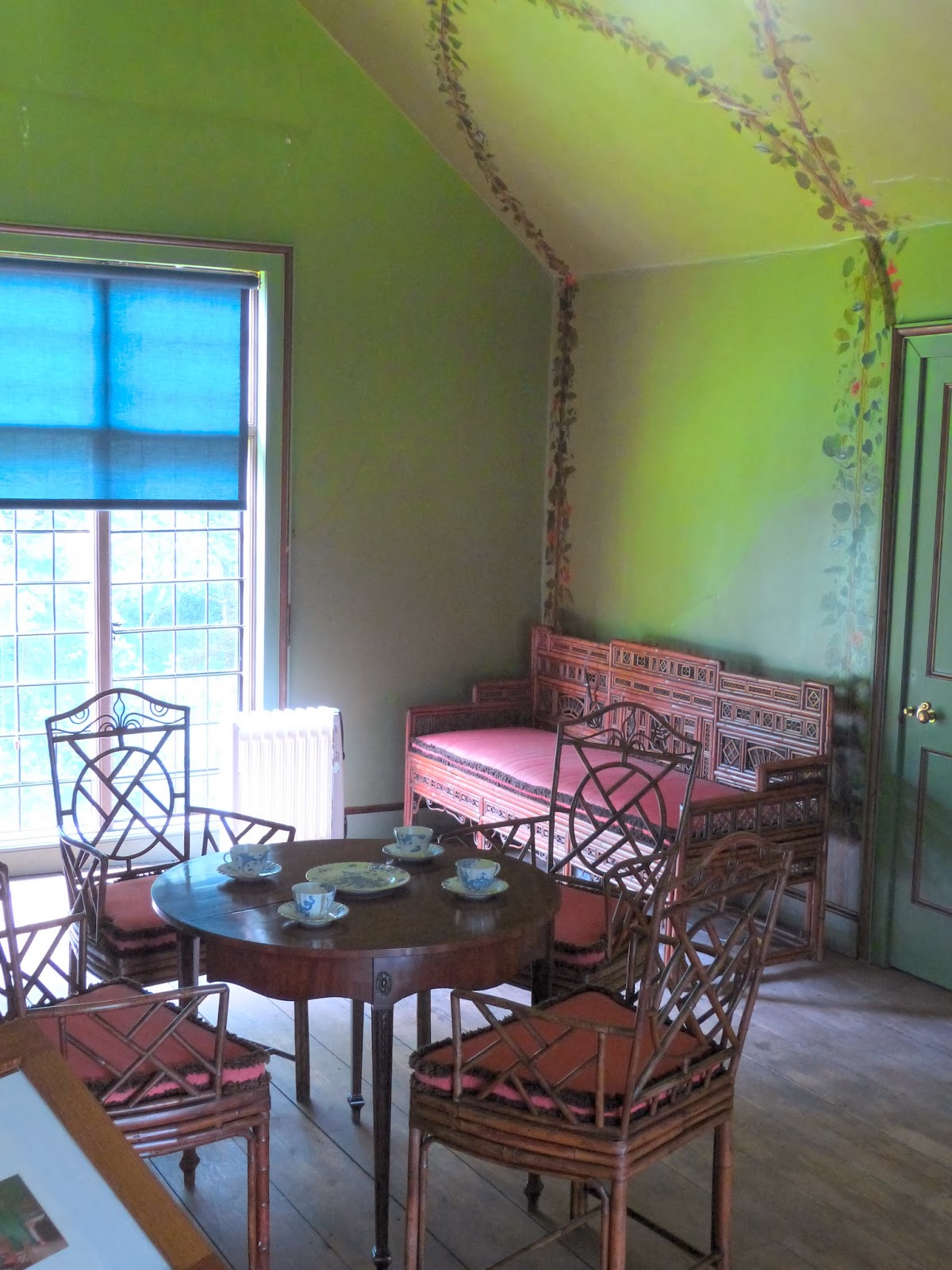
The tea room, Queen Charlotte's Cottage, Kew
The tea room, Queen Charlotte's Cottage, Kew (2013)
Downstairs, the Queen displayed her collection of Hogarth prints on the walls of the print room, whilst upstairs was the tea or picnic room, with its beautifully floral and bamboo decorations which were painted by the Queen’s third daughter, Princess Elizabeth.

What can you see today?

• The picturesque exterior of Queen Charlotte’s Cottage

Queen Charlotte's Cottage, Kew Gardens, London
Queen Charlotte's Cottage, Kew (2013)
• The print room

The print room, Queen Charlotte's Cottage, Kew
The print room, Queen Charlotte's Cottage, Kew (2013)
• The tea room

The tea room, Queen Charlotte's Cottage, Kew
The tea room, Queen Charlotte's Cottage, Kew (2013)
Princess Elizabeth's artwork on the walls and ceiling of the tea room

Detail from the artwork on the wall of  the tea room in Queen Charlotte's Cottage, Kew
Detail from the artwork on the wall of
the tea room in Queen Charlotte's Cottage, Kew (2013)
Last visited: June 2013.

Queen Charlotte's cottage is in the care of Historic Royal Palaces and has limited opening times. Find out more here.
 
If you enjoyed this article, you might like my guides to Kew Palace and the White House.

Headshot of Rachel Knowles author with sea in background(2021)
Rachel Knowles writes clean/Christian Regency era romance and historical non-fiction. She has been sharing her research on this blog since 2011. Rachel lives in the beautiful Georgian seaside town of Weymouth, Dorset, on the south coast of England, with her husband, Andrew.

Find out more about Rachel's books and sign up for her newsletter here.

If you have enjoyed this blog and want to encourage me and help me to keep making my research freely available, please buy me a virtual cup of coffee by clicking the button below.

 
Notes
(1) From the Kew Gardens website (accessed 19/2/14). The dates for the building are very vague and if the building was erected after 1761, presumably it could not have been a wedding present. One possible explanation is that the original building was put up in 1754, but alterations were made to it in the period to 1771, after it was given to Queen Charlotte and transformed into her rustic summerhouse.
(2) From Kew Palace, the official illustrated history by Groom and Prosser (2006). They state that the cottage was on the site by 1771. However, if the cottage was altered rather than completely rebuilt, this would explain how the two different histories might fit together.

Sources used include:
Groom, Susanne and Prosser, Lee, Kew Palace, the official illustrated history (2006)
Kew Gardens website (accessed 19/2/14) 
Kew Palace website (accessed 19/2/14) 
The pages I used to write this article no longer exist, but there is a new page about Queen Charlotte's Cottage on the Historic Royal Palaces website here.

Photographs © RegencyHistory.net
Updated 28/1/22

Friday, 4 May 2012

Princess Elizabeth - the artist

Princess Elizabeth
from La Belle Assemblée (1806)
Elizabeth the designer

Princess Elizabeth, the third daughter of George III and Queen Charlotte, was a notable designer and artist.

She painted a trellis on the ceiling of the Picnic Room in Queen Charlotte's Cottage at Kew.

The painted trellis on the ceiling of the Picnic Room
in Queen Charlotte's Cottage, Kew
Elizabeth designed the hermitage at Frogmore - a small round building with a thatched roof situated in the south west corner of the garden. She also painted the Princess Royal’s closet at Frogmore in imitation of rich japan.

She was responsible for the decorations at the lavish entertainment given by Queen Charlotte at Frogmore in August 1799 to celebrate the recovery of the Princess Amelia.

Oulton describes them in his Memoirs of the Late Queen Charlotte:
“The pillars were covered with bay leaves and artificial flowers, wreaths of flowers decorating the intermediated spaces at the top; the chandeliers suspended from the ceiling were in the shape of a bee hive: at the upper end of them formed the tassel; between each row of lamps were interwoven ears of corn, blue bells, violets, lilies of the valley.”
The Birth and Triumph of Cupid

Birth from The Birth and Triumph of Love (1796)
In 1795, a series of twenty-four prints was published under the name of Lady Dashwood from drawings by Princess Elizabeth entitled “The Birth and Triumph of Cupid”. In La Belle Assemblée, the set of engravings was alternatively called “The Progress of Cupid”. They were engraved by PW Tomkins, the court engraver, who had studied under Bartolozzi, and were published at the King’s expense. La Belle Assemblée describes the pictures as “allegorical representations of the power of love”.

The Birth and Triumph of Love

Triumph from The Birth and Triumph of Love (1796)
The prints inspired Sir James Bland Burges to write an epic poem in the style of Spenser. Sir James was the undersecretary of state for foreign affairs until 1795 when he was made a baronet and became Knight Marshal of the King’s household. He took the name Lamb in 1821 in order to receive an inheritance. The plates were republished with the poem under the title “The Birth and Triumph of Love” in 1796 and met with considerable acclaim.


Opening lines from The Birth and Triumph of Love
by Sir James Bland Lamb
The complete set of 24 prints is available here - Regency History on Facebook

The Power and Progress of Genius

A second series of twenty-four sketches was issued in 1806 called “The Power and Progress of Genius”. La Belle Assemblée records that “Her Royal Highness has likewise distributed among her most favoured circle another publication and tribute to the fine arts just finished. It is entitled ‘The Progress of Genius’ and exhibits, under allegorical images, the different acts of that intellectual power.”

A vignette of the hermitage

A review in Noctes Ambrosianæ talks of a work of Pyne consisting of a hundred plates which are facsimiles of coloured drawings by various artists of different rooms in the various royal palaces – a History of Royal Residences. He notes that “it may not be uninteresting to know, that the vignette, representing the hermitage, in the garden at Frogmore, is copied from a plate etched by the Princess Elizabeth herself”. Robert Shelton Mackenzie wrote that the Princess “drew and etched, as well as if she had been an artist”.

Sources used include:
Bell, John, La Belle Assemblée, various (1806, London)
Hall, Mrs Matthew, The Royal Princesses of England (1871, London)
Hibbert, Christopher, George IV (1972, 1973)
Lamb, Sir James Bland, The Birth and Triumph of Love (1823, London)
Oulton, Walley Chamberlain, Authentic and Impartial Memoirs of Her Late Majesty Charlotte, Queen of Great Britain and Ireland (1819, London)
Wilson, John, with memoirs and notes by Robert Shelton Mackenzie, Noctes Ambrosianæ 1819-1824 (1867, New York)

Wednesday, 2 May 2012

The Six Princesses: Princess Elizabeth (1770-1840)

Princess Elizabeth  from The Lady's Magazine (1793)
Princess Elizabeth
from The Lady's Magazine (1793)
Profile

Princess Elizabeth (22 May 1770 - 10 January 1840) was the third daughter of King George III and Queen Charlotte. She was a gifted artist and married Prince Frederick of Hesse-Homburg at the age of 47.

Birth of Princess Elizabeth

Princess Elizabeth was born at Buckingham House on 22 May 1770, the seventh child of King George III and Queen Charlotte. She was christened by the Archbishop of Canterbury in the great council chamber at St James’ on 17 June.

The Queen's Palace (Buckingham House), from The Microcosm of London (1808-10)
The Queen's Palace (Buckingham House),
from The Microcosm of London (1808-10)
Queen Charlotte was an advocate of vaccination and so the young Princess was inoculated against smallpox on 1 October 1775, along with her brothers, Ernest and Augustus.

A restrictive upbringing

Elizabeth and her sisters received their education at home, under the auspices of Lady Charlotte Finch. They were taught English, modern foreign languages, geography, history, music, art and needlework. Elizabeth had excellent taste in music and was particularly gifted artistically, excelling in both design work and painting.

Read more about Princess Elizabeth - the artist.

The Princesses were allowed very little freedom; Queen Charlotte had to approve of every book that they read and every acquaintance that they made.

Visits and holidays

There was little variation in their routine except for the occasional outing or visit, such as in 1785, when Elizabeth was in the party that went to the Egham Races and to Oxford, and visited Lord and Lady Harcourt at Nuneham.

The royal family visited the seaside at Weymouth almost every year from 1789 to 1805 for the sake of the King’s health. Elizabeth also visited Bath with her mother in 1817, a visit which ended abruptly because of the death of Princess Charlotte.

Weymouth
Weymouth
Elizabeth's first ball

Elizabeth made her first appearance in the ball room at the King’s birthday celebrations in 1785, where she walked a minuet with Lord Rochford. Her dress was “the very counterpart of the Princess Royal’s”, suggesting that there was little scope for individuality.

An alarming incident

On 29 April 1788, Princess Elizabeth suffered an alarming incident. While she was sitting in her room, she was disturbed by the entrance of an unknown man, who must have climbed over the wall into the Queen’s garden. On the Princess alerting her attendants, the man was seized and forced to leave, but he returned a short while later to request an interview with the Princess so that he could pour out his love for her! The intruder was a hairdresser of the name of Spang who proved to be insane and was committed to Tothill Fields Bridewell.

Person and character

Elizabeth was very sensitive and emotional, but inclined to be rather managing. She suffered from poor health and became very overweight. As a result, her sisters nicknamed her Fatima.

Princess Elizabeth  from A Biographical Memoir of Frederick,  Duke of York and Albany by John Watkins (1827)
Princess Elizabeth
from A Biographical Memoir of Frederick,
Duke of York and Albany by John Watkins (1827)

The reluctant spinster

Elizabeth passionately desired to get married and have children of her own. Ever hopeful of becoming a bride, she drank sugar melted in water at night, supposedly to keep her temper sweet, and took long walks to prevent herself getting any fatter.

In the meantime, she kept herself occupied. She wrote her mother’s letters, collected porcelain and kept some Chinese pigs in a field at Frogmore. Unable to have her own children, she looked after other people’s children and devoted herself to charitable works for orphans.

Frogmore House  from Memoirs of Her Late Majesty Queen Charlotte  by WC Oulton (1819)
Frogmore House
from Memoirs of Her Late Majesty Queen Charlotte
by WC Oulton (1819)
The loves of Princess Elizabeth

There are unsubstantiated rumours that, as a young woman, Elizabeth had an affair with one of the King’s pages which resulted in an illegitimate child.

In 1808, the Duke of Orleans, the future French King Louis-Philippe, made her an offer which she desperately wanted to accept. However, the Queen was horrified at the proposed match because he was a penniless Roman Catholic.
King Louis Philippe of France  from Life of Louis Philippe  by SG Goodrich (1848)
King Louis Philippe of France
from Life of Louis Philippe
by SG Goodrich (1848)
Marriage at last

It was not until 1818 that Elizabeth received another offer of marriage, this time from Philip Augustus Frederick, Hereditary Prince of Hesse-Homburg, with whom she had been corresponding for two years. The Queen initially seemed resigned to the marriage, but when she realised that she would soon be deprived of her favourite daughter’s company, she became very difficult, causing Elizabeth considerable distress. Eventually, the Queen withdrew her opposition, having gained the assurance that Elizabeth would remain in England for a while after the marriage.

Prince Frederick did not have a prepossessing appearance: he was extremely fat, had flamboyant whiskers and smelled of garlic and tobacco. He was known to the public as “Humbug”.

Prince Frederick of Hesse-Homburg  from The New Monthly Magazine (1818)
Prince Frederick of Hesse-Homburg
from The New Monthly Magazine (1818)
A royal wedding

Prince Frederick and Princess Elizabeth were married on 7 April 1818 at Buckingham House. The Prince of Wales lent them the Royal Lodge at Windsor for their honeymoon, but unfortunately they were forced to travel in an old landaulet because the new coach that Elizabeth had ordered was not ready because the manufacturer had gone on strike and the journey was so bumpy that it made Prince Frederick sick!

They left Buckingham House on 3 June and then, having spent a week in Brighton, they sailed for Frankfurt.

Although it is doubtful whether it was a love match, the marriage appears to have been a great success. Elizabeth’s dowry funded the repair of Frederick’s castles in Hesse-Homburg and on 20 January 1820, Frederick succeeded his father as the Landgrave of Hesse-Homburg. Elizabeth seemed genuinely fond of her husband, calling him her “beloved Bluff”, but the marriage, unsurprisingly, did not produce any children.

Final years and death

After her husband’s death in 1829, Elizabeth divided her time between Homburg and Hanover. In 1835 to 1836, she visited England and spent much of her time visiting spas.
She died at Frankfurt am Main on 10 January 1840 aged 69.

Sources used include:
Bell, John, La Belle Assemblée, various (1806-1831, London)
Chedzoy, Alan, Seaside Sovereign - King George III at Weymouth, (Dovecote Press, 2003, Dorset)
Colburn, H, The New Monthly Magazine and Universal Register (1818, London)
Hall, Mrs Matthew, The Royal Princesses of England (1871, London)
Hibbert, Christopher, George IV (Longmans,1972, Allen Lane, 1973, London)
Oulton, Walley Chamberlain, Authentic and Impartial Memoirs of Her Late Majesty Charlotte, Queen of Great Britain and Ireland (1819, London)
Purdue, AW, George III, daughters of (act.1766-1857), Oxford Dictionary of National Biography, (Oxford University Press, 2004, online edn, May 2009, accessed 10 Feb 2012)
Watkins, John, A Biographical Memoir of Frederick, Duke of York and Albany (1827, London)

All photographs © Andrew Knowles - www.flickr.com/photos/dragontomato