|
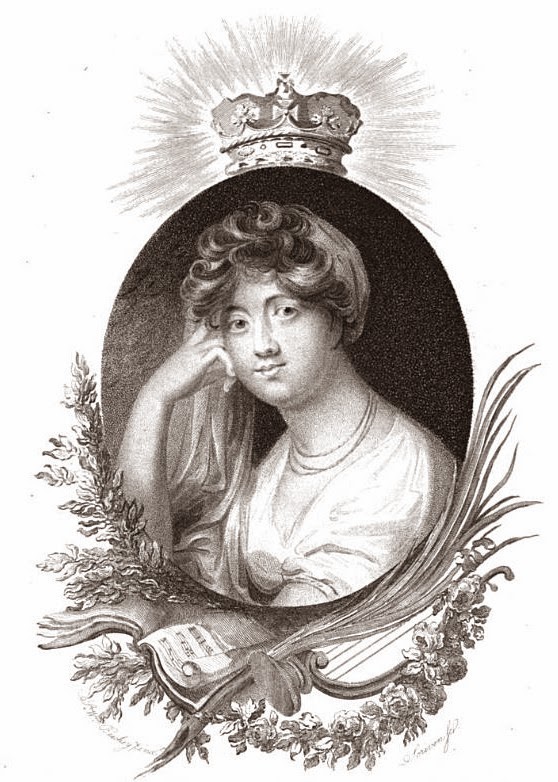
| Frederica, Duchess of York from A Biographical Memoir of Frederick, Duke of York and Albany by John Watkins (1827) |
Who was Frederica, Duchess of York?
Frederica, Duchess of York (7 May 1767 – 6 August 1820), was a Prussian princess who married Frederick, Duke of York, George IV’s brother. She was known for her love of animals and for the large number of dogs she kept at Oatlands, the Duke of York’s residence in Weybridge, Surrey.
Family background
Frederica Charlotte Ulrica Catherina, Princess Frederica of Prussia, was born on 7 May 1767, the eldest daughter of Frederick William II, King of Prussia, by his first wife, Elizabeth of Brunswick. According to La Belle Assemblée, Frederica was
… educated under the eye of her mother, in those strict principles of the Protestant faith which govern the Ecclesiastical Constitution of Prussia.1
Marriage to the Duke of York
On 29 September 1791, Princess Frederica married Frederick, Duke of York, the second son of George III, in Berlin. In order to fulfil the requirements of the Royal Marriage Act (1772), the ceremony had to be repeated in England so that the King’s consent could ‘be set out in the licence and register of marriage.’2
This second ceremony took place on 23 November 1791 at the Queen’s House, later Buckingham Palace. I confess, I do not know which is the official date of marriage, though I guess it is probably the second one, as in the eyes of English law, it was this ceremony that made the union legal.
According to La Belle Assemblée, Princess Frederica
… had been seen by the Duke of York in an excursion which he made abroad some four years previous to their union. His Royal Highness, in his German tour, had paid a visit to the Court of Berlin, and had there imbibed those elements of military knowledge which prevail in the school of the Great Frederick. He had, at that period, formed an attachment for the Princess Royal of Prussia, who then shone in the full splendour of her beauty, and whose numerous accomplishments, and many mild and amiable virtues, were the common theme of admiration.3
Despite this rosy account of the Duke’s affection, it was an arranged marriage, and not particularly successful. There were no children from the union and the royal couple lived separate lives, though from all that I have read, their relationship was amicable.
The diarist Charles Greville wrote:
 |
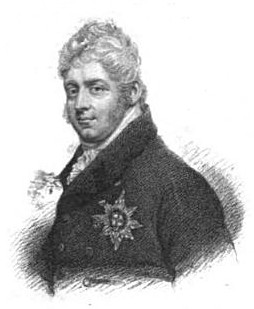
| Prince Frederick, Duke of York and Albany from La Belle Assemblée (1827) |
The Duke and the Duchess live upon the best terms; their manner to one another is cordial, and while full of mutual respect and attention, they follow separately their own occupations and amusements without interfering with one another. Their friends are common to both, and those who are most attached to the Duke are equally so to the Duchess.4
What did the Duchess look like?
La Belle Assemblée (1806) described the Duchess of York:
Her Royal Highness’s stature is somewhat below the common height, and her figure elegantly formed in proportionate delicacy and slightness. Her countenance has so far the best beauty, that it is made to win tenderness, esteem and affection. Her complexion is exquisitely fair, and the bloom with which it is enlivened is rather a tint appearing through her skin, than that sort of colour which seems to exist in it. Her hair is light, and her eye-lashes are long and nearly white, resembling those of our Royal Family, to whom, indeed, she is not much unlike in features. Her eyes are blue, and of uncommon brilliancy.5
 |
| The Duchess of York by John Hoppner from John Hoppner RA by WD McKay and W Roberts (1909) |
In Greville’s opinion, the Duchess was rather more intelligent than her royal husband and liked to entertain clever men. He wrote:
The Duchess likes the society of men of wit and letters; more, I think, from the variety of having them around her than from any pleasure she takes in their conversation. Lord Alvanley is the man in whom she takes the greatest delight.6
Greville also suggested that the Duchess was quite at home with conversation that might have been deemed by others as unfit for female ears:
Her mind is not perhaps the most delicate; she shows no dislike to coarseness of sentiment or language, and I have seen her very much amused with jokes, stories, and allusions which would shock a very nice person. But her own conversation is never polluted with anything the least indelicate or unbecoming. She is very sensible to little attentions, and is annoyed if anybody appears to keep aloof from her or to shun conversing with her.7
Charitable nature
The Duchess was known for her generosity towards the poor and, perhaps because childless herself, many of the charitable works she carried out were for the benefit of children. La Belle Assemblée wrote that she
… established many charity schools at Oatlands and in the neighbourhood, and her humanity and tenderness to the poor are the theme of all who approach her.8
The Duke of York’s biographer, John Watkins, enlarged upon this:
The children of the whole neighbourhood, at least all who stood in need of assistance, were considered by the Duchess as belonging to her household. They were accordingly clothed and educated under her own immediate inspection, and entirely at her expense. Every Saturday whole troops of these infants were to be seen crossing the park in their simple clean attire, to the mansion of their royal benefactress, from whose hand they frequently received cake and wine.
As they grew up, the patronage of her royal highness was still continued; the girls being either put out to service, or provided for with suitable employment, while the boys were apprenticed at the charge of the Duchess, who also gave marriage portions to the deserving, and extended her benevolence to their rising families.9
Besides this, she had a long list of infirm pensioners, of both sexes, in London, who received regular allowances.
Love of animals
The Duchess was passionately fond of animals, particularly dogs. She kept a huge number of them at Oatlands and created a cemetery in the park in which to bury them after they had died. She also kept monkeys and parrots.
Greville wrote:
Her dogs are her greatest interest and amusement, and she has at least forty of various kinds. She is delighted when anybody gives her a dog, or a monkey, or a parrot, of all of which she has a vast number; it is impossible to offend her or annoy her more than by ill-using any of her dogs, and if she were to see anybody beat or kick any one of them she would never forgive it.10
Watkins wrote:
To the canine species the Duchess was remarkably attached; and it was no uncommon thing to see her in the park surrounded by thirty or forty of these animals of various sorts, as English lapdogs, Dutch pugs, and French barbettes. Their respective litters were taken great care of, and the young ones not unfrequently boarded out, under the superintendence of the cottagers. Nor was this tenderness confined to them while living, for a cemetery was actually formed in the park to receive their remains.11
Writing in 1828, after Oatlands had passed out of royal hands, Prosser described where the cemetery was:
Before the grotto, which is entwined with ivy and other creeping plants, was a gold and silver fish pond and a small cascade, now in a neglected and ruinous state. Near are numerous small stone tablets, bearing the names of nearly seventy of her late Royal Highness's favorite dogs that lie buried here.12
The Duchess’s other interests
Among the other amusements of the Duchess, gardening constituted one of the most favourite; and she also took great delight in collecting shells, with which she formed one of the finest grottoes ever seen in this kingdom, expending thereon, it is said, near twelve thousand pounds.13
Watkins’ estimate of the cost of the grotto, though expensive, was quite conservative. La Belle Assemblée stated that it had cost at least £50,000!
The Grotto, which has grown to its present elegance chiefly under her Royal Highness’s hands, is reckoned one of the principal curiosities of this kingdom, and perhaps in any part of the world.
Her Royal Highness has very condescendingly opened it for public inspection, every Sunday evening during the summer season. It is shown, free of all expense, to the visitants.14
Friends and family
The Duchess was very close to Princess Charlotte and friendly towards her mother Caroline, Princess of Wales. According to Greville, the Duchess
… always lived on good terms with the Royal Family, but is intimate with none of them, and goes as little as possible to Court. The Regent dislikes her, and she him. With the Princess Charlotte she was latterly very intimate, spent a great deal of time at Claremont, and felt her death very severely.15
Ian Kelly, in his biography of Beau Brummell, wrote that the Duchess and the Prince Regent were on friendly terms - rather better than Watkins suggested.
Kelly also wrote of the Duchess’s close friendship with Beau Brummell. She helped him financially after he fled to France to escape his debts in 1816 and it was for her sake that he agreed not to publish his memoirs whilst the Regent or any of his brothers were alive.
A private person
 |
| George Brummell from The History of White's by Hon Algernon Bourke (1892) |
The Duchess of York did not like being in the public eye and preferred to live at Oatlands when she could. Greville wrote:
The Duchess has no taste for splendour or magnificence, and likes to live the life of a private individual as much as possible.16
In Watkins’ opinion:
The life of the Duchess was marked by scarcely any circumstances calculated to bring her prominently under public observation. She mixed very little in the gaieties of fashionable life.17
 |
| Oatlands from Select illustrations of the County of Surrey by GF Prosser (1828) |
Whilst the Duchess loved entertaining, and regularly gave parties at Oatlands, she was not a very attentive hostess. Greville recorded his observations on the Duchess’s eccentricity and the haphazard style of living that existed there:
Oatlands is the worst managed establishment in England; there are a great many servants, and nobody waits on you; a vast number of horses, and none to ride or drive.18
On another occasion he wrote:
The Duchess seldom goes to bed, or, if she does, only for an hour or two; she sleeps dressed upon a couch, sometimes in one room, sometimes in another. She frequently walks out very late at night, or rather early in the morning, and she always sleeps with open windows. She dresses and breakfasts at three o’clock, afterwards walks out with all her dogs, and seldom appears before dinner-time. At night, when she cannot sleep, she has women to read to her. 19
A brush with death
On 6 June 1794, there was a dreadful fire at Oatlands. Fortunately, the Duchess was not harmed.
Watkins wrote:
The Duchess beheld the dreadful conflagration from her sleeping room, which was in the centre of the mansion, and from which the flames were kept by pulling down a gateway, over which the wing joined the house. His Majesty, on hearing of the misfortune, went to Oatlands early the next morning, and gave the necessary orders for clearing the ruins, and rebuilding the wing which had been destroyed, at his own expense.20
Illness and death
Princess Frederica died of consumption on Sunday 6 August 1820. Greville described the cause as water on her chest. She was buried, at her own request, in Weybridge Church, on 14 August.
Watkins wrote that:
The Duke, when consulted upon the subject of the funeral, at once determined that the wish of his lamented consort should be complied with; and directions were accordingly given that the obsequies should be performed as she had requested, and that with as little ostentation as possible.21
Greville wrote:
She is deeply regretted by her husband, her friends, and her servants. Probably no person in such a situation was ever more really liked. She has left 12,000ℓ. to her servants and some children whom she had caused to be educated. She had arranged all her affairs with the greatest exactitude, and left nothing undone.22

Rachel Knowles writes clean/Christian historical romance set in the time of Jane Austen. She has been sharing her research on this blog since 2011. Rachel lives in the beautiful Georgian seaside town of Weymouth, Dorset, on the south coast of England, with her husband, Andrew.
Find out more about Rachel's books and sign up for her newsletter here.If you have enjoyed this blog and want to encourage me and help me to keep making my research freely available, please buy me a virtual cup of coffee by clicking the button below.
Notes
1. Bell, John, La Belle Assemblée (1806).
2. Ibid.
3. Ibid.
4. Entry for 15 August 1818, Greville, Charles, A journal of the reigns of King George IV and King William IV, edited by Henry Reeve (Longmans, 1874) Volume 1.
5. Bell op cit.
6. Entry for 24 December 1819, Greville op cit.
7. Entry for 15 August 1818, Greville op cit.
8. Bell op cit.
9. Watkins, John, A Biographical Memoir of Frederick, Duke of York and Albany (1827)
10. Entry for 15 August 1818, Greville op cit.
11. Watkins op cit.
12. Prosser, George Frederick, Select Illustrations of the County of Surrey (1828).
13. Watkins op cit.
14. Bell op cit.
15. Entry for 15 August 1818, Greville op cit.
16. Ibid.
17. Watkins op cit.
18. Entry for 4 August 1818, Greville op cit.
19. Entry for 15 August 1818, Greville op cit.
20. Watkins op cit.
21. Watkins op cit.
22. Entry August 1820, Greville op cit.
Sources used include:
Bell, John, La Belle Assemblée (John Bell, 1806, London)
Greville, Charles, A journal of the reigns of King George IV and King William IV, edited by Henry Reeve (Longmans, 1874) Volume 1
Kelly, Ian, Beau Brummell, The Ultimate Dandy (Hodder & Stoughton, 2005)
Prosser, George Frederick, Select Illustrations of the County of Surrey (1828)
Stephens, HM, revised by Van der Kiste, John, Frederick, Prince, Duke of York and Albany (1763-1827), Oxford Dictionary of National Biography (Oxford University Press 2004, updated 2007)
Watkins, John, A Biographical Memoir of Frederick, Duke of York and Albany (1827, London)