Search this blog

Showing posts with label Rome. Show all posts

Thursday, 5 September 2013

Mystery portrait of a Regency gentleman

Charles-Joseph-Laurent Cordier
John Klawitter's painting
A mystery portrait

I recently received an email from John Klawitter asking me about this painting which he and his wife had inherited. It is a portrait of an unknown gentleman by an unknown painter and he wondered if I could shed any light on it.

What does the painting show us?

The gentleman is wearing a dark, probably blue, double-breasted coat with a red ribbon on his left lapel. His shirt collar is high and he wears a white neck cloth adorned by some kind of silver brooch. His hair is dark and wavy and he has sideburns, which look quite similar to Beau Brummell’s.

George Brummell  from The History of White's   by Hon Algernon Bourke (1892)
George Brummell
from The History of White's
 by Hon Algernon Bourke (1892)
In the background there are some ruins – maybe part of the Forum in Rome.

"Campo Vaccino" - the Roman Forum  from A New Picture of Rome by Marien Vasi (1824)
"Campo Vaccino" - the Roman Forum
from A New Picture of Rome by Marien Vasi (1824)
What can we learn from this?

The clothes and hairstyle would indicate that the portrait was probably painted in the early 19th century. The ruins in the background immediately suggested to me that it might have been painted to celebrate the gentleman’s Grand Tour – probably painted in Rome, as often happened.

My research

Armed with these clues I searched on the internet for early 19th century portrait artists who had painted in Rome. I came up with the name of the French painter Jacques-Louis David, but I was by no means convinced. Then I looked at the work of his pupil, Jean-Auguste-Dominique Ingres, and to my amazement and delight, there was the gentleman in the painting amongst his work!

The gentleman finds a name

The subject of the portrait is Charles-Joseph-Laurent Cordier and on some websites the painting title gives an indication of who he was: "Charles Cordier (1777-1870), Inspecteur des domaines à Rome et Paris."

He was painted in oils by Ingres in 1811 who was based at the Villa Medici in Rome at this time. The painting is owned by the Louvre, Paris.

But who painted this portrait?

One mystery solved. But the other question remains: who painted John’s portrait?

John’s painting differs from the one in the Louvres by a few details such as the fob. Could Ingres have made the copy himself or was it painted by another artist? Was it a contemporary copy or was it painted many years after? Any ideas?

Sources used include:
Bourke, Hon. Algernon, The History of White's (1892)
Vasi, Marien, A New Picture of Rome and its environs, in the form of an itinerary (1824)
Wikipedia

Tuesday, 30 April 2013

The Grand Tour

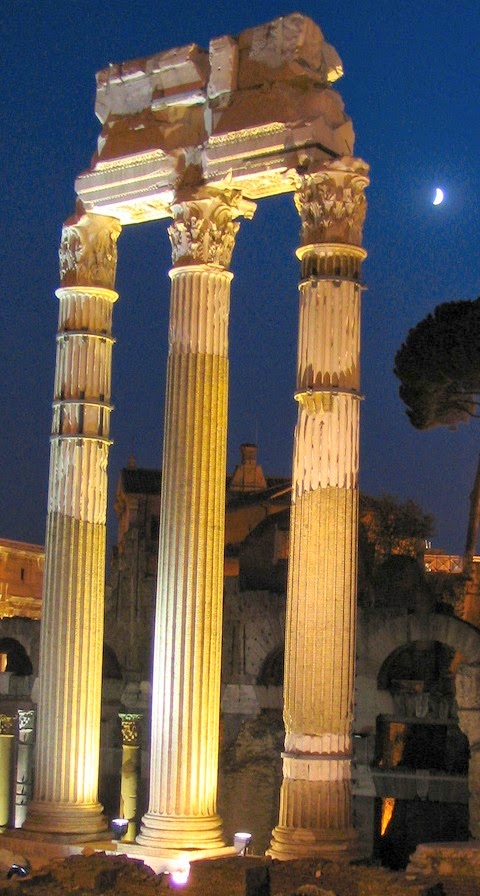
Part of the Forum, Rome
Part of the Forum, Rome (2005)
What was the Grand Tour?

The Grand Tour was a period of foreign travel commonly undertaken by gentlemen to finish off their education. It was popular from the mid-17th century until the end of the 18th century when the outbreak of the Napoleonic Wars stopped most foreign travel.

It saw a revival in the early 19th century after peace was restored in Europe. However, as travel became cheaper and easier, and in particular with the advent of the railways, visiting Europe ceased to be the province of the elite; the days of the Grand Tour were over.

Who went on the Grand Tour?

The Grand Tour was extremely exclusive and only undertaken by the very rich, mainly the sons of the aristocracy. This was because travel was both difficult and expensive. Travellers carried little money for fear of robbery. Instead, they took letters of credit from their London banks which they then presented in major cities.

An added benefit of sending young gentleman abroad was that they were able to sow their wild oats with as little inconvenience to their families as possible. Typically, the young travellers experienced greater freedom on the continent, and became involved in drinking, gaming and romantic liaisons.

The “bear leader”

Gentlemen often travelled abroad under the care of a tutor  - what Georgette Heyer refers to as a “bear leader”. In her novel, Devil’s Cub, the Marquis of Vidal discovers an English clergyman travelling in France: 
“There is a divine, lately passed through Paris, bear-leading some sprig of the nobility. They are bound for Italy.” 
Mr Comyn goes on to describe him as 
“...a needy divine…who has the good fortune to be in charge of a young gentleman making the Grand Tour.”1
A trunk for the Grand Tour at A La Ronde
How long did they go for?

Originally, the Grand Tour was expected to last about three and a half years: six months of travelling and three years of living abroad, allowing gentlemen to absorb the cultures they were visiting and improve their language skills.

The period of time spent abroad gradually shortened until most travelled for no more than two years.

Where did they go?

The most popular destination was France as French was the most commonly spoken second language. It was also the easiest place to get to. The fastest crossing was from Dover to Calais and the roads to Paris were very good.

From Paris, travellers usually proceeded to the Alps and then by boat on the Mediterranean to Italy. They would usually visit Rome and Venice but their tour might also include Spain, Portugal, Germany, Eastern Europe, the Balkans and the Baltic.

Samuel Johnson said:
A man who has not been in Italy is always conscious of an inferiority, from his not having seen what it is expected a man should see.2
"Campo Vaccino" - the Roman Forum  from A New Picture of Rome by Marien Vasi (1824)
"Campo Vaccino" - the Roman Forum
from A New Picture of Rome by Marien Vasi (1824)
What did they see?

The chief destinations were the great cities of the Renaissance and the remains of classical civilisations, which usually included the excavations at Herculaneum and Pompeii.

Classical statues were very popular, such as the Nile and the Tiber – statues representing river gods – which were discovered in Rome in the 16th century and formed part of the Pope’s collection. They were on display in the Museo Pio-Clementino from the 1770s.

Those on the Grand Tour commonly visited the French and Italian royal families and the British envoys, such as Sir William Hamilton, who was the British ambassador to the court of Naples from 1764 to 1800.

The Colosseum, Rome
The Colosseum, Rome (2005)
The legacy of the Grand Tour

One of the aims of the Grand Tour was to give gentlemen an aesthetic education. It was desirable to have an interest in French and Italian art. Travellers typically came home with crates full of souvenirs that they had collected, such as paintings, sculptures and fine clothes. Canaletto, Vernet and Panini all painted for the 18th century tourist market.

It was also fashionable to have your portrait painted, usually at the end of the Tour. Pompeo Batoni (1708-1787) painted over 175 portraits of travellers in Rome.

Did women go on the Grand Tour?

Although the Grand Tour was predominantly undertaken by gentlemen, a number of ladies also travelled abroad. The blue-stocking Hester Piozzi was particularly well-known for her travels in the 1770s and 1780s.

Hester Piozzi from The Life of Samuel Johnson    by James Boswell (1831)
Hester Piozzi from The Life of Samuel Johnson
by James Boswell (1831)
Women who were separated or divorced from their husbands often travelled abroad as they were more readily accepted on the continent. Georgiana, Duchess of Devonshire, went into exile abroad after becoming pregnant with her lover’s child in the early 1790s, whilst Caroline, Princess of Wales, travelled abroad from 1814 to 1820.

A group of women including Jane Parminter and her cousin Mary undertook the Grand Tour in the 1780s. When they returned in 1795, they built the sixteen-sided house, A la Ronde, in Exmouth to remind them of their travels and display their mementoes including several Bartolozzi prints and a shell picture.

A La Ronde, Exmouth, now owned by the National Trust

Headshot of Rachel Knowles author with sea in background(2021)
Rachel Knowles writes clean/Christian historical romance set in the time of Jane Austen. She has been sharing her research on this blog since 2011. Rachel lives in the beautiful Georgian seaside town of Weymouth, Dorset, on the south coast of England, with her husband, Andrew.

Find out more about Rachel's books and sign up for her newsletter here.

If you have enjoyed this blog and want to encourage me and help me to keep making my research freely available, please buy me a virtual cup of coffee by clicking the button below.

 
Notes
(1) Devil's Cub by Georgette Heyer (1932), a Georgian romance.
(2) A journal entry dated 11 April 1776 in James Boswell’s Life of Samuel Johnson (1831), volume 3.

Sources used include:
Boswell, James, The Life of Samuel Johnson LL.D, with new additions by John Wilson Croker (1831)
Foreman, Amanda, Georgiana, Duchess of Devonshire (HarperCollins, 1998, London)
Franklin, Michael J, Piozzi, Hester Lynch (1741-1821) Oxford Dictionary of National Biography (Oxford University Press, 2004; online edn Jan 2008, accessed 6 Oct 2012)
The National Trust, A la Ronde guidebook
Vasi, Marien, A New Picture of Rome and its environs, in the form of an itinerary (1824)

National Gallery website on The Grand Tour
The Grand Route – BBC Radio 4 programme

All photographs ©Regencyhistory.net

Friday, 19 October 2012

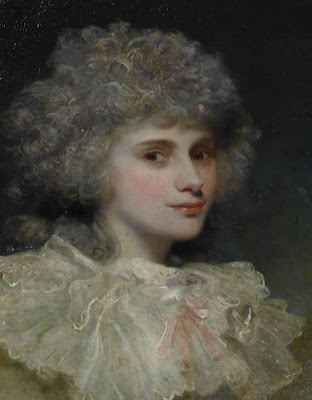
Lady Elizabeth Foster, later Duchess of Devonshire (1758-1824)

Lady Elizabeth Foster, later Duchess of Devonshire,  in South Sketch Gallery, Chatsworth
Lady Elizabeth Foster, later Duchess of Devonshire,
in South Sketch Gallery, Chatsworth
Profile

Lady Elizabeth Foster (baptised 13 May 1758 - 30 March 1824) was the intimate friend of Georgiana, Duchess of Devonshire, and the mistress of Georgiana's husband, William Cavendish, 5th Duke of Devonshire. She became the Duchess of Devonshire after Georgiana's death.

Early years

Elizabeth Christiana Hervey was baptised on 13 May 1758 in Horringer, Suffolk, the daughter of Frederick Hervey and Elizabeth Davers. The family moved to Ireland when Hervey was appointed Bishop of Cloyne (1767) and then Bishop of Derry (1768) through the influence of his brother. Elizabeth, known as Bess, spent her childhood in relative poverty, in Ireland and on the continent. The family fortunes changed drastically when Hervey became 4th Earl of Bristol in December 1779, but by this time, Bess was already married.

A short-lived marriage

On 16 December 1776, Bess married John Foster, an Irish MP. She had two sons, Frederick (1777) and Augustus (1780), but the marriage was not a success and in 1780, the couple separated. Foster was unfaithful, but on her side, Bess may have been regretting marriage to someone beneath her newly elevated status as Lady Elizabeth Foster. Bess gave up custody of her sons to Foster and returned to England, where she was forced to live in reduced circumstances.

The Duke and Duchess of Devonshire

Georgiana, Duchess of Devonshire  in South Sketch Gallery, Chatsworth
Georgiana, Duchess of Devonshire
in South Sketch Gallery, Chatsworth
In 1782, Bess met the Duke and Duchess of Devonshire in Bath. Seeing an opportunity to improve her circumstances, she attached herself to the emotionally-starved Duchess, with whom she formed an instant bond. She succeeded so well that when Georgiana went home, Bess was invited to accompany them. Eager to please, Bess provided the Duke with the companionship he needed and at some point became his mistress.

Intrigues abroad

Georgiana’s mother, Lady Spencer, was keenly jealous for Georgiana’s position and encouraged the Cavendishes to send Bess abroad for her health. Bess duly left for France in December 1782, acting as governess to Charlotte Williams, the Duke’s natural daughter. The doors of Parisian high society were closed to her as a governess, but she enjoyed the freedom of being on her own in receipt of a large income.

Rumours drifted back to the Duchess that Bess was involved in scandalous behaviour in Italy. Bess hastened to reassure Georgiana but did not hurry to return home, afraid that she would have lost her influence after the birth of Georgiana’s daughter. Eventually, Bess was persuaded to return to Devonshire House, in July 1784.

A secret birth

She did not remain long. At the end of 1784, Bess went abroad again, ostensibly for her health. The reality was that she was pregnant. This time, she was given letters of introduction to the Duchesse de Polignac to enable her to move in polite society in Paris. Despite carrying the Duke of Devonshire’s child, she became mistress to the Duke of Dorset.
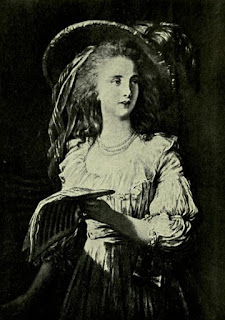
Duchesse de Polignac    from Seven Splendid Sinners,   by WRH Trowbridge (1908)
Duchesse de Polignac
  from Seven Splendid Sinners,
 by WRH Trowbridge (1908)
When her pregnancy could no longer be hidden, she fled to her brother in Naples and confessed all. He arranged for her to have the baby in a squalid inn and quickly reappear in society to preserve secrecy. In July 1786, Bess left her daughter, Caroline, with the elderly Comte St Jules who agreed to accept paternity, and finally acquiesced to the Duke and Duchess’ pleas for her to come home.

Ménage à trois 

By this time, Georgiana could no longer be in any doubt about the relationship between her husband and her best friend, but, to the amazement of society, she accepted the strange threesome, or ménage à trois. It is unclear whether this was due to Georgiana’s emotional dependence on Bess or whether Bess was blackmailing her over her massive debts which she was anxious to conceal from the Duke.

William Cavendish, 5th Duke of Devonshire  after Sir Joshua Reynolds    stipple engraving pubd 1808    NPG D13723 © National Portrait Gallery, London
William Cavendish, 5th Duke of Devonshire
after Sir Joshua Reynolds
  stipple engraving pubd 1808
  NPG D13723 © National Portrait Gallery, London
An illegitimate son

In 1788, Bess was pregnant again and went abroad to have her child. She had her son, Augustus Clifford, in relative comfort, and left him with foster parents before returning to England. There was some question about Augustus’ paternity, as Bess had also had an affair with the Duke of Richmond, but the Duke of Devonshire accepted that the child was his. Two years later, she succeeded in having Caroline and Augustus brought to England, to be raised with the Cavendish children.

The bonds of friendship

After the birth of her son in 1790, Georgiana confessed her debts to the Duke. Bess stood by her throughout the ordeal. But the real test of her friendship came the following year when Georgiana was banished abroad because she was carrying Charles Grey’s child. Bess went with her.

After two years abroad, the Duke relented, and Georgiana and Bess came home in the autumn of 1793. They resumed their strange ménage à trois, but Georgiana and the Duke were getting on much better than before, and Bess feared that her influence was waning.

The Duke of Richmond

Anxious for her long-term future, Bess rekindled her affair with the Duke of Richmond and became his mistress. When, in 1796, both the Duchess of Richmond and her own husband died, she expected the Duke to marry her. But after many months of waiting, it was clear that the Duke had no intention of doing so.
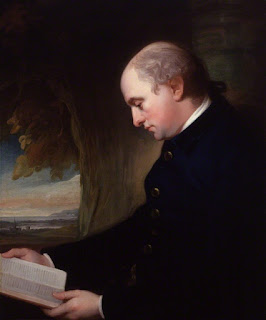
Charles Lennox,  3rd Duke of Richmond and Lennoxl    by George Romney 1775-7    NPG 4877 © National Portrait Gallery, London.
Charles Lennox,
3rd Duke of Richmond and Lennox
  by George Romney 1775-7
  NPG 4877 © National Portrait Gallery, London.
The new Duchess of Devonshire

On 30 March 1806, Georgiana died. Bess was distraught. “She was the charm of my existence,” she wrote to her son, “my constant support in all my sorrows, the doubler and sharer of every joy.”1

Georgiana had secured her friend’s immediate future by making her sole guardian of her papers. The Cavendish children might resent her presence, but the Duke found he could not do without Bess to look after him.

Eventually, on 19 October 1809, the Duke and Bess were married. But Bess did not have long to enjoy the attainment of the position that she had coveted for so long. The Duke died on 29 July 1811, less than two years later.

Roman excavations

After the Duke’s death, Bess lived alone, in style, in Piccadilly before moving to Rome in 1816. Here, Bess found a new vocation as a devoted patron of the arts, in particular, archaeology. For eleven years, she funded the excavation of the Forum, enabling the recovery of the Column of Phocas and the stones of the Via Sacra. In Rome, she also found the last love of her life - Cardinal Hercule Consalvi, secretary of state to the Vatican.

The Forum, Rome
The Forum, Rome
Bess died in Rome on 30 March 1824 and was buried in the Cavendish family vault in Derby Cathedral.

Headshot of Rachel Knowles author with sea in background(2021)
Rachel Knowles writes clean/Christian historical romance set in the time of Jane Austen. She has been sharing her research on this blog since 2011. Rachel lives in the beautiful Georgian seaside town of Weymouth, Dorset, on the south coast of England, with her husband, Andrew.

Find out more about Rachel's books and sign up for her newsletter here.

If you have enjoyed this blog and want to encourage me and help me to keep making my research freely available, please buy me a virtual cup of coffee by clicking the button below.


Note

1. From a letter from Lady Elizabeth Foster to her son Augustus (9 July 1806).

Sources used include:
Bell, John, La Belle Assemblée (John Bell, 1810, London)
Bourke, Hon. Algernon, The History of White's (1892)
Cavendish, Georgiana, Duchess of Devonshire and others, The Two Duchesses, Family Correspondence ed by Vere Foster (Blackie & Son, 1898, London)
Foreman, Amanda, Cavendish, Elizabeth Christiana, Duchess of Devonshire, Oxford Dictionary of National Biography (OUP 2004, online edn May 2010, accessed 11 Oct 2012)
Foreman, Amanda, Georgiana, Duchess of Devonshire (HarperCollins, 1998, London)
Horringer Parish Registers with biographies (1900)
Trowbridge, WRH, Seven Splendid Sinners (1908)

Photographs © Regencyhistory.net