 |
| Kenwood (2014) |
Kenwood is a stunning neoclassical villa on Hampstead Heath in London. You may recognise its beautiful white façade from one of my favourite films,
Notting Hill, where it is the backdrop for the Henry James film that Anna Scott (played by Julia Roberts) is shooting. It also appears in
Mansfield Park (1999) starring Frances O’Connor, and
Belle (2014) starring Gugu Mbatha-Raw. Belle is based on the story of Dido Elizabeth Belle (1761-1804), the illegitimate, mixed-race great niece of Lord Chief Justice William Murray, Earl of Mansfield, who once lived there. Kenwood also boasts some of architect
Robert Adam’s best work.
William Murray, Earl of Mansfield (1705-1793)
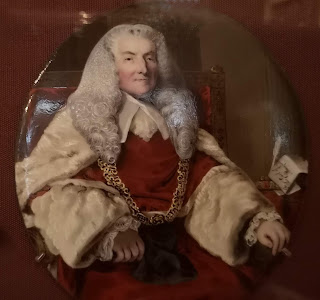 |
William Murray, 1st Earl of Mansfield
from a miniature on display in Kenwood (2019) |
The first house at Kenwood was built in the early 17th century. In 1746, the estate was bought by John Stuart, 3rd Earl Bute, who added the orangery. He sold Kenwood to lawyer William Murray in 1754. Two years later, Murray became Lord Chief Justice and received a barony, thereby becoming Lord Mansfield, the name by which he is better known. Lord Mansfield is famous for his legal judgements which aided the abolition of slavery, in particular, the Somerset case of 1772. He lived in a house in Bloomsbury during the week and spent the weekends at Kenwood. In 1776, he was made Earl of Mansfield.
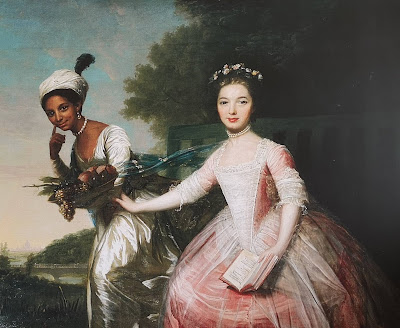 |
Dido Elizabeth Belle and Lady Elizabeth Murray from a replica
of the painting by David Martin (c1778) on display in Kenwood.
The original hangs in Scone Palace, Scotland. |
Lord Mansfield and his wife Lady Elizabeth Finch (1704-84) had no children. However, from about 1766, Kenwood became home to three of Lord Mansfield’s relations – his niece, Anne Murray, the sister of his heir, David Murray, 7th Viscount Stormont; Elizabeth Murray, Viscount Stormont’s daughter by his first marriage; and Dido Elizabeth Belle, the illegitimate, mixed-race daughter of another of Lord Mansfield’s nephews, Sir John Lindsay.
 |
| Kenwood from The Works in Architecture of Robert and James Adam (1773) |
Between 1767 and 1779, Lord Mansfield employed Robert Adam and his brother James to remodel Kenwood. Adam built the library on the east side to counterbalance the orangery already existing on the west, achieving a neoclassical symmetry on the south front overlooking the park. He also designed the new north front with its pillared portico. Adam remodelled and redecorated the interiors using master craftsmen such as Joseph Rose and Antonio Zucchi. The library is reckoned to be one of Adam’s masterpieces and I would agree – it is an amazing room, worth just whiling away some time in.
 |
| The library, Kenwood (2019) |
During
the Gordon Riots of 1780, Lord Mansfield became a target for anti-Catholic sentiment. He was known for his Catholic sympathies and his Scottish descent led people to suspect him of Jacobite sympathies too. Lord Mansfield’s London home was attacked, and his legal library destroyed. Fortunately, Lord Stormont was able to use the militia to deter the mob from descending on Kenwood, diverting their attention by offering them refreshments at the nearby Spaniards Inn.
 |
Toll gate house, Spaniards Gate (left) and Spaniards Inn (right),
less than half a mile from Kenwood, Hampstead (2019) |
David Murray, 7th Viscount Stormont and 2nd Earl of Mansfield (1727-96)
Viscount Stormont inherited Kenwood from his uncle in 1793. He employed architect Robert Nasmith, and later George Saunders, to make improvements to the house. He added a music room, decorated by Julius Caesar Ibbetson, and service wings including a new dairy. He diverted Hampstead Lane away from the house to gain more privacy and commissioned Humphry Repton to landscape the grounds. Repton’s designs for Kenwood appear in his Red Book of before and after pictures in 1793.
 |
| The bridge - picturesque but sham, Kenwood (2019) |
David William Murray, 3rd Earl of Mansfield (1777-1840)
The third earl carried out some necessary work at Kenwood but spent most of his time at his Scottish seat of Scone Palace. He entertained
William IV with a grand luncheon at Kenwood in 1835.
Later history
Like his father, the fourth earl, William David Murray (1806-1898) also preferred Scone Palace but he spent three months of the year at Kenwood. His son, another William David Murray (1860-1906) loved to entertain at Kenwood but on his sudden death in 1906, his brother Alan David Murray (1864-1935) inherited and as he preferred Scone Palace, Kenwood was leased to tenants.
The sixth earl planned to sell Kenwood for redevelopment and sold off the contents by auction in 1922. Edward Cecil Guinness, 1st Earl of Iveagh, was a Hampstead resident at this time. He took out a lease on Kenwood in 1924 and his family trust then bought the house and the remaining land. Lord Iveagh bequeathed Kenwood to the nation and it became an independent museum which is now managed by
English Heritage.
What you can see today
Kenwood is open to visitors and offers free admission. It is well worth a visit. Although the original contents were sold, Kenwood is full of works of art bequeathed by Lord Iveagh, including both Old Masters and Georgian portraits.
The north front
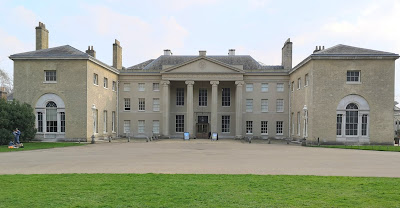 |
| The north front, Kenwood (2019) |
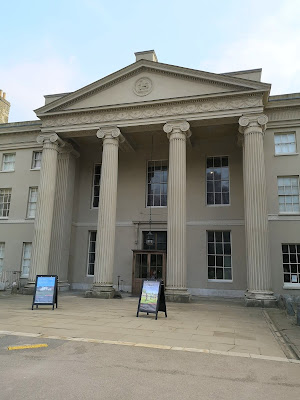 |
| The portico of the north front, Kenwood (2019) |
The south front
 |
| The south front, Kenwood (2019) |
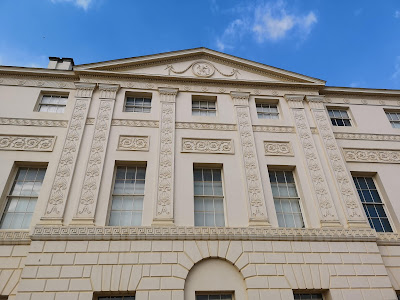 |
| Detail of the south front, Kenwood (2019) |
The entrance hall
 |
| Entrance hall, Kenwood (2019) |
 |
| Entrance hall ceiling, Kenwood (2019) |
The great staircase
 |
| The great staircase, Kenwood (2019) |
The antechamber
 |
| The antechamber, Kenwood (2019) |
The library
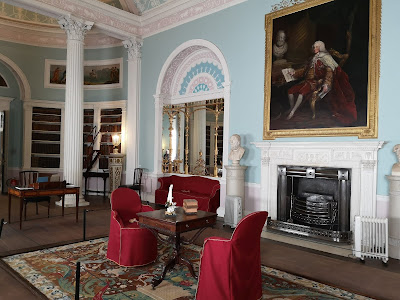 |
| The library, Kenwood (2019) |
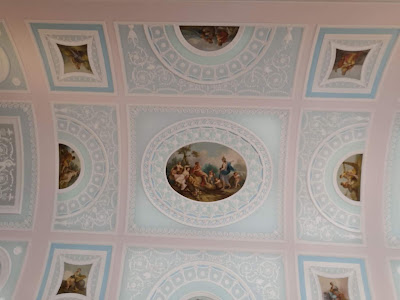 |
| The library ceiling, Kenwood (2019) |
The dining room
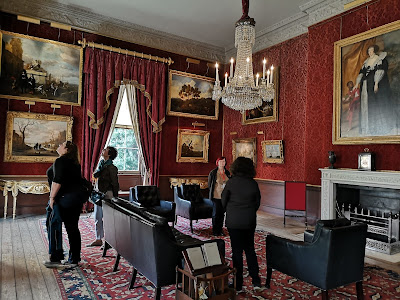 |
| The dining room, Kenwood (2019) |
The breakfast room
 |
| The breakfast room, Kenwood (2019) |
The orangery
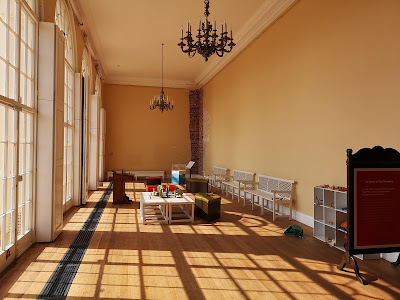 |
| The orangery, Kenwood (2019) |
The green room
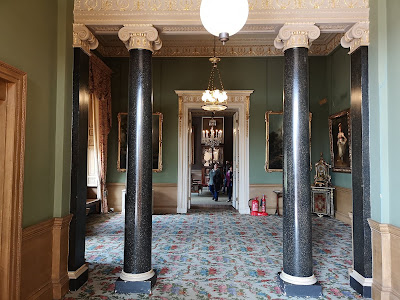 |
| The green room, Kenwood (2019) |
The music room
 |
| The music room, Kenwood (2019) |
The upper hall
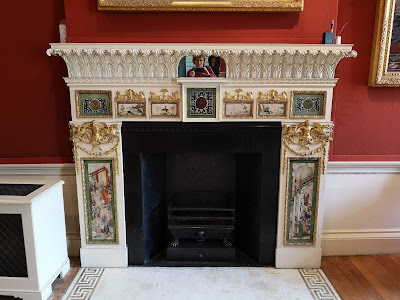 |
| Adam fireplace in the upper hall, Kenwood (2019) |
The miniatures room
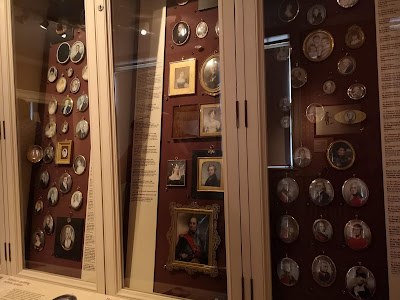 |
| Miniatures cabinet, Kenwood (2019) |
 |
| Miniature of Earl Grey in the miniatures room, Kenwood (2019) |
The bath house
 |
| The restored 18th century cold bath, Kenwood (2014) |
Last visited March 2019.
Rachel Knowles writes clean/Christian Regency era romance and historical non-fiction. She has been sharing her research on this blog since 2011. Rachel lives in the beautiful Georgian seaside town of Weymouth, Dorset, on the south coast of England, with her husband, Andrew.
Find out more about Rachel's books and sign up for her newsletter here.
If you have enjoyed this blog and want to encourage me and help me to keep making my research freely available, please buy me a virtual cup of coffee by clicking the button below.
Sources used include:
Houliston, Laura and Jenkins, Susan, Kenwood, The Iveagh Bequest (English Heritage, 2014)
All photos © RegencyHistory.net


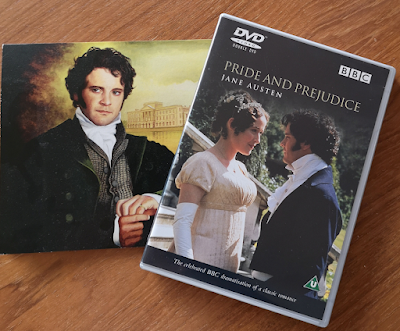
 It is now 20 years since Colin Firth and Jennifer Ehle ‘became’ Darcy and Elizabeth Bennet for thousands of fans of Jane Austen’s Pride and Prejudice. For many, it was their first encounter with Austen’s wonderful characters and it brought her novel to a new audience – those who had never picked up her classic work and read her words for themselves.


