Search this blog

Wednesday, 11 April 2012

Wilberforce and the abolition of the slave trade

William Wilberforce  from The Great and Good (1855)
William Wilberforce
from The Great and Good (1855)
Wilberforce in Parliament

Wilberforce’s political career started in September 1780 when he was elected MP for Hull at the age of twenty-one, having spent £8000 ‘buying’ supporters at the going rate of two guineas a vote, as was the custom at the time. Four years later, he was elected one of the MPs representing the County of York, a prestigious but demanding role from which he resigned in 1812 due to ill health. He then became an MP for the pocket borough of Bramber in Sussex. This enabled him to stay in the Commons but was less taxing on his health and allowed him to spend more time with his family.

The independent politician

Wilberforce’s private resources allowed him to be independent of any political party as he did not need to seek a paying public office. He was a passionate speaker and was able to captivate the house whenever he spoke. His earliest recorded speeches were on smuggling and naval shipbuilding – things close to the heart of his Hull constituents – but it was not until he took up the anti-slavery cause that his political contribution became significant.

The abolitionist cause

After his conversion to evangelical Christianity, Sir Charles and Lady Middleton and Thomas Clarkson urged Wilberforce to take up the plight of slaves in Parliament. After a pivotal discussion with William Grenville and William Pitt the Younger under an oak tree at Holwood in Kent – later known as the “Wilberforce oak” – Wilberforce became fully committed to the cause and thereafter sought the abolition of the slave trade.

Wilberforce launched his campaign for the abolition of slavery on 12 May 1789 and continually brought the matter before Parliament despite repeated disappointment and opposition. In 1791, he helped his friend, Henry Thornton, to establish the Sierra Leone Company to resettle former slaves and promote legitimate trade and on 31 January 1807, his book, A Letter on the Abolition of the Slave Trade, was published. Finally, Wilberforce’s perseverance was rewarded and the Abolition of the Slave Trade Act received royal assent on 25 March 1807.

Front cover of A Letter on the Abolition of the Slave Trade by Wilberforce

But Wilberforce’s efforts did not stop there. The Anti-Slavery society was created in 1823 and, for the rest of his life, he worked towards the total abolition of slavery.

The Clapham Sect

During the 1790s and 1800s, Wilberforce was a leading member of the group of evangelical Christians known as the Clapham Sect, so named because of their location around the green at Clapham. These included Henry Thornton, Edward Eliot, Charles Grant, Zachary Macaulay, John Shore (Lord Teignmouth), and James Stephen (who married Wilberforce’s sister, Sarah, in 1800).

He was informally recognized as the leader of the group of evangelical ‘Saints’ in Parliament and the second great cause in his life was to promote true Christian values – what he called “the reformation of manners”.

With this in mind, Wilberforce successfully urged George III to issue a proclamation for the encouragement of piety and virtue on 1 June 1787 and in April 1797, his work, A practical view of the prevailing religious system of professed Christians in the higher and middle classes of this country contrasted with real Christianity, was published. Although this was unfashionable, it was widely read and influential.

The Queen Caroline Affair

On 6 June 1820, Queen Caroline returned from her exile on the continent, claiming her right to be crowned as Queen, despite the attempts of her adviser, Lord Brougham, to prevent her return to England. The injured Queen became a figurehead for the political unrest that had been made worse by the Peterloo Massacre of 16 August 1819. George IV wanted to put his wife on trial for adultery so that he could divorce her.

Wilberforce feared that in the current state of unrest, such a move could lead to revolution. He proposed that the “Green Bag” debate over the Queen’s alleged adultery be adjourned, giving time for the King and Queen to reach a settlement outside of the courts. The move was enthusiastically taken up and in the process nearly brought the government down.

Wilberforce presented a Motion for an Address to the Queen, and was encouraged by Lord Brougham to believe that the Queen would accept the omission of her name from the liturgy. The Queen refused. The failure of Wilberforce’s attempts at mediation led to the trial of Queen Caroline and subsequent exclusion from the coronation ceremony.

Princess Caroline of Brunswick
from Huish's Memoirs of her late
 royal highness Charlotte Augusta (1818) 
Wilberforce’s legacy

Wilberforce resigned from politics in 1825 due to ill health and died on 29 July 1833, three days after the Abolition of Slavery Bill had passed its third hearing in the House of Commons. It came into force the following year. Wilberforce was honoured by members of both Houses and buried in Westminster Abbey. He will always be remembered for his perseverance in the struggle against slavery.

Read more about the rest of Wilberforce's life
 
Sources used include:
Cooper, Charles Henry, Memorials of Cambridge (1861, William Metcalfe)
Huish, Robert, Memoirs of George IV (1830, Thomas Kelly) 
Pollock, John, Wilberforce (1977, Constable)
Price, Thomas, Memoir of William Wilberforce (1836, Light & Stearns, Boston)
Seeley, Jackson & Halliday, The Great and Good ( 1855, Seeley, Jackson & Halliday)
Vizetelly & Branston, The Georgian Era (1832, Vizetelly, Branston & Co.)
Weale, John, The Pictorial Handbook of London (1854, Henry G Bohn)
Wilberforce, Robert Isaac and Samuel, The Life of William Wilberforce (1839, John Murray)

Tuesday, 10 April 2012

William Wilberforce (1759-1833)

William Wilberforce  from The Life of William Wilberforce  by Robert and Samuel Wilberforce (1839)
William Wilberforce
from The Life of William Wilberforce
by Robert and Samuel Wilberforce (1839)


Profile

William Wilberforce (24 August 1759 - 29 July 1833) was a highly influential politician who was instrumental in the abolition of the slave trade.

Family background
 
William Wilberforce was born in Hull on 24 August 1759, the only son of Robert Wilberforce and Elizabeth Bird. His father was a merchant, as was his grandfather, who had amassed considerable wealth through trade with the Baltic.

When his father died prematurely in 1768, Wilberforce was sent to London to live with his aunt and uncle, William and Hannah Wilberforce. However, when his grandfather and mother realised that he was being influenced by Hannah’s Methodist beliefs, Wilberforce was taken back to Hull, where his predilection for evangelicalism was temporarily quashed.

Friendship with Pitt

St John's College, Cambridge  from Memorials of Cambridge  by Charles Henry Cooper (1861)
St John's College, Cambridge
from Memorials of Cambridge
by Charles Henry Cooper (1861)
Wilberforce went up to St John’s College, Cambridge in October 1776 where he obtained a BA in 1781 and an MA in 1788. Whilst at Cambridge, he became friends with William Pitt the younger, who was also intent upon a career in politics. Wilberforce entered Parliament in 1780, just a few months before Pitt, who entered the following January.

William Pitt  from Memoirs of George IV  by Robert Huish (1831)
William Pitt
from Memoirs of George IV
by Robert Huish (1831)
Pitt often stayed at Wilberforce’s house in Wimbledon. They were members of the same clubs, in particular, Goostree’s, a Pall Mall club where around twenty-five Cambridge contemporaries, whom Wilberforce referred to as “The Gang”, met regularly. Pitt and Wilberforce travelled together to France in the autumn of 1783 with another friend, Edward Eliot. Their relationship was strained from time to time by political differences, but they remained friends until Pitt’s death in 1806.

Conversion

In 1785, after travelling extensively with Isaac Milner, later Dean of Carlisle, Wilberforce had a Christian conversion experience. He considered giving up politics, but was persuaded not to by the urging of both his good friend, Pitt, and the evangelical ex-slave master, John Newton. Wilberforce demonstrated an ability to combine spiritual earnestness with charm and tact whilst his Christian principles gave him integrity and perseverance.

What was Wilberforce like?

Wilberforce was known to his friends as Wilber; none of his friends called him William. He was short in stature and, in later years, he developed a curvature of the spine which caused him to become bent over. Although he suffered from weak eyes, he did not wear spectacles; as a man of fashion, he used only an eye-glass on a riband. His conversation was witty and he had a good singing voice. However, he was not a good time keeper, was inclined to be lazy, and gained a reputation for being the noisiest member in the House.
William Wilberforce aged 20 from The Life of William Wilberforce by RI & S Wilberforce (1839)
William Wilberforce aged 20
from The Life of William Wilberforce
by RI & S Wilberforce (1839)
Marriage and family life

On 15 April 1797, whilst in Bath, Wilberforce met Barbara Ann Spooner, the daughter of a Birmingham banker. He proposed within a fortnight and the couple were married at Walcot Church in Bath on 30 May. Wilberforce was a devoted husband and father to his six children: William (1798), Barbara (1799), Elizabeth (1801), Robert (1802), Samuel (1805), and Henry (1807). Sadly, both his daughters died before him and his eldest son caused him much grief and financial loss. The younger sons, however, took orders, which delighted their father.

Ill health and opium

Wilberforce suffered from ill health throughout much of his life and often travelled to Bath to recuperate. He was prone to stress-related illness, probably ulcerative colitis, and to combat a bout of this illness in February 1788, he started to use opium; he regularly used this to combat his intestinal disorders for the rest of his life.

A fitting farewell

Following a further period of illness, Wilberforce resigned from politics in 1825. He died in London on 29 July 1833. Such was the esteem in which Wilberforce was held that, despite his own desire for a quiet funeral, many eminent persons requested permission from his family for him to be buried at Westminster Abbey.

The funeral was held on 3 August, attended by thousands of mourners, including many distinguished persons from both houses. The pall bearers included the Duke of Gloucester; the Lord Chancellor, Lord Brougham; and the Speaker of the House of Commons, Charles Manners-Sutton, later, Viscount Canterbury. 

North end of transept in Westminster Abbey  from The Pictorial Handbook of London (1854)
North end of transept in Westminster Abbey
from The Pictorial Handbook of London (1854)
Read more about Wilberforce's political career

Sources used include:
Cooper, Charles Henry, Memorials of Cambridge (1861, William Metcalfe)
Huish, Robert, Memoirs of George IV (1830, Thomas Kelly) 
Pollock, John, Wilberforce (Constable, 1977; Kingsway, 2007, Eastbourne)
Price, Thomas, Memoir of William Wilberforce (1836, Light & Stearns, Boston)
Weale, John, The Pictorial Handbook of London (1854, Henry G Bohn)
Wilberforce, Robert Isaac and Samuel, The Life of William Wilberforce (1839, John Murray)

Tuesday, 3 April 2012

Post-Regency spring fashion – walking dress

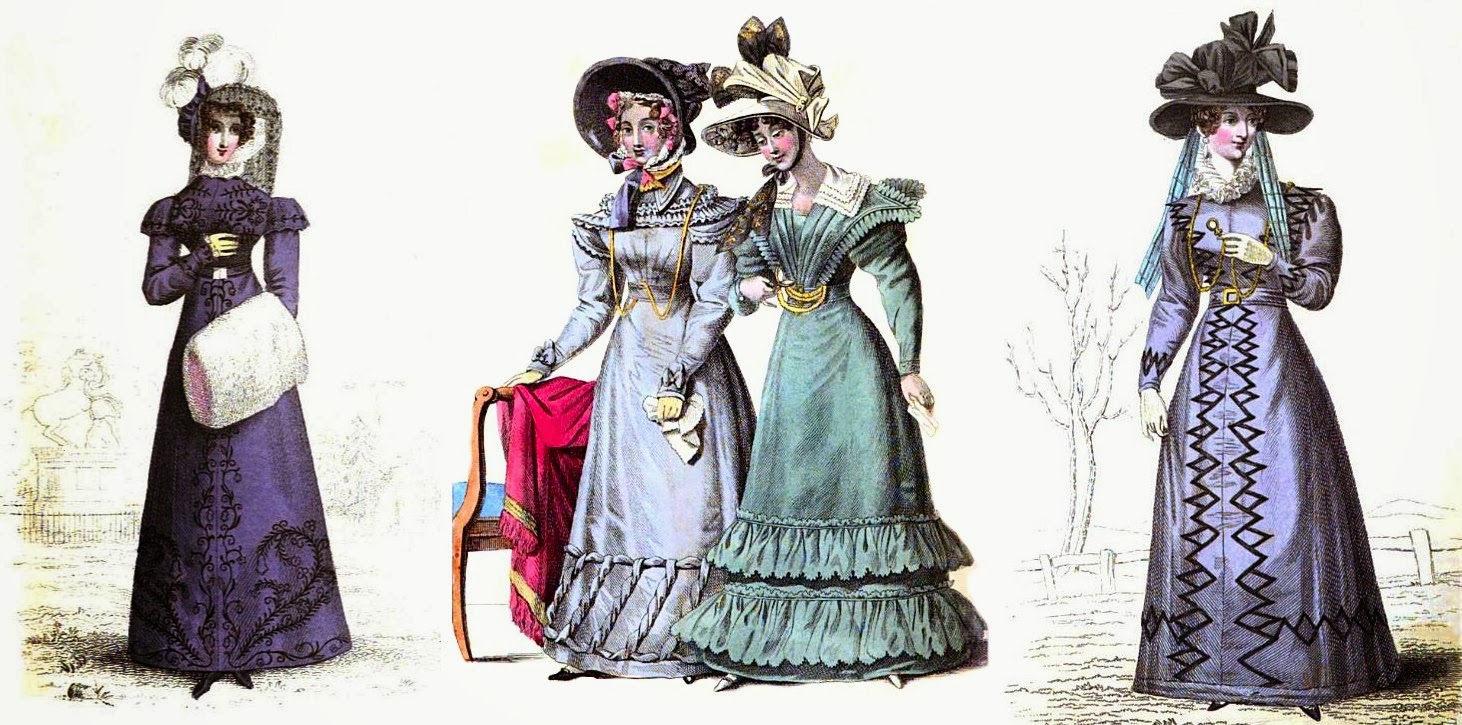
This series of fashion blogs takes a final look at outdoor wear, this time in the post-Regency period, using the fashion pages from La Belle Assemblée in 1823 and 1827.

Walking dresses in the reign of George IV  from La Belle Assemblée (1823 and 1827)
Walking dresses in the reign of George IV
from La Belle Assemblée (1823 and 1827)
Spring 1823

“The braided pelisses, which were but partially patronized on their first appearance, are now in high favour with those ladies of rank who may be said to lead the fashions, and we, this month, present a specimen of this most appropriate and elegant out-door envelope to our subscribers.”

Walking dress   from La Belle Assemblée (Jan 1823)
Walking dress
 from La Belle Assemblée (Jan 1823)
“Over a round-dress of milk white bombazine or Norwich crape, is a close pelisse of puce colored cashmere, ornamented down the front and round the border with a peculiarly rich braiding in silk, the flowers of which represent the Caledonian thistle; two beautiful long branches of the same braiding rise from the points that terminate the bottom of the facings, and form a superb ornament in front, one each side of the border. The ornaments across the bust consist of a braiding in foliage only; but it has a very rich appearance, being composed of several rows reaching across the front to the forepart of each shoulder. The mancherons are plain, and are almost close to the sleeve; these are finished with one row of leaves in braiding.

A belt of black velvet, fastened in front with a polished steel buckle, confines the pelisse round the waist. The bonnet is of puce colored velvet, lined with white satin, and crowned with a plume of white ostrich feathers: a veil of Chantilly lace is thrown carelessly across the brim of the bonnet, but this is not always adopted; the bonnet is of a charming shape and becoming size, to our ideas better without the veil, especially at this season of the year, though much depends on fancy. A single frill of the finest Mechlin lace is worn round the throat; a muff of the white Siberian fox, with half-boots of puce-colored kid, and light doe-skin gloves, finish this promenade dress, in which is combined richness, elegance and simplicity.”
Bombazine is a twilled or corded dress fabric that was originally made of silk or wool and silk.
There seems to be some variety in the actual shade of puce, but it is generally a dark purple or brownish purple colour.
"Mancherons" are small, short sleeves or ornamental trimmings on the upper part of the sleeve.

Spring 1827

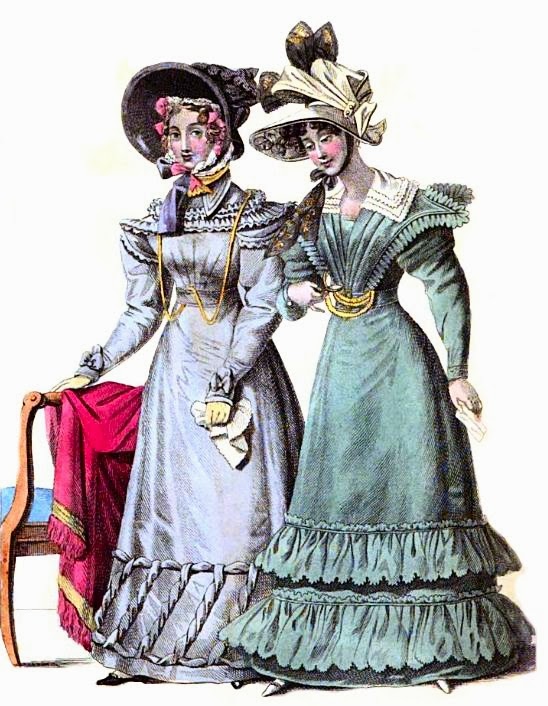
Walking dress (left) and morning dress (right)   from La Belle Assemblée (Jan 1827)
Walking dress (left) and morning dress (right)
 from La Belle Assemblée (Jan 1827)
Walking dress (on the left):
“A high pelisse-dress of slate-coloured gros de Naples, with a broad border, formed of twisted rouleaux, set on in bias stripes at separate distances, and confined above and beneath under a rouleau, which two rouleaux cross the skirt, and complete the border; the sleeves loose, with mancherons formed of double scallops trimmed round with quilling of gros de naples, pinked. A pelerine cape, the same as the dress, fastens behind, and is finished by a narrow falling collar of the same; above which is tied round the throat a pink silk sautoir. Under a plain black velvet bonnet is worn a cornette of British lace, ornamented with full-blown roses.”

"Gros de Naples" is a heavy silk with a dull finish.
"Rouleaux" are rolls or coils of ribbon or other material.

A quilling is a piece of quilled lace or other fabric used as a trim.
A pelerine cape is a lady's cape, often made of fur, but here made to match the dress, which tapers to long points in the front.
A sautoir is a long chain or beaded necklace, usually worn like a scarf, which was designed to imitate military braids or chains.
A cornette is a type of head covering. My research suggests that this was a type of wimple, usually made of starched white material, with long tails that could be tied up, left free or folded upwards to represent horns!

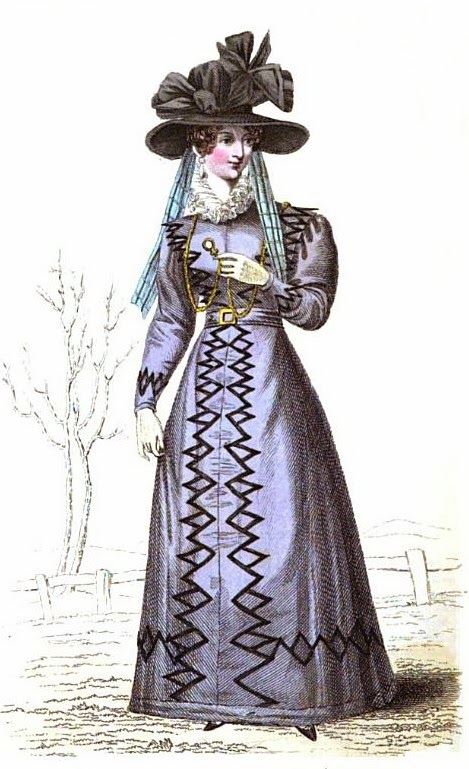
Walking dress   from La Belle Assemblée (Mar 1827)
Walking dress
 from La Belle Assemblée (Mar 1827)
“This dress, though apparently second, or fancy-mourning, is still in high favour, and is the last novelty we may look for in the pelisse department, till the approaching spring. It is of French grey gros de Naples, fancifully trimmed round the border, and down each side of the front, in diamonds and zig-zags of black velvet: a double row of these ornaments is carried down each side of the bust, in the Anglo-Greek style. The sleeves are only moderately full, with a double row of antique points at the wrists, edged round with narrow black velvet. The pelisse is without a collar, and is finished at the throat by a triple ruff of fine lace. The bonnet worn with this dress is of a correspondent colour: it is gros de Naples, and trimmed with large bows and puffs of the same, with broad strings of ribbon in shaded stripes, floating loose. Black kid slippers, white doe-skin gloves. Round the neck is worn a gold chain with an eye-glass.”

My observations

Note the change in the shape of the sleeves and the increasingly large hats. I love the inclusion of the eye-glass as an accessory to the last outfit.

Sources used include:
Bell, John, La Belle Assemblée, various (1823, 1827)