Search this blog

Showing posts with label Parliament. Show all posts

Friday, 22 January 2016

Elizabeth Fry - prison reformer (1780-1845)

Elizabeth Fry from Elizabeth Fry, the angel of the prisons by LE Richards (1916)
Elizabeth Fry from Elizabeth Fry, the angel of the prisons
by LE Richards (1916)
Profile

Elizabeth Fry (née Gurney) (21 May 1780 – 13 October 1845) was a Quaker minister famous for her pioneering work in prison reform. She was featured on the British £5 note from 2001-2016.

An unhappy childhood

Elizabeth Gurney was born in Norwich, Norfolk, on 21 May 1780, one of the 12 children of John Gurney and Catherine Bell. Both her parents were from families that belonged to the Religious Society of Friends, more commonly referred to as the Quakers. John Gurney was a wealthy businessman operating in the woollen cloth and banking industries.

Elizabeth, known as Betsy, was moody, often unwell and tormented by numerous fears. She was dubbed stupid by her siblings for being slow to learn, but was most probably dyslexic. In 1792, Betsy was devastated when her mother died.

Conversion

Betsy’s family were ‘gay’ Quakers as opposed to ‘plain’ Quakers. Though they attended the weekly Quaker meetings, they did not abstain from worldly pleasures like the theatre and dancing or wear simple clothes as ‘plain’ Quakers did.

In 1798, an American Quaker named William Savery visited the Friends’ Meeting House in Goat Lane where the Gurneys worshipped. Betsy had a spiritual experience which was strengthened later that year when she met Deborah Darby, a Quaker minister, who prophesied that Betsy would become “a light to the blind, speech to the dumb and feet to the lame.”1
 
Betsy gradually adopted the ways of a plain Quaker, wearing the simple dress and Quaker cap in which she is depicted on the British £5 note.

In 1811, Betsy became a minister for the Religious Society of Friends and started to travel around the country to talk at Quaker meetings.

Elizabeth Gurney from Elizabeth Fry, the angel of the prisons by LE Richards (1916)
Elizabeth Gurney from Elizabeth Fry, the angel of the
prisons
by LE Richards (1916)
Marriage and family

On 19 August 1800, Betsy married Joseph Fry, a plain Quaker whose business was tea and banking. They went to live in Mildred’s Court in Poultry, Cheapside, London, which was also the headquarters for Joseph’s business. In 1808, Joseph inherited the family estate at Plashet in East Ham, further out of London.

It was a fruitful marriage though not always a harmonious one. Joseph and Betsy had 11 children: Katherine (1801), Rachel (1803), John (1804), William (1806), Richenda (1808), Joseph (1809), Elizabeth (1811), who died young, Hannah (1812), Louisa (1814), Samuel Gurney (1816) and Daniel Henry (1822).

Betsy’s prison ministry

Throughout her life, Betsy was active in helping others. At Plashet, she established a school for poor girls, ran a soup kitchen for the poor in cold weather and was the driving force behind the programme for smallpox inoculation in the parish.

In 1813, while living at Mildred's Court, she visited the women’s wing of nearby Newgate Prison for the first time. Betsy was filled with compassion for the awful state of the women and took flannel clothes with her to dress their naked children.

The front of Newgate Prison from Old and New London Vol II by Walter Thornbury (1872)
The front of Newgate Prison
from Old and New London Vol II by Walter Thornbury (1872)
Over the next few years, Betsy’s life was absorbed by family issues, but in 1816, she resumed her visits to the women in Newgate Prison. With the support of the female prisoners, she set up the first ever school inside an English prison and appointed a schoolmistress from among the inmates.

Encouraged by her success, Betsy set out to help the women themselves. She read the bible to them and set up a workroom where the women could make stockings. All the female prisoners agreed to abide by Betsy’s rules. Against all odds, the scheme was successful. The women became more manageable and the atmosphere of the prison was transformed.

Elizabeth Fry in Newgate Prison from Elizabeth Fry, the angel of the prisons by LE Richards (1916)
Elizabeth Fry in Newgate Prison from Elizabeth Fry, the angel of the
prisons
by LE Richards (1916)
Fame and influence

News of Betsy’s success spread and she was inundated with requests for advice from prison authorities and ladies who wanted to set up prison visiting.

Over the years that followed, Betsy visited prisons up and down the country, in Scotland, Ireland and on the continent. She became one of the foremost authorities on prison conditions and twice spoke as an expert witness on the subject to Parliamentary Select Committees – in 1818 and again in 1835.

Many of Betsy’s recommendations were included in the Prison Act of 1823 and in 1827 she published Observations on the Visiting, Superintendence and Government of Female Prisoners which became a manual for good management of prisons and prison visiting.

Family problems

Betsy found it hard to balance family life with her extensive ministry. She was plagued continuously with ill health and oscillated between periods of intense activity and times of nervous exhaustion and depression. She often had to delegate her domestic responsibilities to her husband and other family members whilst she devoted herself to good works. Although Joseph always supported his wife, he sometimes complained that she neglected him.

The Frys were often forced to economise because of financial problems with Joseph’s business. Betsy’s brothers repeatedly came to their rescue, but in 1828, Joseph was declared bankrupt. They had to move permanently to a much smaller house in Upton Lane, Essex, and Joseph was expelled from the Society of Friends in disgrace.

Other areas of ministry

As well as her prison work, Betsy was able to improve the lot of women being transported to Australia for their crimes, providing them with a bundle of belongings to help each woman make a fresh start after their long voyage.

She instigated a project to provide libraries of books for the coastguards whose chief role of preventing smuggling made them isolated and unpopular. This was so successful that the government took over the project and extended it to the navy.

Betsy also set up the first nursing academy, to train nurses who could go into private homes and provide care for those who could not normally afford it.

A fitting end

Betsy died on 13 October 1845 whilst on a holiday in Ramsgate. Her funeral was held at the Friends’ Meeting House in Barking on 20 October. The funeral procession from her house to Barking was over half a mile long. Even more mourners waited in Barking to celebrate the life of this remarkable woman.

In 1914, a marble statue of Elizabeth Fry was erected inside the Old Bailey in London, on the site of the Newgate Prison where her prison ministry had begun.

Headshot of Rachel Knowles author with sea in background(2021)
Rachel Knowles writes clean/Christian Regency era romance and historical non-fiction. She has been sharing her research on this blog since 2011. Rachel lives in the beautiful Georgian seaside town of Weymouth, Dorset, on the south coast of England, with her husband, Andrew.

Find out more about Rachel's books and sign up for her newsletter here.

If you have enjoyed this blog and want to encourage me and help me to keep making my research freely available, please buy me a virtual cup of coffee by clicking the button below.

Notes
(1) From the journal of Elizabeth Fry, 4 September 1798, as recorded in Life of Elizabeth Fry: compiled from her journal, as edited by her daughters, and from various other sources by Susanna Corder (1853).
(2) Corder, De Haan, Hatton and Isba all record Elizabeth Fry's death as the 13 October 1845, but some sources state the 12th.

Sources used include:
Corder, Susanna, Life of Elizabeth Fry: compiled from her journal, as edited by her daughters, and from various other sources (1853)
De Haan, Franciscas, Fry (née Gurney) Elizabeth (1780-1845), Oxford Dictionary of National Biography (Oxford University Press, 2004; online edn May 2007, accessed 24 Aug 2015)
Hatton, Jean, Betsy - the dramatic biography of prison reformer Elizabeth Fry (2005)
Isba, Anne, The Excellent Mrs Fry - unlikely heroine (2010)

Friday, 8 November 2013

Henry Bankes (1757-1834)

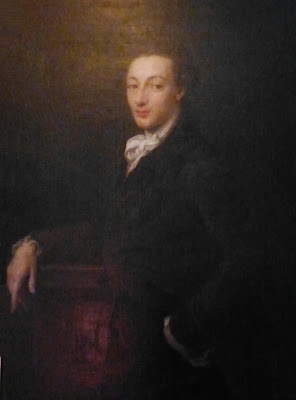
Henry Bankes the Younger
Henry Bankes the Younger by Pompeo Batoni (1779)
In the library at Kingston Lacy
Profile

Henry Bankes (19 December 1757–17 December 1834) was a Tory MP and a trustee of the British Museum. He owned Kingston Lacy and the Corfe Castle estate in Dorset.

Family

Henry Bankes was born on 19 December 1757, the son of Henry Bankes, a wealthy Dorset landowner, and Margaret Wynne, daughter of the Bishop of Bath and Wells. The Bankes estate encompassed Corfe Castle and the surrounding Dorset countryside including the family seat of Kingston Lacy near Wimborne. 
 
The family also owned a lucrative black lead mine in Cumberland. Henry inherited the estate on the death of his father in 1776.

Kingston Lacy
Kingston Lacy
Education

Henry was educated at Westminster Hall and went up to Trinity Hall, Cambridge, in 1773 where he became friends with William Pitt. In 1778, he went on the Grand Tour and had his portrait painted by Pompeo Batoni in Rome in 1779. Whilst in Rome, he met John Soane and Robert Furze Brettingham, two young English architects who both drew up designs for remodelling Kingston Hall.

Tory MP

From 1780 to 1831, Henry served as a Tory MP, representing Corfe Castle (1780-1826) and then Dorset (1826-31). He was a great opponent of the American War of Independence and became a fierce enemy of Catholic Emancipation and other political reforms which led to his failure in the 1831 election.

Corfe Castle, Dorset
Throughout the majority of his parliamentary career, Henry kept a journal which provides an extensive account of the day-to-day business of the House of Commons.1

On 26 July 1832, the Tories held a dinner for him in Dorchester to celebrate fifty years of parliamentary service.

A man of principle

Although Henry generally supported the government of his friend, William Pitt the Younger, his “attachment to his friend was always restrained and regulated by high public principle” and his “independent mind revolted at every sacrifice of principle to private friendship.”2
 
He was also a friend of the Duke of Wellington.

William Pitt the Younger
from Posthumous Memoirs of his own time
by N Wraxall (1836)
A man of good sense

Nathaniel Wraxhall described Henry Bankes in his Memoirs:
His talents compensated by their calm solidity, for the want of brilliancy; his enunciation, slow, formal, precise, and not without some degree of embarrassment, was nevertheless always controlled by judgment, caution, and good sense. No man displayed more rectitude of intention, independence of mind, and superiority to every private object of interest, or of ambition.2
However, he went on to describe Henry’s manners as “altogether cold, repulsive, and destitute of amenity.”2

Family life

On 18 August 1784, Henry married Frances Woodley, a celebrated beauty and the daughter of William Woodley, the governor of the Leeward Islands. She brought the sum of £6,000 to the marriage.

Frances Woodley by George Romney (1780-1)
In the drawing room at Kingston Lacy
They had six children: Henry (1785), William (1786), George (1787), Edward (1794), Anne (1789) and Maria (1791).

Kingston Hall remodelled

After his marriage, Henry embarked on the huge task of altering Kingston Hall according to Brettingham’s design. The revised layout included the creation of a new entrance on the east side of the building, a kitchen block outside of the main house, a new dining room and a magnificent ballroom.

In December 1791, the Bankes family held a ball to celebrate the completion of the building works.
 

A reenactment of Frances Bankes' ball  at Kingston Lacy (2013)
A reenactment of Frances Bankes' ball
at Kingston Lacy (2013)
Antiquarian

Henry was a trustee of the British Museum and was active in parliament on its behalf.

The hall and staircase of the British Museum
from The Microcosm of London (1808-10)
In 1818, he published The Civil and Constitutional History of Rome from its Foundation to the Age of Augustus.

Death

Tregothnan House, Cornwall,
from Devonshire and Cornwall illustrated
by J Britton & EW Brayley (1832)
Henry Bankes died on 17 December 1834 in Tregothnan, Cornwall, at the home of his daughter Anne and her husband, Lord Falmouth. He was buried at Wimborne Minster, Dorset, on 24 December.

Wimborne Minster
Wimborne Minster
from The Beauties of England and Wales
by J Britton & EW Brayley (1803)

Headshot of Rachel Knowles author with sea in background(2021)
Rachel Knowles writes faith-based Regency romance and historical non-fiction. She has been sharing her research on this blog since 2011. Rachel lives in the beautiful Georgian seaside town of Weymouth, Dorset, on the south coast of England, with her husband, Andrew.

Find out more about Rachel's books and sign up for her newsletter here.

If you have enjoyed this blog and want to encourage us and help us to keep making our research freely available, please buy us a virtual cup of coffee by clicking the button below.

 
Notes
1. This journal comprises 177 notebooks which are in the archives of the Dorset records office.
2. Posthumous Memoirs of his own time by N Wraxhall (1836).

Sources used include:
Ackermann, Rudolph, and Pyne, William Henry, The Microcosm of London or London in miniature Volume 1-3 (Rudolph Ackermann 1808-1810, reprinted 1904)
Britton, John & Brayley, Edward Wedlake, Devonshire and Cornwall illustrated, from original drawings by T Allom, WH Bartlett etc with historical and topographical descriptions (1832)
Britton, John & Brayley, Edward Wedlake, The Beauties of England and Wales (1803, London)
Farrell, SM, Bankes, Henry (1757-1834) Oxford Dictionary of National Biography (Oxford University Press, 2004; online edn Jan 2008, accessed 3 Oct 2013)
The National Trust, Kingston Lacy (guidebook) (1994)
Wraxall, Sir Nathaniel William, Posthumous Memoirs of his own time (1836)

Photographs © Andrew Knowles - RegencyHistory.net

Saturday, 21 July 2012

William Pitt the Younger (1759-1806)

William Pitt  from Memoirs of George IV by Robert Huish (1830)
William Pitt
from Memoirs of George IV by R Huish (1830)
Profile

William Pitt (28 May 1759 - 23 January 1806) was a Tory MP who served as First Lord of the Treasury, effectively prime minister, from 19 December 1783 to 14 March 1801 and again from 10 May 1804 until his death in 1806. He first took on this role aged 24 years and 205 days (1) making him the youngest prime minister to date.

Family and early years

William Pitt was born in Kent on 28 May 1759, the second son of William Pitt, Earl of Chatham, and Lady Hester Granville. He was designated 'Pitt the Younger' to distinguish him from his father who had also served as First Lord of the Treasury.

From an early age, he demonstrated a very keen, able mind and a determination to follow in his father’s footsteps in parliament. He suffered from frequent bouts of ill health, for which he was prescribed port wine, and so was educated at home by the Reverend Edward Wilson. He went up to Pembroke College, Cambridge, in April 1773, at the early age of 14.
  
Cambridge University

Pembroke College, Cambridge  from Memorials of Cambridge by CH Cooper (1829)
Pembroke College, Cambridge
from Memorials of Cambridge by CH Cooper (1829)
At Cambridge, he pursued his love of the classics and mathematics and developed his debating skills. He socialised little outside the university grounds, where he had a small group of friends including his tutor, George Pretyman, and William Wilberforce.

Because of his ill health, he used his right as the son of a nobleman to graduate without taking exams. He continued to reside at the college until financial necessity forced him to take up a profession after the death of his father.

In 1780, Pitt was called to the bar and joined the western circuit as a barrister. He witnessed the Gordon Riots from his rooms in Lincolns Inn.

William Pitt the Younger  from Posthumous Memoirs of his own time  by N Wraxall (1836)
William Pitt the Younger
from Posthumous Memoirs of his own time
by N Wraxall (1836)
Pitt enters politics

In the general election of 1780, Pitt stood as a candidate for Cambridge University but was returned at the bottom of the poll. However, in a by-election the following January, he was elected to the borough of Appleby through the influence of the Duke of Rutland.

On 26 February 1781, Pitt gave his maiden speech in the House of Commons. According to Debrett, his voice was “rich and striking, full of melody and force; his manner easy and elegant; his language beautiful and luxuriant. He gave in this first essay, a specimen of eloquence, not unworthy the son of his immortal parent” (2).

Chancellor of the Exchequer

Pitt became Chancellor of the Exchequer under Shelburne but declined to take over the government when Shelburne’s ministry failed. The King was forced to ask the Duke of Portland to form a government, backed by a coalition of Fox and North.

Pitt became a member of the opposition, but when the King vehemently opposed the proposed reforms of the East India Company and declared that any who voted in favour would be counted his enemies, his moment had come. The government collapsed and the King offered the leadership to Pitt who was now ready to accept it. In the general election that soon followed, Pitt was elected member for the University of Cambridge and obtained a significant majority.

Pitt’s first ministry (1783-1801)

During Pitt's ministry he took steps to reduce the national debt, reformed the administration of the East India Company and the collection of excise duties, introduced the first income tax and supported the abolition of slavery. Pitt’s leadership was threatened by the Regency crisis of 1788 when it looked like the Prince of Wales would be made Regent and his friend Fox would come into power, but the King recovered.

Charles James Fox  from Memoirs of George IV by Robert Huish (1830)
Charles James Fox
from Memoirs of George IV by R Huish (1830)
After the French Revolution, there was the threat of rebellion in Ireland and renewed war with France. Pitt saw the Act of Union as the solution to the Irish problem, but when he proposed to allow Irish Catholics into Parliament, the King was outraged and on 3 February 1801, Pitt resigned, returning the seals of office on 14 March, and Henry Addington took over.

Pitt’s second ministry (1804-1806)

When Addington resigned in April 1804, Pitt was again asked to form a government. Pitt wanted to include Fox and Grenville in his cabinet, but the King refused to accept Fox, and Grenville refused to serve without him, and so Pitt was forced to manage without either of these talented men. Pitt struggled continually to hold the government together under the strains of war and the impeachment of the corrupt Lord Melville.
  
Pitt's house in Bath in 1802
The private life of Pitt

Pitt was a man with few vices. Lord Macaulay wrote: “The correctness of his private life added much to the dignity of his public character.”(3) He drank port heavily, but was rarely drunk. He had a strong inclination towards gambling, but had the prudence and resolution of character to prevent his taste for play from becoming a habit. Though unmarried, he did not keep a mistress. His niece Hester Lucy Stanhope lived with him for the last three years of his life.

Married to his career

Only once did Pitt consider marriage – to Eleanor Eden, eldest daughter of Lord Auckland – but whilst expressing great affection for her in a letter to her father, he stated that circumstances made marriage impossible. There was some speculation that he was homosexual, but his lack of involvement with women may simply have resulted from shyness coupled with ill health and a busy life committed to politics.

An affectionate friend

Pitt had few friends but in the small circle of his intimate associations, he was amicable, affectionate, even playful. He frequently stayed at Wilberforce's house in Wimbledon and accompanied him to the continent in the summer of 1783.

William Wilberforce  from The Life of William Wilberforce  by Robert and Samuel Wilberforce (1839)
William Wilberforce
from The Life of William Wilberforce
by Robert and Samuel Wilberforce (1839)
He did not patronise the arts and rarely went into society, especially after the outbreak of war in 1793. He spent time at his home in Holwood, Kent, where he enjoyed improving the grounds and farming sheep and also at Walmer Castle, which he had held as warden of the Cinque Ports since 1792.

Walmer Castle, Kent  from England's Topographer or a new and complete history  of the county of Kent by WH Ireland (1829)
Walmer Castle, Kent
from England's Topographer or a new and complete history
of the county of Kent by WH Ireland (1829)
Pitt in debt

Although neither a gambler nor a family man, Pitt was extravagant and somewhat careless with the generous income that he received whilst in power. By the time he died, he had amassed debts of £40,000, which the House of Commons obligingly voted money to satisfy.

Illness and death

The strain of government took its toll on Pitt’s health. He visited Bath in December 1805 but was no better when he returned to his villa in Putney in January. Pitt died on 23 January 1806. He was given a state funeral on 22 February and buried in Westminster Abbey near his father.

Notes
(1) From the Gov.uk website (see link below).
(2) From The Parliamentary Register or History of the Proceedings and Debates of the House of Commons - 26 February 1781 - edited by Debrett.
(3) From Lord Macaulay's The Life of William Pitt (1859)

Sources used include:
Debrett (ed), The Parliamentary Register or History of the Proceedings and Debates of the House of Commons during the first session of the Fifteenth Parliament of Great Britain (1781)
Ehman, JPW and Smith, Anthony, Pitt, William (1759-1806) Oxford Dictionary of National Biography (Oxford University Press, 2004; online edn May 2009, accessed 20 July 2012)
Huish, Robert, Memoirs of George IV (Thomas Kelly, 1830, 1831, London)
Ireland, William Henry, England's Topographer or a new and complete history of the county of Kent (G Virtue, 1829, London)
Macaulay, Lord, The Life of William Pitt (The Riverside Press, 1859, Cambridge)
Pollock, John, Wilberforce (Constable, 1977; Kingsway, 2007, Eastbourne)
Wraxall, Sir Nathaniel William, Posthumous Memoirs of his own time (1836)

History of Parliament online: William Pitt
Gov.uk website: past prime ministers

All photographs © Andrew Knowles - www.flickr.com/photos/dragontomato

Friday, 11 May 2012

The Assassination of Spencer Perceval 11 May 1812

Spencer Perceval,  from The Life and Administration of the  Right Hon. Spencer Perceval  by Charles Williams (1813)
Spencer Perceval from The Life and Administration of the
Right Hon. Spencer Perceval by Charles Williams (1813)
On 11 May 1812, Spencer Perceval was assassinated. He remains the only British Prime Minister to have been assassinated.

A difficult political situation

Spencer Perceval became First Lord of the Treasury in 1809 when the Duke of Portland’s health made it impossible for him to continue leading the government. He was not the King’s first choice, but such was the division in the government at the time that many of the politicians refused to serve with one another. Perceval was eventually chosen to form a cabinet, effectively making him Prime Minister. He also kept the role of Chancellor of the Exchequer as no one else would accept it.

The assassination

The June 1812 issue of La Belle Assemblée included a long account of the assassination of Perceval and subsequent trial of his murderer. It gave the following account of the assassination:
On the 11th May, about a quarter past five, as the Right Honourable Spencer Perceval, Chancellor of the Exchequer and First Lord of the Treasury &c. &c. was entering the lobby of the House of Commons, he was shot by a person of the name of Bellingham, who had place himself for that purpose at the side door leading from the stone staircase. Mr Perceval was in company with Lord F Osborne, and immediately on receiving the Ball, which entered the left breast, he staggered and fell at the feet of Mr W Smith, MP for Norwich, who was standing near the second pillar. The only words he uttered were – “Oh! I am murdered,” and the latter was inarticulate, the sound dying between his lips. He was instantly taken up by Mr Smith, who did not recognise him until he had looked in his face. The report of the pistol immediately drew great numbers to the spot, who assisted Mr Smith in conveying the body of Mr Perceval into the Speaker’s apartments, but before he reached them, all signs of life had departed.1
The assassin

John Bellingham, a disgruntled bankrupt, shot Perceval as the figurehead of the government which he held responsible for his financial misfortune. Had he been of a mind to escape, he probably could have done so, as little attention was paid him in the furore surrounding the fallen Perceval. However, such was not his intention. Bellingham was arrested, tried at the Old Bailey, pronounced guilty and sentenced to death.

Tribute to Perceval 

Before the death sentence was given, the Recorder spoke these words:
You have been guilty of the murder of a person whose suavity of manners disarmed hostility and rancour. By his death charity has been deprived of its warmest friend, and religion of its best support, and the country of its greatest ornament. A man whose public character and talents were capable of saving his country. The murder you have perpetrated in the midst of unarmed men, confiding in their innocence and the sacred functions vested in them by their country, and in the very sanctuary of the law.2
Spencer Perceval,  from The Georgian Era (1832)
Spencer Perceval
from The Georgian Era (1832)
This post was written on 11 May 2012 to celebrate the 200th anniversary of Spencer Perceval's assassination. 

Notes
1. Bell, John, La Belle Assemblée (May 1812)
2. Ibid.
Sources used include:
Bell, John, La Belle Assemblée (1812, London)
Clarke, The Georgian Era (Vizetelly, Branston and Co, 1832, London)
Williams, Charles, The Life and Administration of the Right Hon. Spencer Perceval (1813)

Wednesday, 11 April 2012

Wilberforce and the abolition of the slave trade

William Wilberforce  from The Great and Good (1855)
William Wilberforce
from The Great and Good (1855)
Wilberforce in Parliament

Wilberforce’s political career started in September 1780 when he was elected MP for Hull at the age of twenty-one, having spent £8000 ‘buying’ supporters at the going rate of two guineas a vote, as was the custom at the time. Four years later, he was elected one of the MPs representing the County of York, a prestigious but demanding role from which he resigned in 1812 due to ill health. He then became an MP for the pocket borough of Bramber in Sussex. This enabled him to stay in the Commons but was less taxing on his health and allowed him to spend more time with his family.

The independent politician

Wilberforce’s private resources allowed him to be independent of any political party as he did not need to seek a paying public office. He was a passionate speaker and was able to captivate the house whenever he spoke. His earliest recorded speeches were on smuggling and naval shipbuilding – things close to the heart of his Hull constituents – but it was not until he took up the anti-slavery cause that his political contribution became significant.

The abolitionist cause

After his conversion to evangelical Christianity, Sir Charles and Lady Middleton and Thomas Clarkson urged Wilberforce to take up the plight of slaves in Parliament. After a pivotal discussion with William Grenville and William Pitt the Younger under an oak tree at Holwood in Kent – later known as the “Wilberforce oak” – Wilberforce became fully committed to the cause and thereafter sought the abolition of the slave trade.

Wilberforce launched his campaign for the abolition of slavery on 12 May 1789 and continually brought the matter before Parliament despite repeated disappointment and opposition. In 1791, he helped his friend, Henry Thornton, to establish the Sierra Leone Company to resettle former slaves and promote legitimate trade and on 31 January 1807, his book, A Letter on the Abolition of the Slave Trade, was published. Finally, Wilberforce’s perseverance was rewarded and the Abolition of the Slave Trade Act received royal assent on 25 March 1807.

Front cover of A Letter on the Abolition of the Slave Trade by Wilberforce

But Wilberforce’s efforts did not stop there. The Anti-Slavery society was created in 1823 and, for the rest of his life, he worked towards the total abolition of slavery.

The Clapham Sect

During the 1790s and 1800s, Wilberforce was a leading member of the group of evangelical Christians known as the Clapham Sect, so named because of their location around the green at Clapham. These included Henry Thornton, Edward Eliot, Charles Grant, Zachary Macaulay, John Shore (Lord Teignmouth), and James Stephen (who married Wilberforce’s sister, Sarah, in 1800).

He was informally recognized as the leader of the group of evangelical ‘Saints’ in Parliament and the second great cause in his life was to promote true Christian values – what he called “the reformation of manners”.

With this in mind, Wilberforce successfully urged George III to issue a proclamation for the encouragement of piety and virtue on 1 June 1787 and in April 1797, his work, A practical view of the prevailing religious system of professed Christians in the higher and middle classes of this country contrasted with real Christianity, was published. Although this was unfashionable, it was widely read and influential.

The Queen Caroline Affair

On 6 June 1820, Queen Caroline returned from her exile on the continent, claiming her right to be crowned as Queen, despite the attempts of her adviser, Lord Brougham, to prevent her return to England. The injured Queen became a figurehead for the political unrest that had been made worse by the Peterloo Massacre of 16 August 1819. George IV wanted to put his wife on trial for adultery so that he could divorce her.

Wilberforce feared that in the current state of unrest, such a move could lead to revolution. He proposed that the “Green Bag” debate over the Queen’s alleged adultery be adjourned, giving time for the King and Queen to reach a settlement outside of the courts. The move was enthusiastically taken up and in the process nearly brought the government down.

Wilberforce presented a Motion for an Address to the Queen, and was encouraged by Lord Brougham to believe that the Queen would accept the omission of her name from the liturgy. The Queen refused. The failure of Wilberforce’s attempts at mediation led to the trial of Queen Caroline and subsequent exclusion from the coronation ceremony.

Princess Caroline of Brunswick
from Huish's Memoirs of her late
 royal highness Charlotte Augusta (1818) 
Wilberforce’s legacy

Wilberforce resigned from politics in 1825 due to ill health and died on 29 July 1833, three days after the Abolition of Slavery Bill had passed its third hearing in the House of Commons. It came into force the following year. Wilberforce was honoured by members of both Houses and buried in Westminster Abbey. He will always be remembered for his perseverance in the struggle against slavery.

Read more about the rest of Wilberforce's life
 
Sources used include:
Cooper, Charles Henry, Memorials of Cambridge (1861, William Metcalfe)
Huish, Robert, Memoirs of George IV (1830, Thomas Kelly) 
Pollock, John, Wilberforce (1977, Constable)
Price, Thomas, Memoir of William Wilberforce (1836, Light & Stearns, Boston)
Seeley, Jackson & Halliday, The Great and Good ( 1855, Seeley, Jackson & Halliday)
Vizetelly & Branston, The Georgian Era (1832, Vizetelly, Branston & Co.)
Weale, John, The Pictorial Handbook of London (1854, Henry G Bohn)
Wilberforce, Robert Isaac and Samuel, The Life of William Wilberforce (1839, John Murray)

Tuesday, 10 April 2012

William Wilberforce (1759-1833)

William Wilberforce  from The Life of William Wilberforce  by Robert and Samuel Wilberforce (1839)
William Wilberforce
from The Life of William Wilberforce
by Robert and Samuel Wilberforce (1839)


Profile

William Wilberforce (24 August 1759 - 29 July 1833) was a highly influential politician who was instrumental in the abolition of the slave trade.

Family background
 
William Wilberforce was born in Hull on 24 August 1759, the only son of Robert Wilberforce and Elizabeth Bird. His father was a merchant, as was his grandfather, who had amassed considerable wealth through trade with the Baltic.

When his father died prematurely in 1768, Wilberforce was sent to London to live with his aunt and uncle, William and Hannah Wilberforce. However, when his grandfather and mother realised that he was being influenced by Hannah’s Methodist beliefs, Wilberforce was taken back to Hull, where his predilection for evangelicalism was temporarily quashed.

Friendship with Pitt

St John's College, Cambridge  from Memorials of Cambridge  by Charles Henry Cooper (1861)
St John's College, Cambridge
from Memorials of Cambridge
by Charles Henry Cooper (1861)
Wilberforce went up to St John’s College, Cambridge in October 1776 where he obtained a BA in 1781 and an MA in 1788. Whilst at Cambridge, he became friends with William Pitt the younger, who was also intent upon a career in politics. Wilberforce entered Parliament in 1780, just a few months before Pitt, who entered the following January.

William Pitt  from Memoirs of George IV  by Robert Huish (1831)
William Pitt
from Memoirs of George IV
by Robert Huish (1831)
Pitt often stayed at Wilberforce’s house in Wimbledon. They were members of the same clubs, in particular, Goostree’s, a Pall Mall club where around twenty-five Cambridge contemporaries, whom Wilberforce referred to as “The Gang”, met regularly. Pitt and Wilberforce travelled together to France in the autumn of 1783 with another friend, Edward Eliot. Their relationship was strained from time to time by political differences, but they remained friends until Pitt’s death in 1806.

Conversion

In 1785, after travelling extensively with Isaac Milner, later Dean of Carlisle, Wilberforce had a Christian conversion experience. He considered giving up politics, but was persuaded not to by the urging of both his good friend, Pitt, and the evangelical ex-slave master, John Newton. Wilberforce demonstrated an ability to combine spiritual earnestness with charm and tact whilst his Christian principles gave him integrity and perseverance.

What was Wilberforce like?

Wilberforce was known to his friends as Wilber; none of his friends called him William. He was short in stature and, in later years, he developed a curvature of the spine which caused him to become bent over. Although he suffered from weak eyes, he did not wear spectacles; as a man of fashion, he used only an eye-glass on a riband. His conversation was witty and he had a good singing voice. However, he was not a good time keeper, was inclined to be lazy, and gained a reputation for being the noisiest member in the House.
William Wilberforce aged 20 from The Life of William Wilberforce by RI & S Wilberforce (1839)
William Wilberforce aged 20
from The Life of William Wilberforce
by RI & S Wilberforce (1839)
Marriage and family life

On 15 April 1797, whilst in Bath, Wilberforce met Barbara Ann Spooner, the daughter of a Birmingham banker. He proposed within a fortnight and the couple were married at Walcot Church in Bath on 30 May. Wilberforce was a devoted husband and father to his six children: William (1798), Barbara (1799), Elizabeth (1801), Robert (1802), Samuel (1805), and Henry (1807). Sadly, both his daughters died before him and his eldest son caused him much grief and financial loss. The younger sons, however, took orders, which delighted their father.

Ill health and opium

Wilberforce suffered from ill health throughout much of his life and often travelled to Bath to recuperate. He was prone to stress-related illness, probably ulcerative colitis, and to combat a bout of this illness in February 1788, he started to use opium; he regularly used this to combat his intestinal disorders for the rest of his life.

A fitting farewell

Following a further period of illness, Wilberforce resigned from politics in 1825. He died in London on 29 July 1833. Such was the esteem in which Wilberforce was held that, despite his own desire for a quiet funeral, many eminent persons requested permission from his family for him to be buried at Westminster Abbey.

The funeral was held on 3 August, attended by thousands of mourners, including many distinguished persons from both houses. The pall bearers included the Duke of Gloucester; the Lord Chancellor, Lord Brougham; and the Speaker of the House of Commons, Charles Manners-Sutton, later, Viscount Canterbury. 

North end of transept in Westminster Abbey  from The Pictorial Handbook of London (1854)
North end of transept in Westminster Abbey
from The Pictorial Handbook of London (1854)
Read more about Wilberforce's political career

Sources used include:
Cooper, Charles Henry, Memorials of Cambridge (1861, William Metcalfe)
Huish, Robert, Memoirs of George IV (1830, Thomas Kelly) 
Pollock, John, Wilberforce (Constable, 1977; Kingsway, 2007, Eastbourne)
Price, Thomas, Memoir of William Wilberforce (1836, Light & Stearns, Boston)
Weale, John, The Pictorial Handbook of London (1854, Henry G Bohn)
Wilberforce, Robert Isaac and Samuel, The Life of William Wilberforce (1839, John Murray)