 |
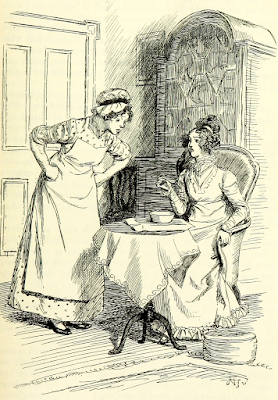
Like her father, Mr Woodhouse, Mrs John Knightley
liked a basin of gruel for supper, but her cook
was unable to make anything tolerable
from Emma by Jane Austen
1896 edition illustrated by Hugh Thomson
|
What was
supper in the Regency period?
I use the
word supper interchangeably with dinner to mean my main evening meal. But if we
have an early dinner, my hungry husband is sometimes looking for a bite of
supper before he goes to bed! It is this latter use of the word that is more
akin to what a Regency person would have understood by the term supper.
Samuel
Johnson’s 1785 dictionary states:
Supper:
The last meal of the day; the evening repast.1
Was supper
a large meal?
What
people ate for supper and even whether they ate it at all varied. Though influenced
by personal preference, as a rule, the longer the gap between dinner and
bedtime, the more substantial the supper.
In Jane
Austen’s fragment of a novel, The Watsons, Emma Watson’s sister-in-law,
Mrs Robert Watson, declares:
I always wish to be treated quite
en famille when I come to see you. And now I do hope you have not been getting
a great dinner for us. Remember, we never eat suppers.2
In Fanny Burney’s Camilla, we see two other preferences for
supper – Mrs Arlbery providing a light supper and Mr Dennel excusing himself so
he could eat something more substantial:
Her father
[Mr
Dennel] was already gone home to a hot supper, which he had ordered in his
own room, and meant to eat before their return; Mrs Arlbery, to his great
discomfort, allowing nothing to appear at night but fruit or oysters.3
In Jane
Austen’s Sense and Sensibility, Mrs Jennings believes eating will help Marianne
Dashwood recover her spirits:
“Let her name her own supper, and go to bed.”4
Visiting
England in 1810, Don Manuel Alvare Espriella wrote:
Supper is
rather a ceremony than a meal; but the hour afterwards, over our wine and
water, or spirits, is the pleasantest in the day.5
This
suggests that supper sometimes involved more drinking as well as eating. A passage
in Jane Austen’s Mansfield Park supports this:
Edmund
said no more to either lady; but going quietly to another table, on which the
supper-tray yet remained, brought a glass of Madeira to Fanny, and obliged her to
drink the greater part.6
This
passage also makes mention of the supper-tray, which suggests that supper was
not always a sit-down meal at the dinner table.
 |
Cordial and glasses, Kew Palace
|
Supper at
evening entertainments
In Jane
Austen’s Emma, supper was the closing event of the evening’s
entertainment at Hartfield. The following excerpt also gives some ideas as to
the types of food served for supper:
The evening flew away at a very
unusual rate; and the supper-table, which always closed such parties, and for
which she [Emma] had been used to sit and watch the due time, was all set
out and ready, and moved forwards to the fire, before she was aware. With an
alacrity beyond the common impulse of a spirit which yet was never indifferent
to the credit of doing everything well and attentively, with the real good-will
of a mind delighted with its own ideas, did she then do all the honours of the
meal, and help and recommend the minced chicken and scalloped oysters, with an
urgency which she knew would be acceptable to the early hours and civil
scruples of their guests.
Upon such occasions poor Mr
Woodhouse's feelings were in sad warfare. He loved to have the cloth laid,
because it had been the fashion of his youth, but his conviction of suppers
being very unwholesome made him rather sorry to see anything put on it; and
while his hospitality would have welcomed his visitors to everything, his care
for their health made him grieve that they would eat.
Such another small basin of thin
gruel as his own was all that he could, with thorough self-approbation,
recommend; though he might constrain himself, while the ladies were comfortably
clearing the nicer things, to say:
“Mrs Bates, let me propose your
venturing on one of these eggs. An egg boiled very soft is not unwholesome.
Serle understands boiling an egg better than anybody. I would not recommend an
egg boiled by anybody else; but you need not be afraid, they are very small,
you see—one of our small eggs will not hurt you. Miss Bates, let Emma help you
to a little bit of tart—a very little bit. Ours are all
apple-tarts. You need not be afraid of unwholesome preserves here. I do not
advise the custard. Mrs Goddard, what say you to half a glass of wine? A
small half-glass, put into a tumbler of water? I do not think it could
disagree with you.”
Emma allowed her father to
talk—but supplied her visitors in a much more satisfactory style, and on the
present evening had particular pleasure in sending them away happy.7
 |
| Oysters were a Regency supper dish |
In Jane
Austen’s Pride and Prejudice, Mrs Phillips gives a dinner for some of the
officers and invites her nieces to join them after dinner:
Some of
them were to dine with the Phillipses the next day, and their aunt promised to
make her husband call on Mr Wickham, and give him an invitation also, if the
family from Longbourn would come in the evening. This was agreed to, and Mrs
Phillips protested that they would have a nice comfortable noisy game of
lottery tickets, and a little bit of hot supper afterwards.8
A supper
at Mrs Phillips’s house was a noisy affair:
They [Elizabeth
Bennet and Mr Wickham] continued talking together, with mutual satisfaction
till supper put an end to cards, and gave the rest of the ladies their share of
Mr Wickham’s attentions. There could be no conversation in the noise of Mrs
Phillips’s supper party, but his manners recommended him to everybody.9
Supper at
balls
It was
expected that supper would be provided at a ball. In Emma, this
caused some issues for the Westons during their planning for a ball at the Crown:
One perplexity, however, arose,
which the gentlemen did not disdain. It regarded a supper-room. At the time of
the ballroom's being built, suppers had not been in question; and a small
card-room adjoining, was the only addition. What was to be done? This card-room
would be wanted as a card-room now; or, if cards were conveniently voted
unnecessary by their four selves, still was it not too small for any
comfortable supper? Another room of much better size might be secured for the
purpose; but it was at the other end of the house, and a long awkward passage
must be gone through to get at it. This made a difficulty. Mrs Weston was
afraid of draughts for the young people in that passage; and neither Emma nor
the gentlemen could tolerate the prospect of being miserably crowded at supper.
Mrs Weston proposed having no
regular supper; merely sandwiches, &c., set out in the little room; but
that was scouted as a wretched suggestion. A private dance, without sitting
down to supper, was pronounced an infamous fraud upon the rights of men and
women; and Mrs Weston must not speak of it again.10
It later mentions that the dishes included “a delicate fricassee
of sweetbread and some asparagus” and soup.
Supper was
also provided by Mr Bingley at the ball at Netherfield in Pride and Prejudice.
After supper, ladies had the chance to play and sing before the dancing began
again:
At length,
however, Mrs Bennet had no more to say; and Lady Lucas, who had been long
yawning at the repetition of delights which she saw no likelihood of sharing,
was left to the comforts of cold ham and chicken. Elizabeth now began to
revive. But not long was the interval of tranquillity; for, when supper was
over, singing was talked of, and she had the mortification of seeing Mary,
after very little entreaty, preparing to oblige the company.11
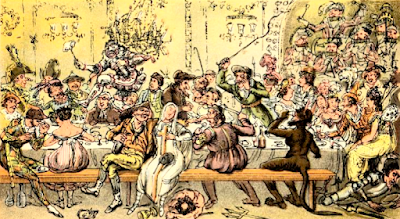 |
Tom & Jerry larking at a masquerade supper, at the Opera House
by IR & G Cruikshank in Tom and Jerry: Life in London
by P Egan (1869 first pub 1821) |
When was
supper time?
I imagine
that supper times varied as much as dinner times did.
You can read more about Regency dinner times here.
If at home
with their family and house guests, supper time would be set according to the
habits of the household and personal preference.
In Jane Austen’s Northanger Abbey, Catherine Morland and
Elinor Tilney did not finish supper until 11pm. This suggests that supper
started some time earlier, say at 10pm:
His loss was not now what it had
been while the general was at home; it lessened their gaiety, but did not ruin
their comfort; and the two girls agreeing in occupation, and improving in
intimacy, found themselves so well sufficient for the time to themselves, that
it was eleven o’clock, rather a late hour at the abbey, before they quitted the
supper-room on the day of Henry’s departure.12
If at a
ball or other evening entertainment, whether at home or elsewhere, supper would
be later, to better bridge the gap between dinner and bedtime. This might be at
1am or even later.
For example,
in December 1791, Frances Bankes held a ball at Kingston Lacy in Dorset. In a letter
to her mother-in-law, Frances wrote that the ball started around 9pm and included
a sit-down supper for around 140 people at 1am. After supper, the dancing
continued until about 7am.
You can read more about Frances’s ball here.
 |
The Gothic Conservatory, Carlton House
Published by Rudolph Ackermann (1811)
|
At the Prince Regent’s fête at Carlton House held on 19 June 1811, the company began
to arrive soon after 9pm, and the dancing started about midnight. Supper was
even later:
At three
o’clock supper was announced by the striking up of three bands of grand martial
music stationed in the gardens.13
You can read more about the Prince Regent’s fête here.
Rachel Knowles writes
clean/Christian historical romance set in the time of Jane Austen. She has been
sharing her research on this blog since 2011. Rachel lives in the beautiful
Georgian seaside town of Weymouth, Dorset, on the south coast of England, with
her husband, Andrew.
Find out more about Rachel's books and sign up for her newsletter here.
If you have enjoyed this blog and want to
encourage me and help me to keep making my research freely available, please buy
me a virtual cup of coffee by clicking the button below.
Notes
Johnson, Samuel, A Dictionary of the English Language (6th
edition 1785).
Austen, Jane, The Watsons (a fragment published in Austen-Leigh,
James Edward, Memoir of Jane Austen (1871)).
Burney, Fanny, Camilla (1796).
Austen, Jane, Sense and Sensibility (1811).
Espriella, Don Manuel Alvare, Letters from England, translated
from the Spanish by Robert Southey 3rd edition (1814) Volume 1.
Austen, Jane, Mansfield Park (1814).
Austen, Jane, Emma (1815).
Austen, Jane, Pride and Prejudice (1813).
Ibid.
Austen, Jane, Emma (1815).
Austen, Jane, Pride and Prejudice (1813).
Austen, Jane, Northanger Abbey (1817).
Bell, John, La Belle Assemblée (June 1811).
Sources used include:
Austen, Jane, Emma (1815)
Austen, Jane, Jane Austen's Letters, Collected and Edited by Le
Faye, Deirdre (Oxford University Press, 1995)
Austen, Jane, Mansfield Park (1814)
Austen, Jane, Northanger Abbey (1817)
Austen, Jane, Pride and Prejudice (1813)
Austen, Jane, Sense and Sensibility (1811)
Austen, Jane, The Letters of Jane Austen selected from the
compilation of her great nephew, Edward, Lord Bradbourne ed Sarah Woolsey
(1892)
Austen, Jane, The Watsons (a fragment published in Austen-Leigh,
James Edward, Memoir of Jane Austen (1871))
Bell, John, La Belle Assemblée (June 1811)
Burney, Fanny, Camilla (1796)
Cruickshank, Dan and Burton, Neil, Life in the Georgian City
(1990)
Dyche, Thomas and Pardon, William, A New General English Dictionary
(14th edition 1771)
Espriella, Don Manuel Alvare, Letters from England, translated
from the Spanish by Robert Southey 3rd edition (1814) Volume 1
Hassan Khan, Mirza Abul, A Persian at the Court of King George
1809-10, edited by Margaret Morris Cloake (1988)
Johnson, Samuel, A Dictionary of the English Language (6th
edition 1785)
Simond, Louis, Journal of a Tour and Residence in Great Britain,
during the years 1810 and 1811 (1815)
All photographs © Regencyhistory.net


