Did Napoleon’s troops fire
cannons at the pyramids of Egypt? And what was his army doing there?
Those were questions provoked
by the teaser trailer for the 2023 movie Napoleon. The second of these
questions is answered by this new book by Jonathan North, Napoleon’s Invasion
of Egypt.
The book’s subtitle, ‘An
Eyewitness History’, promises a wealth of firsthand accounts from the French
invasion and occupation of a corner of North Africa. It delivers on that
promise. This is a compelling account of that French adventure, told in the
words of many who were there.
 |
Napoleon at Arcole from The Life of Napoleon
Bonaparte by W Sloane 1896 |
An introduction to
Napoleon’s occupation of Egypt
While it’s titled the ‘Invasion
of Egypt’, Jonathan North’s book covers the full period of the French
occupation. Napoleon and his army arrived in July 1798 and the survivors left
three years later, in 1801. Bonaparte himself effectively abandoned his troops
in late 1800, sailing back to France, somehow evading the British Royal Navy.
The expedition was sent by the
Directory, the committee that ruled revolutionary France. Their star general,
Napoleon, proposed it, with a view to opening a land route to India.
It was also to be a scientific
expedition, taking scholars to examine the marvels of ancient Egypt. Their
discovery of the Rosetta Stone, the key to deciphering Egyptian writing, helped
to open up the field of Egyptology.
Napoleon and his army landed in
Egypt on 1 July 1798 and was immediately engaged in fighting the occupying
Mamelukes, rulers of Egypt under the distant auspices of the Ottoman Empire.
‘The boats were rowed to the
shore and a mass of cavalry showed itself and seemed ready to wade into the sea
to oppose the landing. A few rounds of artillery saw them off,’ wrote 18-
year-old soldier Joseph Laporte.1
The Battle of the Pyramids on
21 July inflicted a heavy defeat on the Mamelukes, allowing Napoleon to enter
Cairo and commence his occupation of Egypt.
Despite sweeping in as
victorious invaders, in only days the French became a beleaguered garrison. On
1 August 1798 a British fleet, under Horatio Nelson, defeated the warships of
the French fleet that had transported the army across the Mediterranean, at the
Battle of the Nile. The victory put the British in command of the sea, making
it unlikely that the plan to reach India could be fulfilled.
‘We realised that any
communication with Europe would now be impossible,’ wrote Captain Etienne Louis
Malus in his journal. ‘We began to lose hope that we would ever see our
homeland again.’2
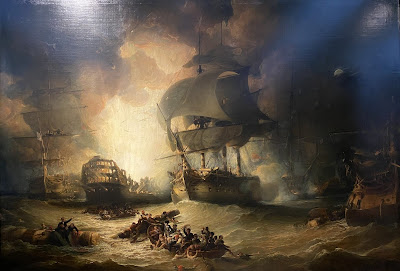 |
The Destruction of L'Orient at the Battle of the Nile
1 August 1798 by G Arnald (1825-7)
at National Maritime Musuem Photo A Knowles (2022) |
Occupation and assimilation
Napoleon set up a French administration
of Egypt that included some of the local rulers, and established a scientific
Institute. During their time in Cairo the French attempted to replicate
something of their culture from home, including street cafes. Some adopted a
local style of dress, partly because of the climate.
The French invasion force was
almost exclusively male. It wasn’t long before soldiers began to find
mistresses among the local population. General Menou married a Muslim woman and
converted. He seemed to be one of the few who would have preferred to remain in
Egypt indefinitely.
Most did not feel the same way.
Etienne Geoffroy Saint-Hilaire, a young scholar, wrote:
The soldiers yearn for the
delights of France. Their hatred for Egypt stems from being denied essentials. They
have only water to drink. They cannot be attracted to women who hide themselves
in veils.3
North’s book goes into
considerable details about the challenges faced by the French as they
experienced life in a different climate and culture. Scorpions, slavery,
plague, mirages and mummies are all discussed, often in the words of
eyewitnesses.
The end of the
Egyptian adventure
To help protect Egypt,
Napoleon’s army ventured into Syria and reached the Holy Land in 1799. Unable
to capture the city of Acre, defended with British help, he had to turn back.
By now Napoleon sought a return
to France, knowing he would be welcomed by the people. His departure was kept
secret from almost all his officers and when they discovered he’d gone, many
felt abandoned in a strange, unwelcoming land.
The remaining French army,
significantly reduced by death and disease, began looking for its own way home.
They continued to fight off local revolts and attacks by the Ottomans. On 21
March 1801 they were defeated by the British at the Battle of Alexandria, after
which many were repatriated to France in British ships.
The British kept many of the
artefacts discovered by the French in Egypt, including the Rosetta Stone.
A page-turning eyewitness
account
This is my kind of history book—a
strong story illustrated with an extensive tapestry of quotes from those who
experienced it firsthand. Letters, journals and reports provide a rich seam of
material which North has used to great effect.
I would like to have heard more
from those being occupied. How did they feel about this French army inserting
itself into their world? I’m guessing that sources for this are limited, hence
their scant use.
The book contains a number of
illustrations and maps, along with a detailed bibliography. The index only
seems to include names of people—not places or key subjects. There’s a separate
list of the around 40 eyewitnesses whose words are included in the book
(presumably all translated).
This book has a high, and
sometimes gruesome, body count. Thousands died, both soldiers and civilians.
Battles, executions, revolts, raids, assassinations and plague all contributed
to the carnage, and both sides carried out massacres.
I recommend this book to anyone
who’s interested in the history of Napoleon or that of France or the Middle
East in the period. It’s packed with fascinating details and has certainly
helped me better understand Bonaparte himself, along with how Egypt became a
subject of fascination during the Regency period.
Napoleon's Invasion of Egypt is available from Amberley Publishing.
Andrew Knowles researches and writes about the Regency and late Georgian period. He's also a freelance editor and writer for business. He lives in the beautiful Georgian seaside town of Weymouth, Dorset, on the south coast of England, with his wife, Rachel. If you found this article interesting or useful, and you want to encourage us, help us to keep our research freely available by buying us a virtual cup of coffee. Click the button below.
Notes – all quotes from Napoleon’s
Invasion of Egypt
1. p49
2. p99
3. p114
All photos © A Knowles RegencyHistory.net


