Search this blog

Showing posts with label Caroline of Ansbach. Show all posts

Wednesday, 9 August 2017

Enlightened Princesses - 2017 exhibition at Kensington Palace


Enlightened Princesses: Caroline, Augusta, Charlotte and the Shaping of the Modern World was an exhibition at Kensington Palace, London, which ran from 22 June until 12 November 2017.

Who were these enlightened princesses?

The enlightened princesses were three German princesses who married into the Georgian royal family:

Caroline of Ansbach (1683-1737) – wife of George II

Queen Caroline by J Highmore (c1735)  Royal Collection  Photo from The First Georgians exhibition
Queen Caroline by J Highmore (c1735)
Royal Collection
Photo from The First Georgians exhibition

Augusta of Saxe-Gotha (1719-1772) – wife of Frederick, Prince of Wales, and mother of George III

Princess Augusta of Wales  by Jean-Etienne Liotard (1754)  Royal Collection
Princess Augusta of Wales
by Jean-Etienne Liotard (1754)
Royal Collection
Charlotte of Mecklenburg-Strelitz (1744-1818) – wife of George III

Queen Charlotte  by Johan Joseph Zoffany (1771)  Royal Collection
Queen Charlotte
by Johan Joseph Zoffany (1771)
Royal Collection
Why were they considered ‘enlightened’?

These three German princesses had widespread interests in art, medicine, science and charitable concerns which they pursued with enthusiasm. Together they changed the role of women in the royal family and influenced the development of British culture.

What objects are on display?

The exhibition includes objects owned by the princesses and reflects their diverse interests.The following pictures are just a taster of the items on display.

Queen Charlotte and inoculation

Queen Charlotte was an advocate of inoculation against smallpox and supported Edward Jenner’s research which determined that cowpox vaccination was less hazardous than smallpox vaccination.

Left arm showing cowpox inoculation compared to smallpox inoculation  Watercolour by G Kirtland after Charles Gold (1802)  Wellcome Library, London
Left arm showing cowpox inoculation compared to smallpox inoculation
Watercolour by G Kirtland after Charles Gold (1802)
Wellcome Library, London
Kew Gardens

All three princesses were interested in botany and gardening. Queen Caroline developed the gardens at Richmond Lodge and commissioned buildings and sculpture, whilst her daughter-in-law Princess Augusta developed the botanical gardens at Kew and commissioned the Orangery and the Pagoda.

Elevation of the Great Pagoda, Kew, as first intended  T Miller after William Chambers (1763)  Board of Trustees of the Royal Botanic Gardens, Kew
Elevation of the Great Pagoda, Kew, as first intended
T Miller after William Chambers (1763)
Board of Trustees of the Royal Botanic Gardens, Kew
Queen Charlotte continued to develop the gardens at Kew and expanded the collection of exotic plants. She also kept a menagerie which inclued a pair of Nilgai - Asian antelope.

The Nilgai by George Stubbs (1769)  Hunterian Museum and Art Gallery, University of Glasgow
The Nilgai by George Stubbs (1769)
Hunterian Museum and Art Gallery, University of Glasgow
Foundling Hospital

The princesses actively supported charities, particularly those that helped women and children, including the Magdalen Hospital, of which Queen Charlotte was patroness, and the Foundling Hospital.

Foundling tokens from the Foundling Hospital
British industry

Queen Charlotte supported national industry including the silk-weavers at Spitalfields. The photograph shows fragments of material from dresses worn by the royal family for the wedding of the future George IV and Caroline of Brunswick in 1795, some of which were woven in Spitalfields.

Queen's silk samples  Historic Royal Palaces
Queen's silk samples
Historic Royal Palaces
Progressive education

Queen Caroline’s children were taught how to turn a lathe. The photograph shows the work of her eldest daughter, Princess Anne.

Woodturnings by Princess Anne (1709-1759)  Royal Collections, the Netherlands
Woodturnings by Princess Anne (1709-1759)
Royal Collections, the Netherlands
Princess Augusta’s children used a camera obscura both as a drawing aid and as a means of entertainment. The placard under the camera obscura explains that it ‘projected a reversed image of an object through its lens onto a glass screen’.

Camera obscura - Stephen Demainbray, before 1753  Camera obscura - Stephen Demainbray, before 1753  King's College London
Camera obscura - Stephen Demainbray, before 1753
King's College London
Lady Charlotte Finch, governess to Queen Charlotte’s children, used dissected geographical maps, flash cards and counters to educate her royal pupils.

Group of dissected maps of America - Lady Charlotte Finch  Historic Royal Palaces and V&A Museum of Childhood
Group of dissected maps of America - Lady Charlotte Finch
Historic Royal Palaces and V&A Museum of Childhood
Needlework

This needlework pocket-book is thought to have been made by Queen Charlotte as a gift for her friend, the artist Mrs Delany. It contains tools for making the paper mosaics for which Mrs Delany is famous.

Needlework pocket-book - Queen Charlotte (1781)  Lent by Her Majesty the Queen
Needlework pocket-book - Queen Charlotte (1781)
Lent by Her Majesty the Queen
Tribuna of the Uffizi

Many drawings and paintings are on display, including what for many is the highlight of the exhibition – this vibrant painting by Johan Zoffany of the Tribuna room in the Uffizi Gallery in Florence which was commissioned by Queen Charlotte.

Tribuna of the Uffizi by J Zoffany (1772-8)  Lent by Her Majesty the Queen
Tribuna of the Uffizi by J Zoffany (1772-8)
Lent by Her Majesty the Queen
© Various collections as indicated. All photographs © RegencyHistory.net

Headshot of Rachel Knowles author with sea in background(2021)
Rachel Knowles writes faith-based Regency romance and historical non-fiction. She has been sharing her research on this blog since 2011. Rachel lives in the beautiful Georgian seaside town of Weymouth, Dorset, on the south coast of England, with her husband, Andrew.

Find out more about Rachel's books and sign up for her newsletter here.

If you have enjoyed this blog and want to encourage me and help me to keep making my research freely available, please buy me a virtual cup of coffee by clicking the button below.

Thursday, 10 April 2014

The First Georgians exhibition at the Queen’s Gallery

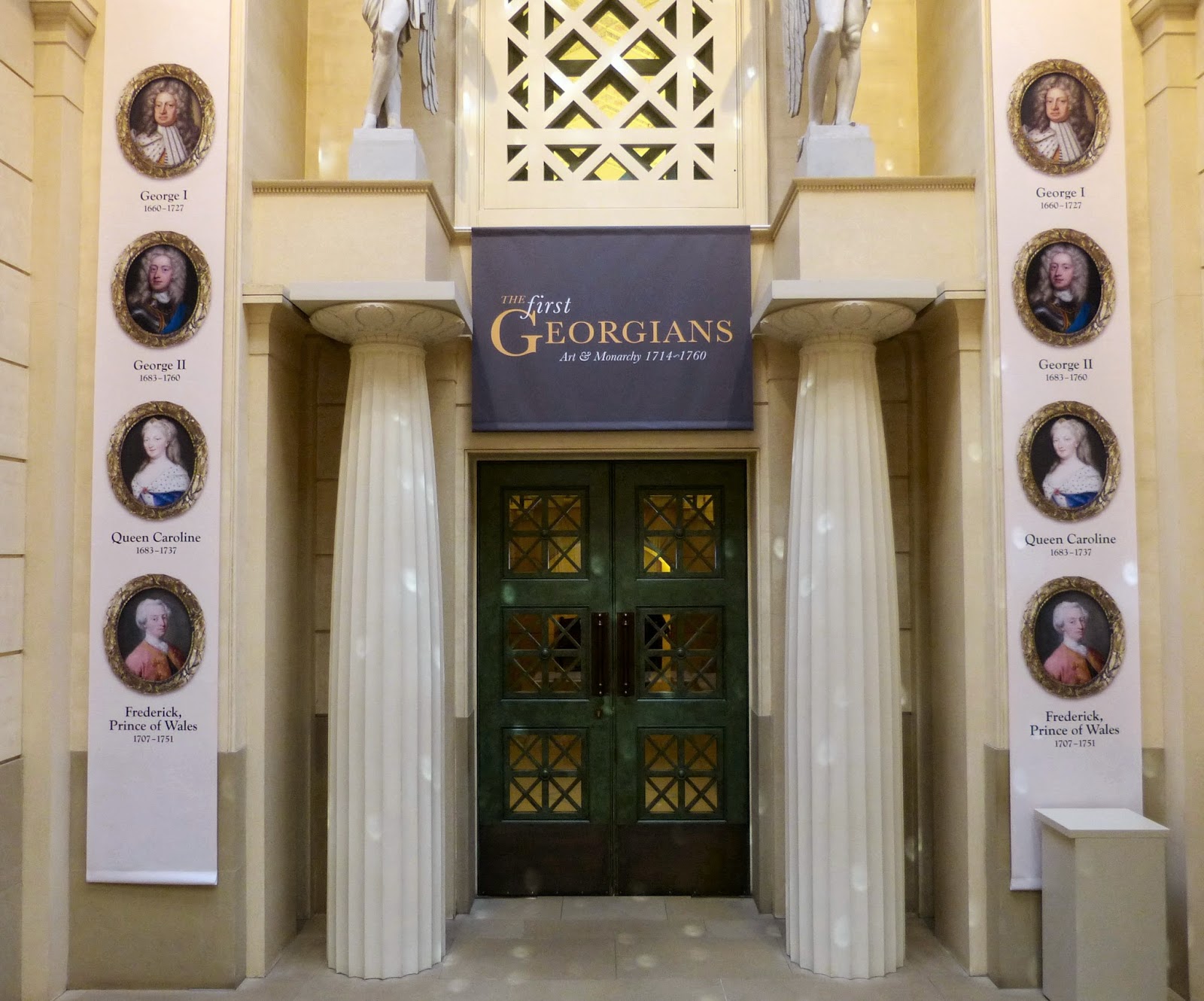
Entrance to The First Georgians exhibition inside the Queen's Gallery, Buckingham Palace

The First Georgians – Art & Monarchy 1714-1760 was an exhibition at the Queen’s Gallery, Buckingham Palace, which ran from Friday 11 April to Sunday 12 October 2014.

Why I am blogging about The First Georgians

I was privileged to attend the exhibition preview. But I claim to blog about late Georgian and Regency history, so why am I writing about the First Georgians exhibition which stops in the year that George III became King?

There are two reasons why this exhibition is still relevant. Firstly, the reigns of George I and George II were immediately before that of George III and so set the scene for the late Georgians. What took place in those years shaped the nation that George III became ruler of.
 
Secondly, George III was born in 1738, and so his formative years took place during the last 22 years of his grandfather George II’s reign.

For those of you that are unfamiliar with the early Georges, here is a very brief introduction:

George I (1714-1727)

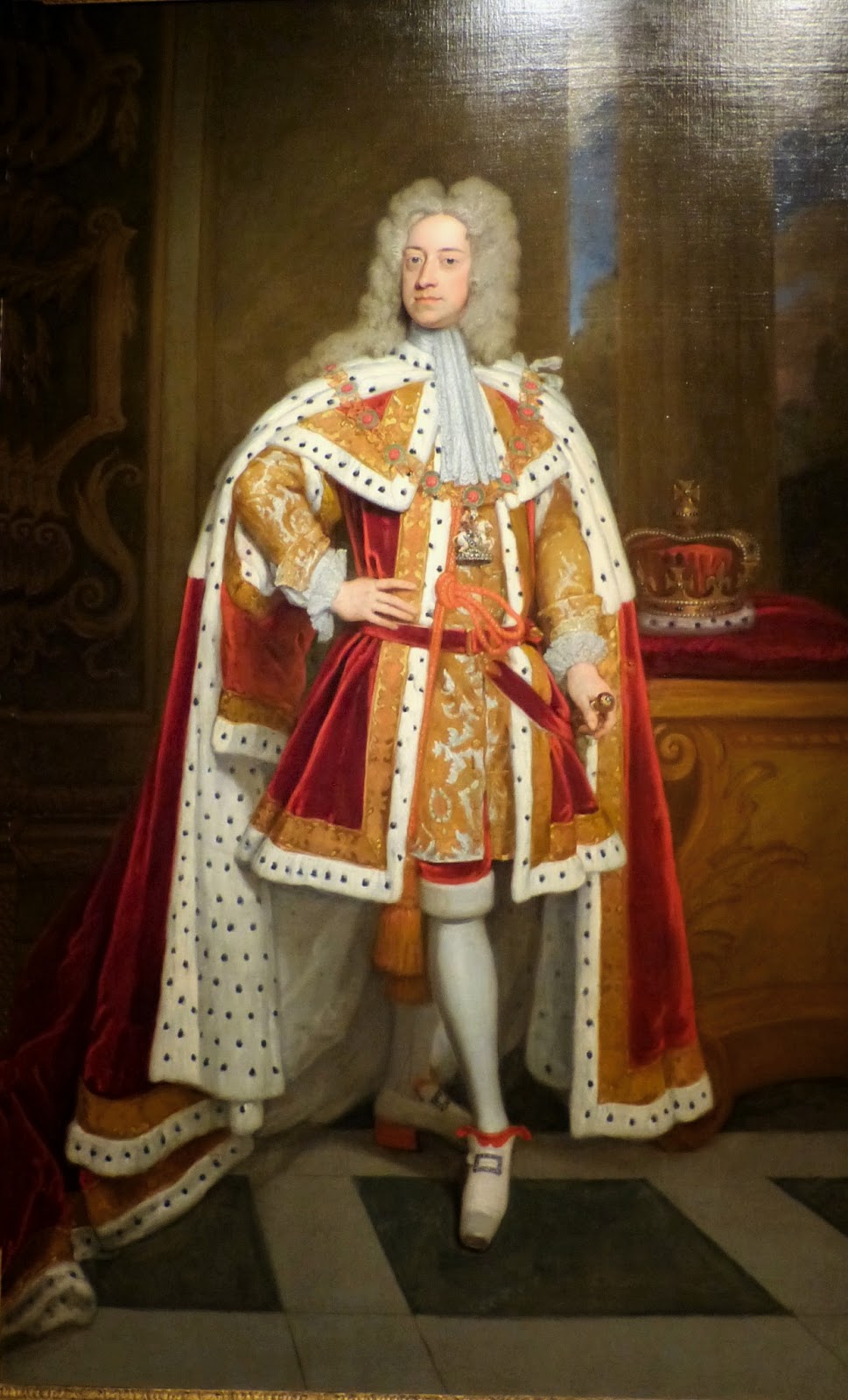
George I by Sir Godfrey Kneller c1715
George I by Sir Godfrey Kneller (c1715)
(On display in the portrait room)
The Act of Settlement of 1701 decreed that Great Britain had to be ruled by a Protestant monarch. Accordingly, George I, Elector of Hanover, was proclaimed King on the death of Queen Anne who had no surviving offspring.

George I had two children, George and Sophia, but was no longer married to their mother, Sophia Dorothea. George had divorced and incarcerated his wife for abandoning him when she had eloped with her lover, whose death it was generally believed that he had arranged.

He did not marry again, but had two main mistresses, Ehrengard Melusina von Schulenburg, Duchess of Kendal, and Charlotte Sophia Kielmannsegge, Countess of Darlington.

In 1717, he fell out with his son George so badly that he banished him from the Court. He often visited Hanover and died there unexpectedly in 1727.

George II (1727-1760)

George II by Sir Godfrey Kneller 1716
George II by Sir Godfrey Kneller (1716) - note his wonderful red heels!
(On display in Georgian royals, giltware and the Garricks)

George II was the last British monarch not to be born on British soil. His wife was Caroline of Ansbach, a beautiful and intelligent woman, who was very popular at Court. She embraced the philosophy of the enlightenment, respecting reason above tradition, and was a keen collector of art.

Queen Caroline by J Highmore (c1735)
(On display in the Portraits room)

They had four children in Hanover: Frederick, Anne, Amelia and Caroline, and another four in England: George who died in infancy, William, Mary and Louisa.

George II was the last British monarch to lead his troops into battle, which he did at the Battle of Dettingen in 1743.

Like his father, George II quarrelled with his eldest son. He banished Frederick, Prince of Wales, and his wife Augusta from Court in 1737 after a row over the birth of their first child. Frederick had whisked Augusta away from Hampton Court whilst she was in labour to make sure his parents would not be there at the birth. The breach between Frederick and his mother was never healed.

Frederick died in 1751 leaving his eldest son, George, to become King George III in 1760.

The exhibition

The exhibition composes entirely of items from the Royal Collection. It presents us with a snapshot into the lives of the first Georgian Kings: their families and where they lived; the battles they fought and the works of art with which they surrounded themselves.

Portraits

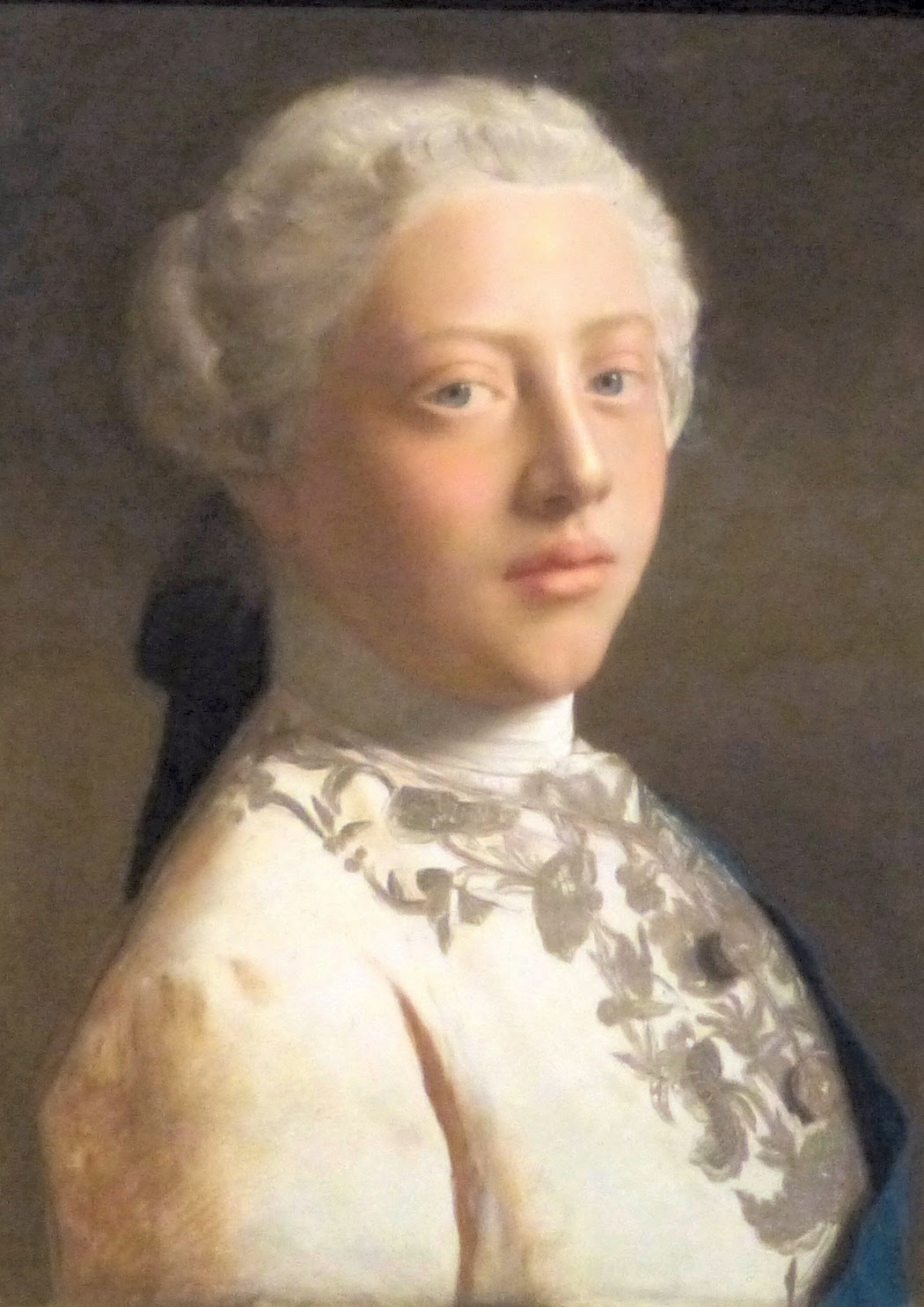
The first room introduces us to the early Georgians with some lovely portraits, including that of Caroline of Ansbach (above) and a pastel of George III by Jean-Étienne Liotard.

George III by Jean-Étienne Liotard (1754)
The next three rooms are themed: royal residences, maps and the prints of Hogarth:

Royal residences

This display includes prints of some of the internal rooms of the royal residences, such as the King’s Gallery at Kensington and the Queen’s State Bedchamber at Hampton Court.

The King's Gallery, Kensington Palace by Charles Wild (c1816)
Maps 

The maps were largely collected by William Augustus, Duke of Cumberland, a younger son of George II. He was nicknamed ‘Butcher Cumberland’ because of his ruthless policy against the Jacobite rebels after the Battle of Culloden in 1746.

Medley drawing by JFC Schilling (1767)
It may have been a gift to George III.
The Hogarth room

This room includes a selection of prints by Hogarth including The Harlot’s Progress which acted as a comment on the society of the time. This series of prints tells the story of the fall of the harlot, Moll Hackabout, and they were hugely popular in the 1730s.

The South Sea Scheme by William Hogarth (c1721)
Old Masters

From the monochrome prints of Hogarth, you pass into the first of the large display rooms, where you are dazzled by colour. The walls are covered with paintings, including several huge pieces by Rubens, collected by the early Georgians and exhibited symmetrically as they would have displayed them.

Room displaying Old Masters
There are two tables, beautifully gilded and supported on either side by gilt pedestals which would have held candelabra. The candlelight would have been reflected in the mirrors which would originally have been behind each table to dazzling effect.

One item that particularly caught my interest is a clock. It was bought by Frederick, Prince of Wales, but you have to search to find the clock which is very small compared to the overall size of the piece. In the bottom, there is an organ which plays tunes by Handel.

Miniatures and botanical drawings

Two small chambers off the Old Masters room show displays of royal miniatures and beautifully illustrated books of botany. A further anteroom has a collection of pistols, snuff boxes and other decorative items.

Botanical drawings by GD Ehret described by CJ Trew (1750-73)
Georgian royals, giltware and the Garricks

The second of the two large display rooms is my favourite and contains portraits of all the early Georgians. There is an enormous painting of six of Frederick Prince of Wales’ children, including the eight year old, George III, wielding a bow.

Detail from painting of Prince Frederick of Wales' children
 showing the future George III and his brother Edward
 by BarthĂ©lemy du Pan (1746)
This room also boasts two paintings by Canaletto depicting the River Thames and a table laden with gilt tableware.

Detail from London: The Thames from Somerset House terrace
by Canaletto (c1750)
One of my favourite works of art on display is the picture of David and Eva Garrick which has been used as the definitive image of the exhibition. I was surprised to discover that this very colourful and cheerful picture was in fact painted by William Hogarth, whom I have always associated with the rather sobering black and white prints displayed in the earlier room.

David Garrick and his wife, Eva-Maria Veigel  by William Hogarth (1757-64)
David Garrick and his wife, Eva-Maria Veigel
by William Hogarth (1757-64)
The Georgian coffee shop

The Millar Learning Room set up as a Georgian coffee shop
The final room to explore is to the left of the portrait room at the start of the exhibition. This is the Millar Learning Room which has been set up as a Georgian coffee shop. This is an interactive space, particularly good for those with children. There are background noises and ‘windows’ displaying Georgian street scenes. There are bags full of family activities available, short videos playing on a screen set within a picture frame and period hats with headphones, so that you can take in the atmosphere. I really enjoyed visiting the exhibition.

Rachel Knowles in the Georgian coffee shop
Me in the Georgian coffee shop

There are three videos which you can watch online:
Warrior Kings
A King’s Ransom
The Enlightened Queen
and lots more information about the different items on display on the Royal Collection website.

Headshot of Rachel Knowles author with sea in background(2021)
Rachel Knowles writes faith-based Regency romance and historical non-fiction. She has been sharing her research on this blog since 2011. Rachel lives in the beautiful Georgian seaside town of Weymouth, Dorset, on the south coast of England, with her husband, Andrew.

Find out more about Rachel's books and sign up for her newsletter here.

If you have enjoyed this blog and want to encourage me and help me to keep making my research freely available, please buy me a virtual cup of coffee by clicking the button below.


Sources used include:
Plumb, JH, The First Four Georges (1956)
Royal Collection website

All photographs © Andrew Knowles Regencyhistory.net