Search this blog

Showing posts with label science. Show all posts

Wednesday, 9 August 2017

Enlightened Princesses - 2017 exhibition at Kensington Palace


Enlightened Princesses: Caroline, Augusta, Charlotte and the Shaping of the Modern World was an exhibition at Kensington Palace, London, which ran from 22 June until 12 November 2017.

Who were these enlightened princesses?

The enlightened princesses were three German princesses who married into the Georgian royal family:

Caroline of Ansbach (1683-1737) – wife of George II

Queen Caroline by J Highmore (c1735)  Royal Collection  Photo from The First Georgians exhibition
Queen Caroline by J Highmore (c1735)
Royal Collection
Photo from The First Georgians exhibition

Augusta of Saxe-Gotha (1719-1772) – wife of Frederick, Prince of Wales, and mother of George III

Princess Augusta of Wales  by Jean-Etienne Liotard (1754)  Royal Collection
Princess Augusta of Wales
by Jean-Etienne Liotard (1754)
Royal Collection
Charlotte of Mecklenburg-Strelitz (1744-1818) – wife of George III

Queen Charlotte  by Johan Joseph Zoffany (1771)  Royal Collection
Queen Charlotte
by Johan Joseph Zoffany (1771)
Royal Collection
Why were they considered ‘enlightened’?

These three German princesses had widespread interests in art, medicine, science and charitable concerns which they pursued with enthusiasm. Together they changed the role of women in the royal family and influenced the development of British culture.

What objects are on display?

The exhibition includes objects owned by the princesses and reflects their diverse interests.The following pictures are just a taster of the items on display.

Queen Charlotte and inoculation

Queen Charlotte was an advocate of inoculation against smallpox and supported Edward Jenner’s research which determined that cowpox vaccination was less hazardous than smallpox vaccination.

Left arm showing cowpox inoculation compared to smallpox inoculation  Watercolour by G Kirtland after Charles Gold (1802)  Wellcome Library, London
Left arm showing cowpox inoculation compared to smallpox inoculation
Watercolour by G Kirtland after Charles Gold (1802)
Wellcome Library, London
Kew Gardens

All three princesses were interested in botany and gardening. Queen Caroline developed the gardens at Richmond Lodge and commissioned buildings and sculpture, whilst her daughter-in-law Princess Augusta developed the botanical gardens at Kew and commissioned the Orangery and the Pagoda.

Elevation of the Great Pagoda, Kew, as first intended  T Miller after William Chambers (1763)  Board of Trustees of the Royal Botanic Gardens, Kew
Elevation of the Great Pagoda, Kew, as first intended
T Miller after William Chambers (1763)
Board of Trustees of the Royal Botanic Gardens, Kew
Queen Charlotte continued to develop the gardens at Kew and expanded the collection of exotic plants. She also kept a menagerie which inclued a pair of Nilgai - Asian antelope.

The Nilgai by George Stubbs (1769)  Hunterian Museum and Art Gallery, University of Glasgow
The Nilgai by George Stubbs (1769)
Hunterian Museum and Art Gallery, University of Glasgow
Foundling Hospital

The princesses actively supported charities, particularly those that helped women and children, including the Magdalen Hospital, of which Queen Charlotte was patroness, and the Foundling Hospital.

Foundling tokens from the Foundling Hospital
British industry

Queen Charlotte supported national industry including the silk-weavers at Spitalfields. The photograph shows fragments of material from dresses worn by the royal family for the wedding of the future George IV and Caroline of Brunswick in 1795, some of which were woven in Spitalfields.

Queen's silk samples  Historic Royal Palaces
Queen's silk samples
Historic Royal Palaces
Progressive education

Queen Caroline’s children were taught how to turn a lathe. The photograph shows the work of her eldest daughter, Princess Anne.

Woodturnings by Princess Anne (1709-1759)  Royal Collections, the Netherlands
Woodturnings by Princess Anne (1709-1759)
Royal Collections, the Netherlands
Princess Augusta’s children used a camera obscura both as a drawing aid and as a means of entertainment. The placard under the camera obscura explains that it ‘projected a reversed image of an object through its lens onto a glass screen’.

Camera obscura - Stephen Demainbray, before 1753  Camera obscura - Stephen Demainbray, before 1753  King's College London
Camera obscura - Stephen Demainbray, before 1753
King's College London
Lady Charlotte Finch, governess to Queen Charlotte’s children, used dissected geographical maps, flash cards and counters to educate her royal pupils.

Group of dissected maps of America - Lady Charlotte Finch  Historic Royal Palaces and V&A Museum of Childhood
Group of dissected maps of America - Lady Charlotte Finch
Historic Royal Palaces and V&A Museum of Childhood
Needlework

This needlework pocket-book is thought to have been made by Queen Charlotte as a gift for her friend, the artist Mrs Delany. It contains tools for making the paper mosaics for which Mrs Delany is famous.

Needlework pocket-book - Queen Charlotte (1781)  Lent by Her Majesty the Queen
Needlework pocket-book - Queen Charlotte (1781)
Lent by Her Majesty the Queen
Tribuna of the Uffizi

Many drawings and paintings are on display, including what for many is the highlight of the exhibition – this vibrant painting by Johan Zoffany of the Tribuna room in the Uffizi Gallery in Florence which was commissioned by Queen Charlotte.

Tribuna of the Uffizi by J Zoffany (1772-8)  Lent by Her Majesty the Queen
Tribuna of the Uffizi by J Zoffany (1772-8)
Lent by Her Majesty the Queen
© Various collections as indicated. All photographs © RegencyHistory.net

Headshot of Rachel Knowles author with sea in background(2021)
Rachel Knowles writes faith-based Regency romance and historical non-fiction. She has been sharing her research on this blog since 2011. Rachel lives in the beautiful Georgian seaside town of Weymouth, Dorset, on the south coast of England, with her husband, Andrew.

Find out more about Rachel's books and sign up for her newsletter here.

If you have enjoyed this blog and want to encourage me and help me to keep making my research freely available, please buy me a virtual cup of coffee by clicking the button below.

Wednesday, 11 May 2016

1816: the year without a summer

A wet day on the beach in Weymouth, Dorset
We might joke that you can blink and miss the English summer, but what if it really was cancelled this year?

Two hundred years ago, in 1816, people in England and much of Europe were bemused by a summer that was noticeably colder and wetter than usual. This was bad news for a society that depended largely on a good harvest for its wellbeing. It was even worse news for nations ravaged by the recent Napoleonic wars.

1816: the year without a summer

A priest in northern Portugal wrote:
July of 1816 was a particularly unusual month concerning both rainfall and temperature. I am 78 years old and I have never seen so much rain and cold, not even in winter months.1
Scientist Luke Howard (1772-1864), who kept detailed records of the weather in London for forty years from 1801, noted that much of 1816 was wetter and colder than usual. In September he toured parts of Europe and observed that along the length of the Rhine:
Not meadows and villages alone but portions of cities and large towns lay long underwater; dikes were broken, bridges blown up, the crops spoiled or carried off by torrents and the vintage ruined by the want of sun to bring out and ripen the fruit.2
The Times newspaper of 13 July 1816 reported that heavy rain in Switzerland and Germany had led the Rhine to flood in Holland. 
Farmers who had cut their hay eight days ago have lost the whole, it is all washed away; the grass which is yet standing is now rotting in the ground.3
Flood waters in Weymouth, Dorset (2012)
The eastern United States was also affected by the adverse weather. Six inches of snow fell across New England on 6 June 1816. This and continued heavy frosts destroyed crops and killed livestock. Famine drove people to eat hedgehogs, nettles and pigeons.

The effects of the exceptionally cold year stretched into future years. In 1817-18, the price of bread almost doubled as supplies of grain and flour ran short. Over half a million barrels of flour came into Liverpool in 1818, the year that Britain imported more food than ever before.

Britain, with its well-developed trade network and relatively easy access to ports, was not as badly impacted by food shortages as other nations. Areas where travel was more difficult, such as central Europe, saw food prices spiral and people going hungry. Demonstrations, riots and looting were not uncommon, as people were desperate to express their frustration and feed their families.

Did the poor summer of 1816 create a monster?

The bad weather in England drove a group of writers to head for Switzerland. On arrival, Lord Byron, Percy Bysshe Shelley and his young lover, Mary Wollstonecraft Godwin (later Shelley), enjoyed a few days of good weather before being driven indoors by continued storms and rain.
It proved a wet, ungenial summer, and incessant rain often confined us for days to the house wrote Mary Shelley in 1831. ‘We will each write a ghost story,’ said Lord Byron; and his proposition was acceded to.4
As a result, Mary was inspired to write Frankenstein, creating a monster that’s become an established character in popular culture.

Frontispiece of Frankenstein by Mary Shelley (1831 edition)
The cause of the year without a summer

Modern scientific study now links the poor weather of 1816 to a massive volcanic eruption in April 1815, on the other side of the world.

Mount Tambora, on the small Sumbawa Island in Indonesia, exploded dramatically in mid-April 1815. The eruption was the largest volcanic event for hundreds, perhaps even thousands, of years. It threw around 160 cubic kilometres of material into the atmosphere, which would have been enough to cover the entire surface of the UK in ash up to 45 cm (18 inches) deep.

The eruption killed tens of thousands of people and could be heard hundreds of miles away. But in 1815, news travelled more slowly than soundwaves and it was months before the story of the eruption reached Britain.

Even then, no one understood the impact the event would have on the weather. It’s taken scientists nearly two hundred years to connect the Mount Tambora eruption with the dismal summer of 1816 and its consequences.

Aerial view of the caldera of Mount Tambora,
Sumbawa, Indonesia - photo by Jialiang Gao6
Reports from the scene of the Mount Tambora eruption

Sir Thomas Stamford Raffles (1781-1826), Lieutenant Governor of British Java, recorded and published accounts of the eruption.
The first explosions were heard on this Island in the evening of the 5th of April; they were noticed in every quarter, and continued at intervals until the following day. The noise was in the first instance almost universally attributed to distant cannon.5
On the following morning, however, a slight fall of ashes removed all doubt as to the cause of the sound, and it is worthy of remark, that as the Eruption continued, the sound appeared to be so close that in each district it seemed near at hand.5
The inhabitants of Java thought that a nearer volcano had erupted, but in reality, the source was hundreds of miles away.
From the 6th, the sun became observed: it had everywhere the appearance of being enveloped in fog, the weather was sultry and the atmosphere close and still; the sun seemed shorn of its rays, and the general stillness and pressure of the atmosphere foreboded an Earthquake.5
In the following days, the sky filled with ash. Some accounts talk of days being so unnaturally dark that candles were needed throughout and visibility was reduced to a few metres.

An account from a sailor recorded:
On the 11th April, while at sea far distant form Sumbawa, he was in utter darkness; that on his passing the Tomboro Mountain at a distance of 5 miles, the lower part of it was in flames, and the upper part covered with clouds; he went on shore for water and found the ground covered with ashes to the depth of three feet, several large prows thrown on the land by a concussion of the sea, and many of the Inhabitants dead from famine.5
Some reported how for miles the surface of the sea was covered in a solid mass of pumice stone, up to several feet deep.

View in Bima, Sumbawa, Indonesia from The Cruise of the Marchesa (1887)
Cold weather and dramatic sunsets

Today, science tells us that the volcanic eruption created a huge cloud of sulphur. Over the following months this spread across much of the world, acting as an almost invisible barrier to the heating effect of the sun.

The painter Joseph Turner (1775-1851) is famous for his moody skies and rich sunsets. The colours of these dramatic sunsets were affected by the sulphur in the sky following volcanic eruptions: Tambora in 1815, Babuyan in the Philippines in 1831 and Cosiguina in Nicaragua in 1835. Study has shown that when the air was dirtiest, the sunsets were reddest.

Although Turner’s most famous sunsets were painted after these later eruptions, we can be fairly confident that there must have been some spectacular sunsets in 1816 too. A small compensation for those who had to endure the year without a summer.

Sunset by JMW Turner © Tate (1856)7

Headshot of Rachel Knowles author with sea in background(2021)
Rachel Knowles writes clean/Christian Regency era romance and historical non-fiction. She has been sharing her research on this blog since 2011. Rachel lives in the beautiful Georgian seaside town of Weymouth, Dorset, on the south coast of England, with her husband, Andrew.

Find out more about Rachel's books and sign up for her newsletter here.

If you have enjoyed this blog and want to encourage me and help me to keep making my research freely available, please buy me a virtual cup of coffee by clicking the button below.

Notes
(1) From Iberia in 1816, the year without a summer by RM Trigo et al (2008).
(2) From The Climate of London by Luke Howard (1818).
(3) From The Times newspaper Saturday July 13 1816 p3 © Times Digital Newspaper Archive.
(4) From the introduction to the 1831 edition of Frankenstein by Mary Shelley (1831).
(5) From Narrative of the Effects of the Eruption from the Tomboro Mountain by Sir Thomas Stamford Raffles (1816).
(6) Photo by Jialiang Gao (peace-on-earth.org) under a Creative Commons licence via Wikimedia Commons.
(7)  Used under Creative Commons CC-BY-NC-ND 3.0 (unported)

Sources include
Howard, Luke, The Climate of London: Deduced from Meteorological Observations (1818)
Raffles, Sir Thomas, Narrative of the Effects of the Eruption from the Tomboro Mountain, in the island of Sumbawa on the 11th and 12th April 1815 (1816)
Shelley, Mary, Frankenstein (1831 edition)
Trigo, RM, Vaquero, JM, Alcoforado, M, Barriendos, M, Taborda, J, Garcia-Herrera, R and Luterbacher, J, Iberia in 1816, the year without a summer in the International Journal of Climatology © Royal Meteorological Society (2008)

The Guardian.com website
Times Newspaper Archive Online

Wednesday, 20 April 2016

Maria Merian's Butterflies - 2016 exhibition at the Queen's Gallery


I recently visited the Queen’s Gallery, Buckingham Palace, London, for a curator-led tour of the new exhibitions: Scottish Artists 1750-1900: From Caledonia to the Continent and Maria Merian’s Butterflies. This post is about the second exhibition: Maria Merian’s Butterflies.

You can read my blog about the Scottish Artists exhibition here. 

The amazing Maria Merian (1647-1717)

I confess that I wasn’t at all sure that I would be interested in Maria Merian’s work. After all, she was born around 100 years too early for me and died just three years into the reign of George I. However, I knew that the pictures on display had all been acquired by George III and so I had my Georgian connection. I prefer paintings of people and places rather than plants and animals, but I have to admit that Merian’s work is stunning.

Frangipani Plant with Red Cracker Butterfly by Maria Merian (1702-3)
Maria Sibylla Merian was born in Germany but later settled in the Netherlands. Encouraged by her step-father, Jacob Marrel, she became a skilled artist, specialising in painting plants and insects. But Merian was not just an artist. She had an enquiring, scientific mind and wanted to know more about the insects she was painting. Metamorphosis was little understood at the time and she bred insects so that she could observe their lifecycles and documented what she saw in meticulously accurate paintings.

In 1699, Merian travelled to Suriname in South America with her daughter Dorothea so that she could study insects in their natural habitat, selling her own paintings in order to finance the voyage. She had hoped to stay for five years but was forced to return to the Netherlands in 1701 due to ill health. She published the results of her observations in Metamorphosis Insectorum Surinamensium (The Metamorphosis of the Insects of Suriname) in 1705, in Latin and Dutch, and it became an important source for Georgian scientists.

Branch of Banana with Bullseye Moth by Maria Merian (1702-3)
The book was full of prints of her incredibly detailed life-size paintings, illustrating the different stages of the lifecycles of various caterpillars. Some copies were in black and white; others she hand-coloured with utmost accuracy. 

Grape Vine with Gaudy Sphinx Moth by Maria Merian (1702-3)
She financed her self-publishing venture by producing luxury prints of her paintings. There are only two sets known to be in existence – Hans Sloane’s set which is now in the British Museum and the set in the Royal Collection. These were acquired by George III some time before 1810 when they appear in a royal inventory. Many of these prints were on display in the exhibition.

Ripe Pineapple with Dido Longwing Butterfly by Maria Merian (1702-3)
The copy of Metamorphosis Insectorum Surinamensium on display was acquired by William IV for the royal library. The curator explained how this copy was particularly exclusive because it was a counterproof version. As I understand it, this means that a print was made from the plate and then this print was immediately used to make another print. The result was a faint but exact copy of the original, without print marks, which would then be finished by hand. This made it a very expensive luxury product.

Metamorphosis Insectorum Surinamensium by Maria Merian (1705)
As well as insects, Merian painted watercolours of frogs, showing their lifecycles, and a few other creatures such as the Cayman crocodile.

One treat that I almost missed was in the Millar Learning Room, which you can find to the left of the entrance stairs. There was a touchscreen showing a picture of a branch with several different caterpillars on it from Merian’s watercolours. Touching one of these caterpillars started a short animation of the lifecycle of that caterpillar, using Merian’s illustrations. My husband took a short video of one of these animations.


Maria Merian’s Butterflies is on at the Queen’s Gallery, Buckingham Palace, London, alongside Scottish Artists 1750-1900, until Sunday 9 October 2016.

Friday, 21 November 2014

Blue John: Britain's Georgian gemstone

Another post by my husband Andrew, inspired by our visit to Derbyshire.

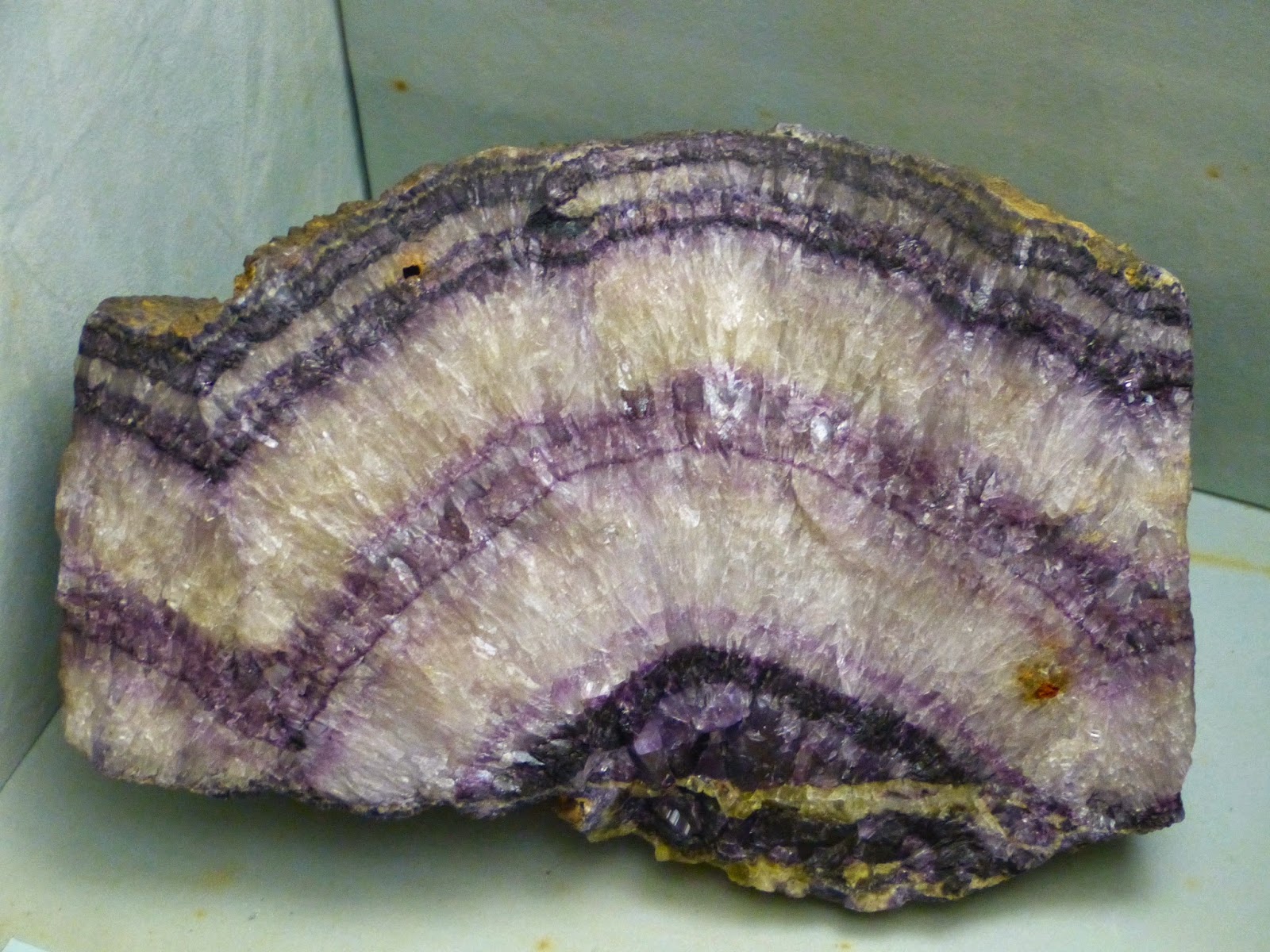
Blue John - Millers Vein - from Treak Cliff, Castleton  on display in Buxton Museum
Blue John - Millers Vein - from Treak Cliff, Castleton
on display in Buxton Museum
One of the less well known facts about Georgiana Cavendish, Duchess of Devonshire and leader of fashion in the late eighteenth century, was that she collected rocks.

Georgiana Cavendish, Duchess of Devonshire (painting in the South Sketch Gallery)
Georgiana Cavendish, Duchess of Devonshire
(painting in the South Sketch Gallery)
Visitors to Chatsworth, home of the Duke of Devonshire, can view her mineral collection, along with vases and bowls made from Britain's rarest semi-precious stone, Blue John. The mineral became hugely popular with craftsmen and their customers in the late Georgian period, and coincidentally its only known source was just a few miles from Chatsworth, in the hills above Castleton.

Display case in South Sketch Gallery, Chatsworth
Display case of minerals
in South Sketch Gallery, Chatsworth
Blue John is found nowhere else in the world. It is still mined today, but only in tiny quantities as very little remains in the ground. The two remaining mines, which are mainly natural caverns, are now largely tourist attractions.

The beginnings of Blue John mining 

Lead has been mined around Castleton for hundreds of years, possibly even by the Romans, and mining records began in 1280. But there is no reference to the mining and use of Blue John before the 1760s. Trevor Ford, in his book Derbyshire Blue John, explores and debunks stories of Blue John ware being found in Roman Pompeii.

Blue John is a form of fluorspar, a common mineral that occurs in many colours. What makes it unique to Derbyshire is the particular colouring, with bands of purple and blue, yellow and off-white. Formed in the cracks within limestone, no two sections of Blue John are alike.

Blue John spar, Buxton Museum
Where the bands of Blue John reached the surface, they would have been visible. Seventeenth century travellers refer to azure or sapphire spar being found in the Peak District but say nothing about it being mined or used in any way.

All that changed in the 1760s, when the name 'Blue John' appeared in guidebooks and the mineral was used in ornaments. Robert Adam inlaid Blue John into fireplaces at Kedleston Hall and manufacturer Matthew Boulton used it extensively.

In his Sketch of a Tour, dated 1777, William Bray wrote of a mine near Castleton: "They get out of it some blue-john, used by the polishers for making vases etc."1

Blue John urn, Buxton Museum
How Blue John was mined

The lead miners of Castleton must have observed Blue John as they went about their business underground. In naturally formed caverns, loose pieces of both lead and Blue John would be mixed in with the silt that filled the caves, and which the miners dug out and searched through for minerals.

Entrance to the Blue John Cavern
Digging Blue John out of the cave walls demanded some skill, as it is relatively fragile. The limestone around the mineral would have been chipped away to release it, with miners using various techniques to break into the rock walls.

One of these ways was to push wooden pegs into cracks, then soak the wood with water, causing it to swell and break the crack open further. Another approach was to light a fire against a wall, leave it to burn overnight, then throw water against the wall. The sudden change in temperature would cause it to crack.

Blue John vein in the rock, Blue John Cavern
Having been extracted, Blue John had to be dried for a year or two before it could be worked without damaging it structure. Because it is relatively soft, Blue John is easily damaged. Many objects are coated in resin to protect them and the process of applying this resin was often regarded as a trade secret.

While they are tourist caverns today, the mines held little to interest Georgian visitors. William Bray seems to be have been persuaded to go down during his tour and records: "The descent, however, is dirty and difficult, and there is not any thing at the bottom worth seeing."1

The popularity of Blue John

"I have found a new use for Blew John," wrote Matthew Boulton in 1768, which was to turn it into vases. His intent was expressed in a letter, in which he asked someone to enquire about the possibility of leasing a Blue John mine. He also asked that his contact not reveal the name of Boulton as part of the enquiry: "I beg you will be quite secret as to my intentions."2

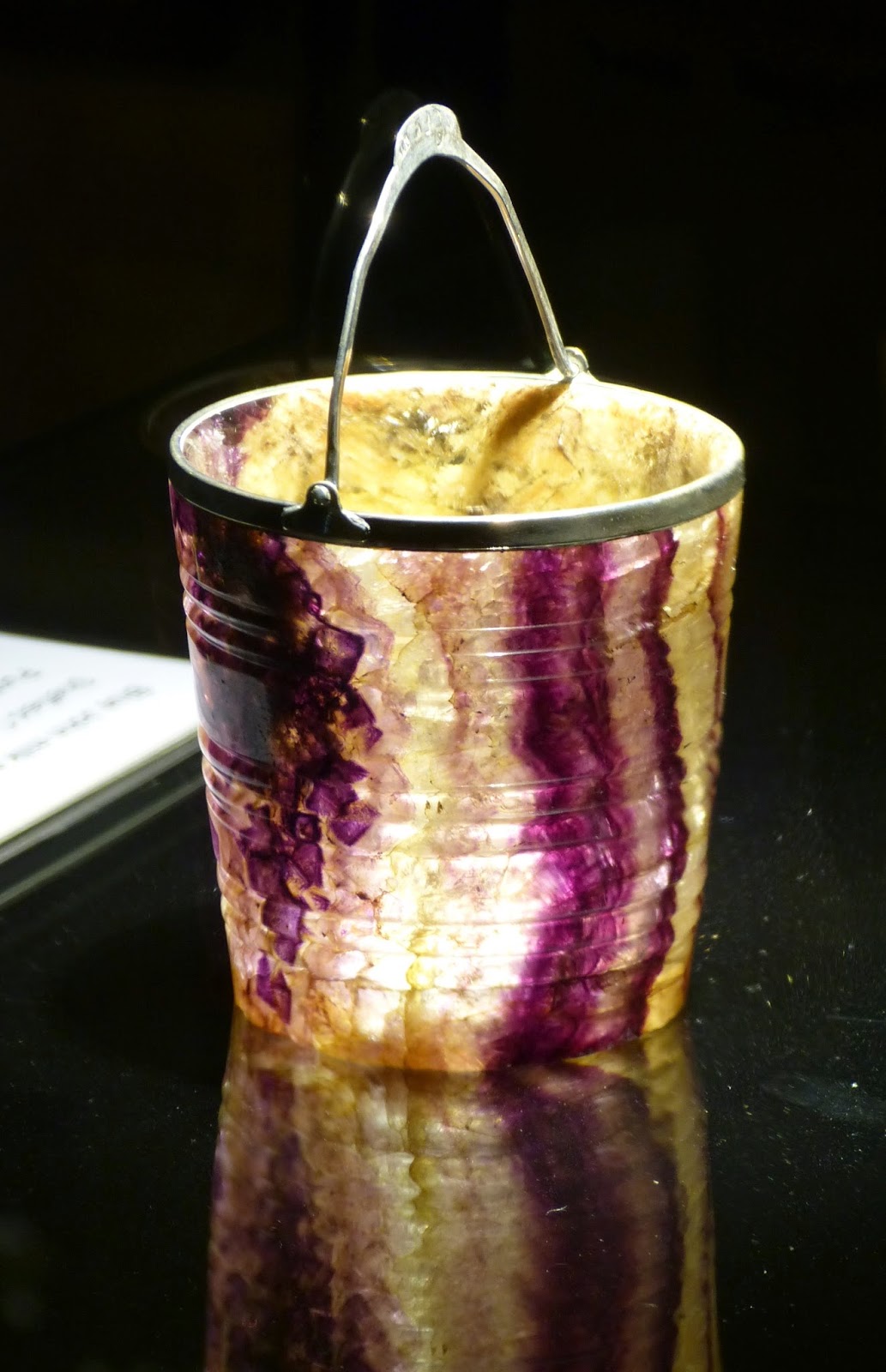
Blue John milk pail, Buxton Museum
A year later, Boulton bought 14 tons of best quality Blue John, from which he made vases, candelabra and other ornaments. Some survive in Britain's great houses, including Buckingham Palace.

A tourist trade developed around the Blue John mines in the early 1800s, although going underground remained difficult. It wasn't until 1836 that a new, easier path was cut through the rock into the Blue John Cavern mines, and concrete steps were not laid until the early twentieth century.

Inside the Blue John Cavern today
William Adam had plenty to say about Blue John in his book The Gem of the Peak, or Matlock Bath and its vicinity, first published in 1838. He noted that a tour of the mine cost  one shilling per person, and that "the descent is very rapid and over very rough but safe steps, down which a rail is carried for the passage of the mining wagon."3

But by the time Adam was exploring the Blue John mines, the mineral was already starting to fall from favour and the latter half of the nineteenth century saw the small industry decline sharply. The stone is still being mined today, although in very small quantities. The supply of this rare mineral, highly prized by Georgian gentry, could be exhausted within the next decade.

Georgian examples of Blue John

Here are some of the places where you can see Blue John being used in Georgian decorative objects:

Chatsworth House

Unsurprisingly, given its proximity to the source of Blue John, the house contains several vases and other ornaments and even a window made of Blue John. The collection includes the Chatsworth Tazza, the largest single-piece ornament, made in 1842, and currently on display in the dining room. The house also contains the Shore vase, made in 1815, although it's not clear whether this is on public display.

The Chatsworth Tazza, Chatsworth
Natural History Museum

Here you can see several Blue John vases. According to Ford, the collection includes what is probably the largest Blue John vase ever made, created by John Vallance around 1840.

Lauriston Castle, Edinburgh

This museum houses a collection of over 80 Blue John ornaments from the late eighteenth century.

Fireplaces containing Blue John can be found at Kedleston Hall and the Georgian House Museum in Bristol (see below). Others exist, but are less accessible to the public.

Blue John fire surround in the study  of the Georgian House, Bristol
Blue John fire surround in the study of the
Georgian House Museum, Bristol (July 2018)
Notes
(1) From Sketch of a Tour into Derbyshire and Yorkshire by William Bray (1777).
(2) Quoted in Derbyshire Blue John by Trevor Ford (2005) p64.
(3) From The Gem of the Peak by William Adam (1838).

Sources used include:
Adam, William, The Gem of the Peak or Matlock Bath and its vicinity (1838, this 6th edition 1857)
Bray, William, Sketch of a Tour into Derbyshire and Yorkshire (1777, this 2nd edition 1783)
Ford, Trevor D, Derbyshire Blue John (Landmark Publishing, 2005) Castleton Historical Society
Harrison, Peter C, Some Castleton History and Things Remembered (2010) PDF

BBC Derbyshire
Bulletin of the Peak District Mines Historical Society, Vol 11, No 5, (1992)
Edinburgh Museums
Natural History Museum

Photographs © Andrew Knowles - www.flickr.com/photos/dragontomato

Wednesday, 12 November 2014

The Philae obelisk at Kingston Lacy

Philae, a robotic probe, landed on a distant comet today. The European Space Agency hopes that the information that it gathers will help scientists understand the early development of the Solar System.

It shares its name with the Philae obelisk which stands at Kingston Lacy. The inscriptions on this obelisk helped Georgian scholars to understand Egyptian hieroglyphics.

Philae obelisk, Kingston Lacy
Discovery of the Philae obelisk

The Philae obelisk was discovered by William John Bankes on his first journey into Egypt in 1815. The pink granite needle was one of a pair in front of the Temple of Isis on Philae, an island in the Nile. The island has since been flooded as a result of the building of the Aswan Dam. Giovanni Finati acted as Bankes' guide and his travel journals give details of some of Bankes’ excavations.

William John Bankes Portrait at Kingston Lacy
William John Bankes
Portrait at Kingston Lacy
Finati wrote that Bankes
“by the light of his candles at night found an inscription in it that had never been observed up to that time. It was also during this short stay that he first brought to light the granite pedestal of the obelisk, which has more than twenty lines upon it in the Greek character; this was buried altogether below the surface; but the probable position of it was conjectured from the obelisk lying near the spot, and search was made there accordingly. Some steps were taken, even then, towards the removal of this monument; but, for want of proper tackle, it was abandoned for that time.” (1)
On his second journey into Egypt in 1818-19, Bankes’ party included Henry Beechey, son of Sir William Beechey, the famous portrait painter; Dr Alessandro Ricci; Louis Linant de Bellefonds, a French midshipman; and Giovanni Belzoni. After starting out as a performing strong man at Sadler’s Wells, Belzoni had become a hydraulic engineer specialising in the excavation of Egyptian antiquities.

A disastrous attempt

Bankes employed Belzoni to take the Philae obelisk back to his family home of Kingston Lacy in Dorset, England.

Kingston Lacy, Dorset
The operation was fraught with difficulties and the first attempt to remove the obelisk ended in disaster. Finati wrote:
“Meanwhile the obelisk had been brought on rollers to the water's edge, and a boat below to receive it; all hands were at work, and five minutes more would have sufficed to set it afloat; when all at once the temporary pier built for it gave way under the pressure, and the monument plunged end long into the river almost out of sight.” (1)
A striking descent

Belzoni tried again with more success. Finati wrote:
“Mr Bankes said little, but was evidently disgusted by the accident, and set sail within a day or two afterwards, leaving me to witness Mr Belzoni's further operations respecting it. These were certainly conducted with great skill, though not quite without injury, and the scene of its actual descent down the cataract (2) (the passage being at that time narrower, and the fall more considerable, from the decrease of the Nile) was very striking, the great boat wheeling and swinging round, and half filling with water, while naked figures were crowding upon all the rocks, or wading or swimming between them, some shouting, and some pulling at the guide ropes, and the boat-owner throwing himself on the ground, scattering dust upon his head, and hiding his face. The danger, if any, was but for a few seconds, the equilibrium was recovered, and the mass glided smoothly and majestically onwards with the stream.” (1)
The obelisk arrived in England in 1821 and the Duke of Wellington offered to send a gun carriage to transport it to Kingston Lacy.

Duke of Wellington by William Salter (c1839) in the NPG
Duke of Wellington
by William Salter (c1839) in the NPG
The pedestal

The excavation of the obelisk’s pedestal was equally difficult. Finati wrote:
“The only commission left with me, was to see to the removal of the Greek pedestal belonging to the obelisk, from the spot where it had been left by Belzoni” but “the inundation (3) had already put the stone quite under water and out of sight, which rendered useless both the tackle and the boat that I had brought with me on purpose. For unfortunately, Mr Belzoni, fearing fresh disputes as to Mr Bankes's property in this pedestal, (though the original and uncontested finder of it,) had, in default of means for sending it at once down the cataract, carried it across from Philae to a low sand bank opposite, and there laid it on its so little judgment, that the smallest rise of the river must inevitably cover it, and make the transport impossible, during all those months of the year when the passage by water is the easiest, and it was owing to this, that, at length, after more than two years, it was found to be the best expedient to drag it by land, till it could be shipped below the rapids.” (1)
The Philae obelisk in the garden of Kingston Lacy
The platform

Finati noted that:
“This platform consists of four blocks only of red granite, and had served, without doubt, as the base to some obelisk now destroyed.” (1)
It was not until 1829 that Linant de Bellefonds, who had accompanied Bankes on his second trip to Egypt, sent what was left of the matching obelisk and the three huge steps of granite from Maharraga which were used to make the platform.(4)
 
Finati wrote:
“The heaviest block weighs nearly eleven tons, and was not removed till 1822, nor brought to England till 1829, when nineteen horses were required to drag it to its position at Kingston Hall.” (1)
It was damaged in transit and had to be repaired using some granite from the ruins of Leptis Magna – a prominent city in the Roman Empire situated in what is now Libya – given to Bankes for the purpose by George IV.

The inscription around the bottom of the Philae obelisk, Kingston Lacy
A monument to tax exemption!

The Duke of Wellington chose the spot in the garden, south of the house, for the site of the obelisk. He laid the foundation stone in 1827, but it was not until 1839 that the obelisk was finally erected.

The inscription written around the bottom of the obelisk reads as follows:

THIS SPOT WAS CHOSEN
AND THE FIRST STONE OF THE FOUNDATION LAID BY
ARTHUR DUKE OF WELLINGTON
AUGUST 17 1827.

WILLIAM JOHN BANKES ESQ MP ELDEST SON OF HENRY BANKES ESQ MP (5)
CAUSED THIS OBELISK AND THIS PEDESTAL FROM WHICH IT HAD FALLEN
TO BE REMOVED UNDER THE DIRECTION OF G BELZONI IN 1818
FROM THE ISLAND OF PHILAE BEYOND THE FIRST CATARACT
AND BROUGHT THIS PLATFORM FROM THE RUINS OF HIERASYCAMINON
IN NUBIA.

THE GRANITE USED IN THE REPARATION OF THIS MONUMENT
WAS BROUGHT FROM THE REMAINS OF LEPTIS MAGNA IN AFRICA
AND WAS GIVEN FOR THAT PURPOSE BY HIS MAJESTY
KING GEORGE IV.

THE INSCRIPTIONS ON THIS OBELISK AND PEDESTAL RECORD
THEIR DEDICATION TO KING PTOLEMY EUERGETES II
AND TWO CLEOPATRAS HIS QUEENS
WHO AUTHORIZED THE PRIESTS OF ISIS IN THE ISLE OF PHILAE
TO ERECT THEM ABOUT 150 YEARS BC
AS A PERPETUAL MEMORIAL OF EXEMPTION FROM TAXATION. 

The significance of the Philae obelisk

Bankes studied the obelisk carefully, and found he could make out the names of Ptolemy and Cleopatra. He made lithographs of the bilingual inscriptions – both Greek and hieroglyphic - and this helped scholars in their understanding of hieroglyphics.

Recently, a new study has been conducted on the obelisk. Current researchers have been able to confirm that Bankes’ lithograph, particularly of the hieroglyphs, was very accurate. Modern imaging methods have made it possible to read the whole of the Greek inscription for the first time. Much of this had been worn away by the time the obelisk arrived at Kingston Lacy.

Notes
(1) From Finat's Life and Adventures (1830).
(2) A cataract is a large waterfall.
(3) An inundation is a flooding.
(4) Finati mentioned four blocks of granite, but only three were used in the platform for the obelisk. It is not clear whether only three were transported or whether Finati remembered incorrectly.
(5) William John Bankes was the second, but eldest surviving son of Henry Bankes. His elder brother Henry died in 1806.

Sources used include:
Finati, Giovanni, Narrative of the Life and Adventures of Giovanni Finati, edited by William John Bankes, Esq (1830)
The National Trust, Kingston Lacy (guidebook) (1994)
The National Trust website

Photographs © Andrew Knowles - www.flickr.com/photos/dragontomato