Search this blog

Showing posts with label Kensington Palace. Show all posts

Wednesday, 24 January 2018

Kensington Gardens in Regency London

View of Kensington Palace from Kensington Gardens
The history of Kensington Gardens

Kensington Gardens were originally part of Hyde Park. They were created when, in 1689, William and Mary bought Nottingham House and made it their London residence, renaming it Kensington Palace. The palace gardens were formed out of the western edge of Hyde Park and consisted of a mere 26 acres which Mary planted with formal flower beds and ‘closely-cropped yews, and prim holly hedges’.1

Queen Anne enlarged the gardens by another 30 acres and created an English garden. She also added the orangery and built a hermitage in the gardens.

Map of Kensington Gardens in 1764  from Old and New London by E Walford (1878)
Map of Kensington Gardens in 1764
from Old and New London by E Walford (1878)
In 1728, Queen Caroline, wife of George II, took another 200 acres out of Hyde Park to further enlarge Kensington Gardens. She employed Charles Bridgeman to redesign the gardens. He dug the Round Pond in front of Kensington Palace and dammed the River Westbourne to create the Serpentine, which spanned both Kensington Gardens and Hyde Park. The part of the Serpentine in Kensington Gardens became known as the Long Water.

The round pond, Kensington Gardens  from Old and New London by E Walford (1878)
The round pond, Kensington Gardens
from Old and New London by E Walford (1878)
Queen Caroline’s Temple was built in the gardens, not far from the Long Water.

Queen Caroline's Temple, Kensington Gardens
Kensington Gardens were separated from Hyde Park by a long ditch, known as a ha-ha, which divided the two parks without interrupting the view of the landscape with a high wall or fence. Ha-has were widely copied around the country. 

According to Old and New London, ‘the principal embellishments were entrusted to Mr Kent, and subsequently carried out by a gentleman well known by the familiar appellation of "Capability" Brown.’2

Kensington Palace, Kensington Gardens  from Old and New London by E Walford (1878)
Kensington Palace, Kensington Gardens
from Old and New London by E Walford (1878)
In his Views in Kensington Gardens (1831), John Sargeant wrote:
These grounds appear to have been a favourite resort of the high-born and fair, as far back as the reign of George II. though they were then only open to the public on Saturdays, when the court was at Richmond.3
Queen Caroline’s gardens were opened to the public on Saturdays when the king and his court were at Richmond, but presumably only those of the highest classes of society came, as visitors were required to wear full dress.

Flower walks, Kensington Gardens  from Old and New London by E Walford (1878)
Flower walks, Kensington Gardens
from Old and New London by E Walford (1878)
Kensington Gardens in the reign of George III

An article in the Monthly Register for September 1802 remarked:
All the views from the south and east facades of the edifice suffer from the absurdity of the early inspectors of these grounds. The three vistas opening from the latter, without a single wave in the outline, without a clump or a few insulated trees to soften the glare of the champagne, or diminish the oppressive weight of the incumbent grove, are among the greatest deformities. The most exquisite view in the Gardens is near the north-east angle; at the ingress of the Serpentine river, which takes an easy wind towards the park, and is ornamented on either side by sloping banks, with scenery of a different character. To the left the wood presses boldly on the water, whose polished bosom seems timidly to recede from the dark intruder; to the right, a few truant foresters interrupt the uniformity of the parent grove, which rises at some distance on the more elevated part of the shore; and through the boles of the trees are discovered minute tracts of landscape, in which the eye of taste can observe sufficient variety of light and shade of vegetable and animal life to gratify the imagination, and disappoint the torpor, which the more sombre scenery to the east is accustomed to invite.4
Kensington Gardens  from Views in Kensington Gardens by J Sargeant (1831)
Kensington Gardens
from Views in Kensington Gardens by J Sargeant (1831)
The Picture of London for 1810 stated:
These gardens join the western extremity of Hyde Park, to which they give a very fine effect; as the park on that side appears, from the noble foliage of the gardens, to terminate in an extensive wood. The disposition of the grounds, though far from the present refinement in gardening, abounds too much with strait walks and lines, yet it possesses great beauty and grandeur. These gardens were improved by the celebrated Brown.
Near the palace, within the pleasure-grounds, is a very noble green-house, and adjoining are excellent kitchen and fruit gardens.5
Kensington Palace from Kensington Gardens  from Old and New London by E Walford (1878)
Kensington Palace from Kensington Gardens
from Old and New London by E Walford (1878)
In his Views in Kensington Gardens (1831), John Sargeant wrote:
Few spots have attained so universal, and deserved a reputation as these delightful grounds. Their convenient situation, immediately on the western border of the metropolis, united to the beauty and sequestered nature of the scenery, have made them the favourite promenade, and resort, during favourable weather, of the high born and fair, as well as the more humble classes of our ‘modern Babylon’. Thus, affording so pleasing, and healthful a source of recreation to the inhabitants of a great capital, we can scarcely regret that the palace has so long been abandoned by the court.6
The fashionable promenade

Kensington Gardens  from Views in Kensington Gardens by J Sargeant (1831)
Kensington Gardens
from Views in Kensington Gardens by J Sargeant (1831)
Kensington Gardens were a very fashionable place to walk, especially on Sunday afternoons, between two and five o’clock. Many people followed a path across Hyde Park from Hyde Park Corner to reach Kensington Gardens, and at times, this path became extremely crowded. The Picture of London for 1813 wrote:
A noble walk, stretching from north to south, in Kensington Gardens, at the eastern boundary, with its gay company, completes this interesting scene. Numbers of people of fashion, mingled with a great multitude of well-dressed persons of various ranks, crowd the walk for many ours together.7
Kensington Gardens  from Views in Kensington Gardens by J Sargeant (1831)
Kensington Gardens
from Views in Kensington Gardens by J Sargeant (1831)
In his Historical and Literary Tour of a Foreigner in England and Scotland (1825), Amédée Pichot wrote:
At Kensington-gardens you are obliged to leave your horse or carriage standing at the gate. Walking through its shady alleys I observed with pleasure that the fashionable ladies pay, in regard to dress, a just tribute to our fair countrywomen. Judging from the costumes of the ladies, you might sometimes fancy yourself walking under the chestnut trees of the Tuileries.8
The Picture of London for 1813 stated:
Kensington Gardens are open to the public, only from spring till autumn; and from eight in the morning till eight at night. There are four gates belonging to these gardens: two that open into Hyde Park; one opening into the Uxbridge-road; and another opening into a road belonging to the king, and leading from the palace into Kensington. The last of these gates, called the Avenue-gate, is open till nine at night. No servant in livery, nor women with pattens, nor persons carrying bundles, are admitted into the gardens. Dogs are excluded.9
Kensington Palace from the fashionable walk in Kensington Gardens  from Views in Kensington Gardens by J Sargeant (1831)
Kensington Palace from the fashionable walk in Kensington Gardens
from Views in Kensington Gardens by J Sargeant (1831)
Jane Austen in Kensington Gardens

In a letter to her sister Cassandra dated 25 April 1811, Jane Austen wrote:
I had a pleasant walk in Kensington Gardens on Sunday with Henry, Mr Smith, and Mr Tilson; everything was fresh and beautiful.10
Kensington Gardens  from Views in Kensington Gardens by J Sargeant (1831)
Kensington Gardens from  
Views in Kensington Gardens by J Sargeant (1831)
A warning

The Picture of London for 1810 stated:
It is necessary to apprize strangers, that it is not always safe to be in Hyde Park, or Kensington Gardens, after dark. These places being so extensive, opportunities of robbery, or ill-usage, are easily given; and it is impossible to shut out public robbers, or other ill-disposed persons.11
Kensington Gardens today

When Queen Victoria established her court at Buckingham Palace, Kensington Gardens went out of fashion. The ha-ha was largely filled in and Kensington Gardens were separated from Hyde Park by the West Carriage Drive instead.

Statue of Queen Victoria in Kensington Gardens
The gardens now contains several statues and memorials including:
• A statue of Queen Victoria, sculpted by her daughter Princess Louise, which was erected outside Kensington Palace to celebrate her golden jubilee.
• The Albert Memorial, in remembrance of Prince Albert, Queen Victoria’s husband.
• Peter Pan.
• Diana, Princess of Wales, Memorial Playground.

Kensington Gardens are open to the public throughout the year, from 6 am to dusk. More information on the Royal Parks website.

View of Kensington Palace from Kensington Gardens

Headshot of Rachel Knowles author with sea in background(2021)
Rachel Knowles writes clean/Christian Regency era romance and historical non-fiction. She has been sharing her research on this blog since 2011. Rachel lives in the beautiful Georgian seaside town of Weymouth, Dorset, on the south coast of England, with her husband, Andrew.

Find out more about Rachel's books and sign up for her newsletter here.

If you have enjoyed this blog and want to encourage me and help me to keep making my research freely available, please buy me a virtual cup of coffee by clicking the button below.

Notes
(1) Walford, Edward, Old and New London: A narrative of its history, its people, and its places (Cassell, Petter & Galpin, 1873, London) Vol 5.
(2) Ibid.
(3) Sargeant, John, Views in Kensington Gardens (1831).
(4) Walford op cit.
(5) Feltham, John, The Picture of London for 1810 (1810).
(6) Sargeant op cit.
(7) Feltham, John, The Picture of London for 1813 (1813).
(8) Pichot, Amédée, Historical and Literary Tour of a Foreigner in England and Scotland (1825) Vol 1
(9) Feltham, John, The Picture of London for 1813 (1813).
(10) Austen, Jane, The Letters of Jane Austen selected from the compilation of her great nephew, Edward, Lord Bradbourne ed Sarah Woolsey (1892).
(11) Feltham, John, The Picture of London for 1810 (1810).

Sources
Austen, Jane, The Letters of Jane Austen selected from the compilation of her great nephew, Edward, Lord Bradbourne ed Sarah Woolsey (1892)
Crosby, B, A View of London; or the Stranger's Guide through the British Metropolis (Printed for B Crosby, London, 1803-4)
Feltham, John, The Picture of London for 1810 (1810)
Feltham, John, The Picture of London for 1813 (1813)
Phillips, Richard, Modern London; being the history and present state of the British Metropolis (1804)
Pichot, Amédée, Historical and Literary Tour of a Foreigner in England and Scotland (1825) Vol 1
Sargeant, John, Views in Kensington Gardens (1831)
Walford, Edward, Old and New London: A narrative of its history, its people, and its places (Cassell, Petter & Galpin, 1873, London) Vol 5

Photos © regencyhistory.net

Wednesday, 9 August 2017

Enlightened Princesses - 2017 exhibition at Kensington Palace


Enlightened Princesses: Caroline, Augusta, Charlotte and the Shaping of the Modern World was an exhibition at Kensington Palace, London, which ran from 22 June until 12 November 2017.

Who were these enlightened princesses?

The enlightened princesses were three German princesses who married into the Georgian royal family:

Caroline of Ansbach (1683-1737) – wife of George II

Queen Caroline by J Highmore (c1735)  Royal Collection  Photo from The First Georgians exhibition
Queen Caroline by J Highmore (c1735)
Royal Collection
Photo from The First Georgians exhibition

Augusta of Saxe-Gotha (1719-1772) – wife of Frederick, Prince of Wales, and mother of George III

Princess Augusta of Wales  by Jean-Etienne Liotard (1754)  Royal Collection
Princess Augusta of Wales
by Jean-Etienne Liotard (1754)
Royal Collection
Charlotte of Mecklenburg-Strelitz (1744-1818) – wife of George III

Queen Charlotte  by Johan Joseph Zoffany (1771)  Royal Collection
Queen Charlotte
by Johan Joseph Zoffany (1771)
Royal Collection
Why were they considered ‘enlightened’?

These three German princesses had widespread interests in art, medicine, science and charitable concerns which they pursued with enthusiasm. Together they changed the role of women in the royal family and influenced the development of British culture.

What objects are on display?

The exhibition includes objects owned by the princesses and reflects their diverse interests.The following pictures are just a taster of the items on display.

Queen Charlotte and inoculation

Queen Charlotte was an advocate of inoculation against smallpox and supported Edward Jenner’s research which determined that cowpox vaccination was less hazardous than smallpox vaccination.

Left arm showing cowpox inoculation compared to smallpox inoculation  Watercolour by G Kirtland after Charles Gold (1802)  Wellcome Library, London
Left arm showing cowpox inoculation compared to smallpox inoculation
Watercolour by G Kirtland after Charles Gold (1802)
Wellcome Library, London
Kew Gardens

All three princesses were interested in botany and gardening. Queen Caroline developed the gardens at Richmond Lodge and commissioned buildings and sculpture, whilst her daughter-in-law Princess Augusta developed the botanical gardens at Kew and commissioned the Orangery and the Pagoda.

Elevation of the Great Pagoda, Kew, as first intended  T Miller after William Chambers (1763)  Board of Trustees of the Royal Botanic Gardens, Kew
Elevation of the Great Pagoda, Kew, as first intended
T Miller after William Chambers (1763)
Board of Trustees of the Royal Botanic Gardens, Kew
Queen Charlotte continued to develop the gardens at Kew and expanded the collection of exotic plants. She also kept a menagerie which inclued a pair of Nilgai - Asian antelope.

The Nilgai by George Stubbs (1769)  Hunterian Museum and Art Gallery, University of Glasgow
The Nilgai by George Stubbs (1769)
Hunterian Museum and Art Gallery, University of Glasgow
Foundling Hospital

The princesses actively supported charities, particularly those that helped women and children, including the Magdalen Hospital, of which Queen Charlotte was patroness, and the Foundling Hospital.

Foundling tokens from the Foundling Hospital
British industry

Queen Charlotte supported national industry including the silk-weavers at Spitalfields. The photograph shows fragments of material from dresses worn by the royal family for the wedding of the future George IV and Caroline of Brunswick in 1795, some of which were woven in Spitalfields.

Queen's silk samples  Historic Royal Palaces
Queen's silk samples
Historic Royal Palaces
Progressive education

Queen Caroline’s children were taught how to turn a lathe. The photograph shows the work of her eldest daughter, Princess Anne.

Woodturnings by Princess Anne (1709-1759)  Royal Collections, the Netherlands
Woodturnings by Princess Anne (1709-1759)
Royal Collections, the Netherlands
Princess Augusta’s children used a camera obscura both as a drawing aid and as a means of entertainment. The placard under the camera obscura explains that it ‘projected a reversed image of an object through its lens onto a glass screen’.

Camera obscura - Stephen Demainbray, before 1753  Camera obscura - Stephen Demainbray, before 1753  King's College London
Camera obscura - Stephen Demainbray, before 1753
King's College London
Lady Charlotte Finch, governess to Queen Charlotte’s children, used dissected geographical maps, flash cards and counters to educate her royal pupils.

Group of dissected maps of America - Lady Charlotte Finch  Historic Royal Palaces and V&A Museum of Childhood
Group of dissected maps of America - Lady Charlotte Finch
Historic Royal Palaces and V&A Museum of Childhood
Needlework

This needlework pocket-book is thought to have been made by Queen Charlotte as a gift for her friend, the artist Mrs Delany. It contains tools for making the paper mosaics for which Mrs Delany is famous.

Needlework pocket-book - Queen Charlotte (1781)  Lent by Her Majesty the Queen
Needlework pocket-book - Queen Charlotte (1781)
Lent by Her Majesty the Queen
Tribuna of the Uffizi

Many drawings and paintings are on display, including what for many is the highlight of the exhibition – this vibrant painting by Johan Zoffany of the Tribuna room in the Uffizi Gallery in Florence which was commissioned by Queen Charlotte.

Tribuna of the Uffizi by J Zoffany (1772-8)  Lent by Her Majesty the Queen
Tribuna of the Uffizi by J Zoffany (1772-8)
Lent by Her Majesty the Queen
© Various collections as indicated. All photographs © RegencyHistory.net

Headshot of Rachel Knowles author with sea in background(2021)
Rachel Knowles writes faith-based Regency romance and historical non-fiction. She has been sharing her research on this blog since 2011. Rachel lives in the beautiful Georgian seaside town of Weymouth, Dorset, on the south coast of England, with her husband, Andrew.

Find out more about Rachel's books and sign up for her newsletter here.

If you have enjoyed this blog and want to encourage me and help me to keep making my research freely available, please buy me a virtual cup of coffee by clicking the button below.

Monday, 9 March 2015

Royal residences of the Georgian kings

A collage of 12 royal residences
12 royal residences (details of each picture below)
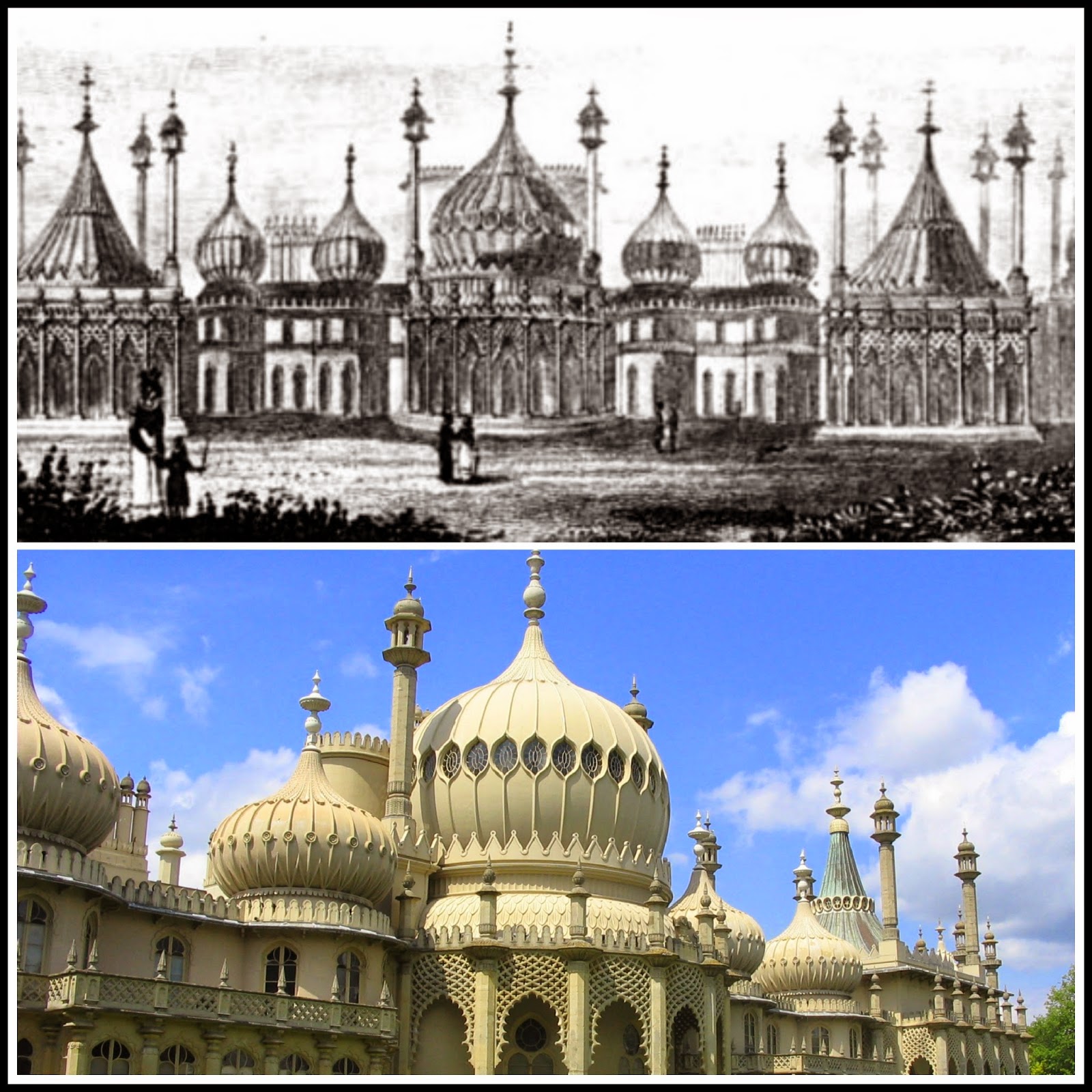
Brighton Pavilion

George IV made the Royal Pavilion at Brighton his summer residence from 1786 until 1827, when he abandoned it as lacking in privacy. It started life as a modest farmhouse and was redeveloped into the magnificent, if somewhat eccentric, palace that exists today.

Brighton Pavilion  Top: From History of Brighton and its environs by R Sickelmore (1827)  Bottom: Brighton Pavilion today © Andrew Knowles
Top: Brighton Pavilion from  
History of Brighton and its environs by R Sickelmore (1827)
Bottom: Brighton Pavilion (2004) © Andrew Knowles
Read more about:
George IV’s Brighton
George IV and the Marine Pavilion, Brighton
George IV and the Brighton Pavilion
What did Regency visitors think of the Brighton Pavilion?
Watch my video: A litter of cupolas – Brighton Pavilion in 1823

Buckingham Palace

Buckingham Palace was acquired by George III as a private residence for the royal family in 1761 and was originally known as Buckingham House or the Queen’s House. George IV transformed it into a palace fit for a king, but did not live to see it completed. William IV disliked it and would not live there, but it became the official London residence of Queen Victoria and British monarchs ever since.

Top: Buckingham House from    The History of the Royal Residences by WH Pyne (1819)  Bottom: Buckingham Palace today © Andrew Knowles
Top: Buckingham House from  
The History of the Royal Residences by WH Pyne (1819)
Bottom: Buckingham Palace (2015) © Andrew Knowles
Bushy House

William IV resided at Bushy House from 1797 when, as Duke of Clarence, he was appointed Ranger of Bushy Park. He lived there with his mistress, Dorothea Jordan, until their relationship ended in 1811, and then later with his wife Princess Adelaide. He continued to live at Bushy House even after he became king and following his death, it became the official residence of Queen Adelaide until her death in 1849. In 1900, the site was offered to the Royal Society to house the National Physical Laboratory and ceased to be a royal residence.

Top: Bushy House from History of the life and reign   of William the Fourth (1837) by R Huish   Bottom: The house in Bushy Park today © Andrew Knowles
Top: Bushy House from History of the life and reign
 of William the Fourth (1837) by R Huish
Bottom: The house in Bushy Park (2014) © Andrew Knowles
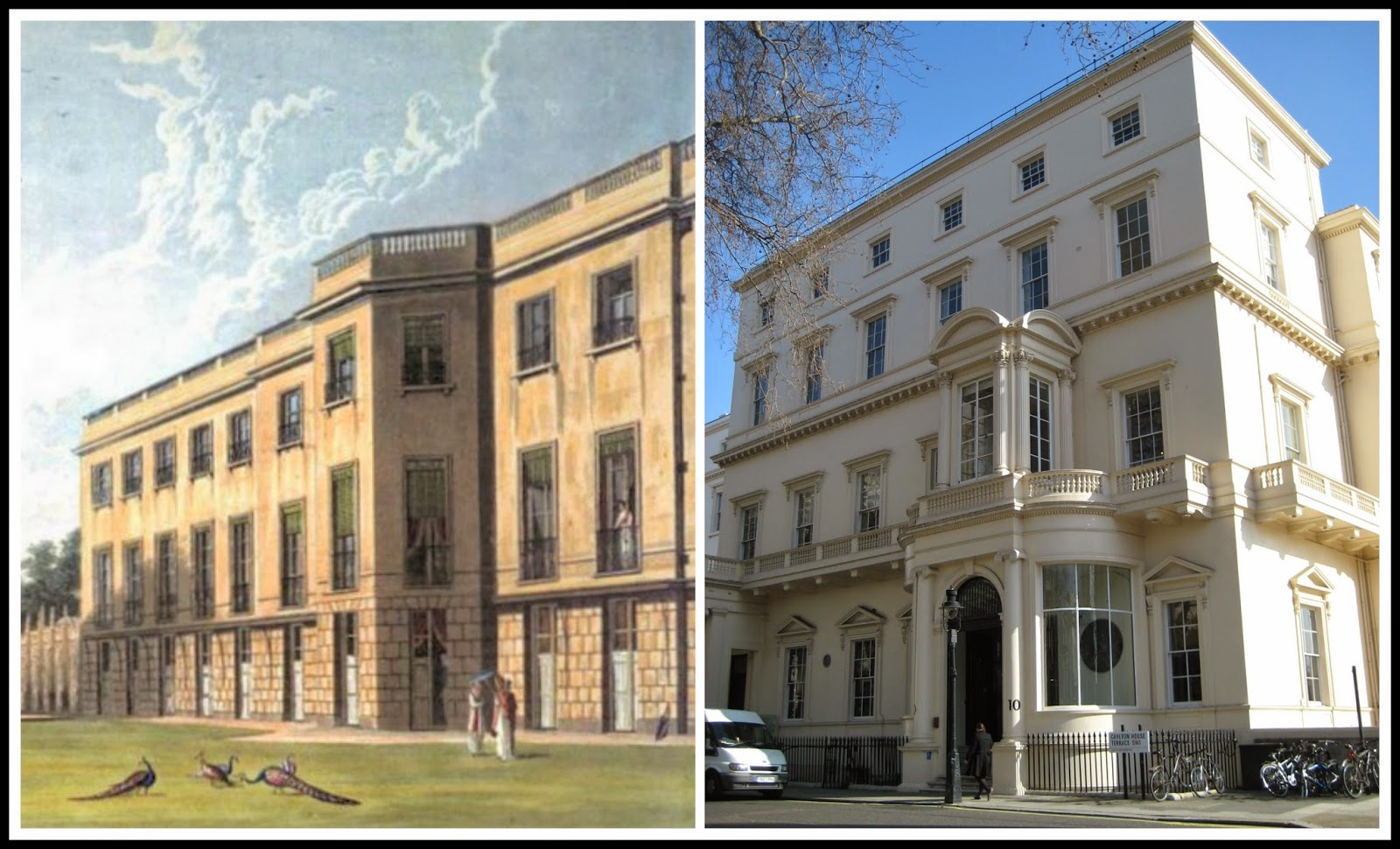
Carlton House

Carlton House was purchased as the official residence of Frederick, Prince of Wales, George III’s father, in 1732. In 1783, it became the residence of the future George IV when he came of age. George IV continually remodelled it until he became king, at which point he transferred his interest to the other royal residences. It was demolished in 1825 and replaced by a number of prestigious houses - Carlton House Terrace.

Left: Carlton House, south front,  from    The History of the Royal Residences by WH Pyne (1819)  Right: Carlton House Terrace © Andrew Knowles
Left: Carlton House, south front,  from  
The History of the Royal Residences by WH Pyne (1819)
Right: Carlton House Terrace (2015) © Andrew Knowles
Clarence House

Clarence House was built in 1825-7 as the London residence of William IV when he was Duke of Clarence. He continued to live there after he became king in 1830. Following his death, it became the residence of Princess Augusta and the Princess Victoria, Duchess of Kent, Queen Victoria’s mother. It is now the official residence of the Prince of Wales.

Top: Clarence House from The Graphic (Nov 1874)  Bottom: Clarence House today © Andrew Knowles
Top: Clarence House from The Graphic (Nov 1874)
Bottom: Clarence House (2015) © Andrew Knowles
Gloucester Lodge

George III visited Weymouth nearly every year from 1789 to 1805 and stayed at Gloucester Lodge, the house built for his brother William, Duke of Gloucester, on the seafront. It was sold by George IV when he became king and is now a hotel.

Top: Weymouth seafront from The Lady's Magazine (1789)  Bottom: Gloucester Lodge today © Andrew Knowles
Top: Weymouth seafront from The Lady's Magazine (1789)
Bottom: Gloucester Lodge (2012) © Andrew Knowles
Read more about:
George III in Weymouth
Sea bathing in Regency Weymouth
Fashionable entertainment in Regency Weymouth
Watch my video: George’s seaside adventure - George III in Weymouth

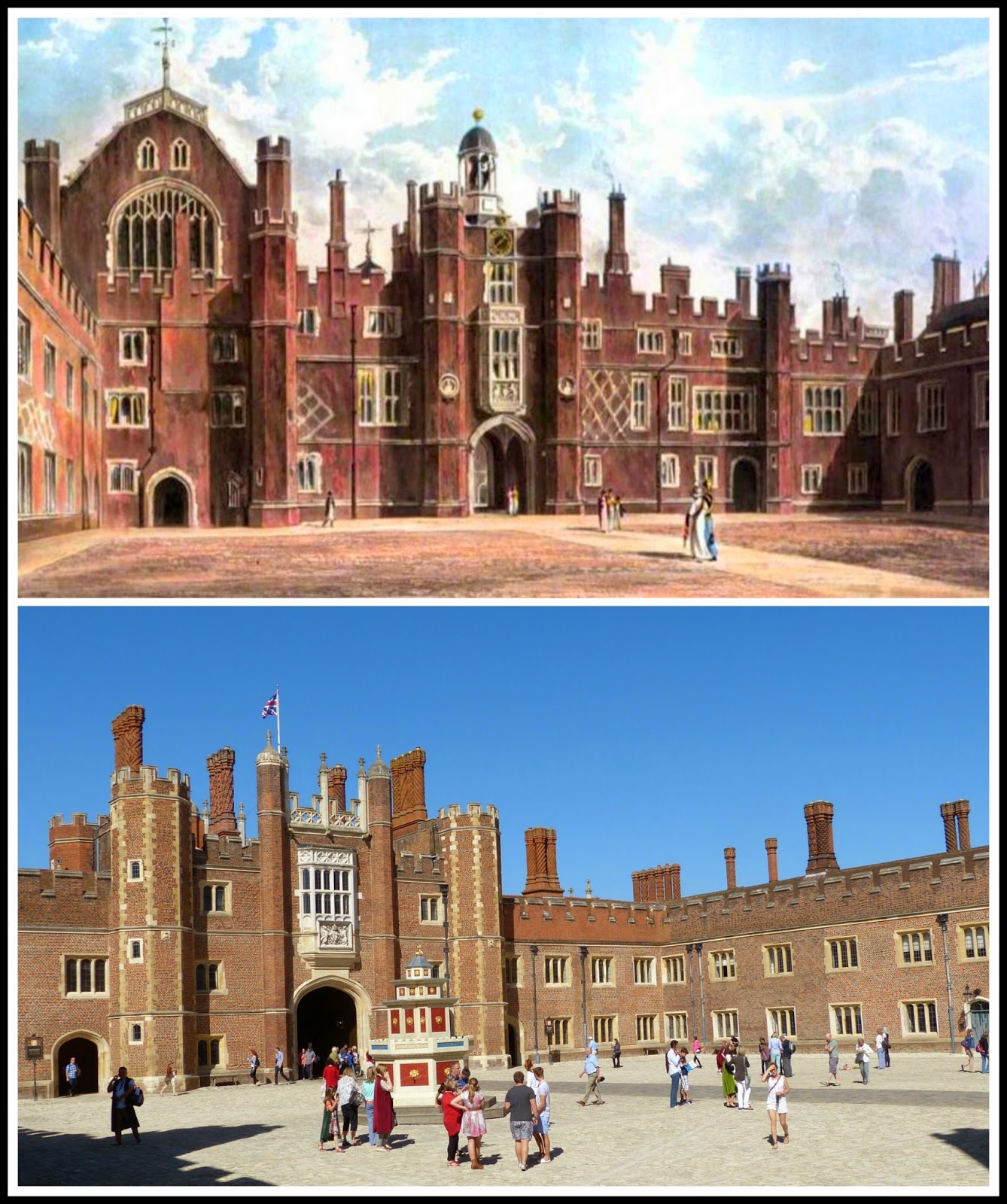
Hampton Court

Hampton Court first became a royal residence after it was acquired by Henry VIII in 1528 and rebuilt to his design. It was used by the early Georgian monarchs, but under George III, the palace was divided up into grace-and-favour apartments – rent-free accommodation for those favoured by the King. It is now in the care of Historic Royal Palaces and is open to the public.

Top: Quadrangle, Hampton Court, from    The History of the Royal Residences by WH Pyne (1819)  Bottom: Hampton Court today © Andrew Knowle
Top: Quadrangle, Hampton Court, from  
The History of the Royal Residences by WH Pyne (1819)
Bottom: Hampton Court (2014) © Andrew Knowles
Kensington Palace

William III and Mary bought Nottingham House in 1689 and transformed it into Kensington Palace, an out-of-town royal residence in which to live in preference to St James’s Palace. It was renovated under George I and used extensively by George II. Members of the royal family continued to live there, but it was never used as the residence of the sovereign again. Kensington Palace is in the care of Historic Royal Palaces and is open to the public.

Top: Kensington Palace from  
The History of the Royal Residences by WH Pyne (1819)
Bottom: Kensington Palace (2012) © Andrew Knowles
Read more about Kensington Palace

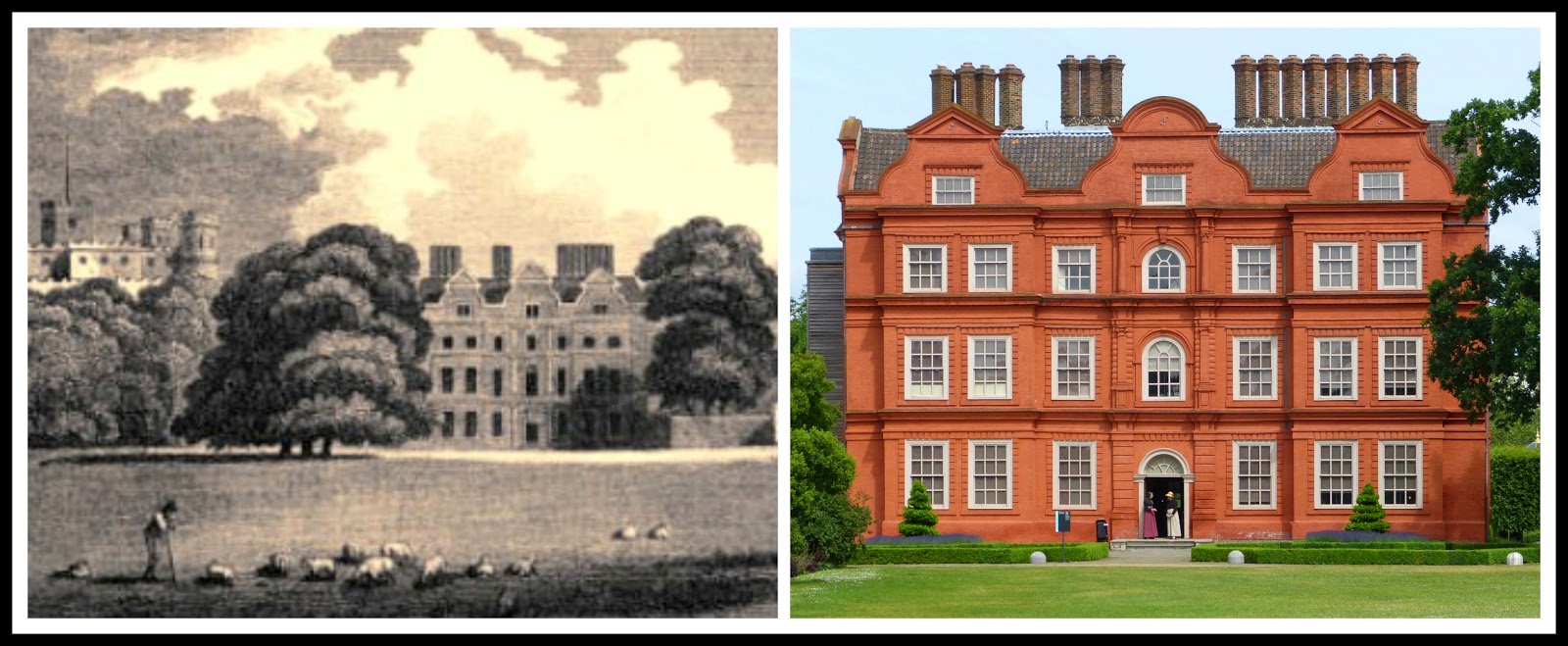
Kew Palace

George II first used Kew Palace as a royal residence for part of his family from 1729. George III housed his two eldest sons here whilst using the White House, Kew, as a country retreat. Kew Palace was used during George III’s mentally incapacitating illness and Queen Charlotte died there in 1818. Queen Victoria gave the palace to the public and it is now managed by Historic Royal Palaces.

Left: The old palace at Kew from Memoirs of HM Sophia Charlotte   of Mecklenburg Strelitz, Queen of Great Britain by WM Craig (1818)  Right: Kew Palace today © Andrew Knowles
Left: The old palace at Kew from Memoirs of HM Sophia Charlotte
 of Mecklenburg Strelitz, Queen of Great Britain by WM Craig (1818)
Right: Kew Palace (2014) © Andrew Knowles
Read more about:
Kew Palace
Kew Gardens
Queen Charlotte’s Cottage, within Kew Gardens

St James’s Palace

Built for Henry VIII in the 1530s, St James’s Palace became the principal London palace of the British sovereign after the Palace of Whitehall was destroyed by fire in 1698. Part of the St James’s Palace was destroyed by fire in 1809, but court levées were still held here until 1939. It remains an official residence although no sovereign has resided here since the time of William IV.


Top: St James' Palace from    The History of the Royal Residences by WH Pyne (1819)  Bottom: St James' Palace today © Andrew Knowles
Top: St James's Palace from  
The History of the Royal Residences by WH Pyne (1819)
Bottom: St James's Palace (2014) © Andrew Knowles
White House, Kew

Frederick, Prince of Wales, George III’s father, lived in the White House at Kew from 1730. George III inherited the White House from his mother and used it as a country retreat. George III was incarcerated here during several bouts of mental illness and he ordered its demolition in 1802. All that remains to mark the site is a sundial opposite to Kew Palace.

Left: The north prospect of HRH The Prince of Wales' House at Kew  - detail from John Rocue's map A New Plan of Richmond Garden (1748)  Right: The sundial opposite Kew Palace that marks the site  of the White House © Andrew Knowles
Left: The north prospect of HRH The Prince of Wales' House at Kew
- detail from John Rocque's map A New Plan of Richmond Garden (1748)
Right: The sundial opposite Kew Palace that marks the site
of the White House (2014) © Andrew Knowles
Read more about the White House at Kew

Windsor Castle

Windsor Castle has been a royal residence since about 1100. It was a favoured out-of-town residence of both George III and George IV who carried out extensive building works at the castle. It remains an official residence of the King today.

Top: The Upper Ward, Windsor Castle from   The History of the Royal Residences by WH Pyne (1819)  Bottom: The Lower Ward, Windsor Castle today © Andrew Knowles
Top: The Upper Ward, Windsor Castle from 
The History of the Royal Residences by WH Pyne (1819)
Bottom: The Lower Ward, Windsor Castle (2015) © Andrew Knowles
Read more about:
Windsor Castle
St George’s Chapel, Windsor Castle
1815 exhibition: Waterloo at Windsor 1815-2015
Updated 30/9/22

Headshot of Rachel Knowles author with sea in background(2021)
Rachel Knowles writes faith-based Regency romance and historical non-fiction. She has been sharing her research on this blog since 2011. Rachel lives in the beautiful Georgian seaside town of Weymouth, Dorset, on the south coast of England, with her husband, Andrew.

Find out more about Rachel's books and sign up for her newsletter here.

If you have enjoyed this blog and want to encourage me and help me to keep making my research freely available, please buy me a virtual cup of coffee by clicking the button below.

 
Sources used include:
Craig, William Marshall, Memoirs of HM Sophia Charlotte of Mecklenburg Strelitz, Queen of Great Britain (1818)
Huish, Robert, History of the life and reign of William the Fourth (1837)
Pyne, WH, The history of the Royal Residences of Windsor Castle, St James's Palace, Carlton House, Kensington Palace, Hampton Court, Buckingham House and Frogmore (1819)
Rocque, John, A New Plan of Richmond Garden (1748)
Sickelmore, Richard, History of Brighton and its environs (1827)
The Graphic (1874)
The Lady's Magazine (1789)

Historic Royal Palaces website
Royal Collection Trust website
The official website of The British Monarchy 
 
© RegencyHistory

Thursday, 16 January 2014

Regency History’s guide to Kensington Palace

Kensington Palace
Kensington Palace (2017)
Where is it?

Kensington Palace is situated in Kensington Gardens in London.

History

Kensington Palace started life as a Jacobean mansion built around 1605. It was bought by William III and Mary II in 1689 and was transformed into a royal palace by Sir Christopher Wren so that the King and Queen could live away from the London air.

The palace is now in the care of Historic Royal Palaces.

Georgian connections

Kensington Palace  from The History of the Royal Residences by WH Pyne (1819)
Kensington Palace
from The History of the Royal Residences by WH Pyne (1819)
George I and George II both used Kensington Palace as one of their principal residences, but after the death of Queen Caroline in 1737, much of the palace fell into disrepair.

Neither George III, George IV nor William IV chose to live at Kensington Palace. They granted “Grace and Favour” apartments to courtiers and members of the royal family. These included:

Kensington Palace through the Gold Gates
Kensington Palace through the Gold Gates (2017)
Kensington Palace from Kensington Gardens
Kensington Palace from Kensington Gardens (2017)
Kensington Palace as a tourist attraction

Visiting royal palaces is not a new entertainment. Although not opened to the public until 1899, it was possible to see inside Kensington Palace during the Regency period.

According to Feltham's Picture of London for 1818:
The palace is a large and splendid edifice of brick, and has a set of very handsome state apartments, and some beautiful staircases and ceilings, painted by Verrio and others. He continued: The whole may be seen any day except Sundays, by applying to the housekeeper, for a trifling douceur.1
The State Apartments

The King's Staircase

The King's Staircase, Kensington Palace
The King's Staircase, Kensington Palace (2012)
The Great Staircase, Kensington Palace, from The History of the Royal Residences by WH Pyne (1819)
The Great Staircase, Kensington Palace, from The History
of the Royal Residences by WH Pyne (1819)
Queen Caroline's Drawing Room

Queen Caroline's Drawing Room, Kensington Palace, from The History  of the Royal Residences by WH Pyne (1819) The Queen's Bedchamber, Kensington Palace, from The History of the Royal Residences by WH Pyne (1819)
Queen Caroline's Drawing Room, Kensington Palace, from The History
of the Royal Residences by WH Pyne (1819)
The Queen's Bedchamber

The Queen's Bedchamber, Kensington Palace, from The History  of the Royal Residences by WH Pyne (1819)
The Queen's Bedchamber, Kensington Palace, from The History
of the Royal Residences by WH Pyne (1819)
The Queen's Dining Room

The Queen's Dining Room, Kensington Palace, from The History  of the Royal Residences by WH Pyne (1819)
The Queen's Dining Room, Kensington Palace, from The History
of the Royal Residences by WH Pyne (1819)
The Queen's Gallery

The Queen's Gallery, Kensington Palace
The Queen's Gallery, Kensington Palace (2017)
The Queen's Gallery, Kensington Palace, from The History of the Royal Residences by WH Pyne (1819)
The Queen's Gallery, Kensington Palace, from The History
of the Royal Residences by WH Pyne (1819)
The Presence Chamber

The Prescence Chamber, Kensington Palace, from The History  of the Royal Residences by WH Pyne (1819)
The Prescence Chamber, Kensington Palace, from The History
of the Royal Residences by WH Pyne (1819)
The Admirals' Gallery

The Admirals' Gallery, Kensington Palace, from The History
of the Royal Residences by WH Pyne (1819)
The Cupola Room

The Cupola Room, Kensington Palace
The Cupola Room, Kensington Palace (2017)
The ceiling of the Cupola Room, Kensington Palace
The ceiling of the Cupola Room, Kensington Palace (2017)
The Cupola Room, Kensington Palace, from The History  of the Royal Residences by WH Pyne (1819)
The Cupola Room, Kensington Palace, from The History
of the Royal Residences by WH Pyne (1819)
The King's Drawing Room

The King's Drawing Room, Kensington Palace, from The History  of the Royal Residences by WH Pyne (1819)
The King's Drawing Room, Kensington Palace, from The History
of the Royal Residences by WH Pyne (1819)
Learning to play Hazard  in the King's Drawing Room, Kensington Palace
Learning to play Hazard
in the King's Drawing Room, Kensington Palace (2017)
The King's Closet

The King's Closet, Kensington Palace, from The History  of the Royal Residences by WH Pyne (1819)
The King's Closet, Kensington Palace, from The History
of the Royal Residences by WH Pyne (1819)
Queen Caroline's Closet

Queen Caroline's Closet, Kensington Palace, from The History of the Royal Residences by WH Pyne (1819)
Queen Caroline's Closet, Kensington Palace, from The History
of the Royal Residences by WH Pyne (1819)
The King's Gallery

The King's Gallery, Kensington Palace
The King's Gallery, Kensington Palace (2017)
The King's Gallery, Kensington Palace, from The History  of the Royal Residences by WH Pyne (1819)
The King's Gallery, Kensington Palace, from The History
of the Royal Residences by WH Pyne (1819)
Victoria Revealed

Queen Victoria was born in Kensington Palace on 24 May 1819. It is believed that she was born in the North Drawing Room of her parents’ apartments.

Room in Kensington Palace where Queen Victoria was born with inset plaque stating her date of birth
Room where Queen Victoria was born , Kensington Palace (2014)
Victoria: A Royal Childhood

Victoria’s father, Edward, Duke of Kent, died suddenly less than a year after her birth, and Victoria and her mother were left virtually penniless. They returned to their apartments at Kensington Palace where Victoria was brought up in relative seclusion.

When William IV visited the palace in August 1836, he discovered that the Duchess of Kent had adopted some of the state rooms and altered them to suit herself. William was furious and publicly complained about the liberties his sister-in-law had taken and announced his wish that he would live long enough for Victoria to reach her 18th birthday, thereby preventing the Duchess from becoming regent. His wish was granted; he died just four weeks after Victoria turned 18.

This post was last updated 7 October 2019.

If you enjoyed this article, you might also enjoy my guides to Kensington Gardens and Kew Palace.

Headshot of Rachel Knowles author with sea in background(2021)
Rachel Knowles writes clean/Christian Regency era romance and historical non-fiction. She has been sharing her research on this blog since 2011. Rachel lives in the beautiful Georgian seaside town of Weymouth, Dorset, on the south coast of England, with her husband, Andrew.

Find out more about Rachel's books and sign up for her newsletter here.

If you have enjoyed this blog and want to encourage me and help me to keep making my research freely available, please buy me a virtual cup of coffee by clicking the button below.

 
Note
1. From Feltham, John, The Picture of London for 1818 (1818)

Sources used:
Feltham, John, The Picture of London for 1818 (1818)
Humphrys, Julian, The private life of palaces (Historic Royal Palaces, 2006)
Pyne, WH, The history of the Royal Residences of Windsor Castle, St James's Palace, Carlton House, Kensington Palace, Hampton Court, Buckingham House and Frogmore (1819)

Kensington Palace official website

Photographs © RegencyHistory.net