Search this blog

Showing posts with label Gretna Green. Show all posts

Thursday, 11 June 2020

Marriage of minors in Regency England

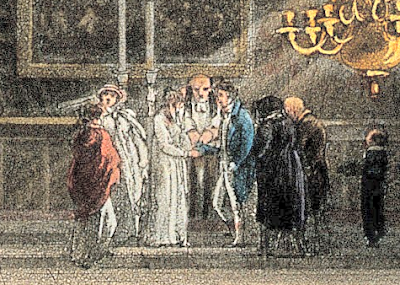
Detail from Merton College, Oxford: a marriage ceremony in the chapel by J Buck (1813) after AC Pugin - Wellcome Collection (CC BY 4.0)
Detail from Merton College, Oxford: a marriage ceremony
 in the chapel
by J Bluck (1813) after AC Pugin
Wellcome Collection used under Creative Commons Licence (CC BY 4.0)
If a young lady or gentleman wanted to get married in Regency England while they were a minor, that is before they came ‘of age’, they needed the permission of their parent or guardian.

When did a Regency person come ‘of age’?

The age of majority during the Regency was 21 years old. It was only reduced to the age of 18 relatively recently, in 1970.

Was parental permission always necessary?

Parental permission for the marriage of minors was required for all weddings in England except where the underage party had been married before.

Marriage by licence

To obtain either a common marriage licence or a special licence for the marriage of underage persons, permission was required from a parent or guardian of each underage person. Either party to the wedding or a third party had to give a sworn statement that this permission had been given before the licence could be granted.

If they lied about having parental consent, the marriage could be set aside.

Marriage by banns
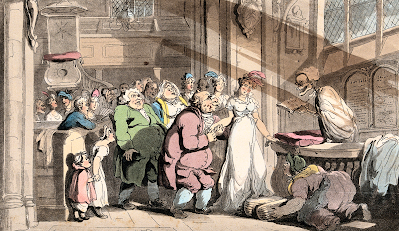
The dance of death: the wedding by T Rowlandson (1816) Wellcome Collection by Creative Commons (CC BY 4.0)
The dance of death: the wedding by T Rowlandson (1816)
Wellcome Collection
Used under Creative Commons Licence (CC BY 4.0)
Explicit permission was NOT required for the banns to be read, but a parent or guardian of a previously unmarried underage party could forbid the banns. As banns had to be read out over three Sundays in the parish church that the couple attended, or in both parish churches if the couple were from different parishes, it was deemed that the parents or guardians had plenty of time to object to the marriage if they wanted to. If they did not forbid the banns, they could not later object to the marriage.

It would appear, however, that some unscrupulous persons tried to ignore this if it was in their interests to do so.

Ackermann’s Repository (January 1815) reported the sad case of Elizabeth Chandler, the daughter of a respectable tradesman:
Four years since, I became acquainted with John P –; we walked out together, we sat next to each other at every holiday meeting, and, in short, I soon began to have a particular affection for him; and as he was constantly at our house, I always treated him as the man who would become one day my loving husband. This, sir, at length was realized, and this day month I uttered the vow, which he also pronounced at the same altar, to cherish each other till death should us part. 

For a whole fortnight did we live, at least if I may judge of his feelings by my own, as happy as sincere love could make us: at the end of this period, however, I began to endure what I have ever since felt, the torments of love unreturned, and a character blasted for ever. 

After the short moments of a fortnight’s joy, he left me, as he said, but for a day, nor could I have believed it to be in the nature of man to be so perjured, if he at that time mean ever to return again. For three days, agony, suspense, and dread racked my frame. I wrote, I followed to the place whither he intended to go: alas! He was denied to me, and though fainting at the door, from the opprobrious terms his friends lavished on me, he came not to comfort her, who had, for him, given up what she supposed the rites of the church had warranted.1
Elizabeth’s husband wrote her a letter, telling her:
I have left you then for ever, for my friends insist upon it, that I must see you no more. My uncle Palmer, on whom you know I depend, has declared, unless our match be set on one aside, he will never see me no more; and you know, you have no fortune, and, if you love me, you cannot wish I should starve. It appears, although I did not know it myself, that I am six months under age, and I find, by the law of the land, I cannot marry. If, however, you should have a child, we will maintain it. I am very sorry, but what can I do? They have sent me to a place which I must not tell you of. In hopes you will bear this with becoming fortitude, I take my leave of you forever. So no more at present from your once loving husband, John P –.2
Elizabeth was distraught and wrote:
His cruel parents are determined to part us, and my poor incensed and less powerful parents can only mingle their tears with mine. They say the bans thrice put up, the solemnization in every particular, will avail me nothing; my husband being a minor is yet no husband to me – wretched, wretched girl!3
The writer of the article, Scriblerus, was deeply moved.
I conjure, therefore, the legal correspondents of the Repository, to exert themselves in behalf of this, perhaps not the last instance of female credulity and male baseness; and through the medium of the next number, point out some remedy to restore an unfortunate female to her peace of mind and respectability of character.4
The following issue published a story of Mary F – r, a lady who had married an underage man after banns who wished to get out of her marriage because of her ‘husband’s cruelty, and infamous behaviour of every description.’5

This woman wrote:
I was told, and am still told, that his being a minor will avail me nothing, as the bans were regularly put up. If what the unfortunate Elizabeth states be the fact, in the broad meaning of the assertion, surely I could as well take advantage of my husband’s minority, as in her case the husband or his friends could. Surely a man ought not to be allowed to take advantage of his own wrong-doings, to leave an innocent and injured woman; when, if that woman wished to do so, from his cruelties or other bad behaviour, she should be shut out from the same remedy.6
In April, Scriblerus published a response:
Johannes Scriblerus feels happy in informing his readers, that the case represented in … January has been answered by several legal gentlemen, who have given as their opinions, that the regular publication of bans stamps a marriage with legality. Elizabeth P – is, consequently, to all intents and purposes, the wife of John P –, although the marriage took place while he was a minor. Of course, according to this decision, our fair correspondent, Mary F – r, cannot withdraw herself from those engagements from which she has such reason to desire a release.7
Runaway marriages
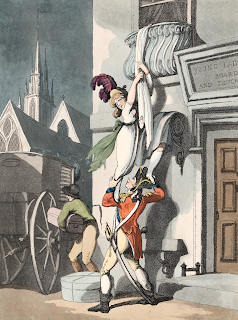
Smuggling Out or Starting for Gretna Green by Rowlandson & Schutz Published by Ackermann (1789) DP872184 from Metropolitan Museum of Art
Smuggling Out or Starting for Gretna Green
by Rowlandson & Schutz
Published by Ackermann (1789)
DP872184 from Metropolitan Museum of Art
No parental consent was required for the marriage of underage persons in Scotland. As a result, couples ran away to the border to get married, at places like Gretna Green, if they did not have the consent of the underage person’s parent or guardian. As this was an expensive business, it usually meant that there was a fortune involved.


Headshot of Rachel Knowles author with sea in background(2021)
Rachel Knowles writes clean/Christian Regency era romance and historical non-fiction. She has been sharing her research on this blog since 2011. Rachel lives in the beautiful Georgian seaside town of Weymouth, Dorset, on the south coast of England, with her husband, Andrew.

Find out more about Rachel's books and sign up for her newsletter here.

If you have enjoyed this blog and want to encourage me and help me to keep making my research freely available, please buy me a virtual cup of coffee by clicking the button below.

Notes
1. Ackermann, Rudolph, The Repository of Arts, Literature, Commerce, Manufactures, Fashions and Politics (January 1815)
2. Ibid.
3. Ibid.
4. Ibid.
5. Ackermann, Rudolph, The Repository of Arts, Literature, Commerce, Manufactures, Fashions and Politics (February 1815)
6. Ibid.
7. Ackermann, Rudolph, The Repository of Arts, Literature, Commerce, Manufactures, Fashions and Politics (April 1815)

Sources used include:
Ackermann, Rudolph, The Repository of Arts, Literature, Commerce, Manufactures, Fashions and Politics (Various)

Wednesday, 17 October 2018

Banns, licences and Hardwicke's Marriage Act - a Regency History guide to marriage in Georgian England

St George's Hanover Square - the most  fashionable church in Regency London
St George's Hanover Square - the most
fashionable church in Regency London
The Marriage Act (1753)

Marriages in late Georgian England were governed by Hardwicke’s Marriage Act of 1753 which came into force on 25 March 1754 – an Act designed for ‘the better preventing of clandestine Marriages’.1

Although marriages usually took place in parish churches prior to this, it was possible to circumvent the system and get married in secret at places like the Fleet prison and St George’s Chapel, Mayfair.

The 1753 Act stated that all marriages in England had to take place in a parish church or chapel, either after banns or by licence, unless under special licence. The law did not apply to members of the royal family. Nor did it apply to Jews and Quakers, but no concessions were made for other non-Conformists. 

There was a rush to get married before the Act came into force and the registers of St George’s Chapel state that 1,136 marriages took place between October 1753 and March 1754 including 61 on the 24 March 1754.

Mayfair Chapel in 1761 from Mayfair and Belgravia by G Clinch (1892)
Mayfair Chapel in 1761
from Mayfair and Belgravia by G Clinch (1892)
Marriage by banns

Banns were a formal way of announcing the couple’s intention to marry. The Banns of Matrimony had to be read out, in a prescribed format, for three Sundays prior to the wedding in the parish church or chapel that the couple attended, or in both parish churches or chapels if the couple were from different parishes. The couple had to give seven days’ notice to the minister of each church before the first reading of the banns, and provide details of their names, where they lived and how long they had lived there for.

If either of the couple were under the age of 21 years and previously unmarried, then a parent or guardian of the underage party could forbid the banns. However, if they failed to object at the time the banns were read, they could not later object to the marriage.

The marriage ceremony could only take place at one of the places where the banns were read. It had to be witnessed by two people in addition to the minister taking the ceremony, and the marriage register had to be signed by the minister, the witnesses and the two parties getting married.

This was by far the most common way of getting married.
 
Entries in the marriage register of St George's Hanover Square from 18-28 July 1811   illustrating the fact that most marriages were by banns.    All the entries are by banns except the one marked licence.
Entries in the marriage register of St George's Hanover Square from 18-28 July 1811
 illustrating the fact that most marriages were by banns.  All the entries are by
banns except the one marked licence.2
Marriage by common licence

Sometimes it was not convenient to wait for the banns to be read, for example if the bride was pregnant, and it was possible to get married more quickly by applying for a common licence. This was available from a bishop or archbishop and their offices.

Before the licence could be issued, one of the couple or someone acting on their behalf had to submit a sworn statement or allegation that there was no impediment of kindred or alliance to the marriage, and if one or both parties were underage and previously unmarried, that they had the consent of their parent or guardian. There was also a requirement for the groom or someone acting on his behalf to enter a bond where a substantial amount of money would be forfeited if an impediment existed.

The marriage had to take place in the church or chapel of the parish where one of the couple had been residing for at least four weeks. As with banns, the wedding had to take place in front of two witnesses who signed the register along with the minster and the couple.

Entry in the marriage register of St George's Hanover Square for a  marriage by licence in 1815. This example is for the marriage of a   minor and states that her father's consent had been obtained.
Entry in the marriage register of St George's Hanover Square for a
marriage by licence in 1815. This example is for the marriage of a
 minor and states that her father's consent had been obtained.
Special licence

The only legal way to be married in a place other than a parish church or chapel after banns or by licence was to be married by special licence. This was a much rarer and more expensive type of licence than a common licence and could only be issued by the Archbishop of Canterbury. A special licence still required an allegation that there was no impediment of kindred or alliance to the marriage, and that the consent of a parent or guardian for underage parties had been given, but it enabled a couple to get married anytime and anywhere, such as in the private chapel of their home.

Entry in the marriage register of St George's Hanover Square for a marriage by   special licence in 1811. This example states where the marriage took place   and that the underage bride's guardians had given consent.
Entry in the marriage register of St George's Hanover Square for a marriage by
special licence in 1811. This example states where the marriage took place
and that the underage bride's guardians had given consent.
1823 Marriage Act

Hardwicke’s Marriage Act was amended several times, most importantly by the Act of July 1823. The new stipulations which took effect on 1 November 1823 included:
• The marriage had to take place within three months of the banns being completed or from the date the licence was granted.
• The marriage had to take place between 8 o’clock and 12 noon, unless by special licence.
• The period of residency for the granting of a licence was reduced to 15 days.
• It was no longer necessary to enter into a separate bond when applying for a licence.

Runaway marriages

Hardwicke’s Marriage Act did not apply in Scotland where it was possible to get married immediately by making declarations in front of witnesses. Underage couples could be married without the consent of parents or guardians, and there was no need to wait for the reading of the banns. As a result, many such couples fled to the border to be married, most famously to Gretna Green.

Travelling chariot at the blacksmith's shop, Gretna Green

Headshot of Rachel Knowles author with sea in background(2021)
Rachel Knowles writes clean/Christian Regency era romance and historical non-fiction. She has been sharing her research on this blog since 2011. Rachel lives in the beautiful Georgian seaside town of Weymouth, Dorset, on the south coast of England, with her husband, Andrew.

Find out more about Rachel's books and sign up for her newsletter here.

If you have enjoyed this blog and want to encourage me and help me to keep making my research freely available, please buy me a virtual cup of coffee by clicking the button below.


Notes
1. From An Act for the better preventing of clandestine Marriages (1753)
2. All quotes from the marriage registers of St George’s Hanover Square are from the transcriptions edited by John Chapman (see full details below).

Sources used include:
An Act for amending the Laws respecting the Solemnization of Marriages in England [18th July 1823]
An Act for the better preventing of clandestine Marriages (1753)
Chapman, John H (ed) The Register book of marriages belonging to the Parish of St George, Hanover Square in the County of Middlesex Vol 3 1810-1823 (1896)
Clinch, George, Mayfair and Belgravia: being an historical account of the parish of St George, Hanover Square (1892)
Familysearch.org website
Lambeth Palace Research guide

Tuesday, 8 December 2015

The blacksmith's shop at Gretna Green - a Regency History guide

Anvil in the main marriage room of the blacksmith's shop, Gretna Green (2015)
Where is Gretna Green?

Gretna Green is a village in the Scottish county of Dumfries and Galloway, just over the border from England.

What is so special about Gretna Green?

Gretna Green is famous for the huge number of couples who eloped there to get married. After Hardwicke’s Marriage Act came into force in 1754, couples under the age of 21 needed parental consent to get married. As this law did not apply in Scotland, couples who wanted to wed without this consent fled to the border and were married before their parents could stop them. As the first village in Scotland on the main post road from London, Gretna Green became a popular destination for eloping couples.

You can read more about why people ran away to Gretna in my earlier post: Why did Regency lovers elope to Gretna Green?

The blacksmith's shop, Gretna Green (2015)
The blacksmith’s shop

Many of the runaway couples were married over the anvil in the blacksmith’s shop. The handfasting (1) ceremony was conducted by one of the self-appointed ‘anvil priests’ who would bring his hammer down on the anvil as he completed the marriage ceremony. It was a very lucrative business. The eloping couples were typically well off and in such a hurry to get married that the anvil priest could charge a substantial fee for obliging them. Once the ceremony had taken place, the marriage was legally binding.

The main marriage room in the blacksmith's shop, Gretna Green (2015)
The anvil priests

The most famous anvil priests during the Georgian period were:

Joseph Paisley (anvil priest 1754-1814)

Joseph Paisley was an ex-tobacconist and smuggler, renowned for his strength. He became a blacksmith, but quickly recognised that it was more lucrative to marry eloping couples and became one of the first blacksmith priests in 1754. Despite becoming immensely fat and addicted to drink, he continued to conduct marriage ceremonies until his death in 1814.

David Lang (anvil priest 1792-1827)

David Lang was Paisley’s nephew. He was pressganged into the British Navy as a young man and then captured by the American pirate John Paul Jones and made part of his crew. He escaped from Jones’ ship when it was near the Solway coast, swimming to the shore near Gretna.

In 1792, he became a rival blacksmith priest and was known as Bishop Lang because of the clerical style of dress he adopted. Like his uncle, he had a reputation for drinking too much. He was the anvil priest responsible for marrying Ellen Turner to her abductor, Edward Gibbon Wakefield, in the notorious Shrigley abduction and gave evidence at the trial in 1827. He died the same year.

David Lang - picture from the blacksmith's museum, Gretna Green (2015)
David Lang - picture from the blacksmith's
museum, Gretna Green (2015)
Simon Lang (anvil priest 1827-1872)

Simon Lang was David Lang’s son and took over from his father in 1827. When the number of marriages started decreasing, he supplemented his income from the wedding business with weaving and smuggling, but he continued as an anvil priest until his death in 1872.

Robert Elliot (anvil priest 1814-1840)

Robert Elliot was a farmer’s son who worked for a stagecoach company. In 1811, he married Paisley’s granddaughter, Ann Graham, in the parish church at Gretna Green. He became Paisley’s assistant in the marriage business and took over from him on his death in 1814. 

In his memoirs, Elliot claimed to have performed between 4,000 and 8,000 marriage ceremonies before he retired from the business in 1840. However, some of the other facts in his memoirs were clearly wrong, so it is hard to know how accurate this figure is and impossible to confirm one way or the other as his registers, and those of Paisley, were destroyed in a fire.

The end of runaway marriages

Travelling chariot in the museum at the blacksmith's shop, Gretna Green (2015)
In 1856, the Marriage (Scotland) Act was passed which changed the law in Scotland. At least one of the people getting married now had to live in Scotland for a minimum of 21 days before they could get married. There was still no need of parental consent for underage couples, but the residency requirement made runaway matches much less appealing as parents had plenty of time to catch their errant offspring. 

The number of eloping couples dwindled and Gretna Green’s once thriving marriage industry petered away.

The blacksmith’s shop gets a new lease of life

Sign on blacksmith's shop, Gretna Green (2015)
It is unlikely that we would be so familiar with the Gretna Green story if it wasn’t for Hugh Mackie. Back in the 1880s, he bought the Gretna estate, including the famous blacksmith’s shop, and founded the family business which still runs Gretna Green today, promoting it as a romantic tourist spot. 

The blacksmith’s shop remained a popular wedding venue until 1940 when an Act of Parliament made handfasting (1) ceremonies illegal, though some couples still liked to have a blessing over the anvil. 

Today, the blacksmith’s shop at Gretna Green is once again in high demand as a romantic place to get married with over 1000 weddings taking place there every year. Scottish law now allows couples to get married over the anvil in either a religious or civil ceremony and, since the residency requirement no longer applies (2), Gretna Green is the obvious romantic destination for eloping couples.

Arch outside the blacksmith's shop, Gretna Green (2015)
What can you see today?

The blacksmith’s shop is part museum, part wedding venue. The museum is not expensive, but when I walked into the room initially, I was somewhat disappointed. There are a number of signboards telling the Gretna Green story, together with a couple of room sets (including one with a spinning wheel set up some years ago by my mother-in-law), a few costumes and various documents displayed on the walls.

The museum at the blacksmith's shop, Gretna Green (2015)
A room depicting a household scene with a spinning wheel set up by my mother-in-law in the blacksmith's shop museum, Gretna Green (2015)
A room depicting a household scene with a spinning wheel set up by
my mother-in-law in the blacksmith's shop museum, Gretna Green (2015)
At the end of the room is the way through to the anvil room. While we were parking our car, we saw one couple who had just been married, but by the time we were in the museum, another ceremony was already in progress. We were told that people were only allocated half hour slots!

Between weddings (there was another wedding group waiting to come in!), we had a few brief moments in the anvil room, enabling us to grab a few pictures. At this stage, I decided that the few pounds I had paid were probably worth it. After all, I had managed to see where the famous runaway weddings had taken place.

With my hand on the anvil at the blacksmith's shop, Gretna Green (2015)
With my hand on the anvil
at the blacksmith's shop, Gretna Green (2015)
But there was more to come. Beyond the entrance to the anvil room, there were more marriage rooms, each with their own anvil. There are a lot of anvils in Gretna, both inside and out!

Another marriage room in the blacksmith's shop, Gretna Green (2015)
Another marriage room in the
blacksmith's shop, Gretna Green (2015)
And the museum continued. There was a collection of horse-drawn vehicles, including a travelling chariot (shown above), a barouche, a Brougham and a stagecoach. I was not expecting this and it was a lovely surprise.

Barouche, blacksmith's shop museum, Gretna Green (2015)
Brougham, blacksmith's shop museum, Gretna Green (2015)
Stagecoach, blacksmith's shop museum, Gretna Green (2015)
Outside, there are various shops and the newest attraction—the Courtship Maze. Not much to look at yet, but I expect it will prove to be a nice addition to the complex when the hedges are fully grown.

Entrance to Courtship Maze, Gretna Green (2015)
If you are looking for a romantic and historic venue for a wedding, what better place than Gretna Green!

Rear entrance into courtyard outside the blacksmith's shop, Gretna Green (2015)
Rear entrance into courtyard outside
the blacksmith's shop, Gretna Green (2015)

Headshot of Rachel Knowles author with sea in background(2021)
Rachel Knowles writes clean/Christian Regency era romance and historical non-fiction. She has been sharing her research on this blog since 2011. Rachel lives in the beautiful Georgian seaside town of Weymouth, Dorset, on the south coast of England, with her husband, Andrew.

Find out more about Rachel's books and sign up for her newsletter here.

If you have enjoyed this blog and want to encourage me and help me to keep making my research freely available, please buy me a virtual cup of coffee by clicking the button below.

 
Notes
(1) A handfasting ceremony simply required a couple to declare their intention to marry in front of witnesses and was a legal form of marriage in Scotland until 1940.
(2) The residency requirement established by the 1856 Marriage (Scotland) Act requiring at least one party to a marriage to live in Scotland for 21 days before the wedding could take place was abolished in 1977.

Sources used include:
Glasgow University website
Gretna Green website
Parliament website

All photographs © regencyhistory.net

Saturday, 28 November 2015

Why did Regency lovers elope to Gretna Green?

A travelling chariot in the museum at Gretna Green
A travelling chariot in the museum at Gretna Green (2015)
If you’ve read many Regency romances, then you are probably familiar with the notion of couples eloping to Gretna Green. But why did couples need to go all the way to Scotland to get married?

The problem of irregular marriages

It all started with Hardwicke’s Marriage Act of 1753. Before this Act came into force, although most people were married in church and subject to the rules laid down by the Church of England, this was not legally necessary. 

According to the Church’s rules, marriages had to take place in the church of the parish where one or both people getting married were living. Either banns had to be read—that is, the intention to marry had to be publicly announced in the church prior to the wedding—or the couple had to procure a license to marry. 

However, as long as the marriage was conducted by an Anglican clergyman, it was still legal, even if all the other conditions were not met!

The Fleet Prison from Ackermann's Microcosm of London (1808-10)
As a result, there was a roaring trade in irregular marriages, particularly at the Fleet Prison in London, where imprisoned clergymen were happy to marry couples at any time of day or night, provided the price was right.

Another popular, but not quite so disreputable location, was St George’s Chapel, Hyde Park Corner, which seems to have been built for the express purpose of conducting irregular marriages. According to the marriage register of St George’s Chapel, an incredible 61 couples were married on 24 March 1754, eager to escape the restrictions that would be imposed by Hardwicke’s Act which came into force the following day (1).

St George's Chapel, Mayfair c1761 from Mayfair and Belgravia: being an historical account of the parish of St George, Hanover Square by G Clinch (1892)
St George's Chapel, Mayfair c1761
from Mayfair and Belgravia: being an historical
account of the parish of St George, Hanover Square
by G Clinch (1892)
Hardwicke’s Marriage Act 1753

Hardwicke’s Marriage Act was devised to put a stop to these irregular marriages. 

The Act required that:
• All marriages had to take place in the parish church of one of the parties getting married and be performed by the minister of that church.
• All marriages had to take place in a public ceremony.
• All marriages had to take place during daylight hours.
• Anyone under the age of 21 wanting to get married had to have parental consent. Formal consent had to be given before a marriage license could be issued and an objecting parent had the right to forbid the banns. However, if the banns were read without challenge, it did not make the marriage illegal even if the parents were against the marriage.
• Marriages could only take place after giving three weeks’ notice of the intention to marry, that is, the banns being read in the parish church for three times before the wedding took place. Marriages without banns required a marriage license. This was more expensive and could only be acquired from a bishop or archbishop.

These rules made it virtually impossible for those under 21 to be married without their parents’ permission.

Scottish marriage law

But crucially for the Gretna Green story, Hardwicke’s Marriage Act only applied in England and Wales. It did not apply in Scotland. The Scottish government was encouraged to adopt the same law, but it did not.

Sign saying Scotland Welcomes You

It was still possible for those aged under 21 to be legally married in Scotland without their parents’ permission. In fact, Scottish law allowed boys as young as 14 and girls as young as 12 to be married. No parental consent was required and the marriage did not have to be consummated to be valid. 

By travelling into Scotland, underage lovers from England could still get married without parental consent. 

Another group of people who took advantage of the more relaxed marriage laws in Scotland were Dissenters. There were special dispensations for Jews and Quakers, but not for non-conformists and some chose to make the journey to Scotland rather than get married in a Church of England church.

Why Gretna Green?

A new trade developed along the Scottish border providing swift marriages for couples eloping from England. The most famous location for these runaway marriages was the blacksmith’s shop at Gretna Green, but other popular places in the Scottish Borders included the toll house on the Scottish side of Coldstream Bridge and the toll house at Lamberton.

Sign saying Welcome to Gretna

Graitney, more familiarly known as Gretna, was the first village in Scotland on the main post road from London. The blacksmith’s shop was ideally located as one of the first buildings that an eloping couple came to.

The blacksmith's shop, Gretna Green
The blacksmith's shop, Gretna Green (2015)
All that was required for a marriage in Scotland to be legal was a declaration in front of witnesses. Couples arriving at the blacksmith’s shop in Gretna Green were married by a self-appointed ‘anvil priest’ – not a clergyman, but an entrepreneur who could see that conducting runaway marriages was big business. As the eloping couples were typically rich and in a great hurry to be married, the anvil priest could charge whatever he liked and the couple would probably pay. 

The anvil priest conducted a short hand-holding ceremony over the anvil in front of two witnesses and pronounced the couple man and wife. If the couple had arrived without witnesses, the anvil priest would obligingly provide them.

Marriage room at the blacksmith's shop, Gretna Green (2015)
Famous Gretna weddings

One of the most famous marriages to take place at Gretna Green was between Sarah Anne Child and John Fane, 10th Earl of Westmorland, which took place on 20 May 1782. Sarah Anne’s father, Robert Child, chased the couple all the way to Scotland, but failed to prevent the marriage. He was so angry that he cut his daughter out of his will, determined that no Earl of Westmorland should benefit from his wealth. As a result, his fortune passed to his eldest granddaughter, Sarah Child Villiers, Countess of Jersey.


Headshot of Rachel Knowles author with sea in background(2021)
Rachel Knowles writes clean/Christian Regency era romance and historical non-fiction. She has been sharing her research on this blog since 2011. Rachel lives in the beautiful Georgian seaside town of Weymouth, Dorset, on the south coast of England, with her husband, Andrew.

Find out more about Rachel's books and sign up for her newsletter here.

If you have enjoyed this blog and want to encourage me and help me to keep making my research freely available, please buy me a virtual cup of coffee by clicking the button below.


Note
(1) The Gretna Green website states that Hardwicke's Marriage Act came into force a day later, on 26 March 1754.

Sources used include:
Armytage, George J, The Register of Baptisms and Marriages at St George's Chapel, May Fair (1889)
Clinch, George, Mayfair and Belgravia: being an historical account of the parish of St George, Hanover Square (1892)

Glasgow University website
Gretna Green website
Parliament website

Photographs © RegencyHistory.net