Search this blog

Showing posts with label Sarah Countess of Jersey. Show all posts

Saturday, 28 November 2015

Why did Regency lovers elope to Gretna Green?

A travelling chariot in the museum at Gretna Green
A travelling chariot in the museum at Gretna Green (2015)
If you’ve read many Regency romances, then you are probably familiar with the notion of couples eloping to Gretna Green. But why did couples need to go all the way to Scotland to get married?

The problem of irregular marriages

It all started with Hardwicke’s Marriage Act of 1753. Before this Act came into force, although most people were married in church and subject to the rules laid down by the Church of England, this was not legally necessary. 

According to the Church’s rules, marriages had to take place in the church of the parish where one or both people getting married were living. Either banns had to be read—that is, the intention to marry had to be publicly announced in the church prior to the wedding—or the couple had to procure a license to marry. 

However, as long as the marriage was conducted by an Anglican clergyman, it was still legal, even if all the other conditions were not met!

The Fleet Prison from Ackermann's Microcosm of London (1808-10)
As a result, there was a roaring trade in irregular marriages, particularly at the Fleet Prison in London, where imprisoned clergymen were happy to marry couples at any time of day or night, provided the price was right.

Another popular, but not quite so disreputable location, was St George’s Chapel, Hyde Park Corner, which seems to have been built for the express purpose of conducting irregular marriages. According to the marriage register of St George’s Chapel, an incredible 61 couples were married on 24 March 1754, eager to escape the restrictions that would be imposed by Hardwicke’s Act which came into force the following day (1).

St George's Chapel, Mayfair c1761 from Mayfair and Belgravia: being an historical account of the parish of St George, Hanover Square by G Clinch (1892)
St George's Chapel, Mayfair c1761
from Mayfair and Belgravia: being an historical
account of the parish of St George, Hanover Square
by G Clinch (1892)
Hardwicke’s Marriage Act 1753

Hardwicke’s Marriage Act was devised to put a stop to these irregular marriages. 

The Act required that:
• All marriages had to take place in the parish church of one of the parties getting married and be performed by the minister of that church.
• All marriages had to take place in a public ceremony.
• All marriages had to take place during daylight hours.
• Anyone under the age of 21 wanting to get married had to have parental consent. Formal consent had to be given before a marriage license could be issued and an objecting parent had the right to forbid the banns. However, if the banns were read without challenge, it did not make the marriage illegal even if the parents were against the marriage.
• Marriages could only take place after giving three weeks’ notice of the intention to marry, that is, the banns being read in the parish church for three times before the wedding took place. Marriages without banns required a marriage license. This was more expensive and could only be acquired from a bishop or archbishop.

These rules made it virtually impossible for those under 21 to be married without their parents’ permission.

Scottish marriage law

But crucially for the Gretna Green story, Hardwicke’s Marriage Act only applied in England and Wales. It did not apply in Scotland. The Scottish government was encouraged to adopt the same law, but it did not.

Sign saying Scotland Welcomes You

It was still possible for those aged under 21 to be legally married in Scotland without their parents’ permission. In fact, Scottish law allowed boys as young as 14 and girls as young as 12 to be married. No parental consent was required and the marriage did not have to be consummated to be valid. 

By travelling into Scotland, underage lovers from England could still get married without parental consent. 

Another group of people who took advantage of the more relaxed marriage laws in Scotland were Dissenters. There were special dispensations for Jews and Quakers, but not for non-conformists and some chose to make the journey to Scotland rather than get married in a Church of England church.

Why Gretna Green?

A new trade developed along the Scottish border providing swift marriages for couples eloping from England. The most famous location for these runaway marriages was the blacksmith’s shop at Gretna Green, but other popular places in the Scottish Borders included the toll house on the Scottish side of Coldstream Bridge and the toll house at Lamberton.
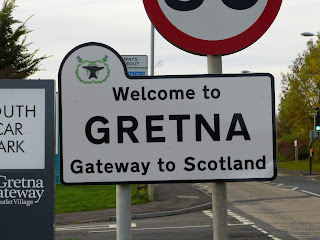
Sign saying Welcome to Gretna

Graitney, more familiarly known as Gretna, was the first village in Scotland on the main post road from London. The blacksmith’s shop was ideally located as one of the first buildings that an eloping couple came to.

The blacksmith's shop, Gretna Green
The blacksmith's shop, Gretna Green (2015)
All that was required for a marriage in Scotland to be legal was a declaration in front of witnesses. Couples arriving at the blacksmith’s shop in Gretna Green were married by a self-appointed ‘anvil priest’ – not a clergyman, but an entrepreneur who could see that conducting runaway marriages was big business. As the eloping couples were typically rich and in a great hurry to be married, the anvil priest could charge whatever he liked and the couple would probably pay. 

The anvil priest conducted a short hand-holding ceremony over the anvil in front of two witnesses and pronounced the couple man and wife. If the couple had arrived without witnesses, the anvil priest would obligingly provide them.

Marriage room at the blacksmith's shop, Gretna Green (2015)
Famous Gretna weddings

One of the most famous marriages to take place at Gretna Green was between Sarah Anne Child and John Fane, 10th Earl of Westmorland, which took place on 20 May 1782. Sarah Anne’s father, Robert Child, chased the couple all the way to Scotland, but failed to prevent the marriage. He was so angry that he cut his daughter out of his will, determined that no Earl of Westmorland should benefit from his wealth. As a result, his fortune passed to his eldest granddaughter, Sarah Child Villiers, Countess of Jersey.


Headshot of Rachel Knowles author with sea in background(2021)
Rachel Knowles writes clean/Christian Regency era romance and historical non-fiction. She has been sharing her research on this blog since 2011. Rachel lives in the beautiful Georgian seaside town of Weymouth, Dorset, on the south coast of England, with her husband, Andrew.

Find out more about Rachel's books and sign up for her newsletter here.

If you have enjoyed this blog and want to encourage me and help me to keep making my research freely available, please buy me a virtual cup of coffee by clicking the button below.


Note
(1) The Gretna Green website states that Hardwicke's Marriage Act came into force a day later, on 26 March 1754.

Sources used include:
Armytage, George J, The Register of Baptisms and Marriages at St George's Chapel, May Fair (1889)
Clinch, George, Mayfair and Belgravia: being an historical account of the parish of St George, Hanover Square (1892)

Glasgow University website
Gretna Green website
Parliament website

Photographs © RegencyHistory.net

Tuesday, 14 July 2015

Lady Jersey in miniature

I was recently contacted by Jayne Parkes who had inherited a wonderful historical booklet from her mother and wanted to know whether I could tell her anything about it. Jayne has very kindly agreed to let me share her booklet with you.

A souvenir booklet

The booklet is labelled ‘Souvenir’ and contains a miniature of a lady and a lock of hair.

Miniature of Lady Jersey in souvenir booklet  © Jayne Parkes
Miniature of Lady Jersey in souvenir booklet
© Jayne Parkes
Lock of hair of Lady Jersey in souvenir booklet  © Jayne Parkes
Lock of hair of Lady Jersey in souvenir booklet
© Jayne Parkes
This would be interesting enough in itself, but in addition, the booklet includes the following note:


As far as I have been able to make out, the text reads:
“Pocket book with miniature & lock of hair of Sarah (nee Fane) Countess of Jersey given by her to my mother Louisa Mrs Hope (afterwards Viscountess Beresford)
Signed A J B Beresford Hope May 6 1883
Nb the almanack (?) lines/here (?) date 1817
Lady Sarah Sophia Fane daughter of John 10th Earl of Westmorland born March 4, 1785, married May 23 1804 George 5th Earl of Jersey, died Jan 26 1867”
Lady Jersey

Let us first consider the subject of the miniature. Sarah Child Villiers, Countess of Jersey (1785-1867), was one of the leading figures of Regency society. You can read more about her in a previous post on this blog. I am not sure what the line ending ‘date 1817’ says, but the details below it concern the birth, marriage and death of Lady Jersey and this information tallies with other sources.

But is the miniature really of Lady Jersey? Below is a close up of the miniature compared with a portrait of Lady Jersey that appeared in The Illustrated Belle Assemblée for 1844 on the left and a print of her on display at Osterley Park on the right. I think that the similarity is very good.
 
Left: Lady Jersey from The Illustrated Belle Assemblée (1844)  Centre: Miniature shown above © Jayne Parkes  Right: Lady Jersey from a print on display at Osterley Park
Left: Lady Jersey from The Illustrated Belle Assemblée (1844)
Centre: Miniature shown above © Jayne Parkes
Right: Lady Jersey from a print on display at Osterley Park
Viscountess Beresford

The miniature was given to Louisa, Viscountess Beresford. In 1837, The Court Magazine and Monthly Critic printed a portrait of the Viscountess together with a brief history of who she was and, very usefully, a list of her children by her first marriage.

Louisa Beresford, Viscountess Beresford  from The Court Magazine and Monthly Critic (1837)
Louisa Beresford, Viscountess Beresford
from The Court Magazine and Monthly Critic (1837)
Louisa Beresford was the youngest daughter of William Beresford, 1st Lord Decies and Archbishop of Tuam, and his wife Elizabeth Fitzgibbon. William Beresford was the brother of George de la Poer Beresford, 1st Marquess of Waterford.

Louisa married Thomas Hope of Deepdene, Surrey, on 16 April 1806. Thomas Hope was a merchant banker, art collector and author. His most famous publication was Anastasius (1819) — a racy novel which rivalled the popularity of Byron’s work and was said to have made Byron weep because he had not written it!

Deepdene, Surrey, the seat of Thomas Hope,  from Select Illustrations of the County of Surrey by GF Prosser (1828)
Deepdene, Surrey, the seat of Thomas Hope,
from Select Illustrations of the County of Surrey by GF Prosser (1828)
Louisa and Thomas had three sons: Henry Thomas Hope; Adrian John Hope and Alexander James Beresford Hope. Thomas Hope died on 2 February 1831 leaving his wealth and art collections to his eldest son Henry.

William Carr Beresford

Viscount Beresford engraved by P Lightfoot  from picture by G Bradley inLife of Field-Marshal His Grace   the Duke of Wellington by WH Maxwell (1840)
Viscount Beresford engraved by P Lightfoot
from picture by G Bradley inLife of Field-Marshal His Grace 
the Duke of Wellington by WH Maxwell (1840)
On 29 November 1832, Louisa married her first cousin William Carr Beresford, the illegitimate son of her uncle, the Marquess of Waterford. William was a General in the British Army, Colonel of the 16th Regiment of Foot and Governor of Jersey and had held the rank of Field Marshal in the Portuguese Army. He served in the Peninsular Wars under the Duke of Wellington and held the chief command in the Battle of Albuera, for which he was honoured with the title of Baron Beresford of Albuera on 17 May 1814. He was given the title of Viscount Beresford on 28 March 1823.

William and Louisa had no children and on his death in 1854, William's estates passed to Louisa’s youngest son, Alexander, who took the additional name Beresford from this time. It is Alexander’s signature—AJB Beresford Hope—that is on the note shown above.

The painter

Signature on miniature of Lady Jersey in souvenir booklet  © Jayne Parkes
Close-up of signature on miniature of Lady Jersey
in souvenir booklet © Jayne Parkes
The last thing I investigated was the painter of the miniature. The painting is signed Dun. Nicholas-François Dun (1764-1832)1 was a French painter who worked mostly in Naples in Italy. 

I have not been able to find out anything else about this painter, but there is another portrait by him from the Metropolitan Museum of Art website shown below. As you can see, the signature is virtually identical.

Portrait of a Woman, said to be Madame Récamier  by Nicolas François Dun c1812-14
Portrait of a Woman, said to be Madame Récamier (1777-1849)
by Nicolas François Dun c1812-14
There are some other paintings by Dun here.

Note
1. Sometimes Dun’s name is spelt Nicolas without the ‘h’.

Sources used include:
Courthope, William, editor, Debrett's Complete Peerage of the United Kingdom of Great Britain and Ireland (1838)
Court Magazine and Monthly Critic (1837)

Anastasius — The Novel Which Made Byron Weep! on The Regency Redingote

Thursday, 2 April 2015

Osterley Park - a Robert Adam showpiece - a Regency History guide

Osterley Park from across the lake
Osterley Park House from across the lake
Where is it?

Osterley Park is a Neoclassical mansion in Isleworth, Middlesex.

Early history

Sir Thomas Gresham, a merchant and financier, built a Tudor manor house at Osterley in the 1570s. In the late 17th century, the property was owned by Nicholas Barbon, an economist and financial speculator who was involved in the development of fire insurance. On Barbon’s death in 1698, there was an outstanding mortgage on the house owing to Child’s Bank.

Front of the house, Osterley Park
Sir Francis Child of Child’s Bank

Sir Francis Child the Elder (1642-1713) started out as an apprentice goldsmith and rose to become a partner in the firm, which by then was concentrating on its banking activities. He married his employer’s daughter and inherited the whole business in 1681.

In 1713, Osterley Park passed to Sir Francis Child the Elder in settlement of Barbon's debt to the bank. It was an early case of bank repossession!

Detail from View of Temple Bar attributed to John Collett  The premises of Child & Co are immediately to the left   of Temple Bar
Detail from View of Temple Bar attributed to John Collett
The premises of Child & Co are immediately to the left
 of Temple Bar
Neoclassical redevelopment

In 1761, Sir Francis Child the Elder’s grandson, also called Francis (1735-63), commissioned Robert Adam to redevelop the house at Osterley in the Neoclassical style. Francis died suddenly two years later and his brother Robert Child (1739-82) further commissioned Adam to design Neoclassical interiors for the house. 
 
Osterley Park is one of the best examples of Robert Adam’s work. Read more about Adam’s work here.
 

Francis Child (1735-1763) by Allan Ramsay
Adam was responsible for the total design of Osterley – from the magnificent portico to the patterns on the ceilings and the designs for the furniture. He also designed garden buildings such as the Garden House, the Orangery (no longer standing) and the Temple of Pan. Adam’s work at Osterley spanned from 1761 to 1779 and many of his designs have been preserved at the Sir John Soane’s Museum in London.

Inside the Temple of Pan in the garden, Osterley Park
The runaway bride

Robert Child and his wife Sarah Jodrell were extremely wealthy. As well as Osterley, they had a house in Berkeley Square in London and a hunting lodge in Warwickshire. They lived in their Neoclassical show home at Osterley Park from May to November. They had one child, a daughter Sarah Anne (1764-1793).

John Fane, 10th Earl of Westmorland, asked to marry Sarah Anne, but Robert refused. Robert wanted his heir to take the Child name and also feared that his fortune would be squandered by the Earl who was known as ‘Rapid Westmorland’ because of his gambling habit. The Earl of Westmorland took matters into his own hands and eloped with Sarah Anne. They were married on 20 May 1782 at Gretna Green.

Robert Child was so angry that he cut his daughter out of his will, leaving Osterley Park and his entire fortune to Sarah Anne’s second son or eldest daughter provided that they took the name Child.

Robert and Sarah Child and their daughter Sarah   Anne by Margaret Battine after Daniel Gardner  Portrait originally created in 1781
Robert and Sarah Child and their daughter Sarah
 Anne by Margaret Battine after Daniel Gardner
Portrait originally created in 1781
Lady Jersey

Sarah Anne had only one surviving son and so Robert Child’s fortune passed to her eldest daughter, Sarah Sophia Fane, who married George Villiers, later 5th Earl of Jersey. Lady Jersey was a leading figure in Regency society and was a patroness of Almack's Assembly Rooms. The Earl of Jersey added the name Child to his own in 1819.

Sarah Sophia Fane - Countess of Jersey
Given to the National Trust

Osterley Park proved expensive to maintain, but it stayed in the family until 1949 when the 9th Earl of Jersey gave the house and grounds to the National Trust.

A tour of Osterley Park

Adam’s Neoclassical façade

Front of the house, Osterley Park
Adam's magnificent portico

Front entrance of the house, Osterley Park
The ceiling of Adam's pillared portico, Osterley Park
The ceiling of Adam's pillared portico, Osterley
The Entrance Hall

The panels in the alcoves look three-dimensional, but they are in fact just paintings – a convincing example of trompe-l’œil. The fireplaces are made of Portland stone and display the Child family crest of an eagle with an adder in its mouth.

The entrance hall, Osterley Park House
The Entrance Hall, Osterley
The entrance hall, Osterley Park House
The Entrance Hall, Osterley
The Eating Room

Gate-leg tables were kept in the adjacent corridors and brought in as required for mealtimes. The pedestals on either side of the sideboard open and could be used to hide away a chamber pot.

The Eating Room, Osterley Park
The Eating Room, Osterley
One of the pedestals in the Eating Room, Osterley
Detail of one of the pedestals
in the Eating Room, Osterley
The Long Gallery

The Long Gallery, Osterley
The Drawing Room
 
The ceiling in the Drawing Room, Osterley
The ceiling design is cleverly reflected in the carpet.

The Drawing Room, Osterley
The Tapestry Room

The chairs were upholstered to match the tapestries.

The Tapestry Room, Osterley
The State Bedchamber

This bed was designed to impress rather than to be slept in. It is an eight-poster bed; there are two posts at each corner. The domed roof of the bed is beautifully decorated, both inside and out.

The State Bedchamber, Osterley
View inside the canopy above the state bed
in the State Bedchamber, Osterley
The Etruscan Dressing Room

Adam’s inspiration for this room came from Sir William Hamilton’s collection of Etruscan vases.

The Etruscan Dressing Room, Osterley

The ceiling of the Etruscan Dressing Room, Osterley
The Library

The books in the library are representative rather than belonging to the family. Francis Child’s book collection had to be sold in the late 19th century in order to pay for repairs to the house.

The Library, Osterley
The Great Stair


The Great Stair, Osterley
Detail from one of the pillars of the Great Stair, Osterley
 Mr Child's Bedchamber

The room used by Robert and Sarah Child when they lived at Osterley.

Mr Child's Bechamber, Osterley
Mr Child's Dressing Room

Mr Child's Dressing Room, Osterley
 Mrs Child's Dressing Room

Mrs Child's Dressing Room, Osterley
The Yellow Taffeta Bedchamber

The Yellow Taffeta Bedchamber, Osterley
The Steward’s Room

The Steward's Room  Displayed as left by the Earl of Jersey in the 1970s
The Steward's Room
As left by the Earl of Jersey in the 1970s
Mrs Bunce’s Room

Mr Bunce was the steward at Osterley in the late 18th century and he was assisted by his wife, Mrs Bunce. The photograph shows the safe which was installed in the 19th century.

Mrs Bunce's Room, Osterley
The Sun Room

I have called this little room the sun room, but it is not listed in my guidebook. It is decorated in the Etruscan style and could be accessed through the house downstairs when I visited in August 2014.

The Sun Room, Osterley
The rear view of the house

The rear view of the house, Osterley
The back door of the house, Osterley
The Garden Room

The Garden Room in the gardens at Osterley
The Temple of Pan
The Temple of Pan in the gardens at Osterley
Last visited June 2022.

Headshot of Rachel Knowles author with sea in background(2021)
Rachel Knowles writes faith-based Regency romance and historical non-fiction. She has been sharing her research on this blog since 2011. Rachel lives in the beautiful Georgian seaside town of Weymouth, Dorset, on the south coast of England, with her husband, Andrew.

Find out more about Rachel's books and sign up for her newsletter here.

If you have enjoyed this blog and want to encourage us and help us to keep making our research freely available, please buy us a virtual cup of coffee by clicking the button below.


Sources used include:
Evans, Sian, Osterley Park and House (National Trust 2009)

All photos © Andrew Knowles & RegencyHistory.net