Search this blog

Thursday, 27 October 2022

Fashionable Goodness: Christianity in Jane Austen's England by Brenda S Cox - book review & author interview

Front cover of Fashionable Goodness by Brenda S Cox - Regency couple standing outside church

You won’t travel very far in England without encountering a parish church building. Likewise, you won’t read much Jane Austen before running into a reference to the church.

The Church of England was deeply embedded in the landscape that Austen lived in and wrote about. But just as many of England’s church buildings are now considered relics, the references to church in her writing are seen as throwbacks to another time. The world she inhabited is no more.

What many Austen fans don’t realise is that there are subtleties and humour that escape the modern reader. While we can still laugh at the absurd Mr Collins in Pride and Prejudice, or Mr Elton in Emma, we can’t appreciate the depth of the humour or the pathos as Austen intended.

However, we can now get closer to it with the help of Brenda Cox’s excellent new book, Fashionable Goodness: Christianity in Jane Austen’s England. Motivated by her own Christianity and love of Austen’s works, Brenda sought to better understand faith and church in Regency England.

Mr Collins and Charlotte Lucas by Hugh Thomson in Pride and Prejudice by Jane Austen 1896 edition
Mr Collins and Charlotte Lucas
by Hugh Thomson in Pride and Prejudice
by Jane Austen 1896 edition
Fashionable Goodness: a resource for readers and writers

Brenda wanted to write her own version of an Austen story, but soon realised that to do so meant knowing more about how the church operated in England at that time. Unable to find a book that told her everything she wanted to know, she decided to write one herself.

It was a labour of love that took nearly ten years. The result is an in-depth study not only into the church, but also into Austen’s own experience of faith and religious institutions. It describes how this coloured her writing. This analysis is both broad and deep. It includes discussion of how the clergy were organised, how people worshipped, the different types of church buildings and the typical work of a clergyman.

The book also discusses faith in the community, attitudes to elopement, adultery and divorce, along with the relationship between faith and science.

However, Brenda doesn’t stop there—that’s just part one. In part two she discusses the challenges facing the Church of England during Jane Austen’s time. Part three looks at outreach and the legacy of church.

Chapters cover the Methodist movement, parishioners of colour, Nonconformists and dissenters, and the abolitionist movement. Brenda profiles a number of high-profile Christians such as John Newton (author of Amazing Grace), William Wilberforce, and Hannah More.

It’s easy to forget that the church in Jane Austen’s day had deep medieval roots. This was reflected in complicated, arcane structures that defied easy explanation. These fed into the language of the church, which used terms like  beneficed clergyman, living, advowson, glebe land and prebend stall. Brenda’s book explains all of these, and much more. 

Hannah More from Memoirs of the life and correspondence  of Mrs Hannah More by William Roberts (1835)
Hannah More
from Memoirs of the life and correspondence 
of Mrs Hannah More by William Roberts (1835)
Thorough, in-depth and well referenced

All this material is backed by glossaries and comprehensive notes. There are nearly 100 pages of reference material.

I was given a digital pre-publication copy of the book, so I can’t judge its size and weight. However, the number of pages imply that it’s sizeable.

Brenda states that she started looking into faith and church in the time of Jane Austen as research for a novel. But she learned so much that she wanted to share it with others who, like her, loved Austen and the church.

Arguably, she could have appealed to a wider audience by sharing less. Many researchers, excited by the wealth of their discoveries, are tempted to share everything they have learned. There will be some who appreciate that depth, while others would prefer a summarised approach.

There’s little to criticise in Brenda’s work. Inevitably, given the depth she goes to, the same passages of Austen are referred to over and over, with different emphasis. In some sections there’s quite a lot of explanations, or the reader is referred to the many pages of notes, or the comprehensive glossary. This is inevitable, given the unfamiliar and sometimes confusing terminology used by the church.

Box pews, Loughwood Meeting House, Devon (2015)

A fascinating read containing a wealth of stories

Brenda’s work makes a fascinating read for anyone who (like me) loves to dig deep into the world of the late eighteenth and early nineteenth centuries. So often I’m left wanting more— not so with this book.

The book contains a wealth of stories about Christians who lived around the time of Jane Austen. I was intrigued to learn about ‘spiritual routs’ hosted by Lady Huntingdon, the faith of property-owning black man Ignatius Sancho, and the evangelical fervour of Charles Simeon. Austen may have known about some, even all, of these people. While they, or characters like them, do not appear in her novels, they were part of the world around her.

I highly recommend Brenda’s book to anyone seeking to better understand the thoughts behind church and clergy references in Jane Austen.

From our twenty-first century perspective it’s easy to forget how deeply church and faith influenced every aspect of life in Jane Austen’s England. Any author claiming to write historical fiction of this period, and who wants to be taken seriously, can’t afford to neglect this.

Andrew interviews Brenda S Cox

Buy Fashionable Goodness: Christianity in Jane Austen’s England

About the author 

Photo of Brenda S Cox
Brenda S Cox has loved Jane Austen since she came across a copy of Emma as a young adult; she went out and bought a whole set of the novels as soon as she finished it! She has spent years researching the church in Austen’s England, visiting English churches and reading hundreds of books and articles, including many written by Austen’s contemporaries. She speaks at Jane Austen Society of North America meetings (including three AGMs) and writes for Persuasions On-Line (JASNA journal) and the websites Jane Austen’s World and Faith, Science, Joy, and Jane Austen

You will look at Mr. Collins, the Crawfords, the Dashwoods, the Tilneys, the Wickhams, and Willoughbysand especially Fanny Price!with new and surprising insights. Bravo to Brenda Cox for giving us this very accessible, illuminating take on the ‘fashionable goodness’ of Austen’s era! 

Deborah Barnum, Jane Austen in Vermont

Headshot of Rachel Knowles author with sea in background(2021)
Rachel Knowles writes faith-based Regency romance and historical non-fiction. She has been sharing her research on this blog since 2011. Rachel lives in the beautiful Georgian seaside town of Weymouth, Dorset, on the south coast of England, with her husband, Andrew, who wrote this review.

Find out more about Rachel's books and sign up for her newsletter here.

If you have enjoyed this blog and want to encourage us and help us to keep making our research freely available, please buy us a virtual cup of coffee by clicking the button below.


© RegencyHistory.net

Friday, 1 July 2022

A Regency History guide to the British Army in 1815

The Battle of Waterloo from The wars of Wellington, a narrative poem by Dr Syntax, illustrated by W Heath & JC Stadler (1819)
The Battle of Waterloo from The wars of Wellington, a narrative poem
by Dr Syntax, illustrated by W Heath & JC Stadler (1819)
Such carnage I never before beheld. The firing of guns etc was so great that the man next to me could not hear my orders.

Captain Joseph Logan, 2nd Battalion 95th Foot, writing from Paris a month after the Battle of Waterloo.1

Captain Logan was one of the thousands of British soldiers on the battlefield that June day in 1815.

Every one of those thousands of soldiers could tell their own tale of British Army life. They’d have stories of how they were recruited, of hours of drill and practice, of travelling to new places and of strict regulations and tough discipline. 

You can read more about the Battle of Waterloo here.

Like Captain Logan, many would also have graphic stories from battlefields in India, North and South America, Portugal and Spain and, of course, the rolling Belgian countryside at Waterloo.

The British Army of 1815 had been honed by years of active confrontation and battle, most recently with France, in the Revolutionary and Napoleonic wars.

Infantry, Cavalry, Artillery and More

There were many different types of soldier in the British Army of 1815. Each type performed a different function, both on and off the battlefield.

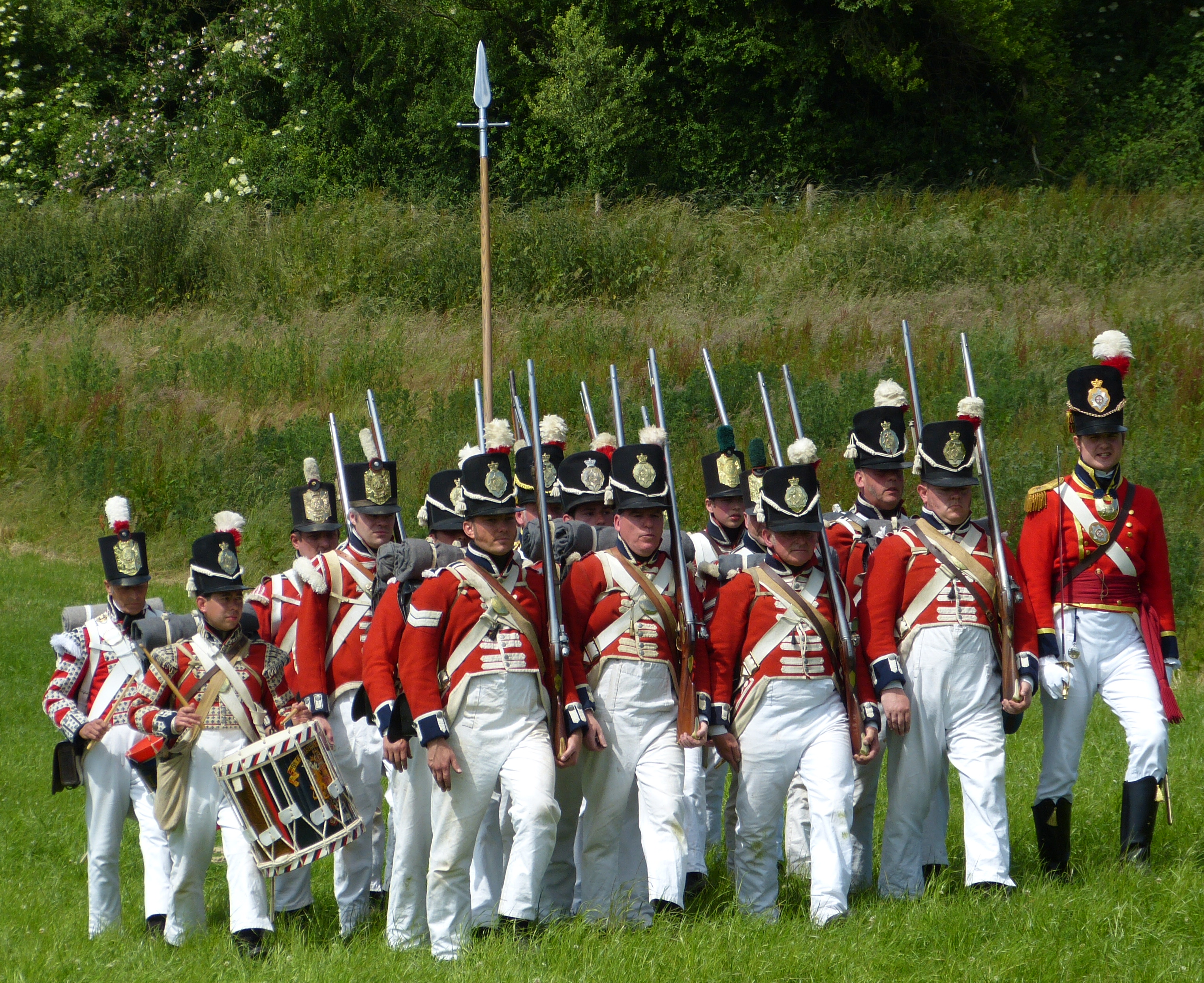
Reenactors at Chalke Valley history fair (2013)
Infantry

The bulk of the British Army in 1815 were foot soldiers. As such, they walked everywhere - or rather, marched, carrying everything they needed with them.

Rifleman Harris served in the British Army from 1802 to 1814. He recalled:

I am convinced that many of our infantry sank and died under the weight of their knapsacks...Besides my well-filled kit, there was the great-coat rolled on its top, my blanket and camp kettle, my haversack, stuffed full of leather for repairing the men’s shoes, together with a hammer and other tools, ship-biscuit and beef for three days. I also carried my canteen filled with water, my hatchet and rifle, and eighty rounds of ball cartridge in my pouch.2

Harris was no longer with the army in 1815, but he served as part of Wellington’s army in the Peninsula Wars.

Infantrymen were known as ‘red coats’, because of the colour of their jackets. They were armed with a musket and a bayonet. There were two battalions of rifles, which were more accurate than muskets.

Cavalry 

The Marquis of Anglesea wounded whilst leading a charge of heavy cavalry at the close of the Battle of Waterloo (1815) Print by M Dubourg after JA Atkinson (1815) Yale Center for British Art, Paul Mellon Collection
The Marquis of Anglesea wounded whilst leading a charge
of heavy cavalry at the close of the Battle of Waterloo
Print by M Dubourg after JA Atkinson (1815)
Being on horseback, the cavalry was the most glamorous unit in the British Army. They were also the shock troops, having both a height and speed advantage over foot soldiers.

Captain Charles Edward Radclyffe wrote:

The charge of the heavy cavalry in line was a magnificent sight, and I have every reason to believe they did everything to justify the high expectations their appearance had excited.3

Cavalry were armed with a sabre and a carbine, a light pistol.

Artillery

Waterloo battery - bronze 6-pounder seized at the Battle of Waterloo - Tower of London (2016)
Waterloo battery - bronze 6-pounder gun seized at the
Battle of Waterloo - Tower of London (2016)
The British infantry and cavalry of 1815 were supported by three different forms of artillery.

The first was the regular cannon, which typically fired either a solid ball or canister shot—smaller pieces of shot designed to damage infantry or cavalry. The cannon usually aimed directly at their target.

Gunner John Edwards of the Royal Horse Artillery wrote:

About half past 10 o’clock the French Imperial Guards dressed in steel armour back and breast plates, they weigh about 32 pounds, charged up the main road till they came within 600 yards they extended right and left of the road, we fired case shot at them and swept them off like a swathe of grass before a scythe.4

The second was the howitzer, a short-barrelled cannon angled upwards. These fired shot into the air, reaching targets behind obstacles.

The third was the Congreve rocket, a relatively new innovation that delivered mixed results. The rockets were easier to deploy and faster to fire than cannon, but they weren’t always the most effective.

Years after Waterloo, Henry Leathes recalled that a rocket launched during the battle opened a gap in the French ranks “probably from the novelty of such a pyrotechnique salute.”5

Bronze 3-pounder gun, 1815 at National Army Museum, London (2022)
Bronze 3-pounder gun, 1815
at National Army Museum, London (2022)

Supporting roles

Royal Engineers

The Royal Engineers were formed a century before 1815 to provide map-making, bridge building, fortifications and camp drainage systems. They also ran the Army’s postal service.

Initially the Royal Engineers comprised only officers, who would hire civilian labour or use private soldiers to perform the hands-on work of digging and building. However, by 1815 they had their own private soldiers, known as sappers.

Medical services

Saw used to amputate Lord Uxbridge's leg at the Battle of Waterloo (1815) On display in the National Army Museum, London (2022)
Saw used to amputate Lord Uxbridge's leg
at the Battle of Waterloo (1815)
On display in the National Army Museum, London (2022)
The British Army had various medical roles, from Deputy Inspectors of Hospitals to staff surgeons, orderlies and nurses. Most battalions had a medical officer and a couple of assistants.

There was no formal process for getting injured soldiers from the frontline to wherever the medical service was based.

Amputation of damaged limbs was a common procedure, with around 500 probably being performed during the Battle of Waterloo. The most well-known was the removal of Lord Uxbridge’s leg. These and other procedures were performed without anaesthetic.

Deputy Inspector John Hume wrote:

There was but one opinion amongst us, so having prepared the dressings etc, we returned into the room where I announced to Lord Uxbridge that the operation being found necessary the sooner it was performed the better.6

Civilians

A number of non-military personnel, typically women, followed the British Army of 1815. Many of  these camp followers were working class wives, widows and mothers who had some form of relationship with soldiers.

A number of wives were permitted to travel with their soldier husbands, both of commissioned and non-commissioned officers.

Other civilians included clerks, cooks and those associated with transport and supply activities.

Organisation of the British Army in 1815

As today, the British Army of 1815 was made up of many different regiments—there were well over 100. Every regiment has its own history, traditions, insignia and colours (flag). The oldest regiments trace their history back to the English Civil War in the mid-1600s

The Coldstream Guards hold the honour of being the oldest continuously serving regiment. It was formed in 1650, ten years before the British Army was founded by Charles II in 1660.

A regiment was made up of battalions, each numbering several hundred men. Some regiments had more than one battalion and these usually operated independently, rarely fighting together.

In 1815 most infantry regiments had been allocated a number and a county designation. The numbering indicated their seniority, or precedence, which was based on when and where they were founded.

This led to regiments having names such as:

  • 54th (West Norfolk) Regiment of Foot
  • 1st Life Guards
Some historic regiments were permitted to keep their name, such as:
  • Coldstream Guards
  • Royal Welch Fusiliers

A regiment was led by a colonel.

Ranks in the British Army of 1815

Most men entered the army by enrolling as a private soldier.

Many never progressed beyond the rank of private, but they were often referred to with a designation that represented the branch of the army they were part of, such as Trooper, Gunner, Sapper, Rifleman etc.

A private soldier could be promoted to a non-commissioned officer, such as a corporal or sergeant. 

A captain from A book explaining the ranks and dignitaries of British Society (1809)
A captain from A book explaining
the ranks and dignitaries of British Society
(1809)
A second route of entry into the army was the purchase of a commission. 

This allowed a man to join up as an officer, despite having no military experience or training. Because the commission had to be paid for, it ensured that most officers came from the upper levels of society.

Some soldiers were promoted from the ranks on merit, but it wasn’t very common.

Listing a hierarchy of ranks in 1815 isn’t as simple as it might appear. There were various forms of rank, and there were exceptions to all of these. It was possible for a specific captain to be senior to a specific major, depending on the positions they were serving in.

Another example would be a colonel given the rank of brigadier general while they were leading a brigade (a force comprising a number of battalions). Once that role was over, they went back to being a colonel.

Outline of ranks in the army

  • General
  • Lieutenant general
  • Major general
  • Brigadier general
  • Colonel - one per regiment, and not a rank that could be purchased.
  • Lieutenant Colonel - between one and three in a regiment.
  • Major
  • Captain
  • Lieutenant
  • Ensign/Cornet (Infantry/Cavalry)
  • Sergeant
  • Corporal
  • Private

Headshot of Rachel Knowles author with sea in background(2021)
Rachel Knowles writes clean/Christian Regency era romance and historical non-fiction. She has been sharing her research on this blog since 2011. Rachel lives in the beautiful Georgian seaside town of Weymouth, Dorset, on the south coast of England, with her husband, Andrew, who wrote this blog. 
 
Find out more about Rachel's books and sign up for her newsletter here.

If you have enjoyed this blog and want to encourage me and help me to keep making my research freely available, please buy me a virtual cup of coffee by clicking the button below.


 Notes

  1. Glover, Gareth (editor), The Waterloo Archive Volume I: British Sources (2010) p157, Captain Joseph Logan.
  2. Hibbert, Christopher (editor), The Recollections of Rifleman Harris (1970) p13.
  3. Glover, Gareth (editor), The Waterloo Archive Volume I: British Sources (2010) p23, Captain Charles Edward Radclyffe.
  4. Glover, Gareth (editor), The Waterloo Archive Volume I: British Sources (2010) p102, Gunner John Edwards, Royal Horse Artillery.
  5. Glover, Gareth (editor), The Waterloo Archive Volume I: British Sources (2010) p110, Henry Leathes.
  6. Glover, Gareth (editor), The Waterloo Archive Volume I: British Sources (2010) p215 Deputy Inspector John Hume

Sources used include:

Burnham, Robert and McGuigan, Ron, The Napoleon Series (2016)

Glover, Gareth (editor), The Waterloo Archive Volume I: British Sources (2010)

Hibbert, Christopher (editor), The Recollections of Rifleman Harris (1970)

Simonson, Sheila, Following the drum: British women in the Peninsular War (1981)

Sinclair, Joseph, A Soldier of the Seventy-first (2010)

All Things Liberty website 

British army website

British Military History website

Military History Matters website 

National Army Museum website 

Royal Armouries Collections website 

Photographs © RegencyHistory.net

Wednesday, 1 June 2022

Visiting cards in the Regency

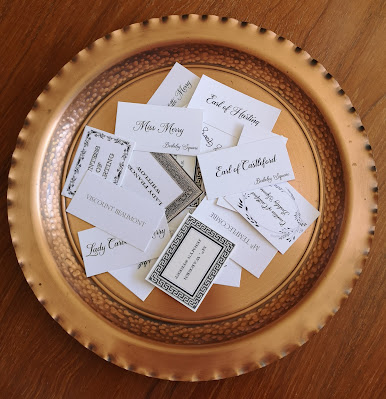
Copper plate filled with facsimile Regency visiting cards (Rachel Knowles's experimental history 2022)
Facsimile Regency visiting cards
(Rachel Knowles's experimental history 2022)
Visiting cards

Visiting cards or calling cards were small rectangular pieces of card similar to a business card today. They were inscribed with a person’s name and often but not always with their address. An important part of Regency etiquette, visiting cards could be used for initiating contact with a stranger, as well as letting someone know you had called.

What did a Regency visiting card look like?

They varied in size and design, but the consistent theme seems to have been small and rectangular.

Some were plain rectangles of parchment or card, whereas others came with a pre-printed design around the edge.

Several of the printed cards I looked at were by William Sharp (1749–1824) – one of the most distinguished British line engravers. He engraved plates for trade cards as well as visiting cards.
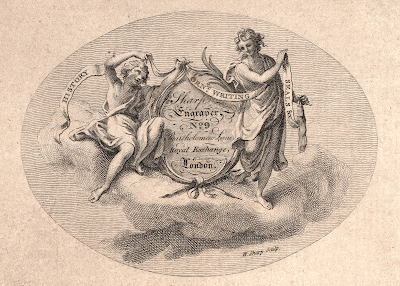
Trade card for William Sharp, Engraver London (1749-1824) The Met Museum DP885194
Trade card for William Sharp, Engraver
London (1749-1824) The Met Museum DP885194
Calling cards were always inscribed with the person’s name. I came across a few examples of cards with two names on—typically, a lady and her daughter. The cards did not always include their address. Some mentioned the person’s position.

Some cards had the details handwritten, others had the name engraved onto the card. Some, like Colonel Roche’s card designed by Cipriani, had the name incorporated in an elaborate design.

You can look at a large collection of calling cards in the British Museum collections here.

How big were Regency visiting cards?

The visiting cards I looked at in the British Museum’s collection varied in size, ranging from 32mm X 66mm to 78mm X 121mm. The majority of cards were at the smaller end of the scale.

To put this into context, a standard US business card today is 50.8mm X 88.9mm (3.5 X 2 inches) and a standard British card today is a little wider and shorter at 55mm X 85mm.

I decided to do a little bit of experimental history. Using the cards on the British Museum’s website as a guide, I created a number of facsimile Regency visiting cards for characters in my novels using the dimensions of actual cards and similar designs.  

The photo below shows my card (based on US measurements despite being in the UK!) and a selection of the cards I made. As you can see, most of the calling cards are smaller.

Although many of the plainest and smallest cards I looked at were for men, some gentlemen’s cards were as big and as elaborate as those used by ladies.
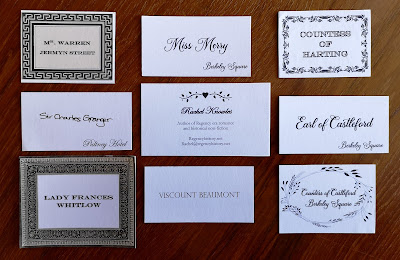
Facsimile Regency visiting cards with a modern business card to show relative sizes (Rachel Knowles's experimental history 2022)
Facsimile Regency visiting cards with a modern business
card to show relative sizes
(Rachel Knowles's experimental history 2022)
Leaving cards when someone was ‘not at home’

The etiquette of leaving cards is linked to the etiquette surrounding morning calls.

You can read about morning calls here.

When making a morning call, it was customary to present your card on arrival. By this means, the visitor discovered whether the host was ‘at home’ to visitors and specifically, whether they were willing to receive you.

If the visitor was an acquaintance, then the response of ‘not at home’ either meant that the person was out, or that it was simply not a convenient time for visitors.

In Domestic Duties or Instructions to young married ladies on the management of their households (1825), Mrs Parkes wrote:

As the words ‘not at home’ have become synonymous with ‘being engaged’, they neither deceive , nor are intended to deceive; therefore they may be employed innocently, as far as regards our friends and ourselves.1

If the visitor was a stranger, then ‘not at home’ might mean the same, but it might indicate that the person did not desire the acquaintance.

Either way, if the person was not at home, the visitor would leave their card. They might turn down the corner of the card to indicate they had visited personally. Alternatively, as in one example I found at the British Museum, they might write the words ‘called’ or similar on it to indicate that they had left the card in person.

In Sense and Sensibility, Elinor Dashwood knew that Edward Ferrars was in town because he left his card:

Edward assured them himself of his being in town, within a very short time, by twice calling in Berkeley Street. Twice was his card found on the table, when they returned from their morning’s engagements. Elinor was pleased that he had called; and still more pleased that she had missed him.2

Etiquette dictated that the person should return the visit as soon as possible. However, if the visitor was a stranger and the person did not desire the acquaintance, it was sufficient to send a card instead.

In February 1807 Jane Austen wrote of a visitor they had missed whose visit they were unable to return because the visitor had left no address:

Mary has for some time had notice from Mrs Dickson of the intended arrival of a certain Miss Fowler in this place. Miss Fowler is an intimate friend of Mrs Dickson, and a good deal known as such to Mary. On Thursday last she called here while we were out. Mary found, on our return, her card with only her name on it, and she had left word that she would call again. The particularity of this made us talk, and, among other conjectures, Frank said in joke, “I dare say she is staying with the Pearsons.” The connection of the names struck Mary, and she immediately recollected Miss Fowler's having been very intimate with persons so called, and, upon putting everything together, we have scarcely a doubt of her being actually staying with the only family in the place whom we cannot visit.3
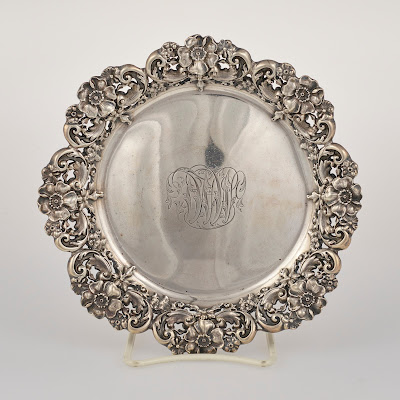
19th century silver calling card tray, Redlich Co. Minneapolis Institute of Art
19th century silver calling card tray, Redlich Co.
Minneapolis Institute of Art
How many cards should be left?

It was polite to leave a card to each person in the household whom you had intended to visit.

In Domestic Duties (1825) Mrs Parkes wrote:

Where cards are to be left, the number must be determined according to the various members of which the family called upon is composed. For instance, where there are the mother, aunt, and daughters (the latter having been introduced to society), three cards should be left.4

Leaving cards on arrival in town

When a person arrived in a town where they had some acquaintance, it was customary to call or leave cards to let them know of your arrival.

In Jane Austen’s Sense and Sensibility, Mrs Jennings left cards on her return to London:

The morning was chiefly spent in leaving cards at the houses of Mrs Jennings’s acquaintance to inform them of her being in town.5

Some hotels had printed cards for those staying there to use. A hotel guest could write their details on these cards and leave them with their acquaintances so they would know where they were staying.
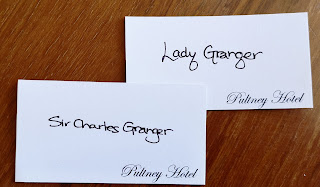
Facsimile hotel cards with handwritten names (Rachel Knowles's experimental history 2022)
Facsimile hotel cards with handwritten names
(Rachel Knowles's experimental history 2022)
Leaving cards to begin an acquaintance

If you deemed someone worthy of being included in your circle of acquaintance, you could leave your card in the hope of initiating a relationship.

In Persuasion, Sir Walter Elliot and Miss Elliot made such an impact on Bath society that they were inundated with cards:

Their acquaintance was exceedingly sought after. Everybody was wanting to visit them. They had drawn back from many introductions, and still were perpetually having cards left by people of whom they knew nothing.6

In a letter to her sister in January 1807 Jane Austen complained that their acquaintance was growing too quickly:

Our acquaintance increase too fast. He was recognized lately by Admiral Bertie, and a few days since arrived the Admiral and his daughter Catherine to wait upon us. There was nothing to like or dislike in either. To the Berties are to be added the Lances, with whose cards we have been endowed, and whose visit Frank and I returned yesterday.7

Leaving cards to convey thanks

Cards could also be sent to convey thanks. In Arthur Freeling’s The Pocket Book of Etiquette (1837) he wrote:

After dining at the house of a lady , it is customary to leave a card the next day, or as soon after as circumstances will permit.8

Leaving cards to take leave

When a person was leaving the area, such as going from London to the country, it was customary to take leave in person, or by leaving cards.

Leaving a calling card after receiving a verbal invitation

In The Pocket Book of Etiquette (1837) Freeling wrote that it was advisable to leave a card after a verbal invitation from an acquaintance:

Occasionally verbal invitations are given to evening parties, by persons with whom you have not been in habits of intimacy. To prevent the awkwardness of being an unexpected visitor, you will, previous to the party, leave your card with the lady of the house.9

Sending and receiving cards when someone got married

When a gentleman married, he might have acquaintances that he would not wish to be part of the circle he would introduce to his wife. After his marriage, he and his wife would send cards to those acquaintances they wished to keep. If you did not receive a card, you assumed that the relationship had been dropped.

In The Pocket Book of Etiquette (1837) Freeling wrote:

When a man is about to be married, it is customary for him to give a dinner to his bachelor friends. He then informs them of the intended alteration in his circumstances; the health of the bride elect is drank, and it is understood that the visiting acquaintanceship ceases, unless a special invitation is received, or unless a desire to renew it be intimated by his sending his own and his wife's cards, with the customary favors.10

Etiquette required the couple to send cards in return for any left at their house after their marriage. Mrs Parkes wrote in Domestic Duties (1825):

A newly married woman, on arriving at her future home, will have to send her cards in return for those which are left at her house, after her marriage. She may afterwards expect the calls of her acquaintance; for which it is not absolutely necessary to remain at home, although politeness require that they should be returned as soon as possible. But having performed this, any further intercourse may be avoided (where it is deemed necessary) by a polite refusal of invitations.11

In Sense and Sensibility, the self-interested Lady Middleton

…determined (though rather against the opinion of Sir John) that as Mrs Willoughby would at once be a woman of elegance and fortune, to leave her card with her as soon as she married.12

Leaving cards when someone died

It was customary to leave a card in condolence rather than visiting someone who had been bereaved unless you knew the person very well.

Sending a card with a letter of recommendation

Sometimes, a stranger was given a letter of introduction by a mutual acquaintance or someone of importance. In these cases, it was customary to deliver the letter in person, and to include a visiting card with the letter.

Etiquette demanded that the person receiving the letter of introduction should respond by sending a card as soon as possible. They were not, however, obliged to receive the person.

Putting your connections on display 
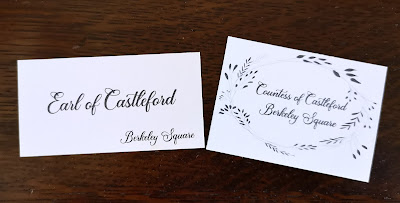
Facsimile Regency visiting cards for the Earl and Countess of Castleford (the couple from A Reason for Romance) I'm sure Sir Walter would have wanted these cards on display too! (Rachel Knowles's experimental history 2022)
Facsimile Regency visiting cards for the Earl and
Countess of Castleford (the couple from A Reason for Romance)
I'm sure Sir Walter would have wanted these cards on display too!
(Rachel Knowles's experimental history 2022)

Having the right connections could make a lot of difference to your standing in society. In Persuasion, Sir Walter Elliot is desperate for his relative, the Dowager Viscountess Dalrymple, to recognise him:

Sir Walter, however, would choose his own means, and at last wrote a very fine letter of ample explanation, regret, and entreaty, to his right honourable cousin. Neither Lady Russell nor Mr Elliot could admire the letter; but it did all that was wanted, in bringing three lines of scrawl from the Dowager Viscountess. "She was very much honoured, and should be happy in their acquaintance." The toils of the business were over, the sweets began. They visited in Laura Place, they had the cards of Dowager Viscountess Dalrymple, and the Honourable Miss Carteret, to be arranged wherever they might be most visible: and "Our cousins in Laura Place,"—"Our cousin, Lady Dalrymple and Miss Carteret," were talked of to everybody.13

Headshot of Rachel Knowles author with sea in background(2021)
Rachel Knowles writes clean/Christian Regency era romance and historical non-fiction. She has been sharing her research on this blog since 2011. Rachel lives in the beautiful Georgian seaside town of Weymouth, Dorset, on the south coast of England, with her husband, Andrew.

Find out more about Rachel's books and sign up for her newsletter here.

If you have enjoyed this blog and want to encourage me and help me to keep making my research freely available, please buy me a virtual cup of coffee by clicking the button below.


Notes

  1. Parkes, Mrs William, Domestic Duties or Instructions to young married ladies on the management of their households (London, 1825).
  2. Austen, Jane, Sense and Sensibility (1811).
  3. Austen, Jane, Jane Austen's Letters, Collected and Edited by Le Faye, Deirdre (1995).
  4. Parkes op cit.
  5. Austen, Jane, Sense and Sensibility (1811).
  6. Austen, Jane, Persuasion (1817).
  7. Austen, Jane, Jane Austen's Letters, Collected and Edited by Le Faye, Deirdre (1995).
  8. Freeling, Arthur, The Pocket Book of Etiquette (Liverpool, 1837).
  9. Ibid.
  10. Freeling op cit.
  11. Parkes op cit.
  12. Austen, Jane, Sense and Sensibility (1811).
  13. Austen, Jane, Persuasion (1817, London)

Sources used include:
Austen, Jane, Emma (1815, London)
Austen, Jane, Jane Austen's Letters, Collected and Edited by Le Faye, Deirdre (Oxford University Press, 1995)
Austen, Jane, Mansfield Park (1814, London)
Austen, Jane, Northanger Abbey (1817, London)
Austen, Jane, Persuasion (1817, London)
Austen, Jane, Pride and Prejudice (1813, London)
Austen, Jane, Sense and Sensibility (1811, London)
Freeling, Arthur, The Ladies' Pocket Book of Etiquette (7th edition) (London, 1840)
Freeling, Arthur, The Pocket Book of Etiquette (Liverpool, 1837)
Parkes, Mrs William, Domestic Duties or Instructions to young married ladies on the management of their households (London, 1825)
Trusler, Rev Dr John, A System of Etiquette (1804) 

All photos © RegencyHistory.net