Search this blog

Showing posts with label Lady Cowper. Show all posts

Tuesday, 15 January 2013

Elizabeth Lamb, Viscountess Melbourne (1751-1818)

From The Three Witches from Macbeth by Daniel Gardner (1775) Elizabeth Lamb, Viscountess Melbourne
Elizabeth Lamb, Viscountess Melbourne from
The Three Witches from Macbeth by Daniel Gardner (1775)
© National Portrait Gallery
Profile

Lady Melbourne (baptised 15 October 1751 - 6 April 1818) was a leading Whig hostess, the intimate friend of Georgiana, Duchess of Devonshire and Lord Byron, a mistress of George IV and the mother of the Prime Minister, William Lamb, Viscount Melbourne, and his sister Emily, Lady Cowper, one of the patronesses of Almack's Assembly Rooms.

Family life

Elizabeth Milbanke was baptised on 15 October 1751, the only daughter of Sir Ralph Milbanke, a Yorkshire landowner and politician, and his wife, Elizabeth Hedworth. She married Sir Peniston Lamb, 2nd Baronet, a wealthy Whig politician, on 13 April 1769, at the age of seventeen.

Sir Peniston was made an Irish peer, Lord Melbourne, Baron of Kilmore, on 8 June 1770, and then Viscount Melbourne on 11 January 1781. Later, in 1815, he was made a peer of the United Kingdom, Baron Melbourne of Melbourne.
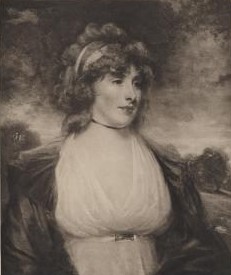
Elizabeth Lamb, Viscountess Melbourne  by Braun, Clement & Co, after John Hoppner  © National Portrait Gallery, London
Elizabeth Lamb, Viscountess Melbourne
by Braun, Clement & Co, after John Hoppner
© National Portrait Gallery, London
Whig hostess

Elizabeth was beautiful and vibrant and ambitious for the advancement of her family. She helped increase her husband’s political visibility, becoming the leading Whig hostess of the time. From 1770, she entertained in the white and gold magnificence of Melbourne House in Piccadilly, designed by William Chambers. Her regular visitors included some of the keenest minds of the day: Charles James Fox; Richard Brinsley Sheridan; Granville Leveson-Gower, 1st Earl Granville; Georgiana Cavendish, Duchess of Devonshire; Harriet Ponsonby, Countess of Bessborough; and the sculptor, Anne Seymour Damer.

Lady Melbourne by Anne Seymour Damer (1784) © Andrew Knowles
Lady Melbourne by Anne Seymour Damer (1784)
in an exhibition at Strawberry Hill
The Duchess of Devonshire

In 1774, the Duke of Devonshire married Georgiana Spencer and Lady Melbourne saw at once that she was in danger of losing her place as leading Whig hostess. But rather than compete with the Duchess, Lady Melbourne chose to embrace her potential rival and became her indispensable friend. They were opposites in character and temperament, but Lady Melbourne’s disposition made her the ideal confidante for the troubled Duchess.

Georgiana, Duchess of Devonshire,  from a miniature by Antonio Fattori  from Lord Granville Leveson Gower,   private correspondence 1781 to 1821 (1916)
Georgiana, Duchess of Devonshire,
from a miniature by Antonio Fattori
from Lord Granville Leveson Gower,
 private correspondence 1781 to 1821 (1916)
Lady Melbourne’s character

Lady Melbourne was a brilliant conversationalist who was a master of the art of being a delightful companion to gentlemen. She was easy going and good humoured, a willing confidante and advisor who rarely talked about herself. Melbourne House was a comfortable place for gentlemen to go, where they could speak freely without fear of shocking their hostess.

On the other hand, she was cynical, hard-hearted and somewhat coarse, and she seemed to delight in making cutting remarks. Her moral standards were low and she did not seem to care what people did, provided they were discreet. She believed that:
When anyone braves the opinion of the world, sooner or later they will feel the consequences of it.1
Ambition was paramount and she was always prepared to make sacrifices to achieve it. When Frederick, Duke of York expressed a fancy for her Piccadilly home, she agreed to part-exchange it for his home in Whitehall. 2

Melbourne House, Piccadilly,  by Thomas H. Shepherd c1830
Melbourne House, Piccadilly,
by Thomas H. Shepherd c1830
Family

Lady Melbourne had six children: Peniston (1770), William (1779), Frederick (1782), George (1784), Emily (1787) and Harriet (1789), who did not survive childhood. Of these, only Peniston was definitely Lord Melbourne’s child; William was almost certainly Lord Egremont’s and George, the son of the Prince of Wales.

She was devoted to all her children who spent most of their time at the family’s country home in Hertfordshire, Brocket Hall. Here they rode and played together and took part in theatricals as well as learning. When the boys went to Eton, she often visited them, encouraging the development of their tastes and characters.

William Lamb, 2nd Viscount Melbourne  from The History of White's   by Hon Algernon Bourke (1892)
William Lamb, 2nd Viscount Melbourne
from The History of White's
 by Hon Algernon Bourke (1892)
Romantic liaisons

Within a year of their marriage, Elizabeth’s husband began an affair with the actress Sophia Baddeley. Elizabeth appeared to be unbothered. She did not expect men to be monogamous, though she strongly believed in family responsibility. Having produced an heir, she had her own romantic liaisons, though she made sure she never put her husband in an awkward position.

Lady Melbourne’s name was linked variously with Lord Coleraine3; Francis Russell, 5th Duke of Bedford; George, Prince of Wales, the future George IV; and George Wyndham, 3rd Earl of Egremont.

The Earl of Egremont

From 1779, Lady Melbourne’s most favoured intimate friend and advisor was George Wyndham, 3rd Earl of Egremont. It was the most serious and long-lasting of her attachments, though not monogamous on either side; Egremont kept a number of mistresses and their children at Petworth House. Egremont was almost certainly William’s father and possibly Frederick and Emily’s as well.

Lady Melbourne learned much from Egremont who was an agriculturalist and canal enthusiast. She encouraged her husband to invest in the Cromford Canal and introduced agricultural innovations in Hertfordshire.

George Wyndham, 3rd Earl of Egremont  by Samuel William Reynolds, after Thomas Phillips (1826)   © National Portrait Gallery, London
George Wyndham, 3rd Earl of Egremont
by Samuel William Reynolds, after Thomas Phillips (1826)
 © National Portrait Gallery, London
The Prince of Wales

Lady Melbourne’s friendship with the Prince of Wales began in 1782 and their names were linked together until around 1786. He is generally believed to be the father of her fourth son, George, and stood as his godfather.

Through her relationship with the Prince, Lady Melbourne secured the position of Gentleman of the Bedchamber for her husband in 1783.

George, Prince of Wales  from Huish's Memoirs of her late  royal highness Charlotte Augusta (1818)
George, Prince of Wales
from Huish's Memoirs of her late
royal highness Charlotte Augusta (1818)
William and Caroline

Lady Melbourne soon realised that William’s abilities were superior to those of his siblings and he became the focus for all her ambitions. After the death of her eldest son, Peniston, in 1805, William embarked on a career in politics. He also married Lady Bessborough’s daughter, Lady Caroline Ponsonby. Lady Melbourne was not keen on the match or the influence that Caro and her mother had on William. On her side, Lady Bessborough disliked Lady Melbourne and referred to her as “The Thorn”.

Lady Caroline Lamb  from Wives of the Prime Ministers    (1844-1906)
Lady Caroline Lamb
from Wives of the Prime Ministers
  (1844-1906)
It was with some frustration that Lady Melbourne saw William failing to reach the heights which she sought for him. He was hedonistic and lazy, loyal to people rather than policies, and did not advance as she had hoped, and his deteriorating relationship with Caroline was not helping.

Lady Melbourne had no sympathy with Lady Caroline’s highly strung nature and was disgusted when, in 1812, she had a very public affair with Lord Byron. Lady Melbourne was keen to bring it to a close and became Lord Byron’s confidante, suggesting her own niece, Annabella Milbanke, as a wife for him.

Illness and death

Lady Melbourne became ill with rheumatism and died at Melbourne House, Whitehall, on 6 April 1818, after a painful illness of four months. She was buried on 14 April in Hatfield, Hertfordshire. Even on her death bed, she encouraged her children’s ambitions, telling Emily to be faithful, not to her husband, Lord Cowper, but to her lover, Lord Palmerston.

Lady Melbourne's legacy

Lady Melbourne did not live to see that her ambitions for her children were indeed fulfilled: William became Prime Minister to William IV and then Queen Victoria, and Emily married Lord Palmerston, who later became another of Queen Victoria’s Prime Ministers.

Headshot of Rachel Knowles author with sea in background(2021)
Rachel Knowles writes clean/Christian Regency era romance and historical non-fiction. She has been sharing her research on this blog since 2011. Rachel lives in the beautiful Georgian seaside town of Weymouth, Dorset, on the south coast of England, with her husband, Andrew.

Find out more about Rachel's books and sign up for her newsletter here.

If you have enjoyed this blog and want to encourage me and help me to keep making my research freely available, please buy me a virtual cup of coffee by clicking the button below.

 
Notes
(1) From a letter to Lady Caroline Lamb 13 April 1810.
(2) The agreement to the exchange was concluded on 25 December 1791 although the comment made by the Duke of York to which Lady Melbourne assented may have been made some time before. The Duke took residence of Melbourne House the following year, renaming it Albany House.
(3) The relationship with Lord Coleraine is referred to in Cecil's book Melbourne. Based on the dates quoted, I am assuming that it is John Hanger, 2nd Baron Coleraine, with whom Lady Melbourne had an affair.

Sources used include:
Cecil, Lord David, Melbourne (1939, 1954)
Gross, Jonathan David, Lamb, Elizabeth, Viscountess Melbourne (1751-1818) Oxford Dictionary of National Biography (Oxford University Press, 2004; online edn May 2008, accessed 12 Nov 2012)
Huish, Robert, Memoirs of her late royal highness Charlotte Augusta (1818)
Lee, Elizabeth, Wives of the Prime Ministers 1844-1906 (1918)
Leveson-Gower, Lord Granville, Lord Granville Leveson-Gower, Private correspondence 1781-1821, ed by Castalia, Countess Granville (John Murray, 1916, London)
Shepherd, FHW, Survey of London (1963, British History online, accessed 7 February 2013)

Photographs © RegencyHistory.net

Tuesday, 1 November 2011

Regency History's guide to Almack's Assemby Rooms

Highest Life in London - Tom & Jerry 'sporting a toe' among the Corinthians at Almacks in the West by IR & G Cruikshank in Tom and Jerry: Life in London by P Egan (1869 first pub 1821)
Highest Life in London - Tom & Jerry 'sporting a toe' among the
Corinthians at Almacks in the West by IR & G Cruikshank
in Tom and Jerry: Life in London by P Egan (1869 first pub 1821)
The importance of Almack’s

During the Regency period, Almack’s Assembly Rooms were at the heart of the London season. Their importance cannot be overstated. Possessing a voucher to enter the sacred portals of the rooms could make or break a young lady’s entrance into the ton and her chances of finding a suitable husband.

Captain Gronow declared in his reminiscences of 1814:
At the present time one can hardly conceive the importance which was attached to getting admission to Almack's, the seventh heaven of the fashionable world.1
According to Lord Lamington:
Almack's was the portal to that select circle of intellect and grace which constituted the charm of Society.2
The early days

Almack’s Assembly Rooms opened on 12 February 1765 in King Street, St. James's, in the heart of fashionable London.3 They were situated immediately to the east of Pall Mall Place and comprised
 … three very elegant new-built rooms, a ten-guinea subscription, for which you have a ball and supper once a week for twelve weeks.4
Willis's Rooms from Old and New London by E Walford (1878)
Willis's Rooms
from Old and New London by E Walford (1878)
The rooms were named after their founder, a Scotsman named William Almack.5 Almack also owned The Thatched House Tavern and founded a club for gentlemen that later became Brooks’s. On his death in 1781, the management of the rooms passed to Almack’s niece and her husband, Mr Willis.

During the first phase of the life of Almack’s, the rooms were home to a ladies’ club, where both sexes met to gamble, whilst dancing went on in the great room. It rivalled Carlisle House, whose entertainments, run by the redoubtable Madame Cornelys, were becoming increasingly scandalous. Almack’s combated the mixed nature of the Carlisle assemblies by developing an exclusiveness that set it apart.

When the Pantheon opened in 1772, Almack’s suffered a loss of popularity. Twenty years later, in January 1792, the Pantheon burned down and although rebuilt, it never rivalled Almack’s again.

The exclusive club of the ton

From the 1790s onwards, Almack’s entered a new phase. The excessive gambling disappeared, and the rooms became entirely given over to dances and assemblies. The exclusivity of the rooms increased and Almack’s became the place for a young lady to be seen to demonstrate her position in the ton and for a gentleman to go in search of a wife of good social standing. Hence, it was sometimes referred to as ‘The Marriage Mart’.

Almack’s exclusivity stemmed from the way that it restricted its membership. To attend a ball at Almack’s, it was necessary to procure a voucher, signed by one of the patronesses, and the patronesses kept lists of who was ‘in’ and who was ‘out’.

A printed copy of a genunie Almack's voucher used with  kind permission STG Misc. Box 7 (Almack's Voucher) © The Huntington Library, San Marino, CA
A printed copy of a genunie Almack's voucher used with
 kind permission STG Misc. Box 7 (Almack's Voucher)
© The Huntington Library, San Marino, CA
You can read more about the vouchers here: A genuine Almack’s voucher.

To be offered a voucher meant acceptance into the ton; to lose one’s voucher indicated social ostracism. This lasted until around 1824 when the exclusive nature of the club began to lessen.

As the English poet and wit, Henry Luttrell wrote in Advice to Julia (1820):
All on that magic List depends;
Fame, fortune, fashion, lovers, friends;
'Tis that which gratifies or vexes
All ranks, all ages, and both sexes.
If once to Almack's you belong,
Like monarchs you can do no wrong;
But banished thence on Wednesday night,
By Jove, you can do nothing right.6
When were the balls held?

The timing and frequency of the balls varied over time, but by 1818, a pattern of weekly balls held on Wednesday evenings during the season had been established.

According to Leigh’s New Picture of London (1818):
The balls at Willis's rooms, commonly called Almack's, are held every Wednesday during the season. They are very splendid, and are very numerously and fashionably attended. Some ladies are styled lady patronesses of these balls; and in order to render them more select, (the price being only seven shillings,) it is necessary that a visitor's name should be inserted in one of these ladies' books, which of course makes the admission difficult.7
The patronesses of Almack’s

Sarah Villiers, Lady Jersey © Rachel Knowles
The lady patronesses changed over time. Seven are mentioned in Gronow’s often-quoted list:
… the Ladies Castlereagh, Jersey, Cowper, and Sefton, Mrs Drummond Burrell, now Lady Willoughby, the Princess Esterhazy, and the Countess Lieven.8
They were not, however, all patronesses in 1814 as Gronow suggested. Other patronesses included the Marchioness of Salisbury and Lady Downshire.

According to Ticknor, writing in 1819, one of the ladies acted as the patroness of each ball.9

Vouchers were granted to those who met the criteria of the patronesses. This depended more on position in society, address, and behaviour than on wealth. If granted a voucher, a young lady could be introduced to suitable partners by the patronesses.

The rules of Almack’s

The first quadrille at Almack's c1815 from The Reminiscences and Recollections of Captain Gronow (1889)
The first quadrille at Almack's c1815
from The Reminiscences and Recollections of Captain Gronow (1889)
Once your name was entered on the hallowed list and a voucher issued, you could purchase a ticket. For entry to Almack’s, you needed both a voucher and a ticket.

Luttrell wrote in his Advice for Julia (1820):
Suppose the prize by hundreds miss’d
Is yours at last. – You’re on the list. –
Your voucher’s issued, duly signed;
But hold – your ticket’s left behind.
What’s to be done? There’s no admission.
In vain you flatter, scold, petition,
Feel your blood mounting like a rocket,
Fumble in vain in every pocket.
‘The rule’s so strict, I dare not stretch it,’
Cries Willis, ‘pray, my lord, go fetch it.’10
By 1819, a rule was introduced that forbade entry to the rooms after 11 pm. Ticknor recounted the story of how the Duke of Wellington was famously turned away by Lady Jersey for arriving at seven minutes past eleven. Later, this rule was relaxed, and Ticknor recorded that in 1835, the doors were closed at midnight.

Another rule was dress. According to Captain Gronow, in 1814, there was a rule
… that no gentleman should appear at the assemblies without being dressed in knee-breeches, white cravat, and chapeau bras.11
Gronow wrote that the Duke of Wellington was once turned away for wearing trousers but I am inclined to doubt his memory as it seems unlikely that the Duke was turned away for being late and for wearing trousers and Ticknor is generally considered the more reliable source.

According to Moers, Almack’s served
… positively meagre refreshments: weak bohea, weak lemonade for variety, thin slices of brown bread and butter, biscuits and stale cake.12
Only country dances – both Scotch reels and English country dances - were performed until about 1815 when Lady Jersey introduced the quadrille and the Countess Lieven introduced the waltz.

Updated 12 June 2020

Headshot of Rachel Knowles author with sea in background(2021)
Rachel Knowles writes clean/Christian historical romance set in the time of Jane Austen. She has been sharing her research on this blog since 2011. Rachel lives in the beautiful Georgian seaside town of Weymouth, Dorset, on the south coast of England, with her husband, Andrew.

Find out more about Rachel's books and sign up for her newsletter here.

If you have enjoyed this blog and want to encourage me and help me to keep making my research freely available, please buy me a virtual cup of coffee by clicking the button below.

 
Notes
1. Gronow, Captain RH, The Reminiscences of Captain Gronow (1862).
2. Chancellor, E. Beresford, Memorials of St. James’s Street and Chronicles of Almack’s (1922).
3. Date from Walpole, Horace, The Letters of Horace Walpole, edited by P Cunningham, in eight volumes (1857) Volume 4 (1762-66) and confirmed by Gronow. Some sources say 13th or 20th.
4. In a letter from Gilly Williams to George Selwyn, 22 February 1765, in Jesse, John Heneage, George Selwyn and his contemporaries (1843).
5. EB Chancellor wrote that his name may have been a pseudonym to disguise his Scottish origins, as anything Scottish was out of favour at this time.
6. Luttrell, Henry, Advice to Julia (1820).
7. Leigh, Samuel, Leigh's New Picture of London (1818).
8. Gronow, Captain. The Reminiscences and Recollections of Captain Gronow (1862).
9. Ticknor, George, Life, Letters, and Journals of George Ticknor (1876).
10. Luttrell, Henry, Advice to Julia (1820).
11. Gronow, Captain. The Reminiscences and Recollections of Captain Gronow (1862).
12. Moers, Ellen, The Dandy (1960).

Sources used include:
Chancellor, E. Beresford, Memorials of St. James’s Street and Chronicles of Almack’s (1922)
Gronow, Captain. The Reminiscences and Recollections of Captain Gronow (1862)
Jesse, John Heneage, George Selwyn and his contemporaries (1843)
Leigh, Samuel, Leigh's New Picture of London (1818)
Luttrell, Henry, Advice to Julia (1820)
Moers, Ellen, The Dandy (1960)
Ticknor, George, Life, Letters, and Journals of George Ticknor (1876)
The Times digital archive.