
 |
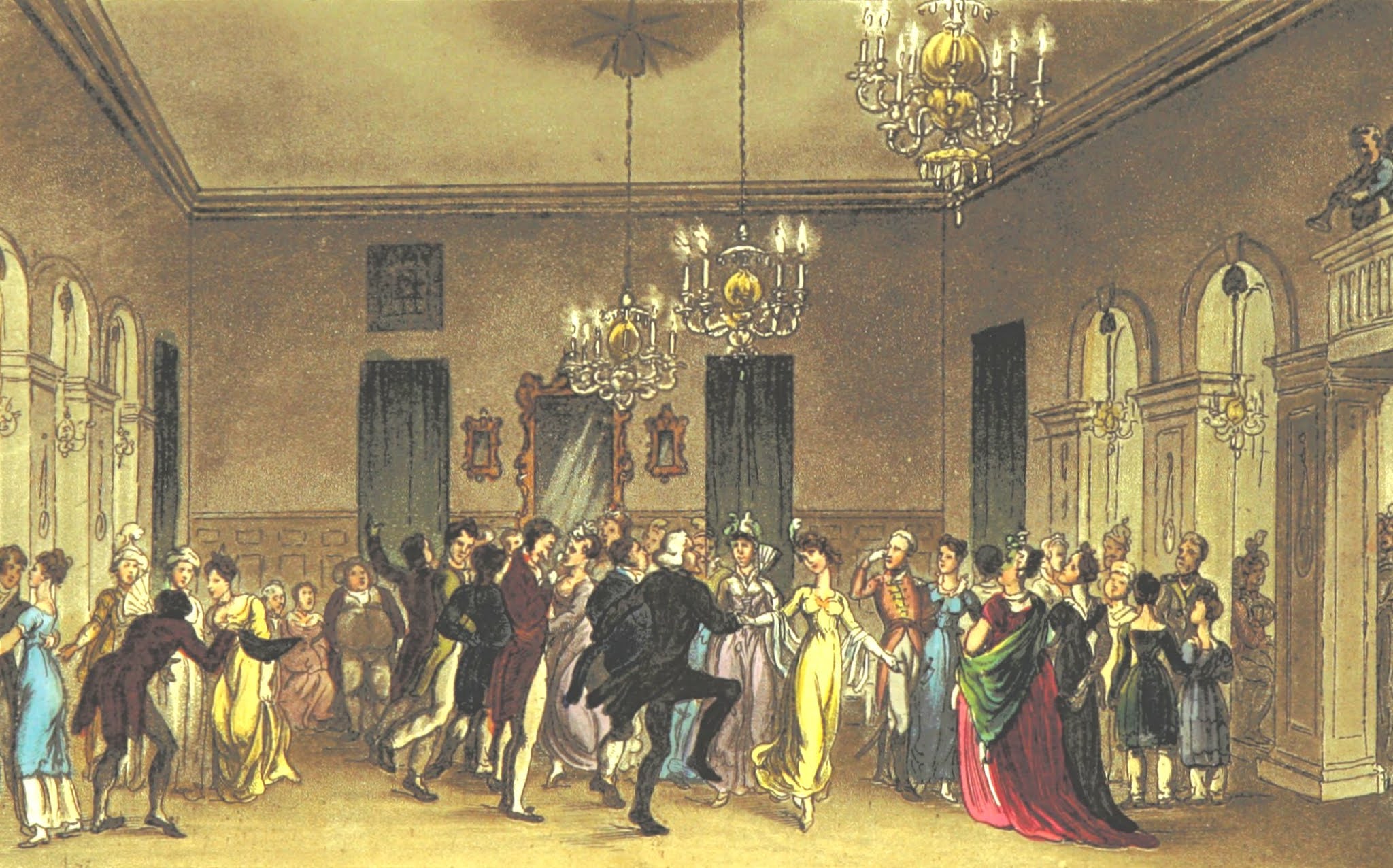
| Ballroom, Scarborough, from Poetical Sketches of Scarborough by F Wrangham, W Combe and J B Papworth Pub Ackermann (1813) from Metropolitan Museum of Art |
In Regency society, dancing was more than just a pleasurable activity. A young lady of quality taking part in the round of balls and other events that comprised the London season knew she was not there simply to have fun. Her aim (and even more so that of her parents) was to make a good match – to attract a suitable marriage partner from amongst the eligible gentlemen. Preferably a gentleman she liked as well as one of good standing and fortune.
Dancing was an important part of this process. It was a chance for a young lady to display the elegance of her person by the way she conducted herself both on and off the dancefloor, and for her to meet and converse with potential suitors.
There were two main types of ball – private balls and public balls.
Private balls
Private balls were organised by a hostess who chose the venue (usually her own house) and the guest list. Invitations were sent out ten days to six weeks beforehand and replies sent to the hostess. Typically a ball began at 9 or 10pm and lasted until 5am the next morning or later and might end with a breakfast.
Frances Bankes held a ball at Kingston Lacy in December 1791. The dancing began at 9pm; supper was at 1am; and the dancing continued until 7am when breakfast was served.1
Jane Austen wrote of a ball she had attended in 1800:
There were only twelve dances, of which I danced nine, and was merely prevented from dancing the rest by the want of a partner. We began at ten, supped at one, and were at Deane before five. There were but fifty people in the room.2
 |
| Highest Life in London - Tom & Jerry 'sporting a toe'
among the Corinthians at Almacks in the West by IR & G Cruikshank in Tom and Jerry: Life in London by P Egan (1869 first pub 1821) |
Public balls in London were held at venues such as the Pantheon and the Argyll Rooms and were less select as they were open to anyone who bought a ticket.
The balls at Almack’s Assembly Rooms were technically public balls, but as they were ruled over by patronesses who decreed who was allowed to purchase a ticket, they were as exclusive as a private ball.
You can read more about Almack’s here.
Outside London, public balls were held at local assembly rooms, some of which were ruled over as tightly as Almack’s.
You can read about balls at the Upper Rooms, Bath, here.
Who could a young lady dance with?
An unmarried lady of quality always appeared at a ball under the protection of a chaperon – usually an older married lady, most often her mother. It was the chaperon’s duty to ensure that her charge’s partners were eligible gentlemen.
A lady had to wait, of course, for a gentleman to ask her to dance. If she did not already have an acquaintance with the gentleman, then before he could ask her to dance, he had to request an introduction and her chaperon might prevent this if she saw fit.
You can read more about the importance of Regency introductions here.
At a private ball, the most suitable person to perform the introduction would be the hostess or a mutual friend. As the gentleman is a guest of the hostess, to decline the introduction could be seen as an insult as he has already been approved by the person who invited him to the ball. If the introducer were in any doubt as to whether the introduction was acceptable, they should ask the lady or her chaperon beforehand to prevent any embarrassment.
At a public ball, the introduction could be performed by a mutual friend or by the Master of Ceremonies.
 |
| "Not handsome enough to tempt me" by Hugh Thomson from Pride and Prejudice by Jane Austen (1894 edition) |
“Come, Darcy,” said he, “I must have you dance. I hate to see you standing about by yourself in this stupid manner. You had much better dance.”
“I certainly shall not. You know how I detest it, unless I am particularly acquainted with my partner. At such an assembly as this it would be insupportable. Your sisters are engaged, and there is not another woman in the room whom it would not be a punishment to me to stand up with.”
“I would not be so fastidious as you are,” cried Mr Bingley, “for a kingdom! Upon my honour, I never met with so many pleasant girls in my life as I have this evening; and there are several of them you see uncommonly pretty.”
“You are dancing with the only handsome girl in the room,” said Mr Darcy, looking at the eldest Miss Bennet.
“Oh! She is the most beautiful creature I ever beheld! But there is one of her sisters sitting down just behind you, who is very pretty, and I dare say very agreeable. Do let me ask my partner to introduce you.”
“Which do you mean?” and turning round he looked for a moment at Elizabeth, till catching her eye, he withdrew his own and coldly said: “She is tolerable, but not handsome enough to tempt me; I am in no humour at present to give consequence to young ladies who are slighted by other men. You had better return to your partner and enjoy her smiles, for you are wasting your time with me.”3
In Northanger Abbey, Mr Tilney asks the Master of Ceremonies to introduce him to Catherine Morland:
They made their appearance in the Lower Rooms; and here fortune was more favourable to our heroine. The master of the ceremonies introduced to her a very gentlemanlike young man as a partner; his name was Tilney.4
Once the introduction was made, the gentleman could ask the lady to dance.
 |
| Mr Tilney is presented to Catherine Morland by H M Brock (1898) in Northanger Abbey by Jane Austen from The Novels and Letters of Jane Austen ed by R B Johnson (1906) |
Note that an introduction made in the ballroom was considered insufficient for a gentleman to claim an acquaintance with the lady afterward, unless she chose to acknowledge it first.
In The Pocket Book of Etiquette (1837), Freeling wrote:
It is usual, at public balls, to appoint a master of the ceremonies, and stewards to regulate them: if you wish to dance with any lady with whom you are unacquainted, you must apply to the master of the ceremonies for an introduction; and if there be no manifest difference of station, he will introduce you. Recollect, however, that your acquaintance with the lady ceases with the dance; therefore, should you ever meet her, you must not attempt to address her, unless she should first bow; then you will merely lift your hat, and return the salute.5
Could a lady refuse to dance with a gentleman?
Not easily. Once the introduction had been made, a lady could not refuse to dance with a gentleman unless she was already engaged for that dance.
Freeling’s The Ladies’ Pocket Book of Etiquette (1840) states:
When a gentleman who has been properly introduced requests the honour of dancing with you, etiquette requires that you will accede, unless prevented by a previous engagement.6
If this were not the case and she still refused, it was tantamount to declaring that she was not intending to dance at all and she could not accept an invitation to dance with anyone else.
In Pride and Prejudice, Elizabeth Bennet is forced into promising the first two dances of the Netherfield ball to Mr Collins, even though he was an unpleasant partner, as she had no prior engagement. Had she refused, she would not have been able to dance at all.
“I am by no means of the opinion, I assure you,” said he [Mr Collins], “that a ball of this kind, given by a young man of character, to respectable people, can have any evil tendency; and I am so far from objecting to dancing myself, that I shall hope to be honoured with the hands of all my fair cousins in the course of the evening; and I take this opportunity of soliciting yours, Miss Elizabeth, for the two first dances especially, a preference which I trust my cousin Jane will attribute to the right cause, and not to any disrespect for her.”
Elizabeth felt herself completely taken in. She had fully proposed being engaged by Mr Wickham for those very dances; and to have Mr Collins instead! her liveliness had never been worse timed. There was no help for it, however. Mr Wickham’s happiness and her own were perforce delayed a little longer, and Mr Collins’s proposal accepted with as good a grace as she could.7
However, there were clearly instances where ladies broke the rules of etiquette, either intentionally or unintentionally, and in The Pocket Book of Etiquette (1837), Freeling wrote:
Should a lady decline dancing with you, and afterwards dance with another person, you will not be offended, if you will suffer yourself to reflect on the many reasons which may have induced the apparent rudeness. Personal preference, and the various emotions which may agitate the female heart, will furnish abundant cause for her decision, without her considering you either a fool or a boor, both of which characters she would infallibly attach to you, if, by indecorous conduct on the occasion, you thwarted her wishes; whereas, by a judicious blindness, you will probably secure her respect and confer an obligation.8
 |
| The Netherfield ball by Hugh Thomson from Pride and Prejudice by Jane Austen (1894 edition) |
No. I have not been able to find this rule written down in any of the 19th century etiquette guides I have looked at, but it seems a reasonable conclusion to reach when you consider the following conversation between Mr Knightley and Emma Woodhouse in Jane Austen’s Emma. Mr Knightley, whose brother is married to Emma’s sister, asks Emma to dance:
“Whom are you going to dance with?” asked Mr Knightley.
She hesitated a moment, and then replied, “With you, if you will ask me.”
“Will you?” said he, offering his hand.
“Indeed I will. You have shown that you can dance, and you know we are not really so much brother and sister as to make it at all improper.”
“Brother and sister! no, indeed.”9
The implication from Emma’s words is that to dance together as brother and sister would be improper.
I struggled to understand why this would be frowned upon until I was reminded about the main purpose of dancing, as part of the courting ritual. As you would not court your sister, it would be inappropriate to dance with her, in public, at least.
What was expected of an unmarried gentleman at a ball?
An unmarried gentleman attending a private ball was declaring he was looking for a wife and was expected to dance. Etiquette decreed that he should dance with any lady who had no partner.
If he danced with the same partner twice, he was considered to have shown a particular interest in the lady and his behaviour could give rise to expectations that he was courting her.
In Pride and Prejudice, Mrs Bennet starts expecting that Mr Bingley will marry Jane after he dances with her twice at the Meryton assembly. Mrs Bennet tells her husband:
Jane was so admired, nothing could be like it. Everybody said how well she looked; and Mr Bingley thought her quite beautiful, and danced with her twice! Only think of that, my dear; he actually danced with her twice! and she was the only creature in the room that he asked a second time.10
Mr Bingley also dances with Jane at the Netherfield ball and spends time talking to her. As the host, he was perhaps following his inclination above etiquette as he should have been seeing to the welfare of his guests and could be judged to be slighting other young ladies by not dancing with them. As his pointed interest gave rise to expectations which he did not immediately fulfil, Jane Bennet gains the reputation of being jilted.
At a public ball, a single gentleman was not required to dance with just anyone but should always be ready to partner any lady of his party who was not otherwise engaged, even if it meant dancing with her more than twice.
Conversation on the dancefloor
The majority of dances were country dances and usually a gentleman engaged a partner for a set of two dances and changed partners during the break between sets. As these were danced in a long line, with a gentleman facing his partner, the time taken to complete a dance could vary, depending on the number of couples. On average, two dances lasted about half an hour.
During the dance, a couple were expected to make conversation. There might be a considerable amount of time during a country dance where the couple was not dancing and could more easily exchange comments.
In Pride and Prejudice, when Elizabeth Bennet first dances with Mr Darcy, conversation seems to be a trial:
They stood for some time without speaking a word; and she began to imagine that their silence was to last through the two dances, and at first was resolved not to break it; till suddenly fancying that it would be the greater punishment to her partner to oblige him to talk, she made some slight observation on the dance. He replied, and was again silent. After a pause of some minutes, she addressed him a second time with: “It is your turn to say something now, Mr Darcy. I talked about the dance, and you ought to make some sort of remark on the size of the room, or the number of couples.”
He smiled, and assured her that whatever she wished him to say should be said.
“Very well. That reply will do for the present. Perhaps by and by I may observe that private balls are much pleasanter than public ones. But now we may be silent.”
“Do you talk by rule, then, while you are dancing?”
“Sometimes. One must speak a little, you know. It would look odd to be entirely silent for half an hour together; and yet for the advantage of some, conversation ought to be so arranged, as that they may have the trouble of saying as little as possible.”11
To be able to converse easily whilst dancing was a skill that both sexes needed to master.
In Routledge's Manual of Etiquette (c1860) he wrote:
Young gentlemen are earnestly advised not to limit their conversation to remarks on the weather and the heat of the room. It is, to a certain extent, incumbent on them to do something more than dance when they invite a lady to join a quadrille. If it be only upon the news of the day, a gentleman should be able to offer at least three or four observations to his partner in the course of a long half-hour.12
 |
| Mr Crawford leads Fanny to the top of the dance from Mansfield Park by Jane Austen (1898 edition) |
A gentleman’s duty to his partner did not end when the dance finished. According to Routledge:
At the conclusion of a dance, the gentleman bows to his partner, and either promenades with her round the room, or takes her to a seat. Where a room is set apart for refreshments, he offers to conduct her thither. At a public ball no gentleman would, of course, permit a lady to pay for refreshments.13
There was a correct way to lead your partner to and from the dancefloor. In The Dancers’ Guide (1821), Chivers wrote:
In conducting a lady either to or from the dance, the gentleman should take the ladies (sic) left hand within his right (ie the lady should be on the right side of a gentleman).14
Freeling urged ladies to rely on their partners. He wrote in The Ladies’ Pocket Book of Etiquette (1840):
If in the intervals of dancing you wish to go from one part of the room to another, you will request your partner to conduct you; on no account be seen parading the room by yourself.15
Could married couples dance?
Married people could dance but tended to dance less as they grew older; the dances were quite energetic and demanded a reasonable level of physical fitness.
Mrs William Parkes, in her Domestic Duties or instructions to young married ladies (1825), wrote of a private ball:
When the lady of the house is a dancer, she generally commences the dance; but when this is not the case, her husband should lead out the greatest stranger, or person of highest rank present.16
When the Westons hosted a ball in Emma, Mrs Weston did not choose to dance, so Mr Weston formed the top couple with the recently married Mrs Elton, who was the newest resident of Highbury. As the hostess, Mrs Weston spent the ball ensuring her guests were looked after and all the ladies had partners.
A married gentleman could dance but did not have to. However, if he were dancing, he was subject to the same expectations as an unmarried gentleman at a private ball. Etiquette required that he dance with any lady who did not have a partner. Alternatively, he could stand with the chaperons and other non-dancers or withdraw to the cardroom.
In Emma, Mr Elton demonstrated poor etiquette by refusing to dance with Miss Smith having already danced with other ladies. He had to fall back on his excuse of being married and would then be obliged not to dance with anyone else.
The two last dances before supper were begun, and Harriet had no partner;—the only young lady sitting down;—and so equal had been hitherto the number of dancers, that how there could be any one disengaged was the wonder!—But Emma's wonder lessened soon afterwards, on seeing Mr Elton sauntering about. He would not ask Harriet to dance if it were possible to be avoided: she was sure he would not—and she was expecting him every moment to escape into the card-room.17
Mr Knightley shows he is by far the better-mannered gentleman by abandoning his personal preference not to dance and inviting Harriet to stand up with him when Mr Elton refuses to ask her. Though he has just expressed a willingness to dance with Mrs Weston or Mrs Gilbert, Mr Elton excuses himself as “an old married man”. Mr Elton is then forced to spend the rest of the evening in the cardroom.
Could married couples dance with each other?
To dance with your spouse was frowned upon. On the rare occasions I dance, I always prefer to partner my husband, so this did not make sense to me.
However, in The Laws of Etiquette (Philadelphia, 1836) it states:
If you accompany your wife to a dance, be careful not to dance with her.18
As it is listed in miscellaneous rules of etiquette along with an adjuration not to repeat the same anecdotes, I was not inclined to take it seriously. However, Routledge’s Manual of Etiquette says something similar:
It is not customary for married persons to dance together in society.19
This suggests that it was not scandalous, merely unfashionable and perhaps not good form. This makes sense when we remember that dancing was part of the courting ritual and as such was largely between unmarried ladies and gentlemen. By dancing with his wife (who did not need to attract a husband), a married man was not giving an unmarried lady the chance to exhibit her elegance in the dance.
As a result of this research, I decided to rewrite part of a scene in A Reason for Romance where I had originally had Mr and Mrs Merry dancing with each other.
Other points of etiquette
At public balls and some private balls, people were given numbers on arrival which indicated their place in the set. The top couple called the dance – that is the tune and the figures to be danced.
If people did not know the steps, they could walk through the dance with elegance.
The same dance could not be called twice in the same evening.
If a couple failed to take their places at the start, they had to go to the bottom of the dance.
It was bad etiquette to leave the dance before it ended.
Always wear white , or light-coloured gloves at a ball.20
Never be seen without gloves in a ball-room.21

If you have enjoyed this blog and want to encourage me and help me to keep making my research freely available, please buy me a virtual cup of coffee by clicking the button below.
Notes
1. You can read more about Frances Bankes’s ball at Kingston Lacy here.
2. Austen, Jane, The Letters of Jane Austen selected from the compilation of her great nephew, Edward, Lord Bradbourne ed Sarah Woolsey (1892).
3. Austen, Jane, Pride and Prejudice (1813, London).
4. Austen, Jane, Northanger Abbey (1817, London).
5. Freeling, Arthur, The Pocket Book of Etiquette (Liverpool, 1837).
6. Freeling, Arthur, The Ladies' Pocket Book of Etiquette (7th edition) (London, 1840).
7. Austen, Jane, Pride and Prejudice (1813, London).
8. Freeling, Arthur, The Pocket Book of Etiquette (Liverpool, 1837).
9. Austen, Jane, Emma (1815, London).
10. Austen, Jane, Pride and Prejudice (1813, London).
11. Ibid.
12. Routledge, George, Routledge's Manual of Etiquette (London, c1860).
13. Ibid.
14. Chivers, G M S, The Dancers' Guide to which is added the etiquette of a ballroom (1821).
15. Freeling, Arthur, The Ladies' Pocket Book of Etiquette (7th edition) (London, 1840).
16. Parkes, Mrs William, Domestic Duties or Instructions to young married ladies on the management of their households (London, 1825).
17. Austen, Jane, Emma (1815, London).
18. A Gentleman, The Laws of Etiquette; or, Short Rules and Reflections for Conduct in Society (Philadelphia, 1836).
19. Routledge op cit.
20. Freeling, Arthur, The Pocket Book of Etiquette (Liverpool, 1837).
21. Routledge op cit.
Sources used include:
A Gentleman, The Laws of Etiquette; or, Short Rules and Reflections for Conduct in Society (Philadelphia, 1836)
Austen, Jane, Emma (1815, London)
Austen, Jane, Northanger Abbey (1817, London)
Austen, Jane, Pride and Prejudice (1813, London)
Austen, Jane, The Letters of Jane Austen selected from the compilation of her great nephew, Edward, Lord Bradbourne ed Sarah Woolsey (1892)
Chivers, G M S, The Dancers' Guide to which is added the etiquette of a ballroom (1821)
Freeling, Arthur, The Ladies' Pocket Book of Etiquette (7th edition) (London, 1840)
Freeling, Arthur, The Pocket Book of Etiquette (Liverpool, 1837)
Routledge, George, Routledge's Manual of Etiquette (London, c1860)
Routledge, George, The Etiquette of Courtship and Matrimony: with a complete guide to the forms of a wedding (London, 1852)
Trusler, Rev Dr John, A System of
Etiquette (1804)


