Search this blog

Showing posts with label Regency style. Show all posts

Sunday, 28 July 2019

Theatre Royal, Bury St Edmunds - a Regency playhouse

The auditorium of the Theatre Royal, Bury St Edmunds
The auditorium of the Theatre Royal, Bury St Edmunds (2019)
On our way back from holiday in Norfolk, my husband Andrew and I managed to squeeze in a tour of the Theatre Royal, Bury St Edmunds – the only surviving Regency theatre in England. I was interested to see inside this restored Grade I listed playhouse to get an idea of what a provincial theatre in late Georgian England, like the one that once existed on Weymouth seafront, would have looked like.

William Wilkins (1778-1839)

Bust of William Wilkins in the saloon  of the Theatre Royal, Bury St Edmunds
Bust of William Wilkins in the saloon
of the Theatre Royal, Bury St Edmunds (2019)
The theatre was built in 1819 by William Wilkins, an architect who, like Robert Adam, drew his inspiration from classical architecture. His most famous works are the National Gallery, London; Downing College, Cambridge; and University College, London. Wilkins had bid for the contract to rebuild the Drury Lane Theatre in 1811 but had been unsuccessful.

The Wilkins family were shareholders in the Norwich circuit of theatres and Bury St Edmunds was the most profitable stop. The previous playhouse was in the centre of town, on the upper floor of the market hall. Although the Market Cross building had been remodelled by Robert Adam in 1774, Wilkins felt it was inadequate.

In 1818, Wilkins purchased a piece of land on Westgate Street for £200. He clearly did not choose this spot for the convenience of his audience. Westgate Street was on the southern edge of the town, which was rapidly expanding on the opposite, northern side. An 1827 book about Bury St Edmunds noted:
The present Theatre is neat and convenient, situate in West-gate-street, it was erected in 1819, but the situation, being so distant from the centre of the town is a source of regret and loss to the proprietors.1
It seems that Wilkins chose this location because of its natural slope. This enabled the pit to be made low enough so as not to obscure the view from the boxes without requiring an excessive amount of excavation.

The theatre was erected in 1819, opening in October. There seems to be some variance as to exactly how much the building cost. According to Miller’s theatre history, By Particular Desire, Wilkins estimated the cost at £4,000, but ended up spending £5,000 and paid the difference himself.

In his History, Gazetteer and Directory of Suffolk (1855), William White wrote:
The Theatre in Westgate street is a commodious structure, which was erected in 1819, in lieu of the old theatre at the Town Hall, at the cost of £3000, raised in £100 shares. 2
The entrance to the Theatre Royal, Bury St Edmunds
The entrance to the Theatre Royal, Bury St Edmunds (2019)
The Norwich Company

The new theatre opened on Monday 11 October 1819 with performances of George Colman the younger’s successful comedy John Bull and a new farce, A Roland for an Oliver. Both were performed by the Norwich Company of touring actors who served Bury St Edmunds. They were reckoned to be one of the best of the provincial touring companies.

The Norwich Company consisted of about 14 people who travelled around such places as Great Yarmouth, Ipswich, Norwich, Stourbridge and Colchester, accompanied by their scenery and costumes. During the period 1814 to 1839, the troupe was managed by James Smith.

The company had their own scenic artist, George Thorne, who was the best paid member of the troupe. He helped decorate Wilkins’s theatres, including Bury St Edmunds.

In his 1821 guide to Bury St Edmunds, Deck wrote:
The Bury theatre is occupied by the Norwich company, under the management of Messrs Smith and Bellamy. The season is during the great fair.3
In his 1855 directory of Suffolk, White wrote that the theatre
... is supplied by the Norwich Company, and is usually open for five or six weeks in October and November.4
Tymms wrote in his Bury St Edmunds handbook of the same year:
It was generally supplied by the Norwich company for several weeks in October and November, but now is opened more or less all the year round.5
The auditorium

The ceiling of the Theatre Royal, Bury St Edmunds
The ceiling of the Theatre Royal, Bury St Edmunds (2019)
The ceiling of the auditorium was painted like the sky and the theatre was decorated in a classical style by George Thorne. A few pieces of the original frieze of sphinxes and genii have survived.

The stage was large, coming out into the auditorium, so that the front was well lit and allowed interaction between the players and the audience. The stage boxes were level with the stage and enabled the occupants of these boxes, who tended to be the most important people, to both see the play and be seen by the rest of the audience.

Dress circle boxes from the stage  Theatre Royal, Bury St Edmunds
Dress circle boxes from the stage
Theatre Royal, Bury St Edmunds (2019)
The theatre could accommodate 780 people in three very distinct seating areas: the boxes, the pit and the gallery. The best seats were in the boxes, which accommodated 360 people in two tiers. The boxes were accessed through the main entrance to the theatre via a spacious, classically decorated saloon. The saloon led directly to the lower tier of boxes.

The entrance saloon, Theatre Royal, Bury St Edmunds
The Entrance Saloon, Theatre Royal, Bury St Edmunds (2019)
The entrance saloon, Theatre Royal, Bury St Edmunds  The doors lead directly to the dress circle boxes
The Entrance Saloon, Theatre Royal, Bury St Edmunds
The doors lead directly to the dress circle boxes (2019)
Doors to boxes, Theatre Royal, Bury St Edmunds
Doors to boxes, Theatre Royal, Bury St Edmunds (2019)
View across the theatre showing lower tier of boxes  Theatre Royal, Bury St Edmunds
View across the theatre showing lower tier of boxes
Theatre Royal, Bury St Edmunds (2019)
View from one of the upper boxes  of the Theatre Royal, Bury St Edmunds
View from one of the upper boxes
of the Theatre Royal, Bury St Edmunds (2019)
Another 300 people could be accommodated in the pit. This was accessed through a side door to the theatre and up a stairway which came out just below the stage.

View from the pit showing the entrance to the right  Theatre Royal, Bury St Edmunds
View from the pit showing the entrance to the right
Theatre Royal, Bury St Edmunds (2019)
A further 120 people could be squeezed into the gallery, right at the top of the theatre.

View of auditorium showing gallery area just below the ceiling  Theatre Royal, Bury St Edmunds
View of auditorium showing gallery area just below the ceiling
Theatre Royal, Bury St Edmunds (2019)
View from the gallery  Theatre Royal, Bury St Edmunds
View from the gallery
Theatre Royal, Bury St Edmunds (2019)
As you would expect, the better the seat, the higher the price of a ticket. As was common at the time, most of the seats had two prices and people could come in for the second half of the entertainment for a reduced price. According to a playbill for 1828, the prices were as follows:
  • Boxes 4s - Second Price 2s
  • Pit 2s 6d - Second Price 1s 6d
  • Gallery 1s - No half-price
A playbill from 1839 showed that the prices had changed – some of them had gone down! This was after Wilkins’s death and one can only assume that the theatre was struggling to fill its seats by this time. The theatre now differentiated between lower and upper boxes, with the lower boxes – what we would call the dress circle – charged at the 1828 rate, but the upper boxes now available at 3s (1s 6d second price). The pit charge was also reduced by 6d to 2s (1s second price) and the gallery now had a second price of 6d.

Another view from the gallery  Theatre Royal, Bury St Edmunds
Another view from the gallery
Theatre Royal, Bury St Edmunds (2019)
A surviving playbill from 14 October 1824 indicated that seats could be booked of Mr Hunt in the Box Office between the hours of eleven and two.

The theatre must have had a problem with patrons complaining of the cold because on the same playbill, the theatre advertised that fires had been kept going in the theatre constantly, presumably to raise the temperature.

An 1828 playbill stated that the doors would be opened at six and the performance would commence promptly at seven o’clock.

The performances

The Norwich Company usually performed two, or even three, pieces every night. The theatre has a collection of old playbills which give a flavour of what was performed.

1821 Playbill advertising Lovers' Vows
on display at Theatre Royal, Bury St Edmunds (2019)
The play advertised for Saturday 3 November 1821 was Lovers’ Vows, followed by Timour the Tartar, a romantic melodrama. Lovers’ Vows is, of course, famous amongst fans of Jane Austen because it is the play that the young people of Mansfield Park were going to perform before they were interrupted by the sudden return of Sir Thomas Bertram. Lovers’ Vows was well-received, having been written by local girl, actress and playwright Elizabeth Inchbald, who was born not far from Bury St Edmunds.

On Monday 5 November 1821, the performances comprised a comedy, The Will, and a farce, The Prize, with Miss Kelly. Frances Maria Kelly was a London actress who was sufficiently well known to be featured in The Ladies’ Monthly Museum in 1819.

Frances Maria Kelly  from The Ladies' Monthly Museum (1819)
Frances Maria Kelly
from The Ladies' Monthly Museum (1819)
The performance on Friday 31 October 1828 comprised the melodrama, Jocko, the Brazilian Ape, followed by A Gambler’s Life, a new serious burletta. Jocko was played by Monsieur Gouffe and his performance included a dramatic descent from the gallery to the stage suspended by only three fingers and holding two flags. Also advertised was a second descent where Monsieur Gouffe would be suspended by his neck, supporting a boy and waving two flags.

A playbill for Friday 7 November 1828 advertised another play by Mrs Inchbald – a farce called Animal Magnetism together with George Barnwell, a tragedy, and The Bandit of the Blind Mine, a melodrama in three acts.

William Charles Macready  from The Diaries of William Charles Macready 1833-1851 (1912)
William Charles Macready
from The Diaries of William Charles
Macready 1833-1851
(1912)
The most famous actor to perform at the theatre during the Georgian period was William Charles Macready, one of the stars of the London stage. He appeared at Bury St Edmunds for four nights in November 1828. Macready starred in Virginius on Monday 10th, William Tell on Wednesday 12th, Macbeth on Thursday 13th and Othello and Rob Roy on Friday 14th, the last night of the season, which was also his benefit night. This meant that Macready received a share of the night’s takings in addition to his salary.

1828 Playbill advertising Othello and Rob Roy  on display at Theatre Royal, Bury St Edmunds
1828 Playbill advertising Othello and Rob Roy
on display at Theatre Royal, Bury St Edmunds (2019)
William Charles Macready as Othello  from The Diaries of William Charles Macready 1833-1851 (1912)
William Charles Macready as Othello
from The Diaries of William Charles
Macready 1833-1851
(1912)
The audience

The theatre was patronised by Lord and Lady Bristol of nearby Ickworth House. Another prominent theatre goer was James Oakes, a wealthy merchant and banker, who was a shareholder. The shareholders received silver tokens which gave them free access to the performances at the theatre. There were ongoing arguments as to whether these rights were transferable.

Important patrons and shareholders could bespeak performances, such as the production of Lovers’ Vows in 1821 mentioned above, which was ‘by desire of the subscribers to the theatre.’6

Refreshments included oranges and sweets and it would seem, our theatre guide told us, oysters, as a great number of oyster shells were found during the renovations of the theatre. Clay pipes were also found, indicating that people smoked in the theatre.

Under the stage at Theatre Royal, Bury St Edmunds
Under the stage at Theatre Royal, Bury St Edmunds (2019)
Later history

After Wilkins died in 1839, the theatre was briefly taken over by James Abington who renamed it the Theatre Royal. In the decades that followed, the theatre’s success dwindled, and in 1920, the Greene King brewery bought the building to use as a barrel store.

Although this meant that, sadly, many of the original, internal fittings were stripped out, the fact that the building was repurposed secured its survival.

In 1965, the restored building reopened as a theatre. In 2005, further restoration work began which has returned the theatre to its Regency splendour.

The Theatre Royal, Bury St Edmunds, is well worth a visit. The National Trust operates informative tours which I would highly recommend. When they are available, you can book through the theatre website.

Our fantastic tour guide, outside the   Theatre Royal, Bury St Edmunds
Our fantastic tour guide, outside the 
Theatre Royal, Bury St Edmunds (2019)

Headshot of Rachel Knowles author with sea in background(2021)
Rachel Knowles writes clean/Christian Regency era romance and historical non-fiction. She has been sharing her research on this blog since 2011. Rachel lives in the beautiful Georgian seaside town of Weymouth, Dorset, on the south coast of England, with her husband, Andrew.

Find out more about Rachel's books and sign up for her newsletter here.

If you have enjoyed this blog and want to encourage me and help me to keep making my research freely available, please buy me a virtual cup of coffee by clicking the button below.

Notes
1. Longman (pub), A concise description of Bury Saint Edmund's and its environs (1827)
2. White, William, History, Gazetteer and Directory of Suffolk (1855)
3. Deck, J, A guide to the town, abbey and antiquities of Bury St Edmunds (1821)
4. White, William, History, Gazetteer and Directory of Suffolk (1855)
5. Tymms, Samuel, A handbook of Bury St Edmund's with additions by JR Thompson (1855)
6. From an original playbill displayed at the theatre.

Sources used include:
Deck, J, A guide to the town, abbey and antiquities of Bury St Edmunds (1821)
Longman (pub), A concise description of Bury Saint Edmund's and its environs (1827)
Tymms, Samuel, A handbook of Bury St Edmund's with additions by JR Thompson (1855)
White, William, History, Gazetteer and Directory of Suffolk (1855)

National Gallery website
National Trust website

All photographs © RegencyHistory.net

Saturday, 16 August 2014

Georgian architecture - a Regency History guide

Nostell Priory
Nostell Priory
An introduction to Georgian architecture

The reigns of George I through to George IV are characterised by a distinctive form of building design and decoration. The symmetry and simplicity of Georgian architecture has become a symbol of British restrained good taste, and indeed of 'Britishness' itself.

This short guide is an introduction to what is a huge subject.

Early Georgian architecture

Importing a new monarchy from Hanover to Britain in 1714 represented a major break with the past. The optimistic, forward-looking spirit of the age was reflected in the adoption of a new architecture for the nation's buildings.

This change meant putting aside the Baroque, which peaked in St Paul’s Cathedral, Castle Howard and Blenheim Palace. It was replaced by the Palladian style, based heavily on Roman antiquity and inspired by the works of Andrea Palladio (1508-1580).
 
Andrea Palladio
Andrea Palladio
from The gallery of portraits with memoirs
by AT Malkin (1836)
Two leading proponents of Palladian architecture in England were Lord Burlington (1694-1753) and William Kent (1685-1748). Burlington travelled to Italy to study Palladio’s work for himself. Here he met Kent, who became his assistant and spent much of his time designing sumptuous interior decoration.

Palladio's Villa Capra or Villa Rotunda from The gallery of portraits with memoirs by AT Malkin (1836)
Palladio's Villa Capra or Villa Rotunda
from The gallery of portraits with memoirs
by AT Malkin (1836)
The heyday of Palladianism was 1715 to 1760. Buildings of this style constructed in this period are often referred to as Neo-Palladian, to distinguish them from earlier uses of Palladian principles. Inigo Jones (1573-1652), who built the Banqueting House in Whitehall, was the first to apply the Palladian approach to British buildings, but the style fell from favour after the English Civil War.

The Pantheon
The Pantheon,
- the inspiration for Palladio's Villa Capra
Features of Palladian architecture

Strict adherence to the rules of proportion. Palladio was heavily influenced by the writing of Roman architect Vitruvius, who believed there was a perfect symmetry and proportion in nature, which could be replicated in buildings. By studying the work of Vitruvius, and ruins of ancient buildings, Palladio created a set of architectural rules.
Symmetry - one half of the building, or at least the façade, is a mirror image of the other.
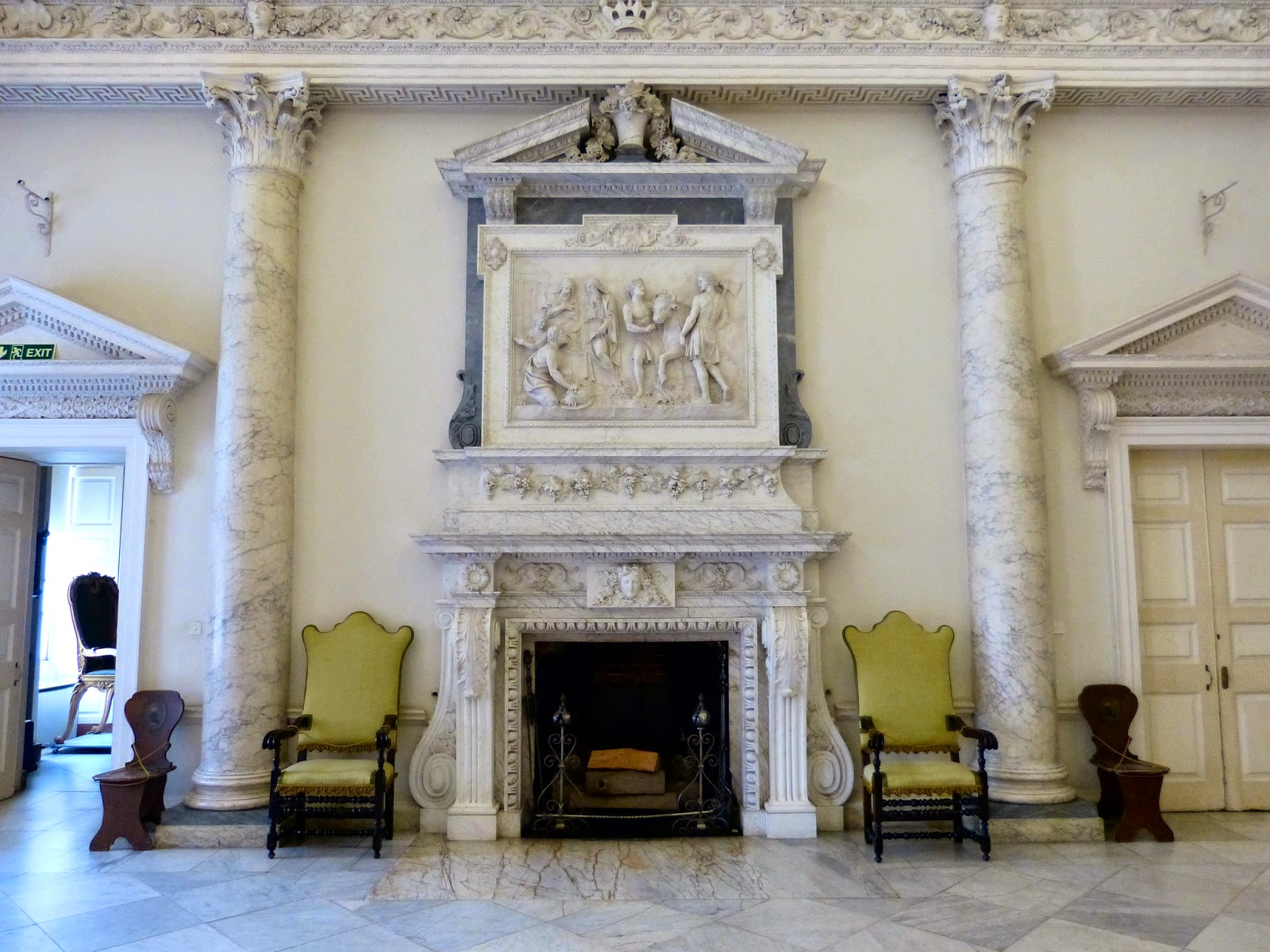
Columns topped with capitals carved into the shape of acanthus leaves, often referred to as Corinthian columns.
Scallop shell motifs.
Pediments over doors and windows - these are triangular, often containing some form of decoration.

The entrance hall, Clandon Park
True Palladian designs come over as heavy when compared to their Neoclassical successors.

Examples of Palladian architecture

Chiswick House, West London, is usually regarded as the best example, being built by the leader in Palladian fashion, Lord Burlington, with interiors designed by William Kent.

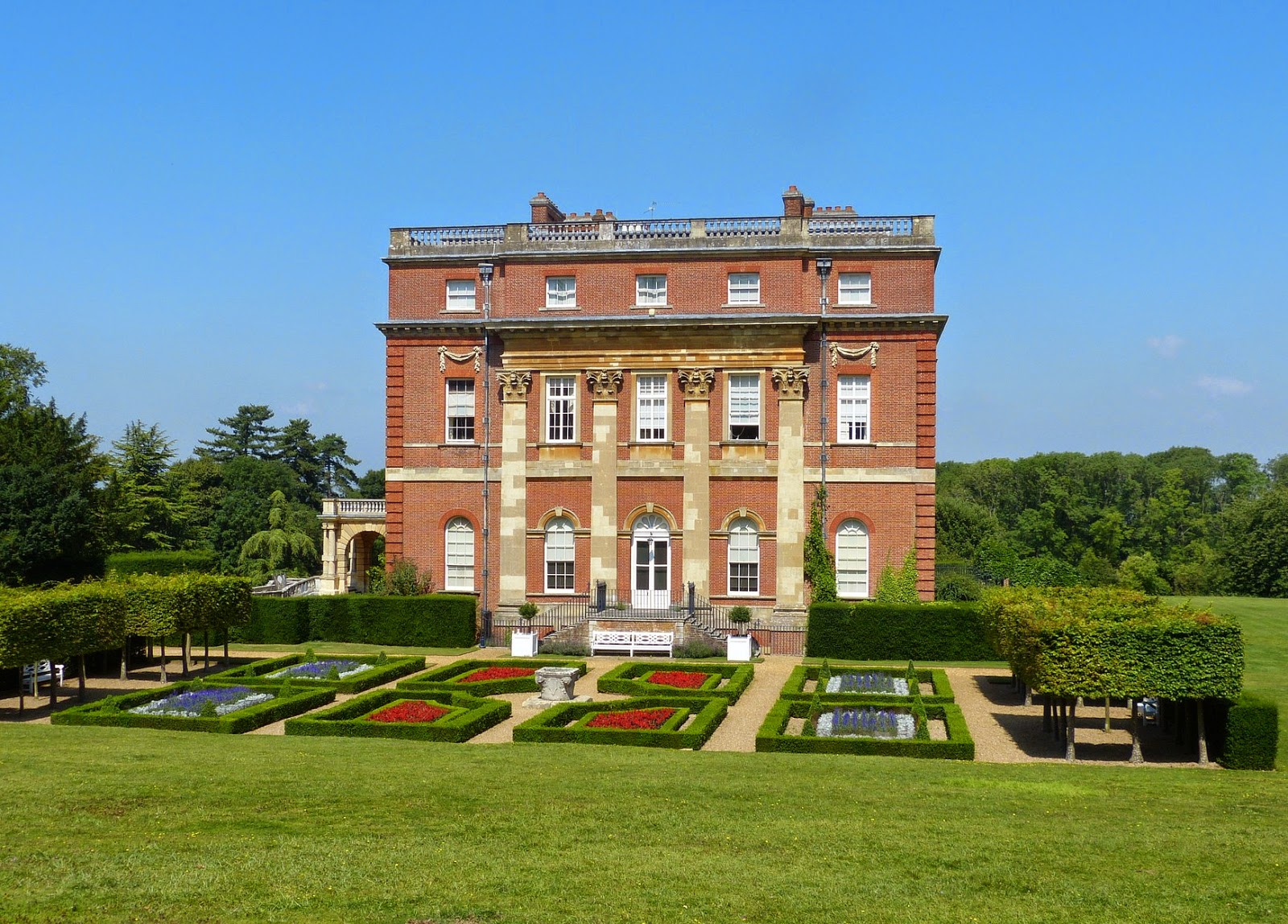
Clandon Park, Surrey, was designed by a Venetian architect and built in 1720 for Lord Onslow. Sadly, this house was severely damaged by fire in April 2015. You can read more about Clandon Park here.

Clandon Park - from the back
Clandon Park - rear view
Houghton Hall, Norfolk, built by Sir William Walpole, the first British Prime Minister, in the 1720s. The interiors were designed by William Kent.

Rebellion against the rules

Not everyone wants to be constrained, including architects. Robert Adam (1728-92), from Kirkcaldy, Scotland, had no time for the restrictions imposed by the Palladian style and became an advocate of its successor, the Neoclassical.

While also rooted in the ancient world, Neoclassical design looked beyond Rome to include ideas from Greece. Archaeological curiosity and the advent of the Grand Tour provided a wider perspective on classical cultures. Adam himself went on the Tour in 1754 and spent several years in Rome, studying architecture.

Features of Neoclassical architecture

Many of the features popular in Palladian architecture, such as symmetry, columns and pediments, also feature in the Neoclassical.

In general, Neoclassical style incorporates many more aspects of Ancient Greek art, such as cameos. Josiah Wedgwood, the famous Staffordshire potter, designed in the Neoclassical style.


Examples of Neoclassical architecture

Kedleston Hall, Derbyshire, which Robert Adam worked on for around 20 years.

Kedleston Hall
Kedleston Hall
Osterley Park, designed by Robert Adam and built by 1780.

Saltram House, again designed by Adam, who worked on it 1768-69.

Saltram House
Saltram House
What is the difference between Palladian and Neoclassical architecture?

At first glance, the building constructed in the Palladian style is very similar to a Neoclassical design. Both have pillars; both have symmetry; both have strong classical lines.

The date of construction might be a clue, with Palladian preceding Neoclassical, but there was a considerable period of overlap.

The biggest difference, which might be hard to spot, is that Palladian architecture adhered to the rules of proportion. Neoclassical architects, such as Robert Adam, made a conscious decision to break free of the restrictions these rules imposed. The results were lighter, more elegant constructions which, for many, represent the pinnacle of Georgian architectural achievement.

The Marble Hall, Kedleston Hall,
designed by Robert Adam
An explosion of styles

The Georgians were not afraid to experiment and explore architectural alternatives to the classical form. The late eighteenth and early nineteenth centuries saw the emergence of Gothic revival and the Regency style, while the incorporation of exotic ideas reached its zenith in the Brighton Pavilion.

Brighton Pavilion
Brighton Pavilion
Gothic revival

The Gothic style, firmly rooted in the medieval period, is celebrated in numerous churches and cathedrals across Britain. It made a resurgence in the late eighteenth century, most famously at Strawberry Hill, built by writer Horace Walpole (1717-1797).

Here, in Twickenham, he built his “little Gothic castle”. Its battlements and towers rapidly became a tourist attraction, although he restricted entry to just four people per day, and no children. The popularity of the house, and the revived Gothic style, opened the way for the more significant Gothic revivals of the mid-nineteenth century.

Gothic cottage, Stourhead
The Regency style

The Georgian architectural legacy stretches far beyond grand houses and public buildings. Numerous towns and cities enjoy elegant rows of terraced houses built in what is now called the Regency Style.

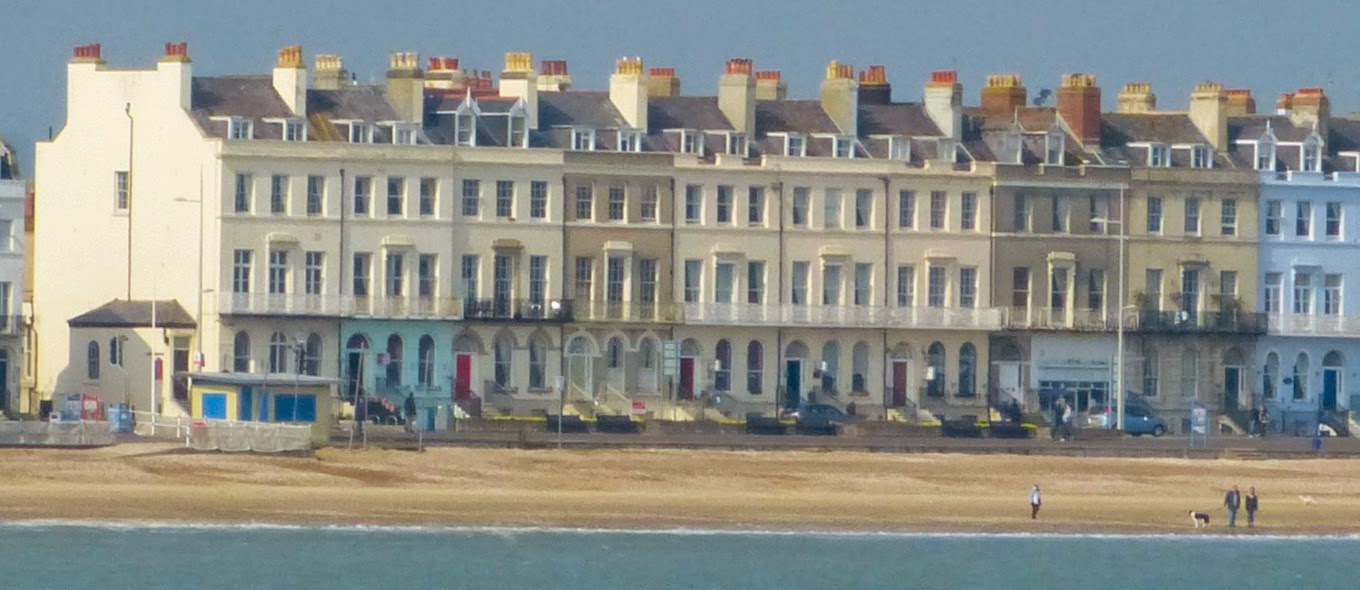
Part of Weymouth Esplanade
Much of Bath, large swathes of London including Regent Street, the Esplanade in Weymouth - all these are surviving examples of the Regency Style. It began in Bath, where John Wood the Elder (1704-1754) combined the Palladian style with his own ideas on town planning.

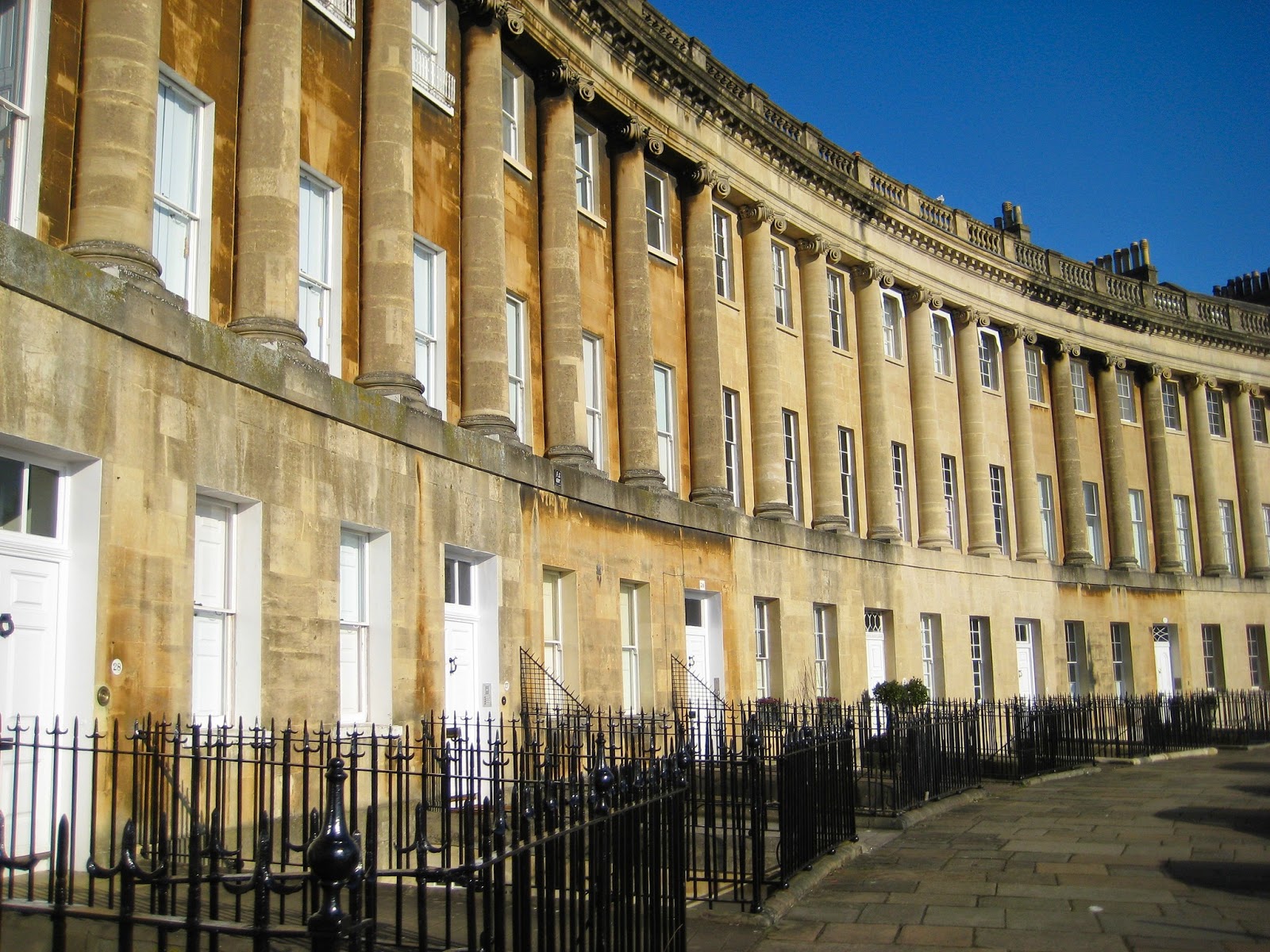
The world-renowned Royal Crescent, probably the most photographed example of Georgian architecture, was built in 1767-1775 by John Wood the Younger, who continued the architectural vision of his father.

Royal Crescent, Bath
John Nash (1752-1835) took Wood’s ideas and applied them in his work for the Prince Regent, which began in earnest in 1810. His major project was the route linking Regent’s Park to Carlton House, a major exercise in town planning.

Brighton Pavilion

While the Georgian architecture of the eighteenth century was heavily influenced by classical Greek and Roman forms, the early nineteenth century began to absorb more exotic ideas.

Brighton Pavilion
Brighton Pavilion
These influences are exemplified in the extravagant display constructed by the Prince Regent in Brighton. The Royal Pavilion, initially a farmhouse, then the Neoclassical Marine Pavilion, became a curious mixture of Indian, Chinese, Tudor and Gothic styles. The domes and towers of the creation we see today are another example of the work of John Nash.

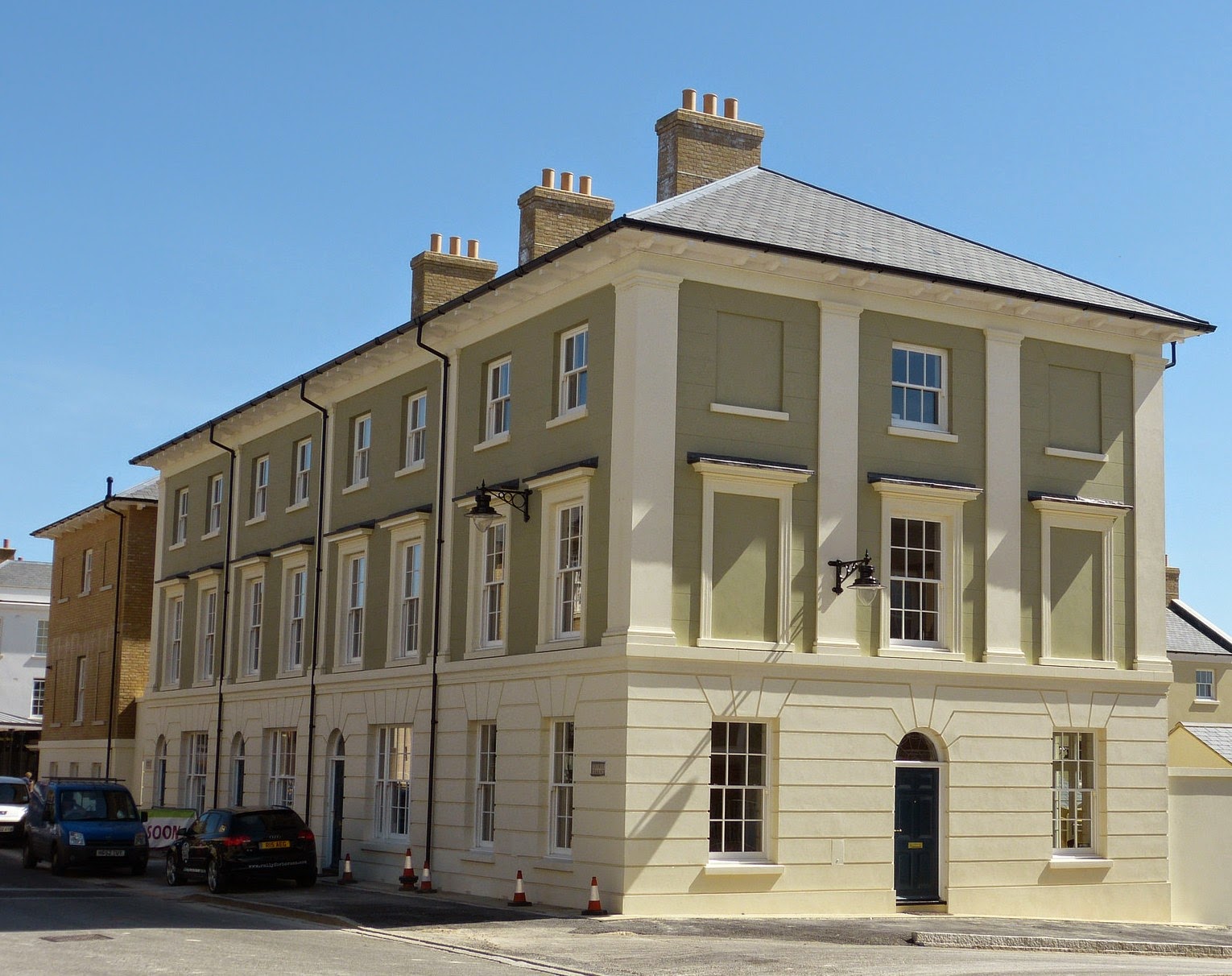
Georgian architecture in Britain reflected both the growing wealth of the nation and its increasing global reach. It also created a set of styles that are still popular with many today. Prince Charles famously holds strong views on building design and is constructing his own vision of a modern town at Poundbury in Dorset. The architecture is distinctly Neoclassical, literally building on the tradition established during the reign of his ancestor George III.

Poundbury, Dorset
Poundbury, Dorset

Headshot of Rachel Knowles author with sea in background(2021)
Rachel Knowles writes faith-based Regency romance and historical non-fiction. She has been sharing her research on this blog since 2011. Rachel lives in the beautiful Georgian seaside town of Weymouth, Dorset, on the south coast of England, with her husband, Andrew, who wrote this blog.

Find out more about Rachel's books and sign up for her newsletter here.

If you have enjoyed this blog and want to encourage me and help me to keep making my research freely available, please buy me a virtual cup of coffee by clicking the button below.


Sources used include:
Architectural Trust website
BBC website
Country Life website
Guardian website
Houghton Hall website 
John Wood the Elder website
Strawberry Hill website
Suppes, Patrick, Rules of Proportion in Architecture (Stanford edu articles)
Telegraph website
V&A website: Gothic revival
V&A website: Neoclassicism
V&A website: Palladianism

All photographs by Andrew Knowles © regencyhistory.net

Wednesday, 14 November 2012

The rise and fall of Beau Brummell (1778-1840)

George Brummell  from The History of White's   by Hon Algernon Bourke (1892)
George Brummell
from The History of White's
 by Hon Algernon Bourke (1892)
Profile

George "Beau" Brummell (7 June 1778 - 30 March 1840) was a Regency dandy and fashion leader, famous for his elegant dress, his witty remarks and his friendship with George, Prince of Wales, the future George IV.

From Downing Street to Eton

George Bryan Brummell, famously nicknamed “Beau”, was born on 7 June 1778, the younger son of Billy Brummell and Mary Richardson. He was born in Downing Street, where his father worked as private secretary to Lord North. In 1783, Billy Brummell retired from politics and bought an estate, Donnington Grove in Berkshire.

In 1786, Brummell was sent to Eton with his elder brother, William. They were Oppidans or fee-paying boys and boarded with Dame Young. Brummell mingled with the aristocracy, becoming known for his gentlemanly manners and ready wit, which kept him out of trouble. He developed an interest in dress and his elegant bearing earned him the nickname Buck Brummell.

A grand inheritance

When Brummell’s father died in 1794, he left his estate to be shared equally between his three children, rather than the whole going to his eldest son. The estate, valued at around £60,000, was to be held in trust until the children came of age. This was a huge fortune, equivalent to more than £5 million today using the retail price index, and more like £70 million when relative earnings are taken into account.(1)

The Hussars

Brummell went up to Oriel College, Oxford, in May 1794, but after just one term, he asked his father’s executors for a commission in the army. He became a cornet in the 10th Light Dragoons – the Prince of Wales’ own regiment. The dragoons wore elaborate uniforms and liked to be known as Hussars. They were disorderly, hard drinking and known for their lack of morality, and included many of the Prince of Wales’ set, of which Brummell soon became an important member.

Brummell obtained promotion to lieutenant in 1795 and then captain in 1796, and with each promotion came a new, and grander, uniform. But life in the army had its costs. A fall, or possibly a kick, from his horse broke his nose, damaging his classic profile.

Brummell and the Prince

George, Prince of Wales  from Memoirs of George IV  by Robert Huish (1830)
George, Prince of Wales
from Memoirs of George IV
by Robert Huish (1830)
It seems incredible that a non-aristocratic boy of sixteen should be accepted into the Prince’s own regiment and then into his circle of intimate friends. How Brummell first came to the Prince’s notice is not known, but it seems likely that it was his wit and dress sense that attracted the Prince, probably while Brummell was still at Eton.

Brummell supported the Prince at his wedding to Princess Caroline in 1795; he was also one of the drunken companions whom she accused of ruining her honeymoon.

When the regiment were ordered to Manchester in 1798, Brummell sold out, anxious not to lose his position of influence with the Prince. The following year, he came into his inheritance. He was now a man of means and meant to make his mark.

Beau Brummell the dandy

Brummell moved into 4 Chesterfield Street in 1799 and determined to become the best dressed gentleman in London. His levées became events of great importance as gentlemen, including the Prince of Wales, came to see how he dressed. It was around 1800, after Brummell’s first season in London, that he acquired the nickname Beau.

His style was understated elegance, with a limited palette of colours, rather than the gaudy finery of the Georgian gentleman. He was famous for the intricate folds of his neck cloth and the Bath coating material of his blue jacket. He patronized a variety of tailors so that no one could say that they made him famous.

Brummell rules the ton

For many years, it was Brummell’s opinion that mattered. It was he who influenced who should be given vouchers for Almack’s. He could bring someone into fashion by showing them favour or put someone out of fashion by cutting them.

He was a member of Whites, Brooks and Watiers. A bow window in his club at White’s became known as the Beau window because that was where Brummell liked to sit. He was the perpetual president of Watiers which was established to provide better suppers to the gentlemen who ate in their clubs.

The bow window at White's  from The History of White's   by Hon Algernon Bourke (1892)
The bow window at White's
from The History of White's
 by Hon Algernon Bourke (1892)
Brummell’s lady friends

Though he flirted prolifically, Brummell’s affections were rarely engaged. Brummel’s first love was reputedly Julia Storer, later Julia Johnstone, who became a famous courtesan. 

He was particular friends with Lady Hester Stanhope, the eccentric bluestocking; Lady Elizabeth Howard, Duchess of Rutland, until his rudeness alienated her; and the Duchess of Devonshire who wrote poems for his collection.

But his closest lady friend was Frederica, Duchess of York. He loved her unstructured house parties at Oatlands and shared her love of animals. He gave her a dog, Fidélité; she sent him gifts in exile, including a comfy chair. One of the few items in Brummell’s possession at his death was a miniature of Princess Frederica’s left eye. This suggests a level of intimacy that can only be guessed at. Brummell claimed it was out of respect for promises to the Princess that he refused to publish his memoirs even when he was desperate for money.

Frederica, Duchess of York  from A Biographical Memoir of Frederick,   Duke of York and Albany  by John Watkins (1827)
Frederica, Duchess of York
from A Biographical Memoir of Frederick,
 Duke of York and Albany
by John Watkins (1827)
Brummell’s downfall

Brummell was famous for his wit, but infamous for his rudeness. It was this rudeness which eventually cost him the Prince of Wales’ regard. “Alvanley, who’s your fat friend?”(2) he asked, referring to the Prince.

Brummell ran up debts through his extravagance, but also through his heavy gambling losses. He was continually borrowing money, but matters came to a head when a man named Richard Meyler discovered that Brummell was going to renege on his debt to him. He sat in White’s and told all who came of Brummell’s infamous conduct. He was, effectively, asking him out. Meyler became known as Dick the Dandy-killer.

Escape to Calais

On the night of 16 May 1816, after attending the theatre, Brummell fled from London to escape his debts. He travelled through the night to Dover and on to Calais, which was as far as he could go without a passport. He stayed at Dessin’s Hotel and entertained in his apartments whilst learning French and writing his memoirs.

Brummell had escaped his debts, but he could not escape the reality that he was ill. He probably acquired the habit of visiting prostitutes whilst in the army, and at some point, late in his time in London, he was infected with syphilis.

Before he died in 1830, George IV made Brummell the British consul in Caen. The salary enabled him to start paying off the debts he had already accumulated in Calais. He celebrated his freedom in Paris before taking up his post.

Consul in Caen

In Caen, he lodged with Madame de St Ursain and fell in love with her teenage daughter, Aimable. By now, he was suffering from terrible headaches and depression from the progression of his illness.

But his position as consul did not last and when the post was abolished in 1832, his debts became pressing and he had to hide to escape the bailiffs.

That summer, Brummell suffered a temporary paralysis. His letters to Aimable were discovered and her furious mother evicted him from his lodgings. When she was sent to England, Brummell gave her his album – poems that he had collected from his friends.

Brummell as an old man  from The History of White's   by Hon Algernon Bourke (1892)
Brummell as an old man
from The History of White's
 by Hon Algernon Bourke (1892)
Decline and death

On 4 May 1835, Brummell was arrested for the money he owed to Leleux, the owner of Dessin’s Hotel in Calais. George Armstrong, a Caen grocer, agreed to travel to England to seek pecuniary help on Brummell’s behalf. Brummell was awarded compensation for the loss of the consulship and was duly released from prison on 21 July 1835.

Brummell struggled on as the syphilis took its course. He was increasingly in pain, delusional, depressed and subject to seizures and eventually insanity. In January 1839, he was transferred to an asylum where he died on 30 March 1840. His death went virtually unnoticed in England where he had ruled as king of the ton for so long.

Read more about Beau Brummell - 30 quotes and anecdotes.

Headshot of Rachel Knowles author with sea in background(2021)
Rachel Knowles writes clean/Christian historical romance set in the time of Jane Austen. She has been sharing her research on this blog since 2011. Rachel lives in the beautiful Georgian seaside town of Weymouth, Dorset, on the south coast of England, with her husband, Andrew.

Find out more about Rachel's books and sign up for her newsletter here.

If you have enjoyed this blog and want to encourage me and help me to keep making my research freely available, please buy me a virtual cup of coffee by clicking the button below.

Notes
(1) For a closer look at how relative worth is calculated, please see my blog, "How much did a ticket to a Regency ball really cost?"
(2) From Jesse's The Life of George Brummell Volume I p273.

Sources used include:
Bell, John, La Belle Assemblée (John Bell, 1806, 1810, London)
Bourke, Hon. Algernon, The History of White's (1892)
Carter, Philip, Brummell, George Bryan (Beau Brummell) (1778-1840), Oxford Dictionary of National Biography (Oxford University Press, 2004; online edn Jan 2011, accessed 5 Oct 2012)
Huish, Robert, Memoirs of George IV (1830)
Jesse, William, The Life of George Brummell, esq., Commonly called Beau Brummell (Saunders & Otley, 1844, London)
Kelly, Ian, Beau Brummell, The Ultimate Dandy (Hodder & Stoughton, 2005)
Watkins, John, A Biographical Memoir of Frederick, Duke of York and Albany (1827, London)

MeasuringWorth website - for calculators of relative worth

Tuesday, 25 September 2012

When is the Regency era?

The first quadrille at Almack's  from The Reminiscences and Recollections of Captain Gronow (1850)
The first quadrille at Almack's
from The Reminiscences and Recollections of Captain Gronow (1850)

When is a Regency romance not a Regency romance?

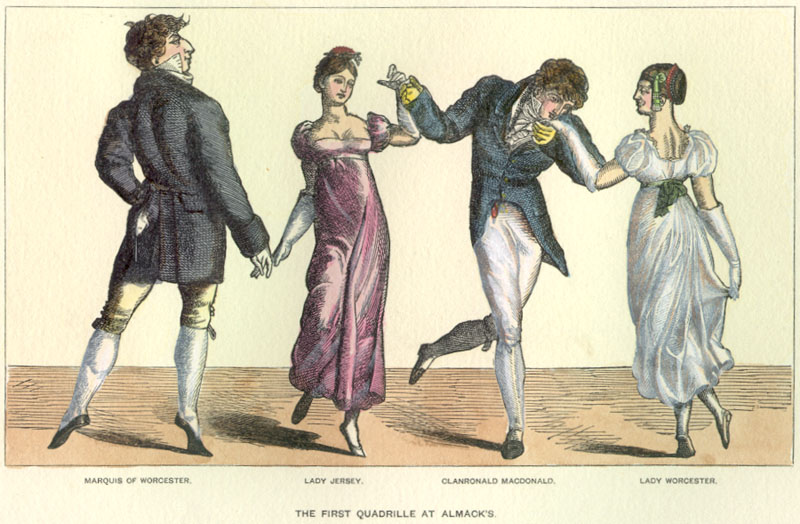
I love Regency romances. The Regency is a period ruled by elegance and etiquette. It is a romantic world full of balls and duels, Corinthians and debutantes, Almack’s and Vauxhall Gardens, and rakes reformed by love.

When I started to blog about Regency history, I was motivated by wanting to explore the historical background to the Regency romances that I love to read so that I could write my own. And yet I have often picked up a ‘Regency’ romance, only to find that it is set in 1823 and not set in the Regency at all!

The strict definition of the Regency period

The Regency lasted a mere nine years, from February 1811 until January 1820. In 1810, George III was taken seriously ill. He was declared incapable of ruling because of mental incapacity and the Regency Act was passed the following year making his son George Prince Regent to rule in his stead. The Regency lasted until George III’s death in 1820 when the Regent became King George IV and was able to rule in his own right.

Regency feel

So why is it that not all Regency romances are set in the period 1811 to 1820? And if they are not set in the Regency, why do we call them Regency romances?

I believe the answer lies in the ‘feel’ of the Regency. The term Regency has come to represent a much wider period of time than the nine years to which it actually relates.

The Regent
George IV  from Huish's Memoirs of her late  royal highness Charlotte Augusta (1818)
George IV
from Huish's Memoirs of her late
royal highness Charlotte Augusta (1818)
The Regency period is epitomised by the Regent himself. As a young man, George IV was a handsome and personable figure, described as ‘the first gentleman of England’. The romantic figure of Prinny had almost disappeared by the time the long-awaited Regency started. He had become fat and his extravagant habits had made him unpopular and, as the years progressed, he became more and more reclusive.

But to the modern reader, the Regent in his youth represents the world of glamorous elegance, extravagant follies and romantic liaisons. It is this image of George IV as a young man that embodies the Regency, an image that was established long before he ever became Regent.

Romanticism

The Romantic Movement was well-established by the time the Regency started. This was a time that was rich in literature, both poetry and prose. It was the time of the Romantic poets like Wordsworth, Byron, Coleridge and Shelley and the Romantic novelist, Sir Walter Scott. Constable and Turner were painting and Beethoven was composing. The Regency finished, but the Romantics went on.

Jane Austen

The works of Jane Austen are inextricably linked to the Regency. All six of Jane Austen’s completed novels were published during this period, making them archetypal Regency romances. But they were not wholly written during the nine years of the Regency and although Jane died before the Regency ended, her books lived on.

Regency style

The Regency is associated with a style of architecture, furniture and design that spans more than a single decade. The Encyclopaedia Britannica describes Regency style as the
... decorative arts produced during the Regency of George, Prince of Wales, and the opening years of the 19th century as well as his entire reign as King George IV of England, ending in 1830.1
A period of high fashion

Saul David in his biography of George IV describes the Regency ‘in its widest sense (1800-1830)’ as a ‘devil-may-care period of low morals and high fashion’.2

A notice at the entrance to the Regency galleries in the National Portrait Gallery suggests an even wider time span:
As a distinctive period in Britain’s social and cultural life, the Regency spanned the four decades from the start of the French Revolution in 1789 to the passing of Britain’s great Reform Act in 1832.3
Ball dress  from La Belle Assemblée (1816)
Ball dress
from La Belle Assemblée (1816)
So, when is the Regency era?

The Regency era is, by very definition, related to the life of the Regent. It is characterised by the freedom and extravagance of George IV compared with the ascetic lifestyle of his father. Although the Regency is a mere nine years long, I am inclined to think that the Regency ‘feel’ starts around the time that George IV came of age in 1783 and continues until his death in 1830. This is sometimes referred to as the 'long Regency'.

Perhaps ‘Regency’ romances can be set in 1823 after all!

Headshot of Rachel Knowles author with sea in background (2021)Rachel Knowles writes clean/Christian historical romance set in the time of Jane Austen. She has been sharing her research on this blog since 2011. Rachel lives in the beautiful Georgian seaside town of Weymouth, Dorset, on the south coast of England, with her husband, Andrew.

Find out more about Rachel's books and sign up for her newsletter here.

If you have enjoyed this blog and want to encourage me and help me to keep making my research freely available, please buy me a virtual cup of coffee by clicking the button below.


Notes

  1. Encyclopaedia Britannica 15th edition (1994, Encyclopaedia Britannica Inc).
  2. David, Saul, The Prince of Pleasure (Little, Brown & co., 1998).
  3. From a sign in the National Portrait Gallery, London (2012).
Sources used include:
David, Saul, The Prince of Pleasure (Little, Brown & co., 1998)
Encyclopaedia Britannica 15th edition (1994, Encyclopaedia Britannica Inc)
Gronow, Captain, The Reminiscences and Recollections of Captain Gronow (1850)