Search this blog

Showing posts with label Perdita. Show all posts

Wednesday, 3 December 2014

Perdita and Florizel - Mary Robinson's affair with the Prince

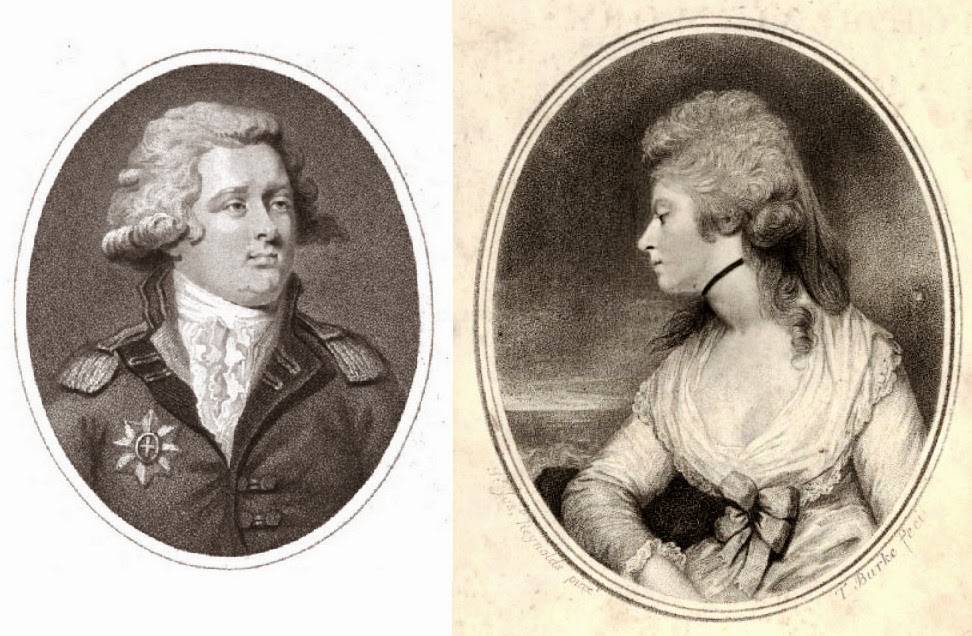
Left: Florizel - George, Prince of Wales from The Lady's Magazine (1792)  Right: Perdita - Mary Robinson from The Poetical Works of   the late Mrs Mary Robinson (1806)
Left: Florizel - George, Prince of Wales from The Lady's Magazine (1792)
Right: Perdita - Mary Robinson from The Poetical Works of 
the late Mrs Mary Robinson (1806)
Who was Perdita?

On Saturday 20 November 1779, Mary Robinson first played the part of Perdita at the Theatre Royal, Drury Lane. Perdita was the female lead in Perdita and Florizel, David Garrick’s adaptation of the last two acts of Shakespeare’s A Winter’s Tale.

Rather than the flowing pretty dress usually worn by Perdita, Mary sported a closely fitted jacket with the red ribbons of a common milkmaid. Although this costume was criticised in some of the papers, it undoubtedly contributed to Mary’s success.

Mary Robinson

Mary had been about to launch her theatrical career in 1773 but had been persuaded to get married instead. Her husband was Thomas Robinson, an indigent solicitor’s clerk, who had lied about his future prospects. The couple lived beyond their means and, desperate for money, Robinson agreed to Mary becoming an actress.

Richard Brinsley Sheridan engaged Mary to perform at his theatre in Drury Lane. David Garrick, who had coached her for her 1773 debut that had never taken place, loyally came out of retirement to prepare her for the part of Juliet. Mary gave her first performance on 10 December 1776 to widespread acclaim.
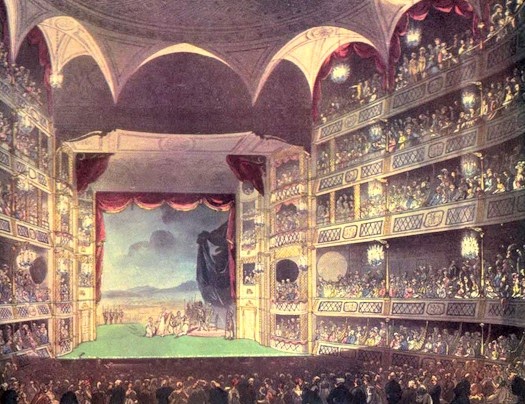
Theatre Royal, Drury Lane, from The Microcosm of London (1808-10)
The royal command performance

Perdita and Florizel was well-received and the King commanded a royal performance which took place on 3 December 1779. The King’s eldest son, George, Prince of Wales, accompanied his parents to the theatre. The royal box was very close to the stage and gave the 17-year-old Prince a close view of the actors on the stage and in the wings.
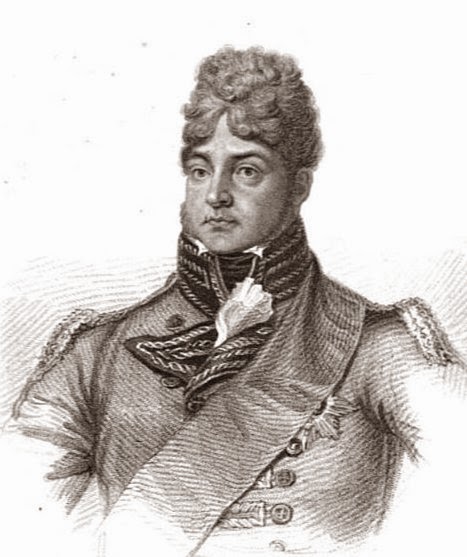
George IV from Huish's Memoirs of her late royal highness Charlotte Augusta (1818)
George IV
from Huish's Memoirs of her late
royal highness Charlotte Augusta (1818)
George made flattering comments that were loud enough for Mary to hear whilst Mary performed her lines as if for the Prince alone. George was dazzled. The next morning, he declared to his confidante Mary Hamilton, one of the ladies in waiting at court, that he had fallen madly in love with Mary Robinson.

Florizel in love

Adopting the name Florizel, the Prince started a passionate correspondence with ‘Perdita’. His friend, George Capel, Viscount Malden, acted as messenger, urging Mary to meet the Prince. Mary wrote back, encouraging the Prince to be patient and offering sisterly advice.

Writing table at Hampton Court Palace
Although for many months, George’s affair with Mary was no more than a passionate correspondence, the press was quick to comment on their relationship.

In order to quash this unfavourable publicity and comply with the Prince’s wishes, Mary agreed to leave the theatre. On 31 May 1780, she gave her farewell performance, playing the cross-dressed part of Eliza/Sir Harry Revel in The Miniature Picture and Widow Brady in The Irish Widow.
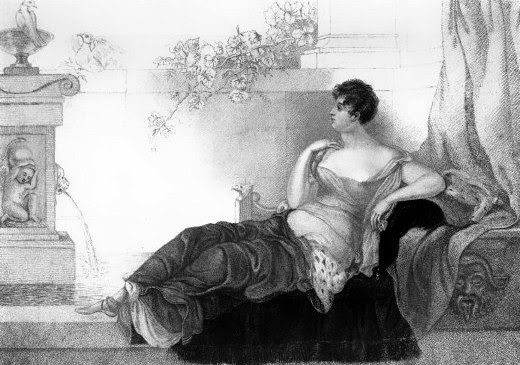
Mrs Robinson - the celebrated Perdita  from The Memoirs of George IV by R Huish (1830)
Mrs Robinson - the celebrated Perdita
from The Memoirs of George IV by R Huish (1830)
Reputation at risk

The Prince continued to push for a meeting. Mary knew that she was risking her entire reputation if she agreed. It was not until George enclosed a bond for £20,000 to be paid on his reaching his majority in one of his letters that Mary eventually agreed to an assignation.

George and Mary probably did not meet until as late as June 1780. The chosen venue was Kew, near to the house where the Prince lived with the Duke of York. Over the next few months, they met many times at Kew, either in the gardens or at one of the servants’ houses or at the inn on nearby Eel Pie Island in the River Thames.
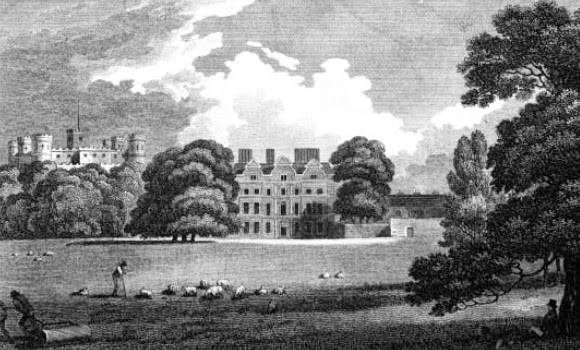
The Old Palace at Kew  from Memoirs of HM Sophia Charlotte of Mecklenburg Strelitz, Queen of Great Britain, by WM Craig (1818)
The Old Palace at Kew
from Memoirs of HM Sophia Charlotte of Mecklenburg Strelitz,
Queen of Great Britain
, by WM Craig (1818)
Celebrity status

Mary’s relationship with the Prince pushed her into the limelight even more than her acting career had done. People were interested in what she wore and where she went. She had become a Georgian celebrity!

The Prince established Mary in a house in Cork Street where she lavishly entertained him and his male friends. She wore a miniature of George around her neck and paraded around town in a variety of carriages. One carriage in particular was emblazoned with her initials encircled by a wreath of rosebuds which at a distance gave the appearance of a royal coronet.

Vauxhall by T Rowlandson  - Mary is on the right in a white dress with the Prince of Wales  at her side © British Museum
Vauxhall by T Rowlandson
- Mary is on the right in a white dress with the Prince of Wales
at her side © British Museum
The end of the affair

Mary continued to receive bad press. Cartoons were printed lampooning the Prince and his lover. There was outrage when Mary had dared to take a side box at the Opera House as if she was one of the nobility and not merely a courtesan. There was an unfortunate incident at Covent Garden where Mary flew into a rage on finding her husband with another woman. The King did not like all the bad publicity and wanted the affair finished, promising George his own establishment.

Opera House from The Microcosm of London (1808-10)
The Prince’s interest began to wane. The bad press was uncomfortable and George doubted Mary’s faithfulness to him. And with good cause; Mary was intimately involved with his friend, Lord Malden. By the end of 1780, Mary’s charms had been superseded by those of the courtesan, Elizabeth Armistead. All at once, it was over. Mary did not see it coming.

The price of a reputation

Mary was determined not to go quietly. She had been living expensively and had massive debts. The Prince’s desertion was disastrous. She had a large number of the Prince’s love letters which she threatened to publish, using them as leverage in negotiations to compensate her for the loss of her reputation and her career. Eventually Mary agreed to give up the letters in return for £5,000 and the promise of an annuity.
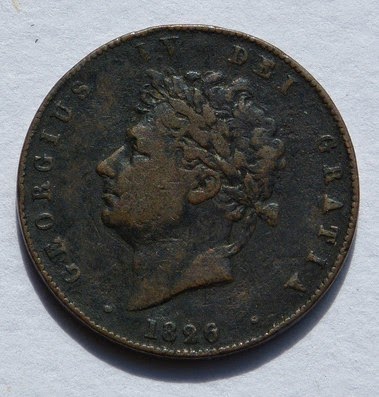
George IV coin
George IV coin (2012)
The papers continued to link their names together for years, perhaps encouraged by Mary’s persistence in wearing the Prince’s miniature, now encrusted with diamonds, around her neck.

It is a sad reflection that Mary Robinson, an acclaimed actress and later a feminist writer and poet, is remembered today for her brief affair with the Prince of Wales and not for her other achievements.

Headshot of Rachel Knowles author with sea in background(2021)
Rachel Knowles writes clean/Christian Regency era romance and historical non-fiction. She has been sharing her research on this blog since 2011. Rachel lives in the beautiful Georgian seaside town of Weymouth, Dorset, on the south coast of England, with her husband, Andrew.

Find out more about Rachel's books and sign up for her newsletter here.

If you have enjoyed this blog and want to encourage me and help me to keep making my research freely available, please buy me a virtual cup of coffee by clicking the button below.


Sources used include:
Ackermann, Rudolph, and Pyne, William Henry, The Microcosm of London or London in miniature (1808-1810, reprinted 1904)
Byrne, Paula, Perdita, the life of Mary Robinson (2004)
Huish, Robert, Memoirs of George IV (1830)
Levy, Martin J, Robinson, Mary (Perdita) (1756/8-1800) Oxford Dictionary of National Biography (Oxford University Press, 2004; online edn Jan 2008, accessed 2 July 2013)
Robinson, Mrs Mary, The Poetical Works of the late Mrs Mary Robinson: including many pieces never before published (1806)

All photographs © RegencyHistory.net

Monday, 14 July 2014

Mary Robinson - more than Perdita

Mary Robinson  from an engraving by Smith after Romney  in Memoirs of Mary Robinson (1895)
Mary Robinson
from an engraving by Smith after Romney
in Memoirs of Mary Robinson (1895)
Mary Robinson the writer

Mary ‘Perdita’ Robinson (1757-1800) was an actress who famously became the first mistress of George IV when he was still a teenager. But what is less well known today is that in addition to her beauty, her exalted lover and her success on the stage, Mary was a talented writer.


Early patronage

In 1775, Mary published her first volume of poems. She presented the Duchess of Devonshire with a copy, and in return, the Duchess was pleased to offer her support. A second volume of poems in 1777 was dedicated to her patroness.

Georgiana, Duchess of Devonshire  from Posthumous memoirs of his own time  by NW Wraxall (1836)
Georgiana, Duchess of Devonshire
from Posthumous memoirs of his own time
by NW Wraxall (1836)
Reinventing Mary

A severe illness in 1783 left Mary lame and she struggled with ill health for the rest of her life. The following year, Lister published his Memoirs of Perdita, a scandalous history of Mary's life that she was eager to contradict. She wanted to create a new persona for herself as a respectable person and not as the courtesan Perdita that the world labelled her. Her writing gave her that opportunity.

Mary’s obituary

On 14 July 1786, The Morning Post announced that Mrs Robinson, the once famous Perdita, had died a few days before in Paris. It printed an obituary that praised her beauty and person, but reminded its readers of her immoral relationships. Mary’s response was to write a witty letter declaring that she was alive and well, apart from her lameness, and implying that the details of her life were as fictional as her death.

The Della Cruscans

In 1788, Mary started writing poems under the pseudonym of Laura in response to Robert Merry’s Della Crusca in The World. The Della Cruscans favoured a flowery sort of poetry and included Hannah Cowley and Hester Theale amongst their number.

When The Oracle started up as a rival paper to The World, Mary became its regular poet, writing under the pseudonym Laura Maria. One poem of particular note was Insanity (1791) which Mary composed whilst drugged with opium to dull the pain of her illness. It was later renamed The Maniac.

Mary also wrote poems for The Morning Post and essays under the pseudonym The Sylphid.

The English Sappho

Mary published a deluxe anthology of her poems in 1791 with 600 subscribers. It was later republished as a cheaper volume as The Beauties of Mrs Robinson. It was generally well received by the critics and the Monthly Review labelled Mary “our English Sappho”a nickname that stuck.

Her final volume of poetryLyrical Taleswas published in 1800 shortly before her death. This included the poem The Mistletoea Christmas tale. You can read an excerpt from this poem in my blog about mistletoe here.

Novels

Mary wrote a number of novels of varying quality. Her first, Vancenza, or the Dangers of Credulity (1792) was a Gothic romance and included veiled references to the Prince of Wales. Her second novel, The Widow, or a Picture of Modern Times (1794), painted faro players in a bad light and was less popular.

Angelina (1796) was enthusiastically reviewed by Mary Wollstonecraft, but Hubert de Sevrac: A Romance of the Eighteenth Century (1796) was hastily written and was a rather poor Gothic novel.

Walsingham (1797) had a cross-dressed hero/heroine, The False Friend (1799) was full of feminist ideas and The Natural Daughter, with portraits of the Leadenhead Family (1799) was her most autobiographical novel but was poorly received because of its radical content.

Writing for the stage

Mary returned to the theatre, not to perform, but to write. However her major attempts did not meet with success. Her play, Nobody, written to showcase the comedic talents of Dora Jordan, but its anti-gambling undertones prompted hate mail to Mary and Dora and it failed after only three performances.

Mrs Jordan  from The Life of Mrs Jordan by J Boaden (1831)
Mrs Jordan
from The Life of Mrs Jordan by J Boaden (1831)
Another play, A Sicilian Lovera tragedywas greatly admired by the Duke of Leeds, but poorly received by everyone else.

She also wrote an opera for Sheridan called Kate of Aberdeen, but it was never performed.

Radical writings

Toward the end of her life, Mary became increasingly radical in her views, possibly influenced by such friends as William Godwin and Mary Wollstonecraft.

In 1790, she wrote a poem Ainsi va le Monde, in support of the French revolution, inscribed to Robert Merry.

She also wrote anti-slavery poems and a feminist essayA Letter to the Women of England, on the Injustice of Mental Subordination (1799) under the pseudonym of Anne Frances Randall. In this essay she advocated the creation of a university for women.

Monodies and Memoirs

Mary wrote a monodya poem lamenting another’s deathin honour of her close friend Sir Joshua Reynolds who died in 1792 and another to the memory of Marie Antoinette in 1793.

Sir Joshua Reynolds  from The Literary Works of Sir Joshua Reynolds  ed Farington and Malone (1819)
Sir Joshua Reynolds
from The Literary Works of Sir Joshua Reynolds
ed Farington and Malone (1819)
Intense personal emotion also impelled her to write Stanzas written between Dover and Calais, July 24th 1792 inscribed to... which were dedicated to her lover Tarleton, when she thought they had separated irrevocably. The stanzas were set to music and became very popular.

Tarleton’s History of the Campaigns in Virginia and the Neighbouring Provinces (1787) was generally believed to have been written, at least in part, by Mary.

Mary also wrote her memoirsMemoirs of the Late Mrs Robinson written by herself (1801)which, though undeniably biased in her own favour, are one of the first examples of an English author writing an autobiography. They were published posthumously by her daughter.

Headshot of Rachel Knowles author with sea in background(2021)
Rachel Knowles writes faith-based Regency romance and historical non-fiction. She has been sharing her research on this blog since 2011. Rachel lives in the beautiful Georgian seaside town of Weymouth, Dorset, on the south coast of England, with her husband, Andrew.

Find out more about Rachel's books and sign up for her newsletter here.

If you have enjoyed this blog and want to encourage me and help me to keep making my research freely available, please buy me a virtual cup of coffee by clicking the button below.

 
Sources used include:
Byrne, Paula, Perdita, the life of Mary Robinson (2004)
Levy, Martin J, Robinson, Mary (Perdita) (1756/8-1800) Oxford Dictionary of National Biography (Oxford University Press, 2004; online edn Jan 2008, accessed 2 July 2013)
Robinson, Mary, Memoirs of Mary Robinson "Perdita" from the edition edited by her daughter with intro & notes by J Fitzgerald Molloy (1895)
Robinson, Mrs Mary, The Poetical Works of the late Mrs Mary Robinson: including many pieces never before published (1806)