Search this blog

Showing posts with label Richard Brinsley Sheridan. Show all posts

Sunday, 23 February 2020

Drury Lane Theatre burns down 24 February 1809

Drury lane Theatre on fire from Shakspere to Sheridan - a book about   the theatre of yesterday and today by A Thaler (1922)
Drury lane Theatre on fire from Shakspere to Sheridan - a book about 
the theatre of yesterday and today by A Thaler (1922)
Fire was a constant threat to Georgian buildings, especially theatres. Covent Garden theatre burnt down on 20 September 1808 and less than six months later, its rival, Drury Lane Theatre, suffered the same fate.

When did Drury Lane Theatre burn down?

Feltham’s The Picture of London for 1818 said:
On the twenty-fourth of February [1809], about eleven o'clock at night, the superb theatre of Drury Lane was discovered to be on fire, and though such a vast building, it was entirely consumed by four o'clock on the following morning.1
How did Drury Lane Theatre burn down?

According to Mrs Cornwell Baron Wilson’s Memoirs of Miss Mellon:
A fire had been left in the upper coffee-room at four in the afternoon, and there being no performance, all the servants were out of that part of the theatre; it is supposed that it ignited and caught the wood-work.2
The Picture of London for 1810 stated:
At a quarter after 11 o’clock at night, Feb 24, 1809, this splendid Theatre, the most magnificent perhaps in Europe, was enveloped in flames, and in less than one hour and an half the whole was an immense heap of ruins … In less than a quarter of an hour from the first discovery of it, the fire spread in one unbroken flame over the whole of the immense building, extending from Brydges-street to Drury-lane, and displaying a pillar of fire not less than 450 feet in breadth. The rapidity of the flames was such, that before twelve o'clock the whole of the interior from the extremity of the boxes in Brydges-street to the back of the stage, including a newly-erected building for the scenes, was in one tremendous blaze. Neither the burning of the Opera House, nor of Covent-garden, nor the late fire at St James’s, can be compared in terrific grandeur with this dreadful conflagration.3
Theatre Royal, Drury Lane, from The Microcosm of London Vol 1 (1808)
Was it arson?

Some questioned whether the fire was an accident, judging it unlikely that rival theatres should have burnt down in such a short space of time. Boaden wrote in his Memoirs of Mrs Siddons (1827):
So speedy a coincidence, as it defied the doctrine of chances, and the probabilities of life, so in the breasts of persons suffering by the system of irregularity at that house, it begot a suspicion that the destruction of Drury Lane Theatre was wilful. One person was frequently named as the contriver of the whole mischief, and he, certainly, was a man who possessed the entire means in himself; but his very accusers could assign no motive to such an action.4
The Picture of London for 1810 said:
It has been fully ascertained that this melancholy catastrophe was occasioned by accident.5
How much was lost?

Wilson wrote:
In that short space of time, a theatre that had cost £129,000, and was not then completed, was reduced to one huge mass of ashes and rubbish.6
The Picture of London for 1810 valued the loss at rather more:
The building of this Theatre cost 200,000l; and the immense property of all sorts, in scenery, machinery, dresses, decorations, music, instruments, plays, &c of which nothing was saved, nearly amounted to the same sum. The wardrobe alone was valued at 40,000l. The whole insurance did not exceed 45,000l.7
Boaden wrote:
Some of the performers, among whom was my friend Charles Matthews, at a personal risk sufficiently alarming, thridded the suffocating maze of passages, and bore away their personal property. Mrs Jordan found some kind help in this disaster, and lost, I think, little or nothing.8
Financial disaster for Sheridan

Richard Brinsley Sheridan from A Journal of the Conversations of Lord Byron with the Countess of Blessington (1893)
Richard Brinsley Sheridan
from A Journal of the Conversations of Lord Byron
with the Countess of Blessington (1893)
The fire was a disaster, not least for theatre owner and manager, Richard Brinsley Sheridan. He had borrowed extensively to finance the new, bigger theatre building – a building that was still unfinished when it was burnt to the ground. 

Ironically, the new theatre had boasted improved fire precautions. The Microcosm of London said:
In the roof of the theatre is contained, besides the barrel-loft, ample room for scene-painters, and four very large reservoirs, from which water is distributed over every part of the house, for the purpose of instantly extinguishing fire in any part where such accident is possible.9
The theatre was under-insured, and Sheridan faced financial ruin. Boaden wrote:
Sheridan had used his theatre as a store to deposit the spoils of office; and by this fire was destroyed the furniture, which adorned his house in Somerset Buildings, when he was for a short time Treasurer of the Navy. He was himself in the House of Commons when he received the disastrous intelligence; and he behaved with his accustomed fortitude. The sympathy of the House would have led the members to adjourn, but he refused such a personal compliment to his feelings; and only at the proper time could be prevailed on himself to repair to the neighbourhood of his ruin, where he sat out the last appearances of conflagration.
When the reader reflects upon the state of this great man's finances, the little hope he could entertain of his theatre's being rebuilt at all, or of its ever yielding an income to him again, if it were — and is told that neither his fortitude nor his pleasantry abandoned him, he may suspect that wit has a buckler more impassive than adamant, and think him an object of envy in every condition of his fortune.10
Old and New London’s account of the fire, published in 1878, wrote that the House of Commons did adjourn, despite Sheridan’s protests. It said:
He [Sheridan] went thither, however, in all haste, and whilst seeing his own property in flames, sat down with his friend Barry in a coffee-house opposite to a bottle of port, coolly remarking, in answer to some friendly expostulation, that it was ‘hard if a man could not drink a glass of wine by his own fire!’11
I wonder whether Sheridan was truly calm enough, in the face of financial ruin, to be so witty, or whether this story is apocryphal. It’s hard to tell, but I think it sounds like his wit, and it gives a light-hearted touch to an otherwise miserable story of ruin.

You can read more of Sheridan's wit here.

The disaster commemorated in verse

When Drury Lane Theatre was rebuilt, a competition was held for an address to be given on its reopening. One hundred and twelve addresses were submitted, of which only one could be successful. Horace and James Smith were inspired to write the extremely successful Rejected Addresses, twenty-one imaginary entries, parodying some of the greatest writers of the day, including Lord Byron, Dr Johnson and Matthew ‘Monk’ Lewis.

The story of the fire at Drury Lane, by Horace, in the style of Sir Walter Scott, was judged to be the best imitation. You can read the full poem, and all the other imaginary entries, on Project Gutenberg. Here are three excerpts:
Rest there awhile, my bearded lance,
While from green curtain I advance
To yon foot-lights—no trivial dance,
And tell the town what sad mischance
Did Drury Lane befall.
As Chaos, which, by heavenly doom,
Had slept in everlasting gloom,
Started with terror and surprise
When light first flash’d upon her eyes—
So London’s sons in nightcap woke,
In bed-gown woke her dames;
For shouts were heard ’mid fire and smoke,
And twice ten hundred voices spoke—
‘The playhouse is in flames!’
E’en Higginbottom now was posed,
For sadder scene was ne’er disclosed
Without, within, in hideous show,
Devouring flames resistless glow,
And blazing rafters downward go,
And never halloo ‘Heads below!’
Nor notice give at all.
The firemen terrified are slow
To bid the pumping torrent flow,
For fear the roof should fall.12

Headshot of Rachel Knowles author with sea in background(2021)
Rachel Knowles writes clean/Christian Regency era romance and historical non-fiction. She has been sharing her research on this blog since 2011. Rachel lives in the beautiful Georgian seaside town of Weymouth, Dorset, on the south coast of England, with her husband, Andrew.

Find out more about Rachel's books and sign up for her newsletter here.

If you have enjoyed this blog and want to encourage me and help me to keep making my research freely available, please buy me a virtual cup of coffee by clicking the button below.

 
Notes
1. Feltham, John, The Picture of London for 1818 (1818).
2. Wilson, Mrs Cornwell Baron, Memoirs of Miss Mellon, afterwards Duchess of St Albans new edition Vol 1 (1886).
3. Feltham, John, The Picture of London for 1810 (1810).
4. Boaden, James, Memoirs of Mrs Siddons: interspersed with anecdotes of authors and actors (1827).
5. Feltham, John, The Picture of London for 1810 (1810).
6. Wilson op cit.
7. Feltham, John, The Picture of London for 1810 (1810).
8. Boaden op cit.
9. Ackermann, Rudolph, and Pyne, William Henry, The Microcosm of London or London in miniature Volume 1 (Rudolph Ackermann 1808-1810, reprinted 1904).
10. Boaden op cit.
11. Walford, Edward, Old and New London: A narrative of its history, its people, and its places (Cassell, Petter & Galpin, 1878, London) Vol 3.
12. Smith, James and Horace, Rejected Addresses; or, The New Theatrum Poetarum (1879 - originally printed 1812).

Sources used include:
Ackermann, Rudolph, and Pyne, William Henry, The Microcosm of London or London in miniature Volume 1 (Rudolph Ackermann 1808-1810, reprinted 1904)
Boaden, James, Memoirs of Mrs Siddons: interspersed with anecdotes of authors and actors (1827)
Feltham, John, The Picture of London for 1810 (1810)
Feltham, John, The Picture of London for 1818 (1818)
Smith, James and Horace, Rejected Addresses; or, The New Theatrum Poetarum (1879 - originally printed 1812)
Walford, Edward, Old and New London: A narrative of its history, its people, and its places (Cassell, Petter & Galpin, 1878, London) Vol 3
Wilson, Mrs Cornwell Baron, Memoirs of Miss Mellon, afterwards Duchess of St Albans new edition Vol 1 (1886)

Thursday, 13 April 2017

Haymarket Theatre in Regency London

Old Haymarket Theatre from Old and New London (1873)
In Georgian London, it was necessary to have a licence in order to perform plays. In 1766, the Theatre Royal, Haymarket, was granted a royal patent, allowing it to put on plays, but only during the summer season. There were only two theatres licensed to put on plays during the winter: The Theatre Royal, Drury Lane, and the Theatre Royal, Covent Garden

The First Haymarket Theatre

The first theatre in the Haymarket was built by John Potter in 1720 and was known as The First Haymarket Theatre or Little Theatre. The Licensing Act of 1737 meant that theatre companies needed a licence or patent in order to perform plays. The Haymarket had no such licence and was forced to operate under temporary licences or by trying to circumvent the law by putting on a concert with a ‘free’ play afterwards.

Interior of the Little Theatre, Haymarket,  from the Complete Works of Henry Fielding (1902)
Interior of the Little Theatre, Haymarket,
from the Complete Works of Henry Fielding (1902)
The Theatre Royal, Haymarket

From 1746, comic actor and satirical playwright Samuel Foote sporadically rented the Haymarket Theatre. In 1766, whilst the guest of his noble patrons, the Earl and Countess of Mexborough, Foote was goaded into riding a rather lively horse belonging to George III’s brother, Edward, Duke of York. The horse threw him and Foote broke his leg so badly that it had to be amputated. Undeterred, Foote continued to act with a wooden leg:
Strange as it may appear, with the aid of a cork leg he performed his former characters with no less agility and spirit than before, and continued by his laughable performances to draw together crowded houses.1
The accident brought about a change in fortunes for the Haymarket Theatre. Foote requested a royal patent from the Duke of York and on 5 July 1766, a limited patent was granted, for the duration of Foote’s life. The Haymarket Theatre was permitted to show plays during the summer, between 10 May and 15 September.

Foote purchased the theatre outright and immediately set about enlarging it, adding an upper gallery. It reopened as the Theatre Royal on 14 May 1767.

Samuel Foote  from Old and New London (1873)
Samuel Foote
from Old and New London (1873)
George Colman the elder

Playwright George Colman bought the theatre in 1777, but the patent expired on Foote’s death in the same year, forcing him to apply annually for a licence for the summer season. The Haymarket flourished under his management and he amassed a considerable fortune, only to discover that his banker had embezzled it. His son, also called George Colman, gradually took over the management from 1785 due to his father’s ill health.

Sheridan’s Drury Lane Theatre company performed at the Haymarket during the winter season of 1793-4 whilst his theatre was being rebuilt.

Death at the theatre

During this time, a dreadful tragedy took place. On 3 February 1794, George III and Queen Charlotte attended the Haymarket Theatre for the first time that season, and the royal command performance attracted vast numbers of people. The crowds were so huge that when the door was opened, those in the front of the queue were pushed down the stairs leading to the pit. More than 70 people fell and at least 15 people were fatally crushed to death or suffocated.

George Colman the younger

George Colman the younger inherited the theatre on his father’s death in 1794, along with massive debts. Although a successful playwright, he was forced to mortgage the business to repay his father’s debts and finally, in 1805, to sell shares in the theatre. In 1806, he was arrested for debt but he continued to manage the theatre from the King’s Bench Prison until he was discharged in 1817.

King's Bench Prison from The Microcosm of London Vol 2 (1808-10)
The shareholders included his argumentative brother-in-law, David Morris, who involved Colman in such lengthy litigation which forced the theatre to stay closed during the summer of 1813.

According to The Picture of London for 1809, the season at the Haymarket Theatre ran from 15 May to 15 September. It wrote of the Haymarket Theatre:
This theatre, though not so elegant and spacious as either of the winter houses, is fitted up in a neat and tasteful style, and is capable of containing a numerous audience.2
This house contained three tiers of boxes, a pit, and two galleries.

The Haymarket Theatre presented plays and English operas. The Picture of London for 1813 stated that the Haymarket was putting on plays and farces rather than operas.

Visiting the theatre

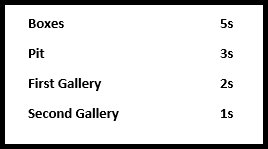
According to the Picture of London for 1809, the prices at the Haymarket were as follows:

Prices for Haymarket Theatre in 1809

The doors opened at six o'clock, and the performance began at seven. Unlike the winter theatres, there was no half-price entry at the Haymarket part the way through the evening’s performance.

The post-Regency years

After his release from prison, Colman sold the remainder of his interest in the theatre. Under the management of David Morris, the theatre was completely rebuilt in 1820, in a slightly different place, according to the design of architect John Nash. It reopened on 4 July 1821 with a production of Sheridan’s The Rivals.

New Haymarket Theatre from Shakespere to Sheridan by A Thaler (1922)
Old and New London wrote:
The front is of stone, and is about sixty feet in length, and nearly fifty in height. The entrance is through a handsome portico, the entablature and pediment being supported by six columns of the Corinthian order; above are circular windows connected by sculpture of an ornamental character. Under the portico are five doors, leading respectively to the boxes, pit, galleries, and box-office. The shape of the interior differs from that of every other theatre in London, being nearly a square, with the side facing the stage very slightly curved. The expense of the new building was about £20,000. It is a remarkably neat and pretty house, having two tiers of boxes, besides other half-tiers parallel with the lower gallery, and will seat about 1,500 persons with comfort.3
Haymarket Theatre from Leigh's New Picture of London (1827)
The Theatre Royal, Haymarket, remains part of the thriving London theatre scene today.

Headshot of Rachel Knowles author with sea in background(2021)
Rachel Knowles writes clean/Christian Regency era romance and historical non-fiction. She has been sharing her research on this blog since 2011. Rachel lives in the beautiful Georgian seaside town of Weymouth, Dorset, on the south coast of England, with her husband, Andrew.

Find out more about Rachel's books and sign up for her newsletter here.

If you have enjoyed this blog and want to encourage me and help me to keep making my research freely available, please buy me a virtual cup of coffee by clicking the button below.

 
Notes
(1) From Walford, Edward, Old and New London: A narrative of its history, its people, and its places (Cassell, Petter & Galpin, 1873, London) Vol 4.
(2) From Feltham, John, The Picture of London for 1809 (1809).
(3) From Walford, Edward, Old and New London: A narrative of its history, its people, and its places (Cassell, Petter & Galpin, 1873, London) Vol 4.

Sources used include:
Ackermann, Rudolph, and Pyne, William Henry, The Microcosm of London or London in miniature Volume 2 (Rudolph Ackermann 1808-1810, reprinted 1904)
Baldwin, Olive and Wilson, Thelma, Colman, George, the elder (bap1732, d1794), Oxford Dictionary of National Biography (Oxford University Press, 2004; online edn Jan 2008, accessed 12 April 2017)
Birling, William J, Colman, George, the younger (1762-1836), Oxford Dictionary of National Biography (Oxford University Press, 2004; online edn Jan 2008, accessed 12 April 2017)
Dircks, Phyllils T, Foote, Samuel (bap 1721, d 1777), Oxford Dictionary of National Biography (Oxford University Press, 2004; online edn Sept 2015, accessed 12 April 2017)
Feltham, John, The Picture of London for 1809 (1809)
Feltham, John, The Picture of London for 1813 (1813)
Walford, Edward, Old and New London: A narrative of its history, its people, and its places (Cassell, Petter & Galpin, 1873, London) Vol 4

Thursday, 30 March 2017

Drury Lane Theatre in Regency London

Theatre Royal, Drury Lane, from The Microcosm of London (1808)
Theatre Royal, Drury Lane, from The Microcosm of London Vol 1 (1808)
The Theatre Royal, Drury Lane, was one of the two theatres with a patent to perform plays in Georgian London. The other was the Theatre Royal, Covent Garden. The Haymarket Theatre could also put on plays, but only during the summer.

Early history

The first theatre (1663-72)

The first theatre on the Drury Lane site opened in 1663. It was built by Thomas Killigrew on an area known as the Riding Yard but seems to have had no particular name at this time, being variously referred to as the King’s Theatre or the King’s House or, confusingly, the Covent Garden Theatre, as it was in the neighbourhood of Covent Garden. It burnt down in 1672.

The second theatre (1674-1791)

Killigrew rebuilt the theatre on the same site and it opened in 1674 as the Theatre Royal in Drury Lane. According to Old and New London, this new theatre was designed by Sir Christopher Wren, but this claim was based on slim evidence and is now thought to be unlikely.

From 1747-76, the theatre was managed and part-owned by the actor David Garrick. During the last year of his tenure, Garrick commissioned his friend Robert Adam and his brother James to remodel the theatre and add a new façade.

On Garrick's retirement in 1776, the theatre passed into the joint ownership of Richard Brinsley Sheridan, Thomas Linley and Doctor James Ford. Sheridan pulled down the theatre in 1791 in order to build a larger one, during which time the company performed at the Haymarket Theatre.

Drury Lane Theatre in 1775 from Shakespere to Sheridan by A Thaler (1922)
Sheridan’s theatre (1794-1809)

The third theatre was designed by Henry Holland. It opened for the first time on 12 March 1794 with ‘a grand selection of sacred music, from the works of Handel’1 rather than a play, because it was Lent.

The exterior of Sheridan’s theatre

The Microcosm of London described the outside of the theatre:
The buildings which surround the theatre are faced with Portland stone, but will be finished with balustrade. The theatre, which rises above them, is cased with plaister in imitation of stone, and finished with a balustrade. Through the roof rises a turret, making a large ventilator. On the summit is placed a figure of Apollo, more than ten feet high; but this is to be removed to the west front when finished, and replaced by one of Shakspeare.2 
Drury Lane Theatre burnt down in 1809  from The Beauties of England and Wales by EW Brayley et al (1810)
Drury Lane Theatre burnt down in 1809
from The Beauties of England and Wales (1810)
The stage

The new theatre was much bigger than the previous one. The Microcosm of London wrote:
The accommodations for the stage are upon a much larger scale than those of any other theatre in Europe. The stage is 105 feet in length, 75 wide, and 45 feet between the stage-doors.
In the roof of the theatre is contained, besides the barrel-loft, ample room for scene-painters, and four very large reservoirs, from which water is distributed over every part of the house, for the purpose of instantly extinguishing fire in any part where such accident is possible.

Over the stage is a double range of galleries, called flies, containing machinery, and where the greatest part of the scenery is worked; but which, from the number of blocks, wheels, and ropes crossing each other in every direction, give it very much the appearance of a ship's deck.3
The Picture of London for 1809 wrote:
To facilitate the working some scenery, and light machinery, there is a stage about ten feet below the upper one, where the carpenters attend either to raise ghosts, pantomime demons, or to obey the magic wand which consigns them to oblivion. Under this second stage there is a depth of about forty feet, furnished with various mechanical engines, requisite for raising the splendid and massy pillars, temples, &c. which enrich the scenery, and contribute so essentially to the effect produced by the grand ballets and pantomimes exhibited at this theatre.4
The Microcosm of London added:
There are two green-rooms, one for the use of chorus-singers, supernumeraries, and figurants; the other for the principal performers: the latter of which is fitted up in the first style of elegance, and occasionally visited by persons of the highest distinction.5
The interior of Sheridan’s theatre

Inside Drury LaneTheatre in 1804 from Old and New London (1873)
Inside Drury Lane Theatre in 1804 from Old and New London (1873)
According to The Microcosm of London:
The audience part of the theatre is formed nearly on a semi-circular plan. It contains a pit, four tiers of boxes on each side of the house, and two galleries, which command a full view of every part of the stage.6
The Picture of London for 1809 stated that there were also 'a number of private boxes, ranged on each side the pit, and constructed so as to afford a perfect view of the stage, and yet conceal the occupiers from observation.'7

The Microcosm of London continued:
The pit is 54 feet in length, 46 in breadth, has twenty-five rows of benches, and contains eight hundred persons. The benches are so well constructed, that those next the orchestra command an uninterrupted view of the whole stage, and the avenues to it are very commodious and safe.

The prevailing colours of the boxes are blue and white, relieved with richly fancied embellishments of decorative ornament. The compartments into which the front of each tier is divided, have centrally a highly finished cameo, the ground of cornelian-stone colour, with exquisitely drawn figures, raised in white; the subjects are chiefly from Ovid, and painted by Rebecca. The stage-boxes project about two feet, and have a rich silver lattice-work, of excellent taste and workmanship. The boxes are supported by cast-iron candalabras, fluted and silver-lackered, resting on elegantly executed feet; from the top of each pillar a branch projects three feet, from which is suspended a brilliant cut-glass chandelier. A circular mirror, about five feet diameter, is placed at each end of the dress-boxes, next the stage, that produces a pleasing reflected view of the audience.8
The Royal Box
On the nights when this theatre is honoured with their Majesties presence, the partitions of the stage-box are taken down, and it is brought forward nearly two feet, a canopy is erected superbly decorated with crimson velvet, richly embroidered with gold, and adjoining them sit the princesses. Their box is usually lined with light blue satin, fancifully festooned and elegantly decorated with silver fringe and rich tassels.9
The entrance

Front of Old Drury Lane Theatre from Old and New London (1873)
Front of Old Drury Lane Theatre from
Old and New London (1873)
There are three entrances to the boxes, two to the pit and galleries. The one in Brydges-street leads to a saloon 75 feet by 21, called the Egyptian Hall. Sixteen pillars, of the Doric order, beautifully painted, in imitation of porphyry, are at once a splendid ornament, and support the back boxes, to which a flight of stairs at each end leads.
At the back of the front boxes there is a semi-circular saloon 41 feet long, containing, at a proper elevation, a handsome statue of Garrick, between the tragic and comic muse. In this place proper persons attend with refreshments. Over this there is a smaller one for the same purpose.10
There are also large saloons on the north and south sides of the theatre, and handsome square rooms, one of which is intended for the use of his Majesty, and the other for the Prince of Wales.11
Visiting the theatre

The seating capacity was around 3,950 in total. The Picture of London for 1809 stated the capacities and prices as follows:

Prices and capacities for Sheridan's Drury Lane Theatre

The 1,960 people in the boxes included the free list, but excluded private boxes.

The Microcosm of London stated the capacities somewhat differently – 675 in the two-shilling gallery and 308 in the one-shilling gallery, with 3,611 spectators in total.

The doors opened at 5.30 pm and the performances started promptly at 6.30 pm. Half-price tickets were available for entry after the third act of the play, usually around 8 o’clock. Boxes could be reserved by paying a shilling to the box office on the morning of the performance.

A sad end to Sheridan's theatre

The Microcosm of London claimed that:
This magnificent structure unites a splendid combination of taste, grandeur, and elegance, which renders it a monument of fame to Mr. Holland, the architect, and when its exterior is completely finished, it will be a national ornament.12
Alas! The theatre never was completely finished. Despite its elaborate fire precautions, this theatre burnt down on 24 February 1809, less than 6 months after its rival at Covent Garden had suffered the same fate. The fire ruined Sheridan who had borrowed heavily to finance his new theatre. The ownership passed into the hands of a committee headed up by the brewer, Samuel Whitbread, who forbade Sheridan to take any part in the management going forward.

Whilst the theatre was, yet again, being rebuilt, the Drury Lane Company performed at the Opera House and then at the Lyceum.

The Regency theatre (1812-present)

Drury Lane Theatre from Leigh's New Picture of London (1827)
The fourth Drury Lane Theatre was designed by Benjamin Wyatt and opened on Saturday 10 October 1812 with a production of Hamlet and an address written by Lord Byron.

The Green Room at Drury Lane (1822) by G Cruikshank  from Life in Regency and Early Victorian Times by EB Chancellor (1926)
The Green Room at Drury Lane (1822) by G Cruikshank
from Life in Regency and Early Victorian Times by EB Chancellor (1926)
The Picture of London for 1813 stated:
The stage is about thirty-three feet wide, the proscenium nineteen and a half. The part usually appropriated to doors, is judiciously occupied by two magnificent lamps, with tripods on triangular pedestals. This theatre is altogether a master-piece of art, and an ornament of the metropolis. Its coup d’oeil is delightful beyond the power of description.
The grand entrance to this theatre is from Brydges-street, through a spacious hall, leading to the boxes and pit. Three large doors lead from this hall into the house, and into a rotunda of great beauty and elegance. On each side of the rotunda are passages to the great stairs, which are peculiarly grand and spacious.

The grand saloon is eighty-six feet long, circular at each extremity, and separated from the box-corridors by the rotunda and grand staircase. The ceiling is arched, and the general effect of two massy Corinthian columns of verd antique at each end, with ten corresponding pilasters on each side, is grand and pleasing. The rooms for coffee and refreshments at the ends of the saloon are convenient.

The body of the theatre presents nearly three-fourths of a circle from the stage. The color of the interior is gold upon green, and the relief of the boxes is by a rich crimson. There are three circles of boxes, each containing twenty-four boxes.13 
Some alterations were later made to the design. The Picture of London for 1818 stated that there were 26 boxes in each circle and complained that the grand saloon had been 'converted into what is called a Chinese temple, with two holes for staircases from the hall below. It is impossible to say whether the man who planned this ridiculous alteration, or the architect who executed it, has shewn most want of taste.'14

Kean as King Richard; Royalty in the box (1823) by W Heath  from Life in Regency and Early Victorian Times by EB Chancellor (1926)
Kean as King Richard; Royalty in the box (1823) by W Heath
from Life in Regency and Early Victorian Times by EB Chancellor (1926)
 Visiting the theatre

The seating capacity of this theatre was around 2,810 – still large, but some 1,000 seats less than the 1794 theatre that it replaced. The Picture of London for 1813 stated the terms and capacities as follows:


Prices and capacities for the 1812 Drury Lane Theatre

In 1813, the season was advertised to run from September to June; in 1818, it was advertised to run until July. Around 1818, the performances moved from a start time of 6.30 pm to 7 pm in order to accommodate later dinner hours.

Behind the scenes

The Picture of London for 1818 stated:
The details of the business of this Theatre present a system worthy of imitation in all similar concerns, of which a competent judgment can alone be formed by persons, who on formal application, for the purpose, obtain permission to see the vast interior in the day-time. The wardrobe, the painting rooms, the machinery above and below the stage, the provisions for preventing and extinguishing fire, all excite the just admiration of those who have the opportunity of beholding them.15
After the Regency

Drury Lane Theatre (2017)
The Drury Lane Theatre today is still the 1812 building, though various alterations and renovations have been made over the years. The Doric portico in Catherine Street was added in 1820, and ‘the interior of the house … was entirely rebuilt in 1822.’16 The colonnade along the side of the building in Little Russell Street was added in 1831.

Drury Lane Theatre (2015)
The colonnade, Drury Lane Theatre (2017)
In 2013, the theatre underwent major renovations and the front of house areas were returned, as far as possible, to their original 1812 design. The Theatre Royal Drury Lane continues to be a thriving part of the West End theatre scene.

Headshot of Rachel Knowles author with sea in background(2021)
Rachel Knowles writes clean/Christian Regency era romance and historical non-fiction. She has been sharing her research on this blog since 2011. Rachel lives in the beautiful Georgian seaside town of Weymouth, Dorset, on the south coast of England, with her husband, Andrew.

Find out more about Rachel's books and sign up for her newsletter here.

If you have enjoyed this blog and want to encourage me and help me to keep making my research freely available, please buy me a virtual cup of coffee by clicking the button below.

 
Notes
1. From The Times, 12 March 1794, The Times Digital Archive. The Microcosm of London stated that the new theatre opened on 13 March 1793 but The Times Digital Archive advertised its opening on 12 March 1794.
2. From The Microcosm of London Volume I.
3. From The Microcosm of London Volume I.
4. From The Picture of London for 1809.
5. From The Microcosm of London Volume I.
6. From The Microcosm of London Volume I.
7. From The Picture of London for 1809.
8. From The Microcosm of London Volume I.
9. From The Microcosm of London Volume I.
10. From The Microcosm of London Volume I.
11. From The Microcosm of London Volume I.
12. From The Microcosm of London Volume I.
13. From The Picture of London for 1813.
14. From The Picture of London for 1818.
15. From The Picture of London for 1818.
16. From Leigh’s New Picture of London (1830).

Sources used include:
Ackermann, Rudolph, and Pyne, William Henry, The Microcosm of London or London in miniature Volume 1 (Rudolph Ackermann 1808-1810, reprinted 1904)
Brayley, Edward Wedlake, Nightingale, J and Brewer, J, et al, The Beauties of England and Wales(1810-16)
Feltham, John, The Picture of London for 1807 (1807)
Feltham, John, The Picture of London for 1809 (1809)
Feltham, John, The Picture of London for 1813 (1813)
Feltham, John, The Picture of London for 1818 (1818)
Leigh, Samuel, Leigh's New Picture of London (1827)
Leigh, Samuel, Leigh's New Picture of London (1830)
The Gentleman’s Magazine (1809)
Walford, Edward, Old and New London: A narrative of its history, its people, and its places (Cassell, Petter & Galpin, 1873, London) Vol 3

Photographs © RegencyHistory.net
Updated 27/6/19

Wednesday, 29 April 2015

The Prime Ministers of George IV's Regency (1811-20) and reign (1820-30)

Prime Ministers of George IV
Left to right: Lord Liverpool, George Canning,
Viscount Goderich, Duke of Wellington (2)
As Prince of Wales, George IV was a strong supporter of the Whig party and had many friends amongst their ranks including Charles James Fox and Richard Brinsley Sheridan. Fox’s support of the French Revolution forced the Prince to distance himself from the Whigs and after Fox’s death in 1806, George’s loyalty to the Whig cause disappeared completely.

By the time he was made Regent in 1811, George was happy to keep his father’s Tory Prime Minister, Spencer Perceval. When he became King, the situation did not change. George IV had four Prime Ministers during his ten-year reign—all Tories.


Find my guide to the Prime Ministers of George III here and William IV here.

Prime Ministers during the Regency (1811-1820)

Spencer Perceval 
Tory – 1809-1812

Spencer Perceval,  from The Life and Administration of the Right Hon Spencer Perceval  by Charles Williams (1813)
Spencer Perceval,
from The Life and Administration
of the Right Hon Spencer Perceval

by Charles Williams (1813)
Read about Spencer Perceval's assassination here.

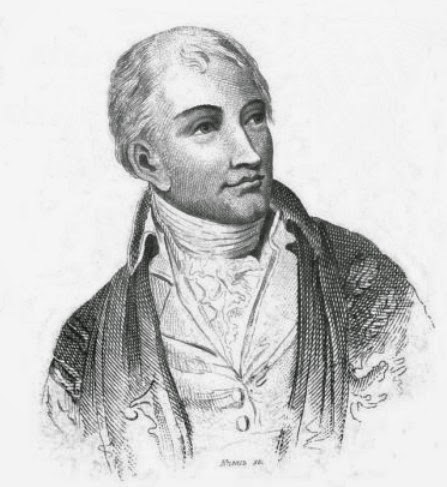
Robert Banks Jenkinson, Earl of Liverpool
Tory – 1812-1827

Lord Liverpool, from the   European Magazine and London Review (1818)
Lord Liverpool, from the 
European Magazine and London Review (1818)
George IV’s Prime Ministers (1820-1830)

Robert Banks Jenkinson, Earl of Liverpool
Tory – 1812-1827

Lord Liverpool, from the   European Magazine and London Review (1818)
Lord Liverpool
(details as above)
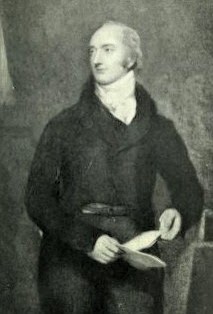
George Canning 
Tory – 1827

George Canning from The Creevey  Papers by Thomas Creevey (1912)
George Canning from The Creevey
Papers by Thomas Creevey (1912)
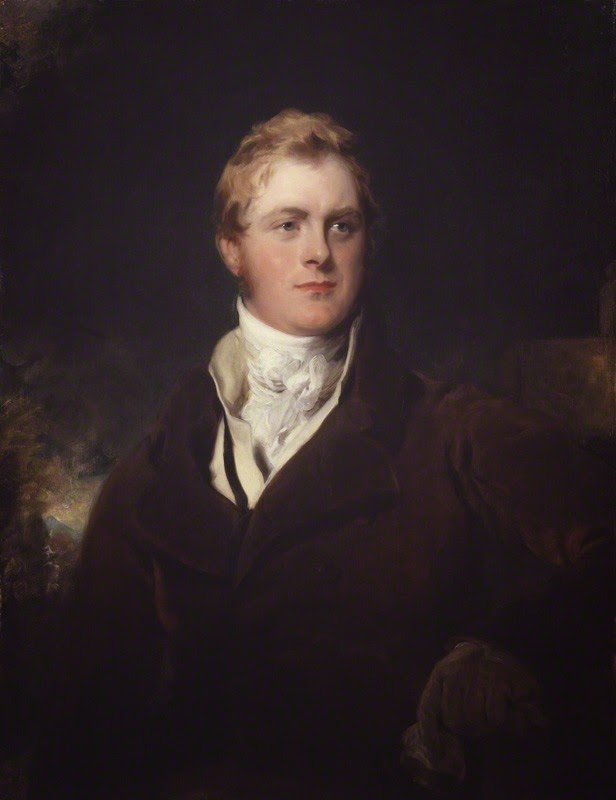
Frederick John Robinson, 1st Earl of Ripon (Viscount Goderich)
Tory – 1827-8

Frederick John Robinson,  1st Earl of Ripon, by Sir Thomas Lawrence  oil on canvas (c1824) © NPG 4875
Frederick John Robinson,
1st Earl of Ripon, by Sir Thomas Lawrence
oil on canvas (c1824) © NPG 4875 (1)
Arthur Wellesley, 1st Duke of Wellington
Tory – 1828-30

Arthur Wellesley, 1st Duke of Wellington  by Robert Home oil on canvas (1804)  © NPG 1471 (1)
Arthur Wellesley, 1st Duke of Wellington
by Robert Home oil on canvas (1804)
© NPG 1471 (1)
Notes
(1) These pictures are © National Portrait Gallery and are displayed under a Creative Commons licence.
(2) Source details of pictures in collage: Lord Liverpool, from the European Magazine and London Review (1818); George Canning and Viscount Goderich from The Georgian Era by Clarke (1832); Duke of Wellington from Life of the Field Marshal, his Grace the Duke of Wellington by James Edward Alexander (1840).

Sources used include:
Government website - past Prime Ministers
National Portrait Gallery website

Wednesday, 3 December 2014

Perdita and Florizel - Mary Robinson's affair with the Prince

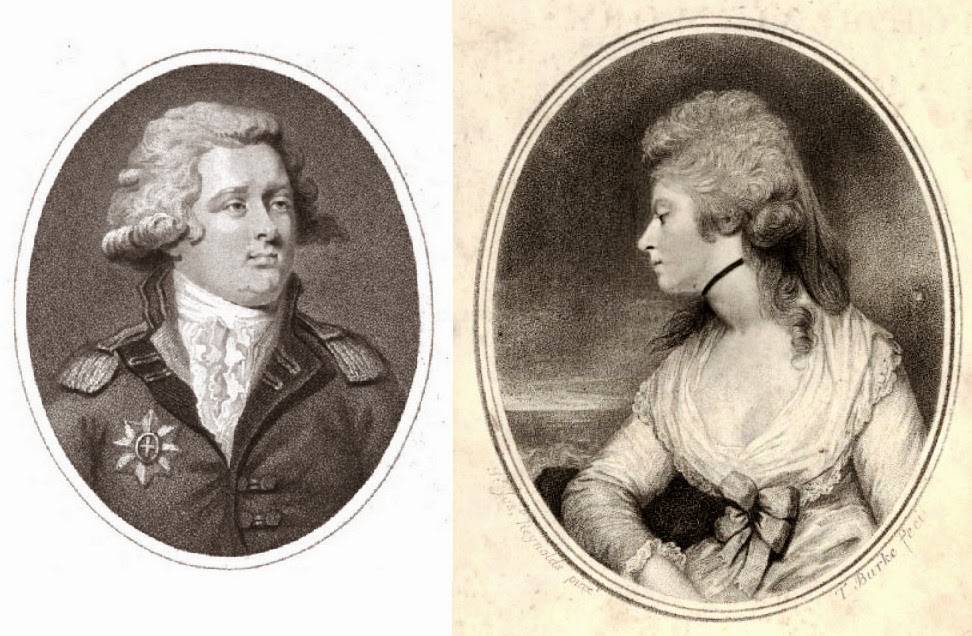
Left: Florizel - George, Prince of Wales from The Lady's Magazine (1792)  Right: Perdita - Mary Robinson from The Poetical Works of   the late Mrs Mary Robinson (1806)
Left: Florizel - George, Prince of Wales from The Lady's Magazine (1792)
Right: Perdita - Mary Robinson from The Poetical Works of 
the late Mrs Mary Robinson (1806)
Who was Perdita?

On Saturday 20 November 1779, Mary Robinson first played the part of Perdita at the Theatre Royal, Drury Lane. Perdita was the female lead in Perdita and Florizel, David Garrick’s adaptation of the last two acts of Shakespeare’s A Winter’s Tale.

Rather than the flowing pretty dress usually worn by Perdita, Mary sported a closely fitted jacket with the red ribbons of a common milkmaid. Although this costume was criticised in some of the papers, it undoubtedly contributed to Mary’s success.

Mary Robinson

Mary had been about to launch her theatrical career in 1773 but had been persuaded to get married instead. Her husband was Thomas Robinson, an indigent solicitor’s clerk, who had lied about his future prospects. The couple lived beyond their means and, desperate for money, Robinson agreed to Mary becoming an actress.

Richard Brinsley Sheridan engaged Mary to perform at his theatre in Drury Lane. David Garrick, who had coached her for her 1773 debut that had never taken place, loyally came out of retirement to prepare her for the part of Juliet. Mary gave her first performance on 10 December 1776 to widespread acclaim.

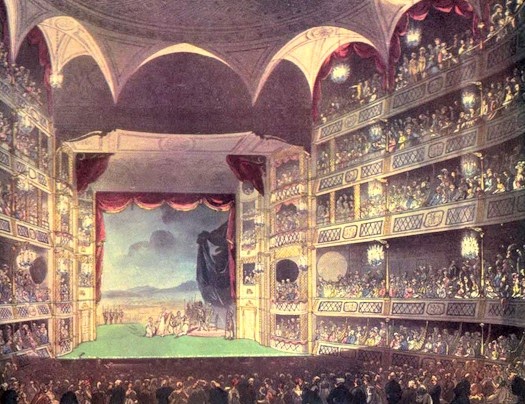
Theatre Royal, Drury Lane, from The Microcosm of London (1808-10)
The royal command performance

Perdita and Florizel was well-received and the King commanded a royal performance which took place on 3 December 1779. The King’s eldest son, George, Prince of Wales, accompanied his parents to the theatre. The royal box was very close to the stage and gave the 17-year-old Prince a close view of the actors on the stage and in the wings.

George IV from Huish's Memoirs of her late royal highness Charlotte Augusta (1818)
George IV
from Huish's Memoirs of her late
royal highness Charlotte Augusta (1818)
George made flattering comments that were loud enough for Mary to hear whilst Mary performed her lines as if for the Prince alone. George was dazzled. The next morning, he declared to his confidante Mary Hamilton, one of the ladies in waiting at court, that he had fallen madly in love with Mary Robinson.

Florizel in love

Adopting the name Florizel, the Prince started a passionate correspondence with ‘Perdita’. His friend, George Capel, Viscount Malden, acted as messenger, urging Mary to meet the Prince. Mary wrote back, encouraging the Prince to be patient and offering sisterly advice.

Writing table at Hampton Court Palace
Although for many months, George’s affair with Mary was no more than a passionate correspondence, the press was quick to comment on their relationship.

In order to quash this unfavourable publicity and comply with the Prince’s wishes, Mary agreed to leave the theatre. On 31 May 1780, she gave her farewell performance, playing the cross-dressed part of Eliza/Sir Harry Revel in The Miniature Picture and Widow Brady in The Irish Widow.

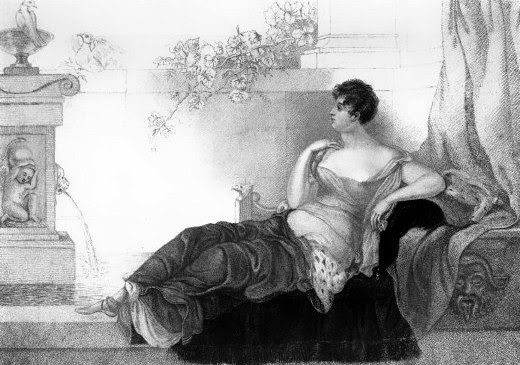
Mrs Robinson - the celebrated Perdita  from The Memoirs of George IV by R Huish (1830)
Mrs Robinson - the celebrated Perdita
from The Memoirs of George IV by R Huish (1830)
Reputation at risk

The Prince continued to push for a meeting. Mary knew that she was risking her entire reputation if she agreed. It was not until George enclosed a bond for £20,000 to be paid on his reaching his majority in one of his letters that Mary eventually agreed to an assignation.

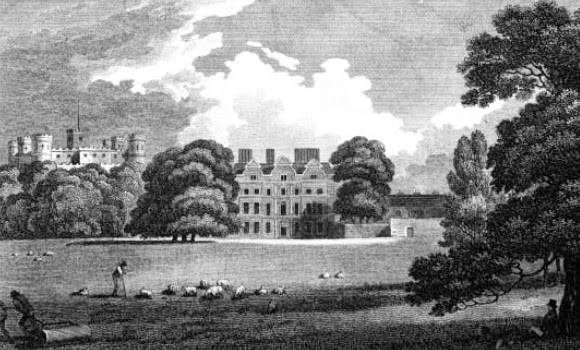
George and Mary probably did not meet until as late as June 1780. The chosen venue was Kew, near to the house where the Prince lived with the Duke of York. Over the next few months, they met many times at Kew, either in the gardens or at one of the servants’ houses or at the inn on nearby Eel Pie Island in the River Thames.

The Old Palace at Kew  from Memoirs of HM Sophia Charlotte of Mecklenburg Strelitz, Queen of Great Britain, by WM Craig (1818)
The Old Palace at Kew
from Memoirs of HM Sophia Charlotte of Mecklenburg Strelitz,
Queen of Great Britain
, by WM Craig (1818)
Celebrity status

Mary’s relationship with the Prince pushed her into the limelight even more than her acting career had done. People were interested in what she wore and where she went. She had become a Georgian celebrity!

The Prince established Mary in a house in Cork Street where she lavishly entertained him and his male friends. She wore a miniature of George around her neck and paraded around town in a variety of carriages. One carriage in particular was emblazoned with her initials encircled by a wreath of rosebuds which at a distance gave the appearance of a royal coronet.

Vauxhall by T Rowlandson  - Mary is on the right in a white dress with the Prince of Wales  at her side © British Museum
Vauxhall by T Rowlandson
- Mary is on the right in a white dress with the Prince of Wales
at her side © British Museum
The end of the affair

Mary continued to receive bad press. Cartoons were printed lampooning the Prince and his lover. There was outrage when Mary had dared to take a side box at the Opera House as if she was one of the nobility and not merely a courtesan. There was an unfortunate incident at Covent Garden where Mary flew into a rage on finding her husband with another woman. The King did not like all the bad publicity and wanted the affair finished, promising George his own establishment.

Opera House from The Microcosm of London (1808-10)
The Prince’s interest began to wane. The bad press was uncomfortable and George doubted Mary’s faithfulness to him. And with good cause; Mary was intimately involved with his friend, Lord Malden. By the end of 1780, Mary’s charms had been superseded by those of the courtesan, Elizabeth Armistead. All at once, it was over. Mary did not see it coming.

The price of a reputation

Mary was determined not to go quietly. She had been living expensively and had massive debts. The Prince’s desertion was disastrous. She had a large number of the Prince’s love letters which she threatened to publish, using them as leverage in negotiations to compensate her for the loss of her reputation and her career. Eventually Mary agreed to give up the letters in return for £5,000 and the promise of an annuity.

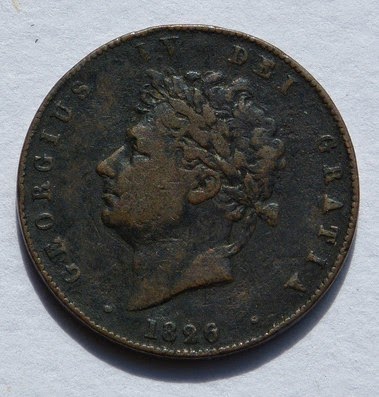
George IV coin
George IV coin (2012)
The papers continued to link their names together for years, perhaps encouraged by Mary’s persistence in wearing the Prince’s miniature, now encrusted with diamonds, around her neck.

It is a sad reflection that Mary Robinson, an acclaimed actress and later a feminist writer and poet, is remembered today for her brief affair with the Prince of Wales and not for her other achievements.

Headshot of Rachel Knowles author with sea in background(2021)
Rachel Knowles writes clean/Christian Regency era romance and historical non-fiction. She has been sharing her research on this blog since 2011. Rachel lives in the beautiful Georgian seaside town of Weymouth, Dorset, on the south coast of England, with her husband, Andrew.

Find out more about Rachel's books and sign up for her newsletter here.

If you have enjoyed this blog and want to encourage me and help me to keep making my research freely available, please buy me a virtual cup of coffee by clicking the button below.


Sources used include:
Ackermann, Rudolph, and Pyne, William Henry, The Microcosm of London or London in miniature (1808-1810, reprinted 1904)
Byrne, Paula, Perdita, the life of Mary Robinson (2004)
Huish, Robert, Memoirs of George IV (1830)
Levy, Martin J, Robinson, Mary (Perdita) (1756/8-1800) Oxford Dictionary of National Biography (Oxford University Press, 2004; online edn Jan 2008, accessed 2 July 2013)
Robinson, Mrs Mary, The Poetical Works of the late Mrs Mary Robinson: including many pieces never before published (1806)

All photographs © RegencyHistory.net