Search this blog

Showing posts with label Seaside. Show all posts

Friday, 18 October 2013

George's seaside adventure - George III in Weymouth

George III  from The History of the Reign of George III   by Robert Bissett (1822)
George III
from The History of the Reign of George III
 by Robert Bissett (1822)
George 's seaside adventure

George III was a frequent visitor to my home town of Weymouth. He visited nearly every year between 1789 and 1805. In my presentation, George’s seaside adventure, I talk about the King’s first visit to Weymouth in 1789 and share two of the more unusual things that happened to him on that occasion.


Did it really happen like that?

Both anecdotes are recorded by author Fanny Burney in the Diaries and letters of Madame d'Arblay.1 Fanny was second keeper of the robes to Queen Charlotte at the time and accompanied the royal party to Weymouth. Apparently the mayor of Weymouth really did have a wooden leg. Unfortunately, though his excuse for not kneeling was perfectly reasonable, the rest of his party followed his lead, and none of them knelt before the King and Queen!

Fanny Burney  from Diary and letters of Madame D'Arblay (1846)
Fanny Burney
from Diary and letters of Madame D'Arblay (1846)
The whole country celebrated the King’s recovery from his incapacitating illness with zeal. Everywhere the King went, crowds of people turned up to see him, frequently launching into the national anthem and cheering His Majesty. Weymouth was no exception.

Fanny Burney wrote:
The king, and queen, and princesses, and their suite, walked out in the evening; an immense crowd attended them—sailors bargemen, mechanics, countrymen; and all united with so vociferous a volley of "God save the king", that the noise was stunning.
The preparations of festive loyalty were universal. Not a child could we meet that had not a bandeau round its head, cap, or hat, of "God save the king"; all the bargemen wore it in cockades and even the bathing-women had it in large coarse girdles round their waists. It is printed in golden letters upon most of the bathing-machines, and in various scrolls and devices it adorns every shop and almost every house in the two towns.2
The story of the band playing when George III went for his first dip was famously caricatured in John Nixon’s print.

Royal dipping – print by John Nixon, published   by William Holland (1789)  © British Museum
Royal dipping – print by John Nixon, published
 by William Holland (1789)  © British Museum
Fanny Burney wrote:
The king bathes, and with great success; a machine follows the royal one into the sea, filled with fiddlers, who play "God save the king," as his majesty takes his plunge!2
If you enjoyed this video, you might like my other YouTube videos:
The three Charlottes – Queen Charlotte, Princess Royal and Princess Charlotte of Wales.
A litter of cupolas – Brighton Pavilion in 1823.

Headshot of Rachel Knowles author with sea in background(2021)
Rachel Knowles writes faith-based Regency romance and historical non-fiction. She has been sharing her research on this blog since 2011. Rachel lives in the beautiful Georgian seaside town of Weymouth, Dorset, on the south coast of England, with her husband, Andrew.

Find out more about Rachel's books and sign up for her newsletter here.

If you have enjoyed this blog and want to encourage me and help me to keep making my research freely available, please buy me a virtual cup of coffee by clicking the button below.

 
Note
1. Madame d'Arblay is Fanny Burney's married name.
2. From the Diary and letters of Madame D'Arblay by Fanny Burney (1846).

Sources used include:
Burney, Fanny, Diary and letters of Madame D'Arblay, edited by her niece, Charlotte Barrett (Henry Colburn, 1846, London)
Chedzoy, Alan, Seaside Sovereign - King George III at Weymouth (The Dovecote Press, 2003, Wimborne)

Tuesday, 16 July 2013

Did Regency ladies ever get sunburnt?

Seaside walking dress La Belle Assemblée (Aug 1810)
Seaside walking dress
La Belle Assemblée (Aug 1810)
Where I live in Weymouth, Dorset, we have enjoyed another day of gloriously hot sunny weather. Fortunately, I have avoided getting sunburnt, but my daughter has not been so lucky, and has a few sore red patches of skin which the sun cream missed.

Weymouth has been a popular seaside resort for more than 250 years and was visited many times by George III and his family. 
 
You can read more about George III in Weymouth here.

It made me wonder whether Regency ladies ever 'caught the sun' and what they would do about it if they did. Was it even possible to get sunburnt, given that ladies wore outfits like the seaside walking dress above when they were beside the sea?

Weymouth Beach (July 2019)
‘Good for taking off sunburnings’

I came across the following recipe for fard in The Mirror of the Graces, which says that it is ‘good for taking off sunburnings’1:

This appears to answer both my questions: ladies did occasionally get sunburnt and they may have used home-made fard to treat it.

An effective after-sun treatment?

I thought that fard sounded quite pleasant until I discovered that spermaceti was a white waxy substance chiefly found in the head cavities of the sperm whale which was widely used in the production of candles, ointments and cosmetics at the time!

A pipkin is a small earthenware or metal cooking pot with three feet and a handle which is used for cooking over direct heat, such as an open fire. Essential equipment if you wanted to make your own cosmetics in the Regency period.

Almonds, honey and whale wax. I wonder whether it was effective.

A full description of the fashionable seaside walking dress shown above
A gown of white French cambric, or pale pink muslin, with long sleeves, and antique cuffs of thin white muslin, trimmed with Mechlen edging; made high in the neck, without a collar, and formed in points at the centre of the bosom, with three rows of letting-in lace; confined down the front of the dress with small buttons; and hemmed round the bottom with three rows of deep Mechlen lace; made rather short, and worn over trowsers of white French cambric, which are trimmed the same as the bottom of the dress. A cap composed of lace and light green silk trimming, tied under the chin, with a bunch of natural flowers in front. Hair in full ringlet curls, divided in the front of the forehead. A figured short scarf of pale buff, with deep pale-green border, and rich silk tassels; worn according to fancy or convenience; with gloves of pale buff kid; and sandals of pale yellow, or white Morocco, complete this truly simple but becoming dress.2

Headshot of Rachel Knowles author with sea in background(2021)
Rachel Knowles writes clean/Christian Regency era romance and historical non-fiction. She has been sharing her research on this blog since 2011. Rachel lives in the beautiful Georgian seaside town of Weymouth, Dorset, on the south coast of England, with her husband, Andrew.

Find out more about Rachel's books and sign up for her newsletter here.

If you have enjoyed this blog and want to encourage me and help me to keep making my research freely available, please buy me a virtual cup of coffee by clicking the button below.

 
Notes
1. A lady of distinction, The Mirror of the Graces; or the English lady's costume (1811)
2. Bell, John, La Belle Assemblée (July 1810)

Sources used include;
A lady of distinction, The Mirror of the Graces; or the English lady's costume (1811)
Bell, John, La Belle Assemblée (John Bell, 1810, London)

Wednesday, 5 September 2012

Jane Austen and the seaside

Sands near Chit Rock, Sidmouth    from A new guide descriptive of the beauties of Sidmouth    by Rev Edmund Butcher (1830)
Sands near Chit Rock, Sidmouth
  from A new guide descriptive of the beauties of Sidmouth
  by Rev Edmund Butcher (1830)
Sanditon

I wrote this post in 2012 after rereading Sanditon, Jane Austen’s last novel, completed by ‘another lady’. The description of Sanditon was of particularly interest to me as I have been researching sea bathing in the Georgian era and this gave me a contemporary, albeit fictional, description of the seaside.

The words that Jane Austen put into Mr Parker’s mouth represented the fashionable view of the seaside at the time and she must have been consciously echoing the words of such sea bathing enthusiasts as Dr Crane of Weymouth who wrote Cursory Observations on Sea-bathing.

Mr Parker
held it indeed as certain that no person could be really well, no person (however upheld for the present by fortuitous aids of exercise and spirits in a semblance of health) could be really in a state of secure and permanent health without spending at least six weeks by the sea every year. The sea air and sea bathing together were nearly infallible, one or the other of them being a match for every disorder of the stomach, the lungs or the blood. They were anti-spasmodic, anti-pulmonary, anti-septic, anti-bilious and anti-rheumatic. Nobody could catch cold by the sea; nobody wanted appetite by the sea; nobody wanted spirits; nobody wanted strength. Sea air was healing, softening, relaxing – fortifying and bracing – seemingly just as was wanted – sometimes one, sometimes the other.1
Was Jane Austen really convinced of the infallibility of the seaside as a cure for all ills? I think not! Rather she was laughing at the current fashion by creating the indefatigable Mr Parker who is both likeable and somewhat ridiculous in his extreme enthusiasm for Sanditon.

In Emma, Mr Woodhouse and Isabella argue about the benefits of the seaside:
“It was an awkward business, my dear, your spending the autumn at South End instead of coming here. I never had much opinion of the sea air.”
“Mr. Wingfield most strenuously recommended it, sir—or we should not have gone. He recommended it for all the children, but particularly for the weakness in little Bella’s throat,—both sea air and bathing.”
“Ah! my dear, but Perry had many doubts about the sea doing her any good; and as to myself, I have been long perfectly convinced, though perhaps I never told you so before, that the sea is very rarely of use to any body. I am sure it almost killed me once.”2
Jane Austen in Devon

Sidmouth from Chit Rock    from A new guide descriptive of the beauties of Sidmouth    by Rev Edmund Butcher (1830)
Sidmouth from Chit Rock
  from A new guide descriptive of the beauties of Sidmouth
  by Rev Edmund Butcher (1830)
Jane Austen visited the seaside on several occasions and seemed to enjoy the experience. She visited Sidmouth in Devon in 1801, and it was here that it is believed that she met the true love of her life, a gentleman who returned her affection but tragically died soon afterwards. It is no wonder that Sidmouth had a special place in her heart and Sanditon is thought to be based on Sidmouth. She stayed in Devon again in 1802, visiting Dawlish and Teignmouth.

Jane Austen in Ramsgate

According to the Austen-Leighs’ Jane Austen, Her Life and Letters, Jane visited Ramsgate in 1803 where she was seen by Sir Egerton Brydges. Her brother Frank was headquartered there at the time and it is likely that she visited him there on one of her trips to Godmersham Park.

In a letter to Cassandra, Jane wrote that a friend was talking of fixing at Ramsgate. She wrote:
Bad Taste! – He is very fond of the Sea however; – some Taste in that – & some Judgement too in fixing on Ramsgate, as being by the Sea.3
Ramsgate in Jane Austen’s novels

Ramsgate does not appear in a good light in Jane Austen’s novels. A fleeting reference is made to Ramsgate in Mansfield Park where Tom Bertram spent a week with his friend Sneyd, but it is in Pride and Prejudice that Ramsgate is painted as a place where bad things happen. It is at Ramsgate that Mr Wickham persuades Georgiana Darcy into an elopement. Mr Darcy wrote:
“Last summer she [Georgiana Darcy] went with the lady who presided over it, to Ramsgate; and thither also went Mr. Wickham, undoubtedly by design; for there proved to have been a prior acquaintance between him and Mrs. Younge, in whose character we were most unhappily deceived; and by her connivance and aid, he so far recommended himself to Georgiana, whose affectionate heart retained a strong impression of his kindness to her as a child, that she was persuaded to believe herself in love, and to consent to an elopement.”4
Jane Austen in Lyme Regis

In 1804, Jane visited Lyme Regis with her parents whilst her sister, Cassandra, was on a visit to Weymouth with her brother Henry. Jane enjoyed sea bathing but could never resist a jibe at fashion. In a letter to Cassandra written on September 14 1804 Jane wrote:
I continue quite well in proof of which I have bathed again this morning. It was absolutely necessary that I should have the little fever and indisposition which I had; it has been all the fashion this week in Lyme.5
Lyme Regis in Jane Austen’s novels

Rachel Knowles walking up the steps on the Cobb, Lyme Regis (2016)
Rachel walking up the steps on the Cobb, Lyme Regis (2016)
Jane was very taken with the natural beauty of Lyme Regis and this comes out in her description of it in Persuasion.
… the remarkable situation of the town, the principal street almost hurrying into the water, the walk to the Cobb, skirting round the pleasant little bay, which, in the season, is animated with bathing machines and company; the Cobb itself, its old wonders and new improvements, with the very beautiful line of cliffs, stretching out to the east of the town, are what the stranger’s eye will seek; and a very strange stranger it must be who does not see charms in the immediate environs of Lyme, to make him wish to know it better.6
They praised the morning; gloried in the sea; sympathised in the delight of the fresh-feeling breeze – and were silent; till Henrietta suddenly began again, with – “Oh, yes! I am quite convinced that, with very few exceptions, the sea-air always does good.”7
Cassandra in Weymouth

On the other hand, Jane Austen’s feelings about Weymouth, which she appears to have known only by report, were less positive. In a letter to Cassandra who was staying there, she pigeonholed it as a resort for the fashionable elite:
Your account of Weymouth contains nothing which strikes me so forcibly as there being no ice in the town; for every other vexation I was in some measure prepared, & particularly for your disappointment in not seeing the Royal family go on board on Tuesday, having already heard from Mr Crawford that he had seen you in the very act of being too late. But for there being no ice, what could prepare me? Weymouth is altogether a shocking place I perceive, without recommendation of any kind & worthy only of being frequented by the inhabitants of Gloucester [referring to a newspaper report of HRH the Duke of Gloucester’s arrival in Weymouth to visit the Royal Family]. I am really very glad that we did not go there.8
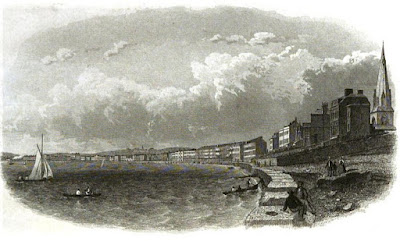
Weymouth and Melcombe Regis seafront  from Weymouth as a Watering Place  published by Simpkin & Marshall (1857)
Weymouth and Melcombe Regis seafront
from Weymouth as a Watering Place
published by Simpkin & Marshall (1857)
Weymouth in Jane Austen’s novels

Maybe the repeated visits of George III had made Weymouth too busy for Jane's liking. Weymouth is portrayed in her novels as a seaside resort for profligate young men and silly women and the ideal place for contracting a foolish, secret engagement.
 
You can read about George III's visits to Weymouth here.

In Mansfield Park, Tom Bertram met John Yates in Weymouth, whilst in Sense and Sensibility, silly Mrs Palmer had been visiting in Weymouth with her uncle and had therefore missed Mr Willoughby’s previous visit to Allenham.

In Emma, it is at Weymouth that Jane Fairfax and Frank Churchill met and fell in love and entered into a secret engagement.

Mr Knightley said of Frank Churchill:
“It is not to be conceived that a man of three or four-and-twenty should not have liberty of mind or limb to that amount. He cannot want money—he cannot want leisure. We know, on the contrary, that he has so much of both, that he is glad to get rid of them at the idlest haunts in the kingdom. We hear of him for ever at some watering-place or other. A little while ago, he was at Weymouth.”9
Mrs Weston later breaks the news to Emma that Jane Fairfax is engaged to Frank Churchill:
“You may well be amazed. But it is even so. There has been a solemn engagement between them ever since October—formed at Weymouth, and kept a secret from every body.”10
Jane Austen’s opinion of Brighton

I have always believed that Jane disliked Brighton. Like many others, I read the following quote from one of her letters, dated 8 January 1799, which suggested that her opinion of Brighton was unfavourable at best:
I assure you that I dread the idea of going to Brighton as much as you do, but I am not without hopes that something may happen to prevent it.11
However, in Deirdre Le Faye’s book of Jane Austen’s Letters, the text reads ‘Bookham’ and not ‘Brighton’. Le Faye writes in her notes that the word was crossed out in the original manuscript, presumably to hide Jane’s unfavourable reference to the home of her Cooke cousins. It was wrongly guessed at by Lord Brabourne and the mistake has been circulating ever since.12

You can read about George IV's Brighton here.

Brighton in Jane Austen’s novels

Brighton Pavilion
Brighton Pavilion
Despite the lack of proof that Jane detested Brighton, I am inclined to think she would have disliked it for its associations with the Prince Regent, whom she hated.13

In Pride and Prejudice, three of Jane Austen’s silliest characters, Mrs Bennet, Lydia and Kitty, are all desperate to go to Brighton, the most fashionable seaside resort of the time:
“If one could but go to Brighton!” observed Mrs Bennet.
“Oh, yes! If one could but go to Brighton! But papa is so disagreeable.”
“A little sea-bathing would set me up for ever.”14
Lydia, of course, gets her wish of going to Brighton – and proceeds to elope from there with the infamous Mr Wickham!

In Mansfield Park, the Rushworths go to Brighton for their honeymoon, with Julia Bertram in tow.
The plan of the young couple was to proceed, after a few days, to Brighton, and take a house there for some weeks. Every public place was new to Maria, and Brighton is almost as gay in winter as in summer.15
But even the entertainments of Brighton and London are insufficient to keep the young Mrs Rushworth contented for long and ultimately she succumbs to the illicit attractions of Henry Crawford.

Southend in Jane Austen's novels

Jane wrote in a letter to her brother Frank in July 1813 that their brother Charles and his family were all in Southend together.16

Southend is mentioned in Emma and the argument between Isabella and Mr Woodhouse quoted above is brought to a rapid conclusion by Emma saying wistfully:
“I must beg you not to talk of the sea. It makes me envious and miserable;—I who have never seen it! South End is prohibited, if you please.”17
Did Jane Austen like the seaside?

I think the answer is most definitely yes. Her description of Lyme Regis in Persuasion is full of praise for its natural beauty, asking the reader the question: ‘How could you not like it?’ I like to think that she would have appreciated Weymouth, my home town, for the same reasons, particularly after the king’s visits had ceased and it became less fashionable.

Emma concludes with Emma Woodhouse's marriage to Mr Knightley. I think that Jane Austen must have liked the seaside to send Emma there for her honeymoon:
They had determined that their marriage ought to be concluded while John and Isabella were still at Hartfield, to allow them the fortnight’s absence in a tour to the seaside.18
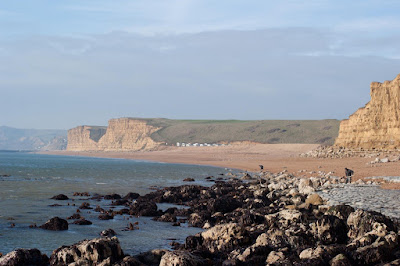
Burton Bradstock, Dorset

Headshot of Rachel Knowles author with sea in background(2021)
Rachel Knowles writes clean/Christian Regency era romance and historical non-fiction. She has been sharing her research on this blog since 2011. Rachel lives in the beautiful Georgian seaside town of Weymouth, Dorset, on the south coast of England, with her husband, Andrew.

Find out more about Rachel's books and sign up for her newsletter here.

If you have enjoyed this blog and want to encourage me and help me to keep making my research freely available, please buy me a virtual cup of coffee by clicking the button below.


This post was updated in June 2017 to include references to Ramsgate and Southend, more quotes from Jane Austen’s work and letters, and updated sections on Brighton and Weymouth. 

Notes
(1) From Sanditon by Jane Austen and another lady (1875).
(2) From Emma by Jane Austen (1815).
(3) In a letter dated 3-6 July 1813 in Jane Austen’s Letters edited by Deirdre Le Faye (1995).
(4) From Pride and Prejudice by Jane Austen (1813).
(5) In a letter from Jane Austen dated 14 September 1804 recorded in Jane Austen, Her Life and Letters by William and Richard Austen-Leigh (1913).
(6) From Persuasion by Jane Austen (1817).
(7) From Persuasion by Jane Austen (1817).
(8) In a letter from Jane Austen dated 14 September 1804, from Jane Austen’s Letters edited by Deirdre Le Faye (1995).
(9) From Emma by Jane Austen (1815).
(10) From Emma by Jane Austen (1815).
(11) In a letter from Jane Austen to her sister dated 8 January 1799, from The Letters of Jane Austen selected from the compilation of Lord Bradbourne (1892).
(12) See text for the above letter and accompanying note in Jane Austen’s Letters edited by Deirdre Le Faye (1995). My thanks to Yoram Cohen for pointing out this mistake in my original post.
(13) Referring to the Princess of Wales, Jane wrote: “Poor Woman, I shall support her as long as I can, because she is a Woman, & because I hate her husband.” In a letter from Jane Austen to Martha Lloyd dated 16 February 1813 in Jane Austen’s Letters edited by Deirdre Le Faye (1995).
(14) From Pride and Prejudice by Jane Austen (1813).
(15) From Mansfield Park by Jane Austen (1814).
(16) In a letter to Frank Austen dated 3-6 July 1813 in Jane Austen’s Letters edited by Deirdre Le Faye (1995).
(17) From Emma by Jane Austen (1815).
(18) From Emma by Jane Austen (1815).

Sources used include:
Austen, Jane, and another lady, Sanditon (1975)
Austen, Jane, Emma (1815)
Austen, Jane, Jane Austen's Letters, Collected and Edited by Le Faye, Deirdre (Oxford University Press, 1995)
Austen, Jane, Mansfield Park (1814)
Austen, Jane, My dear Cassandra, letters to her sister selected and introduced by Penelope Hughes-Hallett (Collins & Brown Ltd, 1990)
Austen, Jane, Northanger Abbey and Persuasion (1817)
Austen, Jane, Pride and Prejudice (1813)
Austen, Jane, Sense and Sensibility (1811)
Austen, Jane, The Letters of Jane Austen selected from the compilation of her great nephew, Edward, Lord Bradbourne ed Sarah Woolsey (1892)
Austen-Leigh, William and Richard Arthur, Jane Austen, Her Life and Letters (1913)
Butcher, Rev Edmund, A new guide descriptive of the beauties of Sidmouth (1830, Exeter)
Cecil, David, A Portrait of Jane Austen (Constable, 1978; Penguin, 1980, London)
Chedzoy, Alan, Seaside Sovereign - King George III at Weymouth (The Dovecote Press, 2003, Wimborne)
Feltham, John, Editor of the Picture of London, A Guide to all the Watering and Sea-Bathing Places (1815)
Simpkin & Marshall, Weymouth as a Watering Place (Simpkin & Marshall, 1857, London)

Photographs © RegencyHistory.net

Wednesday, 15 August 2012

How Weymouth became a Georgian seaside resort fit for a King

Map of Weymouth and Portland    from Weymouth and Melcombe Regis New Guide (1835)
Map of Weymouth and Portland
  from Weymouth and Melcombe Regis New Guide (1835)
Twin towns

Weymouth was historically two towns, one on each side of the harbour, which was protected by the Nothe headland. Melcombe Regis lay to the north, between the sea and the backwater, and Weymouth to the south, and they were connected by a bridge. In 1770, a new seven-arched wooden bridge was built, with a drawbridge in the middle to let tall boats through.

The rise of tourism

After the Civil War, Weymouth lost much of its trade to Poole and its importance as a port declined. But in the 18th century a new trade grew up – tourism. Repeated outbreaks of plague had made the wealthy very health conscious giving rise to the growth of spa towns such as Bath and Harrogate. Then a more revolutionary cure developed: sea bathing. Weymouth, with its sheltered bay and golden sands, was ideally suited and entrepreneurs eagerly sought to capitalise on this.

The turnpike roads

During the second half of the 18th century, the transport system in England was revolutionised by the introduction of turnpike roads – roads which were funded by the collection of tolls. In 1761, an Act was passed to create a turnpike road from Dorchester to Weymouth, much improving access to the town.

A toll house    Weald and Downland Museum
A toll house
  Weald and Downland Museum

Weymouth could be approached by travelling down the turnpike road from Dorchester and then descending the hill through the village of Upwey. The road, called the Narrows, then passed along the seafront with the backwater on the other side, separated from the Esplanade by a chain and post fence.

Weymouth entrepreneurship

On 30 September 1748, Prowse and Bennet were granted twenty-one year leases so that they could build two wooden bathing houses on the north, Melcombe Regis, side of the harbour, to exploit the new fashion for sea bathing.
 

The birth of the assembly rooms

Another entrepreneur, Andrew Sproule, took a lease on land north of Melcombe Regis on which he built a hotel and assembly rooms. Stacie’s Hotel, named for its proprietor, opened for its first season in 1773 and all the apartments were fully booked. It later became the Royal Hotel.

A bid for a better Weymouth

The governing Corporation was keen to develop the town and attract more visitors. In 1776, an Act of Parliament was passed which allowed them to raise money for town improvements by levying a tax on owners and shopkeepers. The money raised was spent on making Weymouth a safer, cleaner, more attractive place to visit.

Weymouth seafront
Weymouth seafront (2012)
Better streets

As a result of the Act, the main streets were paved and drained and lit by street lamps. Watchmen were appointed to patrol the streets to maintain the peace and help visitors and inhabitants alike feel safe. Vandalism was guarded against by threatening fines of up to 40 shillings for the wilful destruction of the new lamps. Riding or driving horses or cattle on the footpaths was also prohibited.

Fire prevention

The Act attempted to combat the very real danger of fire that existed because of the number of dwellings in close proximity to each other by forbidding the use of thatch. All new buildings had to use tile, slate or lead and existing thatch had to be replaced by the beginning of 1794.

In 1792, the Corporation established a fire service of twelve men to operate the two fire engines from March to September. Each man was to be paid six pence. In 1797, a private company was set up to pipe water throughout Melcombe ensuring a good water supply to combat fire.

Congestion

Traffic flow was also tackled by the 1776 Act. Carts were frequently held up because their way was obstructed by another vehicle blocking the road, often resulting in unpleasant shouting matches or fighting. The Act introduced a fine of five shillings on any wagon, cart, dray or carriage left standing in the road longer than necessary for loading and unloading.

Guidebooks

By the 1770s, Weymouth’s summer season was well-established. Guidebooks were issued promoting the town for health and leisure. The post-mistress, Mrs Delamotte, first issued her Weymouth Guide in 1782, followed by Harvey’s Improved Guide in 1800.

They described the fashionable entertainments available as well as the accommodation on offer. This included hotels such as the Crown Inn in St Thomas Street, the King’s Head in Maiden Street and the Golden Lion in St Mary’s Street. It also included lodging houses which were expensive, but single gentlemen could be accommodated on moderate terms all year round.
 

The Golden Lion    St Mary's Street, Weymouth
The Golden Lion
  St Mary's Street, Weymouth
The arrival of influential visitors

On 18 September 1750, Ralph Allen purchased a property on the Weymouth side of the harbour. He had been advised to try sea bathing for his health and Weymouth was his resort of choice. Allen had made his fortune reforming the British postal system and had then acquired quarries in Bath which provided the stone for the building of Georgian Bath.

He visited Weymouth regularly from 1750 until his death in 1764. He was a man of great wealth and influence and many important people visited him there, including the Duke of York in 1758.

After the Duke of York came the Duke of Gloucester who commissioned his own house in Weymouth in 1780, Gloucester House. It was this house that he lent to his brother, George III, when he needed to recuperate from a severe bout of incapacity in 1789.

Gloucester House on Weymouth seafront today
Gloucester House on Weymouth seafront (2012)
Thus Royal Weymouth was born. George fell in love with the town and visited repeatedly until 1805.

Updated 5 March 2020

Headshot of Rachel Knowles author with sea in background(2021)
Rachel Knowles writes clean/Christian Regency era romance and historical non-fiction. She has been sharing her research on this blog since 2011. Rachel lives in the beautiful Georgian seaside town of Weymouth, Dorset, on the south coast of England, with her husband, Andrew.

Find out more about Rachel's books and sign up for her newsletter here.

If you have enjoyed this blog and want to encourage me and help me to keep making my research freely available, please buy me a virtual cup of coffee by clicking the button below.

Sources used include:
Boddy, Maureen and West, Jack, Weymouth, an illustrated history (The Dovecote Press, 1983, Wimborne)
Chedzoy, Alan, Seaside Sovereign - King George III at Weymouth (The Dovecote Press, 2003, Wimborne)
Feltham, John, Editor of the Picture of London, A Guide to all the Watering and Sea-Bathing Places (1815)
Groves, E, The Weymouth and Melcombe Regis New Guide (E Groves, 1835, Weymouth)
Hibbert, Christopher, George III (1998, Viking, Great Britain)
Simpkin & Marshall, Weymouth as a Watering Place (Simpkin & Marshall, 1857, London)

Photographs © RegencyHistory.net

Wednesday, 8 August 2012

Fashionable entertainment in Regency Weymouth

The Royal Hotel on Weymouth seafront
The Royal Hotel on Weymouth seafront (2012)
Weymouth in fashion

Visitors started flocking to Weymouth in the second half of the 18th century when the seaside came into fashion. The sheltered bay offered safe sea bathing and attracted Royal visitors – first the Duke of Gloucester and then his brother George III. The town grew to accommodate the needs of the wealthy tourists and was able to offer fashionable entertainments including assembly rooms, libraries and a theatre.


The public rooms

The Assembly Rooms were housed in Stacie’s Hotel, which was later known as the Royal. It was an imposing building with double bow windows facing the sea, in the centre of Gloucester Row, close to Gloucester Lodge. The main room could hold 100 couples for dancing and there were rooms available for card playing and tea drinking.

Plaque on the Royal Hotel,    Weymouth seafront
Plaque on the Royal Hotel,
  Weymouth seafront (2012)
Balls were held twice a week on Tuesdays and Fridays. As in Bath, the Master of Ceremonies laid down a set of rules for the Rooms that had to be adhered to. This role was held by Mr Rodber from 1784 to at least 1815. The rules and orders for balls he established were as follows:

1. That Gentlemen are not to appear in the rooms, either on Tuesday or Friday evenings, in boots; nor Ladies in riding-habits.
2. That the ball shall begin as soon as possible after seven o’clock, and finish precisely at eleven.
3. That Ladies and Gentlemen who dance down a country dance, shall not quit their place till the dance is finished, unless they do not mean to dance any more that night.
4. That no Lady or Gentleman can be permitted to dance in coloured gloves.
5. That after a Lady has called a dance, and danced it down, her place in the next dance is at the bottom.
6. That no tea-table be carried into the card-room.
7. That Gentlemen will be pleased to leave their swords at the door.
8. That no dogs be admitted.

A dance from La Belle Assemblée (May 1820)
How much did it cost to attend balls in Regency Weymouth?

In 1815, a single ticket during three seasons cost a guinea (£1 1s or 21s) and a three person ticket cost £2 2s. This is rather more than the 14 shillings per person that it cost for a ticket to a season of balls at the Bath Assembly Rooms in the same year, but it did include two balls a week rather than one, the balls may have run all year and there is no mention of an extra charge for tea which effectively doubled the price of a ball in Bath.

A guinea equates to approximately £60.70 in 2010 using the Retail Price Index (RPI) or £705 if adjusted for average earnings. This suggests that the balls at the Assembly Rooms were only for the wealthy. For more information on this, please look at my article: How much did a ticket to a Regency ball really cost?

Gentlemen and ladies could alternatively pay just to walk the rooms at a cost of 10s 6d and 5s respectively. This compares favourably with Bath for gentlemen who would have had to pay twice as much for a subscription to the card and reading rooms in the Assembly Rooms; the cost for ladies is identical to that in Bath.

Harvey’s library

Harvey's library, Weymouth Esplanade (2022)
Harvey’s library was on the centre of the Esplanade and boasted a collection of over 8,000 volumes as well as a large and comfortable room for examining newspapers and periodicals.

There was an elegantly-furnished card room over the library. The subscription rate in 1815 was 10s 6d per quarter, equivalent to £30.30 using the RPI or £352 using average earnings.

The Post Office was based here, sending out mail to London at 10.30am every day except Saturday and receiving mail from London by 3pm every day except Monday.

Harvey's library, Weymouth seafront
Harvey's library, Weymouth seafront (2012)
Wood’s library

Wood’s library was also on the Esplanade and could offer for hire a wide range of musical instruments in addition to books. The subscription rate here was 2s 6d per week – equivalent to £7.22 using the RPI or a rather expensive £83.90 using average earnings.

The theatre

The theatre had been refurbished by James Hamilton and was under the management of Mr Hughes. It seated an audience of up to 400 persons, with performances on Mondays, Thursdays and Saturdays.

The baths

As an alternative to sea bathing, there was a hot salt water bath in the centre of town, for those who chose not to venture into the sea. In 1815, this would have cost 3s 6d before 6pm and 4s after 6pm. The equivalent costs today would be £10.10 and £11.60 using the RPI or £117 and £134 using average earnings. Sedan chairs were always available to take the clients home after being dipped.

This advertisement for the baths appeared in the 1857 guide to Weymouth as a Watering Place. Although it is long after the Regency, it provides an interesting insight into what might have been available: 
Advert fro Royal Baths 1857

Headshot of Rachel Knowles author with sea in background(2021)
Rachel Knowles writes clean/Christian Regency era romance and historical non-fiction. She has been sharing her research on this blog since 2011. Rachel lives in the beautiful Georgian seaside town of Weymouth, Dorset, on the south coast of England, with her husband, Andrew.

Find out more about Rachel's books and sign up for her newsletter here.

If you have enjoyed this blog and want to encourage me and help me to keep making my research freely available, please buy me a virtual cup of coffee by clicking the button below.

 
Sources used include:
Chedzoy, Alan, Seaside Sovereign - King George III at Weymouth (2003, The Dovecote Press, Wimborne)
Editor of the Picture of London, A Guide to all the Watering and Sea-Bathing Places (1815)
Delamotte, Peter, The Weymouth Guide (1785, Weymouth)
Groves, E, The Weymouth and Melcombe Regis New Guide (E Groves, 1835, Weymouth)
Hibbert, Christopher, George III (1998, Viking, Great Britain)
Simpkin & Marshall, Weymouth as a Watering Place (Simpkin & Marshall, 1857, London)
 
MeasuringWorth website - for calculators of relative worth
Photographs © RegencyHistory.net

Monday, 6 August 2012

Sea bathing in Regency Weymouth

Weymouth beach
Weymouth beach (2012)
The fashion for sea bathing

Sea bathing started becoming popular during the second half of the 18th century when two eminent doctors, Dr Russell and Dr Crane, began to recommend it to their wealthy clients as an aid to good health. Dr Russell favoured Brighton which grew rapidly under the patronage of the Prince of Wales, the future George IV. 
 
Dr Crane, on the other hand, advocated his home town of Weymouth, where the regular visits of George III secured its place amongst the most popular seaside resorts. By the time of the Regency, the fashionable predilection for the seaside was firmly established.
 

Weymouth bay

Weymouth and Melcombe Regis seafront  from Weymouth as a Watering Place  published by Simpkin & Marshall (1857)
Weymouth and Melcombe Regis seafront
from Weymouth as a Watering Place
published by Simpkin & Marshall (1857)

Weymouth was particularly suited to sea bathing because of its sheltered bay and wide sandy beach. Dr Crane described the resort in glowing terms:
The water of this fine Bay is quite pure, of a beautiful colour, and perfectly clear and transparent. The sands under foot are soft yet firm, and entirely free from obstruction. The declivity is so gradual as to be almost imperceptible – a great security to the weak and fearful. The Bay is so well sheltered by nature, that for tranquillity it surpasses what I have ever seen.1
The 1815 Guide to All the Watering and Sea-bathing Places says of Weymouth:
Being protected from all winds, the sea is here remarkably tranquil; and hence, at all times of the day, immersion in the briny flood is safe and delightful.2
Bathing machines
A replica of George III's bathing machine    Weymouth seafront
A replica of George III's bathing machine
  Weymouth seafront (2012)
Bathing machines provided an easy and discreet way to change and then enter the water. Every day, they lined up on the beach in front of the Esplanade, ready to be hired. A bathing machine was drawn by a horse guided by a man and led into the required depth of water, at which point the horse would be unhitched and taken away. Female bathers wore long shifts called flannels; men wore drawers or bathed naked. Needless to say, the bathing machines of the different sexes were kept at a distance from each other!

In 1800, it was estimated that there were around 30 bathing machines for hire in Weymouth; by 1815, this estimate had increased to 40. Dr Crane advocated sea bathing in the morning before breakfast and so the machines were busy from about 6am to 12 noon every day in season. Visitors were encouraged to exercise after bathing in order to get warm again.

How much did it cost to hire a bathing machine?

In 1800, the cost of hiring a bathing machine was 6d plus an extra 6d for the guide, whilst a machine with an umbrella cost a shilling. To put these prices into perspective, it is useful to consider what it would cost today. Using the Retail Price Index, 6d in 1800 would be equivalent to approximately £1.57 in 2010 – a very low cost. However, when this is weighted for average earnings in 1800, it is equivalent to around £24.90, which gives us a better idea of how affordable it would have been.

Georgian coins
Georgian coins
For more information on these calculations, please see my article: How much did a ticket to a Regency ball really cost?

Headshot of Rachel Knowles author with sea in background(2021)
Rachel Knowles writes clean/Christian Regency era romance and historical non-fiction. She has been sharing her research on this blog since 2011. Rachel lives in the beautiful Georgian seaside town of Weymouth, Dorset, on the south coast of England, with her husband, Andrew.

Find out more about Rachel's books and sign up for her newsletter here.

If you have enjoyed this blog and want to encourage me and help me to keep making my research freely available, please buy me a virtual cup of coffee by clicking the button below.

Notes

  1. Crane, Dr John, Cursory Observations on Sea-bathing (1795)
  2. Feltham, John, A Guide to all the Watering and Sea-Bathing Places (1815)

Sources used include:

Chedzoy, Alan, Seaside Sovereign - King George III at Weymouth(2003, The Dovecote Press, Wimborne)
Crane, Dr John, Cursory Observations on Sea-bathing (1795)
Feltham, John, A Guide to all the Watering and Sea-Bathing Places (1815)
Groves, E, The Weymouth and Melcombe Regis New Guide(E Groves, 1835, Weymouth)
Hibbert, Christopher, George III (1998, Viking, Great Britain)
Simpkin & Marshall, Weymouth as a Watering Place (Simpkin & Marshall, 1857, London)
MeasuringWorth website - for calculators of relative worth

Photographs © RegencyHistory.net

Friday, 27 July 2012

George III in Weymouth

Weymouth bay from Weymouth and Melcombe Regis New Guide by E Groves (1835)
Weymouth bay
from Weymouth and Melcombe Regis New Guide
by E Groves (1835)
A superior seaside resort

In November 1788, George III became mentally unstable, precipitating the Regency crisis. But just as George, Prince of Wales, was about to take power as Regent, the King recovered. However, the King was not completely better. 
 
Dr Crane, author of “Cursory Observations on Sea-Bathing”, advocated the benefits of sea air, sea bathing and even seawater drinking as a cure for a wide variety of ailments and was quick to recommend his home town of Weymouth as the best place for the King to convalesce.
Weymouth of late years has been much frequented for its commodious Sea-Bathing, which it furnishes, in a manner superior to any other in the Kingdom…I do not wonder at its being the Resort of many people of the first Distinction.1

Weymouth seafront (2012)
Gloucester Lodge2

The Duke of Gloucester owned a house in Weymouth and offered to lend this to his brother for his seaside holiday. Gloucester House or Lodge was a modest red brick house built sideways onto the Esplanade with a sizeable garden called the Shrubbery. However, it was not big enough to accommodate the Royal party comfortably, and the gentlemen were forced to stay in neighbouring buildings.

Gloucester Lodge on Weymouth seafront (2012)
Gloucester Lodge
on Weymouth seafront (2012)

The Royal visit of 1789

The King, together with the Queen and his four oldest daughters, arrived in Weymouth at the end of June 1789 to a tremendous welcome. The words “God Save the King” could be seen everywhere – on caps, on windows and even on bathing assistants’ waistbands. The anthem was played often, sometimes in the most unlikely places. On one occasion, a band hid in a neighbouring bathing machine and struck up the anthem when the King went to bathe in the sea.

The people were delighted that the King had recovered and had come to be amongst them and they were determined to let him know.

George III’s favourite holiday destination

The visit was a big success. The Queen declared that the King was “much better and stronger for the sea bathing”. Life in Weymouth exactly suited the King and he came back in 1791 and then every year until 1805 except 1793 and 1803.

When the King was in Weymouth, the government came to him. William Pitt visited him here whilst serving as First Lord of the Treasury and it was in Weymouth in 1798 that the King signed papers elevating Admiral Nelson to the peerage.

The daily routine

The King’s routine varied little from day to day. He usually rose early and bathed in the sea and then spent time riding, walking and sailing. The King was able to forgo many of the restrictions imposed on his freedom in London. In Weymouth, he was able to walk about freely and talk to his subjects, reportedly ending his sentences with the refrain: “What? What?” He particularly liked to talk to local landowners about agriculture, gaining him the nickname “Farmer George”.

A replica of George III's bathing machine on Weymouth seafront (2012)
A replica of George III's bathing machine
on Weymouth seafront (2012)
Public amusements

The King enjoyed going to the theatre where he was perfectly happy with the mediocre entertainments provided. Fanny Burney, one of the King’s party in 1789, was not impressed with these shows, describing them as “in the barn style” – a mere medley of songs, dances and imitations. Sometimes the theatre managed to secure famous actors, such as Mrs Siddons and John Quick to perform for the King.

The Royal family visited the Assembly Rooms, where balls were held twice a week. Here they could attend in a private room, cordoned off from the public, but not hidden from them.


Excursions from Weymouth

The King liked to visit the local landowners. In 1789 he visited Mr Damer at Came House, the Welds at Lulworth Castle and Sherborne Castle, the home of Stephen Digby, one of the King’s equerries.


Lulworth Castle from The Beauties of England and Wales by J Britton & EW Brayley (1803)
Lulworth Castle
from The Beauties of England and Wales
by J Britton & EW Brayley (1803)
Warships and military reviews

George loved to sail and frequently went on cruises aboard the warship Southampton often visiting the Isle of Portland.

Bow and Arrow Castle, Portland from The Beauties of England and Wales by J Britton & EW Brayley (1803)
Bow and Arrow Castle, Portland
from The Beauties of England and Wales
by J Britton & EW Brayley (1803)
As the war with France progressed, an increasing number of army camps sprang up around Weymouth to guard against the threat of invasion. From 1804, these troops were augmented by men from the German Legion. The King regularly attended military reviews of these troops.

Weymouth remembers 

On 4 October 1805, George III left Weymouth for the last time. But the King was not forgotten. Two lasting monuments to Weymouth’s Royal visitor remain.

The first is the Osmington white horse - a carving of George III on horseback in the hillside at Osmington, overlooking Weymouth bay. It is thought that this was carved in 1808.

The white horse at Osmington (2012)
The second is the King’s Statue - a statue of George III in his coronation robes on Weymouth seafront. The foundation stone was laid at the end of the Esplanade in 1809 and unveiled the following year. It has been painted in heraldic colours since 1949 and remains a popular landmark today, with a replica of George’s bathing machine in the gardens below it.

Statue of George III on Weymouth seafront (2012)
Statue of George III
on Weymouth seafront (2012)

Headshot of Rachel Knowles author with sea in background(2021)
Rachel Knowles writes clean/Christian Regency era romance and historical non-fiction. She has been sharing her research on this blog since 2011. Rachel lives in the beautiful Georgian seaside town of Weymouth, Dorset, on the south coast of England, with her husband, Andrew.

Find out more about Rachel's books and sign up for her newsletter here.

If you have enjoyed this blog and want to encourage me and help me to keep making my research freely available, please buy me a virtual cup of coffee by clicking the button below.

 
Notes
  1. Delamotte, Peter, The Weymouth Guide (1789)

  2. Fanny Burney refers to the Duke of Gloucester's house as Gloucester House in her diaries; others refer to it as Gloucester Lodge.

For an audio visual presentation about George III in Weymouth see George's seaside adventure.

Sources used include:
Britton, John & Brayley, Edward Wedlake, The Beauties of England and Wales (1803, Vernor & Hood et al, London)
Burney, Fanny, Diary and letters of Madame D'Arblay, edited by her niece, Charlotte Barrett (Henry Colburn, 1846, London)
Chedzoy, Alan, Seaside Sovereign - King George III at Weymouth (2003, The Dovecote Press, Wimborne)
Delamotte, Peter, The Weymouth Guide (1789)
Feltham, John, A Guide to all the Watering and Sea-bathing Places (1815) 
Groves, E, The Weymouth and Melcombe Regis New Guide (E Groves, 1835, Weymouth)
Hibbert, Christopher, George III (1998, Viking, Great Britain)

All photographs © RegencyHistory.net