Search this blog

Wednesday, 15 May 2013

Double assassination attempt on George III 15 May 1800

George III from The Public & Domestic Life of his late, most gracious majesty E Holt (1820)
George III from The Public & Domestic Life of his late,
most gracious majesty
E Holt (1820)
A narrow miss

On 15 May 1800, George III went to Hyde Park to review the 1st Foot Guards. During the review, a shot was fired which narrowly missed the King. Mr Ongley, a clerk in the Navy Office, who was standing only a few paces away, was struck, and it was said that “had the wound been two inches higher it must have been mortal.”1

Hyde Park on Sunday from Modern London by R Phillips (1804)
Drama at Drury Lane

Unperturbed, the King visited the Theatre Royal, Drury Lane, in the evening with the Queen and other members of the royal family.

Michael Kelly, the musical director of the theatre at the time recorded:
When the arrival of the King was announced, the band, as usual, played 'God save the King'. I was standing at the stage-door, opposite the royal box, to see His Majesty. The moment he entered the box, a man in the pit, next the orchestra, on the right hand, stood up on the bench, and discharged a pistol at our august Monarch, as he came to the front of the box.

Never shall I forget His Majesty’s coolness - the whole audience was in an uproar. The King, on hearing the report of the pistol, retired a pace or two, stopped, and stood firmly for an instant; then came forward to the very front of the box, put his opera-glass to his eye, and looked round the house, without the smallest appearance of alarm or discomposure.1
The culprit is secured

The orchestral performers seized the perpetrator - an ex-soldier named James Hadfield who was later judged insane - and dragged him into the music room under the stage, where he was examined by the Duke of York; Richard Brinsley Sheridan, the theatre’s manager; and Sir William Addington, a Bow Street magistrate. The audience demanded that Hadfield should be brought on the stage, but Kelly succeeded in calming them with the assurance that he was in safe custody and that, if he were brought forward, he might have the chance to escape.

Theatre Royal, Drury Lane, from The Microcosm of London (1808-10)
Let the play go on!

Despite the Lord Chamberlain urging him to retire, George III determined to remain and see the performance. There was some suggestion that the bullet was “only a squib” but after the narrow miss of the morning, it seems unlikely.2

Kelly wrote:
'God save the King' was then called for, and received with shouts of applause, waving of hats, &c. During the whole of the play, the Queen and Princesses were absorbed in tears; - it was a sight never to be forgotten by those present.1
The play was a comedy by Colley Cibber, She would, and she would not. Kelly wrote:
Never was a piece so hurried over, for the performers were all in the greatest agitation and confusion.1
God save the King

At the end of the play, the audience demanded 'God save the King' again. Kelly sung an extra verse that had been written “on the spur of the moment” by Mr Sheridan, which was met with “the most rapturous approbation.”1

The extra verse was as follows:
From every latent foe,
From the assassin’s blow.
God save the King.
O’er him thine arm extend,
For Britain’s sake defend
Our father, prince, and friend,
God save the King.
Notes
(1) From Reminiscences of Michael Kelly (1826)
(2) From George III by Christopher Hibbert (1998)

Sources used include:
Hibbert, Christopher, George III (1998, Viking, Great Britain)
Kelly, Michael, Reminiscences of Michael Kelly of the King's Theatre and Theatre Royal Drury Lane (1826)

Wednesday, 8 May 2013

Jane Gordon, Duchess of Gordon (c1748-1812)

Jane, Duchess of Gordon
from NW Wraxall's Posthumous memoirs (1836)

Family background

Jane Maxwell was born in Edinburgh in about 1748(1), the daughter of Sir William Maxwell, 3rd Baronet of Monreith(2), and his wife Magdalene.

As a girl, she lived in Hyndford’s Close, Edinburgh, with her mother and sisters. She was somewhat wild and reportedly rode down Edinburgh High Street on the back of a pig.

“The Flower of Galloway”

Jane was an extremely beautiful girl and the song, “Jenny of Monreith”(2) was written in honour of her charms, which also earned her the sobriquet, “The Flower of Galloway”.

She had a lively wit and seemingly limitless energy, but her tendency to speak her mind did not always ingratiate her to others.

An illustrious marriage

Alexander, 4th Duke of Gordon
from The Gordon Book (1902)
On 23 October 1767(3), Jane married Alexander Gordon, 4th Duke of Gordon, in Edinburgh. They had seven children: Charlotte (1768), George (1770), Madeleine (1772), Susan (1774), Louisa (1776), Georgiana (1781) and Alexander (1785).

Sadly, the marriage was not a happy one and the couple became permanently estranged. The Duke had a long-term mistress, Jane Christie, whom he married after Jane’s death. After their separation, Jane lived at Kinrara, a house on the River Spey in Inverness-shire.

Scottish society leader

Jane was a leading figure in Edinburgh society and entertained on a grand scale, first at Gordon Castle, and later at Kinrara.

She was a patron of the Northern Meeting, established in 1788 to promote social intercourse in the Highlands, and sponsored the Scottish poet, Robert Burns.

Robert Burns
from The Complete Works of Robert Burns (1865)
Agricultural reformer

Jane took an active interest in the management of the Gordon estates in Badenoch and Strathspey. She was a proponent of agricultural reform and introduced the growing of flax and the industry of linen manufacture, establishing a lint mill in Kingussie.

Political hostess

Jane was very ambitious and sought to become for the Tory party what Georgiana, Duchess of Devonshire, was for the Whigs. She became a leading political hostess and held lavish assemblies at her Pall Mall home in London.

She was a devoted supporter of William Pitt and was intimate with both him and his best friend and closest advisor, Henry Dundas, who was reputedly also her lover. Sometimes she attended the House of Commons to hear a debate and even acted as a “whipper-in” of ministers.

William Pitt
from Memoirs of George IV
by Robert Huish (1830)
The Duchess of Devonshire’s rival

Nathaniel Wraxall described her as: “Far inferior to her rival [Georgiana, Duchess of Devonshire] in feminine graces, in accomplishments of the mind, and in elegance of manners, the last-mentioned duchess [Jane, Duchess of Gordon] possessed qualities not less useful, - pertinacity which no obstacles could shake, masculine importunity, emancipation from ordinary forms, - propelled by the hope of place, and by views of interest.”(4)
Georgiana, Duchess of Devonshire
from NW Wraxall's
Posthumous memoirs (1836)
But some saw her in a less favourable light. Lady Mary Coke wrote in 1787: “It will not be the first time that a man of great understanding [William Pitt] has been the dupe of a designing woman.”

She continued: “The Duchess of Gordon resembles my Lady Bristol [Lady Elizabeth Foster’s mother], is like her in person, manner, contrivances, and like her, scruples nothing to gain her end, such a person must always be dangerous.”(5)

Fashion leader

In 1808, La Belle Assemblée declared: “It would be impossible to select any living female character who has made a more distinguished figure in the fashionable world than the Duchess of Gordon.”
Jane, Duchess of Gordon
from La Belle Assemblée (1808)
Jane was not as successful as the Duchess of Devonshire at setting fashion, but she did make tartan popular in 1791 after she wore a Gordon tartan dress to a Drawing Room. Horace Walpole called her “one of the Empresses of Fashion”(6).

She introduced Scottish dancing to the ton. Nathaniel Wraxall wrote: “She first introduced the custom of dancing at routs, an agreeable innovation on the interminable carding, and moreover, with patriotic zeal, she introduced Scotch dancing, till then unheard of in the fashionable world.”(4)

The Gordon Highlanders

In 1794, Jane helped to recruit soldiers for a new infantry regiment to join the war against France - the 100th Highlanders. Dressed in a military uniform and wearing a large black feathered hat, Jane toured the Duke’s lands, offering the King’s shilling – the payment for joining up – from between her lips. The regiment was renumbered the 92nd in 1798.

Family ambitions

Jane’s ambitions were not just political. She was extremely proud of the marriages she arranged for her five daughters whose husbands included three dukes and a marquis. Charlotte married Colonel Charles Lennox, later 4th Duke of Richmond; Madeleine married Sir Robert Sinclair, 7th Baronet and then Charles Fysche Palmer; Susan married William Montagu, 5th Duke of Manchester; Louisa married Lord Brome, later Marquis Cornwallis; and Georgiana married John Russell, 6th Duke of Bedford.

Charlotte Lennox,
Duchess of Richmond
from La Belle Assemblée (1807)
Death

Jane died on 14 April 1812(7) at the Pulteney Hotel in London and was buried at Kinrara on 11 May.

Notes
(1) I have found inconsistent details for Jane’s birth and different sources give various dates and places. She was born between 1748 and 1750, probably in Edinburgh, but possibly in Monreith.
(2) Sometimes referred to as Monteith.
(3) The date of Jane's wedding varies across different sources: 18 October (La Belle Assemblée; Debrett's Complete Peerage), 23 October (Oxford Dictionary of National Biography) and 28 October (An autobiographical chapter in the life of Jane, Duchess of Gordon).
(4) From Wraxall's Posthumous memoirs of his own time (1836).
(5) From Amanda Foreman's Georgiana, Duchess of Devonshire.
(6) In a letter by Horace Walpole to Miss Berry in 1791 recorded in Three generations of fascinating women.
(7) The date of Jane's death is sometimes recorded as 11 April (Debrett's Complete Peerage; Three generations of fascinating women).

Sources used include:
Bell, John, La Belle Assemblée (1807-8)
Bulloch, John Malcolm, editor, The Gordon Book (1902)
Courthope, William, editor, Debrett's Complete Peerage of the United Kingdom of Great Britain and Ireland (1838)
Foreman, Amanda, Georgiana, Duchess of Devonshire (HarperCollins, 1998, London)
Gordon, Jane, Duchess of, An autobiographical chapter in the life of Jane, Duchess of Gordon (1864)
Lodge, Christine, Gordon, Jane, Duchess of Gordon (1748/9-1812) Oxford Dictionary of National Biography (Oxford University Press, 2004; online edn Oct 2007, accessed 8 Apr 2013)
Russell, Lady, Three generations of fascinating women and other sketches from family history (1905)
Wraxall, Sir Nathaniel William, Posthumous memoirs of his own time (1836)

Tuesday, 30 April 2013

The Grand Tour

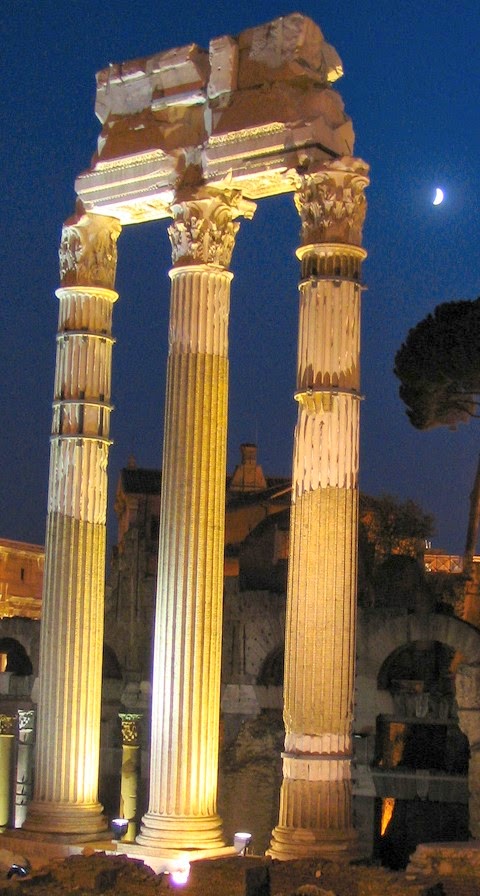
Part of the Forum, Rome
Part of the Forum, Rome (2005)
What was the Grand Tour?

The Grand Tour was a period of foreign travel commonly undertaken by gentlemen to finish off their education. It was popular from the mid-17th century until the end of the 18th century when the outbreak of the Napoleonic Wars stopped most foreign travel.

It saw a revival in the early 19th century after peace was restored in Europe. However, as travel became cheaper and easier, and in particular with the advent of the railways, visiting Europe ceased to be the province of the elite; the days of the Grand Tour were over.

Who went on the Grand Tour?

The Grand Tour was extremely exclusive and only undertaken by the very rich, mainly the sons of the aristocracy. This was because travel was both difficult and expensive. Travellers carried little money for fear of robbery. Instead, they took letters of credit from their London banks which they then presented in major cities.

An added benefit of sending young gentleman abroad was that they were able to sow their wild oats with as little inconvenience to their families as possible. Typically, the young travellers experienced greater freedom on the continent, and became involved in drinking, gaming and romantic liaisons.

The “bear leader”

Gentlemen often travelled abroad under the care of a tutor  - what Georgette Heyer refers to as a “bear leader”. In her novel, Devil’s Cub, the Marquis of Vidal discovers an English clergyman travelling in France: 
“There is a divine, lately passed through Paris, bear-leading some sprig of the nobility. They are bound for Italy.” 
Mr Comyn goes on to describe him as 
“...a needy divine…who has the good fortune to be in charge of a young gentleman making the Grand Tour.”1
A trunk for the Grand Tour at A La Ronde
How long did they go for?

Originally, the Grand Tour was expected to last about three and a half years: six months of travelling and three years of living abroad, allowing gentlemen to absorb the cultures they were visiting and improve their language skills.

The period of time spent abroad gradually shortened until most travelled for no more than two years.

Where did they go?

The most popular destination was France as French was the most commonly spoken second language. It was also the easiest place to get to. The fastest crossing was from Dover to Calais and the roads to Paris were very good.

From Paris, travellers usually proceeded to the Alps and then by boat on the Mediterranean to Italy. They would usually visit Rome and Venice but their tour might also include Spain, Portugal, Germany, Eastern Europe, the Balkans and the Baltic.

Samuel Johnson said:
A man who has not been in Italy is always conscious of an inferiority, from his not having seen what it is expected a man should see.2
"Campo Vaccino" - the Roman Forum  from A New Picture of Rome by Marien Vasi (1824)
"Campo Vaccino" - the Roman Forum
from A New Picture of Rome by Marien Vasi (1824)
What did they see?

The chief destinations were the great cities of the Renaissance and the remains of classical civilisations, which usually included the excavations at Herculaneum and Pompeii.

Classical statues were very popular, such as the Nile and the Tiber – statues representing river gods – which were discovered in Rome in the 16th century and formed part of the Pope’s collection. They were on display in the Museo Pio-Clementino from the 1770s.

Those on the Grand Tour commonly visited the French and Italian royal families and the British envoys, such as Sir William Hamilton, who was the British ambassador to the court of Naples from 1764 to 1800.

The Colosseum, Rome
The Colosseum, Rome (2005)
The legacy of the Grand Tour

One of the aims of the Grand Tour was to give gentlemen an aesthetic education. It was desirable to have an interest in French and Italian art. Travellers typically came home with crates full of souvenirs that they had collected, such as paintings, sculptures and fine clothes. Canaletto, Vernet and Panini all painted for the 18th century tourist market.

It was also fashionable to have your portrait painted, usually at the end of the Tour. Pompeo Batoni (1708-1787) painted over 175 portraits of travellers in Rome.

Did women go on the Grand Tour?

Although the Grand Tour was predominantly undertaken by gentlemen, a number of ladies also travelled abroad. The blue-stocking Hester Piozzi was particularly well-known for her travels in the 1770s and 1780s.

Hester Piozzi from The Life of Samuel Johnson    by James Boswell (1831)
Hester Piozzi from The Life of Samuel Johnson
by James Boswell (1831)
Women who were separated or divorced from their husbands often travelled abroad as they were more readily accepted on the continent. Georgiana, Duchess of Devonshire, went into exile abroad after becoming pregnant with her lover’s child in the early 1790s, whilst Caroline, Princess of Wales, travelled abroad from 1814 to 1820.

A group of women including Jane Parminter and her cousin Mary undertook the Grand Tour in the 1780s. When they returned in 1795, they built the sixteen-sided house, A la Ronde, in Exmouth to remind them of their travels and display their mementoes including several Bartolozzi prints and a shell picture.

A La Ronde, Exmouth, now owned by the National Trust

Headshot of Rachel Knowles author with sea in background(2021)
Rachel Knowles writes clean/Christian historical romance set in the time of Jane Austen. She has been sharing her research on this blog since 2011. Rachel lives in the beautiful Georgian seaside town of Weymouth, Dorset, on the south coast of England, with her husband, Andrew.

Find out more about Rachel's books and sign up for her newsletter here.

If you have enjoyed this blog and want to encourage me and help me to keep making my research freely available, please buy me a virtual cup of coffee by clicking the button below.

 
Notes
(1) Devil's Cub by Georgette Heyer (1932), a Georgian romance.
(2) A journal entry dated 11 April 1776 in James Boswell’s Life of Samuel Johnson (1831), volume 3.

Sources used include:
Boswell, James, The Life of Samuel Johnson LL.D, with new additions by John Wilson Croker (1831)
Foreman, Amanda, Georgiana, Duchess of Devonshire (HarperCollins, 1998, London)
Franklin, Michael J, Piozzi, Hester Lynch (1741-1821) Oxford Dictionary of National Biography (Oxford University Press, 2004; online edn Jan 2008, accessed 6 Oct 2012)
The National Trust, A la Ronde guidebook
Vasi, Marien, A New Picture of Rome and its environs, in the form of an itinerary (1824)

National Gallery website on The Grand Tour
The Grand Route – BBC Radio 4 programme

All photographs ©Regencyhistory.net