 |
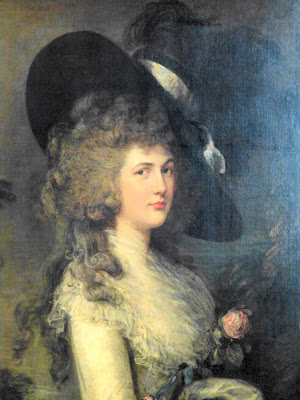
Georgiana, Duchess of Devonshire
by Thomas Gainsborough
in South Sketch Gallery, Chatsworth |
Who was The Duchess?
A lot of people are intrigued to know the true story of Georgiana, the flamboyant central character played by Keira Knightley in the film
The Duchess.
Georgiana Cavendish, Duchess of Devonshire (7 June 1757 - 30 March 1806), was a leading member of late Georgian society, famous for her extrovert personality, her extravagant fashions and her championing of
the Whigs led by
Charles James Fox. She lived in a notorious “ménage à trois” with her husband and his mistress,
Lady Elizabeth Foster, and had an affair with the future prime minister, Charles Grey, which almost ruined her.
Lady Georgiana Spencer was born in Althorp, Northamptonshire, on 7 June 1757. She was the eldest daughter of John Spencer, 1st Earl Spencer, one of the richest men in England, and Margaret Georgiana Poyntz. She had two siblings, George and Henrietta, known as Harriet, later
Lady Bessborough.
 |
Georgiana, Duchess of Devonshire
and her sister Harriet, Countess of Bessborough
from Lord Granville Leveson Gower's
private correspondence 1781-1821 (1916) |
Her father’s temper was somewhat uncertain, but her mother doted on her and remained jealous for her affection throughout her life. Georgiana was brought up to be accomplished, but not too bookish, with a keen emphasis on etiquette. In short, she was raised to make a brilliant marriage.
An illustrious marriage
Georgiana married William Cavendish, 5th Duke of Devonshire, on 7 June 1774, her 17th birthday. The Duke was extremely reserved and ill-matched to the emotionally demonstrative Georgiana.
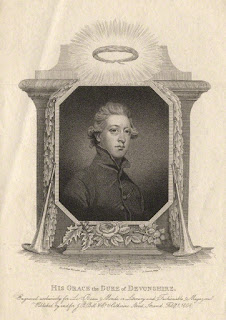 |
William Cavendish, 5th Duke of Devonshire
after Sir Joshua Reynolds
stipple engraving pubd 1808
NPG D13723 © National Portrait Gallery, London |
She in turn was unprepared for her duties as Duchess and hungry for affection. The Duke already had a mistress, Charlotte Spencer, with whom he had a daughter, Charlotte Williams. All he required of Georgiana was to provide him with an heir and this she seemed unable to do.
Queen of fashion
Starved of the affection she craved, Georgiana threw herself into the fashionable world. The Duchess became the darling of the Beau Monde. Where Georgiana led, the ton followed. She set the fashions, whether for three foot high ostrich feathers or tall towers of hair with elaborate decorations or, later, the penchant for free-flowing muslin dresses tied simply with ribbon round the waist.
Devoted Whig
Georgiana enthusiastically embraced her husband’s politics and became “a zealous advocate of the Whigs.”1 Devonshire House became the hub of the Whig party and Georgiana their leading hostess.
In 1780, Georgiana appeared on the hustings for the general election beside Charles James Fox, leader of the Whig party. In 1784, when Fox was struggling to keep his seat in the
Westminster election, Georgiana and her sister went amongst the electorate, canvassing for votes for Fox. Their actions were successful and Fox held his seat, but the press was humiliating, accusing Georgiana of exchanging kisses for votes and forcing her to take a less visible role in the future.
 |
Charles James Fox
from The History of White's
by Hon Algernon Bourke (1892) |
Many years later, Georgiana was instrumental in persuading the different political factions to work together, eventually forming the Ministry of All Talents in 1806.
The Devonshire House Circle
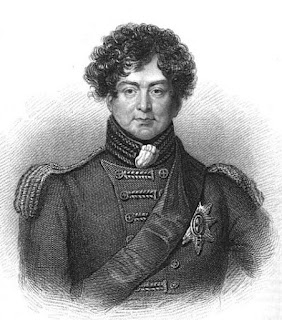 |
George, Prince of Wales
from La Belle Assemblée (1830)
|
Within the set, Georgiana popularised the Cavendish drawl – an affected manner of speaking that bespoke the aristocrat which she had learnt from the Duke.
Debts, debts and more debts
Georgiana was extravagant and gave the most splendid parties. But her real downfall was her addiction to gambling, resulting in ever-increasing debts which she did her best to hide from the Duke, placing a constant strain on her life. When she eventually confessed to her debts, it seemed for a while as if the Duke would divorce her, but instead he treated her with great forbearance.
Bess
In 1782, the Duke and Duchess went to Bath, where they met the fascinating
Lady Elizabeth Foster. She was separated from her husband and living in restricted circumstances and eagerly seized the opportunity to improve her situation. Lady Elizabeth, known as Bess, attached herself to Georgiana and was invited to return home with them.
 |
Lady Elizabeth Foster
from La Belle Assemblée (1810)
|
Bess succeeded in making herself indispensable to both Duchess and Duke, as friend to one and mistress to the other. Whether Georgiana’s emotional dependence clouded her judgement or whether Bess was blackmailing her over her ever mounting debts, Georgiana supported the strange “ménage à trois” that resulted.
Bess bore the Duke two illegitimate children, Caroline St Jules and Augustus Clifford, and became the Duchess of Devonshire after Georgiana’s death.
A devoted mother
Finally, in 1783, Georgiana, known as Little G, was born. Her sister, Harriet, known as Harryo, followed two years later, but it was not until 1790, when the hope of her ever producing an heir had almost disappeared, that
William, Marquess of Hartington, known as Hart, was born.
The love of Georgiana’s life
The true love of Georgiana’s life was the handsome young Whig politician, Charles Grey. She embarked upon an affair, but in 1791 she faced the worst crisis of her life when she discovered that she was carrying his child. The Duke gave her an ultimatum: give up Grey and the child or she would never see her three children again. Grey was furious when she chose her children over him.
 |
Lord Grey from The Historical and
Posthumous Memoirs of Sir Nathaniel Wraxall (1884)
|
Exile
Georgiana fled abroad giving birth to Eliza Courtney on 20 February 1792 and then handing her over to Grey’s parents to be brought up. She was never able to openly acknowledge her motherhood, although she did visit her daughter.
Eventually, the Duke sent word that she could return and in the autumn of 1793, she arrived in England after a two year absence.
Recluse
For several years following her exile, Georgiana lived a quiet life at
Chatsworth House. She suffered a severe eye infection, possibly a tumour, which left her blind in one eye and her face scarred from the primitive treatment that she had received.
 |
Chatsworth House, country seat of the Duke of Devonshire,
from The Lady's Magazine (1789) |
It was not until Little G was to be launched into society that Georgiana overcame her disability and once more entertained at Devonshire House. She rekindled her friendship with the Prince of Wales and became one of his main advisors.
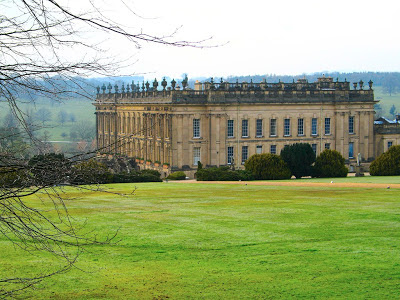 |
| Chatsworth House today |
|
See more of Chatsworth in
my photo tour of Chatsworth.
An intelligent woman
Georgiana is usually associated with her extravagant behaviour, but there is a different side to her which is often overlooked. She was both a writer and a scientist.
In December 1778, she published a satire,
The Sylph, and she also wrote a number of poems, including
The Passage of the Mountain of St Gothard and verses to accompany the bust of Charles James Fox at Woburn.
2
Find out about the plot of Georgiana's novel in my
Regency History guide to The Sylph.
Discover more about Georgiana in my blog post:
what The Sylph can tell us about Georgiana's life and feelings.
Whilst in exile abroad, Georgiana met the scientist Charles Blagden and developed a keen interest in chemistry. She also built a
mineral collection at Chatsworth.
 |
| The library, Chatsworth House |
Death
Georgiana died on 30 March 1806 from a liver complaint. She was buried in the family vault at All Saints Church, Derby, now Derby Cathedral, on Wednesday 9 April.3 All society mourned her passing.
There is no part of the world, I believe, where the angelic Duchess will not be deeply regretted; her kindness and beneficence were wound up with the happiness of so many.4
Rachel Knowles writes
clean/Christian historical romance set in the time of Jane Austen. She has been
sharing her research on this blog since 2011. Rachel lives in the beautiful
Georgian seaside town of Weymouth, Dorset, on the south coast of England, with
her husband, Andrew.
Find out more about Rachel's books and sign up for her newsletter here.
If you have enjoyed this blog and want to
encourage me and help me to keep making my research freely available, please
buy me a virtual cup of coffee by clicking the button below.
Notes
1. La Belle Assemblée (1806).
2. A newspaper report quoted in Amanda Foreman's biography suggests that The Sylph may have been published in December 1778 rather than in 1779.
3. This information was updated on 3 January 2020 after further research to answer a Facebook query. Originally I wrote that Georgiana was buried in St Stephen's Church as stated in The Times article of 10 April 1806 quoted in Foreman's biography Georgiana. However, I discovered that in Foreman's entry for the Oxford Dictionary of National Biography, the burial place was given as All Saints, Derby. I was able to view a copy of the original burial record on Family Search and this confirmed not only the place of burial as All Saints Church, Derby, but also that the burial was recorded as taking place on 9 April, not the 8 April. I have taken this as the most reliable source and changed my blog accordingly!
4. From a letter to Lady Elizabeth Foster from her son Augustus 28 May 1806, from The Two Duchesses, Family Correspondence (1898).
Sources used include:
Bell, John, La Belle Assemblée (John Bell, 1806, 1810, London)
| Bourke, Hon. Algernon, The History of White's (1892) |
Cavendish, Georgiana, Duchess of Devonshire and others, The Two Duchesses, Family Correspondence ed by Vere Foster (Blackie & Son, 1898, London)
Foreman, Amanda, Cavendish (née Spencer), Georgiana, Duchess of Devonshire (1757-1806) Oxford Dictionary of National Biography, Oxford University Press, 2004; online edn Sept 2010, accessed 11 Oct 2012)
Foreman, Amanda, Georgiana, Duchess of Devonshire (HarperCollins, 1998, London)
Hibbert, Christopher, George IV (1972, Longmans, 1973, Allen Lane, London)
McCalman, Iain, Devonshire, Duchess of, An Oxford Companion to the Romantic Age (OUP 2009 Oxford Reference Online, accessed 14 November 2011)
All photographs by Andrew Knowles © Regencyhistory.net


