Search this blog

Showing posts with label Kingston Lacy. Show all posts

Wednesday, 12 November 2014

The Philae obelisk at Kingston Lacy

Philae, a robotic probe, landed on a distant comet today. The European Space Agency hopes that the information that it gathers will help scientists understand the early development of the Solar System.

It shares its name with the Philae obelisk which stands at Kingston Lacy. The inscriptions on this obelisk helped Georgian scholars to understand Egyptian hieroglyphics.

Philae obelisk, Kingston Lacy
Discovery of the Philae obelisk

The Philae obelisk was discovered by William John Bankes on his first journey into Egypt in 1815. The pink granite needle was one of a pair in front of the Temple of Isis on Philae, an island in the Nile. The island has since been flooded as a result of the building of the Aswan Dam. Giovanni Finati acted as Bankes' guide and his travel journals give details of some of Bankes’ excavations.

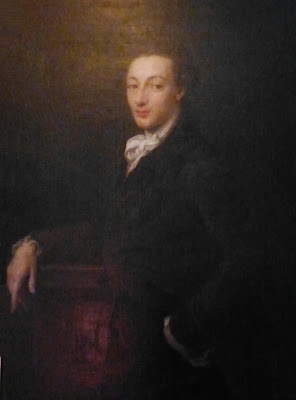
William John Bankes Portrait at Kingston Lacy
William John Bankes
Portrait at Kingston Lacy
Finati wrote that Bankes
“by the light of his candles at night found an inscription in it that had never been observed up to that time. It was also during this short stay that he first brought to light the granite pedestal of the obelisk, which has more than twenty lines upon it in the Greek character; this was buried altogether below the surface; but the probable position of it was conjectured from the obelisk lying near the spot, and search was made there accordingly. Some steps were taken, even then, towards the removal of this monument; but, for want of proper tackle, it was abandoned for that time.” (1)
On his second journey into Egypt in 1818-19, Bankes’ party included Henry Beechey, son of Sir William Beechey, the famous portrait painter; Dr Alessandro Ricci; Louis Linant de Bellefonds, a French midshipman; and Giovanni Belzoni. After starting out as a performing strong man at Sadler’s Wells, Belzoni had become a hydraulic engineer specialising in the excavation of Egyptian antiquities.

A disastrous attempt

Bankes employed Belzoni to take the Philae obelisk back to his family home of Kingston Lacy in Dorset, England.

Kingston Lacy, Dorset
The operation was fraught with difficulties and the first attempt to remove the obelisk ended in disaster. Finati wrote:
“Meanwhile the obelisk had been brought on rollers to the water's edge, and a boat below to receive it; all hands were at work, and five minutes more would have sufficed to set it afloat; when all at once the temporary pier built for it gave way under the pressure, and the monument plunged end long into the river almost out of sight.” (1)
A striking descent

Belzoni tried again with more success. Finati wrote:
“Mr Bankes said little, but was evidently disgusted by the accident, and set sail within a day or two afterwards, leaving me to witness Mr Belzoni's further operations respecting it. These were certainly conducted with great skill, though not quite without injury, and the scene of its actual descent down the cataract (2) (the passage being at that time narrower, and the fall more considerable, from the decrease of the Nile) was very striking, the great boat wheeling and swinging round, and half filling with water, while naked figures were crowding upon all the rocks, or wading or swimming between them, some shouting, and some pulling at the guide ropes, and the boat-owner throwing himself on the ground, scattering dust upon his head, and hiding his face. The danger, if any, was but for a few seconds, the equilibrium was recovered, and the mass glided smoothly and majestically onwards with the stream.” (1)
The obelisk arrived in England in 1821 and the Duke of Wellington offered to send a gun carriage to transport it to Kingston Lacy.

Duke of Wellington by William Salter (c1839) in the NPG
Duke of Wellington
by William Salter (c1839) in the NPG
The pedestal

The excavation of the obelisk’s pedestal was equally difficult. Finati wrote:
“The only commission left with me, was to see to the removal of the Greek pedestal belonging to the obelisk, from the spot where it had been left by Belzoni” but “the inundation (3) had already put the stone quite under water and out of sight, which rendered useless both the tackle and the boat that I had brought with me on purpose. For unfortunately, Mr Belzoni, fearing fresh disputes as to Mr Bankes's property in this pedestal, (though the original and uncontested finder of it,) had, in default of means for sending it at once down the cataract, carried it across from Philae to a low sand bank opposite, and there laid it on its so little judgment, that the smallest rise of the river must inevitably cover it, and make the transport impossible, during all those months of the year when the passage by water is the easiest, and it was owing to this, that, at length, after more than two years, it was found to be the best expedient to drag it by land, till it could be shipped below the rapids.” (1)
The Philae obelisk in the garden of Kingston Lacy
The platform

Finati noted that:
“This platform consists of four blocks only of red granite, and had served, without doubt, as the base to some obelisk now destroyed.” (1)
It was not until 1829 that Linant de Bellefonds, who had accompanied Bankes on his second trip to Egypt, sent what was left of the matching obelisk and the three huge steps of granite from Maharraga which were used to make the platform.(4)
 
Finati wrote:
“The heaviest block weighs nearly eleven tons, and was not removed till 1822, nor brought to England till 1829, when nineteen horses were required to drag it to its position at Kingston Hall.” (1)
It was damaged in transit and had to be repaired using some granite from the ruins of Leptis Magna – a prominent city in the Roman Empire situated in what is now Libya – given to Bankes for the purpose by George IV.

The inscription around the bottom of the Philae obelisk, Kingston Lacy
A monument to tax exemption!

The Duke of Wellington chose the spot in the garden, south of the house, for the site of the obelisk. He laid the foundation stone in 1827, but it was not until 1839 that the obelisk was finally erected.

The inscription written around the bottom of the obelisk reads as follows:

THIS SPOT WAS CHOSEN
AND THE FIRST STONE OF THE FOUNDATION LAID BY
ARTHUR DUKE OF WELLINGTON
AUGUST 17 1827.

WILLIAM JOHN BANKES ESQ MP ELDEST SON OF HENRY BANKES ESQ MP (5)
CAUSED THIS OBELISK AND THIS PEDESTAL FROM WHICH IT HAD FALLEN
TO BE REMOVED UNDER THE DIRECTION OF G BELZONI IN 1818
FROM THE ISLAND OF PHILAE BEYOND THE FIRST CATARACT
AND BROUGHT THIS PLATFORM FROM THE RUINS OF HIERASYCAMINON
IN NUBIA.

THE GRANITE USED IN THE REPARATION OF THIS MONUMENT
WAS BROUGHT FROM THE REMAINS OF LEPTIS MAGNA IN AFRICA
AND WAS GIVEN FOR THAT PURPOSE BY HIS MAJESTY
KING GEORGE IV.

THE INSCRIPTIONS ON THIS OBELISK AND PEDESTAL RECORD
THEIR DEDICATION TO KING PTOLEMY EUERGETES II
AND TWO CLEOPATRAS HIS QUEENS
WHO AUTHORIZED THE PRIESTS OF ISIS IN THE ISLE OF PHILAE
TO ERECT THEM ABOUT 150 YEARS BC
AS A PERPETUAL MEMORIAL OF EXEMPTION FROM TAXATION. 

The significance of the Philae obelisk

Bankes studied the obelisk carefully, and found he could make out the names of Ptolemy and Cleopatra. He made lithographs of the bilingual inscriptions – both Greek and hieroglyphic - and this helped scholars in their understanding of hieroglyphics.

Recently, a new study has been conducted on the obelisk. Current researchers have been able to confirm that Bankes’ lithograph, particularly of the hieroglyphs, was very accurate. Modern imaging methods have made it possible to read the whole of the Greek inscription for the first time. Much of this had been worn away by the time the obelisk arrived at Kingston Lacy.

Notes
(1) From Finat's Life and Adventures (1830).
(2) A cataract is a large waterfall.
(3) An inundation is a flooding.
(4) Finati mentioned four blocks of granite, but only three were used in the platform for the obelisk. It is not clear whether only three were transported or whether Finati remembered incorrectly.
(5) William John Bankes was the second, but eldest surviving son of Henry Bankes. His elder brother Henry died in 1806.

Sources used include:
Finati, Giovanni, Narrative of the Life and Adventures of Giovanni Finati, edited by William John Bankes, Esq (1830)
The National Trust, Kingston Lacy (guidebook) (1994)
The National Trust website

Photographs © Andrew Knowles - www.flickr.com/photos/dragontomato

Thursday, 19 December 2013

Frances Bankes's ball at Kingston Lacy 19 December 1791

Kingston Lacy from the garden
On 19 December 1791, Frances Bankes held a ball at Kingston Hall to celebrate the completion of the alterations to the house which had been going on since her marriage to Henry in 1784. It was also Henry Bankes's birthday.

The alterations

Henry Bankes had completely remodelled Kingston Hall. The principal rooms had been enlarged and new sash windows had been installed nearly everywhere. The entrance was moved from the north side to the east side where visitors now entered under an Ionic porch. A new flight of stone stairs led from the entrance up into the centre of the newly designed house. At the top of the stairs you could turn left into the library or right into the north parlour or go straight ahead into the ballroom which had been created out of the old entrance hall.

Plan of the first floor at Kingston Hall in December 1791
On display at ball re-enactment (Nov 2013)
 The ball

The ballroom was lit by huge numbers of candles with a splendid chandelier hanging down in the centre. The prospect was so dazzling that one guest declared it was like Aladdin's palace. There were around 140 guests with up to 36 couples dancing. The musicians had travelled from Salisbury to play for the ball. The dancing began at 9pm and continued until 7am in the morning, only stopping for supper at 1am.

The ballroom at the re-enactment  of Frances Bankes' ball (Nov 2013)
The ballroom at the re-enactment
of Frances Bankes' ball (Nov 2013)
In a letter to her mother-in-law, Frances expressed her satisfaction:
We had a much greater number of young Men than young Ladies by which means even the ugliest women in the room were sure to dance every dance unless they preferred sitting still which kept them all in good humour.1
Refreshments

Throughout the evening, guests could partake of refreshments: tea, red and white wine, negus (hot sweetened wine and water) and orgeat (a cooling drink made from barley or almonds and orange flower water) and a steady supply of cakes.

Supper

Supper was served at 1am when “the Eating Room and North Parlour Doors were opened, and displayed a very handsome Supper.”2 Long tables were laid out to accommodate all one hundred and forty guests at one sitting.

Frances wrote:
We borrowed all the men servants out of livery in the neighbourhood who were particularly clever and attentive in waiting, and I really believe that not a single Creature had occasion to call twice for any one thing, which is a great deal to say in so large a Company.2
The ballroom at the re-enactment  of Frances Bankes' ball (Nov 2013)
The ballroom at the re-enactment
of Frances Bankes' ball (Nov 2013)
Breakfast

Dancing continued from after supper until breakfast was served around 7am. When breakfast was over, the guests staying at the Hall retired and the other guests left. By 11am, the servants had cleared up the mess and were ready to serve a second breakfast for the guests who had stayed over.

A great success

Frances Bankes was delighted with the evening. She wrote to her mother-in-law that:
I was perfectly satisfied from beginning to end, you know I am very difficult, but every Creature appeared in high good humour.1
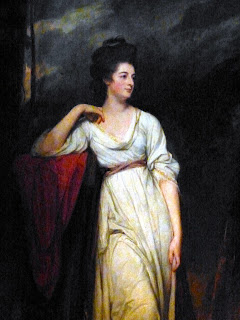
Frances Woodley by George Romney (1780-1)
In the drawing room at Kingston Lacy
A local newspaper report said:
In a word if elegant hospitality and the most attention on the part of the donors, and an assemblage of fashion and beauty seldom seen together, with the utmost good humour and satisfaction pervading the hall, have any merit in entertainments of this kind we may venture to pronounce that this never was or ever will be exceeded.3

Headshot of Rachel Knowles author with sea in background(2021)
Rachel Knowles writes faith-based Regency romance and historical non-fiction. She has been sharing her research on this blog since 2011. Rachel lives in the beautiful Georgian seaside town of Weymouth, Dorset, on the south coast of England, with her husband, Andrew.

Find out more about Rachel's books and sign up for her newsletter here.

If you have enjoyed this blog and want to encourage us and help us to keep making our research freely available, please buy us a virtual cup of coffee by clicking the button below.

 
Notes
1. In a letter from Frances to her mother-in-law quoted in the Ring of Eight leaflet.
2. In a letter from Frances to her mother-in-law quoted in the Kingston Lacy guidebook.
3. From the Ring of Eight leaflet.

Sources used include:
The National Trust, Kingston Lacy (guidebook) (1994)
Leaflets by the Ring of Eight group for the re-enactment of Frances Bankes' ball (Nov 2013)
 
All photos © RegencyHistory.net

Thursday, 12 December 2013

William John Bankes (1786-1855) - Egyptologist and friend of Lord Byron

William John Bankes  - portrait in the Spanish Room, Kingston Lacy
William John Bankes
- portrait in the Spanish Room, Kingston Lacy (2013)
Profile 

William Bankes (11 December 1786 - 15 April 1855) was an antiquarian and Egyptologist and the owner of the Kingston Lacy and Corfe Castle estates in Dorset.

Family

William John Bankes was born on 11 December 1786, the son of Henry Bankes, a wealthy Dorset landowner and politician, and Frances Woodley, a celebrated beauty, who was the daughter of the governor of the Leeward Islands. The Bankes estates included the family seat of Kingston Lacy, Corfe Castle, Studland and the Purbeck hills.

Education

William was educated at Westminster School and went up to Trinity College, Cambridge, in June 1803, where he became close friends with Lord Byron and gained a reputation for extravagance and wild living. Byron described William as his “collegiate pastor, and master, and patron” and “good-naturedly tolerant of my ferocities”. He declared that William “ruled the roast – or rather the roasting – and was father of all mischiefs.”1

Trinity College, Cambridge  from Memorials of Cambridge by CHCooper (1861)
Trinity College, Cambridge
from Memorials of Cambridge by CHCooper (1861)
Member of Parliament

Through the patronage of Lord Falmouth, who married his sister Ann, William became MP for Truro in 1810. He generally supported the government, but failed to shine in political circles and the speeches he made in parliament were unimpressive. He gave up his seat at the dissolution of 1812.

He later became Tory MP for the University of Cambridge (1822-6), Marlborough (1829-32), and then Dorset (1832-4).

Byron’s fashionable friend

Although only the second son, William became heir to his father in 1806 on the death of his elder brother, Henry, and was given an income of £8,000 a year. In 1815, he inherited Soughton Hall in Flintshire from his great grandfather.

During the season of 1812, William and Byron were central figures in society. Byron referred to William as one of his
...early friends. He is very clever, very original and has a fund of information: he is also very good-natured; but he is not much of a flatterer.2
Lord Byron from A Journal of the Conversations of Lord Byron with the Countess of Blessington (1893)
Lord Byron from A Journal of the Conversations
of Lord Byron with the Countess of Blessington
(1893)
William proposed to the bluestocking heiress Annabella Milbanke, but was refused. She later married Byron.
Lady Byron, from The Ladies' Monthly Museum (1816)
The Grand Tour

After his rejection, William followed in Byron’s footsteps and set out on his own Grand Tour. He followed Wellington’s army through Spain and Portugal, purchasing paintings during the disruption of the Peninsula War.

Over the next eight years, William travelled extensively in Italy, Syria and Egypt. He stayed on Mount Lebanon, crossed the desert to Palmyra, travelled up the Nile, explored to the east of the Dead Sea and became one of the first Europeans to reach Petra. Byron nicknamed him the Nubian Explorer or Discoverer.

He employed an Italian, Giovanni Finati, as his interpreter and guide. Later on, he was accompanied by another Italian, the archaeologist, Giovanni Belzoni.

William the archaeologist

The importance of William’s archaeological work has tended to be undervalued because he published very little apart from Finati’s memoirs. He and his team made detailed plans of various sites including the temple at Luxor which are a very important source for Egyptologists as they are not merely artistic impressions, but accurate records accompanied by careful transcriptions.

A stone slab of hieroglyphics in William Bankes' Egyptian collections at Kingston Lacy
From William Bankes' Egyptian collections at Kingston Lacy (2013)
William visited the temple of Rameses II and copied all the wall paintings by candlelight and recorded many objects which have since been lost or destroyed. He carried out excavations at El-Sebua in Nubia and at Abydos, where he found the table of the kings, which is now in the British Museum.

The Philae obelisk

William amassed a collection of Egyptian artefacts many of which are on display in the billiards room at Kingston Lacy. But his most impressive artefact is the Philae obelisk which has sat in the garden at Kingston Lacy since 1839. William employed Belzoni to bring the obelisk to England and it took him twenty years to do it! On the first attempt to move it, it ended up on the river bed. William produced lithographs of the bilingual inscriptions on the obelisk which were a valuable aid to understanding hieroglyphics.


An Egyptian sarcophagus and the Philae obelisk  in the gardens of Kingston Lacy
An Egyptian sarcophagus and the Philae obelisk
in the gardens of Kingston Lacy (2013)
Architectural projects

When he returned to England in 1820, William rebuilt Soughton Hall according to his own design, aided by the architect Charles Barry, whom he had met on his travels. Barry later designed the new building for the Travellers Club to which William belonged and the Houses of Parliament.

As soon as he inherited Kingston Hall in 1834, William started to remodel it with Barry’s help. He moved the entrance back to the north front and dug down to create a new basement entrance where visitors could alight from their carriages out of the rain. He created a Loggia and put in a marble staircase.3 He created a new, bigger dining room and the Spanish Room in which to display his Spanish paintings.
 
Artefacts from the Egyptian collections at Kingston Lacy
From the Egyptian collections at Kingston Lacy (2013)
Scandal

William’s personal life was beset with scandal. In 1820, he was forced to pay damages to James Silk Buckingham for libel after accusing him of stealing and publishing his research.

Then, in 1823, he was subject to a suit for criminal conversation, that is, adultery, with Anne Hobart, Lady Buckinghamshire.

But by far the most serious scandal revolved around repeated accusations of homosexuality, which was at that time a capital offence. In 1833, he was found not guilty after character references from, among others, the Duke of Wellington, but when further allegations were made in 1841, William fled the country.

Exile and death

William lived in Venice for the rest of his life, leaving his estates in the hands of his brother George. But he continued to transform Kingston Lacy from a distance under the supervision of his widowed sister, Lady Falmouth.

He commissioned Carlo Marochetti to create bronze sculptures of Chief Justice Bankes, Dame Mary and Charles I for the Loggia.

The sculptures of Dame Mary Bankes and Charles I  in the Loggia at Kingston Lacy
The sculptures of Dame Mary Bankes and Charles I
in the Loggia at Kingston Lacy (2013)
William died in Venice on 15 April 1855 and was buried in the family vault at Wimborne Minster, Dorset.

Headshot of Rachel Knowles author with sea in background(2021)
Rachel Knowles writes clean/Christian Regency era romance and historical non-fiction. She has been sharing her research on this blog since 2011. Rachel lives in the beautiful Georgian seaside town of Weymouth, Dorset, on the south coast of England, with her husband, Andrew.

Find out more about Rachel's books and sign up for her newsletter here.

If you have enjoyed this blog and want to encourage me and help me to keep making my research freely available, please buy me a virtual cup of coffee by clicking the button below.

 
Notes
(1) From a letter written by Lord Byron to John Murray, 19 October 1820 from Byron’s Letters and Journals, ed Leslie A Marchand (1976)
(2) From A Journal of the Conversations of Lord Byron with the Countess of Blessington (1893)
(3) A loggia is a roofed gallery, often on a upper storey overlooking a courtyard, which is open to the air on at least one side.

Sources used include:
Baigent, Elizabeth, Bankes, William John (1786-1855) Oxford Dictionary of National Biography (Oxford University Press, 2004; online edn Jan 2008, accessed 3 Oct 2013)
Blessington, Countess, A Journal of the Conversations of Lord Byron with the Countess of Blessington (1893)
Byron, George Gordon, Baron and Marchand, LA (ed) Byron's Letter and Journals (1976)
The National Trust, Kingston Lacy (guidebook) (1994)

Photographs © RegencyHistory.net

Friday, 8 November 2013

Henry Bankes (1757-1834)

Henry Bankes the Younger
Henry Bankes the Younger by Pompeo Batoni (1779)
In the library at Kingston Lacy
Profile

Henry Bankes (19 December 1757–17 December 1834) was a Tory MP and a trustee of the British Museum. He owned Kingston Lacy and the Corfe Castle estate in Dorset.

Family

Henry Bankes was born on 19 December 1757, the son of Henry Bankes, a wealthy Dorset landowner, and Margaret Wynne, daughter of the Bishop of Bath and Wells. The Bankes estate encompassed Corfe Castle and the surrounding Dorset countryside including the family seat of Kingston Lacy near Wimborne. 
 
The family also owned a lucrative black lead mine in Cumberland. Henry inherited the estate on the death of his father in 1776.

Kingston Lacy
Kingston Lacy
Education

Henry was educated at Westminster Hall and went up to Trinity Hall, Cambridge, in 1773 where he became friends with William Pitt. In 1778, he went on the Grand Tour and had his portrait painted by Pompeo Batoni in Rome in 1779. Whilst in Rome, he met John Soane and Robert Furze Brettingham, two young English architects who both drew up designs for remodelling Kingston Hall.

Tory MP

From 1780 to 1831, Henry served as a Tory MP, representing Corfe Castle (1780-1826) and then Dorset (1826-31). He was a great opponent of the American War of Independence and became a fierce enemy of Catholic Emancipation and other political reforms which led to his failure in the 1831 election.

Corfe Castle, Dorset
Throughout the majority of his parliamentary career, Henry kept a journal which provides an extensive account of the day-to-day business of the House of Commons.1

On 26 July 1832, the Tories held a dinner for him in Dorchester to celebrate fifty years of parliamentary service.

A man of principle

Although Henry generally supported the government of his friend, William Pitt the Younger, his “attachment to his friend was always restrained and regulated by high public principle” and his “independent mind revolted at every sacrifice of principle to private friendship.”2
 
He was also a friend of the Duke of Wellington.

William Pitt the Younger
from Posthumous Memoirs of his own time
by N Wraxall (1836)
A man of good sense

Nathaniel Wraxhall described Henry Bankes in his Memoirs:
His talents compensated by their calm solidity, for the want of brilliancy; his enunciation, slow, formal, precise, and not without some degree of embarrassment, was nevertheless always controlled by judgment, caution, and good sense. No man displayed more rectitude of intention, independence of mind, and superiority to every private object of interest, or of ambition.2
However, he went on to describe Henry’s manners as “altogether cold, repulsive, and destitute of amenity.”2

Family life

On 18 August 1784, Henry married Frances Woodley, a celebrated beauty and the daughter of William Woodley, the governor of the Leeward Islands. She brought the sum of £6,000 to the marriage.

Frances Woodley by George Romney (1780-1)
In the drawing room at Kingston Lacy
They had six children: Henry (1785), William (1786), George (1787), Edward (1794), Anne (1789) and Maria (1791).

Kingston Hall remodelled

After his marriage, Henry embarked on the huge task of altering Kingston Hall according to Brettingham’s design. The revised layout included the creation of a new entrance on the east side of the building, a kitchen block outside of the main house, a new dining room and a magnificent ballroom.

In December 1791, the Bankes family held a ball to celebrate the completion of the building works.
 

A reenactment of Frances Bankes' ball  at Kingston Lacy (2013)
A reenactment of Frances Bankes' ball
at Kingston Lacy (2013)
Antiquarian

Henry was a trustee of the British Museum and was active in parliament on its behalf.

The hall and staircase of the British Museum
from The Microcosm of London (1808-10)
In 1818, he published The Civil and Constitutional History of Rome from its Foundation to the Age of Augustus.

Death

Tregothnan House, Cornwall,
from Devonshire and Cornwall illustrated
by J Britton & EW Brayley (1832)
Henry Bankes died on 17 December 1834 in Tregothnan, Cornwall, at the home of his daughter Anne and her husband, Lord Falmouth. He was buried at Wimborne Minster, Dorset, on 24 December.

Wimborne Minster
Wimborne Minster
from The Beauties of England and Wales
by J Britton & EW Brayley (1803)

Headshot of Rachel Knowles author with sea in background(2021)
Rachel Knowles writes faith-based Regency romance and historical non-fiction. She has been sharing her research on this blog since 2011. Rachel lives in the beautiful Georgian seaside town of Weymouth, Dorset, on the south coast of England, with her husband, Andrew.

Find out more about Rachel's books and sign up for her newsletter here.

If you have enjoyed this blog and want to encourage us and help us to keep making our research freely available, please buy us a virtual cup of coffee by clicking the button below.

 
Notes
1. This journal comprises 177 notebooks which are in the archives of the Dorset records office.
2. Posthumous Memoirs of his own time by N Wraxhall (1836).

Sources used include:
Ackermann, Rudolph, and Pyne, William Henry, The Microcosm of London or London in miniature Volume 1-3 (Rudolph Ackermann 1808-1810, reprinted 1904)
Britton, John & Brayley, Edward Wedlake, Devonshire and Cornwall illustrated, from original drawings by T Allom, WH Bartlett etc with historical and topographical descriptions (1832)
Britton, John & Brayley, Edward Wedlake, The Beauties of England and Wales (1803, London)
Farrell, SM, Bankes, Henry (1757-1834) Oxford Dictionary of National Biography (Oxford University Press, 2004; online edn Jan 2008, accessed 3 Oct 2013)
The National Trust, Kingston Lacy (guidebook) (1994)
Wraxall, Sir Nathaniel William, Posthumous Memoirs of his own time (1836)

Photographs © Andrew Knowles - RegencyHistory.net

Friday, 11 October 2013

Regency History's guide to Kingston Lacy

Kingston Lacy from the garden
Kingston Lacy from the garden (2013)
Where is Kingston Lacy?

The Kingston Lacy estate is situated near Wimborne in Dorset.

Kingston Lacy
Kingston Lacy (2016)
History

Sir John Bankes, MP and Lord Chief Justice, bought the Isle of Purbeck, Corfe Castle and the Kingston Lacy estate in 1635-6. During the Civil War, Sir John’s wife defended the castle for the King, but was defeated in 1646, and Corfe Castle was destroyed by the Parliamentarians.

Bronze relief of the siege of Corfe Castle,  in the house at Kingston Lacy
Bronze relief of the siege of Corfe Castle,
in the house at Kingston Lacy (2013)
In 1663, Sir John’s son, Sir Ralph Bankes, commissioned the architect Roger Pratt to design a new family seat on the Kingston Lacy estate. The building and furnishing of Kingston House put Sir Ralph seriously into debt and his son was obliged to lease it to the 1st Duke of Ormonde to save money. In 1693, the family was able to return to Kingston Hall and it remained the residence of the Bankes family until 1981 when it was given to the National Trust, as part of a huge bequest which included Corfe Castle and much of the surrounding land.

Georgian connection

Kingston Lacy was owned by the Bankes family throughout the Georgian and Regency periods.

Henry Bankes (1698-1776) inherited from his brother John in 1772 and, although already in his seventies, he reorganised the estate with great determination.

Henry Bankes the Younger (1757-1834) was a Tory MP and a trustee of the British Museum. He was married to Frances Woodley, a renowned beauty. His alterations to Kingston House included the creation of a ballroom.

William John Bankes (1786-1855) was a friend of Lord Byron and travelled extensively. He was an early Egyptologist and his acquisitions included the Philae obelisk. His modifications to Kingston House included the creation of the Spanish room to house his collection of Spanish paintings and a grand marble staircase. He was forced into exile in 1841 due to accusations of homosexuality.

The sarcophagus and the Philae obelisk, Kingston Lacy
The sarcophagus and the Philae obelisk (2013)
George Bankes (1787-1856) managed the family estates in his brother William’s absence. His widowed sister, Anne, Lady Falmouth, lived at Kingston Lacy from 1841 whilst he lived on the family’s Corfe estate. George was married to Georgina Charlotte Nugent, reputedly the illegitimate daughter of Ernest, Duke of Cumberland, by Lady Nugent. He was Tory MP for Cambridge and opposed Catholic emancipation and the reform bill. He was mayor of Corfe three times and wrote The Story of Corfe Castle and of Many who have Lived There (1853).

What is there to see today?

Kingston Lacy is owned by the National Trust. Particular things to look out for are:
• The original keys of Corfe Castle on display in the library.

The keys of Corfe Castle
The keys of Corfe Castle (2013)
• The portrait of Frances Woodley by George Romney in the drawing room (what was the ballroom in her day).

The drawing room, Kingston Lacy  - the portrait of Frances Woodley is on the right
The drawing room, Kingston Lacy (2013)
- the portrait of Frances Woodley is on the right
• The portrait of Charlotte Dee, Lady Nugent, the Duke of Cumberland’s mistress and mother to George Bankes’ wife Georgina, painted by Sir Thomas Lawrence, on display in the drawing room.
• The marble staircase.
• The bronze sculptures of Sir John and Lady Bankes and Charles I sitting above a relief of the siege of Corfe Castle on the half-landing up the marble staircase.

Sculpture of Lady Bankes
Sculpture of Lady Bankes (2013)
• William Bankes’s Spanish room, displaying his collection of Spanish paintings.
• William Bankes’s Egyptian collection in the billiards room.

Part of William Bankes' Egyptian collection
Part of William Bankes's Egyptian collection (2013)
• The Philae obelisk on the south lawn. Be sure to read the metal plates around the bottom – they are quite amusing! You can read more about the Philae obelisk here.
• The sarcophagus on the south lawn.

The sarcophagus and the Philae obelisk, Kingston Lacy
The sarcophagus and the Philae obelisk (2013)
Last visited July 2022.

Headshot of Rachel Knowles author with sea in background(2021)
Rachel Knowles writes clean/Christian Regency era romance and historical non-fiction. She has been sharing her research on this blog since 2011. Rachel lives in the beautiful Georgian seaside town of Weymouth, Dorset, on the south coast of England, with her husband, Andrew.

Find out more about Rachel's books and sign up for her newsletter here.

If you have enjoyed this blog and want to encourage me and help me to keep making my research freely available, please buy me a virtual cup of coffee by clicking the button below.


Sources used include:
Bankes, George, The Story of Corfe Castle, and of Many who Have Lived There (1853)
The National Trust, Corfe Castle (guidebook) (1985)
The National Trust, Kingston Lacy (guidebook) (1994)

Photographs by © RegencyHistory