Search this blog

Showing posts with label British Museum. Show all posts

Thursday, 22 May 2014

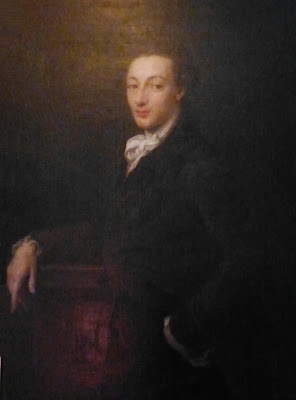
Sir Richard Colt Hoare, 2nd Baronet (1758-1838)

Sir Richard Colt Hoare - a painting at Stourhead
Sir Richard Colt Hoare - a painting at Stourhead (2014)
Profile

Sir Richard Colt Hoare (9 December 1758 – 19 May 1838) was an antiquarian and historian and the owner of the Stourhead estate in Wiltshire.
 

Family background

Richard Colt Hoare was born in Barnes, Surrey, on 9 December 1758, the eldest son of Sir Richard Hoare, 1st Baronet, who had married his first cousin, Anne Hoare, the younger daughter of Henry Hoare of Stourhead, senior partner of Hoare’s Bank. Richard’s mother died when he was six months old and his father remarried. He had six children by his second wife, Frances Acland, and Richard grew up with his half-siblings in Surrey.

Hoare's Bank

Richard pursued his classical studies with a tutor whilst training for a role in the family business, Hoare’s Bank. His grandfather, known as ‘Henry the Magnificent’, gave him a house in Lincoln’s Inn Fields and an allowance of £2,000 a year when he came of age.

Marriage

On 18 August 1783, Richard married Hester Lyttelton, daughter of William Lyttelton of Hagley, 1st Baron Lyttelton. They had one son, Henry, on 17 September 1784, but tragically, Hester died the following year, on 22 August 1785.

Grand Tour

Shortly after the death of his wife, Richard inherited Stourhead from his grandfather, Henry Hoare, on the condition that he left the bank. Henry made this stipulation to ensure the survival of the Stourhead estate in the event that the bank should fail in the future.
 
Stourhead
Stourhead
Deprived of both wife and career, Richard went on a Grand Tour, and for the next six years, he travelled extensively abroad, keeping detailed diaries. These were later published in Recollections abroad: journals of tours on the continent, 1785-1791 (1815-18). He subsequently toured throughout Britain and Ireland, recording his travels with the same meticulous detail.

Antiquarian
 
Richard was very interested in the history and archaeology of Wiltshire and amassed a huge collection of books and drawings. He was the author of The Ancient History of South Wiltshire (1812, 1819) and wrote the majority of The History of Modern Wiltshire (1822-44).

He was elected a fellow of the Society of Antiquaries and admitted to the Society of Dilettanti in 1792. In 1825, he gave his collection of Italian topographical and historical works to the British Museum.

Sportsman
 
Richard was a keen sportsman and bought a fishing lodge in Bala in Gwynedd, Wales, in 1796. He also had a house in St James’s Square, London.

Stourhead

The Temple of Apollo in the gardens at Stourhead
The Temple of Apollo in the gardens at Stourhead (2014)
Richard developed the gardens at Stourhead, planting trees and collecting exotic plants, leading to his election as a member of the Linnean Society in 1812.

Finding that the house at Stourhead did not have enough room for his collections, in 1800 he added two wings, one for the Library to house his books and the other the Picture Gallery to display his paintings.1

Richard Colt Hoare in his library at Stourhead
Richard Colt Hoare in his Library at Stourhead (Photo 2014)
Patron of the arts

Chippendale chairs in the Picture Room, Stourhead
Chippendale chairs in the Picture Room, Stourhead (2014)
Between 1798 and 1820, Richard employed Thomas Chippendale the Younger to make furnishings for Stourhead to the value of around £3,500. Chippendale’s work included furniture for Richard’s two new rooms, some pieces in the Egyptian style and others in an advanced Grecian taste.

Sarcophagus planter by Chippendale in the Picture Room, Stourhead
Sarcophagus planter by Chippendale in the Picture Room, Stourhead (2014)
Richard commissioned works from the water-colourist Francis Nicholson, the portrait artist Samuel Woodforde and JMW Turner.

An unsatisfactory son

The relationship between Richard and his son Henry was very strained. Henry was devoted to a life of pleasure and his father was left to settle his debts. Henry died in 1836 leaving one daughter, Ann.

Illness and death

Richard suffered from gout and rheumatism and became increasingly deaf. He lived mainly at Stourhead with occasional visits to Bath. He died on 19 May 1838 at Stourhead and was buried at St Peter’s, Stourton. There is a marble statue to his memory in Salisbury Cathedral.

Salisbury Cathedral
Salisbury Cathedral (2014)

Headshot of Rachel Knowles author with sea in background(2021)
Rachel Knowles writes faith-based Regency romance and historical non-fiction. She has been sharing her research on this blog since 2011. Rachel lives in the beautiful Georgian seaside town of Weymouth, Dorset, on the south coast of England, with her husband, Andrew.

Find out more about Rachel's books and sign up for her newsletter here.

If you have enjoyed this blog and want to encourage me and help me to keep making my research freely available, please buy me a virtual cup of coffee by clicking the button below.


Note
(1) These were the only rooms to escape the fire which devastated the house at Stourhead in 1902.

Sources used include:
Hutchings, Victoria, Hoare, Henry (1705-1785) Oxford Dictionary of National Biography (Oxford University Press, 2004; online edn May 2009; accessed 15 May 2014)
Hutchings, Victoria, Hoare, Sir Richard Colt (1758-1838) Oxford Dictionary of National Biography (Oxford University Press, 2004; online edn May 2009; accessed 15 May 2014)
Lomax, James, Chippendale, Thomas (bap 1718, d1779) Oxford Dictionary of National Biography (Oxford University Press, 2004; online edn May 2009, accessed 22 May 2014)

Blog update (May 2014)

Whilst researching a post on some paintings at Stourhead for my newsletter, I discovered that the painting which I had previously labelled as Hester Lyttelton, Sir Richard Colt Hoare's wife, was in fact of NOT of her at all! 
 
Someone had previously suggested that the painting was not of Hester, but as it was inscribed as such, I thought I was on safe ground. But no! According to the detailed description of this painting in the National Trust Collections, it was probably of Mrs John O'Neill (someone that I had never heard of before!)

Probably Mrs John O'Neill - a painting at Stourhead
Probably Mrs John O'Neill -
a painting at Stourhead (2014)
   

All photographs © Andrew Knowles - RegencyHistory.net

Wednesday, 23 April 2014

The Society of Dilettanti

Group of members of the Dilettanti Society by Sir Joshua Reynolds (1779)  The central figure with the vase is Sir William Hamilton  from History of the Society of Dilettanti by L Cust (1914)
Group of members of the Dilettanti Society by Sir Joshua Reynolds (1779)
The central figure with the vase is Sir William Hamilton
from History of the Society of Dilettanti by L Cust (1914)
The foundation of the Dilettanti Society

The Society of Dilettanti was founded in the early 1730s by a group of men who had visited Italy on the Grand Tour and wanted to continue to share and build on their experiences.

The preface to Ionian Antiquities stated that:
In the year 1734 some gentlemen who had travelled in Italy, desirous of encouraging at home a taste for those objects which had contributed to their entertainment abroad, formed themselves into a society under the name of the Dilettanti.1,2
The name Dilettanti comes from the Latin 'dilettare', to take delight in, and the Society adopted a policy of 'seria ludo' – looking at serious subjects in a light-hearted manner.

Membership

In 1736, there were 46 members, mostly “young men of rank and fashion”3. New members had to be personally known to an existing member and elected in a secret ballot.

The ballot box  from History of the Society of Dilettanti by L Cust (1914)
The ballot box
from History of the Society of Dilettanti by L Cust (1914)
In 1743, Horace Walpole criticised the Society of Dilettanti, saying that it was
...a club, for which the nominal qualification is having been in Italy, and the real one being drunk; the two chiefs are Lord Middlesex and Sir Francis Dashwood, who were seldom sober the whole time they were in Italy.4
The influence of later members such as Sir William Hamilton, Charles Townley and Richard Payne Knight shifted the focus of the Society toward archaeological investigations. By the end of the 18th century, the Society was the top British establishment for the study of classical antiquities.

Meetings

The Society’s first documented meeting was at the Bedford Head Tavern, Covent Garden, on 6 March 1736. Subsequent meetings were held in various taverns, but by 1757, the Society usually met for dinner on alternate Sundays at the Star and Garter in Pall Mall.5

From 1800 to 1810, they met at Mr Parslow’s tavern in St James’ Street. The Society bought a site in Cavendish Square in 1747 to erect their own building, but plans were later abandoned and the land sold again, at a profit.

Two boxes were commissioned by the Society – an elaborate balloting box for the secret ballots and a box in the shape of the Tomb of Bacchus to hold the Society’s records.

The ballot box  from History of the Society of Dilettanti by L Cust (1914)
The Tomb of Bacchus
from History of the Society of Dilettanti by L Cust (1914)
There was an element of mystery surrounding the proceedings of the Dilettanti Society. It was rumoured that the Society’s rituals were infused with sexual and religious overtones. The officers of the Society were required to dress for their roles. According to the minutes, the President was supposed to wear a crimson toga and the Secretary, to dress like Machiavelli. Some of the members had secret cabinets filled with erotic curiosities.

Portraits and face-money

The Society appointed George Knapton as painter and passed a resolution that every member should have his portrait painted and presented to the Society. A further resolution introduced an annual fine of one guinea on any member who had failed to present his portrait. This was designated 'face-money' and raised considerable sums of money for the Society.

Knapton resigned in 1763 and was replaced by James Stuart, but Stuart failed to paint any portraits and Sir Joshua Reynolds took over in 1769. Reynolds painted two large pictures of members of the Dilettanti Society. These reflected both the serious nature of the Society and the light-hearted camaraderie between its members.

Group of members of the Dilettanti Society by Sir Joshua Reynolds (1779) from History of the Society of Dilettanti by L Cust (1914)
Group of members of the Dilettanti Society by Sir Joshua Reynolds (1779)
from History of the Society of Dilettanti by L Cust (1914)
Subsequently, Sir Thomas Lawrence and then Sir Martin Archer Shee were appointed to this role.

The Royal Academy

In the 1750s, the Society was involved in discussions about the creation of a Royal Academy of art, but it wanted too much influence and the negotiations broke down. However, the Society provided financial support for the Royal Academy in 1775 by starting to provide scholarships for Academy students to study in Italy and Greece.

Sponsorship

The Society raised money through membership subscriptions and face-money and used it to influence taste and sponsor the study of Greek and Roman art.

In the 1740s, the Society sponsored the Earl of Middlesex’s series of Italian operas in London.

In the 1750s, the Society sponsored James Stuart and Nicholas Revett’s Athenian expedition. This resulted in the influential publication, Antiquities of Athens Measured and Delineated which was published in three volumes between 1762 and 1794.

View of Athens from The Antiquities of Athens (Vol I) by J Stuart & N Revett (1762)
View of Athens from The Antiquities of Athens (Vol I)
by J Stuart & N Revett (1762)
In 1764, the Society backed a trip to Ionia – the first archaeological trip to Asia Minor sponsored by any British Institution. The men sponsored were Richard Chandler, a classical scholar and inscription expert; Nicholas Revett, the architect from the Athenian expedition; and William Pars, a topographical artist. They carried out the first excavations of the temple of Zeus at Nemea. The findings of the trip were documented in Antiquities of Ionia (1797).

A second expedition to Ionia was sponsored in 1812, with the team headed by topographical artist, William Gell. Their research was recorded in Unedited Antiquities of Attica (1817).

The Society in disrepute

In 1787, the Dilettanti published An Account of the Worship of Priapus. It included a letter from Sir William Hamilton to Sir Joseph Banks describing his finds concerning the Neapolitan cult of the worship of Priapus. More controversially, it included an essay by Knight which made outrageous suppositions about ancient sexual conduct in religious ceremonies. It was ill-received and damaged Knight’s reputation.

Specimens of Ancient Sculpture

In 1808, the Society published the first volume of Specimens of Ancient Sculpture Aegyptian, Etruscan, Greek and Roman: selected from different collections in Great Britain. John Samuel Agar was responsible for the highly detailed drawings of the classical statutory which were then engraved for this volume. The collections were all held by members of the Dilettanti, but those of Knight and Townley were the most prominent.

The Elgin Marbles

Some of the Parthenon marbles in the British Museum (2014)
Knight was vehemently opposed to the purchase of the Parthenon marbles brought back by Lord Elgin. For more than ten years, he attempted to discredit them as Roman copies of Phidias’ originals. Other members thought differently. The British Museum bought the marbles in 1816 and the Dilettanti Society donated the two pieces of Parthenon frieze that they had brought back from the first Ionian expedition. The episode further damaged Knight’s reputation.

Prominent members

In its early days, prominent members of the Dilettanti Society included:
• Charles Sackville, Earl of Middlesex, later 2nd Duke of Dorset
• Sir Francis Dashwood, later Lord le Despencer
• Simon Harcourt, Viscount and later Earl Harcourt
• Gustavus Hamilton, 2nd Viscount Boyne
• William Ponsonby, later Viscount Duncannon and Earl of Bessborough
• Richard Grenville, Earl Temple
• Sewallis Shirley, Comptroller of Queen Charlotte’s household
• Sir James Gray, British Resident at Venice and British Envoy to Naples and later Spain
• Simon Luttrell, later Earl of Carhampton
• Sir George Gray
• George Knapton

Other notable members included:
• Sir Joshua Reynolds (1766)
• Charles James Fox (1769)
• George Selwyn (1770)
• William Cavendish, Duke of Devonshire (1770)
• Sir Joseph Banks (1774)
• Charles Francis Greville (1774)
• Sir William Hamilton (1777)
• David Garrick (1777)
• Richard Payne Knight (1781)
• Sir George Beaumont (1784)
• Charles Townley (1786)
• Sir Richard Colt Hoare, Baronet (1792)
• Sir Thomas Lawrence (1792)
• Benjamin West (1792)
• Thomas Hope (1800)

Notes
(1) The exact date of the formation of the Society of Dilettanti is unknown. This passage states that it was formed in 1734, but the first recorded meeting was not until 1736. Society annals indicate that the first meetings of the Society may have been held as early as December 1732 in Italy.
(2) From the introduction to Ionian Antiquities, published by the Dilettanti Society (1769).
(3) From History of the Society of Dilettanti by L Cust (1914).
(4) In a letter from Horace Walpole to Sir Horace Mann 14 April 1743 in Letters of Horace Walpole (1840).
(5) From Life and Times of Sir Joshua Reynolds by CR Leslie and T Taylor (1865). Jason Kelly in the Oxford Dictionary of National Biography refers to the Society meeting five times a year in the Star and Garter from 1757, but this may have been referring to business meetings as opposed to regular dining.

Headshot of Rachel Knowles author with sea in background(2021)
Rachel Knowles writes clean/Christian Regency era romance and historical non-fiction. She has been sharing her research on this blog since 2011. Rachel lives in the beautiful Georgian seaside town of Weymouth, Dorset, on the south coast of England, with her husband, Andrew.

Find out more about Rachel's books and sign up for her newsletter here.

If you have enjoyed this blog and want to encourage me and help me to keep making my research freely available, please buy me a virtual cup of coffee by clicking the button below.

 
Sources used include:
Cust, Lionel, MA and Colvin, Sir Sidney, MA, History of the Society of Dilettanti (1914)
Kelly, Jason, Society of Dilettanti (act. 1732-2003), Oxford Dictionary of National Biography (Oxford University Press, May 2006; online edn Sept 2012, accessed 12 Jan 2013)
Leslie, Charles Robert, RA, and Taylor, Tom, MA, Life and Times of Sir Joshua Reynolds (1865)
Stuart, James and Revett, Nicholas, The Antiquities of Athens, measured and delineated Vol I (1762)
Walpole, Horace, The Letters of Horace Walpole, Earl of Orford, in six volumes (1840)

John Paul Getty Museum website – Dilettanti exhibition (2008)

Photographs © Regencyhistory.net

Friday, 8 November 2013

Henry Bankes (1757-1834)

Henry Bankes the Younger
Henry Bankes the Younger by Pompeo Batoni (1779)
In the library at Kingston Lacy
Profile

Henry Bankes (19 December 1757–17 December 1834) was a Tory MP and a trustee of the British Museum. He owned Kingston Lacy and the Corfe Castle estate in Dorset.

Family

Henry Bankes was born on 19 December 1757, the son of Henry Bankes, a wealthy Dorset landowner, and Margaret Wynne, daughter of the Bishop of Bath and Wells. The Bankes estate encompassed Corfe Castle and the surrounding Dorset countryside including the family seat of Kingston Lacy near Wimborne. 
 
The family also owned a lucrative black lead mine in Cumberland. Henry inherited the estate on the death of his father in 1776.

Kingston Lacy
Kingston Lacy
Education

Henry was educated at Westminster Hall and went up to Trinity Hall, Cambridge, in 1773 where he became friends with William Pitt. In 1778, he went on the Grand Tour and had his portrait painted by Pompeo Batoni in Rome in 1779. Whilst in Rome, he met John Soane and Robert Furze Brettingham, two young English architects who both drew up designs for remodelling Kingston Hall.

Tory MP

From 1780 to 1831, Henry served as a Tory MP, representing Corfe Castle (1780-1826) and then Dorset (1826-31). He was a great opponent of the American War of Independence and became a fierce enemy of Catholic Emancipation and other political reforms which led to his failure in the 1831 election.

Corfe Castle, Dorset
Throughout the majority of his parliamentary career, Henry kept a journal which provides an extensive account of the day-to-day business of the House of Commons.1

On 26 July 1832, the Tories held a dinner for him in Dorchester to celebrate fifty years of parliamentary service.

A man of principle

Although Henry generally supported the government of his friend, William Pitt the Younger, his “attachment to his friend was always restrained and regulated by high public principle” and his “independent mind revolted at every sacrifice of principle to private friendship.”2
 
He was also a friend of the Duke of Wellington.

William Pitt the Younger
from Posthumous Memoirs of his own time
by N Wraxall (1836)
A man of good sense

Nathaniel Wraxhall described Henry Bankes in his Memoirs:
His talents compensated by their calm solidity, for the want of brilliancy; his enunciation, slow, formal, precise, and not without some degree of embarrassment, was nevertheless always controlled by judgment, caution, and good sense. No man displayed more rectitude of intention, independence of mind, and superiority to every private object of interest, or of ambition.2
However, he went on to describe Henry’s manners as “altogether cold, repulsive, and destitute of amenity.”2

Family life

On 18 August 1784, Henry married Frances Woodley, a celebrated beauty and the daughter of William Woodley, the governor of the Leeward Islands. She brought the sum of £6,000 to the marriage.

Frances Woodley by George Romney (1780-1)
In the drawing room at Kingston Lacy
They had six children: Henry (1785), William (1786), George (1787), Edward (1794), Anne (1789) and Maria (1791).

Kingston Hall remodelled

After his marriage, Henry embarked on the huge task of altering Kingston Hall according to Brettingham’s design. The revised layout included the creation of a new entrance on the east side of the building, a kitchen block outside of the main house, a new dining room and a magnificent ballroom.

In December 1791, the Bankes family held a ball to celebrate the completion of the building works.
 

A reenactment of Frances Bankes' ball  at Kingston Lacy (2013)
A reenactment of Frances Bankes' ball
at Kingston Lacy (2013)
Antiquarian

Henry was a trustee of the British Museum and was active in parliament on its behalf.

The hall and staircase of the British Museum
from The Microcosm of London (1808-10)
In 1818, he published The Civil and Constitutional History of Rome from its Foundation to the Age of Augustus.

Death

Tregothnan House, Cornwall,
from Devonshire and Cornwall illustrated
by J Britton & EW Brayley (1832)
Henry Bankes died on 17 December 1834 in Tregothnan, Cornwall, at the home of his daughter Anne and her husband, Lord Falmouth. He was buried at Wimborne Minster, Dorset, on 24 December.

Wimborne Minster
Wimborne Minster
from The Beauties of England and Wales
by J Britton & EW Brayley (1803)

Headshot of Rachel Knowles author with sea in background(2021)
Rachel Knowles writes faith-based Regency romance and historical non-fiction. She has been sharing her research on this blog since 2011. Rachel lives in the beautiful Georgian seaside town of Weymouth, Dorset, on the south coast of England, with her husband, Andrew.

Find out more about Rachel's books and sign up for her newsletter here.

If you have enjoyed this blog and want to encourage us and help us to keep making our research freely available, please buy us a virtual cup of coffee by clicking the button below.

 
Notes
1. This journal comprises 177 notebooks which are in the archives of the Dorset records office.
2. Posthumous Memoirs of his own time by N Wraxhall (1836).

Sources used include:
Ackermann, Rudolph, and Pyne, William Henry, The Microcosm of London or London in miniature Volume 1-3 (Rudolph Ackermann 1808-1810, reprinted 1904)
Britton, John & Brayley, Edward Wedlake, Devonshire and Cornwall illustrated, from original drawings by T Allom, WH Bartlett etc with historical and topographical descriptions (1832)
Britton, John & Brayley, Edward Wedlake, The Beauties of England and Wales (1803, London)
Farrell, SM, Bankes, Henry (1757-1834) Oxford Dictionary of National Biography (Oxford University Press, 2004; online edn Jan 2008, accessed 3 Oct 2013)
The National Trust, Kingston Lacy (guidebook) (1994)
Wraxall, Sir Nathaniel William, Posthumous Memoirs of his own time (1836)

Photographs © Andrew Knowles - RegencyHistory.net

Monday, 25 February 2013

Mary Anning, fossilist (1799-1847)

Mary Anning statue, Lyme Regis, Dorset (2022)
Mary Anning statue, Lyme Regis (2022)
Profile

Mary Anning (21 May 1799 - 9 March 1847) was a famous fossilist who lived in Lyme Regis, Dorset.

Blue plaque about Mary Anning outside Lyme Regis museum (2013)
Blue plaque about Mary Anning
outside Lyme Regis museum (2013)
Family background

Mary Anning was born in Lyme Regis, Dorset, on 21 May 1799, one of only two surviving children of Richard and Mary Anning. The other was her brother, Joseph, who was three years older. Richard was a carpenter who supplemented his income by finding and selling curiosities – bones and fossils he had found in the cliffs, which he sold as mementoes of Lyme. They attended the Congregational chapel for dissenters in Coombe Street.

A miraculous escape

On 19 August 1800, Mary had a close brush with death. Elizabeth Haskin, her nurse, had taken the fifteen month old Mary up to the Rack Field to get some air and watch a display of horse riding. There was a violent storm and the girl sheltered underneath some elm trees with Mary in her arms. Elizabeth and two other girls were struck dead by lightning. Miraculously, Mary was taken home to her mother alive.

Flood waters

The family lived in a house on the bridge in Lyme very near to the sea. On one occasion, it is said that the house was badly flooded, completely washing away the staircase, and the family had to be rescued through a window.

Bridge, Lyme Regis
Bridge, Lyme Regis (2013)
Death of Mary’s father

In 1810, Richard had an accident, falling over a cliff in Lyme. He died that winter from the combined effects of the injuries he sustained and consumption. Mary’s mother made some money from lace making, but the family were in dire poverty and were in receipt of parish relief from 1811 to 1816.

Fossil hunting

Mary and Joseph started looking for curiosities as their father had taught them. Joseph was active in the fossil hunting business until about 1825; Mary hunted fossils for the rest of her life. It is said that her dog, Tray, guarded her finds while she went away to employ diggers to help her extract them.

Fossil on Portland beach, Dorset
Fossil on Portland beach, Dorset (2015)
The first ichthyosaur

In the winter of 1810-1811, Joseph discovered what they thought was a crocodile head; it was actually the head of an ichthyosaur. The following winter, when the weather and tides finally allowed it, Mary went back to Black Ven and located the rest of the ichthyosaur. It was not the first one ever found, as has sometimes been reported, but it was in excellent condition. It was not named until about 1817, when Professor Buckland said it resembled a lizard and Cuvier, a fish-lizard or ichthyosaurus.

The Western Flying Post reported on 9 November 1812:
A few days ago, immediately after the late high tide, was discovered, under the cliffs between Lyme Regis and Charmouth, the complete petrification of a crocodile, 17 feet in length, in a very perfect state. It was dug out of the cliff nearly on a level with the sea, about 100 feet below the surface of the earth.1
The ichthyosaur was sold to Mr Henley, the lord of the manor, for £23. It was then acquired by William Bullock for his Museum of Natural History in London. When Bullock’s collection was sold in 1819, the British Museum bought it for £47 5s and it then passed to the Natural History Museum when this became a separate entity.

Fossil hunting friends

Three spinster sisters from the Philpot family started to gather fossils in the Lyme area from around 1817 and became friends with Mary.

Another fossil gathering friend was a Life Guards officer, Lieutenant-Colonel Thomas Birch, who was a keen collector. In May 1820, Birch held a sale at Bullock’s in Piccadilly of all his finds. The sale attracted worldwide interest. A very complete ichthyosaur that Birch had bought from the Annings was sold for £100 to the Royal College of Surgeons. Birch donated the £400 raised to the Annings, whom he had discovered were about to sell their furniture in order to pay their rent.

Lyme Regis  from The History of Lyme Regis  by G Roberts (1823)
Lyme Regis
from The History of Lyme Regis
by G Roberts (1823)
The British Museum is troublesome

In 1821, the British Museum refused to spend £100 on the near-perfect skeleton of a five-foot long ichthyosaur, despite pressure from the eminent geologist Henry de la Beche, who knew Mary well, having grown up in Lyme Regis. They bought an inferior one for £50 which Mary’s mother had problems getting paid for! The £100 ichthyosaur was sold to a consortium of nine Bristol purchasers, who gave it as a gift to the new Bristol Institution in 1823.

The plight of the hunter

Mary Anning received very little recognition as the “hunter” of the fossils; all the credit was given to the “gatherers” - those that had bought them. She was mentioned in the Bristol Mirror in 1823 in relation to the Bristol Institution which said that they owed the specimen to:
...the persevering industry of a young female fossilist of the name of Hanning of Lyme in Dorsetshire and her dangerous employment.2
A plesiosaurus for the Duke of Buckingham

Mary continued to look for fossils. On 10 December 1823, she found a near-perfect plesiosaurus – a long-necked sea dragon - which she sold to Richard Grenville, later 1st Duke of Buckingham, for somewhere in the region of £100 to £200. This caused some controversy as Georges Cuvier initially accused her of fraud. In the end, he was satisfied, and Mary’s reputation soared.

Fossil ink

In 1828, Mary discovered that the ink of fossilized squid-like animals had survived and if these were macerated, the ink could be used to make drawings of the fossils with ink that was contemporary to the finds. This was a great tourist attraction for Lyme. She was also involved in William Buckland’s work on coprolites – the fossilized faeces of reptiles.

More trouble with the British Museum

In December 1828, Mary found a pterodactyl – a flying dragon. For some unknown reason, the British Museum was uninterested and so Buckland bought it himself. When Mary discovered a second complete plesiosaurus in 1829, Buckland insisted that the British Museum buy it for 200 guineas.

The Duria Antiquior

In May 1830, Mary’s friend de la Beche prepared the Duria Antiquior, a more ancient Dorset. This was a lithograph that featured the Annings’ finds and was primarily for their benefit: the proceeds from the first print run all went to the Annings.

Duria Antiquior by Henry de la Beche (1830)  © National Museum of Wales
Duria Antiquior by Henry de la Beche (1830)
© National Museum of Wales
More discoveries by the 'fossalist'

In December 1829, Mary discovered a squaloraja – a shark-like creature – and in 1830, a further large-headed plesiosaurus which was purchased for 200 guineas by William Willoughby, Lord Cole, later the Earl of Enniskillen.

Mary supplied both museums and private individuals with her finds and she became known as the fossil woman. On the 1841 census, Mary is listed as living on Broad Street with her mother; both women give their occupation as ‘fossalist’.

What was Mary like?

Mary became something of a tourist attraction in herself. She was known for being helpful to enquirers and scientists alike. Her visitors included the Duke of Saxony who visited on 1 July 1844. But she was something of a character.

Dr Gideon Mantell, a celebrated geologist and palaeontologist, who visited Mary, described her as a
...prim, pedantic, vinegar-looking, thin female, shrewd, and rather satirical in conversation.3
Anna Maria Pinney recorded in her notebooks of 1831-2 that Mary was liable to marked likes and dislikes and that she complained that people got all the information they could out of her and then went away and made money from it by writing books while she got nothing.

Thomas Allan, the mineralogist, wrote in 1824:
Mary Anning’s knowledge of the subject is quite surprising – she is perfectly acquainted with the anatomy of her subjects, and her account of her disputes with Buckland, whose anatomical science she holds in great contempt, was quite amusing.4
Honoured at last

In 1838, Mary was awarded a small annuity of £25 per annum, financed by the British Association for the Advancement of Science and a small government grant procured for her by Lord Melbourne, Prime Minister. A further subscription was raised by the Geological Society in London in 1846 after she was diagnosed with cancer.

In July 1846, Mary became the first honorary member of the new Dorset County Museum in Dorchester.

The entrance to the Dorset County Museum
The entrance to the Dorset County Museum, Dorchester (2012)
Mary lived all her life in her home town of Lyme Regis, travelling only once to London in July 1829 when she stayed with Charlotte Murchison, the wife of the geologist. She died on 9 March 1847 from breast cancer, aged 47. She was buried on 15 March 1847 at Lyme Regis Parish Church and was posthumously honoured by a commemorative window in the church in 1850.

De la Beche wrote her obituary in the Quarterly Journal of the Geological Society of London in 1848 – an astonishing honour as women were not allowed into membership until 1904!

The only fossil named after her during her lifetime was the acrodus anningiae, a fossil fish species named by the Swiss American naturalist, Louis Agassiz.

Updated 1 July 2022

Headshot of Rachel Knowles author with sea in background(2021)
Rachel Knowles writes clean/Christian Regency era romance and historical non-fiction. She has been sharing her research on this blog since 2011. Rachel lives in the beautiful Georgian seaside town of Weymouth, Dorset, on the south coast of England, with her husband, Andrew.

Find out more about Rachel's books and sign up for her newsletter here.

If you have enjoyed this blog and want to encourage me and help me to keep making my research freely available, please buy me a virtual cup of coffee by clicking the button below.

 
Notes
  1. Western Flying Post, 9 November 1812.
  2. Bristol Mirror, 1823.
  3. Curwin, EC (editor), The Journal of Gideon Mantell, Surgeon and Geologist (1940).
  4. Lang, WD, Mary Anning and the pioneer geologists of Lyme, Proceedings of the Dorset Natural History and Archaeological Society (1939).
Sources used include:
Curle, Richard, Mary Anning (1799-1847), Dorset Worthies no.4 (1963)
Davis, Larry E, Mary Anning: Princess of Palaeontology and Geological Lioness", The Compass: Earth Science Journal of Sigam Gamma Epsilon: Vol 84: Iss 1, Article 8 (2012) Forde, HA, The Heroine of Lyme Regis (1925)
Roberts, G, The History of Lyme Regis, Dorset, from the earliest periods to the present day (1823)
Stinton, Judith, Under Black Ven, Mary Anning's Story (1995)
Torrens, HS, Anning, Mary (1799-1847) Oxford Dictionary of National Biography (Oxford University Press, 2004; online edn Jan 2008, accessed 5 Oct 2012)
Torrens, Hugh, Mary Anning (1799-1847) of Lyme, ‘the greatest fossilist the world ever knew’. British Journal for History of Science, 28, pp257-284
 
Photographs © RegencyHistory.net

Monday, 21 January 2013

Charles Townley (1737-1805)

The Towneley Museum    Print by William Henry Worthington after Johan Joseph Zoffany (1833)  Charles Townley is in the chair to the right.    © Trustees of the British Museum
The Towneley Museum
  Print by William Henry Worthington after Johan Joseph Zoffany (1833)
Charles Townley is in the chair to the right.
  © Trustees of the British Museum
Profile

Charles Townley (1 October 1737 - 3 January 1805) was an antiquarian and collector and a trustee of the British Museum.

Early life

Charles Townley was born on 1 October 1737 at Towneley Hall near Burnley in Lancashire, the eldest child of William and Cecilia Towneley1. Because the family was Catholic, there were limited educational opportunities available for Townley in England, and so, in 1747, he and his brother Ralph were sent to be taught at the English College at Douai in northern France.

In 1753, Townley moved to Paris where he was tutored by the Reverend John Turberville Needham before being introduced into Paris society by his father’s uncle, the Chevalier John Towneley.

The country gentleman

In 1758, Townley came of age and took control of the lands that he had inherited from his father back in 1742. He was a good landlord, improving his estates, and enjoying the life of a country gentleman. He was also involved in the construction of the Leeds-Liverpool canal.

The Grand Tour

In 1767, Townley embarked upon the Grand Tour, visiting Naples, Paestum and Rome. Whilst in Rome, he began to collect antiquities, particularly marbles. Initially he made some bad purchases, but he learnt through his experience and became a more discerning collector, rejecting items which had been incorrectly restored.

He used Roman dealers such as Piranesi and the English dealer, Thomas Jenkins, for his purchases, which included Astragalizontes - two boys quarrelling over a game of knucklebones – which he bought from Jenkins for £400.

The Townley vase   © Trustees of the British Museum
The Townley vase
 © Trustees of the British Museum
The Grand Tour again

In 1771, Townley visited Italy again – Rome, Naples and further afield into southern Italy and Sicily. Amongst the additions made to his collections on this visit was a marble bust thought to be of the nymph Clytie as well as a number of sculptures that he acquired through dealers such as Jenkins and Thomas Byres and also the painter and dealer, Gavin Hamilton.

After returning to London, Townley continued to build his collections through Jenkins and Hamilton, especially with sculptures from Hamilton’s excavations. These included the marble Townley vase and the Townley Venus, which was controversially exported in two parts by Hamilton in order to avoid papal enquiry.

Another visit to Italy

Townley spent another three months in Italy in 1777, mostly in Rome, buying from Hamilton, Jenkins and local dealers as before. After his return to London, Jenkins continued to send him antiquities, including a Roman marble copy of the bronze discus-thrower, Discobolus.

Discobolus    © Trustees of the British Museum
Discobolus
  © Trustees of the British Museum
The Townley Collection

Townley moved into 7 Park Street, a house that had been specially designed for him by Samuel Wyatt to display his collections, in 1778.2 Townley’s collection of marbles could rival any other in England and soon became a London visitor attraction. Townley welcomed visitors, either showing them round himself or, from about 1786, providing them with a catalogue of his collections.

The Townley Collection in the Dining Room at Park Street, Westminster    A watercolour by W Chambers (c1794-5)    © Trustees of the British Museum
The Townley Collection in the Dining Room at Park Street, Westminster
  A watercolour by W Chambers (c1794-5)
  © Trustees of the British Museum
In 1783, Johan Zoffany painted Townley in his Park Street library amongst an imaginary arrangement of some of his sculptures, together with three colleagues: Charles Greville, Thomas Astle and Pierre François Hugues, known as Baron d’Hancarville, who spent years sponging off Townley whilst he catalogued his marbles. A print of this painting appears at the top of this article.

The Gordon Riots

The 1780 Gordon Riots caused great panic amongst the Catholics in London. Fearing an attack on his house, Townley fled from Park Street. Some sources say that he took the Bust of Clytie to his carriage with him; others doubt whether this was physically possible for him to have done single-handedly.3

Recognition as an antiquarian

Townley was elected a fellow of the Society of Antiquaries and a member of the Society of Dilettanti in 1786 and a fellow of the Royal Society in 1791.

He was elected a trustee of the British Museum in 1791 and was able to influence the design for the planned extension to the museum.

Despite the time that Townley devoted to study and his expertise in antiquities, his only printed work was a dissertation on a Roman helmet.

Personal life

Townley never married. Perhaps he was married to his collections. He was certainly a compulsive collector. According to a financial statement from 1779, he had spent about £11,600 on antiquities. The bust of Clytie was his favourite marble and Sir Henry Ellis recorded that “he used jocosely to call it his wife”.3

Marble bust of a woman, possibly Antonia,    traditionally identified as the nymph Clytie    © Trustees of the British Museum
Marble bust of a woman, possibly Antonia,
  traditionally identified as the nymph Clytie
  © Trustees of the British Museum
When at his house in Park Street, he lived simply with few servants and no carriage; all available space was given over to housing his collections. But he was not parsimonious; he gave excellent Sunday dinners to his friends. He was also a talented artist and some of his sculptures are now known only from the drawings he made of them. Most of these drawings are now owned by the British Museum.

Townley’s legacy

Townley died on 3 January 1805 at his house in Park Street in London and was buried in the family vault in St Peter’s Church, Burnley, on 17 January.

He left his marbles in trust for his heir, providing that they build a gallery to display them, or otherwise, to the British Museum. In the end, all the marbles, with some terracottas and bronzes, were sold to the British Museum for £20,000. This became the core of the Graeco-Roman collection at the British Museum.

Headshot of Rachel Knowles author with sea in background(2021)
Rachel Knowles writes faith-based Regency romance and historical non-fiction. She has been sharing her research on this blog since 2011. Rachel lives in the beautiful Georgian seaside town of Weymouth, Dorset, on the south coast of England, with her husband, Andrew.

Find out more about Rachel's books and sign up for her newsletter here.

If you have enjoyed this blog and want to encourage us and help us to keep making our research freely available, please buy us a virtual cup of coffee by clicking the button below.


Notes
1. Although the family name was generally spelt Towneley, Charles Townley signed himself Townley, dropping the extra “e”.
2. This house is now 14 Queen Anne’s Gate.
3. From The Townley Gallery of Classic Sculpture in the British Museum by Sir Henry Ellis p9 (1846).

Sources used include:

Cook, BF, Townley, Charles (1737-1805), Oxford Dictionary of National Biography, (Oxford University Press, 2004, online edn, Jan 2008, accessed 12 Jan 2013)
Ellis, Sir Henry, The Townley Gallery of Classic Sculpture in the British Museum (1846)

British Museum website