Search this blog

Thursday, 17 January 2013

The Real Jane Austen, A Life in Small Things by Paula Byrne – a review

Front cover of The Real Jane Austen by Paula Byrne

If you are looking for a conventional biography of Jane Austen with a chronological record of her life, then this book is probably not for you.

The Real Jane Austen takes a different approach to looking at the life of one of my favourite authors. Byrne presents Jane’s story thematically, basing the chapters on visual stimuli - objects owned by Jane herself and others that represent key aspects of her life. She examines each theme in relation to Jane’s own experiences, and those of her extended family and friends, and shows how these things influenced her writings – her juvenilia and unfinished works as well as the six published novels that we know and love.

Jane is shown to be a woman who loved her work and revelled in her success; who was terrified of childbirth and content to remain single with the companionship of her beloved sister Cassandra; who loved the theatre and the seaside and delighted in family jokes; who was a devout Christian, but by no means so strait-laced as we often imagine.

The book seeks to dispel one of the myths that have grown up around Jane: that she existed in a closed world as a spinster in the country, unaffected by the world events that raged around her. Byrne describes how Jane was a frequent traveller and had family connections with the West Indies and was closely linked to the French Revolution which left one of her relatives a widow.

Although this book is not meant to be a chronological record of Jane’s life, I would have found an appendix with key dates helpful for reference purposes and perhaps a family tree or two to explain visually some of the more convoluted relationships within the extended family, whose stories add so much colour to this biography.

One of the gems with which this book is littered concerns Mrs Norris of Mansfield Park. Byrne makes the connection between the name of Jane’s most unpleasant character and that of a notorious slave trader mentioned in Clarkson’s History of the Abolition with which Jane was familiar.

It is in these small things that we grasp a little more of what the real Jane was like. I would recommend this book to any fan of Jane Austen who is interested in knowing more about her as a person and the things that influenced her work.

Tuesday, 15 January 2013

Elizabeth Lamb, Viscountess Melbourne (1751-1818)

From The Three Witches from Macbeth by Daniel Gardner (1775) Elizabeth Lamb, Viscountess Melbourne
Elizabeth Lamb, Viscountess Melbourne from
The Three Witches from Macbeth by Daniel Gardner (1775)
© National Portrait Gallery
Profile

Lady Melbourne (baptised 15 October 1751 - 6 April 1818) was a leading Whig hostess, the intimate friend of Georgiana, Duchess of Devonshire and Lord Byron, a mistress of George IV and the mother of the Prime Minister, William Lamb, Viscount Melbourne, and his sister Emily, Lady Cowper, one of the patronesses of Almack's Assembly Rooms.

Family life

Elizabeth Milbanke was baptised on 15 October 1751, the only daughter of Sir Ralph Milbanke, a Yorkshire landowner and politician, and his wife, Elizabeth Hedworth. She married Sir Peniston Lamb, 2nd Baronet, a wealthy Whig politician, on 13 April 1769, at the age of seventeen.

Sir Peniston was made an Irish peer, Lord Melbourne, Baron of Kilmore, on 8 June 1770, and then Viscount Melbourne on 11 January 1781. Later, in 1815, he was made a peer of the United Kingdom, Baron Melbourne of Melbourne.

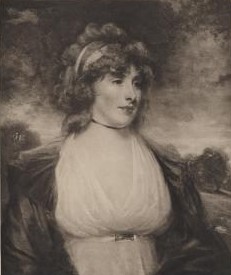
Elizabeth Lamb, Viscountess Melbourne  by Braun, Clement & Co, after John Hoppner  © National Portrait Gallery, London
Elizabeth Lamb, Viscountess Melbourne
by Braun, Clement & Co, after John Hoppner
© National Portrait Gallery, London
Whig hostess

Elizabeth was beautiful and vibrant and ambitious for the advancement of her family. She helped increase her husband’s political visibility, becoming the leading Whig hostess of the time. From 1770, she entertained in the white and gold magnificence of Melbourne House in Piccadilly, designed by William Chambers. Her regular visitors included some of the keenest minds of the day: Charles James Fox; Richard Brinsley Sheridan; Granville Leveson-Gower, 1st Earl Granville; Georgiana Cavendish, Duchess of Devonshire; Harriet Ponsonby, Countess of Bessborough; and the sculptor, Anne Seymour Damer.

Lady Melbourne by Anne Seymour Damer (1784) © Andrew Knowles
Lady Melbourne by Anne Seymour Damer (1784)
in an exhibition at Strawberry Hill
The Duchess of Devonshire

In 1774, the Duke of Devonshire married Georgiana Spencer and Lady Melbourne saw at once that she was in danger of losing her place as leading Whig hostess. But rather than compete with the Duchess, Lady Melbourne chose to embrace her potential rival and became her indispensable friend. They were opposites in character and temperament, but Lady Melbourne’s disposition made her the ideal confidante for the troubled Duchess.

Georgiana, Duchess of Devonshire,  from a miniature by Antonio Fattori  from Lord Granville Leveson Gower,   private correspondence 1781 to 1821 (1916)
Georgiana, Duchess of Devonshire,
from a miniature by Antonio Fattori
from Lord Granville Leveson Gower,
 private correspondence 1781 to 1821 (1916)
Lady Melbourne’s character

Lady Melbourne was a brilliant conversationalist who was a master of the art of being a delightful companion to gentlemen. She was easy going and good humoured, a willing confidante and advisor who rarely talked about herself. Melbourne House was a comfortable place for gentlemen to go, where they could speak freely without fear of shocking their hostess.

On the other hand, she was cynical, hard-hearted and somewhat coarse, and she seemed to delight in making cutting remarks. Her moral standards were low and she did not seem to care what people did, provided they were discreet. She believed that:
When anyone braves the opinion of the world, sooner or later they will feel the consequences of it.1
Ambition was paramount and she was always prepared to make sacrifices to achieve it. When Frederick, Duke of York expressed a fancy for her Piccadilly home, she agreed to part-exchange it for his home in Whitehall. 2

Melbourne House, Piccadilly,  by Thomas H. Shepherd c1830
Melbourne House, Piccadilly,
by Thomas H. Shepherd c1830
Family

Lady Melbourne had six children: Peniston (1770), William (1779), Frederick (1782), George (1784), Emily (1787) and Harriet (1789), who did not survive childhood. Of these, only Peniston was definitely Lord Melbourne’s child; William was almost certainly Lord Egremont’s and George, the son of the Prince of Wales.

She was devoted to all her children who spent most of their time at the family’s country home in Hertfordshire, Brocket Hall. Here they rode and played together and took part in theatricals as well as learning. When the boys went to Eton, she often visited them, encouraging the development of their tastes and characters.

William Lamb, 2nd Viscount Melbourne  from The History of White's   by Hon Algernon Bourke (1892)
William Lamb, 2nd Viscount Melbourne
from The History of White's
 by Hon Algernon Bourke (1892)
Romantic liaisons

Within a year of their marriage, Elizabeth’s husband began an affair with the actress Sophia Baddeley. Elizabeth appeared to be unbothered. She did not expect men to be monogamous, though she strongly believed in family responsibility. Having produced an heir, she had her own romantic liaisons, though she made sure she never put her husband in an awkward position.

Lady Melbourne’s name was linked variously with Lord Coleraine3; Francis Russell, 5th Duke of Bedford; George, Prince of Wales, the future George IV; and George Wyndham, 3rd Earl of Egremont.

The Earl of Egremont

From 1779, Lady Melbourne’s most favoured intimate friend and advisor was George Wyndham, 3rd Earl of Egremont. It was the most serious and long-lasting of her attachments, though not monogamous on either side; Egremont kept a number of mistresses and their children at Petworth House. Egremont was almost certainly William’s father and possibly Frederick and Emily’s as well.

Lady Melbourne learned much from Egremont who was an agriculturalist and canal enthusiast. She encouraged her husband to invest in the Cromford Canal and introduced agricultural innovations in Hertfordshire.

George Wyndham, 3rd Earl of Egremont  by Samuel William Reynolds, after Thomas Phillips (1826)   © National Portrait Gallery, London
George Wyndham, 3rd Earl of Egremont
by Samuel William Reynolds, after Thomas Phillips (1826)
 © National Portrait Gallery, London
The Prince of Wales

Lady Melbourne’s friendship with the Prince of Wales began in 1782 and their names were linked together until around 1786. He is generally believed to be the father of her fourth son, George, and stood as his godfather.

Through her relationship with the Prince, Lady Melbourne secured the position of Gentleman of the Bedchamber for her husband in 1783.

George, Prince of Wales  from Huish's Memoirs of her late  royal highness Charlotte Augusta (1818)
George, Prince of Wales
from Huish's Memoirs of her late
royal highness Charlotte Augusta (1818)
William and Caroline

Lady Melbourne soon realised that William’s abilities were superior to those of his siblings and he became the focus for all her ambitions. After the death of her eldest son, Peniston, in 1805, William embarked on a career in politics. He also married Lady Bessborough’s daughter, Lady Caroline Ponsonby. Lady Melbourne was not keen on the match or the influence that Caro and her mother had on William. On her side, Lady Bessborough disliked Lady Melbourne and referred to her as “The Thorn”.

Lady Caroline Lamb  from Wives of the Prime Ministers    (1844-1906)
Lady Caroline Lamb
from Wives of the Prime Ministers
  (1844-1906)
It was with some frustration that Lady Melbourne saw William failing to reach the heights which she sought for him. He was hedonistic and lazy, loyal to people rather than policies, and did not advance as she had hoped, and his deteriorating relationship with Caroline was not helping.

Lady Melbourne had no sympathy with Lady Caroline’s highly strung nature and was disgusted when, in 1812, she had a very public affair with Lord Byron. Lady Melbourne was keen to bring it to a close and became Lord Byron’s confidante, suggesting her own niece, Annabella Milbanke, as a wife for him.

Illness and death

Lady Melbourne became ill with rheumatism and died at Melbourne House, Whitehall, on 6 April 1818, after a painful illness of four months. She was buried on 14 April in Hatfield, Hertfordshire. Even on her death bed, she encouraged her children’s ambitions, telling Emily to be faithful, not to her husband, Lord Cowper, but to her lover, Lord Palmerston.

Lady Melbourne's legacy

Lady Melbourne did not live to see that her ambitions for her children were indeed fulfilled: William became Prime Minister to William IV and then Queen Victoria, and Emily married Lord Palmerston, who later became another of Queen Victoria’s Prime Ministers.

Headshot of Rachel Knowles author with sea in background(2021)
Rachel Knowles writes clean/Christian Regency era romance and historical non-fiction. She has been sharing her research on this blog since 2011. Rachel lives in the beautiful Georgian seaside town of Weymouth, Dorset, on the south coast of England, with her husband, Andrew.

Find out more about Rachel's books and sign up for her newsletter here.

If you have enjoyed this blog and want to encourage me and help me to keep making my research freely available, please buy me a virtual cup of coffee by clicking the button below.

 
Notes
(1) From a letter to Lady Caroline Lamb 13 April 1810.
(2) The agreement to the exchange was concluded on 25 December 1791 although the comment made by the Duke of York to which Lady Melbourne assented may have been made some time before. The Duke took residence of Melbourne House the following year, renaming it Albany House.
(3) The relationship with Lord Coleraine is referred to in Cecil's book Melbourne. Based on the dates quoted, I am assuming that it is John Hanger, 2nd Baron Coleraine, with whom Lady Melbourne had an affair.

Sources used include:
Cecil, Lord David, Melbourne (1939, 1954)
Gross, Jonathan David, Lamb, Elizabeth, Viscountess Melbourne (1751-1818) Oxford Dictionary of National Biography (Oxford University Press, 2004; online edn May 2008, accessed 12 Nov 2012)
Huish, Robert, Memoirs of her late royal highness Charlotte Augusta (1818)
Lee, Elizabeth, Wives of the Prime Ministers 1844-1906 (1918)
Leveson-Gower, Lord Granville, Lord Granville Leveson-Gower, Private correspondence 1781-1821, ed by Castalia, Countess Granville (John Murray, 1916, London)
Shepherd, FHW, Survey of London (1963, British History online, accessed 7 February 2013)

Photographs © RegencyHistory.net

Monday, 7 January 2013

The history of the British Museum

Staircase of the British Museum in Montagu House    Watercolour by George Scharf I (1845)    © Trustees of the British Museum
Staircase of the British Museum in Montagu House
  Watercolour by George Scharf I (1845)
© Trustees of the British Museum
Sir Hans Sloane’s collection

The British Museum was founded on 7 June 1753 by an Act of Parliament, becoming the first national public museum in the world. It was established as a result of accepting the bequest of the physician and naturalist, Sir Hans Sloane, who left the entire contents of his collection to George II in return for a payment of £20,000 to the beneficiaries of his will.

Sloane’s collection consisted of over 71,000 objects including books, manuscripts, natural specimens and antiquities such as coins, medals, prints and drawings.

Montagu House

The North Front of Montagu House and Gardens    An engraving by James Simon (1714)    © Trustees of the British Museum
The North Front of Montagu House and Gardens
  An engraving by James Simon (1714)
  © Trustees of the British Museum
In 1755, the Trustees of the British Museum bought Montagu House in Bloomsbury to house the museum’s collections. The gardens were opened to the public from 11 March 1757 and the museum was opened to the public for the first time on 15 January 1759.

In 1823, Sir Robert Smirke designed a new building to display the growing collections, consisting of a quadrangle with four wings and Greek style columns. The building was finished in 1852 and is still the centre of the museum complex today.

The British Museum today
The British Museum(2014)
The reading room

According to a guidebook for 1800:
Such literary gentlemen as desire to study in it, are to give in their names and places of abode, signed by one of the officers, of the committee; and if no objection is made, they are permitted to peruse any books or manuscripts which are brought to them by the messenger, as soon as they come to the reading room, in the morning at nine o’clock; and this order lasts six months, after which they may have it renewed. There are some curious manuscripts, however, which they are not permitted to peruse, unless they make a particular application to the committee, and then they obtain them; but they are taken back to their places in the evening, and brought again in the morning.1
The curiosities

Entry was free and granted to “all studious and curious Persons.”2

The 1800 guidebook describes the admission process:
Those who come to see the curiosities, are to give in their names to the porter, who enters them in a book, which is given to the principal librarian, who strikes them off, and orders the tickets to be given in the following manner: In May, June, July and August, forty-five are admitted on Tuesday, Wednesday, and Thursday, viz. fifteen at nine in the forenoon, fifteen at eleven, and fifteen at one in the afternoon. On Monday and Friday fifteen are admitted at four in the afternoon, and fifteen at six. The other eight months in the year, forty-five are admitted in three different companies, on Monday, Tuesday, Wednesday, Thursday, and Friday, at nine, eleven and one o’clock.1
An entrance ticket to the British Museum (1790)    © Trustees of the British Museum
An entrance ticket to the British Museum (1790)
  © Trustees of the British Museum
According to the British Museum’s website, visitors were taken round the exhibition by an under-librarian in groups of five, up the great staircase, through the upper rooms and down again to the ground floor.

A guidebook for 1803-4 says:
All fees are prohibited, and persons who wish to view the Museum must previously enter their names and address, and the time when they would wish to see it, in a book kept by the porter. On a future day they will be supplied with tickets free of expense. Children are not admitted.3
Entrance of the British Museum    from Russell Street; Garden front (1761)    © Trustees of the British Museum
Entrance of the British Museum
  from Russell Street; Garden front (1761)
  © Trustees of the British Museum
Various opening arrangements were adopted over the years, but by 1809, it seems that entry was no longer by ticket. The museum was open on Monday, Wednesday and Friday from 10am to 4pm and “all persons of decent appearance who apply between the hours of ten and two, are immediately admitted.”4 
 
It was closed for Christmas, Easter and Whitsun weeks and during the months of August and September. People could stay until closing time if they wished, though children under ten were still excluded. According to Leigh's London guide, these arrangements were still in force in 1818.
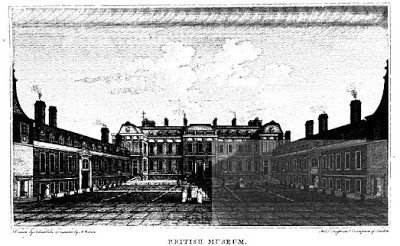
The British Museum   from London; being an accurate history and description  of the British Metropolis and its neighbourhood Volume IV    by David Hughson (1807)
The British Museum
 from London; being an accurate history and description
of the British Metropolis and its neighbourhood Volume IV
  by David Hughson (1807)
The arrangement of the collections

Initially the collections were split into three sections: printed books and prints; manuscripts including medals; and natural and artificial productions - basically, anything else.

By 1809, this had been separated into four: printed books; manuscripts; natural history and modern artificial curiosities; antiquities, coins, drawings and engravings.3

They were arranged over the rooms of Montagu House in these sections:

Lower floor: Library of printed books
Upper floor: modern works of art; manuscripts; minerals; shells, fossils & herbals; insects, worms, corals & vegetables; birds & quadrupeds, stuffed; quadrupeds, snakes, lizards, and fishes, in spirits.
Gallery: terra cottas; Greek & Roman sculptures; Roman sepulchral antiquities; Egyptian antiquities; coins & medals; Sir William Hamilton’s collection; drawings & engravings.
 
The growth of the museum

During the 1850s and beyond, the museum expanded its collections to include British and medieval antiquities, oriental art, prehistoric finds and archaeological material from Europe.

The museum was involved in excavation abroad – its Assyrian collections helped the understanding of an ancient Middle Eastern script called cuneiform and the Rosetta Stone unlocked the meaning of Egyptian hieroglyphic script.

In the 1880s, the natural history collections were moved to a new building in South Kensington. This became the Natural History Museum.
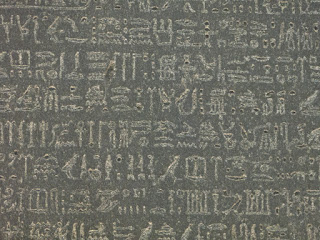
Close-up of the Rosetta Stone in the British Museum
Close-up of the Rosetta Stone
in the British Museum (2014)
The exhibits

The museum’s collections included:
• The Cottonian library of books and manuscripts (early 1750s)
• The Harleian collection of manuscripts (early 1750s) – purchased by parliament for £10,000
• The first ancient Egyptian mummy (1756)
• Various ethnographic artefacts from Captain Cook’s Pacific voyages, including a Tahitian mourner’s dress (1756)
• The “Old Royal Library” of the sovereigns of England – donated by George II (1757)
• The trunk of a tree gnawed by a beaver (1760)
• A stone resembling a petrified loaf (1760)
• Italian antiquities (1762) – £8410
• A live tortoise from North America (1765)
• Gustavus Brander’s fossils (1765)
• Birch’s library (1766)
• Greenwood's collection of stuffed birds – from Holland (1769) - £460
• Sir William Hamilton’s collection of Greek vases (1772) – Etruscan, Grecian and Roman antiquities - £8400
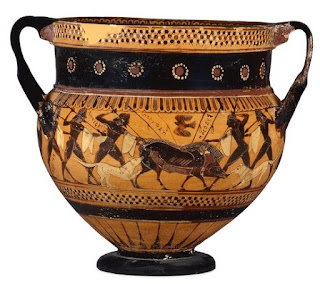
The 'Hunt krater' (575-550BC)    from Sir William Hamilton's collection    © Trustees of the British Museum
The 'Hunt krater' (575-550BC)
  from Sir William Hamilton's collection
  © Trustees of the British Museum
• Halhed’s oriental manuscripts (1796)
• Hatchett’s minerals (1798) - £700
• Tysson’s Saxon coins (1802)
• The Rosetta Stone (1802)
• The Townley collection of classical sculpture including the “Discobolus” statue and the bust of a young woman “Clytie” (1805). You can read more about Charles Townley here.
• Lansdown manuscripts (1807) - £4,925
• Bentley’s classical library (1807)
• Roberts’ coins (1810)
• Greville minerals (1810) - £13,727
• Hargrave library (1813) - £8,000
• Sculptures from the Temple of Apollo at Bassae (1815)
• The Parthenon sculptures (1816)
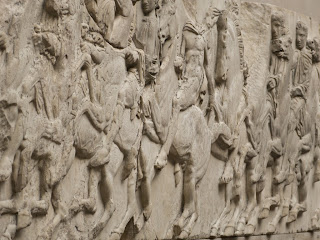
Some of the Parthenon sculptures in the British Museum
Some of the Parthenon sculptures in the British Museum (2014)
• George III’s library (1823) – donated by George IV; the quadrangular building was erected to house it.
• Western Asiatic collection began – manuscripts, medals and antiquities (1825)
• The Nereid monument (1842)
• First stone sculptures from excavations at Nimrud site in the Middle East including the great winged bull (1850s)
• The remains of the Mausoleum of Halikarnassos (1856-7)

Headshot of Rachel Knowles author with sea in background(2021)
Rachel Knowles writes clean/Christian Regency era romance and historical non-fiction. She has been sharing her research on this blog since 2011. Rachel lives in the beautiful Georgian seaside town of Weymouth, Dorset, on the south coast of England, with her husband, Andrew.

Find out more about Rachel's books and sign up for her newsletter here.

If you have enjoyed this blog and want to encourage me and help me to keep making my research freely available, please buy me a virtual cup of coffee by clicking the button below.


Notes
(1) From Scatcherd's Ambulator (1800)
(2) The British Museum website
(3) From Crosby's A View of London (1803-4)
(4) From Hughson's London Volume VI (1809)

Sources used include:
Cox, Son and Baylis (publishers), Synopsis of the contents of the British Museum (1809)
Crosby, B , A View of London; or the Stranger's Guide through the British Metropolis (Printed for B Crosby, London, 1803-4)
Hughson, David, London; being an accurate history and description of the British Metropolis and its neighbourhood Volume IV (1807, London)
Hughson, David, London; being an accurate history and description of the British Metropolis and its neighbourhood Volume VI (1809, London)
Leigh, Samuel, Leigh's New Picture of London (London, 1818)
Scatcherd, J, Ambulator or A Pocket Companion in a tour round London (Printed for J Scatcherd, London, 1800)

The British Museum website

All photographs © RegencyHistory.net